- Average plumbing repair costs $180-$489, with a national median of $331 (Bob Vila, 2026 cost analysis).
- Plumber hourly rates run $45-$200/hour depending on license level: apprentices bill $45-$90, journeymen $70-$120, master plumbers $90-$200+.
- Service call fees run $50-$350 before any work starts; always ask upfront whether this applies toward your total invoice.
- Water heater replacement averages $1,293 installed for a tank unit; tankless averages $2,527 installed.
- Sewer line replacement ranges from $1,253 to $25,000 depending on length, method (trenchless vs. open-cut), and site conditions.
- Getting 3 quotes saves 15-20% on average: prices can vary by 40% between contractors in the same metro area.
The average plumbing job costs $331 in 2026 according to Bob Vila's national cost analysis, but the real range stretches from a $50 trip fee to a $25,000 sewer replacement. That gap is enormous, and it catches homeowners off guard every day.
Knowing what a fair price looks like before you pick up the phone is worth real money. This guide covers how plumbers charge, what the 10 most common jobs actually cost, which factors push prices up or down, and exactly what to ask before you book anyone.
What this guide covers:
- How plumbers charge (hourly, flat rate, service call fees)
- Plumber hourly rates by license level and region
- Quick-reference pricing for the 10 most common jobs
- The 5 cost factors that move prices up or down
- Emergency and after-hours pricing
- How to get an accurate estimate and spot overcharging
- When to DIY and when to call a pro
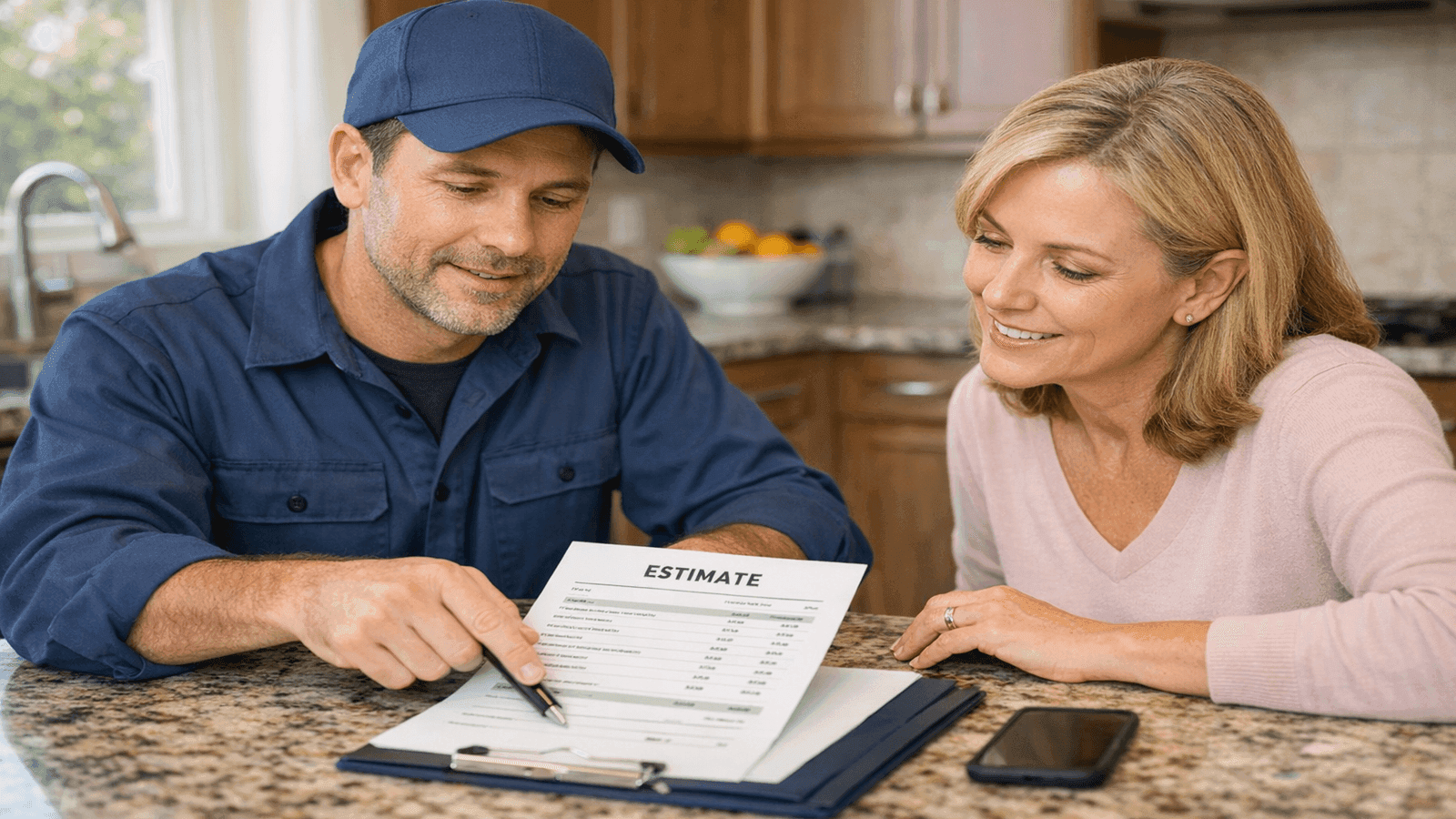
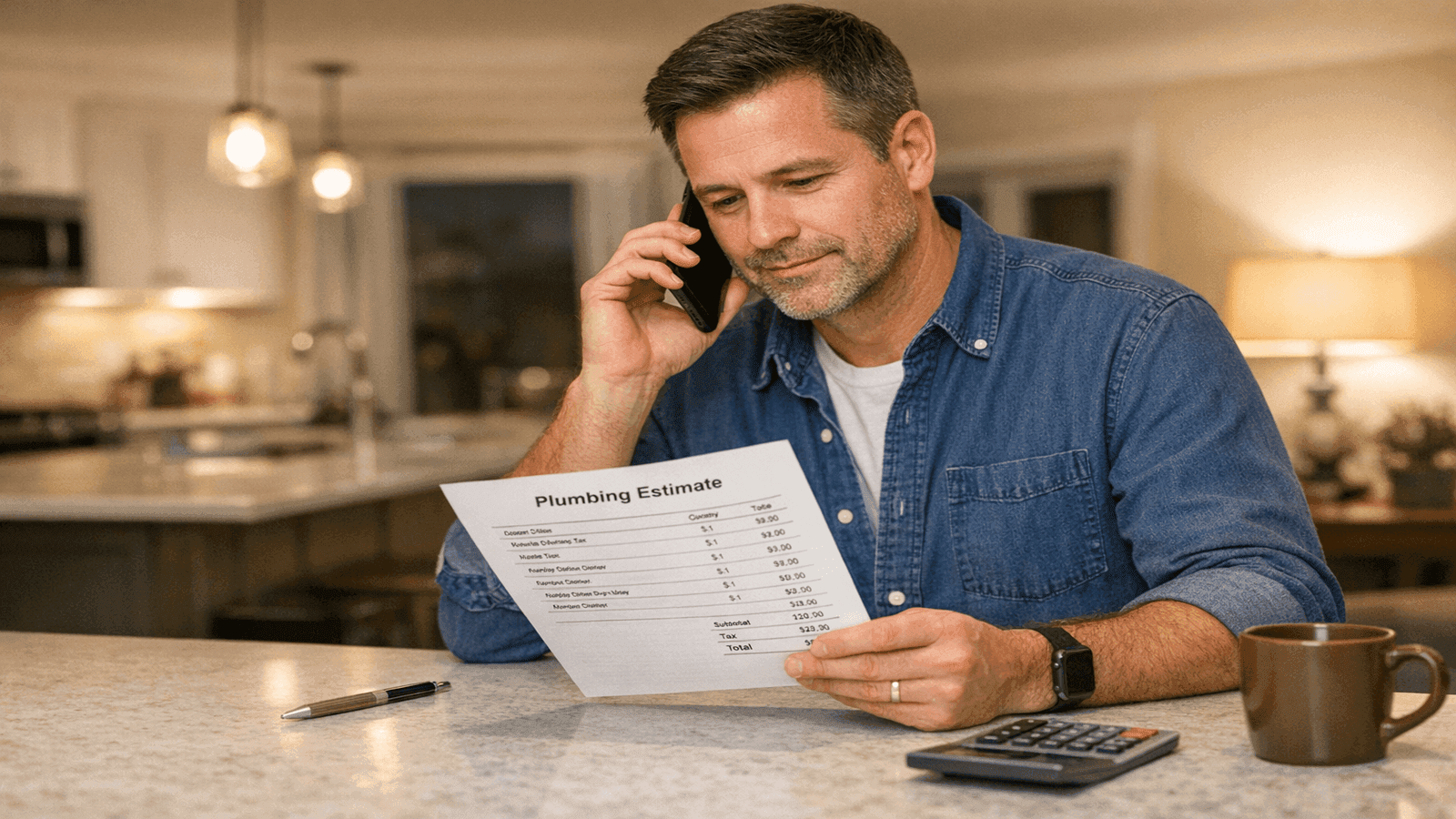
Photo: Licensed plumber reviewing a written estimate with a homeowner at a kitchen counter
How Plumbers Charge: Hourly, Flat Rate, and Project Rate
Before you can compare quotes, you need to understand the three pricing models plumbers use. Each one fits a different type of job, and confusing them is how homeowners end up with unexpected bills.
Hourly rate is used when the scope isn't clear upfront. Diagnostic calls, leak searches, and small repairs with unknown complexity all fall into this category. The clock typically starts when the plumber arrives (or in some cases when they leave their shop) and includes time to diagnose, acquire parts, and complete the work. Hourly billing ranges from $45/hour for an apprentice to $200+/hour for a master plumber in a high-cost metro.
Flat rate pricing is used for clearly-defined, standard jobs: installing a garbage disposal, replacing a toilet, or swapping a shut-off valve. The plumber quotes a single number that covers labor and sometimes materials. Flat rates typically run $150-$500 for common installs. They benefit the homeowner when the job goes smoothly and the plumber when it takes longer than expected.
Project rate is used for large scopes like bathroom remodel plumbing, whole-house repiping, or sewer replacement. A project rate covers the full scope of work, broken into phases, and can run $1,000 to $15,000 or more.
The fourth charge that catches people off guard is the service call fee, also called a trip fee or dispatch fee. Most plumbers charge $50-$350 just to show up, before touching a single pipe. Some apply this fee toward the total invoice; others treat it as a separate charge. This is the single most important question to ask when booking.
| Pricing Model | Typical Range | When Plumbers Use It |
| Hourly | $45-$200/hour | Diagnostic work, repairs with unknown scope |
| Flat rate | $150-$500 per job | Standard installs, defined replacements |
| Project rate | $1,000-$15,000+ | Renovations, repiping, sewer work |
| Service call fee | $50-$350 | Added to nearly all dispatches |
The service call fee is the most misunderstood charge in plumbing. I've been on hundreds of calls where the homeowner thought the fee was the total price. It's not. It's the cost of getting me to your door. A good plumber will explain this clearly before you book. If they don't, ask: 'Does this service fee apply toward my total bill?' If the answer is no, that's fine, just know it going in.

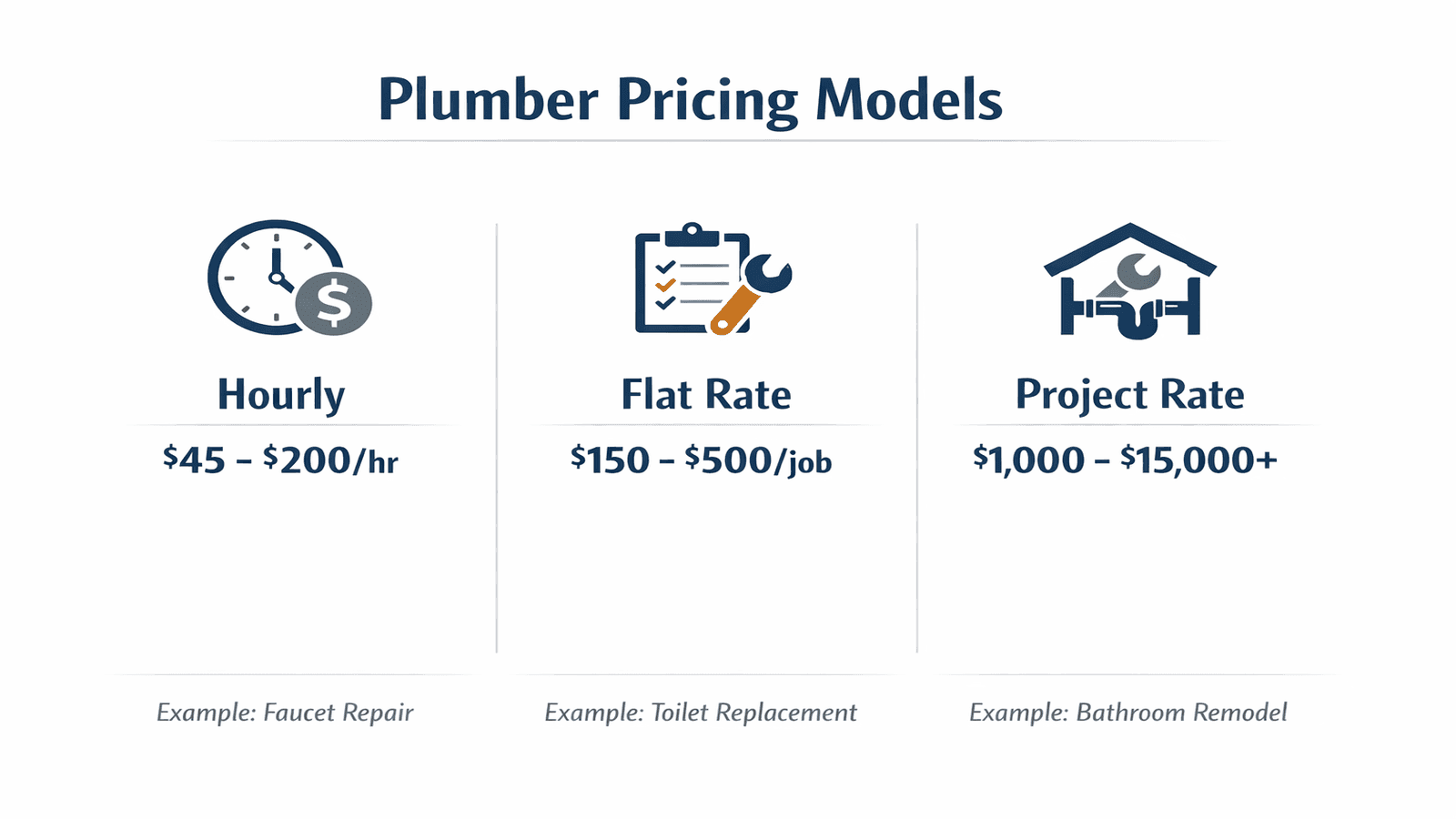
Photo: Infographic showing three plumber pricing models: hourly, flat rate, and project rate with cost ranges
Plumber Hourly Rates by License Level and Region
The hourly rate you pay depends on two things: the license level of the plumber doing the work and where you live. Both variables can swing the final number significantly.
By license level, rates break down into three tiers. An apprentice plumber (1-4 years training) bills $45-$90/hour. They work under supervision and handle lower-complexity tasks. A journeyman plumber (licensed, 4+ years) bills $70-$120/hour and can work independently. A master plumber (highest license tier, typically 8+ years plus exam) bills $90-$200+/hour. Most residential service calls send a journeyman; master plumbers typically handle permit-required projects, inspections, and complex installations.
Bureau of Labor Statistics data from May 2024 shows the median plumber wage across the U.S. is $62,970/year ($30.27/hour in wages). The customer-facing billing rate runs 2-3x this wage figure once overhead, insurance, vehicles, tools, and profit margin are added in. This is why $100-$150/hour for a journeyman isn't overcharging: it's standard business math.
By region, rates split into three tiers
| State Tier | Customer Hourly Rate | Example Markets |
| High-cost metros | $125-$200/hour | NYC, LA, SF, Chicago, DC, Boston |
| Mid-range markets | $80-$130/hour | Dallas, Denver, Seattle, Atlanta, Phoenix |
| Lower-cost/rural | $45-$90/hour | Rural South, rural Midwest, smaller markets |
Union vs. non-union also matters. Union plumbers in metro areas typically bill 20-25% more than non-union competitors. The trade-off is often stricter licensing compliance and larger crews for commercial work.
I work in Dallas and my standard rate is $120/hour for journeyman-level work. When I travel to rural East Texas for a job, the local market rate drops to $75-$85/hour. Same plumber, same skills, completely different pricing. That's just how local labor markets work. If a quote sounds too high compared to what your neighbor paid, it might just be geography, or a different scope.
For a complete state-by-state breakdown of plumber hourly rates, see our full guide: Plumber Cost Per Hour: 2026 Rates by State.
The 10 Most Common Plumbing Jobs and What They Cost
Each section below gives you the cost range and key cost drivers for one specific job. Click the linked guide for the complete breakdown including labor vs. materials, regional variation, and what questions to ask your contractor.
Get quotes from top-rated pros.
1. Water Heater Replacement
Cost range: $650-$3,500 installed (tank) | $1,333-$3,721 installed (tankless)
The national average for water heater replacement is $1,293 for a tank unit and $2,527 for tankless, according to Bob Vila's 2026 cost analysis. The spread is wide because fuel type, tank size, location, and whether you're switching types all affect the final number.
Key cost factors: gas vs. electric ($700-$2,700 for gas tank vs. $600-$3,500 for electric), tank size (40-gallon vs. 80-gallon), location (basement vs. closet vs. attic), and whether a permit and inspection are required. Converting from a tank to tankless adds significant retrofit labor: up to $2,500 for the conversion work alone. If you're considering tankless for its energy efficiency benefits, our guide to Green Plumbing Solutions covers the long-term savings math in detail.
Full guide: Water Heater Replacement Cost: Complete Price Guide
2. Garbage Disposal Installation
Cost range: $150-$500 total (labor + unit)
Garbage disposal installation is one of the more predictable flat-rate jobs. A standard replacement (same brand, same location) runs $150-$300. A first-time installation in a sink without existing wiring runs $300-$500. The unit itself costs $75-$200 for a mid-range model; labour is $80-$150 for a straightforward replacement.
Key cost factors: first install vs replacement (adding wiring costs $100-$200 more), model tier (builder-grade vs premium), and whether the existing drain lines need modification.
Full guide: Garbage Disposal Installation Cost and Pricing Guide
3. Sewer Line Replacement
Cost range: $1,253-$25,000 | National average: $2,914
Sewer line work is the most expensive category most homeowners will ever face. The national average sits at $2,914 according to Bob Vila's 2026 analysis, but severe cases with long runs, deep excavation, or concrete cutting can reach $25,000.
Traditional open-cut replacement runs $400-$1,200 per 100 linear feet of trench. Under-slab work costs $300-$350 per linear foot. Trenchless methods (pipe bursting or CIPP lining) cost $60-$250 per linear foot but save 30-50% over open-cut when the pipe depth allows. Geographic variation is substantial: the same sewer replacement runs $600-$2,300 in Atlanta and $2,500-$6,400 in Cincinnati.
A camera inspection ($100-$500) before any sewer work is money well spent. You need to know the pipe location, depth, material, and failure type before a plumber can provide an accurate quote.
Full guide: Sewer Line Replacement Cost: 2026 Pricing Guide
4. Cost to Repipe a House
Cost range: $5,500-$11,000 (PEX) | $12,000-$22,000 (copper)
Whole-house repiping is a major project. Bob Vila puts the general range at $4,000-$12,000; 2026 repipe guides for a 1,500 sq ft home show PEX at $5,500-$11,000 and copper at $12,000-$22,000. Labor accounts for roughly 70% of the total cost.
PEX vs. copper is the biggest variable. Copper pipe material runs $2.00-$5.00 per linear foot; PEX runs $0.50-$1.00 per linear foot. For an average home, that material difference alone adds $6,000-$11,000 to the copper option. PEX is the dominant choice for residential repiping today, appearing in 65% of new residential installations due to its lower cost, freeze resistance, and faster installation.
Key cost factors: home size, number of fixtures, pipe material choice, wall access difficulty (slab vs. crawl space vs. open basement), and permit fees.
Full guide: Cost to Repipe a House: Complete 2026 Guide
5. Drain Cleaning
Cost range: $100-$500 (snaking) | $350-$1,000 (hydro-jetting)
Standard drain snaking runs $100-$500 depending on which drain and how severe the clog. A simple kitchen sink snake costs $100-$200. A main sewer line snake runs $150-$500. Flat-rate drain clearing from service companies typically runs $200-$400 for most residential drains.
Hydro-jetting uses high-pressure water (2,000-4,000 PSI) to cut through grease, scale, and root intrusion. The national average is $475 according to Bob Vila, with a typical range of $350-$600. Severe commercial cases can reach $3,000.
If you want to clear a simple drain clog yourself before calling a plumber, our How to Snake a Drain guide walks through the DIY process step by step.
Full guide: Drain Cleaning Cost: Professional Service Pricing
6. Bathroom Remodel Plumbing
Cost range: $1,000-$8,000 (plumbing labour only)
Bathroom remodel plumbing costs cover rough-in and finish plumbing for new or repositioned fixtures. Moving drain locations is the single most expensive variable: cutting concrete or moving a drain across a joist bay can add $1,500-$3,000 to the plumbing line item alone.
A simple fixture swap in the same location (toilet, vanity, tub/shower) runs $1,000-$2,500 in plumbing labour. A full gut-and-rebuild with new drain locations and all-new supply runs costs $4,000-$8,000 in plumbing labour before any fixtures, tile, or finish work. Permits are almost always required for this scope.
Full guide: Bathroom Remodel Plumbing Cost Breakdown 2026
7. Emergency Plumber Rates
Cost range: Regular rate × 1.5 to 3x, plus $100-$350 surcharge
Emergency work is priced differently from scheduled service. After-hours weekday calls typically add a 1.5x multiplier to the standard hourly rate plus a flat $100-$350 surcharge. Weekend calls run at 2x. Major holidays can cost up to 3x the standard rate. A job that costs $300 at 2 pm Tuesday can cost $700-$900 at midnight on the same day.
The math matters: a $120/hour journeyman at 1.5x after-hours rate is $180/hour, plus a $150 surcharge, before any parts.
Full guide: Emergency Plumber Rates: After-Hours Pricing Guide
8. Plumbing Inspection
Cost range: $85-$300 (visual) | $250-$1,200 (camera sewer inspection)
A visual plumbing inspection walks through all accessible fixtures, valves, supply lines, and drain access points. These run $85-$300 and are common for pre-purchase home inspections or annual maintenance checks.
A camera sewer inspection adds a video scope down the main drain line to check for root intrusion, bellied pipe, or cracks. These run $250-$1,200 and are strongly recommended before any sewer work or when buying a home older than 30 years. The inspection cost is almost always worth it: catching a $5,000 lining job before it becomes a $20,000 replacement is the definition of money well spent.
Full guide: Plumbing Inspection Cost: What to Expect in 2026
9. Kitchen Sink Replacement
Cost range: $250-$650 (labor + standard sink) | up to $1,200 with premium fixtures
Kitchen sink replacement is straightforward when you're swapping like for like. A standard drop-in sink with basic faucet runs $250-$450 in total installed cost. Upgrading to an undermount sink adds $150-$250 in labor (undermount installation requires more precise fitting and silicone work). Premium fixtures and disposal reinstallation can push the total to $1,200.
Key cost factors: sink type (drop-in vs. undermount vs. farmhouse), faucet grade, whether the garbage disposal needs reinstallation, and condition of existing supply lines.
Full guide: Kitchen Sink Replacement Cost: Complete Price Guide
10. General Hourly Service Work
Cost range: $45-$200/hour + service call fee
Not every plumbing job fits neatly into a defined category. Diagnostic calls, multi-fixture service visits, small-leak repairs, and miscellaneous maintenance work are typically billed at an hourly rate. You pay the service call fee ($50-$350) plus the hourly rate for time on site.
The critical question for hourly work: ask for an estimated number of hours before the plumber starts. An honest plumber can give you a reasonable estimate even when the exact scope isn't certain.
Full guide: Plumber Cost Per Hour: 2026 Rates by State
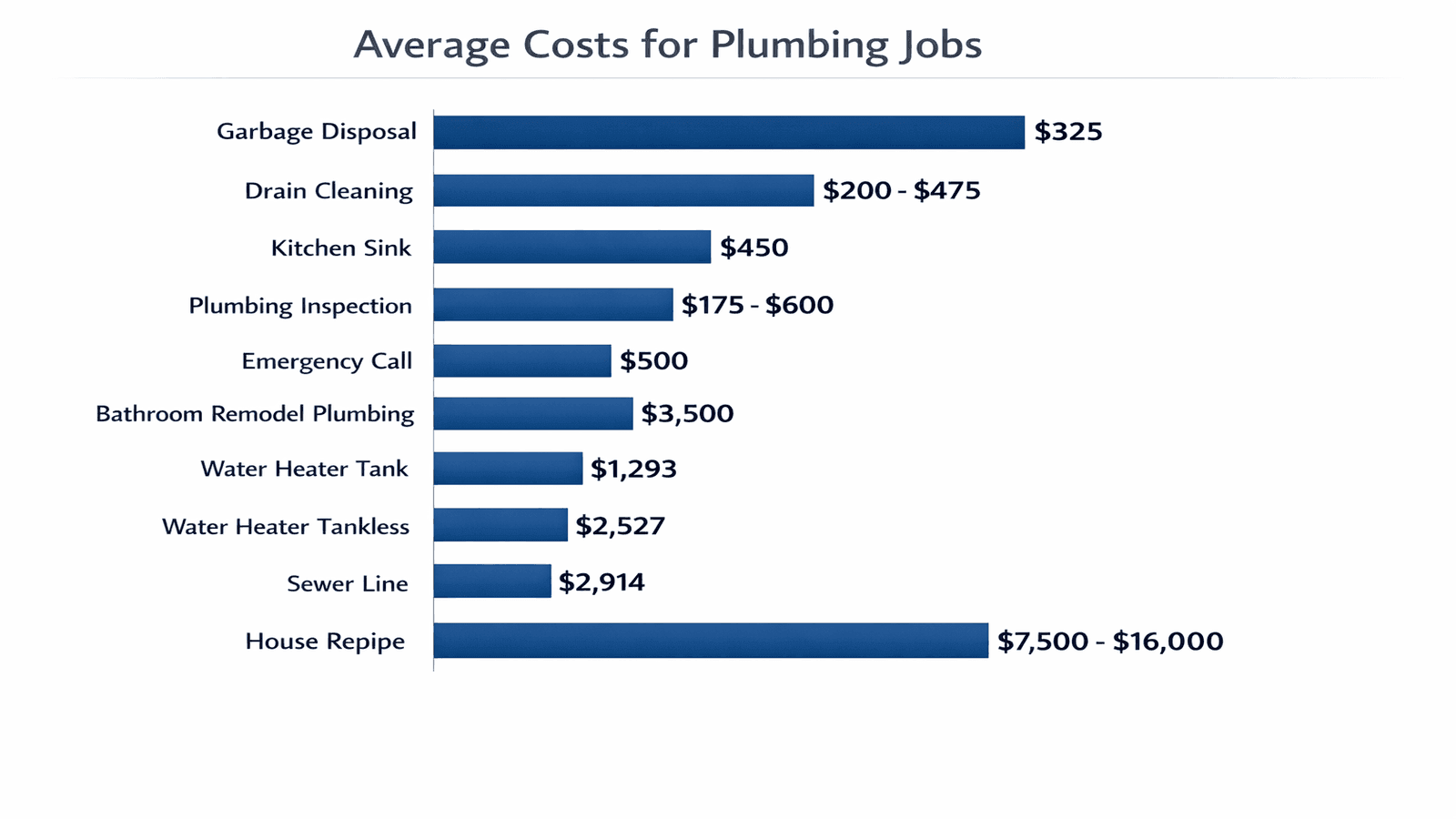
Photo: Bar chart comparing average costs for 10 common plumbing jobs from garbage disposal replacement to sewer line replacement
5 Factors That Push Plumbing Costs Up or Down
Two plumbers quoting the same job can come in 40% apart. Here's why, and which factors you can actually control.
1. Geographic location. Urban markets run 20-30% higher than rural areas. A water heater replacement averaging $1,293 nationally can run $1,900 in Los Angeles and $950 in rural Mississippi. BLS wage data confirms this: median plumber wages in the highest-paying state (Washington) run 13.3% above the national median, and consumer billing rates amplify that gap further.
2. Emergency vs. scheduled timing. This is the biggest controllable factor. Calling at 2pm on Tuesday versus midnight on Saturday can more than double your bill. Emergency rates add 1.5x-3x to the standard hourly rate, plus a flat $100-$350 surcharge. Knowing how to shut off your water supply in an emergency can buy you time to call during business hours instead.
3. Job complexity and access. Pipes hidden in a slab foundation or behind finished walls cost significantly more to reach. Slab access adds $500-$2,000 to a repair just for cutting and patching concrete. Attic runs in summer heat add time and difficulty. Any job where the plumber can't see the pipe before opening a wall carries scope risk: hours and cost can expand once the wall is open.
4. Material choice. This matters most on large jobs. On a whole-house repipe, choosing copper over PEX adds $6,000-$11,000 in material cost alone. On smaller jobs, brand-name fixtures cost 2-4x builder-grade; labor is the same either way. Understanding the types of plumbing pipes and their real-world tradeoffs helps you make an informed material choice before the plumber suggests one.
5. Permit requirements. Water heaters, repiping, sewer work, and bathroom remodels typically require permits. Permit fees run $50-$500 depending on jurisdiction and scope. Skipping permits is tempting but risky: unpermitted work can void your homeowner's insurance, create problems at resale, and leave you liable if the work fails. This is covered in detail in our Plumbing Code Requirements guide.
Get quotes from top-rated pros.
| Cost Factor | Typical Impact | Example |
| Urban vs. rural location | +20-30% | Same job: LA vs. rural Tennessee |
| Emergency timing | +50-200% | After-midnight burst pipe vs. scheduled |
| Slab or wall access | +$500-$2,000 | Pipes in concrete slab |
| Copper vs. PEX material | +$6,000-$11,000 on full repipe | Copper at $2-$5/ft vs. PEX at $0.50-$1/ft |
| Permit fee | +$50-$500 | Water heater install in permit-required city |
The access question is the one that surprises people most. I'll quote a water heater replacement at $900 and then open the utility closet and discover the unit is on a platform in a 4-foot crawl space behind the furnace. That changes the labor time completely. I always walk homeowners through exactly what I found and why the price needs to adjust. A plumber who won't explain a scope change clearly is a plumber I'd be skeptical of.
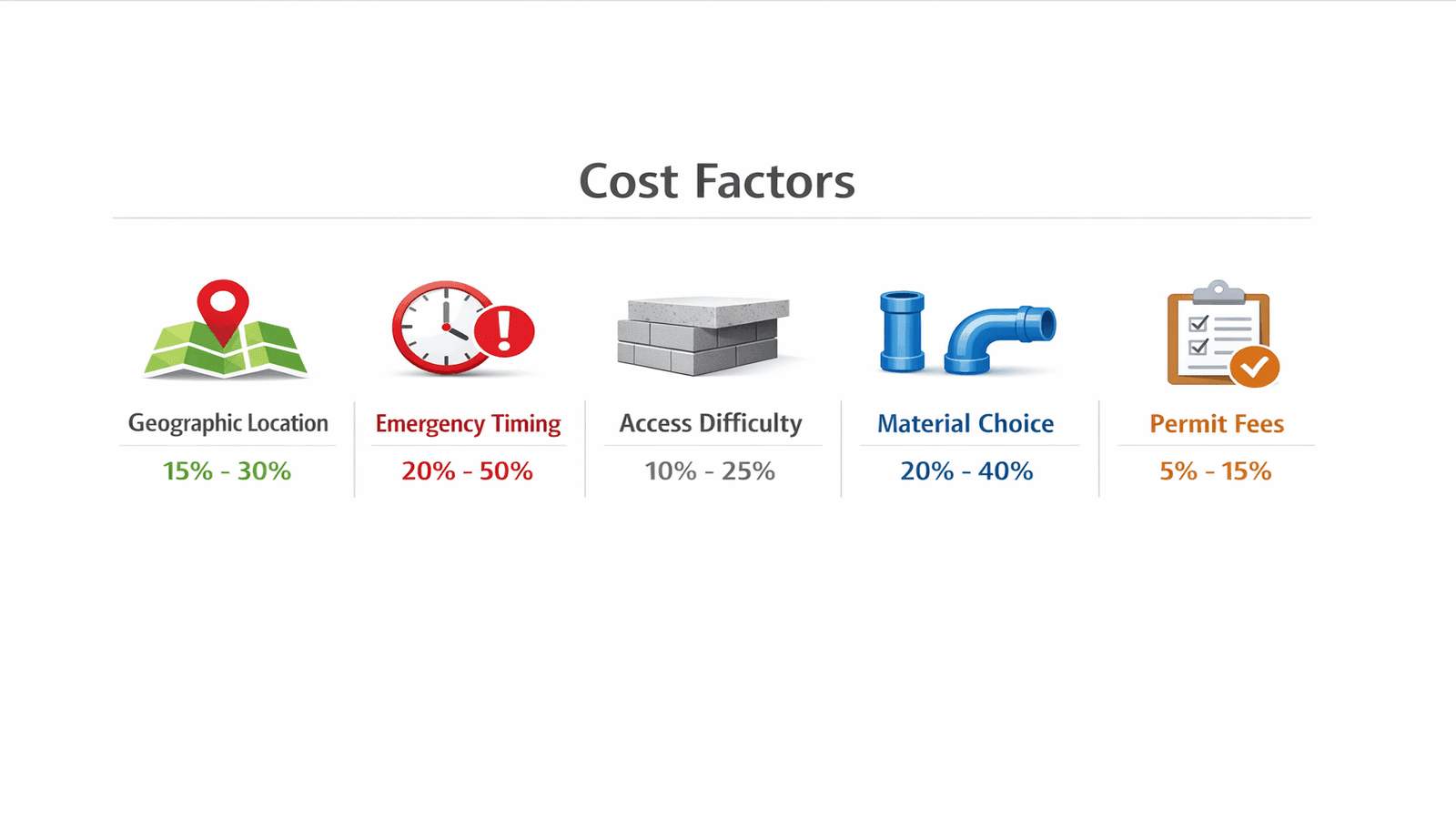
Photo: Infographic showing 5 factors that affect plumbing costs: location, timing, access, materials, and permits
Emergency Plumbing: What After-Hours Really Costs
Emergency plumbing calls are a fact of homeownership. Pipes don't wait for business hours. But the premium you pay for after-hours work is real, and understanding when it's truly necessary vs. when you can wait until morning is worth knowing.
Standard business hours (typically 8am-5pm weekdays) get you the baseline hourly rate: $45-$200/hour depending on license level and market, plus the standard service call fee of $50-$350.
After-hours weekday calls (evening/night) add a 1.5x multiplier to the hourly rate plus a flat $100-$350 surcharge. A $120/hour journeyman becomes $180/hour after 6pm, plus a $150 surcharge. A two-hour repair that costs $390 at 2pm costs $510 at 10pm before parts.
Weekend calls run at roughly 2x the standard rate. The same $120/hour journeyman bills $240/hour on Saturday.
Holiday calls (Thanksgiving, Christmas, New Year's) can reach 3x the standard rate. The holiday plumber who shows up at midnight on December 25th earns it.
The economic argument for calling immediately vs. waiting: a burst pipe releases 4-8 gallons per minute. At 6 minutes of uncontrolled flow, that's enough water to cause $5,000 or more in structural damage to walls, flooring, and subfloor. Paying a $250 emergency surcharge to stop that is the right call. A running toilet or slow drain can almost always wait until morning.
Two situations that always justify an emergency call: active water flowing where it shouldn't be, and no hot water with a gas leak smell. Everything else has a pause-and-evaluate window.
I get calls every week that didn't need to be emergency calls. A slow drain, a dripping faucet, a running toilet: these can wait. What I tell every homeowner is this: know where your main shut-off valve is before anything breaks. If you can stop the water, you've turned a $700 emergency call into a $350 morning appointment. Our guide on [how to shut off your home's water supply](https://www.nearbyhunt.com/articles/shut-off-water-supply) is literally worth reading before anything goes wrong.
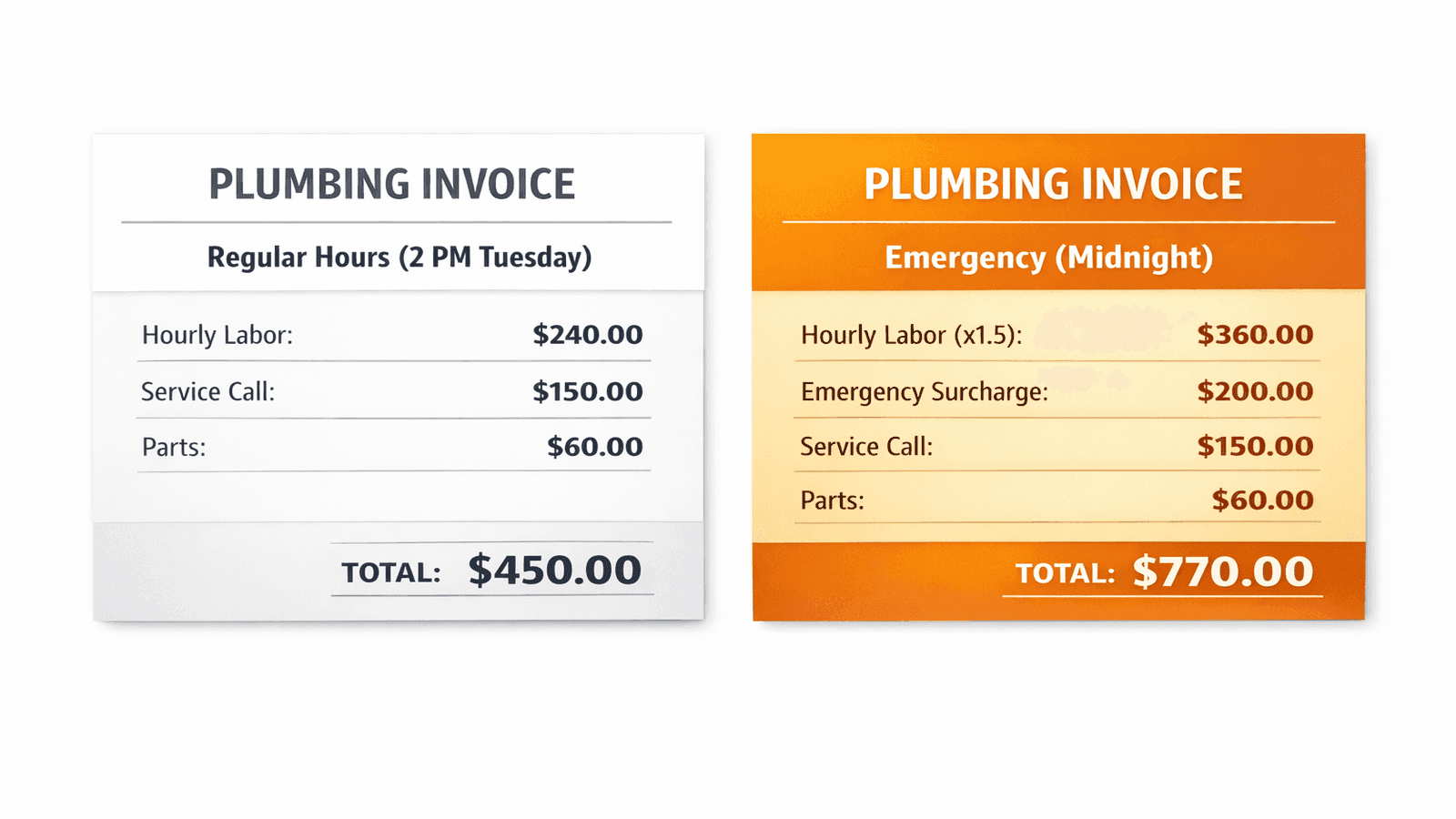
Photo: Side-by-side comparison of a regular-hours plumbing bill versus an emergency after-hours bill showing the surcharge breakdown
How to Get an Accurate Estimate (and Avoid Overcharging)
Getting multiple quotes is the single most effective cost control tool available to a homeowner. Forbes Home and Bob Vila both note that prices for the same job vary by 30-40% within the same metro area. Three quotes consistently saves 15-20% compared to going with the first contractor you call.
What a good written estimate includes:
- Scope of work described specifically (not "plumbing repairs")
- Materials listed by type and brand (especially for fixtures and pipe)
- Labor time estimate or fixed price clearly stated
- Whether the service call fee is included or separate
- Permit responsibility (who pulls it, who pays for it)
- Payment terms (deposit percentage, when balance is due)
- License number visible on the letterhead or document
5 questions to ask before booking any plumber:
- Is your license current and specific to this state?
- Does the service call fee apply toward my total invoice?
- Is this estimate a binding fixed price or an open-ended hourly quote?
- Are permits included, and who pulls them?
- What is your policy if the scope expands once the wall is open?
Red flags to watch for:
- No state license number provided when asked
- Cash-only payment with no written receipt
- "I can start right now" pressure before any diagnosis
- Vague scope: "fix your plumbing" with no specifics
- Refusal to commit to any price range before opening walls
Understanding common plumbing problems and how they're typically diagnosed helps you follow along when a plumber explains their scope. You don't need to know how to fix a p-trap, but knowing what one is makes it harder for anyone to pad a job description with unnecessary work.
An honest estimate is specific. If a plumber hands you a quote that says 'repair main line, $800' with nothing else on the paper, that's not an estimate. It's a number. Push for line items: what pipe are you using? How many hours of labor? What does the service call fee cover? A professional plumber isn't bothered by these questions. A plumber who gets defensive about details is a plumber I'd send home.
Find licensed plumbers near you: Get Free Quotes from NearbyHunt Pros
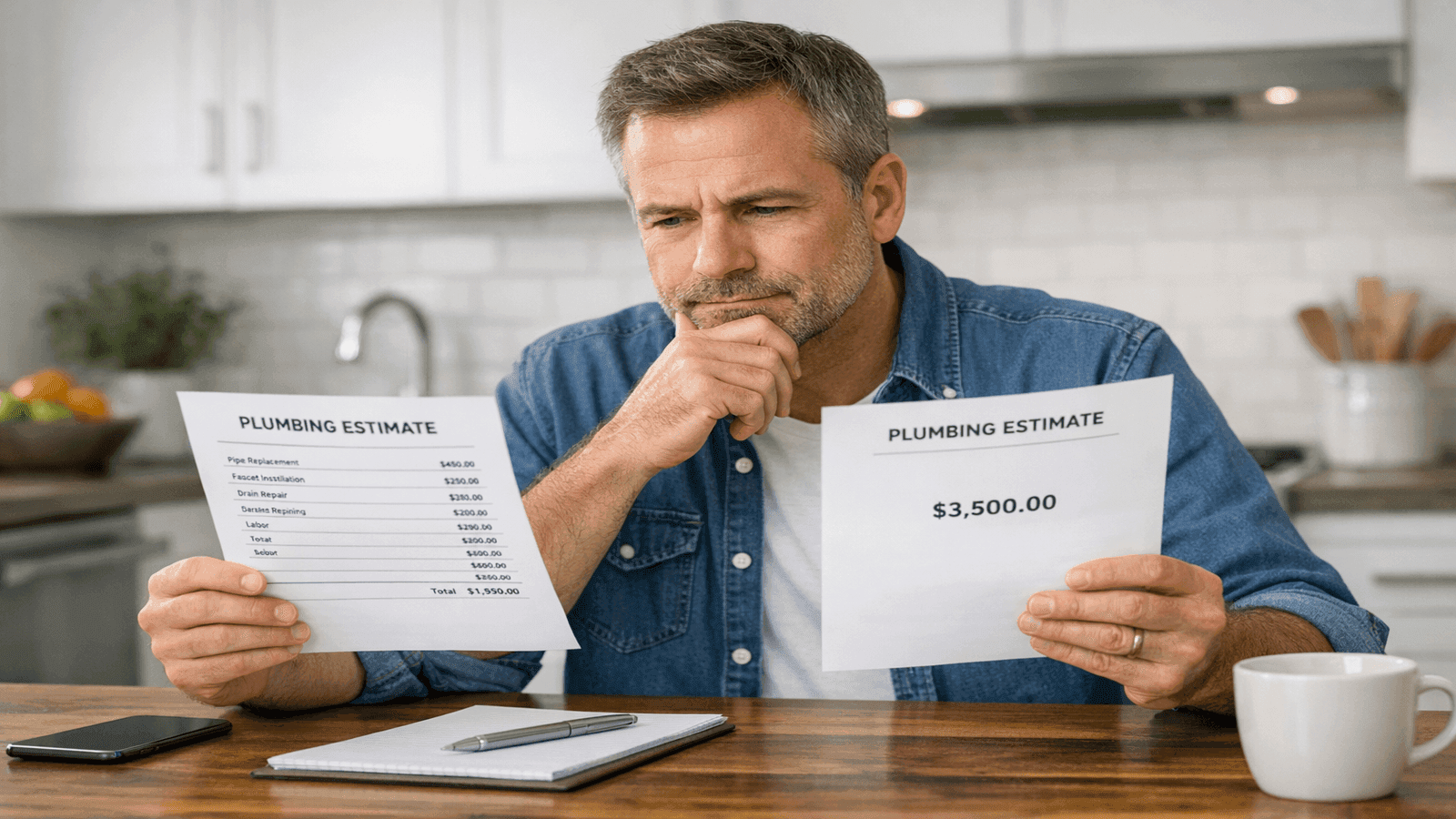
Photo: Homeowner sitting at kitchen table comparing two plumbing estimates, one detailed and itemized, one vague
When to DIY vs. Hire a Licensed Plumber
Some plumbing tasks are genuinely DIY-friendly. Others carry real risk: water damage, code violations, voided insurance, or physical danger. Knowing the line saves both money and headaches.
Safe to DIY (with basic tools):
- Toilet flapper replacement ($5-$15 part, 10 minutes)
- Faucet aerator cleaning or replacement
- Replacing a p-trap under a sink (our Replace a P-Trap guide walks through every step)
- Plunging a clogged toilet (before calling a plumber, always try this first (see How to Unclog a Toilet)
- Fixing a running toilet (the fill valve and flapper account for 90% of running toilet issues (see Fix a Running Toilet)
- Fixing a dripping faucet (see How to Fix a Leaky Faucet)
- Unclogging a shower drain with a drain snake (see Unclog Shower Drain)
Always hire a licensed plumber:
- Water heater replacement (gas connections, pressure relief valves, permits)
- Anything involving gas lines (never DIY under any circumstances)
- Sewer main work (scope and scale require professional equipment)
- Whole-house repiping (permit required, wall access, pressure testing)
- Fixing leaks inside walls or under a slab
- Any work requiring a permit (unpermitted work can void homeowner's insurance)
The insurance issue is serious and underappreciated. Most homeowner policies require that plumbing work meeting a minimum scope threshold (which varies by policy) be performed by a licensed contractor. DIY water heater installations have been denied coverage when the water heater subsequently leaked and caused damage. Review your policy or call your agent before tackling anything larger than a fixture swap.
For more complex DIY guidance and detailed how-to tutorials, our DIY Plumbing Guide 2026 covers 10 of the most common repairs step by step.
Get quotes from top-rated pros.
| Job | Safe to DIY? | Pro Required? | Cost of Getting It Wrong |
| Toilet flapper | Yes | No | $15 part, minor inconvenience |
| Faucet aerator | Yes | No | None |
| P-trap replacement | Yes | No | Minor drip if not tightened correctly |
| Running toilet | Yes | No | Wasted water bill |
| Leaky faucet | Yes | No | Higher water bill |
| Water heater | No | Yes | Scalding risk, explosion risk, permit failure |
| Gas line | Never | Always | Fire or explosion |
| Sewer line | No | Yes | $5,000+ sewage backup and excavation |
| House repipe | No | Yes | Permit failure, insurance void, water damage |
| Bathroom rough-in | No | Yes | Code violation, permit failure |
I love when homeowners do their own maintenance: a leaky faucet, a running toilet, a clogged drain. Those are real money savers and perfectly safe. But I've responded to disasters from DIY water heaters every year. Gas connections, pressure relief valve settings, expansion tanks: these aren't things you figure out from a YouTube video. The permit exists because someone getting it wrong can kill people. The few hundred dollars you save on labor is not worth that risk.
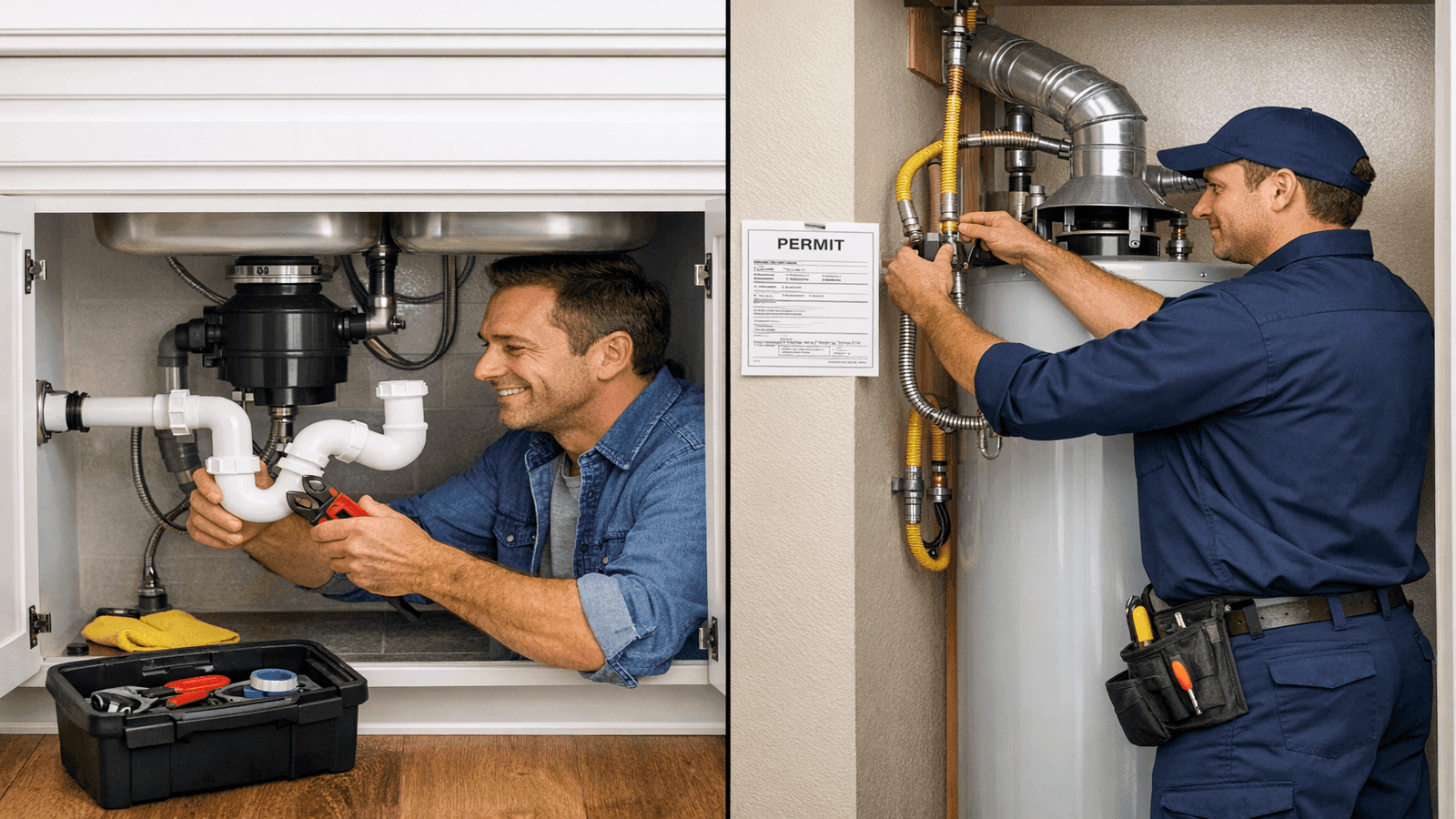
Photo: Split image showing a homeowner safely replacing a p-trap on the left versus a licensed plumber installing a water heater on the right
Quick-Reference Cost Table for All 10 Plumbing Jobs
Use this table as your starting benchmark before contacting any plumber. Actual quotes in your market may fall 20-30% above or below these national figures based on location, scope specifics, and contractor.
| Job | Low | High | National Average | Full Guide |
| Water Heater (tank, installed) | $650 | $3,500 | $1,293 | Guide |
| Water Heater (tankless, installed) | $1,333 | $3,721 | $2,527 | Guide |
| Garbage Disposal Install | $150 | $500 | $325 | Guide |
| Sewer Line Replacement | $1,253 | $25,000 | $2,914 | Guide |
| House Repipe (PEX) | $5,500 | $11,000 | $7,500 | Guide |
| House Repipe (copper) | $12,000 | $22,000 | $16,000 | Guide |
| Drain Cleaning (snaking) | $100 | $500 | $200 | Guide |
| Drain Cleaning (hydro-jetting) | $350 | $1,000 | $475 | Guide |
| Bathroom Remodel Plumbing | $1,000 | $8,000 | $3,500 | Guide |
| Emergency Plumber (call) | $200 | $1,500+ | $500 | Guide |
| Plumbing Inspection (visual) | $85 | $300 | $175 | Guide |
| Plumbing Inspection (camera) | $250 | $1,200 | $600 | Guide |
| Kitchen Sink Replacement | $250 | $1,200 | $450 | Guide |
| Plumber Hourly Rate | $45/hr | $200/hr | $90-$120/hr | Guide |
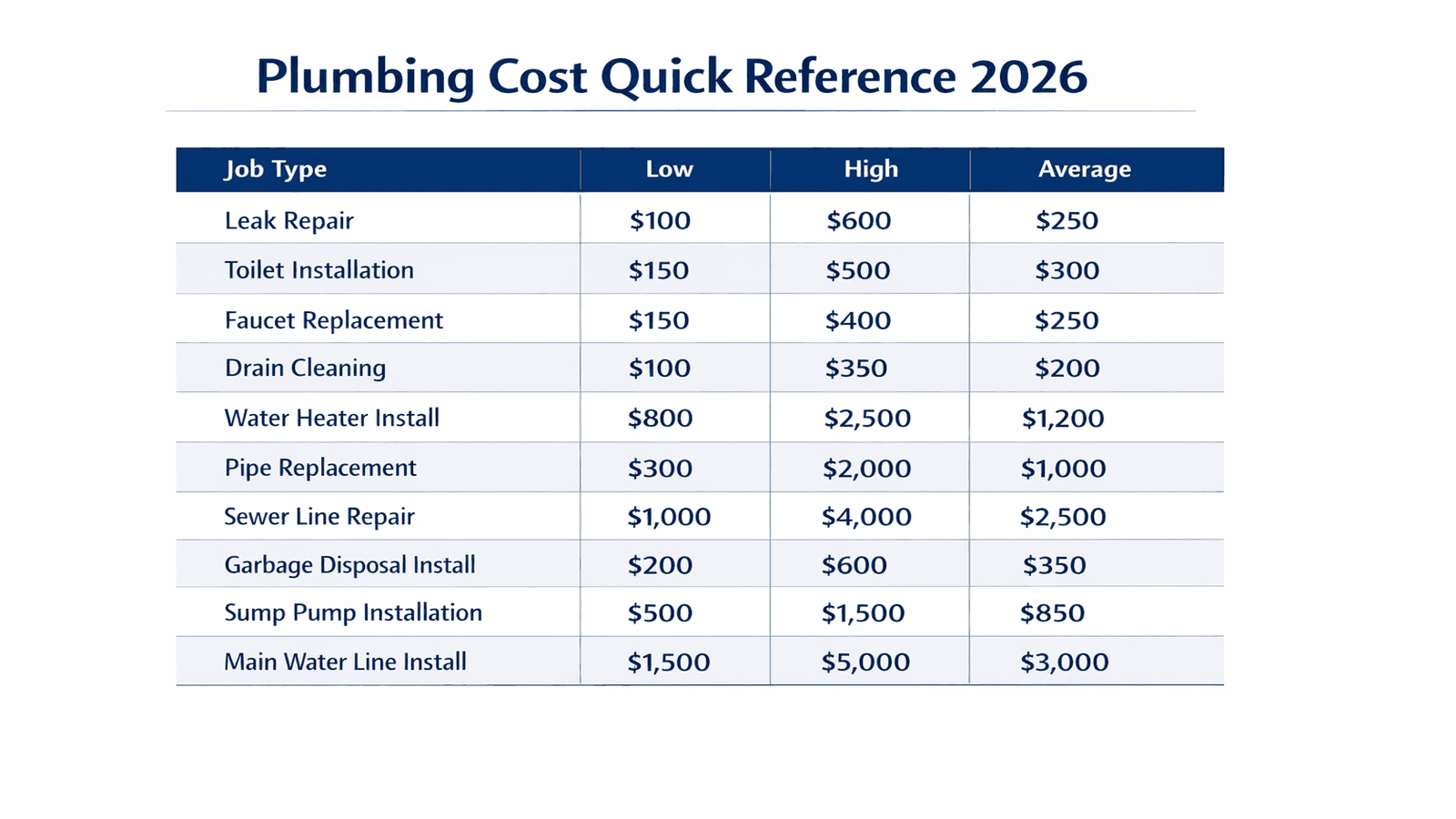
Photo: Quick-reference infographic table showing costs for 10 common plumbing jobs in 2026
Conclusion
Plumbing costs in 2026 span a wider range than most homeowners expect, and the biggest surprises rarely come from the headline number. They come from the service call fee that wasn't disclosed upfront, the emergency surcharge at midnight, the permit that wasn't budgeted, and the extra labor when the wall opened up and the pipe was in concrete.
Going into any plumbing project with a clear understanding of how plumbers charge, what fair rates look like in your region, and what questions to ask before anyone starts work puts you in control. The pricing benchmarks in this guide give you the context you need to evaluate quotes and push back when a number doesn't add up.
For the jobs you can handle yourself, start with our DIY Plumbing Guide. For everything else, get three quotes from licensed contractors, ask for written itemized estimates, and verify the license before work begins.
Sources & References
- Bob Vila. "How Much Does a Plumber Cost?, Water Heater Replacement Cost, Tankless Water Heater Cost, Sewer Line Replacement, Hydro-Jetting Cost." bobvila.com. 2026.
- Fixr. "Cost to Hire a Plumber." fixr.com. Updated January 30, 2025.
- U.S. Bureau of Labor Statistics. "Occupational Employment and Wage Statistics: Plumbers, Pipefitters, and Steamfitters." bls.gov. May 2024.
- ServiceTitan. "Plumber Salary: State-by-State Guide 2026." servicetitan.com. 2026.
- This Old House. "Water Heater Installation Cost 2026." thisoldhouse.com. 2026.
- NerdWallet. "Water Heater Cost 2026." nerdwallet.com. 2026.
- Repipe Solutions Inc. "How Much Does It Cost to Replumb a 1,500 Square Foot House in 2026." repipesolutionsinc.com. 2026.
- Nu Flow. "Average Cost to Replace a 100-Foot Sewer Line." nuflow.com. 2026.
- PHCC (Plumbing-Heating-Cooling Contractors Association). "2026 Industry Outlook." contractingbusiness.com. 2026.
- HouseCall Pro. "2026 Plumbing Price Guide." housecallpro.com. 2026.
- Forbes Home. "How Much Does Plumbing Repair Cost?" forbes.com/home-improvement. 2026.
Disclaimer: Plumbing costs vary significantly based on geographic location, job scope, material selection, permit requirements, and individual contractor pricing. The figures in this guide represent national ranges and averages compiled from multiple industry sources as of early 2026. Always obtain at least three written quotes from licensed plumbers in your area before making any hiring decisions. NearbyHunt does not guarantee specific pricing outcomes.

Michael Jennings is a licensed master plumber & water systems specialist with over 18 years of hands-on experience in residential and commercial plumbing, serving clients across California and Texas. At NearbyHunt, he shares practical advice on pipe installations, water heater maintenance, and home plumbing upgrades. Michael has helped thousands of homeowners prevent costly water damage and improve water efficiency through modern plumbing solutions.

Robert is a licensed master plumber with over 20 years of experience serving both residential and commercial clients across the Midwest. Specialising in advanced plumbing systems and sustainable water technologies, Rob brings deep technical insight and hands-on expertise to every project. As a reviewer for NearbyHunt, he ensures all plumbing content reflects the highest standards of safety, compliance, and practicality.