- Inadequate attic ventilation can cut your roof's lifespan by up to 24%, turning a 25-year shingle system into a 10-to-12-year failure.
- The IRC 1/300 ventilation standard requires 1 square foot of net free area for every 300 square feet of attic floor space, split evenly between intake and exhaust vents.
- Attic temperatures in poorly ventilated homes regularly exceed 150°F in summer, accelerating shingle granule loss, adhesive breakdown, and deck warping.
- Soffit vents and ridge vents require inspection every six months to clear blockages from insulation, debris, and pests.
- Properly maintained ventilation can reduce summer cooling costs by 10 to 15% while extending shingle warranty coverage.
- The NearbyHunt network reports that 68% of premature roof failures on inspected homes involve some form of ventilation deficiency.

Get quotes from top-rated pros.
Most homeowners think about their roof when a shingle blows off or a leak appears on the ceiling. What they rarely consider is the invisible system working underneath that roof every hour of the year: attic ventilation. A well-maintained ventilation system is the single most important factor in protecting your roof decking, shingles, insulation, and structural rafters from heat and moisture damage.
As part of a complete roofing maintenance program, attic ventilation deserves the same seasonal attention you give to gutters or flashing. When ventilation fails quietly, the damage accumulates for years before it becomes visible. By then, you may be looking at a full roof replacement rather than a simple repair.
This guide covers how attic ventilation works, how to calculate whether your system meets code, how to inspect and maintain each component, and how to recognise the warning signs before costly damage sets in.
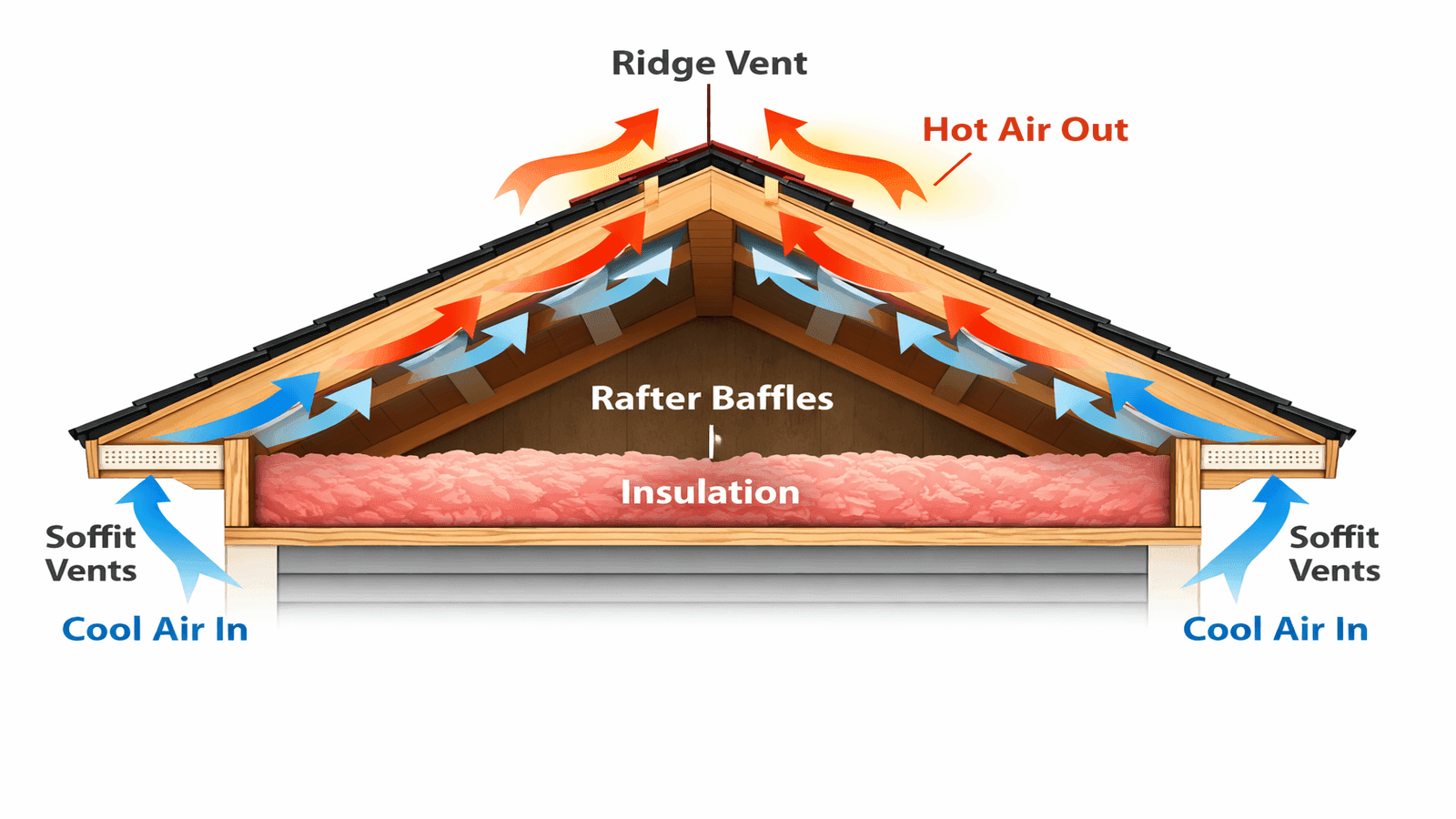
Photo: Cross-section diagram of a residential roof showing airflow from soffit intake vents at the eaves traveling up through rafter bays and exiting through a continuous ridge vent at the peak, illustrating a balanced attic ventilation system.
How Attic Ventilation Works
Attic ventilation operates on a simple thermodynamic principle: hot air rises. Intake vents installed at the lowest point of the attic (typically in the soffits) draw cool outside air in. That air warms as it moves through the attic space, picks up heat and moisture, and exits through exhaust vents at or near the ridge. This continuous airflow prevents the attic from becoming a heat and moisture trap.
There are two categories of ventilation: passive and active. Passive systems rely entirely on temperature differentials and wind pressure. Ridge vents, soffit vents, gable vents, and off-ridge vents are all passive components. Active systems use powered attic fans to force air movement when natural convection is insufficient.
For most residential roofs, a properly sized passive system using continuous soffit vents paired with a continuous ridge vent is the most efficient and durable solution. The goal is balance: equal amounts of intake and exhaust net free area (NFA) so that air flows through the attic rather than stagnating.
The Role of Intake Vents
Soffit vents are the primary intake points in most residential ventilation systems. They run along the underside of the roof overhang (the soffit) and admit outside air at the lowest point of the attic. Continuous soffit vents provide the most consistent airflow, but individual circular or rectangular vents are also common in older construction.
Without functioning intake vents, ridge and exhaust vents cannot work properly. A ridge vent on a home with blocked soffits will actually draw moist conditioned air up from the living space rather than pulling in fresh outside air, worsening moisture problems rather than solving them. [1]
The Role of Exhaust Vents
Ridge vents span the entire length of the roof peak and allow hot air to escape continuously. They are the most effective exhaust option because they use the natural buoyancy of hot air. Other exhaust options include box vents (static roof vents), turbine vents, and powered attic fans. Each has specific maintenance requirements.
For a deeper look at vent types and installation, the install roof vents guide covers materials, placement, and code compliance in detail.
Vent Type Comparison
| Vent Type | Category | Best Use | Maintenance Frequency | Estimated Cost (Installed) |
| Continuous soffit vent | Intake | Most residential roofs | Every 6 months | $3–$6 per linear ft |
| Individual soffit vent | Intake | Older homes, spot repairs | Every 6 months | $15–$30 each |
| Continuous ridge vent | Exhaust | Standard gable roofs | Annually | $400–$700 installed |
| Box vent (static) | Exhaust | Supplemental exhaust | Annually | $60–$150 each |
| Turbine vent | Exhaust | Moderate airflow needs | Every 6–12 months | $75–$200 each |
| Powered attic fan | Active exhaust | High-heat climates, large attics | Semi-annually | $300–$600 installed |
| Gable vent | Passive (cross) | Secondary; not balanced system | Annually | $50–$150 each |
- Cost ranges reflect typical contractor-installed pricing in the Southeast and mid-Atlantic regions as of 2026. Pricing varies by market and roof complexity.*
Ventilation Requirements: The Code Standard
The International Residential Code (IRC) Section R806 establishes the baseline for residential attic ventilation in the United States. Understanding these requirements allows you to verify that your existing system is adequate and identify deficiencies before they lead to damage.
Get quotes from top-rated pros.
The 1/300 Rule
The standard most residential projects follow is the 1/300 ratio: provide at least 1 square foot of net free ventilating area for every 300 square feet of attic floor space. This ratio applies when:
- At least 40% but no more than 50% of the required ventilation is located in the upper portion of the attic (exhaust vents at or near the ridge)
- The remaining ventilation is located in the lower one-third of the attic space (intake vents at the soffits)
- A Class I or II vapor retarder is installed on the warm-in-winter side of the ceiling in Climate Zones 6, 7, and 8 [2]
The 1/150 Rule
Without the balanced placement described above, the code defaults to the more stringent 1/150 ratio: 1 square foot of NFA for every 150 square feet of attic space. This is essentially double the ventilation requirement. While more expensive to achieve, the 1/150 standard reduces condensation potential by 33% compared to the 1/300 standard.
Calculating Your Requirement
To calculate your attic ventilation requirement:
- Measure your attic floor area in square feet (length multiplied by width)
- Divide by 300 (for the standard ratio, assuming balanced placement)
- Multiply by 144 to convert square feet of NFA to square inches
- Split the result in half: that is your required intake NFA and your required exhaust NFA
Example: A 1,500-square-foot attic requires 1,500 / 300 = 5 square feet of NFA. Multiply by 144 = 720 square inches total. You need 360 square inches of intake NFA and 360 square inches of exhaust NFA.
Each vent product is rated with a specific NFA value in square inches. Add up the NFA values of all your intake vents and all your exhaust vents separately, then compare against your calculated requirement.
Quick Reference: NFA Requirements by Attic Size
| Attic Floor Area (sq ft) | Required NFA at 1/300 (sq in) | Intake NFA Needed (sq in) | Exhaust NFA Needed (sq in) |
| 800 | 384 | 192 | 192 |
| 1,000 | 480 | 240 | 240 |
| 1,200 | 576 | 288 | 288 |
| 1,500 | 720 | 360 | 360 |
| 1,800 | 864 | 432 | 432 |
| 2,000 | 960 | 480 | 480 |
| 2,400 | 1,152 | 576 | 576 |
Based on IRC Section R806 1/300 balanced ventilation standard. If vapor retarder or balanced placement conditions are not met, use 1/150 ratio (double all values above). [2]*
Most homeowners have no idea what their attic's NFA requirement is, and most contractors do not calculate it either. They eyeball it. I have been calculating attic NFA on every job for 20 years, and I can tell you that a significant portion of the roofs I inspect are under-ventilated by 30 to 50 percent. The table above takes ten minutes to use. There is no excuse for skipping it.
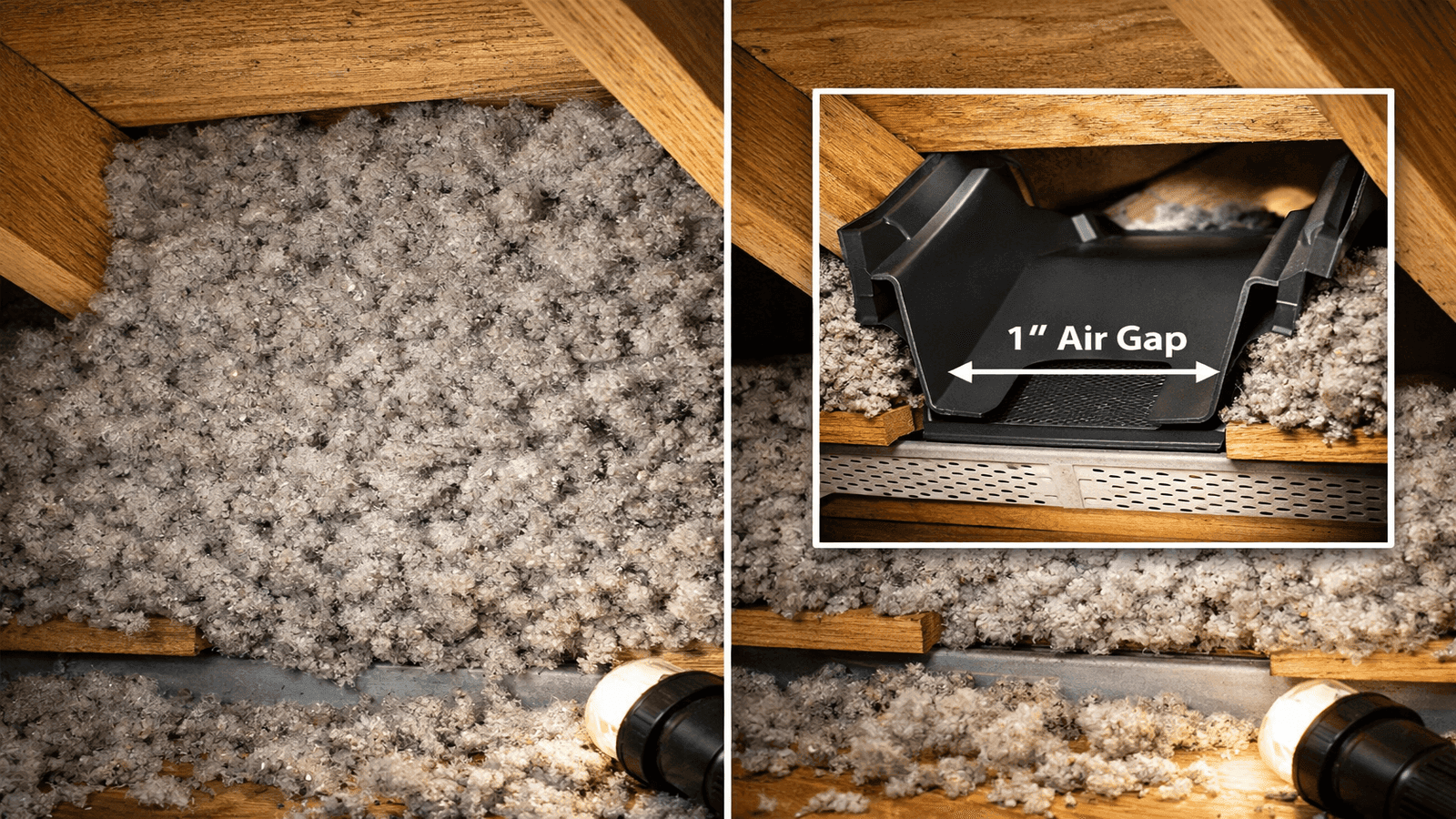
Photo: Side-by-side attic view showing a soffit vent completely blocked by blown-in insulation on the left and a properly installed rafter baffle maintaining a clear airflow channel on the right.
Warning Signs of Inadequate Ventilation
Recognizing the signs of ventilation failure early can save thousands in repair costs. The damage from poor ventilation accumulates slowly and is often invisible from outside the home until it has progressed significantly.
Excessive Heat in Upper Floors
When attic temperatures rise above 150°F (a common occurrence in southern and southwestern states during summer), that heat radiates through the ceiling into living spaces below. Upper floors that are significantly hotter than lower floors during summer are a consistent indicator of inadequate exhaust ventilation. [3]
Robert K. from Memphis, Tennessee experienced this directly. His 14-year-old architectural shingle roof began showing widespread granule loss and cupping across the south-facing slope. A roofing inspection revealed that his soffit vents had been completely blocked by blown-in insulation during a home energy retrofit three years earlier. With no intake airflow, his attic was regularly reaching 162°F. The remediation required reblocking the soffits from inside, adding ventilation baffles to protect the airflow channel, and replacing two roof sections where the decking had begun to delaminate. Total cost: $6,400. Had the blockage been caught during a routine six-month inspection, the fix would have been an afternoon of work and a bag of baffles.
Frost and Ice Dam Formation
In cold climates, warm air leaking from the living space rises into the attic and warms the underside of the roof deck. Snow on that warmed section melts and flows toward the cold roof edge, where it refreezes and forms an ice dam. The dam traps subsequent meltwater, which backs up under shingles and leaks into the home.
Ice dams are almost always a symptom of two combined problems: insufficient attic insulation and inadequate ventilation. A properly ventilated attic stays cold in winter because outside air flushes through continuously, keeping the deck temperature uniform from ridge to eave. The ice dam prevention guide covers both the ventilation and insulation components of this issue in detail.
Get quotes from top-rated pros.
Moisture, Mold, and Deck Damage
Condensation forming on rafters, roof decking, or insulation is a serious sign. Wood that stays wet for extended periods develops mold and rot. OSB and plywood decking delaminates when repeatedly cycled through wet and dry conditions. Once decking is soft or spongy, it must be replaced before new shingles can be installed. [4]
The common roofing problems guide includes photos of delaminated decking and rafter rot that result from chronic moisture issues, giving homeowners a reference for what to look for during their own inspections.
Shingle Deterioration
Shingles on a poorly ventilated roof age from the underside as well as the top surface. Trapped heat cooks the asphalt, causing granules to loosen and shed prematurely. Shingles may begin to cup, curl, or crack years before their rated lifespan. In hot climates, shingles rated for 25 years regularly fail at 10 to 12 years when ventilation is inadequate. Inadequate ventilation also voids most shingle manufacturer warranties, leaving homeowners without recourse when premature failure occurs. [5]
High Energy Bills
An attic that retains heat in summer forces the air conditioning system to work harder to maintain comfortable temperatures. Proper ventilation reduces attic temperatures by 20 to 30 degrees and can lower summer cooling costs by 10 to 15%. A sudden unexplained increase in summer energy consumption, combined with upper-floor heat complaints, often points to a ventilation problem before any visible roof damage appears.
In the Southeast, the combination of summer heat and humidity makes attic ventilation more critical than almost anywhere else in the country. I have pulled shingles off roofs in Atlanta that were eight years old and looked like they were twenty. The attic was hitting 160 degrees every afternoon in July. The shingles just cooked.
Seasonal Maintenance: A Practical Schedule
Attic ventilation maintenance does not require professional expertise for most of its components. A homeowner with a flashlight, a tape measure, and access to the attic can perform the core inspections twice a year. Schedule inspections in spring (after winter) and fall (before heating season).
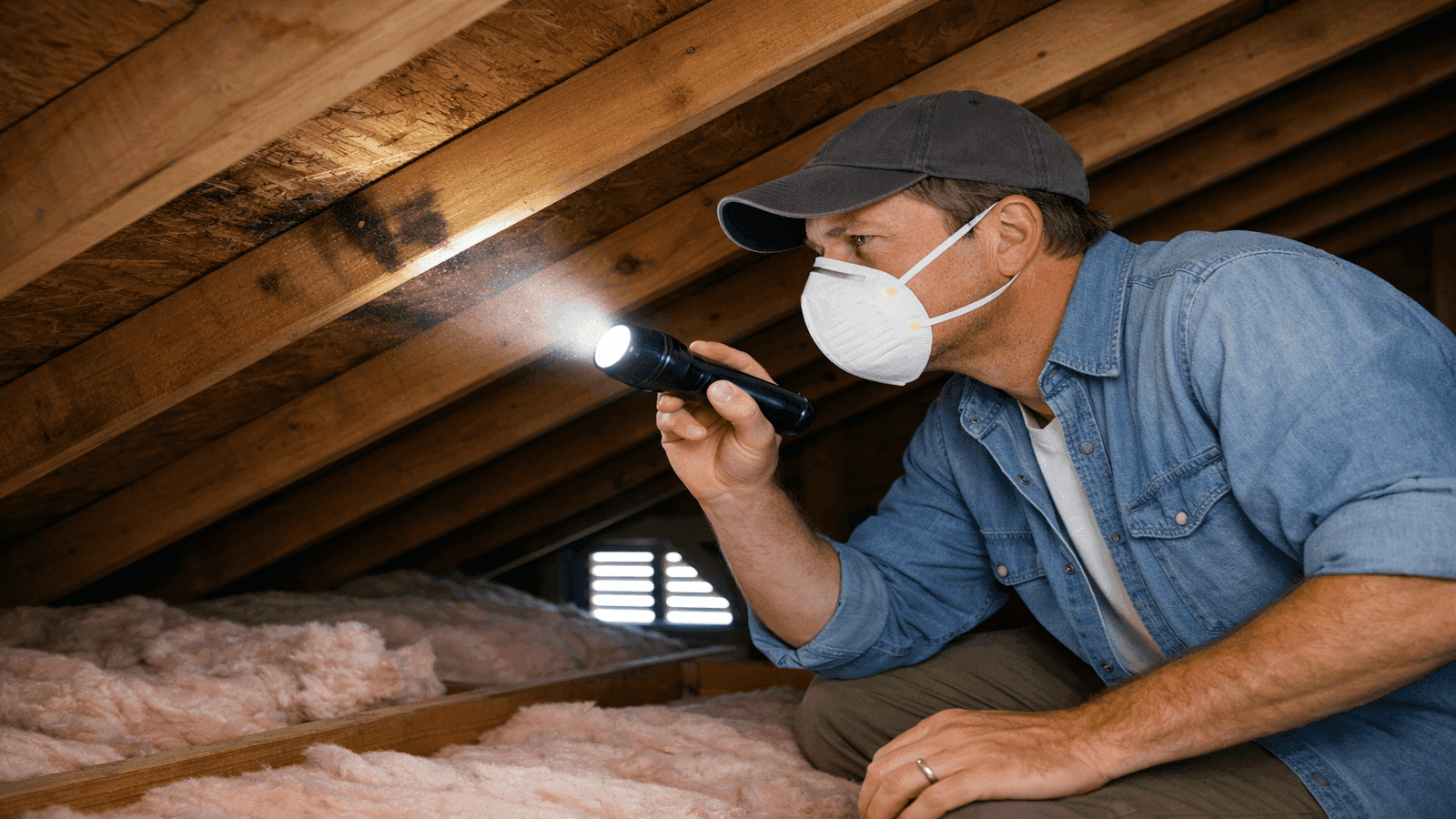
Photo: Homeowner in a residential attic using a flashlight to inspect the underside of the roof deck and rafters, looking for signs of moisture staining and ventilation problems.
Spring Inspection Checklist
Exterior (from the ground or from a ladder at the eaves):
- Confirm soffit vents are unobstructed and screens are intact
- Look for wasp or hornet nests in or around soffit vents
- Check ridge vent cap for cracking, lifting, or damage from winter ice or wind
- Inspect gable vents for damaged screens that admit birds or squirrels
From inside the attic:
- Look along the ridge for daylight gaps indicating a properly installed ridge vent
- Check that ventilation baffles (rafter baffles) are in place and unobstructed at each rafter bay along the eaves
- Inspect all rafters and decking for moisture staining, dark discoloration, or soft spots
- Confirm insulation is not packed against the soffit vent openings
- Check for signs of pest intrusion: nesting material, droppings, or chewed insulation
Documentation: Note the NFA rating of each vent type and compare against your calculated requirement. If you cannot find the rating, measure the vent opening and estimate conservatively.
Fall Inspection Checklist
Before heating season:
- Repeat the exterior inspection for debris accumulation in soffit vents (leaves, seeds, spider webs)
- Verify ridge vent is fully sealed to the decking on both sides to prevent wind-driven rain entry
- Check powered attic fans (if present): test operation, clean motor housing and blade, verify thermostat is set to activate at 90 to 110°F
- Confirm turbine vents spin freely without wobbling or squeaking (a sign of a worn bearing)
- Inspect all vent flashings for cracks, rust, or lifting sealant
From inside the attic:
- Look for any new moisture staining from summer condensation
- Confirm insulation depth and placement have not shifted (especially in homes with blown-in insulation)
- Re-secure any baffles that have shifted away from the eaves
For homes in northern climates, the fall inspection is particularly important because ventilation deficiencies that seemed minor in summer can contribute directly to ice dam formation once temperatures drop. The fall roof preparation guide provides a comprehensive pre-winter checklist that complements this ventilation inspection.
We inspect attic ventilation on every roofing job we take, regardless of whether the homeowner calls us for ventilation or not. I have seen plywood decking that looked fine from below but was structurally compromised from years of condensation cycling. You press on it with your palm and your hand goes through. At that point, you are replacing decking in addition to shingles, and the bill doubles.
Common Ventilation Problems and Fixes
Blocked Soffit Vents
Problem: Insulation installed against the eaves fills the airflow channel between the insulation and the roof deck, blocking soffit vents.
Fix: Install ventilation baffles (also called rafter baffles or AccuVent boards) in each rafter bay between the insulation and the decking. These create a clear 1-inch-minimum airflow channel from the soffit vent to the open attic. This is the most common correction needed on homes that have had blown-in insulation upgrades.
James Carver has completed more than 1,800 roofing projects across the U.S. South and Midwest, and in his experience, blocked soffits account for the majority of ventilation-related decking damage he encounters: "You can have a perfect ridge vent and perfectly installed shingles, and the whole system still fails if there is no intake. The attic becomes a pressure vessel. Moisture cannot escape and heat cannot exchange. The deck pays the price." [6]
Get quotes from top-rated pros.
Mixing Exhaust Vent Types
Problem: Some homeowners or contractors add powered fans or box vents to a roof that already has a ridge vent, believing more ventilation is always better.
Fix: Do not mix exhaust vent types. A powered fan placed below a ridge vent will short-circuit the system, drawing air through the ridge vent rather than from the soffits. This pulls hot, humid air in through the exhaust openings, negating the ventilation effect entirely. If airflow is insufficient, add more intake area at the soffits first, then evaluate whether exhaust capacity needs to match. [1]
The most common mistake I see is homeowners adding a ridge vent to improve their roof and then wondering why the attic is worse. If you do not have the soffit intake to match it, you have not added ventilation. You have added a hole in the roof.
Inadequate Net Free Area
Problem: The system simply does not have enough vent area to meet the 1/300 (or 1/150) ratio for the attic's square footage.
Fix: This typically requires adding vents. Options include extending a continuous soffit vent, adding a continuous ridge vent where a non-ventilating ridge cap exists, or installing additional box vents. For homes where the roof geometry makes soffit venting difficult, over-fascia vents or drip edge vents can provide intake area without modifying the soffit.
Pest and Debris Blockages
Problem: Wasps, birds, squirrels, and accumulated debris partially or fully block individual vents.
Fix: Remove nesting material and blockages. Replace damaged screens with galvanized or stainless mesh rated at 1/16-inch to 1/8-inch openings (per code) to prevent re-entry. Do not use insect mesh finer than 1/16-inch, as it restricts airflow and clogs quickly with fine debris.
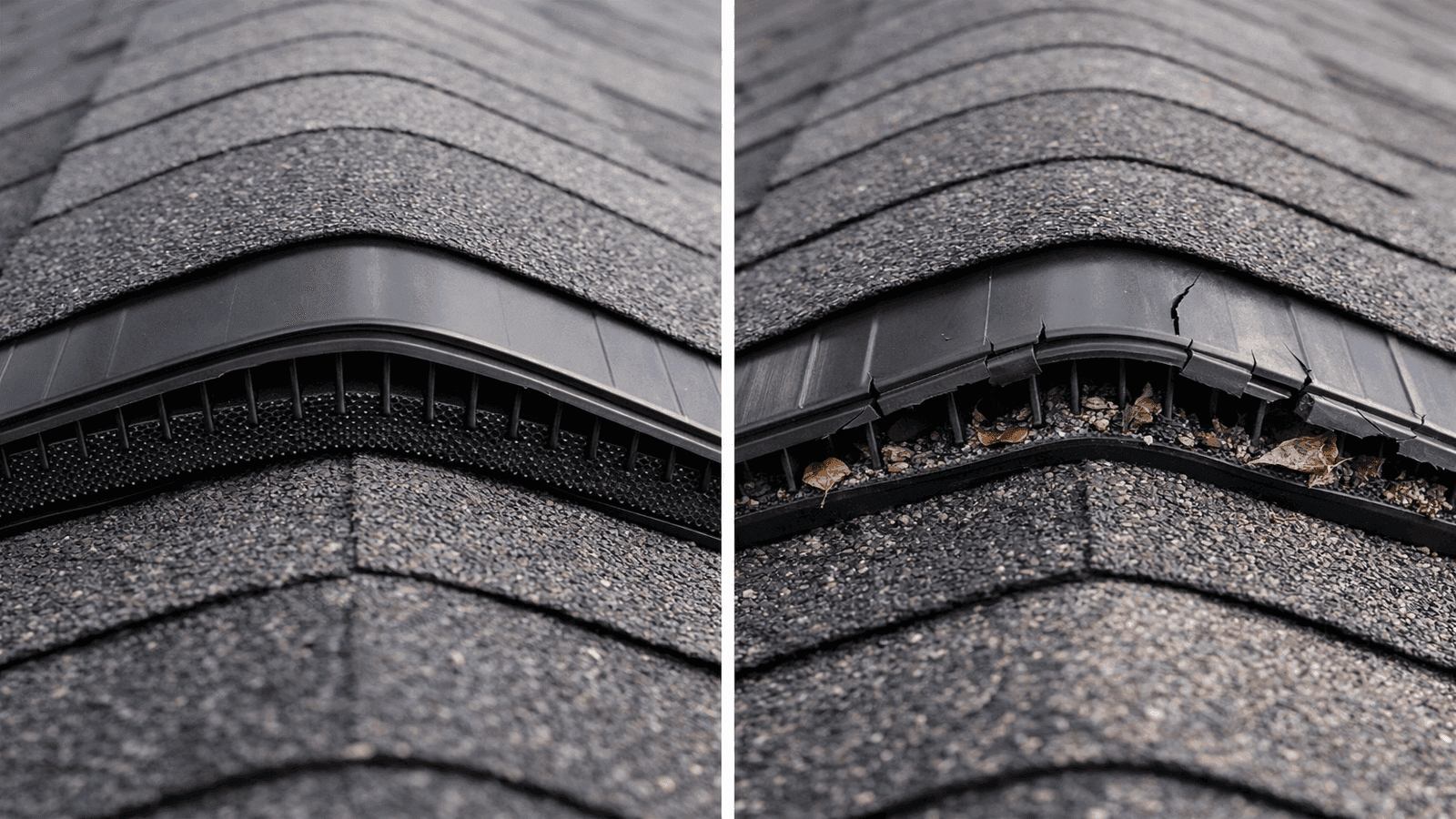
Photo: Side-by-side comparison of a clean, fully functional ridge vent with intact weather-filter baffle on the left versus a damaged ridge vent with cracked baffle and debris accumulation on the right.
Ventilation and Roof Longevity: The Numbers
The connection between ventilation and roof lifespan is well-documented in roofing industry research. Asphalt shingles exposed to excessive attic heat experience accelerated thermal cycling, which degrades the asphalt binder, accelerates granule adhesion loss, and causes shingle curling at a rate far above normal aging. [5]
The licensed roofing contractors in the NearbyHunt network report that 68% of residential roofs they inspect that are failing prematurely show evidence of ventilation deficiency, either through blocked soffits, mismatched exhaust systems, or total NFA below the 1/300 threshold. On homes where ventilation is corrected before shingle replacement, contractors consistently report that the new roofs perform at or near their rated lifespan.
Understanding how roofing materials respond to heat stress over time is covered in the how long do roofs last guide, which includes material-specific lifespan data and the factors that most commonly shorten or extend those ranges.
The roof components explained guide provides additional context on how the ventilation system interacts with decking, underlayment, and insulation as an integrated system, rather than as isolated components.
When to Call a Professional
Most ventilation inspections and minor corrections are within the capability of a confident homeowner. However, some situations call for a licensed roofing contractor:
- When NFA is significantly below the 1/300 ratio and adding vents requires cutting into the decking or soffit structure
- When ridge vent installation is needed on an existing roof (requires removing the ridge cap, cutting the deck, and proper sealing)
- When moisture damage to decking or rafters is discovered (structural assessment required before repairs)
- When mold is present in the attic space (may require remediation before ventilation improvements are made)
- When powered attic fans are failing or need replacement (electrical work may be involved)
- On flat or low-slope roofs where different ventilation standards and products apply; the flat roof maintenance guide covers the specific requirements for those systems
Ventilation improvements are also a logical time to assess your entire roofing system. If decking damage is discovered during an attic inspection, a contractor can evaluate whether spot repairs or full replacement is the more cost-effective path.
For homeowners considering energy-efficiency upgrades alongside ventilation improvements, the green roofing options guide covers cool-roof coatings, radiant barriers, and other technologies that complement a properly ventilated attic.
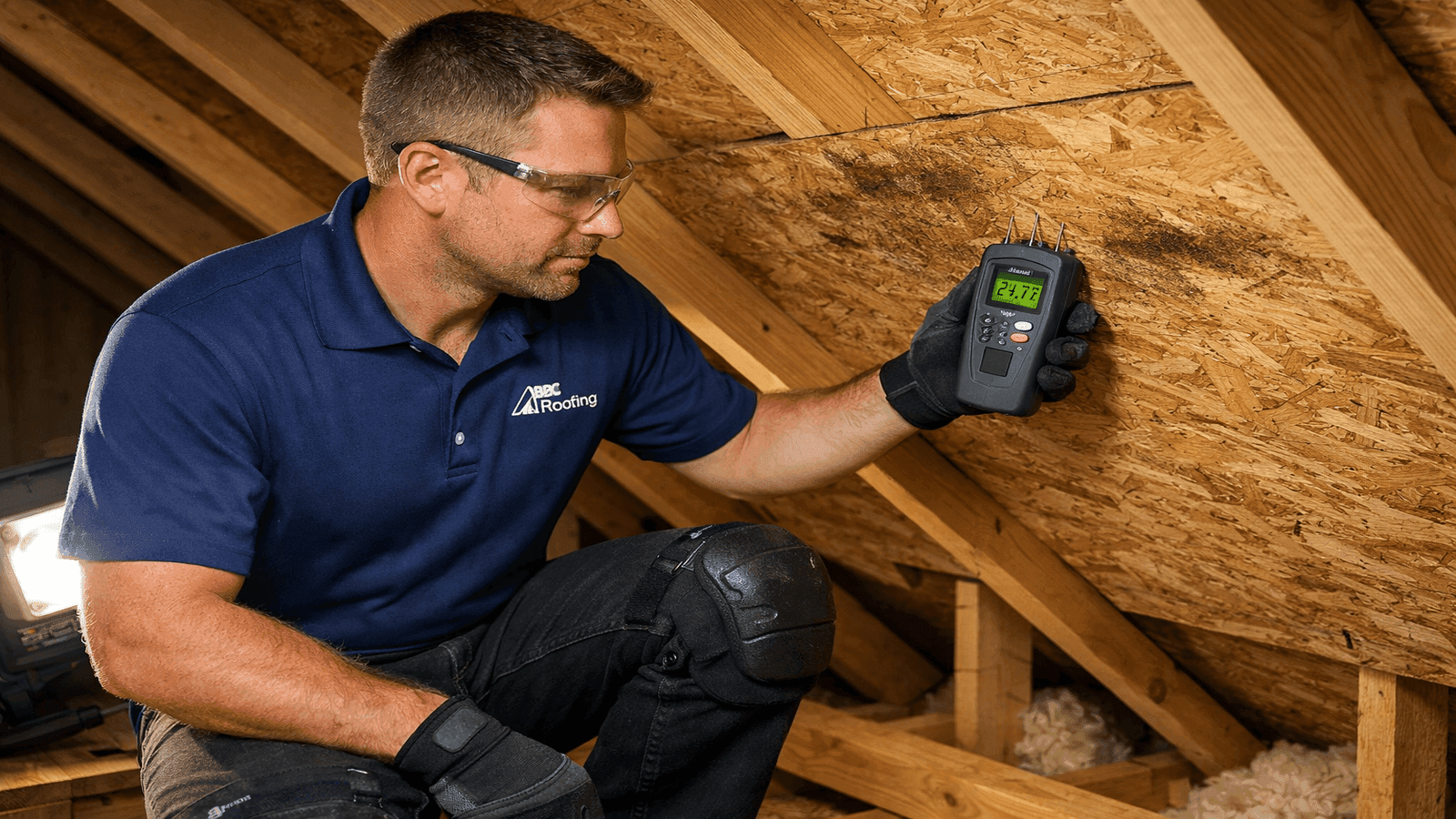
Photo: Licensed roofing contractor using a pin-type moisture meter on attic roof decking, with the digital display showing an elevated moisture reading indicating water damage in the wood.
Conclusion
Attic ventilation is not a set-and-forget system. It requires the same periodic attention as gutters, flashing, and shingles. A twice-yearly inspection that takes an hour can catch blocked soffits, pest intrusions, and damaged ridge vents before they compound into structural repairs costing thousands of dollars.
The formula is straightforward: confirm your system meets the 1/300 NFA ratio, keep intake and exhaust vents clear and undamaged, and never mix exhaust vent types. These basics protect your decking, preserve your shingle warranty, reduce energy costs, and extend roof lifespan by years.
If your last ventilation inspection was more than a year ago, schedule one now. If you are not sure whether your existing system meets code, measure your attic floor area, calculate your NFA requirement, and compare it against the rated NFA of your installed vents. The calculation takes ten minutes and can reveal a deficiency that has been quietly shortening your roof's life.
For a complete professional evaluation, connect with a licensed contractor through NearbyHunt to find vetted roofing professionals in your area who can inspect, test, and correct your attic ventilation system.
Disclaimer
The information in this article is provided for general educational purposes only and does not constitute professional roofing or engineering advice. Ventilation requirements vary by jurisdiction, climate zone, roof geometry, and attic design. Consult a licensed roofing contractor or building inspector in your area to evaluate your specific system and ensure compliance with local building codes. Always follow safety procedures when accessing an attic or working near a roof. NearbyHunt does not warrant that any ventilation system meeting the general guidelines described here will be appropriate or code-compliant for any specific home.
Sources & References
[1] Asphalt Roofing Manufacturers Association (ARMA). "The Attic Needs Ventilation, but How Much Exactly?" https://www.asphaltroofing.org/the-attic-needs-ventilation-but-how-much-exactly/
[2] International Code Council. "IRC Section R806: Roof Ventilation." Cited via UpCodes. https://up.codes/s/minimum-vent-area
[3] Bill Ragan Roofing. "6 Signs of Poor Attic Ventilation." https://www.billraganroofing.com/blog/signs-poor-attic-ventilation
[4] Gerken Roofs. "Identifying and Fixing Poor Attic Ventilation Issues." https://www.gerkenroofs.com/post/identifying-and-fixing-poor-attic-ventilation-issues
[5] Cupples Construction. "How Roof Ventilation Mistakes Shorten Shingle Lifespan." https://www.cupplesconstruction.com/2026/02/18/how-roof-ventilation-mistakes-shorten-shingle-lifespan/
[6] InterNACHI. "Mastering Roof Inspections: Attic Ventilation Systems, Part 3." https://www.nachi.org/attic-ventilation-systems-part3-27.htm
[7] GAF. "How to Plan a Balanced Attic Ventilation System." https://www.gaf.com/en-us/blog/residential-roofing/how-to-plan-a-balanced-attic-ventilation-system-281474980110411
[8] Ice Dam Guys. "How Bad Attic Ventilation Can Cause Ice Dams." https://icedamremovalguys.com/how-bad-attic-ventilation-can-cause-ice-dams-and-good-attic-ventilation-can-prevent-ice-dams/
[9] Owens Corning. "Why Proper Attic Ventilation Is Important for Your Home." https://www.owenscorning.com/en-us/roofing/blog/why-proper-roof-and-attic-ventilation-is-important-for-your-home
[10] Building America Solution Center, PNNL. "Calculating Attic Passive Ventilation." https://basc.pnnl.gov/information/calculating-attic-passive-ventilation

James is a licensed roofing contractor with 20 years of experience in roof installation, inspection, and repair across the U.S. South and Midwest. He specialises in asphalt shingles, metal roofing, and storm damage restoration. On NearbyHunt, James offers practical advice on roof maintenance, insurance claims, and selecting the right materials for long-lasting protection.

Jacob is a licensed roofing contractor with over 18 years of experience in roof inspection, installation, and restoration. Based in Texas, he has led hundreds of successful roofing projects across residential and commercial properties. Jacob is also a certified storm damage specialist, ensuring that all NearbyHunt roofing content meets industry best practices and safety standards.