- 3-tab shingles cost $3.50-$5.50/sq ft installed — the cheapest option but with only a 15-20 year lifespan; architectural shingles at $5-$9/sq ft installed deliver significantly better long-term value for most homeowners.
- Average full roof replacement costs $8,000-$20,000 for a 2,000 sq ft home; most homeowners pay $10,000-$14,000 for architectural shingles with full tear-off included.
- Labor is 60% of total cost — in markets like Houston and Atlanta it runs $200-$350/square; in Boston and Seattle it reaches $350-$600/square, making geography one of the largest cost variables.
- Choosing Class 4 impact-rated shingles adds $1,500-$3,000 to a typical project but can reduce homeowners insurance premiums by 15-30% annually in hail-prone states, recouping the cost within 5-8 years.
- James Carver has installed asphalt shingles on more than 1,200 homes across the U.S. South and Midwest — the most common buyer mistake is choosing the cheapest shingle and paying for a full replacement again within 10 years.
Asphalt shingles cover approximately 78% of U.S. residential roofs — and for good reason. They offer a proven balance of affordability, performance, and availability that no other roofing material consistently matches at scale. But "asphalt shingles" spans a wide range: from basic 3-tab shingles at $80/square in materials to luxury designer shingles at $400/square that mimic natural slate. The installed cost difference between the cheapest and best options on a 2,400 sq ft home can exceed $15,000.
This guide breaks down 2026 pricing by shingle type, home size, brand, and region, and gives you the framework to compare contractor bids on equal terms. For a broader look at all roofing material options and what each costs, see our complete guide to roofing costs. If you are not yet sure what condition your roof is in, start with our roof inspection checklist before requesting bids. The sections below focus entirely on asphalt shingles: what they cost, what drives those costs, and how to get the right product for your project.

Get quotes from top-rated pros.
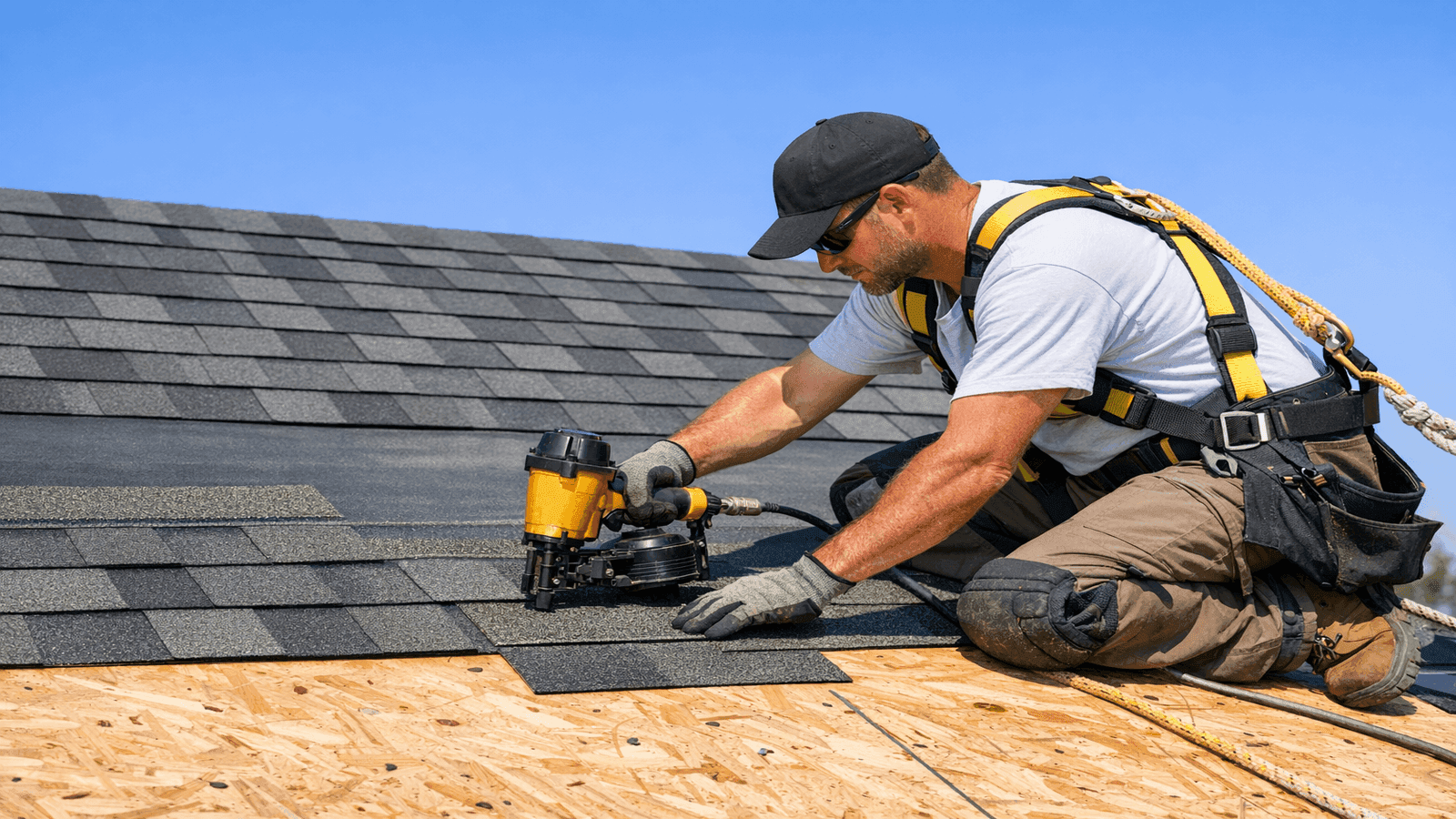
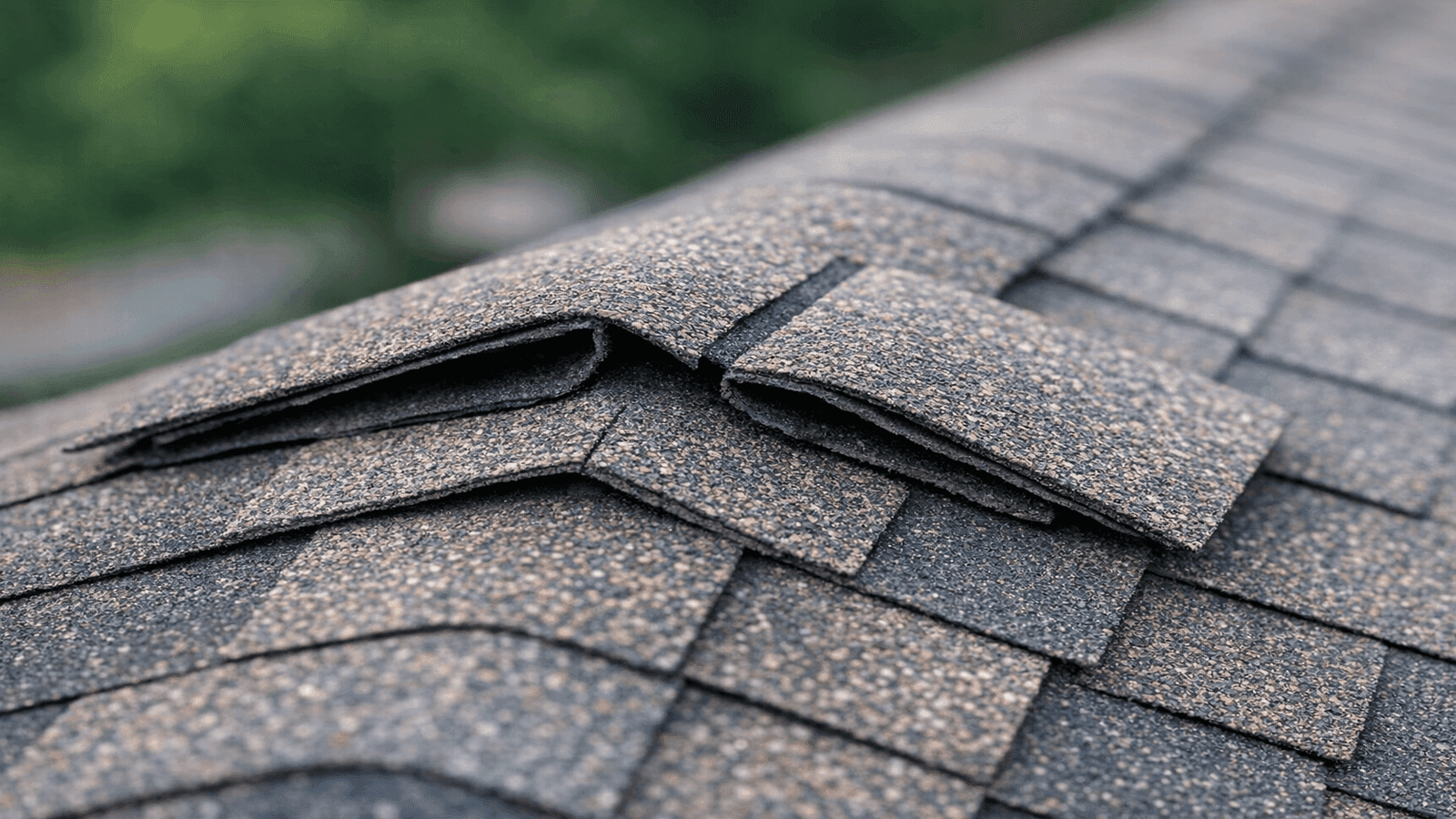
Photo: Roofer installing architectural asphalt shingles on a residential roof, showing overlapping shingle courses and nail placement pattern
Asphalt Shingle Types and Cost Per Square
Roofing materials are priced and quoted in "squares," where one square equals 100 square feet of roof surface. Understanding the per-square cost of each shingle type is the first step to evaluating any contractor bid.
3-tab shingles are the entry-level option. Flat in profile with a uniform cutout pattern, they carry a 15-20 year rated lifespan and material costs of $80-$120 per square. They were the industry standard through the 1990s but now represent a small fraction of new installations. Their single-layer construction offers less wind resistance than laminated shingles, with most rated to 60-80 mph winds versus the 110-130 mph ratings common on architectural products [1].
Architectural shingles (also called dimensional or laminated shingles) are the dominant choice in 2026, accounting for the majority of residential replacements nationwide. Two layers of asphalt mat laminated together create a textured, contoured profile that resembles wood shake. Material cost runs $120-$200 per square, and most products carry a Lifetime Limited warranty from the manufacturer. Rated lifespan is 25-30 years under standard conditions [1].
Luxury and designer shingles are the top tier, with thick profiles engineered to mimic natural slate or cedar shake at material costs of $200-$400 per square. Rated lifespans extend to 30-50 years. Products like GAF Grand Sequoia and Owens Corning Woodmoor belong to this category. They add significant visual impact and are a strong choice when the home's architecture justifies the premium.
Impact-resistant (Class 4) shingles are a separate classification that cuts across all three tiers. These products pass the UL 2218 steel ball drop test at Class 4, the highest rating. Material cost ranges from $160-$250 per square. In parts of Texas, Colorado, and Oklahoma, Class 4 products are mandatory in new construction or required by insurance carriers [2].
Homeowners often ask me whether they should go with 3-tab to save money upfront. My answer is almost always no. In 20 years of roofing across the South and Midwest, I have watched 3-tab roofs installed in the early 2000s fail at year 17 or 18 -- right when the owners were planning to sell. Replacing a roof right before listing a home costs you both the replacement price and the negotiating position. An architectural shingle installed today will still be performing at year 25 with no issues. The math favors the better shingle every single time.
| Shingle Type | Material $/Square | Installed $/Sq Ft | Lifespan | Wind Rating | Best Region |
| 3-Tab | $80-$120 | $3.50-$5.50 | 15-20 yrs | 60-80 mph | Low-wind, tight budgets |
| Architectural | $120-$200 | $5.00-$9.00 | 25-30 yrs | 110-130 mph | Nationwide, most homes |
| Luxury/Designer | $200-$400 | $8.00-$16.00 | 30-50 yrs | 110-150 mph | High-end residential |
| Impact-Resistant Class 4 | $160-$250 | $6.00-$11.00 | 25-40 yrs | 130+ mph | TX, CO, OK, KS, hail zones |
Total Cost by Home Size
The size of your roof is not the same as the square footage of your home. A 2,000 sq ft home has a larger roof than 2,000 sq ft because the roof must span the entire footprint AND account for pitch. A standard 6:12 pitch (rising 6 inches for every 12 inches of horizontal run) carries a pitch multiplier of 1.12, meaning a 2,000 sq ft footprint produces approximately 2,240 sq ft of actual roof surface. Steeper pitches increase roof area proportionally: a 9:12 pitch multiplier is 1.25, and a 12:12 pitch multiplier reaches 1.41.
After calculating roof area, contractors add a waste factor -- typically 10-15% for a simple gable roof and up to 20-25% for a complex hip-and-valley roof. This accounts for cuts at edges, valleys, and hips. Divide the total shingle quantity (in sq ft with waste) by 100 to get squares, and that is what the material pricing is based on.
Roofers in the NearbyHunt network report the average residential project in 2026 is 28 squares for a 2,400 sq ft home with a standard 6:12 pitch, with installed costs ranging from $11,500-$17,000 depending on shingle grade and local labor market. Industry cost data places the national average full replacement at $8,000-$20,000, with most homeowners paying $10,000-$16,000 for a mid-range architectural shingle installation [4][5].
| Home Footprint | Estimated Squares (6:12 pitch) | 3-Tab Installed | Architectural Installed | Luxury Installed |
| 1,000 sq ft | 12-14 squares | $4,200-$7,700 | $6,000-$12,600 | $9,600-$22,400 |
| 1,500 sq ft | 18-20 squares | $6,300-$11,000 | $9,000-$18,000 | $14,400-$32,000 |
| 2,000 sq ft | 23-26 squares | $8,050-$14,300 | $11,500-$23,400 | $18,400-$41,600 |
| 2,500 sq ft | 28-32 squares | $9,800-$17,600 | $14,000-$28,800 | $22,400-$51,200 |
| 3,000 sq ft | 34-38 squares | $11,900-$20,900 | $17,000-$34,200 | $27,200-$60,800 |
| 3,500 sq ft | 40-45 squares | $14,000-$24,750 | $20,000-$40,500 | $32,000-$72,000 |
What Determines Asphalt Shingle Installation Cost
Material cost is only part of the picture. Roof complexity, pitch, existing shingle removal, and local labor rates each have a meaningful impact on what you pay for the same square footage.
Roof complexity is one of the most significant cost drivers. A simple two-plane gable roof -- two flat surfaces meeting at a single ridge -- is the cheapest to roof because cuts and waste are minimal and crews work efficiently. A complex hip roof with dormers, multiple valleys, skylights, and varied planes can add 15-25% to the total labor cost because each transition point requires custom cutting, additional flashing work, and slower installation pace.
Pitch premium applies once you exceed a 6:12 roof slope. Most contractors include standard pitch (up to 6:12) in their base bid. Pitches of 7:12-9:12 typically add 15-20% to labor because crews must use roof jacks, walk boards, and additional safety equipment. Pitches of 10:12 and steeper can add 25-40% to labor cost and require specialized fall protection systems on most commercial projects [1].
Tear-off and disposal adds $1.00-$2.00 per square foot for removing and hauling away old shingles. For a 28-square roof, that is $2,800-$5,600 in tear-off cost alone. Some older homes still have one layer of shingles and qualify for an "overlay" installation, but building codes in most states allow a maximum of two shingle layers, and overlaying an existing layer shortens the new shingle's rated lifespan and voids manufacturer warranties on most product lines.
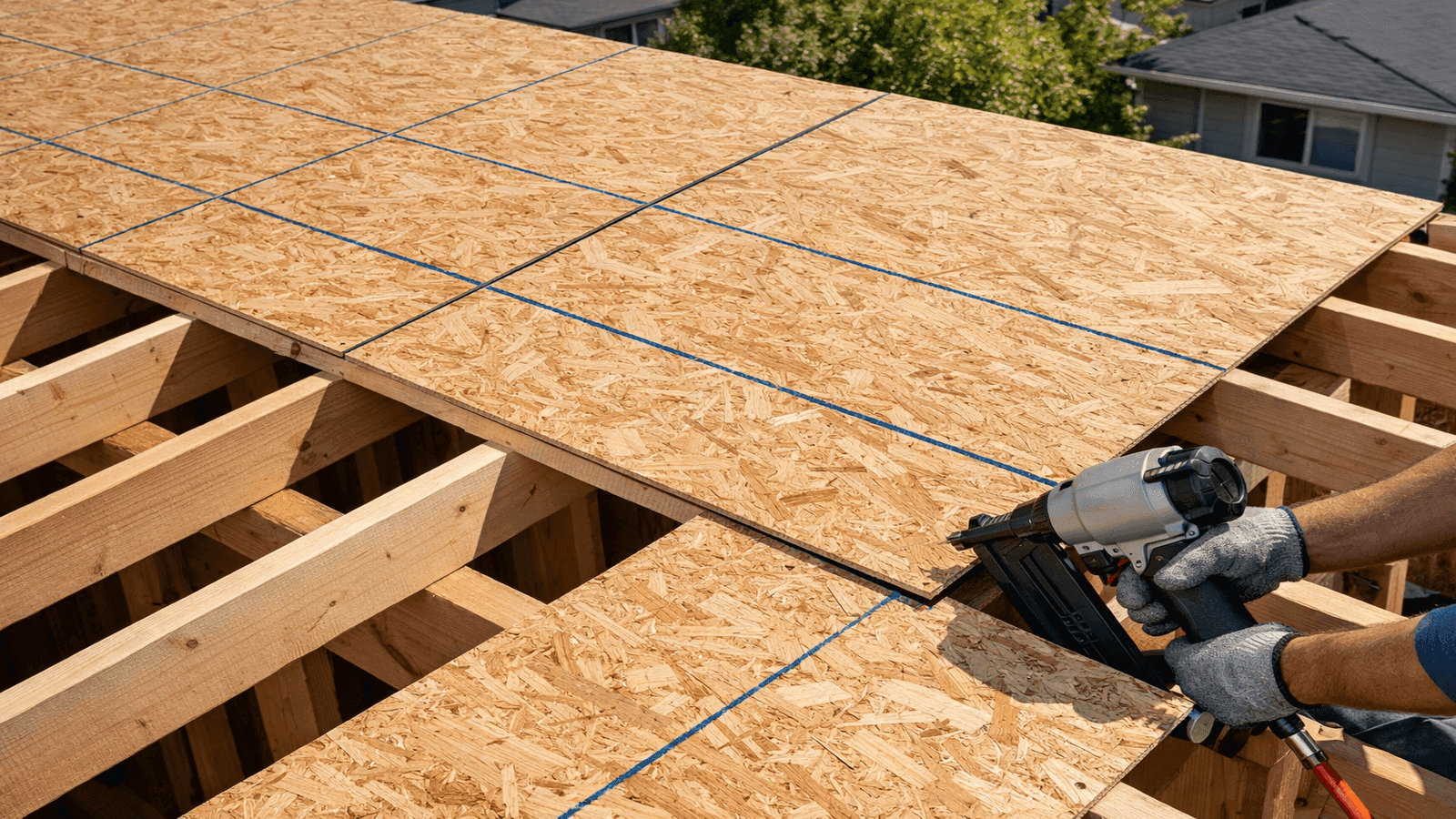
Decking condition is an unknown cost until tear-off is complete. Rotted or damaged OSB or plywood decking must be replaced before new shingles go down. Decking replacement costs $2-$4 per square foot for materials and labor. On older homes, especially in humid climates like the Gulf Coast and Southeast, discovering 200-400 sq ft of damaged decking is common and adds $400-$1,600 to an otherwise straightforward project.
Flashing upgrades for valleys, chimneys, skylights, and drip edge installation range from $300-$800 for a typical home, but chimneys with deteriorated counter-flashing can run $500-$1,200 to restore properly with new copper or galvanized steel.
Labor market variation is the variable most homeowners underestimate. Workers' compensation insurance rates for roofers vary significantly by state -- Texas and Florida have different comp structures than New York and Illinois -- and those costs flow directly into labor rates. Permit requirements, local demand, and union vs. non-union markets also affect what contractors charge. The practical result is that two identical roofs in Houston and Boston can differ by $4,000-$8,000 in labor cost alone.
Get quotes from top-rated pros.
When a homeowner brings me three bids and asks which one to take, the first thing I tell them is: make sure all three bids specify the same shingle brand and product line, the same underlayment type, and whether tear-off is included. I've seen bids that look $3,000 apart where one included full tear-off with a premium synthetic underlayment and one was an overlay with felt paper. Those aren't comparable -- they're two completely different jobs. Get the details in writing before you compare prices.
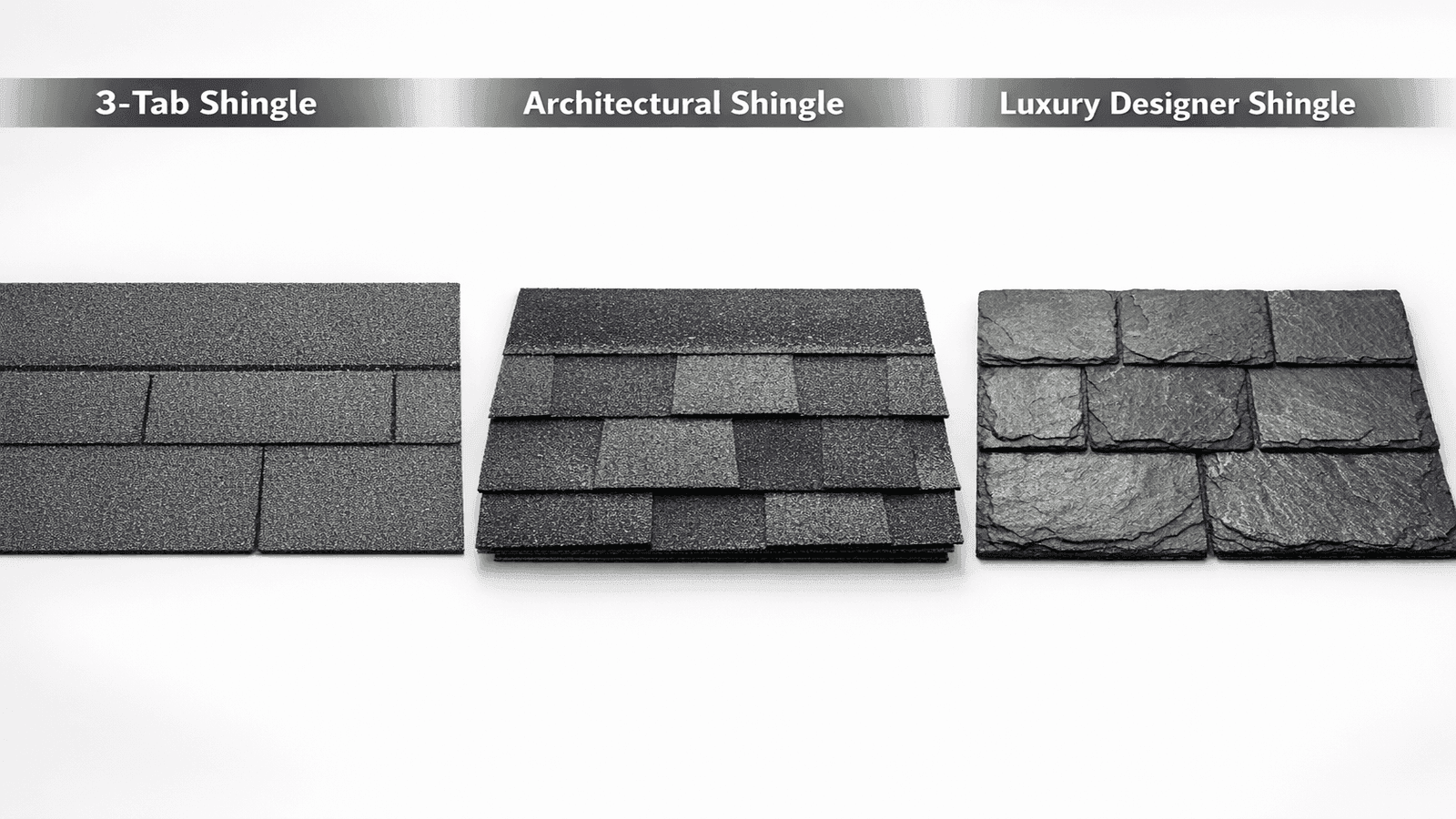
Photo: Side-by-side comparison of three asphalt shingle types: flat 3-tab, dimensional architectural, and thick luxury designer shingles
Shingle Brand Comparison and Pricing
The three manufacturers that dominate the U.S. asphalt shingle market -- GAF, Owens Corning, and CertainTeed -- all produce quality architectural shingles with Lifetime Limited warranties. The differences come down to warranty programs, installer certification requirements, impact-resistance options, and regional availability. For context on how asphalt compares to metal, tile, and flat roofing systems, see our guide to types of roofing materials.
GAF Timberline HDZ is the best-selling asphalt shingle by volume in the United States. Material cost runs $130-$190 per square. The HDZ (High Definition with Dimensional features) adds LayerLock technology that mechanically bonds shingle courses together, improving wind resistance. GAF's premium warranty tier (Golden Pledge) requires installation by a GAF Master Elite contractor, which represents fewer than 3% of roofing contractors nationwide. The warranty covers both materials and workmanship for 25-50 years depending on tier [3].
Owens Corning Duration Series is the most widely installed architectural shingle in the South and Midwest. Material cost is $120-$180 per square. The SureNail Technology strip provides a nailing guide and enhanced wind resistance rated to 130 mph. The Platinum Protection warranty (requiring Owens Corning Preferred Contractor certification) covers full replacement cost for the rated period. Duration Storm adds Class 4 impact resistance at $160-$210 per square [3].
CertainTeed Landmark is the dominant brand in the Northeast, particularly in Massachusetts, Connecticut, and New York. Material cost ranges from $130-$185 per square. CertainTeed's SureStart PLUS warranty runs 10 years for full replacement and requires installation by a SureStart-certified contractor. Landmark MAX adds Class 4 impact resistance for hail-prone markets.
Malarkey Vista AR carries both Class 4 impact resistance and algae-resistant (AR) technology in a single product. Material cost is $170-$230 per square, making it one of the more expensive architectural products on the market. It is widely specified in Colorado and Texas hail corridors where Class 4 may be required by county code or insurance carrier. The polymer-modified asphalt is more flexible in freeze-thaw cycling than standard fiberglass-mat products.
Atlas Pinnacle Pristine uses Scotchgard Protector technology for algae resistance and is a strong choice in the Southeast where algae streaking (black staining caused by Gloeocapsa magma) is a persistent issue. Material cost is $150-$210 per square.
A Lifetime warranty means nothing if the contractor isn't factory-certified. Most manufacturers have two tiers: a basic warranty available to any licensed contractor, and a premium warranty -- Golden Pledge, Platinum, SureStart PLUS -- that requires the installer to be certified. The premium warranty is what transfers the workmanship guarantee to you as the homeowner. Ask every contractor you get a bid from: 'Are you certified with the manufacturer you're proposing?' If they say no, you're getting the basic warranty only.
| Brand | Model | $/Square Material | Wind Rating | Impact Class | Warranty (Premium) |
| GAF | Timberline HDZ | $130-$190 | 130 mph | Standard | Golden Pledge 50-yr |
| Owens Corning | Duration | $120-$180 | 130 mph | Standard | Platinum Limited |
| Owens Corning | Duration Storm | $160-$210 | 130 mph | Class 4 | Platinum Limited |
| CertainTeed | Landmark | $130-$185 | 110 mph | Standard | SureStart PLUS |
| Malarkey | Vista AR | $170-$230 | 130 mph | Class 4 | Sure Start 50-yr |
| Atlas | Pinnacle Pristine | $150-$210 | 130 mph | Standard | True Lifetime |
Labor Cost by Region
Labor is the largest and most variable component of a roofing project. National average labor cost for asphalt shingle installation runs $250-$350 per square, but that figure masks wide regional variation driven by workers' compensation insurance rates, permit complexity, union presence, and local contractor demand [1].
Northeast (NY, MA, CT, NJ, PA): $350-$550 per square. The Northeast carries the highest roofing labor rates in the country. New York City metro and Boston contractors often charge $450-$600 per square due to high workers' comp rates, union labor standards in some markets, and dense permit requirements. Expect full-project costs at the upper end of national ranges.
Southeast (TX, FL, GA, NC, SC, TN): $200-$320 per square. The South and Southeast offer the most competitive roofing labor costs. Texas in particular has a large contractor base, lower workers' comp rates (due to the opt-out system for employers), and fewer mandatory permit inspections in rural counties. This is the most price-competitive roofing market in the country [2].
Midwest (IL, OH, MI, IN, MO, WI): $220-$340 per square. Mid-range labor costs with meaningful city-to-rural variation. Chicago labor runs closer to Northeast rates due to union presence. Rural Ohio and Indiana are among the most affordable markets for roofing labor in the upper Midwest.
West Coast (CA, WA, OR): $320-$500 per square. California's high workers' comp rates, strict licensing requirements (CSLB certification), and overall high cost of doing business push roofing labor toward the top of the national range. Seattle and Portland are less extreme than California but still run 20-30% above the national average.
Mountain West (CO, UT, ID, WY): $280-$420 per square. Colorado is the most complex market in this region. Front Range contractors often price in a complexity premium for hail-damage repair work, which creates compressed scheduling during post-storm periods and drives labor costs up across the board. Impact-resistant shingle installations also take longer due to heavier material weight.
These regional differences mean that the same 28-square architectural shingle roof costs roughly $7,000-$9,800 in labor in Atlanta but $9,800-$15,400 in labor in Boston -- a difference that dwarfs any material savings from shopping shingle brands.
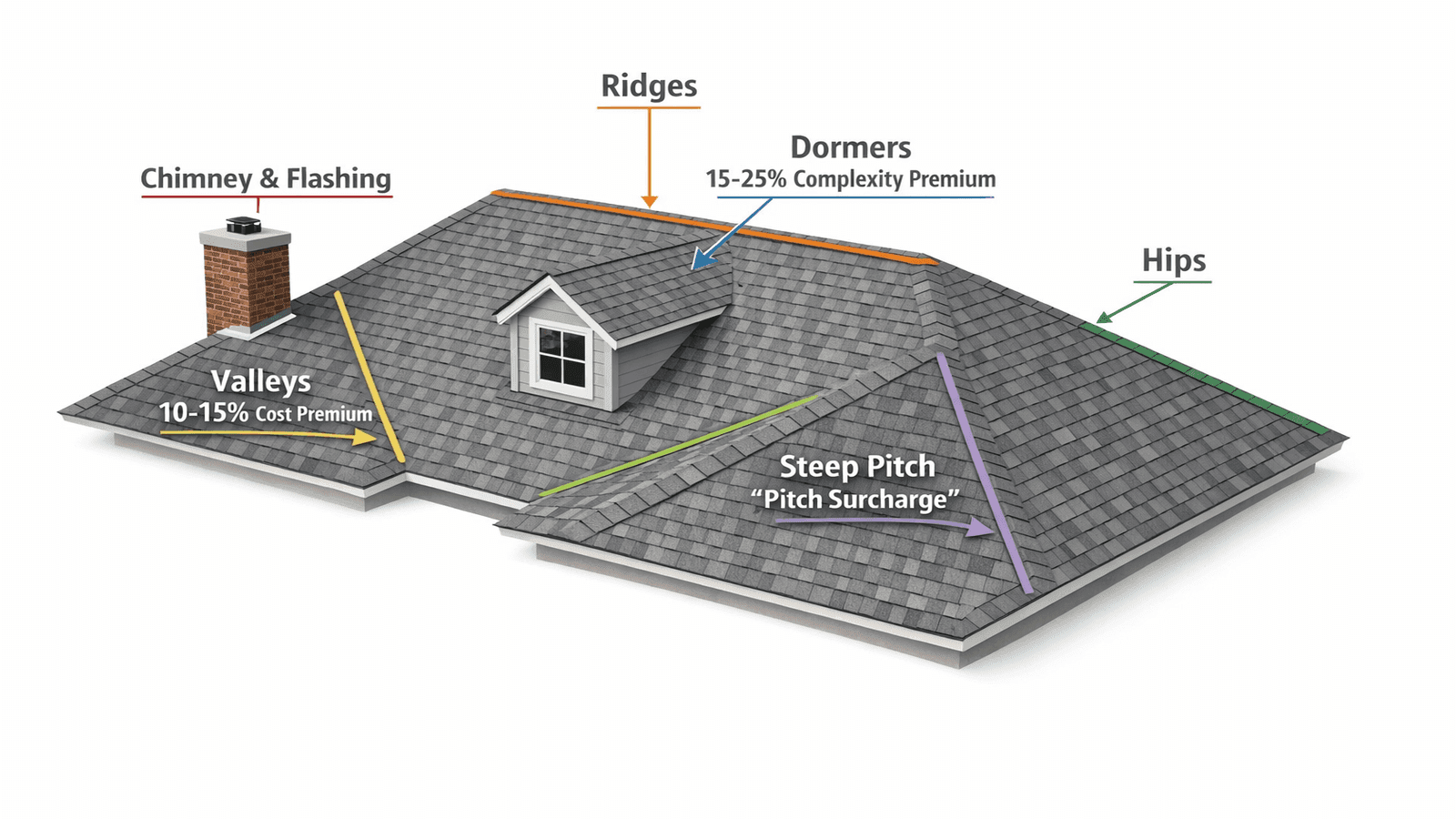
Photo: Annotated roof diagram showing complexity factors including valleys, dormers, hip ridges, and flashing points that increase installation cost
Roof Replacement vs. Repair Cost Decision
Not every roofing problem requires a full replacement. Understanding when repair is the right financial decision versus when replacement is the smarter investment saves most homeowners money -- but the analysis requires accurate information about the roof's actual condition.
Repair makes economic sense when damage is isolated: a single blow-off section from a wind event, localized flashing failure around a chimney or skylight, or a small area of missing shingles on a roof that is otherwise in good condition. Repair cost for 10-20 damaged shingles runs $300-$900 for materials and labor. Flashing repair at a chimney or skylight runs $200-$600 depending on the complexity. These repairs are worthwhile when the surrounding shingles have 10 or more years of useful life remaining and granule loss is minimal [1].
Replacement becomes the better option when the roof is over 20 years old, granule loss is widespread (visible in gutters and downspouts after rain), there are multiple active leaks, or when insurance is covering hail or wind damage and the adjuster has scoped more than 30% of the total roof surface. At that threshold, most roofing contractors and insurance adjusters agree that a full replacement is more cost-effective than patching multiple sections.
The overlay option (installing new shingles over existing shingles without a tear-off) saves $1,000-$2,500 on a typical project by eliminating disposal costs. It is allowed by building code when the existing roof has only one layer. However, overlay installations void manufacturer warranties on most product lines, add 300-500 pounds of weight to the roof structure, trap heat that shortens shingle lifespan, and prevent inspection of the underlying decking [4]. In James Carver's 20 years of experience, overlays consistently underperform tear-off installations and typically require a full replacement 5-8 years earlier than a comparable tear-off job.
Get quotes from top-rated pros.
When I'm called to assess whether a roof needs repair or replacement, I check three things from the attic first: daylight gaps in the decking (which means the sheathing has separated or rotted), staining patterns that indicate active water infiltration at specific locations, and the physical condition of the decking -- whether it's soft underfoot when I step on it. If two of those three are present, I'm recommending replacement, not repair. Patching the exterior while the decking is compromised underneath is the most expensive mistake a homeowner can make.
Insurance and Financing for Shingle Roofs
Roof replacement is one of the most common homeowners insurance claims in the United States, particularly in hail-prone states across the Great Plains and Southeast. Understanding how insurance and financing interact with roofing costs can significantly reduce what comes out of pocket.
Homeowners insurance coverage for roof replacement depends entirely on the cause of damage and your policy type. Wind and hail damage are covered perils under virtually all standard homeowners policies. The critical distinction is between replacement cost value (RCV) and actual cash value (ACV) policies. RCV policies pay the full current cost of replacement once you complete the work and provide proof. ACV policies pay replacement cost minus depreciation -- on a 20-year-old roof, that depreciation could be 60-70%, leaving you responsible for most of the replacement cost. Review your declarations page before a storm event to know which coverage you carry [2].
The claims process works as follows: document damage with photos immediately after a weather event, contact your carrier to open a claim, schedule an adjuster visit, and arrange for a licensed roofing contractor to be present during the adjuster inspection or immediately afterward to review the scope. If the adjuster's scope misses line items -- common on complex roofs -- your contractor can file a supplemental claim with supporting documentation.
Class 4 impact-resistant shingles and insurance discounts: In states including Texas, Colorado, Oklahoma, Kansas, and Nebraska, many insurers offer premium discounts of 15-30% annually for homes with Class 4 certified roofing [2][6]. At average annual premiums of $2,000-$3,500 in hail-prone markets, that discount represents $300-$1,050 per year. The additional cost to upgrade from standard architectural shingles to Class 4 on a 28-square roof is typically $1,500-$3,000, meaning the upgrade pays for itself within 3-5 years of premium savings -- before accounting for reduced deductible exposure in future hail events.
The most important insurance conversation to have is the one before the storm, not after. I tell every homeowner I work with: pull out your declarations page right now and look for three words -- replacement cost value. If it says actual cash value instead, call your agent this week and ask about upgrading the policy. I have seen homeowners with 18-year-old roofs get an ACV check for $4,200 on a $14,000 replacement. That gap comes out of their savings. The policy upgrade typically costs $80-$150 per year. It is the cheapest roofing insurance you can buy.
Financing options include 12-month 0% deferred-interest financing offered directly by many roofing contractors (typically through GreenSky, EnerBank, or similar platforms), home equity lines of credit (HELOC) at current variable rates, and FHA Title I loans for home improvements, which do not require home equity and are available from participating lenders at fixed rates [5].
Energy efficiency tax credits: ENERGY STAR-rated roofing products, including certain reflective asphalt shingles, may qualify for the federal 25C Energy Efficiency Home Improvement Credit, which provides a 30% tax credit up to $3,200 annually for qualifying improvements. Verify current IRS guidance and confirm product eligibility with the manufacturer before relying on this credit in your budget. For a full breakdown of roofing financing options, see our guide to roof financing options.
Real-World Case Study: David L., Columbus, Ohio
David L. owns a 2,400 sq ft colonial in Columbus, Ohio with a 25-year-old 3-tab shingle roof. Two active leaks had developed -- one at a valley intersection above the master bedroom and one at the chimney step flashing -- and granule loss was visible throughout the gutters. He contacted three licensed roofing contractors for bids.
The three bids came back at $10,400, $12,800, and $15,200. David's instinct was to take the lowest bid.
James reviewed each bid's line items with David. The $10,400 bid proposed an overlay installation (no tear-off) using a standard synthetic underlayment with no ice and water shield. The shingle specified was an architectural product from a regional manufacturer with a 40-year limited warranty but no premium warranty tier available. No decking inspection was included.
The $12,800 bid specified full tear-off and disposal, GAF WeatherWatch ice and water shield in all valleys and eaves, standard synthetic underlayment across the field, Owens Corning Duration Pro architectural shingles (130 mph wind rating), new drip edge on all eaves and rakes, and a 10-year workmanship warranty from an Owens Corning Preferred Contractor. The bid included up to 3 sheets of decking replacement in the price.
The $15,200 bid included all the same scope elements as the middle bid but added skylight replacement (the existing skylight was functional), ridge vent installation, and attic insulation assessment -- work David had not requested and the home did not require.
David chose the $12,800 bid. The tear-off revealed two additional sheets of water-damaged OSB decking above the valley leak; the contractor replaced both at no additional cost per the included allowance. The completed project used Owens Corning Duration Pro, a GAF WeatherWatch valley underlayment, and full new drip edge. Twelve-month 0% financing through the contractor's lending partner kept the out-of-pocket commitment manageable. The Owens Corning Preferred Contractor certification transferred the Platinum Limited warranty to David at closing.
Conclusion
Asphalt shingles remain the most cost-effective roofing system for the vast majority of U.S. residential applications -- but the cost range within that category is enormous. A full replacement using 3-tab shingles on a simple gable roof in a Southeast market might cost $8,000. The same home with luxury shingles on a complex hip roof in the Northeast could approach $35,000. Most homeowners fall between these extremes, with a well-specified architectural shingle project on a 2,000-2,500 sq ft home running $10,000-$17,000 in 2026.
The variables that matter most -- shingle type, tear-off vs. overlay, labor market, and whether your roof qualifies for a Class 4 upgrade with an insurance discount -- are all knowable before you get your first bid. Going into the process with that information is the difference between choosing the right bid and choosing the cheapest one.
Disclaimer: Cost figures in this article reflect national and regional averages compiled from contractor reports, published pricing databases, and manufacturer data as of early 2026. Actual costs for any individual project will vary based on roof size, complexity, geographic location, current material costs, and local labor market conditions. This article is for informational purposes only and does not constitute a binding estimate or professional roofing advice. Always obtain multiple bids from licensed, insured roofing contractors before authorizing any roofing work.*
Sources & References
[1] This Old House — "How Much Does a Shingle Roof Cost?" (2026): https://www.thisoldhouse.com/roofing/shingle-roof-cost
[2] Fixr.com — "How Much Does an Asphalt Shingle Roof Cost?" (2026): https://www.fixr.com/costs/asphalt-roof-shingles-installation
[3] Fixr.com — "Owens Corning Shingle Prices: Cheapest to Most Expensive Options" (2026): https://www.fixr.com/articles/owens-corning-shingle-prices
[4] Bob Vila — "How Much Does a New Roof Cost?" (2026): https://www.bobvila.com/articles/how-much-does-a-new-roof-cost/
[5] NerdWallet — "Cost to Replace Roof Shingles in 2026": https://www.nerdwallet.com/home-ownership/home-improvement/learn/cost-to-replace-roof-shingles
[6] Texas Department of Insurance — "Products Qualifying for Impact-Resistant Roofing Credits" (2026): https://www.tdi.texas.gov/company/roofing-discounts.html

James is a licensed roofing contractor with 20 years of experience in roof installation, inspection, and repair across the U.S. South and Midwest. He specialises in asphalt shingles, metal roofing, and storm damage restoration. On NearbyHunt, James offers practical advice on roof maintenance, insurance claims, and selecting the right materials for long-lasting protection.

Jacob is a licensed roofing contractor with over 18 years of experience in roof inspection, installation, and restoration. Based in Texas, he has led hundreds of successful roofing projects across residential and commercial properties. Jacob is also a certified storm damage specialist, ensuring that all NearbyHunt roofing content meets industry best practices and safety standards.