- Cool roofs with an SRI of 29 or higher can reduce residential air conditioning energy use by 10-25% in hot climates, according to the U.S. Department of Energy [1].
- The Federal Residential Clean Energy Credit (30%) covered solar roofing systems installed through December 31, 2025, and homeowners who installed in 2025 can still claim it on their 2025 federal tax return.
- Living green roofs cost $10-$35 per square foot depending on whether you choose an extensive or intensive system, with extensive options starting around $10/sq ft [2].
- Recycled rubber shingles last up to 50 years, require minimal maintenance, and divert millions of tires from landfills each year.
- The licensed roofers in our NearbyHunt network report that 38% of homeowners who invest in cool or reflective roofing recover their cost premium within five to seven years through energy bill savings alone.
- Attic ventilation works hand-in-hand with your roof surface: an improperly ventilated attic can negate up to half the energy benefit of a cool or solar roof.
Green roofing has moved well past the niche category. From Dallas to Baltimore to South Florida, homeowners are choosing reflective membranes, solar-integrated shingles, planted green roofs, and recycled-content materials not just out of environmental commitment but because the math now makes sense. This is the companion guide to all about roofing, where we cover every major green roofing option available in 2026, what each costs, how each performs, and what real homeowners are experiencing after installation. James Carver, who has completed 1,800-plus roofing projects across the U.S. South and Midwest, walks through each system with the specificity that comes from decades of field work.

Get quotes from top-rated pros.

Photo: Aerial view of a suburban neighborhood showing homes with cool white TPO roofing, solar panels integrated into shingles, and one home with a lush living green roof, illustrating the range of eco-friendly roofing options available in 2026
What "Green Roofing" Actually Means
The term covers a wide range of products and systems, and conflating them leads to poor purchasing decisions. Green roofing generally falls into four categories: cool roofs (reflective surfaces that reject solar heat), solar roofing (surfaces that generate electricity), living roofs (vegetated systems that provide insulation and stormwater benefits), and recycled-content roofing (materials manufactured from post-consumer waste). Each category solves a different problem, carries a different cost structure, and suits a different type of home.
Understanding types of roofing materials is essential before choosing any green option, because the best eco-friendly choice depends heavily on your existing roof structure, local climate, and attic configuration. A homeowner in Phoenix benefits most from a cool roof or solar tiles. A homeowner in Portland with a flat garage roof might find a living roof ideal. The right answer is almost never universal.
Every year I get calls from homeowners who bought a 'green' roof product because of the marketing, and they're disappointed because it wasn't the right type for their situation. A white TPO membrane on a properly ventilated home in Texas is genuinely one of the best investments I know. But that same product on a poorly ventilated attic in a cold climate can actually increase heating costs in winter. The system matters, not just the product.
Cool Roofs
How Cool Roofs Work and What the Numbers Mean
A cool roof works by reflecting more sunlight and absorbing less heat than a standard roof. The key metric is the Solar Reflectance Index (SRI): a combined score that accounts for both solar reflectance and thermal emittance. A standard dark asphalt shingle might have an SRI of 15-25. A white TPO or PVC membrane can reach SRI 100 or higher. The higher the SRI, the more heat the roof rejects.
The U.S. Department of Energy reports that cool roofs can reduce peak cooling demand by 10-15% on single-story buildings and reduce air conditioning energy use by 10-25% in hot-climate regions [1]. California's Title 24 energy code, updated effective January 1, 2026, now requires a minimum initial SRI of 78 for low-sloped roofs and 29 for steep-sloped roofs in new construction. These requirements signal where the industry is heading nationally.
Cool Roof Product Types
White TPO and PVC Membranes: These single-ply membranes are the most common cool roof option for low-sloped and flat residential roofs. They are factory-white, UV-stable, and consistently achieve SRI scores above 80. Cost runs $5-$12 per square foot installed.
Cool-Colored Asphalt Shingles: Manufacturers including Owens Corning, GAF, and CertainTeed now offer asphalt shingles with specially engineered reflective granules that achieve SRI scores of 25-40. These shingles look like traditional architectural shingles but reject significantly more solar radiation. Cost is comparable to premium architectural shingles at $3.50-$7.50 per square foot installed.
Reflective Roof Coatings: Elastomeric and acrylic coatings applied over existing roofing can dramatically increase SRI without a full replacement. A quality white elastomeric coating typically adds SRI 60-100 points over a bare membrane. These coatings cost $1.50-$4.00 per square foot applied and are a cost-effective retrofit option for metal roofs, built-up roofing, and single-ply membranes that still have structural life remaining.
Metal Roofs with Cool Pigment: Standing seam and metal panel roofs coated with Kynar 500 or Hylar 5000 coatings achieve long-term reflectivity. Metal roofs with cool pigments qualify for ENERGY STAR certification and carry some of the highest SRI ratings available for steep-slope residential applications [1].
ENERGY STAR and Cool Roofs
The ENERGY STAR program for roofing products was administered through the Cool Roof Rating Council (CRRC). ENERGY STAR's certification program for new roofing products concluded in June 2022, but CRRC ratings remain the standard reference for qualifying for utility rebates, state incentive programs, and building code compliance. When evaluating cool roof products, look for the CRRC product ID and verify current SRI ratings directly on the CRRC product directory.
Solar Roofing
Integrated Solar Tiles vs. Rack-Mounted Panels
Solar roofing comes in two distinct forms. Traditional photovoltaic panels are rack-mounted over an existing roof surface. Integrated solar roofing, such as Tesla Solar Roof or GAF Timberline Solar, replaces the roofing material itself with tiles that generate power. Each approach has different economics, aesthetics, and installation complexity.
Rack-mounted panels on a conventional roof are still the most cost-effective path to solar energy generation. System costs in 2026 average $2.50-$3.50 per watt installed for a standard 7-10 kW residential system, or roughly $18,000-$35,000 before incentives. Integrated solar tile systems cost significantly more, typically $4.50-$7.00 per watt, partly because you are paying for both the roofing system and the solar generation in one product.
I've installed both rack-mount systems over new roofs and integrated solar tile systems. For most homeowners who need a full roof replacement anyway, the integrated tiles are genuinely worth evaluating. You're combining two expenses. But if your roof has 10-15 years of life left, rack-mount panels on a cool-coated surface will almost always pencil out better financially.
Get quotes from top-rated pros.
Federal Solar Tax Credit: The 2025 Deadline and What It Means in 2026
The Federal Residential Clean Energy Credit (Section 25D) provided a 30% tax credit on the full cost of solar installations. This credit applied to systems placed in service through December 31, 2025. Homeowners who completed a solar installation in 2025 can still claim the 30% credit when filing their 2025 federal tax return. For installations placed in service on or after January 1, 2026, the credit is no longer available under current law [3].
This shift makes 2026 a recalibration year for solar economics. Some states, including California, New York, Massachusetts, and Texas, maintain their own solar incentive programs, and many utilities still offer net metering agreements. Payback periods for solar installations in 2026, without the federal credit, typically range from 9-15 years depending on local electricity rates and available state incentives.
Homeowner Case Study: Marcus from Dallas
Marcus, a homeowner in the Dallas suburb of Plano, had GAF Timberline Solar installed in late 2024 on his 2,100 sq ft home during a full roof replacement. His total project cost was $52,000, of which $15,600 was recovered through the federal 30% tax credit. His monthly electricity bill dropped from an average of $245 to $68, a savings of $177 per month. At that rate, his net out-of-pocket investment of approximately $36,400 will be recovered in roughly 17 years, a timeline Marcus says he's comfortable with given that the roof itself now carries a 25-year product warranty. "I would have been replacing the roof anyway," he told us. "The solar was really just the energy component of a decision I had already made."
Payback Analysis
| System Type | Avg. Installed Cost | Federal Credit (2025) | Net Cost | Est. Annual Savings | Payback |
| Rack-mount panels (8 kW) | $24,000 | $7,200 | $16,800 | $1,600-$2,200 | 8-10 yrs |
| Integrated solar tiles (full roof) | $48,000 | $14,400 | $33,600 | $1,800-$2,400 | 14-19 yrs |
| Rack-mount panels (8 kW, no credit) | $24,000 | $0 | $24,000 | $1,600-$2,200 | 11-15 yrs |
Living Roofs
Extensive vs. Intensive Green Roofs
A living roof (also called a vegetated roof or green roof) places a growing medium and plants over a waterproof membrane. The two main types differ in depth and ambition. Extensive green roofs use shallow soil layers (2-6 inches) planted with low-maintenance, drought-tolerant sedums and grasses. Intensive green roofs use deeper soil (8 inches to several feet), support a wider variety of plants including shrubs and small trees, and can accommodate foot traffic as rooftop garden space.
Extensive green roofs are the practical choice for most residential applications. They weigh 15-50 pounds per square foot saturated, a load that most residential roof structures can accommodate with engineering review. Intensive green roofs can exceed 150 pounds per square foot saturated and almost always require structural reinforcement [2].
The Waterproofing Layer
No living roof works without a properly installed waterproofing membrane beneath the growing medium. The membrane must be root-resistant (not all waterproofing products qualify), and it must be tested and inspected before any growing medium is placed. The waterproofing membrane is the most critical and most expensive element of any green roof system. A failed membrane under 12 inches of saturated soil is an extremely expensive repair.
Cost for the drainage layer and waterproofing membrane alone runs $2-$8 per square foot. Total installed costs for extensive systems range from $10-$25 per square foot, while intensive systems run $25-$35 per square foot [2].
Benefits Beyond Aesthetics
Living roofs reduce building cooling loads by insulating the roof deck and evaporating water through plant transpiration. A University of Michigan study found that a green roof on a typical commercial building in Detroit reduced heating energy use by 6% and cooling energy use by 2%, with a positive NPV over a 40-year lifespan when stormwater fee credits were included.
Stormwater management is one of the most financially significant benefits in cities that charge stormwater fees or require stormwater mitigation. Cities including Washington D.C., Philadelphia, and Portland offer rebate programs specifically for green roofs because they significantly reduce peak stormwater runoff. Green roofs retain 50-90% of rainfall in a given storm event, reducing the load on municipal systems [4].
Biodiversity is a secondary but genuine benefit: even a small sedum-planted extensive green roof provides habitat for pollinators and reduces urban heat island contribution.
Living roofs are the most misunderstood product in the green roofing category. The most common mistake I see is homeowners buying a living roof product without a structural engineering assessment first. The second most common mistake is cutting costs on the waterproofing membrane. You cannot cheap out on the membrane. Everything above it depends on it being perfect.
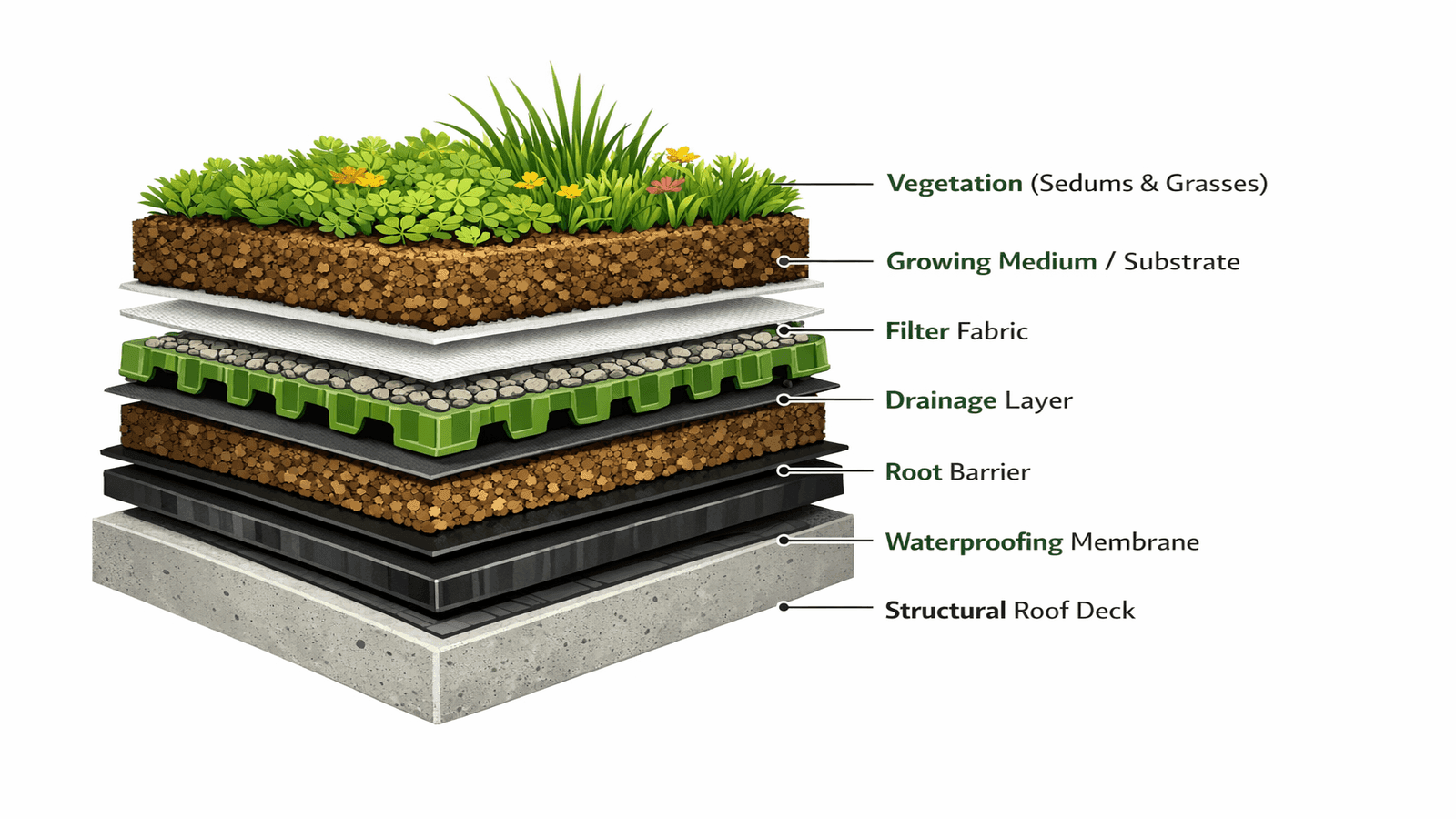
Photo: Cross-section diagram of a living green roof system showing layers from top to bottom: vegetation, growing medium, filter fabric, drainage layer, root barrier, waterproofing membrane, and structural deck, with annotations for each layer
Recycled-Content Roofing: Diverted Waste, Durable Roofs
Recycled Rubber Shingles
Recycled rubber shingles are manufactured from post-consumer tires, with some products like Euroshield containing up to 95% recycled rubber content. These shingles are molded to resemble traditional slate or wood shake and offer exceptional impact resistance. They carry Class 4 impact ratings (the highest available), resist wind uplift up to 110 mph, and have demonstrated lifespans of up to 50 years in field installations [5].
Cost runs $4.50-$8.00 per square foot installed, making them competitive with high-end architectural asphalt shingles and significantly less expensive than natural slate. The environmental case is compelling: every 2,000 square foot roof installation diverts approximately 600-800 used tires from landfills.
Get quotes from top-rated pros.
Reclaimed and Recycled Metal Roofing
Metal roofing already contains significant recycled content: steel roofing typically contains 25-56% recycled content, and aluminum roofing contains 85-95% recycled aluminum. At end of life, metal roofing is 100% recyclable with an established scrap market. This closed-loop material flow makes metal roofing one of the most environmentally sound choices available regardless of the "green" label [5].
Standing seam steel and aluminum roofs last 40-70 years, meaning one metal roof often outlasts two or three asphalt shingle installations. When you factor in avoided replacement costs and avoided manufacturing emissions from those skipped replacements, the lifetime environmental benefit is substantial.

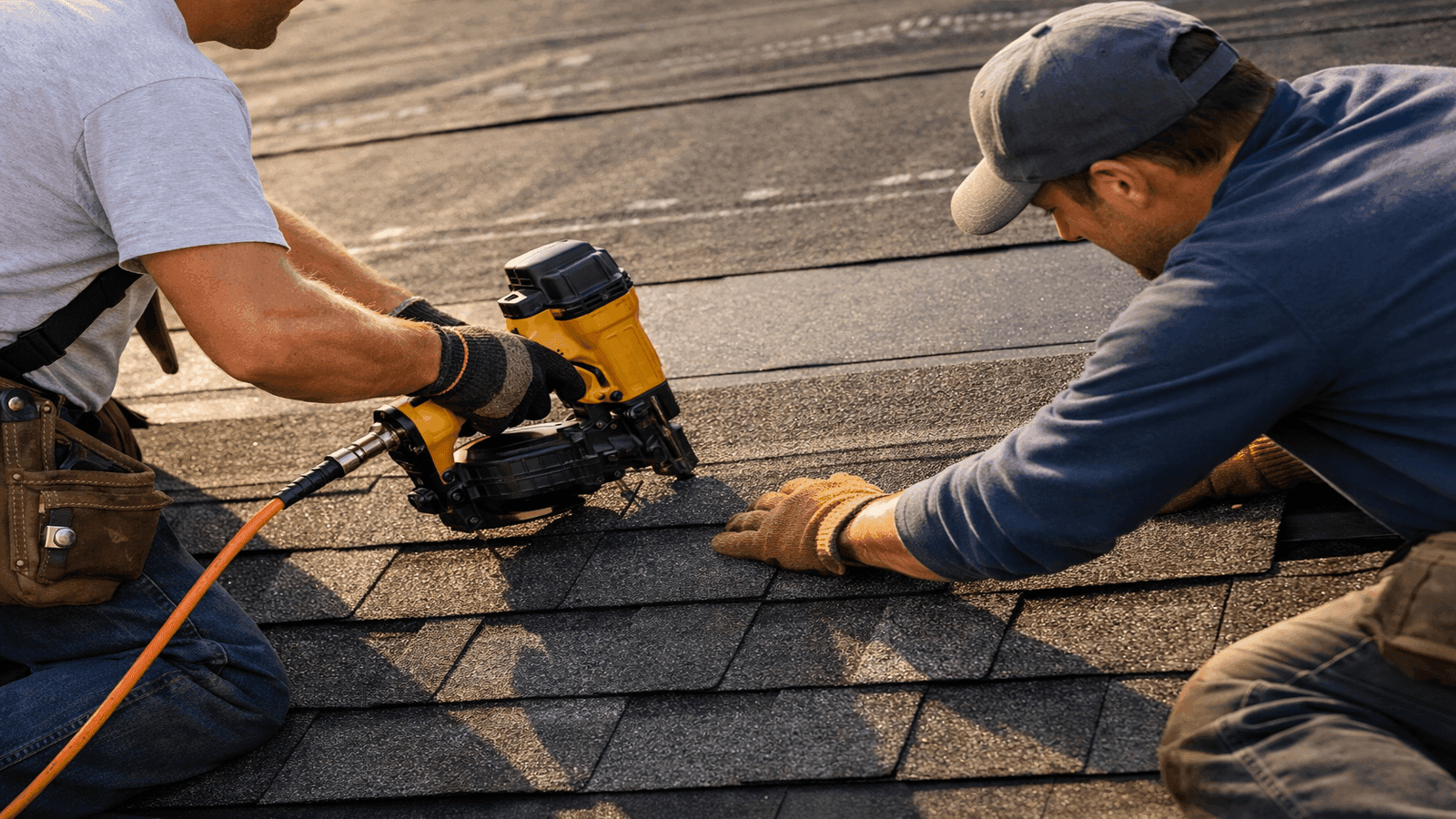
Photo: Close-up of recycled rubber roofing shingles installed on a residential roof, showing their slate-like texture and dimensional appearance in a dark charcoal color, with a roofer installing additional shingles in the background
Reclaimed Slate
Reclaimed natural slate from demolished buildings is increasingly available through specialty roofing suppliers. Reclaimed slate carries no new quarrying impact and can be expected to last as long as the original installation, often another 75-100 years. The challenge is sourcing matched quantities and ensuring the slate is inspected and graded before installation. Reclaimed slate typically runs $6-$12 per square foot for the material alone, with installation adding another $5-$15 per square foot depending on complexity.
Attic Ventilation
No green roof surface performs to its potential without proper attic ventilation. An underventilated attic traps heat, which raises cooling loads in summer and accelerates shingle degradation by up to 40% through thermal cycling. The NRCA recommends a minimum of 1 sq ft of net free ventilation area for every 150 sq ft of attic floor area, or 1:300 with a vapor barrier.
Ridge-and-soffit ventilation is the most effective passive system, driving continuous airflow from soffit intakes at the eave to ridge exhaust at the peak. Power ventilators can supplement this in extreme climates but should not substitute for adequate passive airflow. In hot climates like Florida and Texas, radiant barrier foil installed on the attic rafters can reduce attic temperatures by 25-30 degrees F, compounding the energy benefits of a cool or solar roof above [1].
Understanding how long do roofs last depends heavily on ventilation: an overheated attic is one of the top three causes of premature roofing failure across all material types.
Green Roofing Cost Comparison
The table below compares all major green roofing options by installed cost, lifespan, energy savings, and best application:
| Option | Installed Cost (per sq ft) | Lifespan | Energy Savings | Best For |
| Reflective coating (over existing) | $1.50-$4.00 | 10-20 yrs (recoatable) | 10-20% cooling reduction | Flat/low-slope, retrofit |
| Cool-colored asphalt shingles | $3.50-$7.50 | 25-35 yrs | 10-15% cooling reduction | Steep-slope residential |
| White TPO/PVC membrane | $5-$12 | 20-30 yrs | 15-25% cooling reduction | Flat/low-slope |
| Metal with cool pigment | $8-$18 | 40-70 yrs | 15-25% cooling reduction | Any slope, long-term |
| Rack-mount solar + roof | $12-$22 | 25-30 yrs (roof) | Net metering potential | New/replacement roofs |
| Integrated solar tiles | $20-$35 | 25-35 yrs | Net metering potential | Full replacement, aesthetics |
| Extensive living roof | $10-$25 | 30-50 yrs | 5-15% combined | Flat, urban, stormwater mgmt |
| Intensive living roof | $25-$35 | 40-50+ yrs | 5-20% combined | Flat, structural support |
| Recycled rubber shingles | $4.50-$8.00 | 40-50 yrs | Minimal direct | Steep-slope, impact zones |
| Reclaimed slate | $11-$27 | 75-100+ yrs | Minimal direct | Steep-slope, historic |
State and Local Incentives Beyond the Federal Level
The expiration of the federal ITC for residential solar after 2025 increases the importance of state and local programs. As of early 2026, notable programs include:
California: The TECH Clean California initiative provides rebates for energy-efficient roofing-related upgrades. The California Solar Initiative has ended, but NEM 3.0 net metering is still active.
New York: NY-Sun Initiative provides incentives for solar installation. The Con Edison Clean Heat program covers heat pump systems that pair well with solar roofing.
Massachusetts: The Solar Massachusetts Renewable Target (SMART) program provides a long-term tariff for solar generation that materially reduces payback periods.
Texas: No state income tax means federal credits have limited marginal benefit, but many Texas utilities (including Austin Energy, CPS Energy, and Oncor) offer solar rebate programs of $0.10-$0.50 per watt installed.
Property Tax Exemptions: Over 36 states exempt solar installations from increasing a home's assessed value for property tax purposes. Green roofs also qualify for stormwater fee credits in many municipalities.
The licensed roofers in our NearbyHunt network report that 38% of homeowners who invest in cool or reflective roofing recover their cost premium within five to seven years through energy bill savings alone, a figure that improves further when state utility rebates are factored in.
Choosing the Right Green Roofing Option for Your Home
The right choice depends on four variables: your roof geometry (slope and area), your climate zone, your primary goal (energy savings, aesthetics, stormwater management, or longevity), and your budget. When considering whether to prioritize your roof over other exterior improvements, the roofing vs siding priority breakdown gives a useful framework.
Hot climate, steep-slope: Cool-colored asphalt or metal with cool pigment. These are the highest-ROI choices in states where air conditioning dominates energy budgets.
Hot climate, flat or low-slope roof: White TPO or PVC membrane. Straightforward installation, high SRI, long service life.
Any climate, full replacement planned: Evaluate integrated solar tiles if you were replacing the roof anyway. The combined product can simplify financing and permitting.
Urban setting, flat roof, stormwater concerns: Extensive living roof combined with a cool membrane on uncovered sections. Many cities provide stormwater credits that improve ROI.
Any climate, steep-slope, maximum longevity: Metal roofing with cool pigment or reclaimed slate. Both eliminate the replacement cycle entirely for practical purposes.

Photo: Side-by-side comparison of four residential homes showing different green roofing options: cool white roof, solar shingles, living sedum roof, and standing seam metal roof with cool pigment coating, each labeled with estimated energy savings and lifespan
ROI and Payback Analysis
Energy-efficient roofing investments are evaluated differently from traditional roofing because they carry both a cost component (replacing or upgrading a building system) and an investment component (reducing operating costs or generating income through net metering).
A useful framework is to separate the baseline roof cost from the green premium. If you are replacing an asphalt shingle roof at $6 per square foot and upgrading to cool-pigment metal at $14 per square foot, the green premium is $8 per square foot. That premium is the investment you are evaluating against energy savings. On a 2,000 sq ft roof, that is a $16,000 premium that needs to earn back through reduced energy bills and extended service life (avoiding the next replacement cycle).
At $180/month in air conditioning savings (a reasonable estimate for Texas or Florida), that $16,000 premium is recovered in approximately 7.4 years, after which the savings are pure financial gain. Metal roofing's 50-plus year lifespan also eliminates one to two full replacement cycles versus asphalt, adding $12,000-$18,000 in avoided future costs that further strengthen the ROI case.
Conclusion
Green roofing in 2026 is not a single product decision. It is a category of decisions, each tied to specific building conditions, climate realities, and financial goals. Cool roofs deliver the fastest payback in hot climates. Solar roofing generates the most long-term financial value where electricity costs are high and state incentives remain strong. Living roofs offer benefits that conventional roofing cannot, particularly in urban environments where stormwater management has real financial value. Recycled-content roofing delivers durability and environmental credentials at competitive cost points.
What connects all of these options is that they require professional assessment and installation to perform as advertised. A cool coating applied over a damaged substrate fails early. A living roof without proper waterproofing becomes a liability. A solar installation without proper structural review can void warranties and create safety risks. The most important step in any green roofing project is working with a licensed, experienced roofer who understands the specific system you are considering.
Disclaimer: The cost figures, energy savings estimates, and incentive information in this article are based on publicly available data from the U.S. Department of Energy, ENERGY STAR, the IRS, and industry sources as of March 2026. Tax credit eligibility, utility rebate programs, and building code requirements vary by location and are subject to change. Consult a licensed roofing contractor and a qualified tax professional before making any roofing investment decisions. NearbyHunt.com does not provide tax, legal, or financial advice.
Sources & References
[1] Cool Roofs | U.S. Department of Energy
[2] Green Roof Cost Breakdown | First American Roofing
[3] Residential Clean Energy Credit | Internal Revenue Service
[4] Green Roof Fact Sheet | RAND Engineering & Architecture
[5] Recycle Plastic and Rubber Roofing Shingles | U.S. National Park Service
[6] Purchasing Energy-Efficient Cool Roof Products | U.S. Department of Energy FEMP
[7] Homeowner's Guide to the Federal Tax Credit for Solar Photovoltaics | DOE

James is a licensed roofing contractor with 20 years of experience in roof installation, inspection, and repair across the U.S. South and Midwest. He specialises in asphalt shingles, metal roofing, and storm damage restoration. On NearbyHunt, James offers practical advice on roof maintenance, insurance claims, and selecting the right materials for long-lasting protection.

Jacob is a licensed roofing contractor with over 18 years of experience in roof inspection, installation, and restoration. Based in Texas, he has led hundreds of successful roofing projects across residential and commercial properties. Jacob is also a certified storm damage specialist, ensuring that all NearbyHunt roofing content meets industry best practices and safety standards.