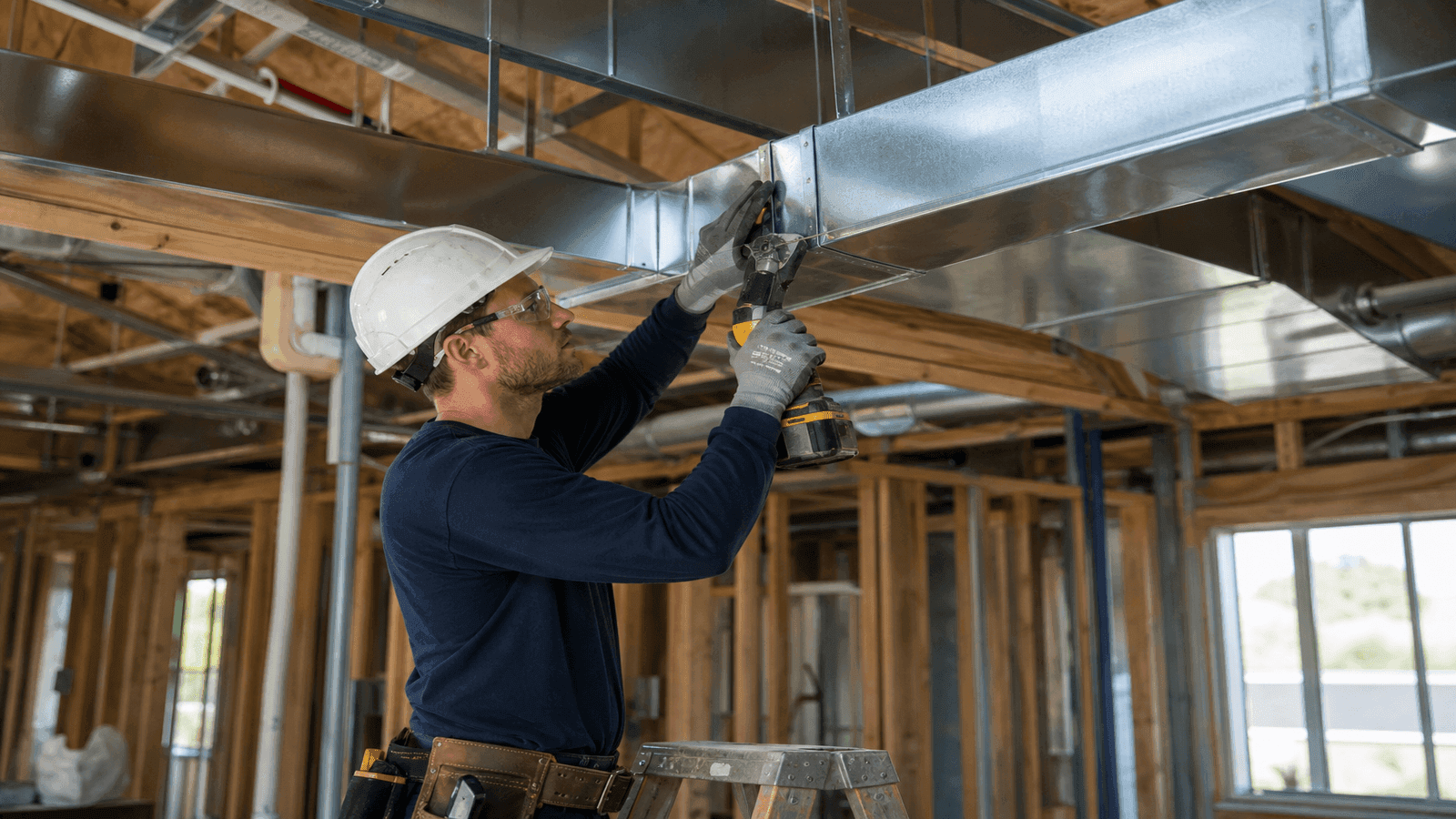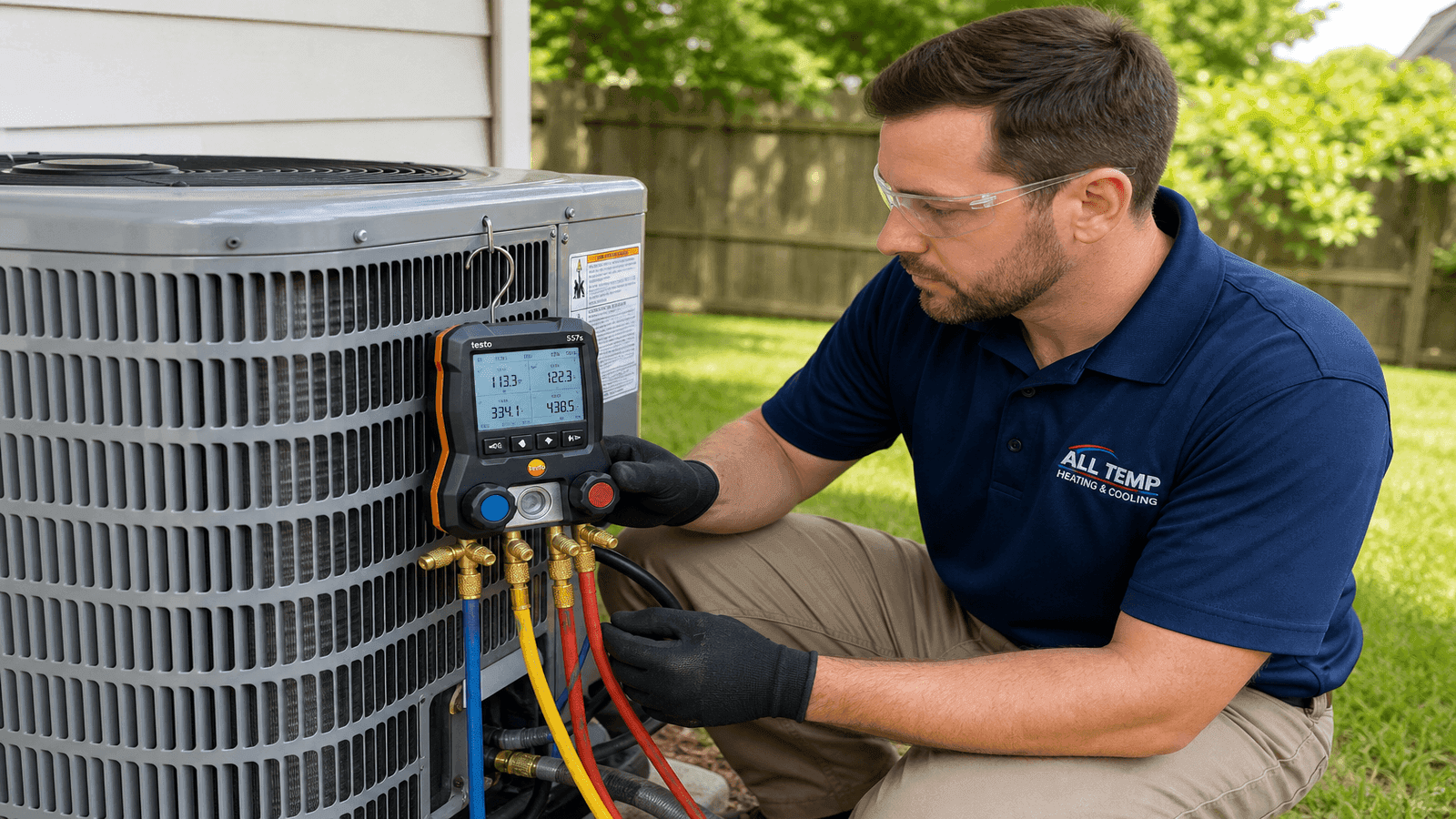
- HVAC accounts for 48% of residential energy consumption, making your system the single biggest factor in your utility bills [1].
- Heat pump sales outpaced gas furnaces by 12% in 2025, driven by cold-climate technology now rated to -15°F and below [3].
- SEER2 minimums increased in 2023: 13.4 SEER2 in Northern states and 14.3 SEER2 in Southern states. Older systems cost significantly more to operate [4].
- Federal 25C tax credits for heat pumps expired December 31, 2025. State rebate programs (up to $8,000) are now the primary incentive source [5].
- The HVAC industry is short an estimated 110,000 technicians, with median pay of $59,810 and 9% projected job growth through 2033 [6].
- Changing your air filter every 1-3 months prevents the #1 cause of HVAC service calls, restricted airflow that damages compressors and spikes energy bills.
Americans spend roughly half their home energy budget on heating and cooling, yet most homeowners can't explain the difference between a heat pump and a furnace, or why their system runs constantly on the hottest days. Your HVAC system is likely the most expensive appliance in your home, with a typical replacement costing $7,000 to $12,000, and it consumes nearly 48% of your total residential energy according to the U.S. Department of Energy [1].
Understanding how it works isn't optional. It's the difference between smart decisions and expensive mistakes. As Daniel Torres, a Certified HVAC Technician and Energy Efficiency Consultant who has spent 14+ years installing and servicing heating and cooling systems across the Midwest, puts it: the homeowners who understand the basics consistently make better choices about their equipment.
The U.S. HVAC market is projected to reach $165 billion in 2026, with over 441,000 technicians employed nationwide [2]. Modern high-efficiency systems can cut heating and cooling costs by 30-50% compared to equipment installed before 2010. And the industry is changing fast: heat pump sales outpaced gas furnace shipments by 12% in 2025, cold-climate models now operate at -15°F, and the R-454B refrigerant transition is reshaping equipment manufacturing [3].
Whether you're maintaining your current system, planning an upgrade, or considering a career in the trades, this guide gives you the foundational knowledge to make informed decisions about all of it.

Get quotes from top-rated pros.
In 14 years working HVAC in Minneapolis, I've seen the industry transform. When I started, heat pumps were considered useless below 30°F, now I install cold-climate models that heat efficiently at -15°F. But the fundamentals haven't changed: proper sizing, correct airflow, and sealed ductwork matter more than the brand name on your equipment. Understanding these basics is what separates a comfortable, efficient home from one that wastes energy and money.
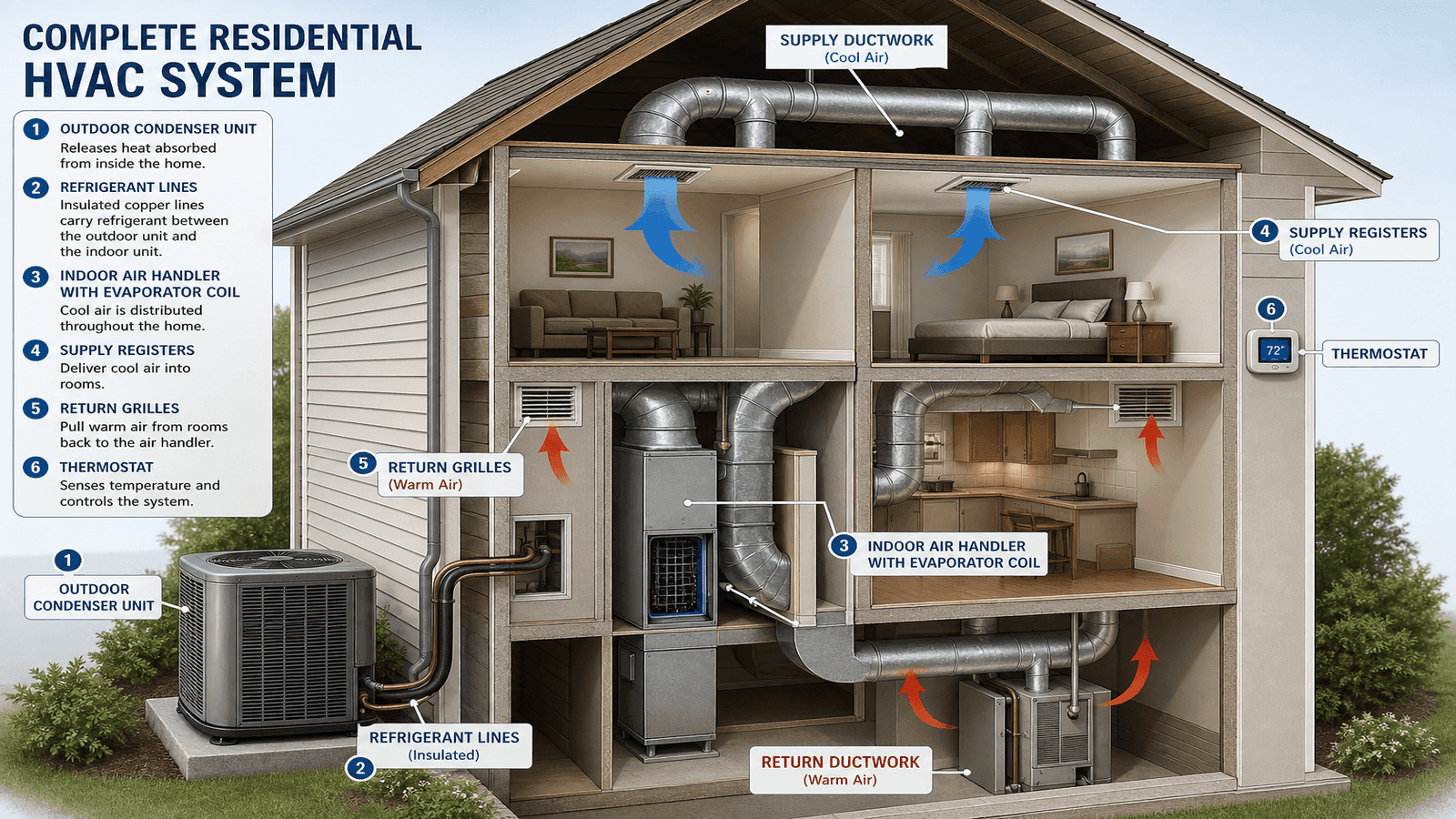
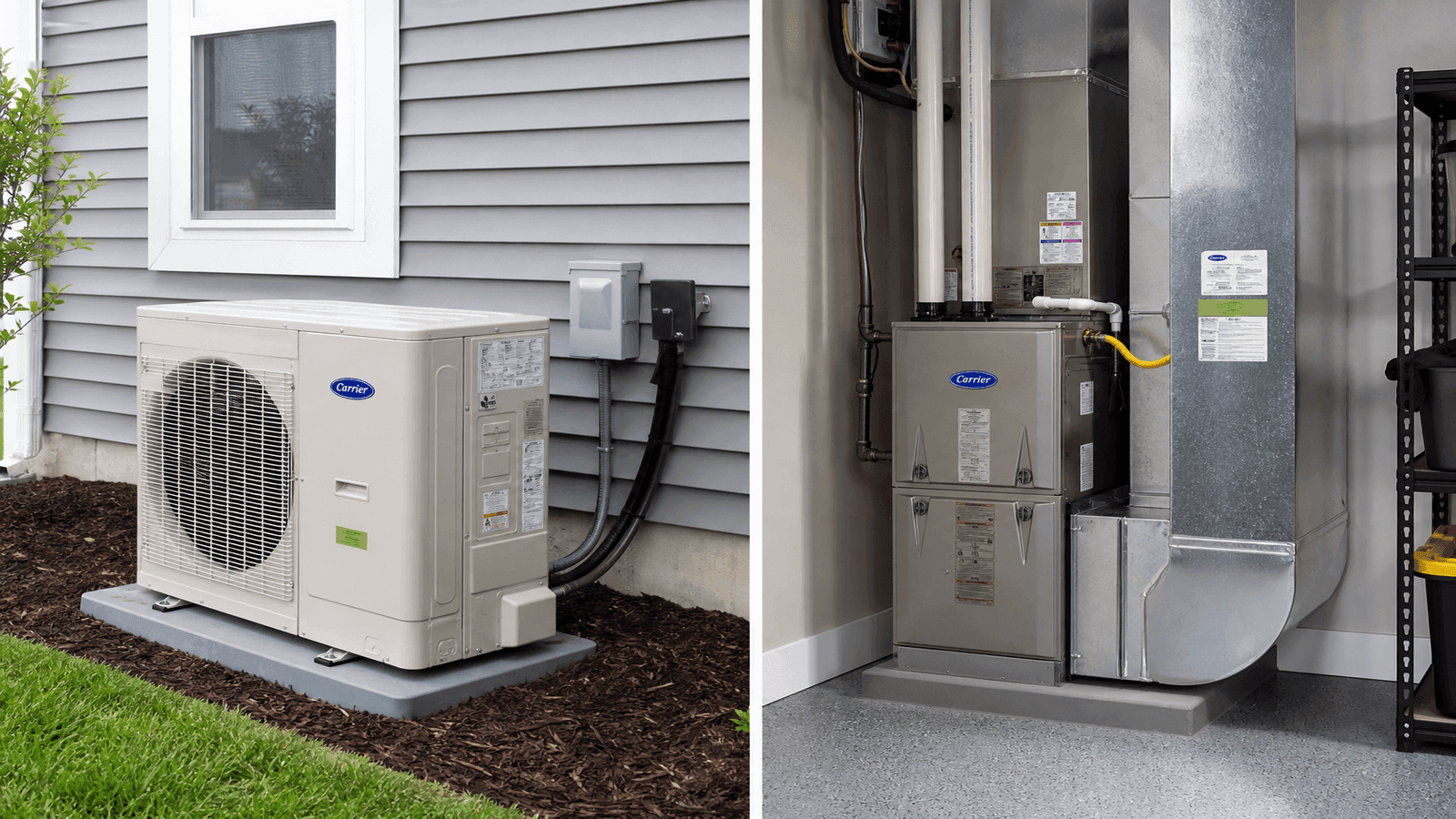
Photo: Overview of modern HVAC systems in residential home showing indoor and outdoor units
Types of HVAC Systems
Choosing the right HVAC system is one of the most impactful decisions a homeowner makes. The wrong system type can mean 30-50% higher energy bills, uneven temperatures, and premature equipment failure. The HVAC professionals in our NearbyHunt network report that approximately 35% of comfort complaints they investigate trace back to a system that was the wrong type or size for the home, not a mechanical failure.
Here are the major system categories and when each makes sense:
Split Systems remain the most common configuration in U.S. homes, found in roughly 60% of existing residential installations. A split system has separate indoor and outdoor units connected by refrigerant lines. The indoor unit contains the air handler or furnace plus an evaporator coil, while the outdoor unit houses the compressor and condenser. These systems distribute conditioned air through existing ductwork and work best for homes with established duct systems.
Heat Pump Systems are the fastest-growing category, accounting for a significant share of new installations. Air-source heat pumps extract heat from outdoor air for heating and reject indoor heat for cooling, one system doing both jobs. Ground-source (geothermal) systems use stable underground temperatures for 300-500% efficiency. Cold-climate models from manufacturers like Mitsubishi, Bosch, and Daikin now maintain full heating capacity to 5°F and continue operating at -15°F to -22°F. The North America cold-climate heat pump market reached $3.25 billion in 2025 and is projected to hit $7.57 billion by 2034 [3].
Ductless Mini-Split Systems use individual wall-mounted indoor units per zone with no ductwork required. This eliminates the 15-25% energy loss typical of ducted systems and provides room-by-room temperature control. Mini-splits are ideal for additions, older homes without existing ductwork, and spaces where different occupants want different temperatures.
Packaged Systems house all components in a single outdoor unit, common in commercial buildings and some Southern homes where space is at a premium. They're installed on rooftops or ground-level concrete pads.
Hybrid/Dual-Fuel Systems combine a heat pump with a gas furnace backup. The heat pump handles heating during mild weather (when it's most efficient), and the gas furnace automatically takes over when outdoor temperatures drop below the economic balance point, typically around 25-35°F depending on local energy costs. This configuration is emerging as the standard recommendation in cold climates with natural gas access.
Key selection factors include your climate zone (DOE zones 1-7), existing infrastructure (ductwork, gas lines, electrical panel capacity), upfront budget versus long-term operating costs, rebate eligibility, home size and insulation quality, and desired comfort features like zoning or humidity control. HVAC professionals in the NearbyHunt network report that dual-fuel heat pump systems now account for roughly 45% of new installations in Northern states, up from under 15% just five years ago.
For a deeper look at each system type with cost comparisons and sizing guidance, read our full guide: Types of HVAC Systems
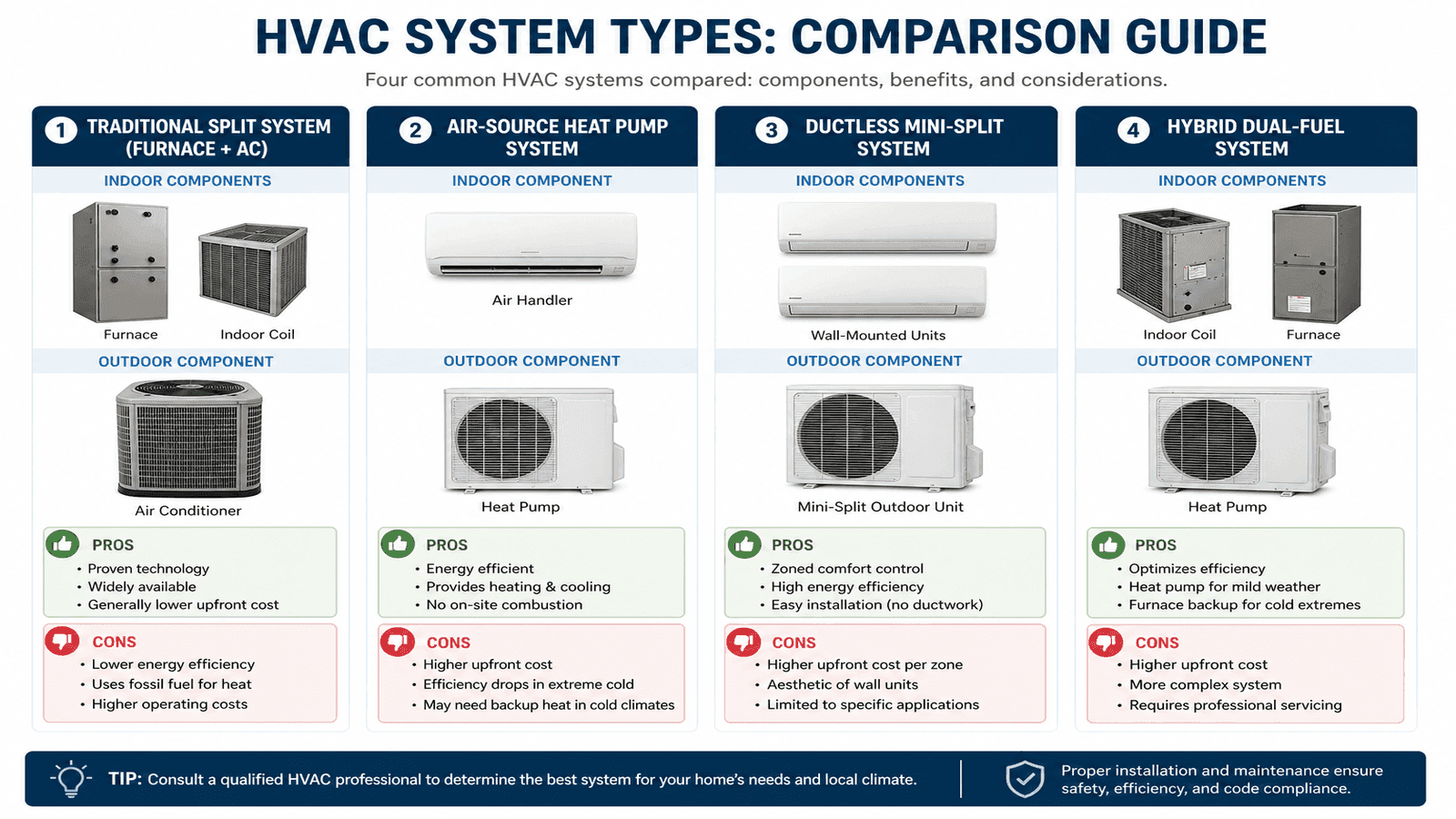
Photo: Comparison diagram of different HVAC system types including split system, heat pump, and mini-split
How HVAC Systems Work
Every air conditioner, heat pump, and refrigerator operates on the same fundamental principle: the refrigeration cycle. Understanding this cycle explains how your system heats and cools your home, why refrigerant matters, and what goes wrong when components fail.
The refrigeration cycle operates in four steps:
- Compression: The compressor pressurizes low-pressure refrigerant gas into hot, high-pressure gas. This is the "engine" of the system, and the most expensive component to replace ($1,500-$3,000).
- Condensation: Hot gas passes through the outdoor coil (condenser), releases heat to outdoor air, and condenses into a liquid. You can feel this rejected heat if you stand near a running outdoor unit.
- Expansion: Liquid refrigerant passes through the expansion valve (also called a metering device), where pressure drops dramatically and temperature plummets.
- Evaporation: Cold refrigerant absorbs indoor heat through the evaporator coil, warming the refrigerant and cooling the air blown across the coil. The refrigerant returns to gas state and cycles back to the compressor.
In cooling mode, the system absorbs heat indoors and rejects it outdoors, standard air conditioning operation. Heat pumps can reverse this cycle using a component called a reversing valve, absorbing heat from outdoor air (even cold air contains thermal energy) and releasing it indoors. This is why heat pumps are so efficient, they move existing heat rather than generating it from scratch through combustion.
I explain the refrigeration cycle to every customer because it changes how they think about their system. Once you understand that a heat pump doesn't 'create' heat, it moves existing heat from outside air into your home, the efficiency numbers make sense. Even at 0°F, there's still thermal energy in the air. Modern variable-speed compressors are incredibly good at extracting it.
The airflow system is equally critical to comfort and efficiency. The blower motor forces air across the evaporator coil and through your ductwork at roughly 400 CFM (cubic feet per minute) per ton of cooling capacity. Supply ducts deliver conditioned air to each room through registers, while return air grilles pull room air back to the system for reconditioning. Your air filter sits between the return air and the coil, removing particulates before they reach the evaporator.
Why airflow matters: restricted airflow from dirty filters, collapsed ducts, or closed vents causes frozen coils, reduced efficiency, and compressor damage. According to ENERGY STAR, duct leakage alone wastes 20-30% of heating and cooling energy in a typical home [7].
Modern systems use three levels of capacity control:
- Single-stage: On/off operation, runs at full capacity or not at all
- Two-stage: High/low capacity for better efficiency and comfort at part-load conditions
- Variable-speed/inverter: Continuously adjusts output to match the exact load, running at 30-100% capacity. These are the most efficient and quietest systems available
For a complete breakdown of the refrigeration cycle, airflow dynamics, and system diagrams, see: How HVAC Systems Work
HVAC vs. Heat Pump
"Should I get a heat pump or HVAC?" is one of the most-searched HVAC questions online, and it reveals a widespread misunderstanding. A heat pump IS a type of HVAC system, not an alternative to one. HVAC stands for Heating, Ventilation, and Air Conditioning, it's an umbrella term for the entire category. The real comparison is: heat pump system vs. traditional furnace plus air conditioner.
Here's the practical difference. A traditional split system uses a gas or oil furnace for heating and a separate air conditioner for cooling, two different mechanisms, two different energy sources. A heat pump system handles both heating and cooling with a single piece of equipment by reversing the refrigeration cycle. In summer it works exactly like an air conditioner. In winter it reverses, pulling heat from outdoor air and delivering it indoors.
Heat pump advantages include 200-300% heating efficiency (meaning for every $1 of electricity, you get $2-$3 worth of heat), no combustion and therefore no carbon monoxide risk, and lower operating costs in moderate climates. Heat pump installations outpaced gas furnace shipments by 12% in 2025, marking the continuation of a trend that began in 2022 [3].
Traditional furnace-plus-AC advantages include hotter supply air temperatures (120-140°F from a furnace vs. 90-100°F from a heat pump in cold weather), a larger installer network familiar with the technology, and potentially lower upfront costs in areas with cheap natural gas.
The 2026 reality has shifted significantly. Cold-climate heat pumps from Mitsubishi (Hyper-Heat), Bosch (IDS), and Daikin maintain effective heating at -15°F to -22°F, performance that was impossible a decade ago. Dual-fuel systems that pair a heat pump with a gas furnace backup are becoming the go-to recommendation in Northern states. The heat pump handles 85-95% of annual heating hours at high efficiency, and gas kicks in only during the coldest stretches.
One important caveat: the federal Section 25C tax credit that previously covered up to $2,000 per year for heat pump installations expired on December 31, 2025 [5]. However, state-administered rebate programs under the HOMES Act still offer up to $8,000 for qualifying households, and geothermal heat pump systems remain eligible for a 30% federal tax credit through 2032.
For a detailed side-by-side comparison with cost modeling and climate zone recommendations, read: HVAC vs Heat Pump
HVAC Terminology
HVAC has its own technical vocabulary that can make contractor proposals feel like a foreign language. Understanding the key terms helps you evaluate quotes, research problems, and communicate clearly during service calls. Here are the categories that matter most:
Efficiency Ratings are the terms you'll encounter most when shopping for equipment:
- SEER2 (Seasonal Energy Efficiency Ratio 2): Measures cooling efficiency over an entire season. Higher is better. Minimums range from 13.4 (North) to 14.3 (South). Top models reach 20-24+ SEER2. Each SEER2 point translates to roughly 7% energy savings [4].
- HSPF2 (Heating Seasonal Performance Factor 2): Measures heat pump heating efficiency over a season. Minimum is 7.5 HSPF2; top models reach 10-13 HSPF2.
- AFUE (Annual Fuel Utilization Efficiency): Measures what percentage of fuel a furnace converts to heat. Standard efficiency is 80% AFUE (some heat escapes up the flue). High-efficiency condensing furnaces reach 96-98.5% AFUE.
- COP (Coefficient of Performance): How many units of heat a heat pump delivers per unit of electricity at a specific temperature. A COP of 3.0 means $1 of electricity produces $3 worth of heat.
Equipment sizing uses specific units:
- Ton: 12,000 BTU/hr of cooling capacity. A typical home needs 2-5 tons depending on size, insulation, and climate.
- BTU (British Thermal Unit): The basic unit of heat energy. One BTU raises one pound of water by 1°F.
- CFM (Cubic Feet per Minute): Measures airflow volume. Proper residential airflow is roughly 400 CFM per ton.
System components you'll hear technicians reference include the condenser (outdoor coil), evaporator (indoor coil), compressor (the pump that circulates refrigerant), expansion valve (controls refrigerant flow and pressure), air handler (the indoor fan unit), and reversing valve (the component that switches a heat pump between heating and cooling).
Performance terms that indicate your system's health include static pressure (resistance to airflow in ductwork, too high means duct problems), delta T (the temperature difference between supply and return air, typically 15-20°F for cooling), and short cycling (when the system turns on and off too frequently, indicating oversizing or other problems).
For a full A-Z glossary with definitions and visual diagrams, see: HVAC Terminology Guide
Get quotes from top-rated pros.
History of HVAC
Understanding HVAC's evolution reveals how rapidly the industry changes and why systems installed even 10-15 years ago are dramatically less efficient than current technology.
Ancient civilizations discovered the basic principles of climate control thousands of years before modern equipment existed. Egyptians hung wet reeds in windows for evaporative cooling. Romans circulated aqueduct water through building walls. Persian wind towers called badgirs directed airflow underground, cooling it before circulating it through living spaces, a passive cooling technique still studied by engineers today.
The modern HVAC industry began in 1902, when Willis Carrier invented mechanical air conditioning for a Brooklyn printing plant that needed humidity control to prevent paper warping. The system wasn't designed for human comfort at all, it was an industrial solution. Residential air conditioning didn't become affordable until Carrier's "Weathermaster" reached the middle class in the 1950s, and by the 1970s, central air conditioning was standard in new construction. This technology arguably enabled the massive Sun Belt population growth of the late 20th century.
The efficiency revolution began with the introduction of SEER ratings in 1992, when the federal minimum was just 10 SEER. That minimum has climbed steadily, to 13 in 2006, 14 in 2015, and then the transition to SEER2 testing in January 2023 with new minimums of 13.4-14.3 SEER2 depending on region [4]. Each increase effectively forced older, less efficient equipment out of the market.
The refrigerant timeline tells its own story. R-22 (Freon) dominated for decades before the Montreal Protocol identified it as an ozone-depleting substance. R-410A replaced it by 2010 mandate. Now R-454B (marketed as Puron Advance and Opteon XL41) is replacing R-410A starting in 2025 due to R-410A's high global warming potential (GWP of 2,088). R-454B has 78% lower GWP but is classified as mildly flammable (A2L), requiring updated safety codes and technician training [8]. Existing R-410A systems can continue to be serviced, but refrigerant costs will rise as production decreases.
For the full timeline from ancient Rome to modern smart systems, read: History of HVAC
The speed of change in this industry is staggering. Five years ago, I'd never recommend a heat pump for a Minneapolis winter. Today, it's my default recommendation for most homes. Smart thermostats save 10-15% on energy bills. Variable-speed compressors run so quietly customers forget they're on. If your system is more than 12-15 years old, you're not just missing out on comfort, you're paying 30-50% more than necessary on every utility bill.
| Era | Key Milestone | Impact |
| 1902 | Willis Carrier invents modern AC | Birth of air conditioning industry |
| 1950s | Residential AC becomes affordable | Enabled Sun Belt population boom |
| 1987 | Montreal Protocol signed | R-12 and R-22 phase-out begins |
| 1992 | SEER rating introduced (min 10) | First federal efficiency standard |
| 2006 | SEER minimum raised to 13 | 30% efficiency improvement mandated |
| 2010 | R-410A replaces R-22 | Ozone-safe refrigerant standard |
| 2023 | SEER2 standard takes effect | New testing method, higher minimums |
| 2025 | R-454B replaces R-410A in new equipment | Low-GWP refrigerant transition begins |
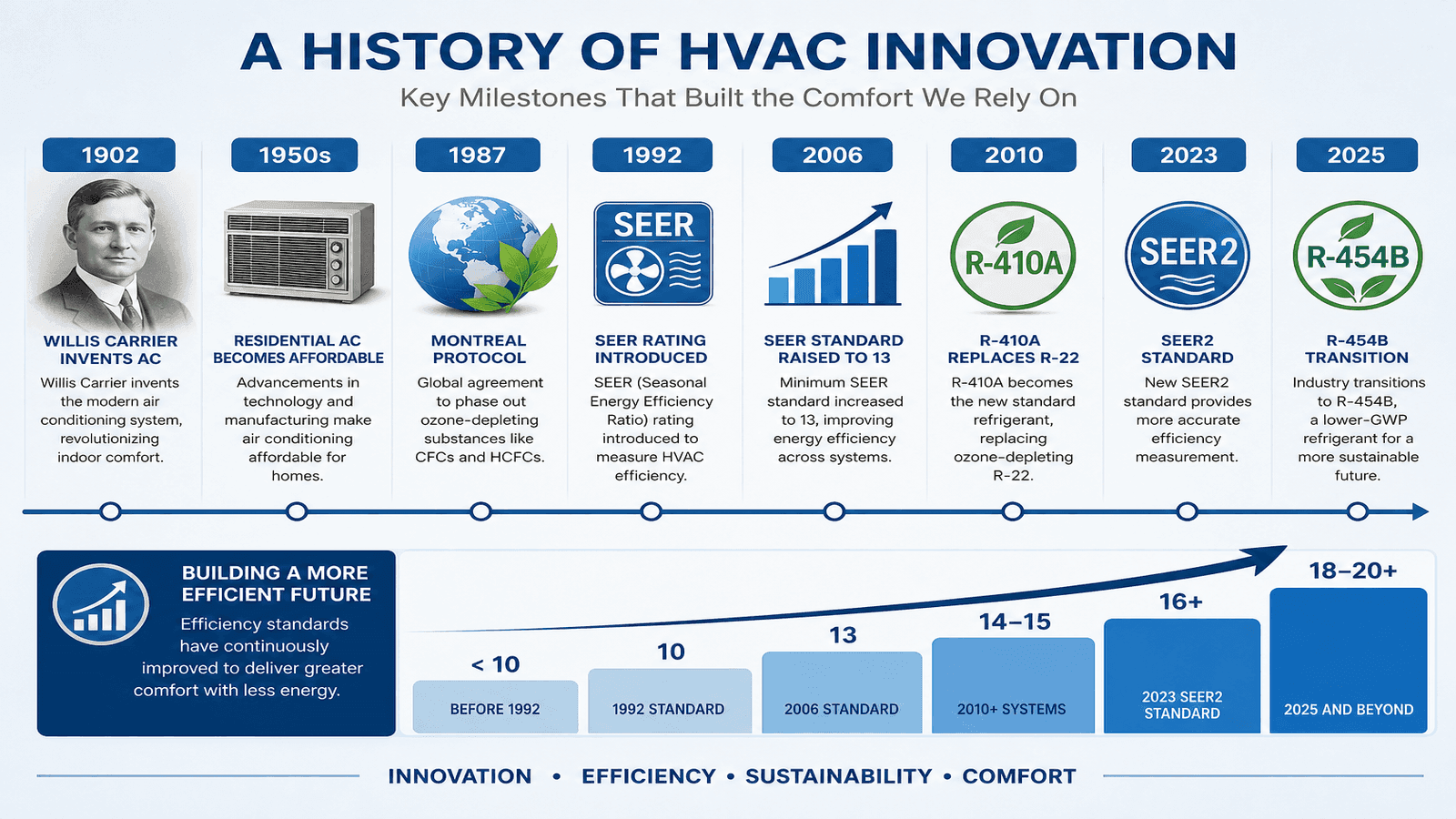
Photo: Timeline infographic showing major HVAC milestones from 1902 to 2025
HVAC Certifications & Licensing
HVAC work involves refrigerants regulated under the Clean Air Act, high-voltage electrical connections, gas combustion systems, and pressurized components. The combination of environmental regulations and safety concerns makes HVAC one of the most heavily credentialed skilled trades.
EPA Section 608 certification is required by federal law for anyone who purchases, handles, or disposes of refrigerants. There are four types: Type I (small appliances like window units), Type II (high-pressure systems including most residential AC), Type III (low-pressure systems like commercial chillers), and Universal (covers all types). Most HVAC technicians pursue Universal certification. The exam is proctored and covers proper handling, leak repair, refrigerant recovery, and disposal protocols. Once earned, EPA 608 certification does not expire [9].
NATE certification (North American Technician Excellence) is the leading third-party industry credential. NATE offers a core exam plus specialty exams covering air conditioning, heat pumps, gas furnaces, oil furnaces, air distribution, and more. Major manufacturers including Carrier, Trane, Lennox, and Rheem recognize NATE certification, and many require it for dealer programs. NATE-certified technicians diagnose problems faster on average and must renew every two years through continuing education [10].
State licensing varies significantly. Some states require a state-specific HVAC contractor license with 2-5 years of documented experience, a written exam, and proof of insurance and bonding. Others delegate licensing to municipalities. Gas line work and electrical connections often require separate licenses or permits, even for HVAC technicians.
Manufacturer certifications from brands like Carrier (Carrier Experts), Trane (Comfort Specialists), and Lennox (Premier Dealers) involve factory training and are often required to offer extended manufacturer warranties, an important selling point for consumers.
For a full breakdown of EPA 608, NATE, state licensing, and manufacturer programs, see: HVAC Certifications Explained
When I hire technicians, NATE certification is the first thing I look for. It tells me they understand the science, not just the mechanics. I've seen uncertified installers put in systems that look fine but run 30% less efficiently because they didn't check static pressure, verify refrigerant charge, or calculate duct sizing. The certification matters because the details matter.
Energy-Efficient HVAC
Efficiency in HVAC means converting the maximum amount of energy input into usable heating or cooling output. Understanding efficiency ratings helps you compare equipment, estimate operating costs, and determine what incentives you may qualify for.
The SEER2 standard replaced the original SEER metric in January 2023. The change reflects updated testing procedures (the M1 test method) that simulate real-world conditions with higher external static pressure, essentially, equipment is tested under more realistic conditions. SEER2 numbers run approximately 4.5-6% lower than equivalent SEER ratings, so a system formerly rated at 16 SEER might be rated around 15.2 SEER2. Current federal minimums are 13.4 SEER2 for Northern states and 14.3 SEER2 for Southern and Southwestern states, with additional EER2 requirements in the Southwest [4].
Here's what efficiency ratings actually mean for your wallet:
| Rating | What It Measures | 2023+ Minimum | ENERGY STAR | Top Tier | Practical Impact |
| SEER2 | AC/HP seasonal cooling | 13.4-14.3 | 15.2+ | 20-24+ | ~7% savings per point |
| EER2 | Peak cooling efficiency | 10.6-11.7 | 12.0+ | 14+ | Peak demand reduction |
| HSPF2 | HP seasonal heating | 7.5 | 8.1+ | 10-13 | Winter heating costs |
| AFUE | Furnace fuel efficiency | 80% | 90%+ | 97-98.5% | % of fuel converted to heat |
Upgrading from an old 10 SEER system to a 16 SEER2 model can save $400-$600 per year in a warm climate. Replacing an 80% AFUE furnace with a 96% AFUE condensing furnace saves $200-$400 annually. Adding a smart thermostat (Nest, Ecobee, Honeywell) saves another $100-$150 per year. Sealing leaky ductwork saves $200-$300. Combined, these upgrades can cut your heating and cooling costs nearly in half.
Financial incentives have shifted significantly in 2026. The federal Section 25C Energy Efficient Home Improvement Credit, which previously offered up to $2,000 per year for qualifying heat pump installations, expired on December 31, 2025, under the One Big Beautiful Bill Act [5]. However, two major incentive programs remain:
- State HOMES Act rebates: Performance-based whole-house rebates of $2,000-$8,000, administered by individual states. Availability and reservation status vary, California's program is already fully reserved with a waitlist as of early 2026.
- Geothermal tax credit: Ground-source heat pump systems remain eligible for a 30% federal tax credit through 2032 under Section 25D.
- Utility rebates: Many local utilities offer their own rebate programs for high-efficiency equipment, often $200-$1,500 depending on the system.
Get quotes from top-rated pros.
The biggest mistake I see homeowners make is focusing only on the upfront price. A system that costs $2,000 less but runs at 14 SEER2 instead of 18 SEER2 will cost you $300-$400 more per year in a hot climate. Over a 15-year system life, that 'savings' costs you $4,500-$6,000 in extra utility bills. Always calculate total cost of ownership, purchase price plus 15 years of energy costs.
For SEER2/HSPF2/AFUE calculations, rebate eligibility, and ROI analysis, read: Energy Efficient HVAC
Common HVAC Problems
While this guide doesn't provide DIY repair instructions, understanding common HVAC problems helps you recognize early warning signs, communicate issues clearly to technicians, and make informed decisions about repair versus replacement. Daniel Torres reports that across his 14-plus years of HVAC work in the Minneapolis-St. Paul metro area, the following issues account for the vast majority of residential HVAC complaints.
Dirty or clogged filters trigger more service calls than any other issue. Restricted airflow forces the system to work harder, increases energy consumption by 5-15%, and can cause frozen evaporator coils and compressor damage. The fix costs nothing, just replace the filter every 1-3 months depending on type, household pets, and allergies.
Refrigerant leaks cause reduced cooling capacity, longer run times, and ice formation on the evaporator coil. Because refrigerants are regulated under the Clean Air Act, only EPA-certified technicians can diagnose and repair refrigerant issues. A simple recharge costs $200-$600, but the leak itself must also be repaired to prevent recurrence and environmental damage.
Thermostat issues are surprisingly common. Dead batteries, misconfigured settings, and poor thermostat placement (near a heat source or drafty window) can make it seem like the entire system has failed. Before calling for service, check that the thermostat is set to the correct mode, the temperature setting is below room temperature (for cooling) or above (for heating), and batteries are fresh.
Drainage problems from clogged condensate drain lines can cause water damage, mold growth, and system shutdown. Most modern systems include a safety float switch that kills the system if the drain line backs up, a nuisance, but far better than ceiling damage from an overflowing drain pan.
Capacitor failures are among the most common electrical issues. Capacitors provide the initial surge of electricity needed to start the compressor and fan motors. Symptoms include a humming sound without the unit starting, intermittent operation, or the system failing to start on hot days when electrical demand is highest. Replacement costs $150-$350.
| Issue | Emergency? | Response Time | Average Cost | Consequences of Delay |
| No heat (below freezing) | YES | Same day | $200-$1,500 | Frozen pipes, health risk |
| Gas smell from furnace | YES | Immediate | $200-$800 | Explosion, CO poisoning |
| Carbon monoxide alarm | YES | Immediate | $300-$1,200 | CO poisoning risk |
| Burning smell from vents | YES | Same day | $150-$600 | Fire risk |
| AC not cooling (hot weather) | Urgent | 1-3 days | $150-$600 | Discomfort, humidity |
| Uneven temperatures | NO | 1-5 days | $100-$500 | Inefficiency |
| Strange noises | NO | 1-5 days | $150-$900 | Component wear |
| Short cycling | NO | 1-3 days | $150-$500 | Compressor damage |
| High energy bills | NO | 1-14 days | $100-$3,000 | Wasted money |
The repair vs. replace decision generally follows this rule: if the repair costs more than 50% of a new system's price and the current system is over 10 years old, replacement is usually the better investment. A new system also brings the latest efficiency standards, warranty protection, and current refrigerant compatibility.
Real-World Case Study (Sarah M., Plymouth, MN): Sarah's 2008 R-22 system failed during a January cold snap when temperatures hit -12°F. With R-22 refrigerant increasingly scarce and expensive, repair would have cost $1,800 for the refrigerant alone, plus the compressor was showing signs of failure. Her HVAC contractor replaced the system with a Mitsubishi Hyper-Heat cold-climate heat pump paired with her existing gas furnace as dual-fuel backup. Total installed cost: $11,200. Sarah's heating bills dropped from $340/month to $195/month, a 43% reduction, and her home stays more evenly heated because the variable-speed compressor runs at low capacity most of the time instead of cycling on and off.
For a full list of 15 common issues with diagnosis steps and repair costs, see: Common HVAC Problems
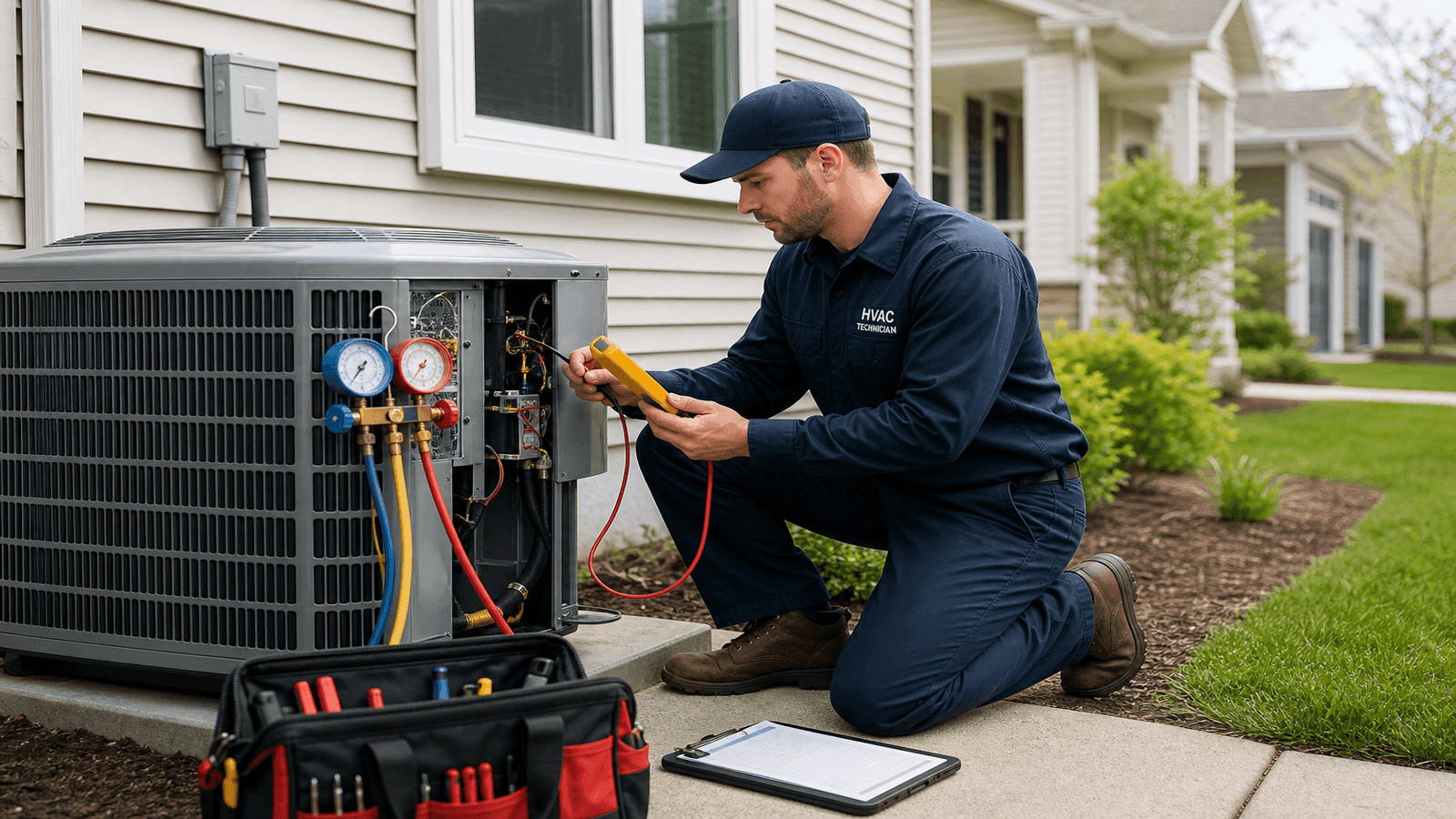
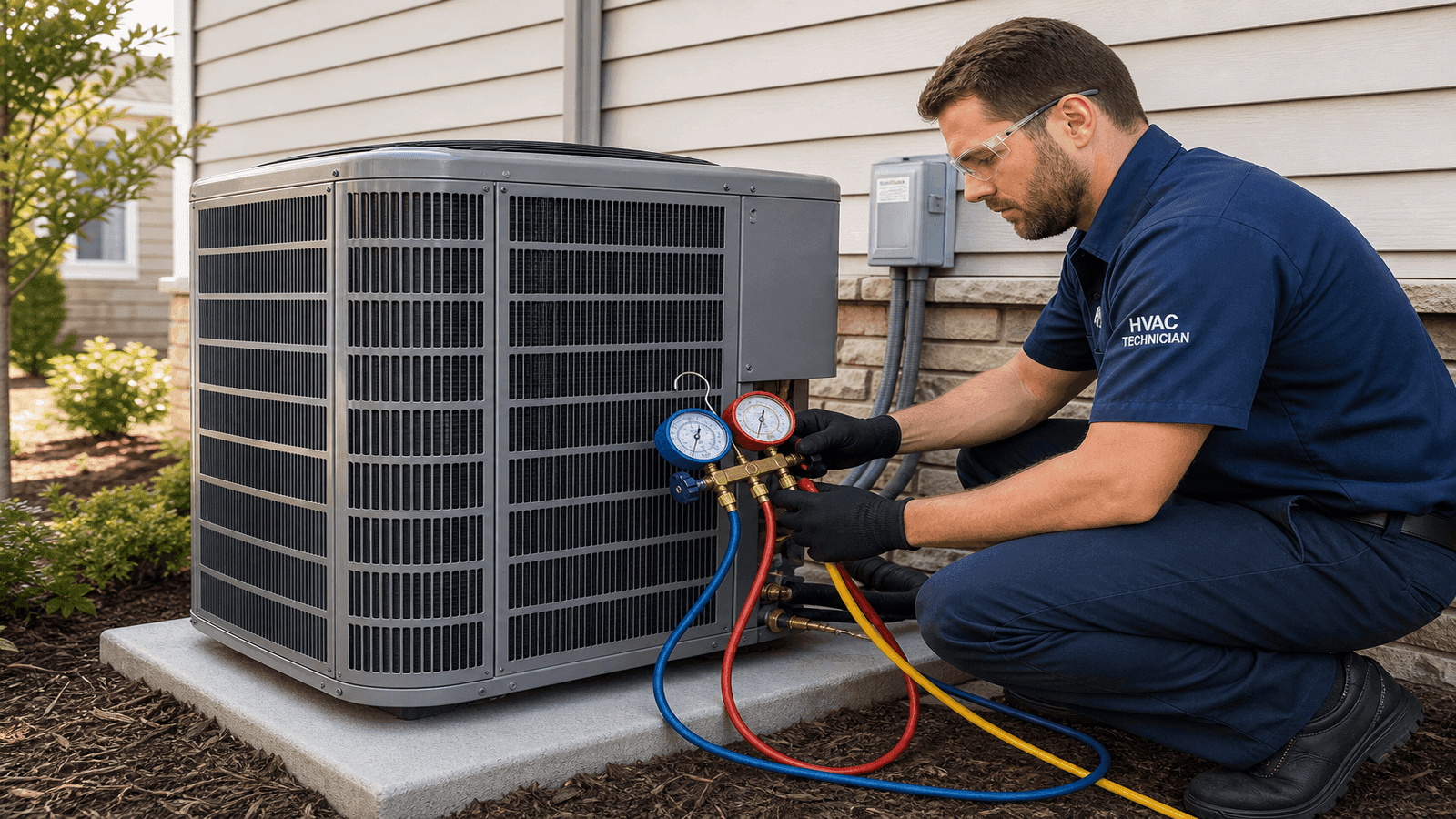
Photo: Technician performing maintenance on residential HVAC outdoor unit
Indoor Air Quality
Americans spend approximately 90% of their time indoors, where air pollution levels can be 2-5 times higher than outdoors according to the EPA [11]. Your HVAC system is the primary tool for controlling indoor air quality, filtering particulates, managing humidity, and circulating fresh air. Post-pandemic awareness has made IAQ a top concern for homeowners, and it's one of the fastest-growing service categories in the HVAC industry.
Filtration is your first line of defense. Filters are rated on the MERV scale (Minimum Efficiency Reporting Value):
- MERV 1-4: Minimal filtration, basic window AC units
- MERV 8: Standard residential, captures dust, pollen, mold spores. The baseline recommendation for most homes.
- MERV 11-13: Enhanced residential, captures pet dander, fine dust, some bacteria. ASHRAE recommends at least MERV 13 for improved health outcomes [12].
- MERV 14-16: Hospital-grade, captures most bacteria, smoke, virus-carrying droplets
- HEPA (MERV 17+): 99.97% of particles at 0.3 microns, typically standalone units, not compatible with standard residential ductwork
A critical warning: higher MERV doesn't automatically mean better. A MERV 16 filter jammed into a system designed for MERV 8 restricts airflow so severely that coils freeze, energy use spikes, and the blower motor works itself to death. Your ductwork and system static pressure rating determine the maximum MERV filter you can safely use. Upgrading to a 4-inch media filter cabinet (which holds thicker filters with more surface area) is often a better solution than forcing a high-MERV filter into a standard 1-inch slot.
Humidity control is equally important. Ideal indoor humidity falls between 30-50% relative humidity. Above 60%, you're creating conditions for mold growth, dust mites, and bacterial reproduction. Below 30%, you'll experience dry skin, respiratory irritation, static electricity, and wood damage. Whole-house humidifiers (for winter) and dehumidifiers (for summer) integrate directly with your HVAC system.
Ventilation brings in fresh outdoor air while exhausting stale indoor air. This is especially important in modern, tightly sealed homes that don't naturally "breathe." Energy Recovery Ventilators (ERVs) and Heat Recovery Ventilators (HRVs) exchange air while recovering 70-80% of the heating or cooling energy, you get fresh air without the energy penalty of simply opening a window in January. ASHRAE Standard 62.2 establishes minimum continuous ventilation rates for residential buildings [12].
The biggest IAQ mistake I see is homeowners buying MERV 16 filters and jamming them into systems designed for MERV 8. The filter catches everything, but your system can't push air through it. The blower works harder, energy use spikes, and airflow drops so much that coils freeze. Better filtration starts with checking what your ductwork can handle. Sometimes upgrading the filter rack to accept a 4-inch media filter is the real solution, more surface area, lower pressure drop, better filtration.
For a complete guide to MERV ratings, ventilation standards, humidity control, and air quality testing, read: Indoor Air Quality Basics
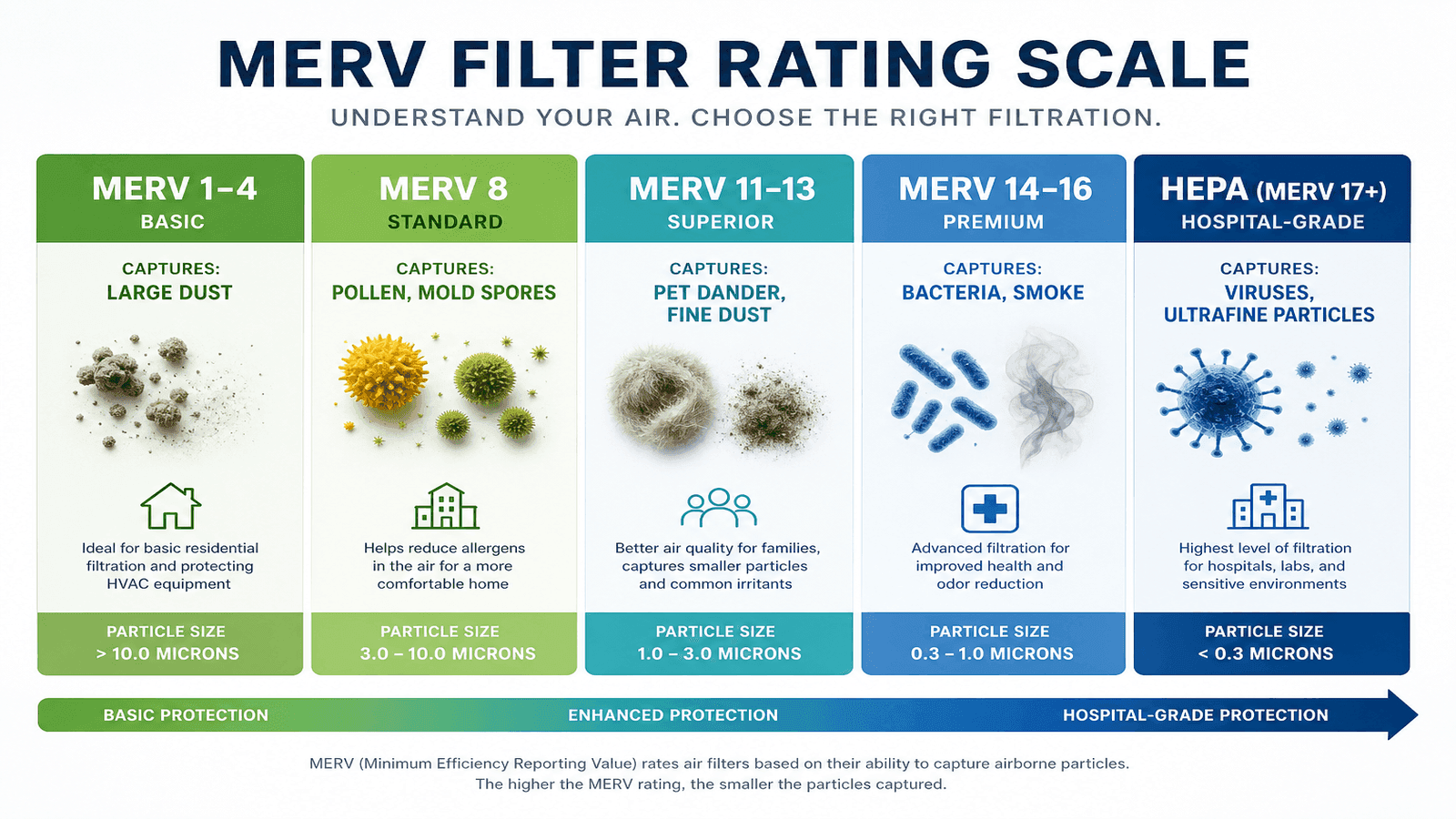
Photo: MERV filter rating scale showing particle sizes captured at each level
HVAC Careers
HVAC is a skilled trade facing a significant workforce shortage, creating strong opportunities for new professionals. The Bureau of Labor Statistics projects 9% job growth for HVAC mechanics and installers through 2033, faster than the average for all occupations, with approximately 42,500 annual openings from both growth and retirements [6]. The industry is estimated to be short 110,000 technicians, with the number of certified techs dropping 50% over the past decade.
Career statistics (2026):
- Median annual salary: $59,810 (BLS) [6]
- Experienced professionals: $58,000-$68,000 range
- Top 10% earn: $82,000+
- Business owners: $85,000-$200,000+
- Entry-level (years 0-3): $32,000-$42,000
- Journey-level (3-7 years): $55,000-$75,000
The typical career pathway starts with a trade school or technical college program (6 months to 2 years), followed by EPA Section 608 certification (federally required for refrigerant handling). Entry-level technicians work under experienced professionals, learning residential system installation, basic troubleshooting, and customer service. After 3-7 years, most technicians pursue NATE certification and can work independently on residential and light commercial systems.
Senior technicians and specialists with 7+ years can pursue manufacturer-specific certifications, commercial/industrial specializations, or building controls expertise. The entrepreneurial path, starting your own HVAC contracting business, requires a state contractor license in most jurisdictions, along with insurance, bonding, and business management skills.
Educational pathways include trade and technical schools, community college AAS programs in HVAC/R, union apprenticeships through UA and SMART locals, and military training with transferable HVAC skills. The key advantage over four-year degrees is financial: HVAC training costs $8,000-$25,000 compared to $60,000+ for a bachelor's degree, and technicians begin earning full-time wages within 6-24 months of starting training.
I graduated trade school with $8,000 in student loans and was earning $40,000 within my first year. By comparison, friends with four-year engineering degrees started at similar salaries with $60,000-plus in debt. Now, 14 years in, I specialize in energy-efficient retrofits and earn well into six figures. The industry is desperate for smart, motivated people, if you're mechanically inclined and don't mind working with your hands, HVAC is one of the best career paths available right now.
Get quotes from top-rated pros.
For the full career pathway, including trade school directories, salary data by state, and certification prep, see: HVAC Career Guide
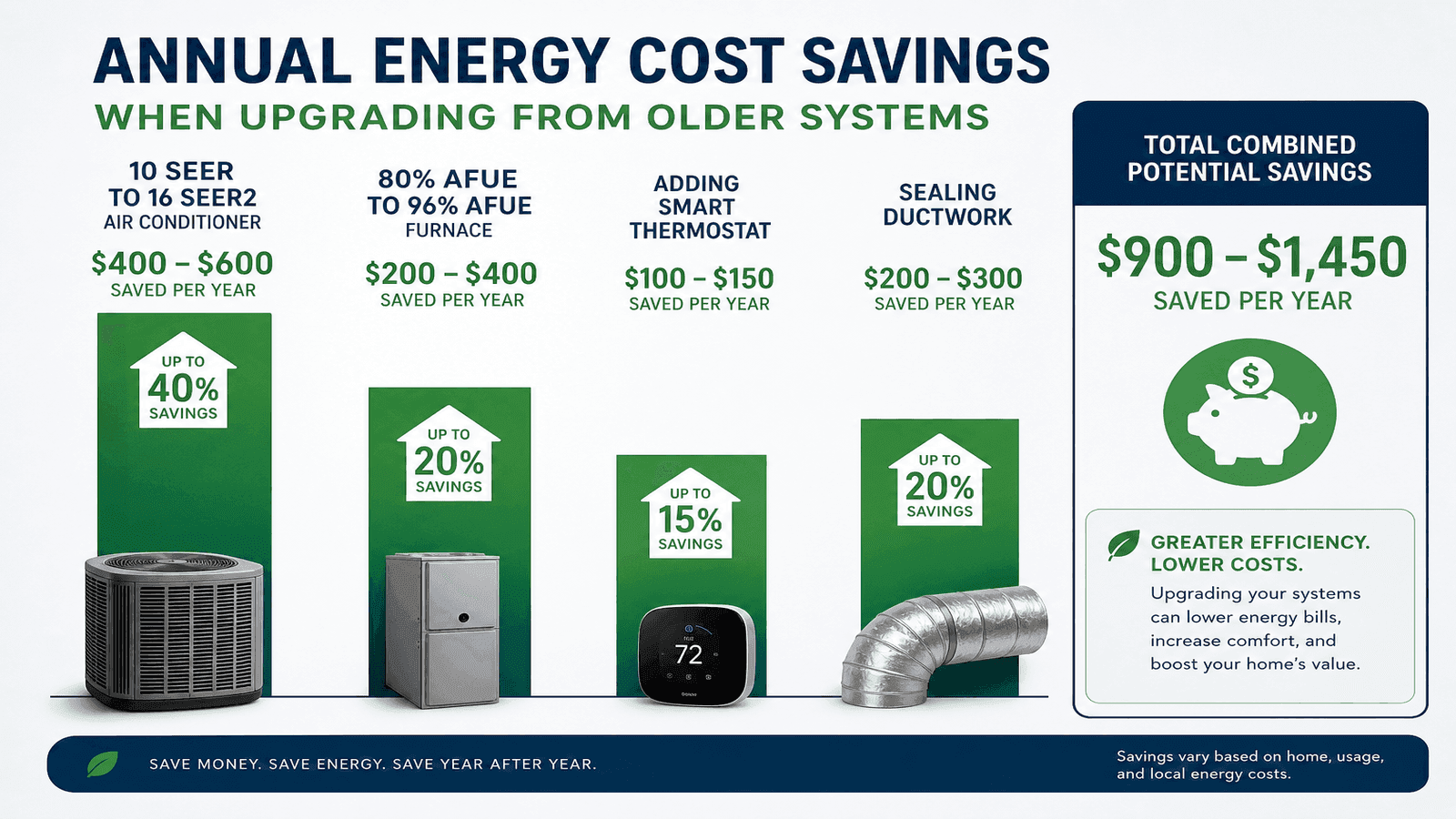
Photo: Chart showing energy savings potential when upgrading HVAC efficiency levels
Professional HVAC Services
Understanding the different categories of HVAC service helps you hire the right professional, know what to expect during a service call, and avoid overpaying. Here's what each service type involves:
HVAC contractors in the NearbyHunt network report that homeowners with active maintenance plans experience 40% fewer emergency calls and their systems last an average of 3-5 years longer than unmaintained equipment. "The customers who sign up for biannual tune-ups almost never call me for a weekend emergency," says Brian R., a NearbyHunt-listed HVAC contractor in Atlanta, GA. "It's the ones who skip maintenance for three or four years straight who end up with a dead compressor on the hottest day in July."
Preventive maintenance (tune-ups) is recommended twice per year, once in spring for cooling and once in fall for heating. A professional tune-up includes checking refrigerant levels, cleaning condenser and evaporator coils, inspecting electrical connections and tightening terminals, lubricating moving parts, testing safety controls, checking ductwork for leaks, and verifying thermostat calibration. Cost: $80-$200 per visit, or $150-$400 for an annual maintenance plan that includes priority scheduling and repair discounts. Annual maintenance extends equipment life by 5-10 years and is often required to keep manufacturer warranties valid.
Repair service starts with a diagnostic fee of $75-$150, which is typically credited toward the repair if you proceed. Technicians use a combination of pressure readings, electrical measurements, and temperature differentials to identify problems. Hourly rates range from $85-$175, though many companies use flat-rate pricing for common repairs so you know the cost upfront.
System replacement involves a full equipment changeout on a 12-20 year cycle. The process should always begin with a Manual J load calculation to determine proper sizing, any contractor who sizes equipment without one is guessing. Expect 1-3 days for installation, including ductwork evaluation and modification if needed. Total project cost ranges from $5,000-$15,000+ depending on system type, efficiency level, home size, and ductwork condition.
Choosing an HVAC contractor, credentials to verify:
- State or local contractor license (verify with your state licensing board)
- EPA Section 608 certification (federal requirement, ask to see the card)
- NATE certification (industry standard for technical competence)
- Insurance: general liability plus workers' compensation
- Manufacturer dealer status (required for extended warranties on most brands)
- Online reviews and references for projects similar to yours
Red flags to watch for: no license or EPA certification, sizing equipment by "rule of thumb" without a load calculation, extremely low bids that suggest corner-cutting, high-pressure sales tactics ("this price is only good today"), and refusal to provide written estimates.
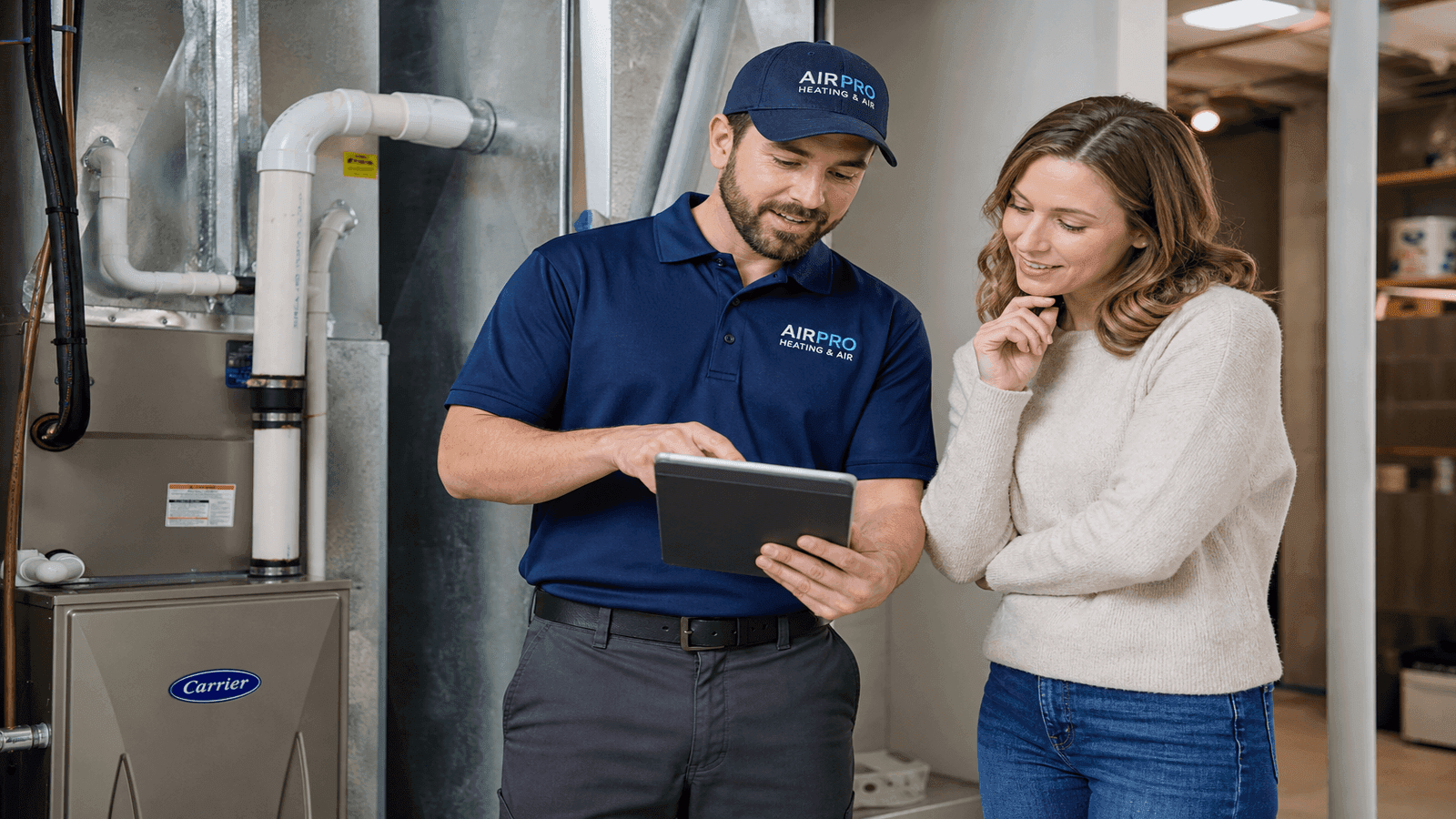
Photo: HVAC technician consulting with homeowner about system options
Why HVAC Knowledge Matters
Your HVAC system is the most expensive appliance in your home and the largest line item on your energy bill. Understanding how it works, even at a foundational level, protects both your comfort and your wallet.
Throughout this guide, we've covered the knowledge that separates informed homeowners from those who get surprised by every repair bill:
- System types: Split systems, heat pumps, mini-splits, and hybrid configurations each serve different needs based on climate, home design, and budget, there is no universally "best" system
- The refrigeration cycle: The universal principle behind all cooling and heat pump heating. Understanding it explains why maintenance matters and what fails when components wear
- The heat pump revolution: Cold-climate technology, shifting economics, and changing incentive structures are reshaping the industry faster than any change since residential AC became mainstream
- Efficiency standards: SEER2, HSPF2, and AFUE ratings directly translate to operating costs. Each efficiency point means real dollar savings over your system's 15-20 year lifespan
- Indoor air quality: Your HVAC system is the primary defense against indoor air pollution. Proper filtration and ventilation are health essentials, not luxuries
- Professional expertise: HVAC work requires federal certification and specialized training. Proper installation means the difference between a system that lasts 20 years and one that fails in 7
- Career opportunities: A growing skilled trade with strong wages, low educational debt, and guaranteed demand for decades
After reading this guide, you'll be able to evaluate contractor proposals with confidence, understand equipment specifications and efficiency claims, recognize when problems need immediate attention versus scheduled service, and take advantage of incentive programs that reduce upgrade costs. We've linked to detailed cluster articles throughout, bookmark those resources for deep dives into specific topics as your needs arise.
The single best piece of advice I give every homeowner is this: invest in maintenance, not just equipment. I've seen $12,000 systems fail in seven years because the filter was never changed and the coils were never cleaned. I've also seen $6,000 systems run perfectly for 18 years because the owner followed a simple biannual maintenance schedule. The equipment matters, but how you care for it matters more. And when it is time to replace, insist on a Manual J load calculation, proper sizing is the foundation of everything else.
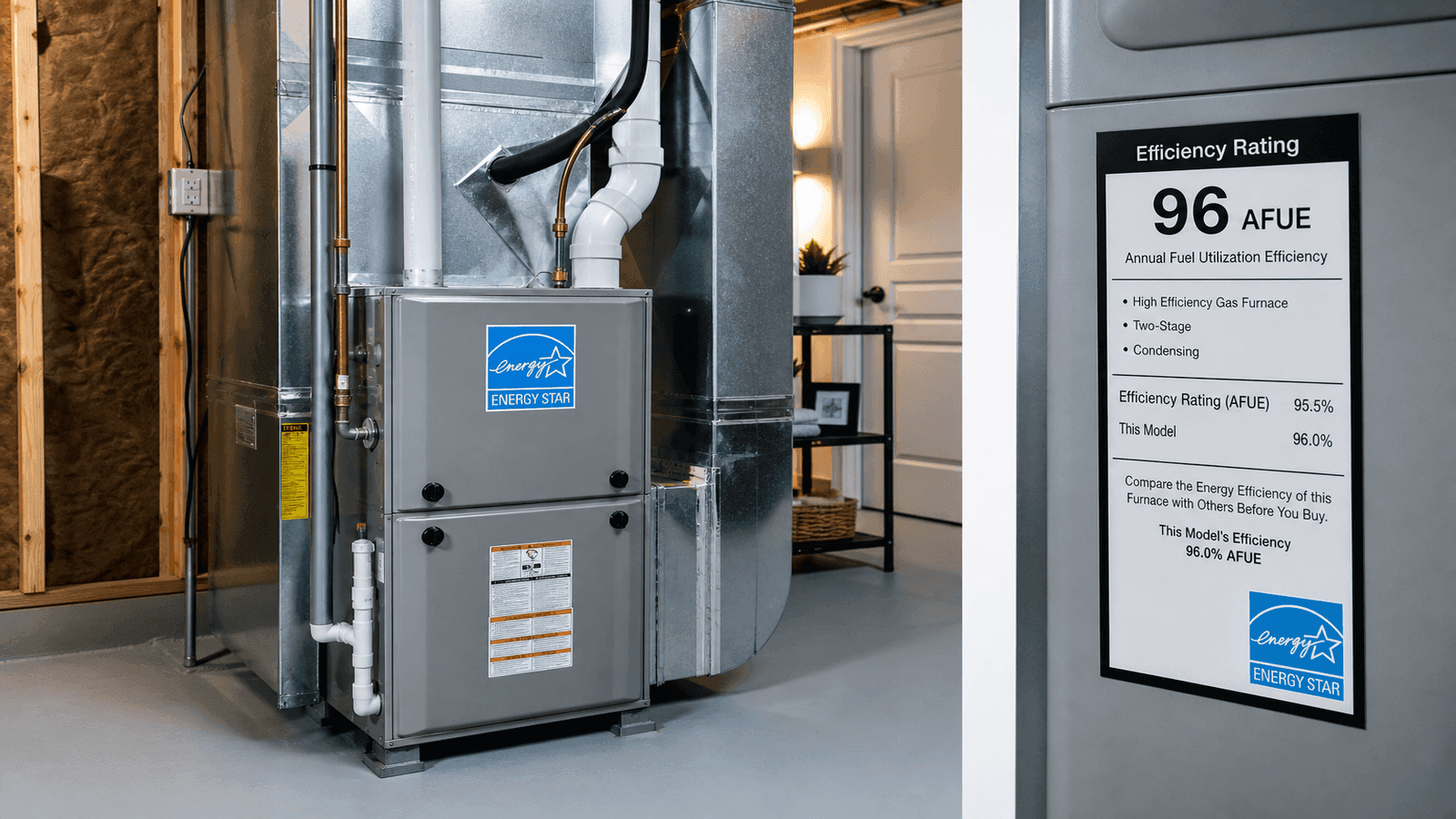
Photo: Modern energy-efficient HVAC system installed in a residential home
Conclusion
How We Gathered This Data?: The statistics and insights in this guide come from federal agency reports (U.S. DOE, EPA, BLS), industry organizations (ASHRAE, ACCA, NATE), market research firms (Grand View Research, Market Data Forecast), and firsthand experience from Daniel Torres (14+ years of HVAC work in the Midwest) and the network of licensed HVAC professionals on NearbyHunt who collectively handle thousands of installations and service calls annually across all 50 states. Reviewed for accuracy by Christine Walters, Expert Reviewer with 17 years of HVAC experience (EPA 608, NATE, OSHA 10-Hour, R-410A Safety Certified) in Kansas City, MO.
Disclaimer: This article provides general educational information about HVAC systems and services. It is not intended as professional HVAC advice for specific situations. Local building codes, climate conditions, and individual home characteristics vary significantly. Always consult a licensed, certified HVAC professional for system-specific recommendations, installations, and repairs. Cost estimates are national averages as of 2026 and may differ in your area.
Sources & References
[1] U.S. Department of Energy. "Heating and Cooling."
[2] ServiceTitan. "HVAC Statistics: The Data You Need to Know for 2026." Grand View Research. "U.S. HVAC Systems Market Report."
[3] Canary Media. "Heat pump sales dipped in 2025. They still beat gas..." Market Data Forecast. "North America Residential Cold Climate Heat Pump Market."
[4] DOE/ICC. "SEER2/EER2 Efficiency Requirements." World Population Review. "SEER Requirements by State 2026."
[5] Beltway HVAC. "2026 HVAC Tax Credits: What Section 25C Expiration Means." ENERGY STAR. "Federal Tax Credits for Energy Efficiency." Rewiring America. "25C Heat Pump Federal Tax Credits."
[6] U.S. Bureau of Labor Statistics. "Heating, Air Conditioning, and Refrigeration Mechanics and Installers."
[7] ENERGY STAR. "Duct Sealing."
[8] Johnson Controls. "Navigating the R-454B Refrigerant Transition." Lennox. "2025 New Refrigerant Transition." ICC. "EPA's Technology Transitions Program."
[9] EPA. "Section 608 Technician Certification."
[10] NATE. "North American Technician Excellence."
[11] EPA. "Introduction to Indoor Air Quality."
[12] ASHRAE. "Standards 62.2 and 52.2."
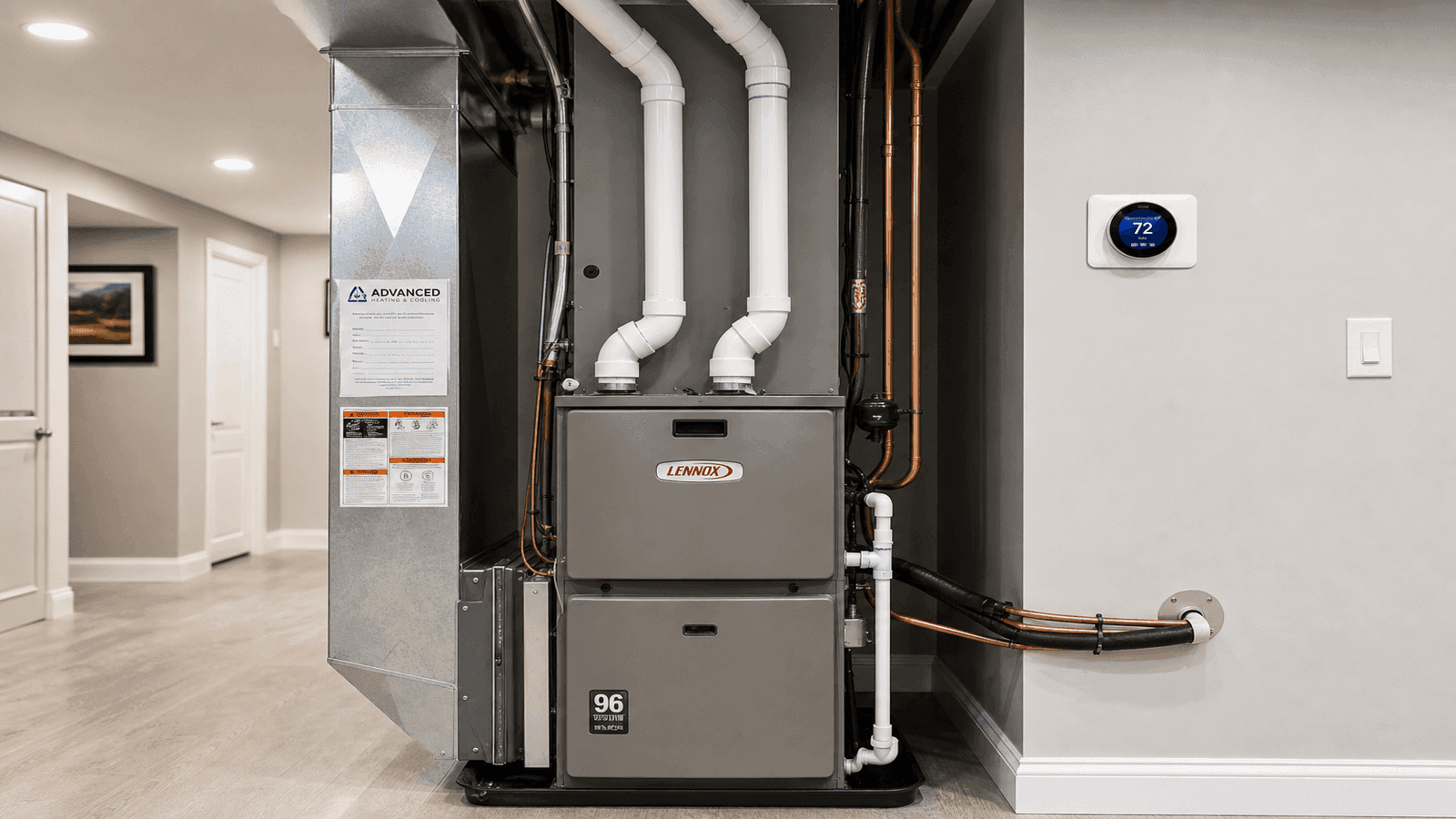

Daniel is an EPA-certified HVAC technician & Energy Efficiency Consultant with over 14 years of experience in maintaining and installing heating and cooling systems throughout the Midwest. Passionate about sustainability, Dan specialises in energy-efficient retrofits and intelligent climate control systems. He writes for NearbyHunt to help homeowners extend the lifespan of their HVAC units while lowering utility bills.

Christine is an EPA-certified HVAC professional with 17 years of experience in heating, cooling, and indoor air quality systems. She has managed large-scale residential installations and worked as a technical trainer for new HVAC apprentices. Chris’s reviews focus on accuracy, safety, and performance standards in modern HVAC practices.