- Split systems remain the most common HVAC configuration in U.S. homes, installed in roughly 60% of existing residences, but heat pumps outsold gas furnaces by 12% in 2025 [1]
- Ductless mini-splits achieve SEER2 ratings up to 35 and eliminate the 15-25% energy loss caused by ductwork, making them the most efficient option for homes without existing ducts [2]
- A full HVAC system replacement costs $7,000 to $18,000 in 2026, with heat pump installations averaging $9,400 to $16,750 depending on system size and region [3]
- Homeowners can claim up to $2,000 in federal tax credits for qualifying heat pump installations that meet ENERGY STAR Most Efficient criteria [4]
- Dual-fuel hybrid systems combine a heat pump with a gas furnace backup and now account for roughly 45% of new installations in Northern states
- Choosing the wrong system type causes 30-50% higher energy bills and is responsible for approximately 35% of comfort complaints that HVAC professionals investigate

Get quotes from top-rated pros.
Picking the right HVAC system is one of the highest-stakes decisions a homeowner faces. The equipment you choose determines your comfort, your energy bills, and your home's resale value for the next 15 to 20 years. Yet most homeowners base this decision on a single contractor recommendation without understanding their options. A system that works perfectly in Phoenix may be a poor choice in Minneapolis. A home without ductwork needs a completely different approach than one with an existing forced-air setup.
This article is part of our All About HVAC pillar guide and breaks down every major HVAC system type available in 2026, with real costs, efficiency ratings, ideal use cases, and the trade-offs that matter most. Whether you are building new, replacing aging equipment, or retrofitting an older home, understanding these categories will help you make a decision you will not regret.
HVAC professionals in the NearbyHunt network report that approximately 35% of comfort complaints they investigate trace back to a system that was the wrong type or size for the home, not a mechanical failure. The right information up front prevents that outcome.
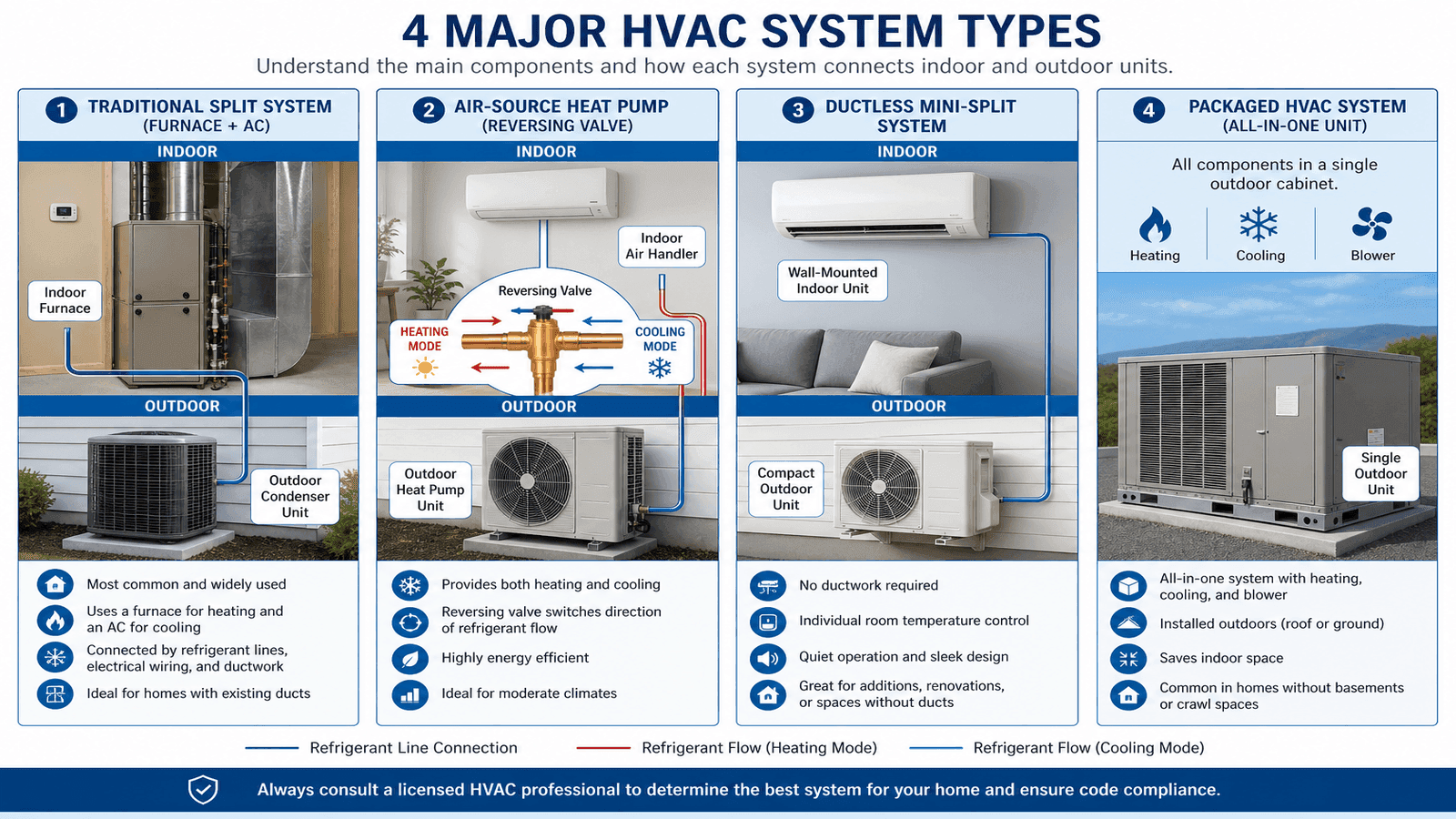
Photo: Overview of different HVAC system types including split system, heat pump, mini-split, and packaged unit in residential settings
Split Systems
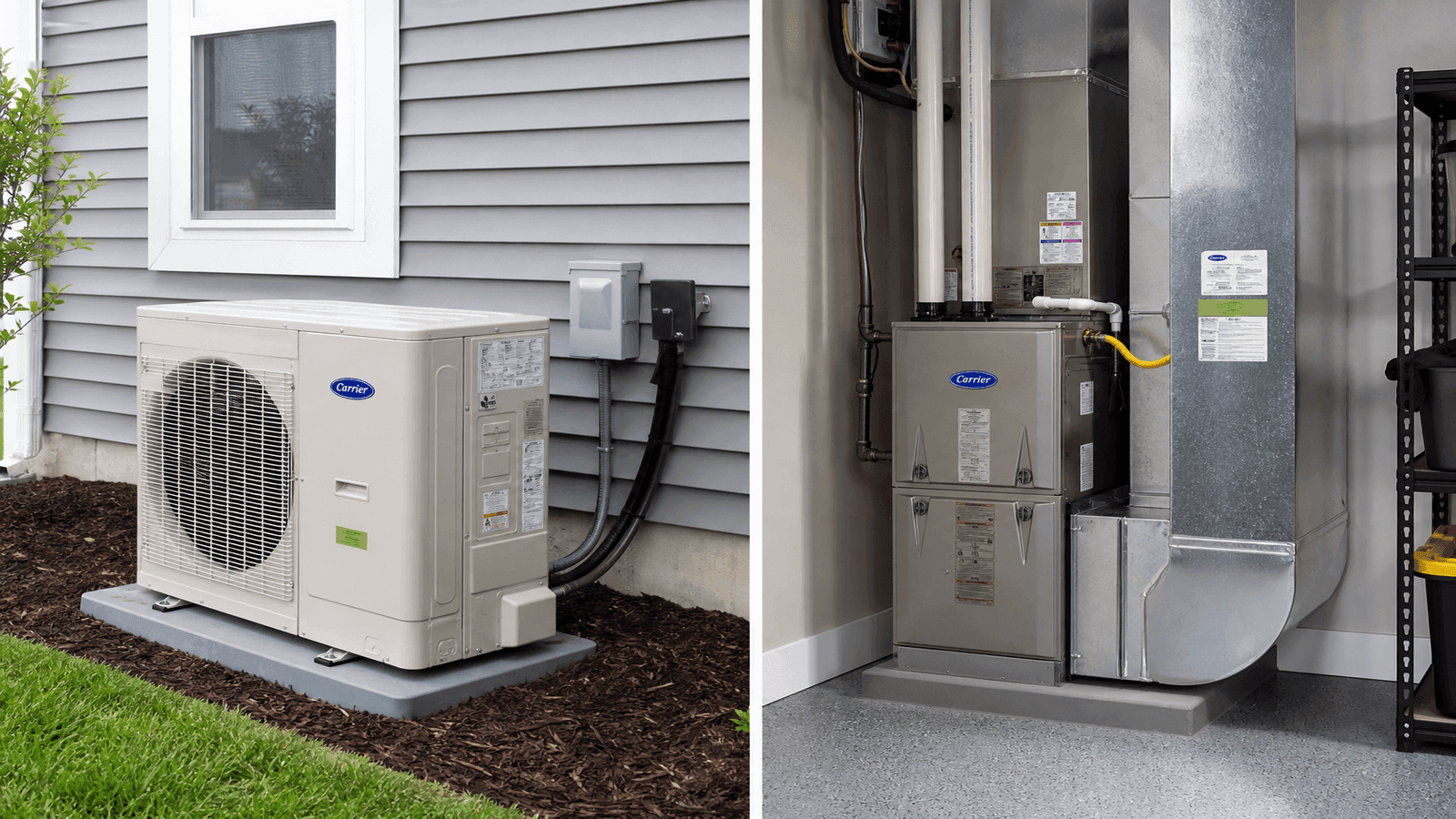
Split systems are the most common HVAC configuration in the United States, found in roughly 60% of existing homes [5]. The name describes the design: components are split between an indoor unit and an outdoor unit connected by refrigerant lines and electrical wiring.
The outdoor unit contains the compressor and condenser coil. The indoor unit houses the evaporator coil and air handler (or furnace, in heating mode). Conditioned air travels through ductwork to supply registers in each room, while return air grilles pull room air back to the system for reconditioning.
Standard split system configurations include:
- AC plus gas furnace: The most traditional setup. The air conditioner handles cooling and the gas furnace provides heating. Installation costs range from $7,000 to $13,500 for a 2,000 to 2,500 square foot home [3].
- AC plus electric furnace: Common in milder climates or areas without natural gas access. Electric furnaces are less expensive to install but cost more to operate in cold climates.
- Heat pump plus air handler: A single outdoor unit handles both heating and cooling by reversing the refrigeration cycle. More on heat pumps in the next section.
Split systems work best for homes with existing ductwork in good condition. The ductwork is the critical factor. Leaky or poorly insulated ducts waste 20-30% of conditioned air according to ENERGY STAR [6], so even a high-efficiency unit connected to bad ductwork will underperform.
I've installed split systems in every type of home across the Midwest for 14 years, and the single biggest waste of money I see is a homeowner buying a 20 SEER2 unit connected to ductwork that leaks 25% of the air. Always fix the ducts first. A 16 SEER2 system with sealed, insulated ducts will outperform a 20 SEER2 system with leaky ducts every time.
Average costs in 2026: A complete split system (AC plus furnace) runs $7,000 to $14,000 installed for a typical 3-ton residential system. High-efficiency models with variable-speed compressors can push past $18,000. The outdoor unit typically lasts 15 to 20 years; furnaces last 20 to 30 years with proper maintenance [7].
Heat Pump Systems
Heat pumps are the fastest-growing HVAC category in the United States. Manufacturers shipped 12% more heat pumps than gas furnaces in 2025 (3.6 million units versus 3.2 million), continuing a trend that began in 2022 [1]. The U.S. heat pump market reached $14.81 billion in 2026 and is projected to grow at 8.89% annually through 2031 [8].
A heat pump works like an air conditioner in summer, removing heat from indoor air and rejecting it outside. In winter, it reverses the process, extracting heat from outdoor air and delivering it indoors. This is possible because even cold outdoor air contains thermal energy. Modern variable-speed compressors are very efficient at capturing it.
Three main categories of heat pumps:
- Air-source heat pumps are the most common, accounting for 88.5% of the U.S. residential heat pump market [8]. They transfer heat between indoor and outdoor air. Minimum efficiency standards require 14.3 SEER2 for cooling and 7.5 HSPF2 for heating. High-efficiency models reach 22 SEER2 and 10+ HSPF2 [9].
- Ground-source (geothermal) heat pumps use stable underground temperatures (50-60 degrees F year-round) as the heat exchange medium. They achieve 300-500% efficiency but require extensive ground loop installation. Upfront costs run $15,000 to $35,000, though federal tax credits and lower operating costs offset the premium over time [10].
- Cold-climate heat pumps are engineered to maintain heating capacity at sub-zero temperatures. Models from manufacturers like Mitsubishi, Daikin, and Bosch now provide full rated heating output down to 5 degrees F and continue operating at -15 degrees F to -22 degrees F [1]. This technology eliminated the historical limitation that made heat pumps impractical in Northern states.
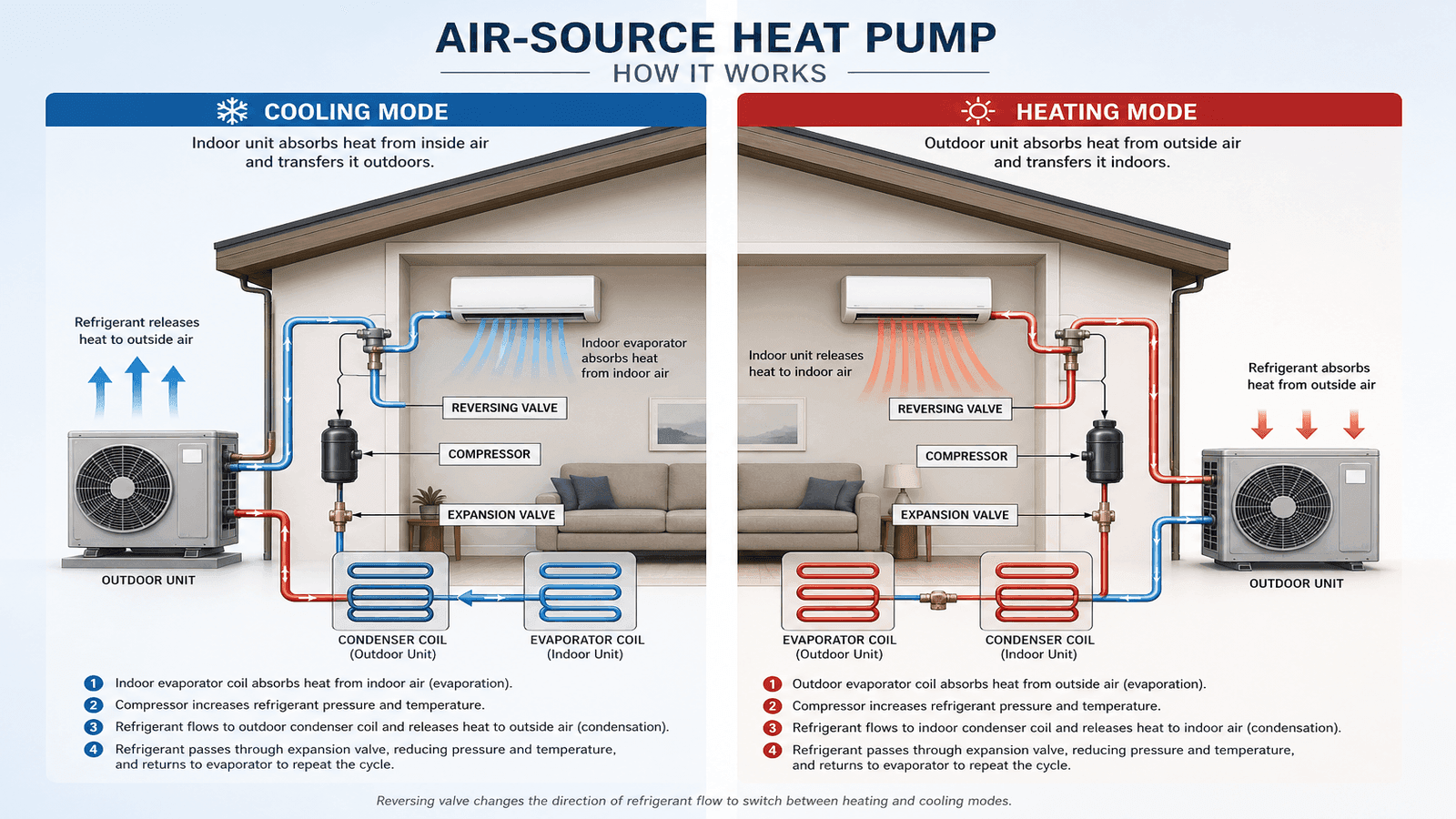
Photo: Diagram showing how an air-source heat pump works in heating and cooling modes with refrigerant cycle arrows
Cost comparison: A heat pump installation averages $9,400 to $16,750 for a 2.5 to 3 ton air-source system in an existing home [3]. This is higher than a basic AC-only installation but lower than purchasing separate heating and cooling equipment. The federal tax credit covers up to $2,000 (or 30% of cost, whichever is less) for systems meeting ENERGY STAR Most Efficient criteria [4].
Case study: Marcus in Charlotte, NC replaced a 17-year-old, 10 SEER AC and gas furnace with a 17.5 SEER2 air-source heat pump system. Total installed cost was $12,800, reduced to $10,800 after the federal tax credit. His combined heating and cooling costs dropped from $2,400 annually to $1,560, a 35% reduction. The system paid for the price difference within six years.
Get quotes from top-rated pros.
In Minneapolis, I install cold-climate heat pumps that heat efficiently at -15 degrees F. Ten years ago, recommending a heat pump in Minnesota would have been questioned by every colleague in the shop. The technology has changed that completely. For homes with natural gas, I now recommend dual-fuel systems as the default. The heat pump handles 80% of the heating season, and the gas furnace kicks in only during the coldest stretches.
Ductless Mini-Split Systems
Ductless mini-splits use individual wall-mounted, ceiling-mounted, or floor-mounted indoor units (called heads or cassettes) connected to an outdoor compressor by small refrigerant lines. No ductwork is required. Each indoor unit conditions a specific zone and can be controlled independently.
This system type is experiencing rapid growth. The global ductless HVAC market reached $94.26 billion in 2026 and is projected to grow at 7.6% annually through 2033 [2]. The residential segment accounts for 53.4% of ductless system sales.
Why ductless systems are so efficient:
Mini-splits eliminate the 15-25% energy loss associated with ductwork in conventional forced-air systems [6]. Without ducts, every unit of conditioned air reaches the living space. Top-tier mini-splits achieve SEER2 ratings of 30 to 35, compared to 14-22 SEER2 for most ducted systems [2]. Upgrading from a standard system to an 18-22 SEER2 mini-split can cut cooling energy use by 20-40%.
Ideal applications for ductless systems:
- Older homes without ductwork: Installing ducts in a home that was never designed for them costs $2,100 to $4,000 for a 2,000 square foot house and often requires significant renovation. A ductless system avoids this entirely.
- Room additions and converted spaces: Garages, attics, basements, and additions often cannot connect to the existing duct system efficiently.
- Multi-zone temperature control: Each indoor unit operates independently. An upstairs bedroom can be set to 68 degrees F while the downstairs living room stays at 72 degrees F.
- Supplemental heating and cooling: A single-zone mini-split ($3,000 to $5,000 installed) can condition a problem room without modifying the whole-house system.
Cost range: A single-zone ductless system costs $3,000 to $5,000 installed. Multi-zone systems (one outdoor unit serving 2-5 indoor heads) run $5,000 to $18,000 depending on capacity and number of zones [3]. Operating costs are typically 20-40% lower than comparable ducted systems.
Trade-offs to consider: Each indoor unit is visible on the wall or ceiling. Some homeowners find the aesthetics objectionable, though recessed ceiling cassettes and slim-profile units minimize visual impact. Installation requires a 3-inch hole through the exterior wall for each indoor unit. In very cold climates, ductless systems may need supplemental heating below -10 degrees F unless sized for cold-climate performance.
Packaged Systems
Packaged HVAC systems house all components, including the compressor, condenser, evaporator, and air handler, inside a single outdoor cabinet. They are installed on rooftops, concrete pads adjacent to the building, or crawlspace-adjacent platforms.
Common packaged system configurations:
- Packaged air conditioner with gas heat: Combines an AC section with a gas furnace section in one unit.
- Packaged heat pump: Provides both heating and cooling from a single cabinet.
- Packaged dual-fuel: Combines a heat pump with a gas furnace backup in one unit.
Packaged systems are most common in manufactured homes, commercial buildings, and residential properties in the South and Southwest where basements and utility closets are rare. They require less indoor space than split systems because there is no indoor air handler or furnace to accommodate.
Cost range: Packaged systems typically cost $5,000 to $14,000 installed, depending on capacity and configuration. Efficiency ratings generally run 1-2 SEER2 points lower than comparable split systems because of the longer refrigerant runs and exposure to outdoor temperatures [7].
Advantages: Simplified installation (single connection point), reduced indoor noise, easier maintenance access (all components in one location), and no indoor floor space required. Packaged units are also faster to install, which reduces labor costs.
Disadvantages: Lower efficiency compared to split systems, more exposure to weather elements, and limited options for high-efficiency variable-speed configurations. Rooftop units require structural assessment to confirm the roof can support the weight (300-400 pounds for residential units).
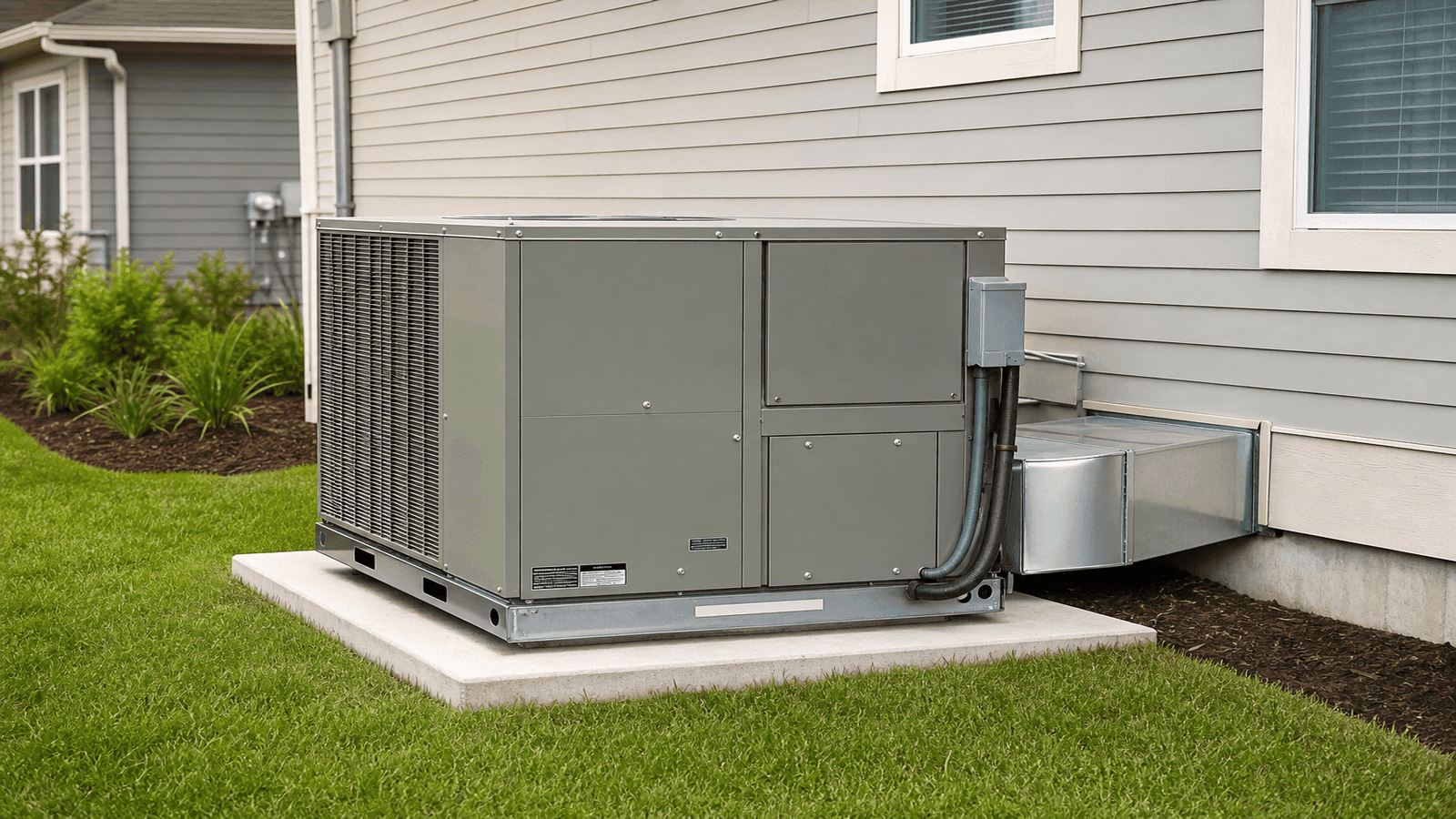
Photo: Packaged HVAC unit installed on a concrete pad beside a residential home showing the single-cabinet design
Dual-Fuel Hybrid Systems
Dual-fuel systems combine a heat pump with a gas furnace in a single integrated setup. The system automatically switches between electric heat pump operation and gas furnace operation based on outdoor temperature, choosing whichever fuel source is more cost-effective at any given moment.
HVAC professionals in the NearbyHunt network report that dual-fuel heat pump systems now account for roughly 45% of new installations in Northern states, up from under 15% just five years ago. This growth reflects improvements in heat pump performance and rising natural gas prices in many regions.
How dual-fuel switching works:
The system monitors outdoor temperature and compares operating costs for each fuel source at a predetermined balance point, typically set between 25 and 35 degrees F depending on local electricity and gas rates. Above the balance point, the heat pump runs because it produces 200-300% efficiency (2-3 units of heat per unit of electricity). Below the balance point, the gas furnace takes over because it maintains consistent output regardless of outdoor temperature.
Cost range: Dual-fuel systems run $8,000 to $18,000 installed, reflecting the cost of both a heat pump outdoor unit and a gas furnace indoor unit [3]. The operating cost savings over a gas-only or electric-only system typically range from 15-30% annually, depending on climate zone and local energy prices.
Best candidates for dual-fuel systems:
- Homes in DOE climate zones 4-7 (roughly the northern half of the U.S.)
- Properties with existing natural gas service
- Homeowners who want maximum efficiency without sacrificing heating reliability during extreme cold
- Regions where electricity rates are low relative to natural gas
Dual-fuel is what I recommend for 90% of my Minneapolis installations where gas service is already available. The heat pump covers about 80% of the heating season on its own. The furnace only fires during those 4-6 week stretches of extreme cold. My customers see 20-30% savings on their heating bills compared to a gas furnace running all winter.
HVAC System Comparison
Selecting between system types requires comparing costs, efficiency, lifespan, and suitability for your specific situation. The following table summarizes the key differences.
Get quotes from top-rated pros.
| System Type | Installed Cost | SEER2 Range | Lifespan | Best For |
| Split System (AC + Furnace) | $7,000 to $14,000 | 14.3 to 22 | 15-20 years (AC), 20-30 years (furnace) | Homes with existing ductwork |
| Air-Source Heat Pump | $9,400 to $16,750 | 14.3 to 22 | 15 years average | Moderate to warm climates, whole-home replacement |
| Ductless Mini-Split | $3,000 to $18,000 | 16 to 35 | 15-20 years | No ductwork, additions, zone control |
| Packaged System | $5,000 to $14,000 | 13 to 18 | 15 years average | Limited indoor space, manufactured homes |
| Dual-Fuel Hybrid | $8,000 to $18,000 | 14.3 to 22 | 15-20 years | Cold climates with gas service |
| Geothermal Heat Pump | $15,000 to $35,000 | 30+ (EER) | 20-25 years (indoor), 50+ years (ground loop) | Long-term investment, high efficiency |
Efficiency context: The federal minimum for split-system air conditioners is 14.3 SEER2 in Southern states and 13.4 SEER2 in Northern states [9]. Every 1 SEER2 point above minimum saves approximately 5-7% on cooling costs. A 20 SEER2 system costs roughly 30% less to cool than a 14.3 SEER2 system in the same home.
How to Choose the Right System
The right HVAC system depends on five key factors specific to your home and situation. Working through each one narrows your options quickly.
1. Existing infrastructure. If your home has ductwork in good condition, a split system or ducted heat pump is the most cost-effective path. If ducts are absent, damaged beyond repair, or inaccessible, ductless mini-splits avoid the $2,100 to $4,000 cost of new duct installation. If natural gas is available, dual-fuel becomes an option worth evaluating.
2. Climate zone. In DOE climate zones 1-3 (the South and Southwest), a standard air-source heat pump handles both heating and cooling efficiently year-round. In zones 4-5, a cold-climate heat pump or dual-fuel system performs best. In zones 6-7 (the upper Midwest and Northeast), dual-fuel systems or cold-climate heat pumps paired with backup heat provide the most reliable comfort.
3. Budget and payback period. A standard-efficiency split system costs less upfront but more to operate. A high-efficiency heat pump or mini-split costs more initially but delivers 20-40% lower operating costs. The typical payback period for the efficiency upgrade is 5-8 years, after which you save money every year for the remaining equipment life.
4. Home size and layout. Homes under 1,500 square feet can often be served by a single-zone system. Homes over 2,000 square feet with multiple floors benefit from zoned systems (multi-head mini-splits or ducted systems with zone dampers). Open floor plans distribute conditioned air more evenly than homes with many small rooms.
5. Tax credits and rebates. The federal tax credit covers up to $2,000 for qualifying heat pump installations [4]. State and utility rebate programs can add $500 to $8,000 in additional incentives. These credits can shift the cost comparison significantly in favor of heat pump systems.
When to call a professional: A qualified HVAC contractor should perform a Manual J load calculation to determine the correct system size for your home. Oversized equipment short-cycles (turns on and off frequently), reducing efficiency, increasing humidity, and wearing out components faster. Undersized equipment runs constantly and cannot maintain comfort during peak conditions. Find a qualified HVAC professional near you to get a proper assessment.
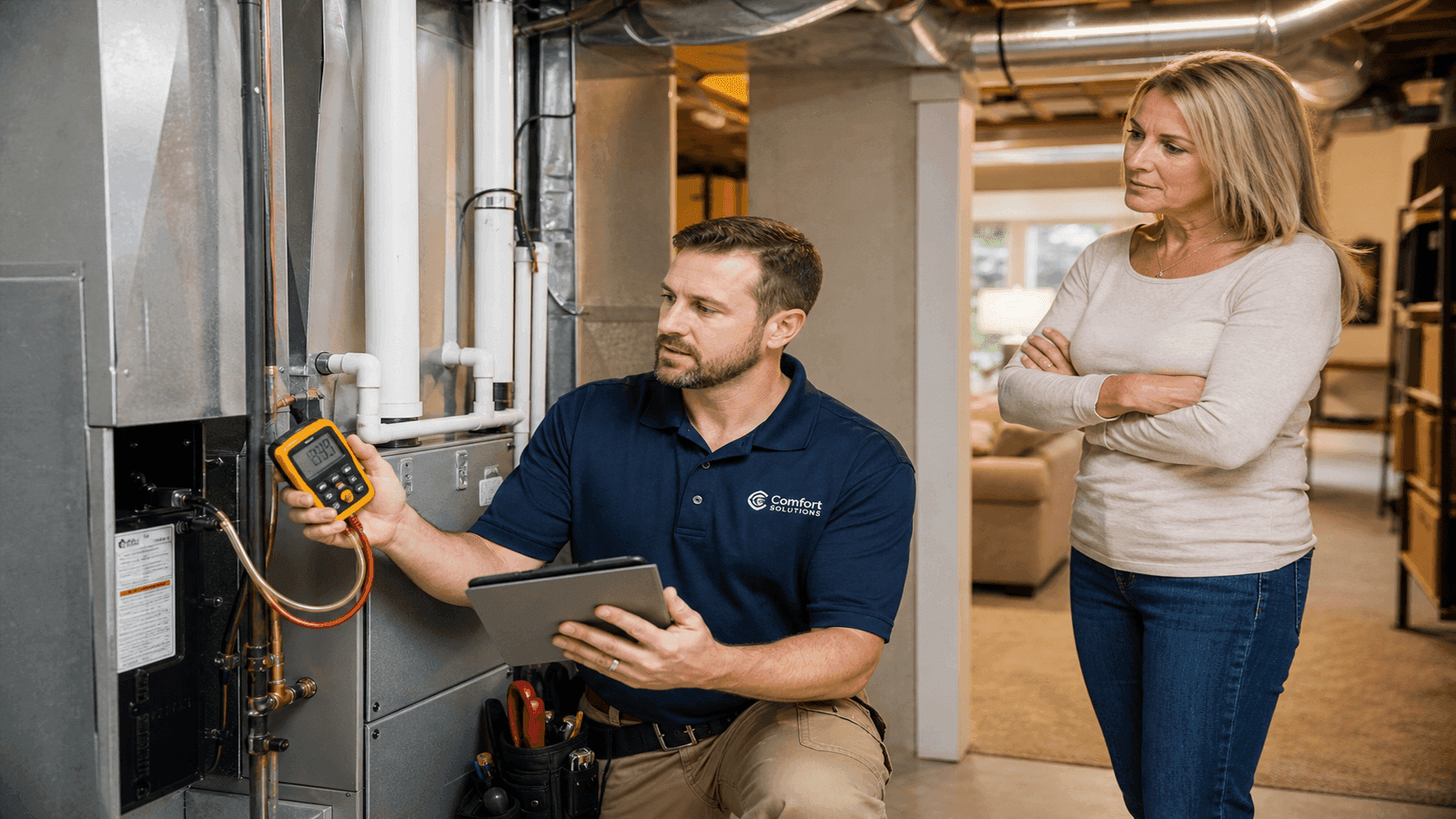
Photo: HVAC contractor performing a home assessment with measuring tools for system sizing
Maintenance by System Type
Every HVAC system type requires specific maintenance to reach its full rated lifespan and maintain efficiency. Neglected systems lose 5% efficiency per year of skipped maintenance and fail years earlier than maintained equipment.
Split system maintenance:
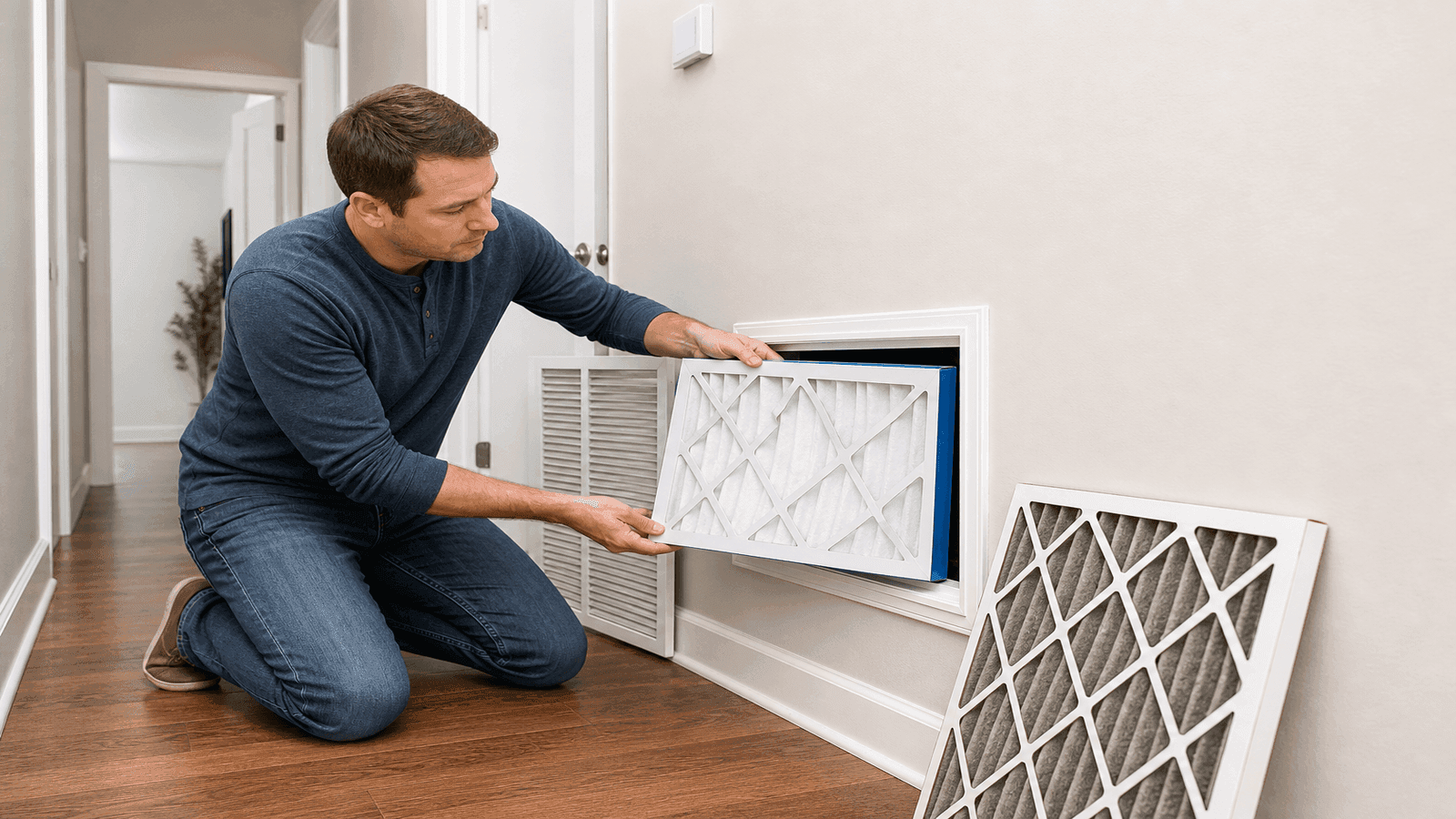
- Replace air filters every 1-3 months (most critical task for any forced-air system)
- Annual professional tune-up for both indoor and outdoor units ($100 to $200 per visit)
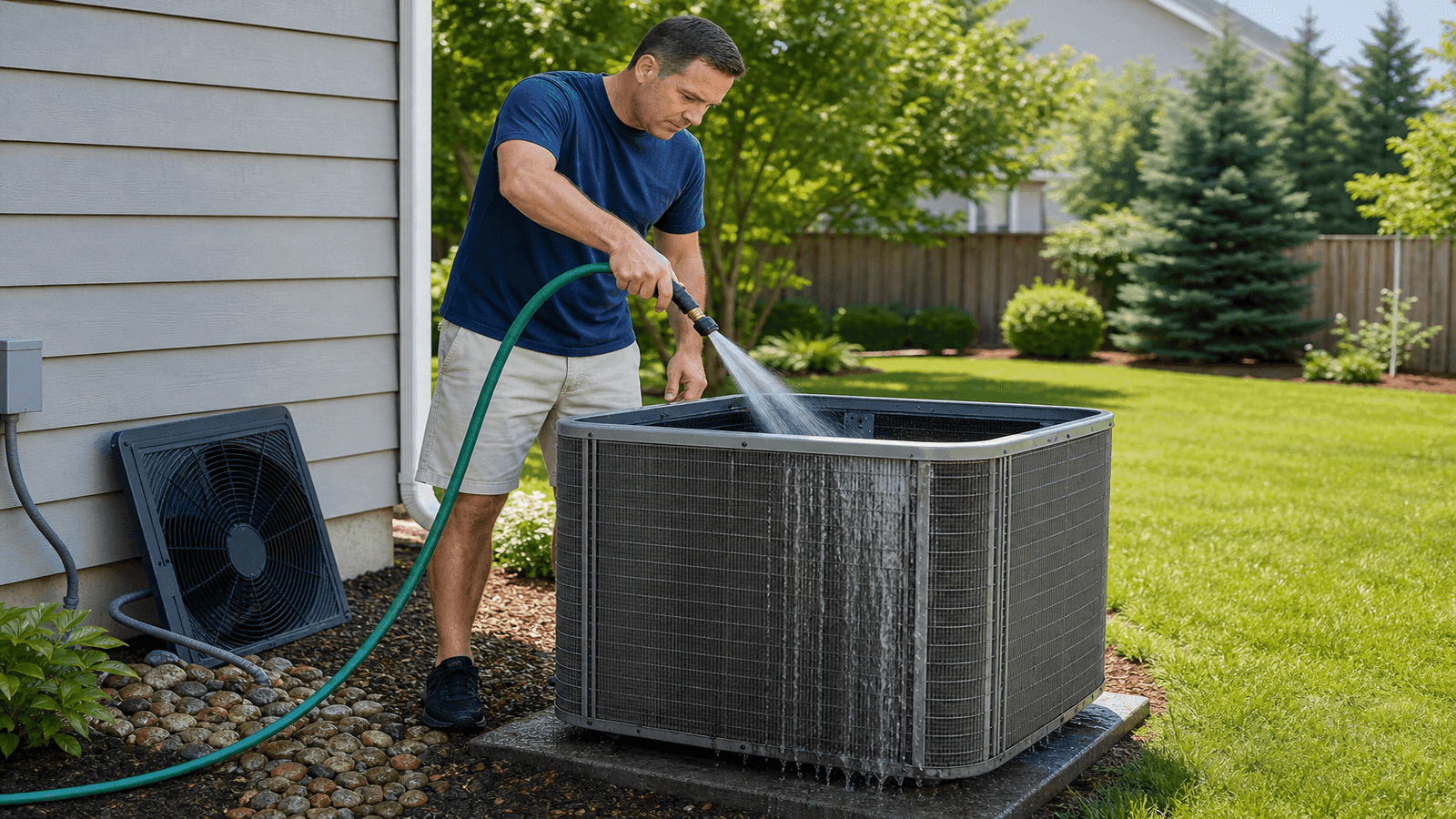
- Clean outdoor condenser coils annually, remove debris and vegetation within 2 feet
- Inspect and seal ductwork every 3-5 years
Heat pump maintenance:
- All of the above, plus check the reversing valve and defrost cycle operation annually
- Clean or replace the filter monthly during heavy-use seasons (heat pumps run year-round)
- Keep outdoor unit clear of snow and ice buildup in winter
- Check refrigerant charge annually (heat pumps are more sensitive to low charge than AC-only systems)
Ductless mini-split maintenance:
- Clean indoor unit filters every 2-4 weeks (washable filters make this easy)
- Professional cleaning of indoor coils and blower wheels annually ($150 to $250 per unit)
- Check refrigerant lines for damage where they enter the exterior wall
- Flush condensate drain lines seasonally to prevent mold growth
Packaged system maintenance:
- Quarterly filter changes
- Semi-annual professional service ($125 to $225 per visit)
- Clear vegetation and debris around the unit regularly
- Inspect cabinet seals and weatherstripping for air leaks
Case study: Jennifer in Cleveland, OH skipped maintenance on her 8-year-old heat pump for three consecutive years. When she called for service after the system failed to heat adequately, the technician found a completely blocked evaporator coil, a burned-out defrost board, and low refrigerant from a slow leak. Repair cost: $2,800. A $150 annual tune-up would have caught all three issues early, with an estimated repair cost under $400 total.
Energy Efficiency Standards
Understanding efficiency ratings helps you compare systems accurately and estimate operating costs before you buy.
SEER2 (Seasonal Energy Efficiency Ratio 2) measures cooling efficiency over a typical cooling season. Higher numbers mean lower cooling costs. The federal minimum is 14.3 SEER2 for Southern states and 13.4 SEER2 for Northern states as of 2023 [9]. Premium systems reach 22 SEER2 (ducted) or 35 SEER2 (ductless).
HSPF2 (Heating Seasonal Performance Factor 2) measures heat pump heating efficiency. The federal minimum is 7.5 HSPF2. High-efficiency models achieve 9 to 10+ HSPF2 [9]. Higher HSPF2 means lower heating bills.
AFUE (Annual Fuel Utilization Efficiency) measures gas furnace efficiency as a percentage of fuel converted to heat. Standard furnaces are 80% AFUE; high-efficiency condensing furnaces reach 95-98% AFUE.
EER2 (Energy Efficiency Ratio 2) measures cooling efficiency at a single outdoor temperature (95 degrees F). This rating matters most in consistently hot climates. The federal minimum for split systems is 12 EER2.
Federal tax credit requirements for 2026: To qualify for the $2,000 heat pump tax credit, systems must be recognized as ENERGY STAR Most Efficient. Requirements include meeting specific SEER2, HSPF2, and EER2 thresholds through one of two pathways: Path A for cold-climate installations or Path B for cooling-dominated and dual-fuel applications [4].
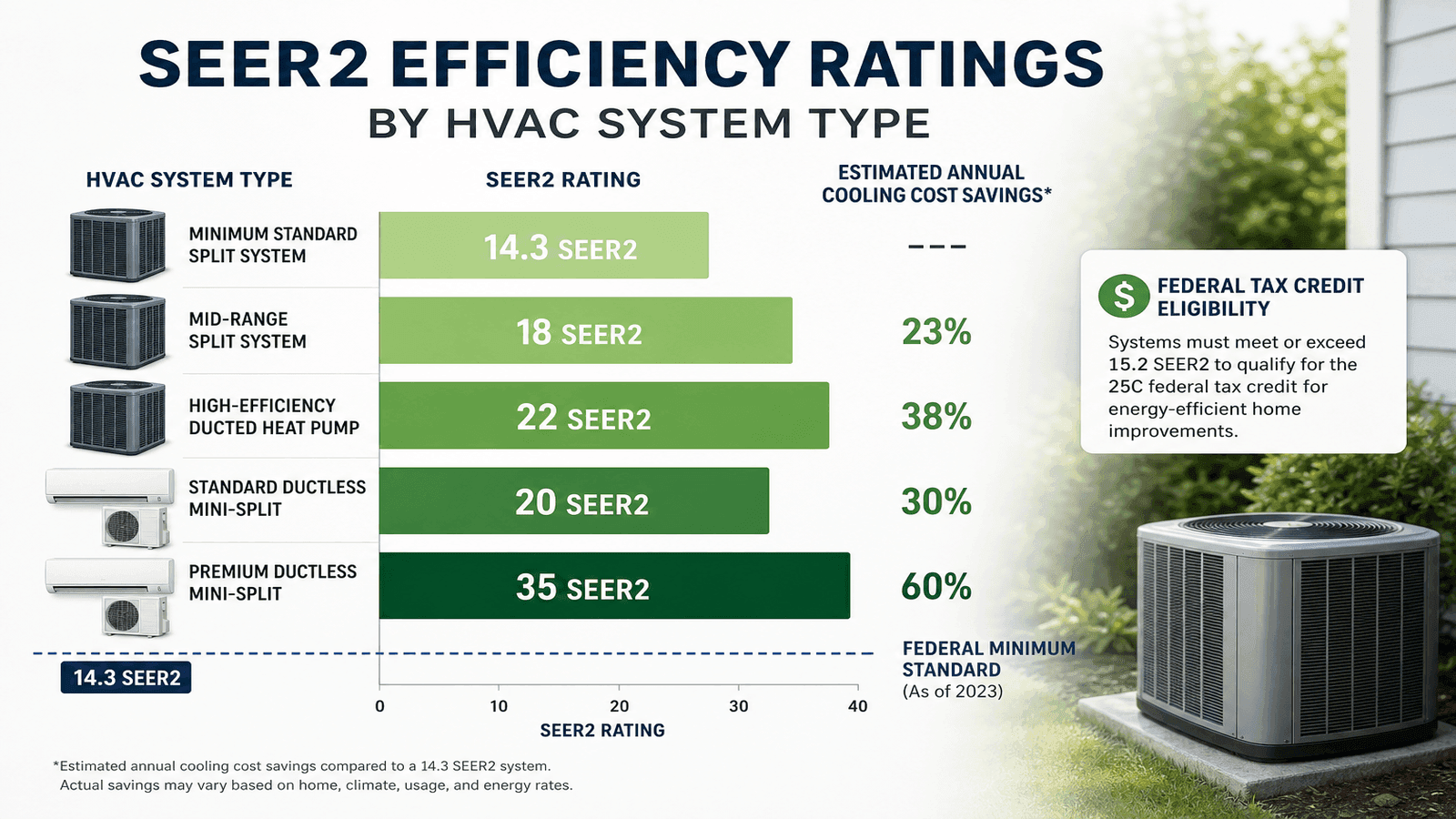
Photo: Infographic comparing SEER2 efficiency ratings across different HVAC system types with cost savings estimates
Disclaimer: This article provides general educational information about HVAC systems and services. It is not intended as professional HVAC advice for specific situations. Local building codes, climate conditions, and individual home characteristics vary significantly. Always consult a licensed, certified HVAC professional for system-specific recommendations, installations, and repairs. Cost estimates are national averages as of 2026 and may differ in your area.
Sources
- U.S. DOE. "Heating and Cooling."
- ENERGY STAR. "Heat Pumps."
- Canary Media. "Heat Pump Sales 2025."
- ACCA. "Manual J."
- Grand View Research. "US HVAC Market."

Daniel is an EPA-certified HVAC technician & Energy Efficiency Consultant with over 14 years of experience in maintaining and installing heating and cooling systems throughout the Midwest. Passionate about sustainability, Dan specialises in energy-efficient retrofits and intelligent climate control systems. He writes for NearbyHunt to help homeowners extend the lifespan of their HVAC units while lowering utility bills.

Christine is an EPA-certified HVAC professional with 17 years of experience in heating, cooling, and indoor air quality systems. She has managed large-scale residential installations and worked as a technical trainer for new HVAC apprentices. Chris’s reviews focus on accuracy, safety, and performance standards in modern HVAC practices.