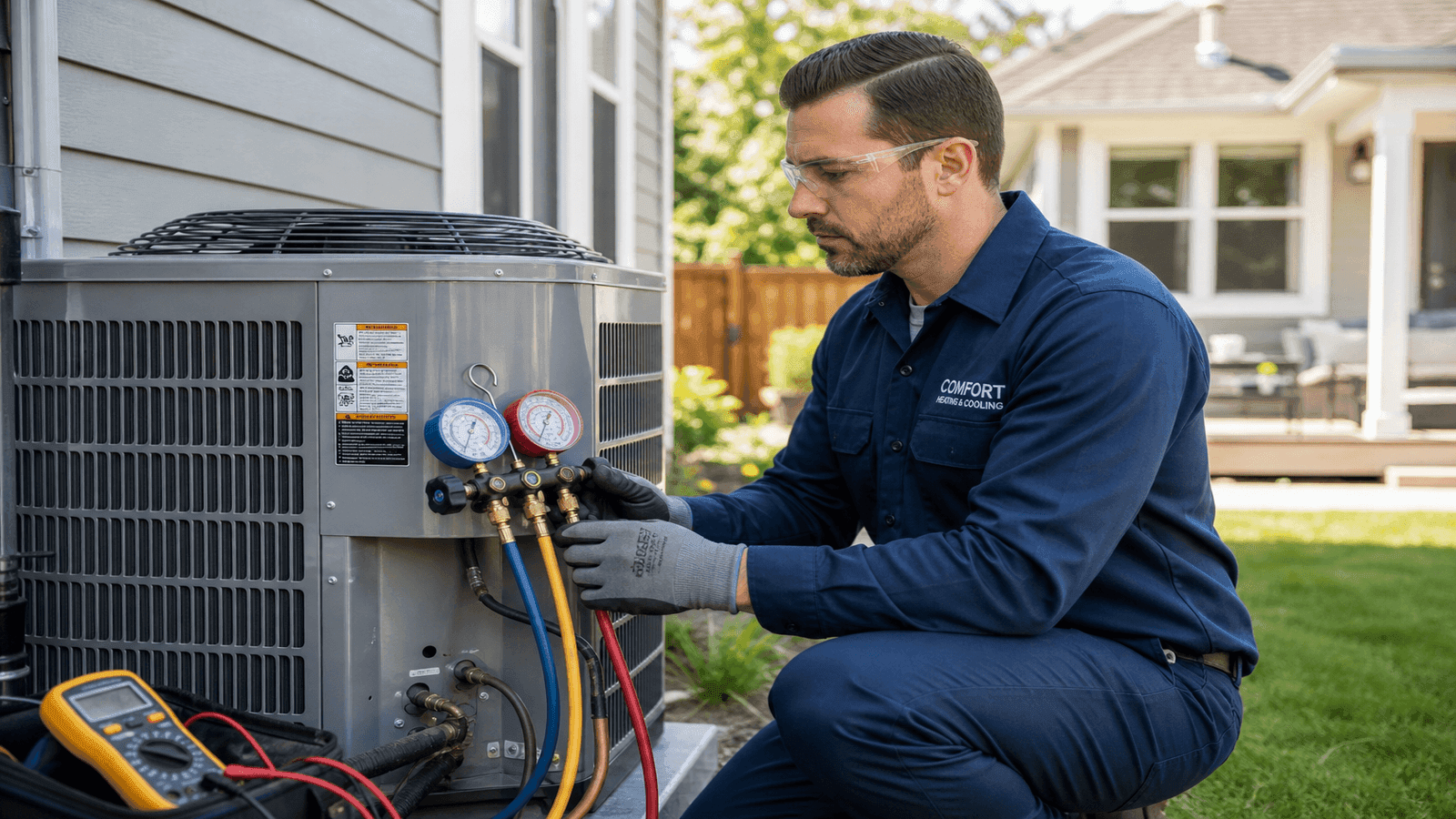
- EPA Section 608 certification is required by federal law for any technician who handles, purchases, or disposes of refrigerants under the Clean Air Act [1].
- NATE certification is the leading voluntary credential in the HVAC industry, recognized by major manufacturers including Carrier, Trane, Lennox, and Rheem [2].
- State licensing requirements vary significantly, with some states requiring contractor exams, years of documented experience, insurance, and bonding, while others delegate licensing to municipalities [3].
- Manufacturer certifications from brands like Carrier, Trane, and Lennox often determine whether a contractor can offer extended factory warranties on installed equipment.
- The HVAC industry faces a shortage of 110,000 technicians, making certified professionals increasingly valuable to both employers and homeowners seeking qualified service [4].
- Homeowners should verify at minimum EPA 608 and state licensing before hiring any HVAC contractor, and look for NATE certification as a marker of higher diagnostic skill.

Get quotes from top-rated pros.
A typical HVAC system replacement costs $7,000 to $12,000, and installation quality directly determines whether that system runs efficiently for 15 to 20 years or develops problems within the first five [5]. Yet most homeowners have no way to evaluate whether the technician bidding on their project actually knows what they are doing.
HVAC certifications exist at multiple levels: federal requirements every technician must meet, voluntary industry credentials demonstrating advanced competence, state licenses authorizing legal operation, and manufacturer programs qualifying dealers for factory warranty support. This guide, expanding on the certifications overview in the All About HVAC pillar, breaks down what each certification means and how to verify credentials before signing a contract.
Certifications are not just pieces of paper. The EPA 608 exam tests whether a technician understands refrigerant chemistry and environmental regulations. NATE exams test whether they can actually diagnose a failing system. I have worked alongside technicians who could install equipment all day but could not troubleshoot a bad capacitor or calculate proper refrigerant charge. The certifications that require ongoing education are the ones that separate competent technicians from the rest.
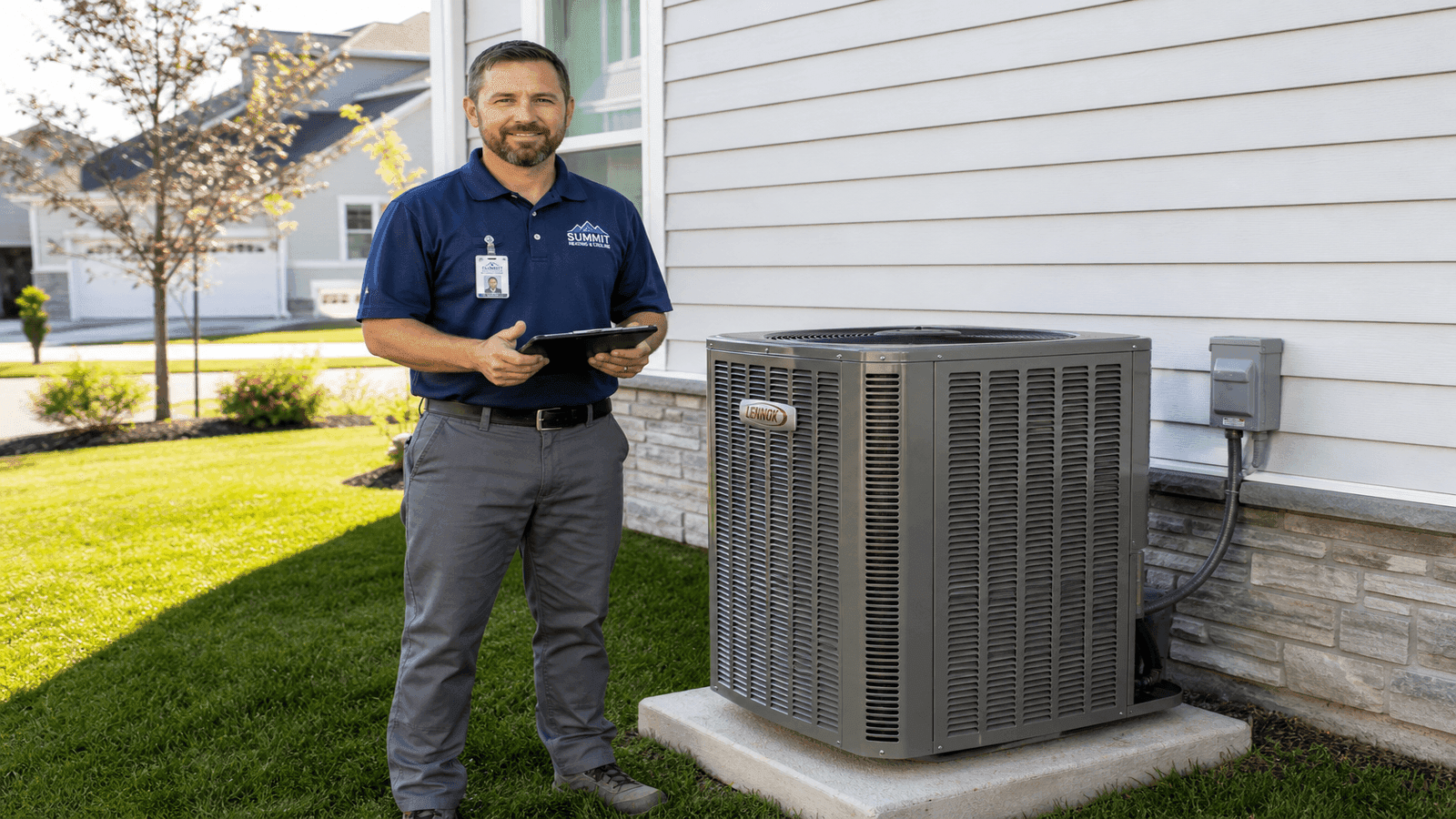
Photo: Professional HVAC technician in company uniform standing next to a residential outdoor condensing unit, holding a clipboard and displaying professional credentials.
EPA Section 608 Certification
EPA Section 608 is the only HVAC credential required by federal law. Under the Clean Air Act, anyone who maintains, services, or disposes of equipment that could release refrigerants must hold this certification. Working without it is a federal violation carrying fines of up to $44,539 per day [1]. The certification exists because refrigerants are regulated substances: older R-22 depletes the ozone layer, while newer R-410A and R-454B have high global warming potential.
The Four EPA 608 Types
EPA 608 certification is divided into four types, each covering different equipment categories:
Type I covers small appliances (under 5 lbs refrigerant) like window units and refrigerators. The only section that may be taken open-book online [1].
Type II covers high-pressure systems including most residential central AC, heat pumps, and commercial rooftop units. This is the certification most relevant to residential work. Must be proctored [1].
Type III covers low-pressure commercial and industrial chillers.
Universal requires passing all three types plus Core. Most professional HVAC technicians pursue Universal for maximum flexibility [1].
Exam Structure and Requirements
Each section contains 25 questions with a 72% passing threshold (18 correct). The Core exam covers ozone depletion, the Montreal Protocol, recovery/recycling rules, leak repair, and refrigerant safety. There are no prerequisites: no minimum experience, education, or apprenticeship hours required. Exams must be administered by an EPA-approved certifying organization such as ESCO Institute or RSES [1].
What EPA 608 Does and Does Not Tell You
Once earned, EPA 608 certification does not expire and is valid for life [1]. This is important context: a technician with EPA 608 has demonstrated knowledge of refrigerant handling, but the certification does not test installation quality, diagnostic ability, or system design skills. It is the legal minimum, not a measure of excellence.
Every technician I hire must have EPA 608 Universal. It is the baseline. But I have interviewed candidates with Universal certification who could not explain the difference between subcooling and superheat. The EPA exam covers regulations and environmental protection. It does not test whether someone can properly charge a system or diagnose a bad reversing valve. That is where NATE and hands-on experience come in.
NATE Certification
NATE (North American Technician Excellence) is the most widely recognized voluntary certification in the HVAC industry. While EPA 608 is a legal requirement, NATE certification demonstrates that a technician has passed rigorous testing on real-world HVAC diagnostics, installation practices, and system knowledge beyond entry-level competence [2].
The U.S. Department of Energy recognizes NATE as the leading certification program for HVAC technicians. Major manufacturers including Carrier, Trane, Lennox, Rheem, and Daikin accept or require NATE certification for their dealer programs [2]. For homeowners, a NATE-certified technician represents a higher standard of training and accountability than the legal minimum.
NATE Exam Structure
NATE offers two pathways. The Traditional Pathway requires a Core exam (50 questions) plus at least one Specialty exam (100 questions) in areas like air conditioning, heat pumps, gas furnaces, or air distribution. The CHP-5 Pathway covers five exams: HVAC Fundamentals, Electrical and Controls, Comfort and Airflow, Installation, and Service. Both require a 70% passing score [2].
NATE recommends two years of field experience before testing. Fees range from $150 to $250. Unlike EPA 608, NATE expires every two years and requires 16 hours of continuing education for renewal, keeping technicians current with new refrigerants, efficiency standards, and equipment technology [2].
Get quotes from top-rated pros.
What NATE Tells Homeowners
NATE exams test diagnostic reasoning, electrical troubleshooting, airflow measurement, refrigerant charge verification, duct sizing, and system performance evaluation. These are the skills that determine whether your system is installed correctly, sized properly, and running at rated efficiency. The NearbyHunt network reports that homeowners who request NATE-certified technicians report higher satisfaction rates, particularly for heat pump installations and system replacements.
When I hire technicians, NATE certification is the first thing I look for. It tells me they understand the science, not just the mechanics. I have seen uncertified installers put in systems that look fine but run 30% less efficiently because they did not check static pressure, verify refrigerant charge, or calculate duct sizing. The certification matters because the details matter.
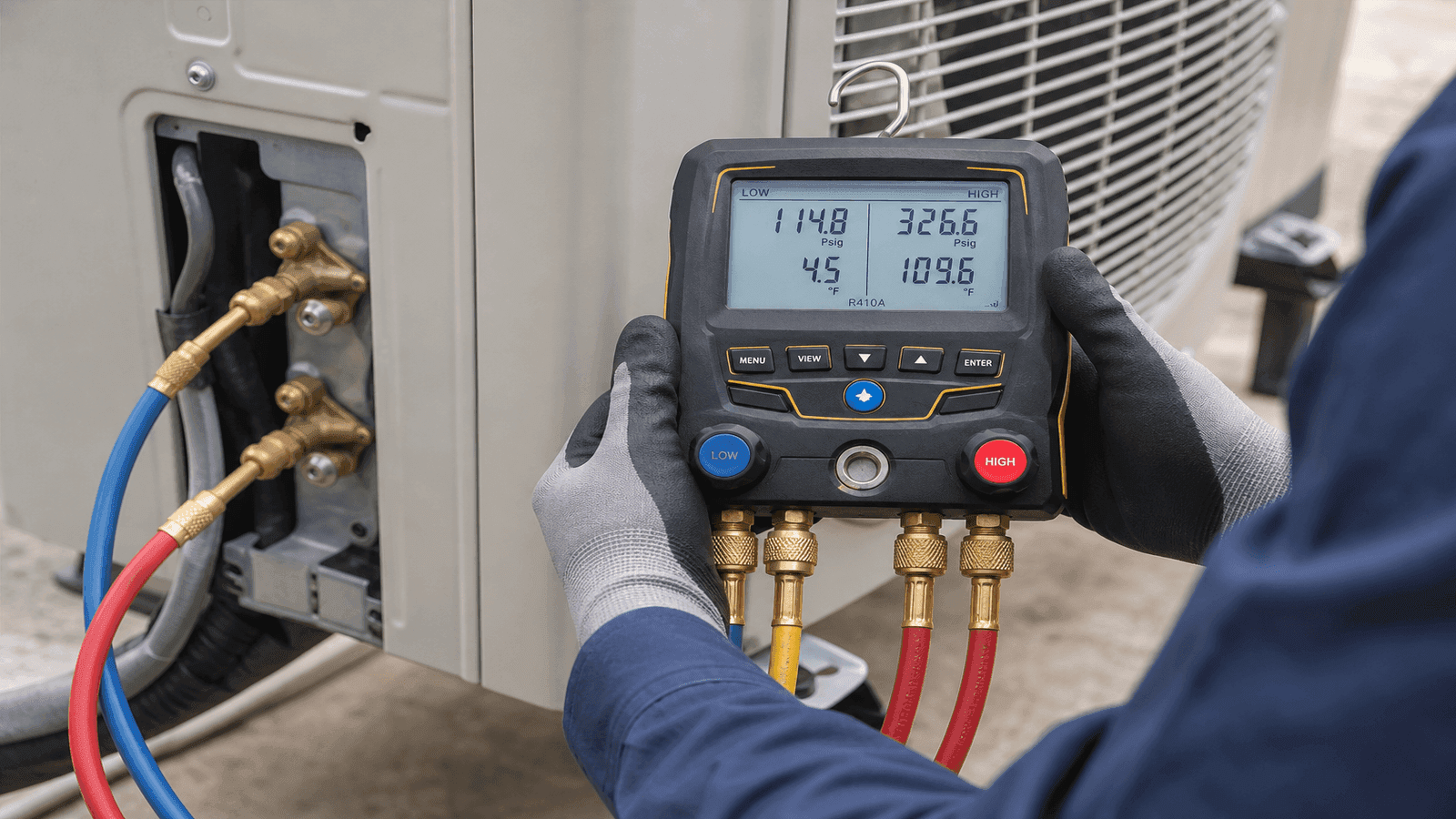
Photo: HVAC technician using a digital manifold gauge set to verify refrigerant charge on a residential air conditioning condensing unit, demonstrating diagnostic skills tested in NATE certification.
State and Local HVAC Licensing
Beyond federal EPA requirements and voluntary NATE certification, most states impose their own licensing requirements for HVAC contractors. State licensing is primarily about consumer protection: ensuring that contractors carry insurance, meet minimum experience thresholds, and pass exams covering local building codes and business practices [3].
How State Licensing Works
State HVAC licensing typically distinguishes between two levels:
Technician License (or Journeyman License): Authorizes a person to perform HVAC work under the supervision of a licensed contractor. Requirements usually include completion of an apprenticeship or trade school program plus 2 to 4 years of documented field experience [3].
Contractor License (or Master License): Authorizes a person to own and operate an HVAC business, pull permits, and take responsibility for all work performed. Requirements are more demanding: typically 4 to 5 years of verifiable experience, passing both a trade exam and a business/law exam, proof of liability insurance, workers' compensation insurance, and a surety bond [3].
State Licensing Varies Significantly
Requirements differ dramatically. California requires four years of experience, trade and business/law exams, a $25,000 bond, and liability insurance. Texas uses technician-level licensing at the state level and defers contractor licensing to municipalities. Georgia requires 4 to 5 years of experience, a 70% exam score, and a $10,000 surety bond [3].
A valid state license confirms minimum experience, exam passage, insurance coverage, and registration with authorities who investigate complaints. Every state with licensing maintains a public online database. Search "[your state] HVAC contractor license lookup" to verify any contractor's status before hiring.
Many municipalities also require separate permits for HVAC installations involving gas line connections or electrical modifications.
Manufacturer Certifications
The major HVAC equipment manufacturers operate their own dealer certification programs that directly affect warranty coverage and installation quality [6].
Each brand operates a tiered dealer program. Contractors who meet training, customer satisfaction, and quality standards earn preferred designations:
- Trane Comfort Specialist: Requires factory training, high customer satisfaction scores, and annual benchmarks. Trane backs these dealers with a satisfaction guarantee [6].
- Carrier Factory Authorized Dealer: Requires NATE-certified technicians, Carrier product training, and business practice standards. These dealers can offer Carrier's full 10-year parts warranty [6].
- Lennox Premier Dealer: Requires factory training, customer satisfaction performance, and access to Lennox's full product line and extended warranty programs [6].
- Rheem Pro Partner: Requires product-specific training and service quality standards with enhanced warranty access.
Why Manufacturer Certifications Matter to Homeowners
Most manufacturers offer a base warranty (typically 5 years on parts) regardless of installer. Extended warranties (10 years on parts, limited lifetime on heat exchangers) are often available only through manufacturer-certified dealers. Choosing a non-certified installer can cost thousands in repairs if a major component fails after the base warranty period. Certified dealers also receive priority factory technical support for complex problems that local technicians cannot resolve independently.

Photo: Interior of a professional HVAC contractor's office showing manufacturer certification plaques and dealer awards displayed on the wall behind a consultation desk.
R-410A and Refrigerant Safety Certifications
R-410A operates at pressures approximately 60% higher than the older R-22 (approximately 400 PSI versus 250 PSI). While EPA 608 covers the legal requirements for handling all refrigerants, R-410A safety certification programs from RSES and ESCO Institute train technicians on high-pressure tools, proper brazing techniques with nitrogen purge, and correct charging procedures specific to R-410A systems [7].
The EPA does not mandate a separate R-410A certification beyond Section 608. However, many manufacturers require it for their dealer programs, and some supply houses restrict R-410A refrigerant sales to technicians who hold it [7].
Starting in 2025, new equipment is transitioning from R-410A to R-454B, which has 78% lower global warming potential but is classified as mildly flammable (A2L). This transition is creating demand for updated technician training on A2L refrigerant handling and modified safety codes [8].
Other Industry Certifications
Beyond EPA, NATE, and manufacturer programs, two additional credentials appear frequently on HVAC resumes:
OSHA 10-Hour Construction: The most common safety certification held by HVAC technicians. It covers fall protection, electrical safety, PPE, and construction-site hazard recognition. While not federally mandated for all HVAC work, many general contractors and some municipalities (notably New York City) require it. The OSHA 10 DOL card does not expire, though many employers require retraining every 3 to 5 years [9].
HVAC Excellence Certifications: A nationally recognized program offering Employment Ready, Professional Technician, and Master Specialist levels. While less well-known to homeowners than NATE, HVAC Excellence credentials are respected within the trade and recognized by employers and trade schools. HVAC Excellence also accredits training programs, ensuring curriculum meets industry standards [10].
How Certifications Work Together
No single certification covers everything. They stack to create a complete professional profile:
Get quotes from top-rated pros.
| Certification | Required? | Renewal |
| EPA Section 608 (Universal) | Yes (federal law) | Never expires |
| NATE Certification | Voluntary | Every 2 years |
| State Contractor License | Varies by state | Typically annual |
| Manufacturer Certification | No (affects warranties) | Varies |
| R-410A Safety | No (often manufacturer-required) | Varies |
| OSHA 10/30-Hour | Varies by jurisdiction | Retraining every 3-5 years |
The technicians I trust the most hold EPA Universal, NATE certification in their specialty, and have completed at least one manufacturer training program. That combination tells me they understand the regulations, can diagnose problems methodically, and know the specific equipment they are working on. When you add a valid state license with insurance, you have a professional who is accountable at every level.
Case Study: The Hendersons' Heat Pump Installation (Overland Park, KS)
Mark and Jennifer Henderson needed to replace a 16-year-old R-22 system in their 2,200-square-foot Overland Park, Kansas home. They received three bids ($9,800 to $14,200). The lowest came from a contractor with EPA 608 but no NATE credentials and no manufacturer dealer status. The middle bid ($11,400) came from a NATE-certified Carrier Factory Authorized Dealer who recommended a dual-fuel heat pump system and included Manual J load calculations, static pressure testing, and refrigerant charge verification.
The Hendersons chose the middle bid. Eighteen months later, heating and cooling costs had dropped 38%. The Carrier extended warranty covered a control board replacement at no cost, a $600 repair under the base warranty alone. The Manual J calculation also revealed the old system had been oversized by a full ton, explaining years of humidity complaints.
Jennifer Henderson told the NearbyHunt network: "We almost went with the cheapest bid. But when the contractor could not show current credentials, that was the red flag. The NATE-certified contractor explained every step, and the installation has been flawless."
NearbyHunt Network Insight
HVAC professionals in the NearbyHunt network report that certification status correlates directly with installation quality. Key findings:
- NATE-certified contractors receive 23% fewer callbacks within the first year after installation.
- Manufacturer-certified dealers resolve approximately 15% of complex service calls through factory technical support that non-certified contractors cannot access.
- The most common certification gap is R-410A safety training: many technicians hold EPA 608 but lack formal high-pressure refrigerant training.
- State licensing verification remains the step homeowners most often skip. An estimated 10 to 15% of HVAC work in unregulated markets is performed by unlicensed individuals.
Find certified HVAC professionals in your area through NearbyHunt
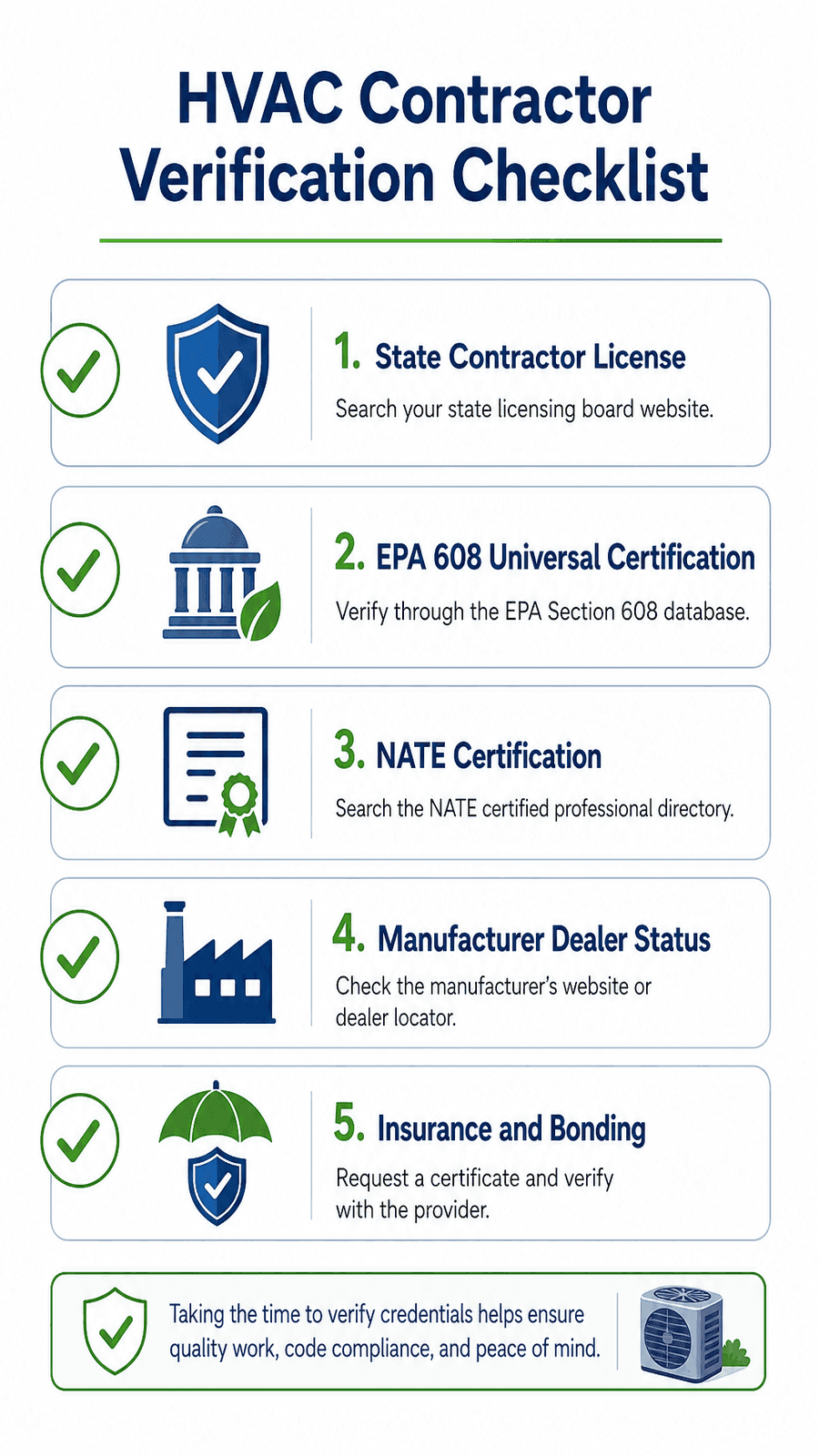
Photo: Infographic showing a five-step HVAC contractor verification checklist covering state license, EPA 608 certification, NATE certification, manufacturer dealer status, and insurance verification.
How to Verify Certifications Before Hiring
Knowing what certifications exist is only useful if you can verify them. Here is how to check each credential, along with the red flags that should stop you from signing a contract:
- EPA 608: Ask to see the technician's card showing their name, certifying organization, and type. No centralized federal database exists, so the card is the primary verification method. Red flag: a contractor who cannot produce this card may be operating illegally [1].
- NATE: Search the public directory at natex.org by name or company. The directory shows certification status, specialty areas, and expiration date. Red flag: a contractor who claims NATE certification but cannot be found in the directory [2].
- State License: Search your state's contractor licensing board website to verify license number, status (active/expired/revoked), disciplinary actions, and insurance. Red flag: a contractor who refuses to provide their license number or says they "don't need one."
- Manufacturer Dealer Status: Use the dealer locator on carrier.com, trane.com, or lennox.com to confirm authorized status. Red flag: a contractor who claims manufacturer dealer status but does not appear in the brand's locator.
- Insurance: Request a certificate of insurance (COI) showing general liability ($1 million minimum) and workers' compensation. Red flag: a contractor who hesitates or cannot provide current proof of insurance.
One additional warning sign: any contractor who offers a low price but refuses to pull permits. Permits ensure code compliance, protect your homeowner's insurance, and prevent problems when you sell the home.
The Technician Shortage and Why Certifications Matter More
The HVAC industry faces a shortage of approximately 110,000 technicians, with 25,000 leaving annually due to retirement and over 50% of the current workforce above age 45 [4]. The shortage could reach 225,000 unfilled positions by 2027. This makes certification verification more important than ever: as demand outpaces supply, less-qualified individuals enter the market. Homeowners who prioritize certified contractors get professionals who have demonstrated competence through testing and maintain their skills through continuing education.
Connect with certified HVAC contractors near you through NearbyHunt
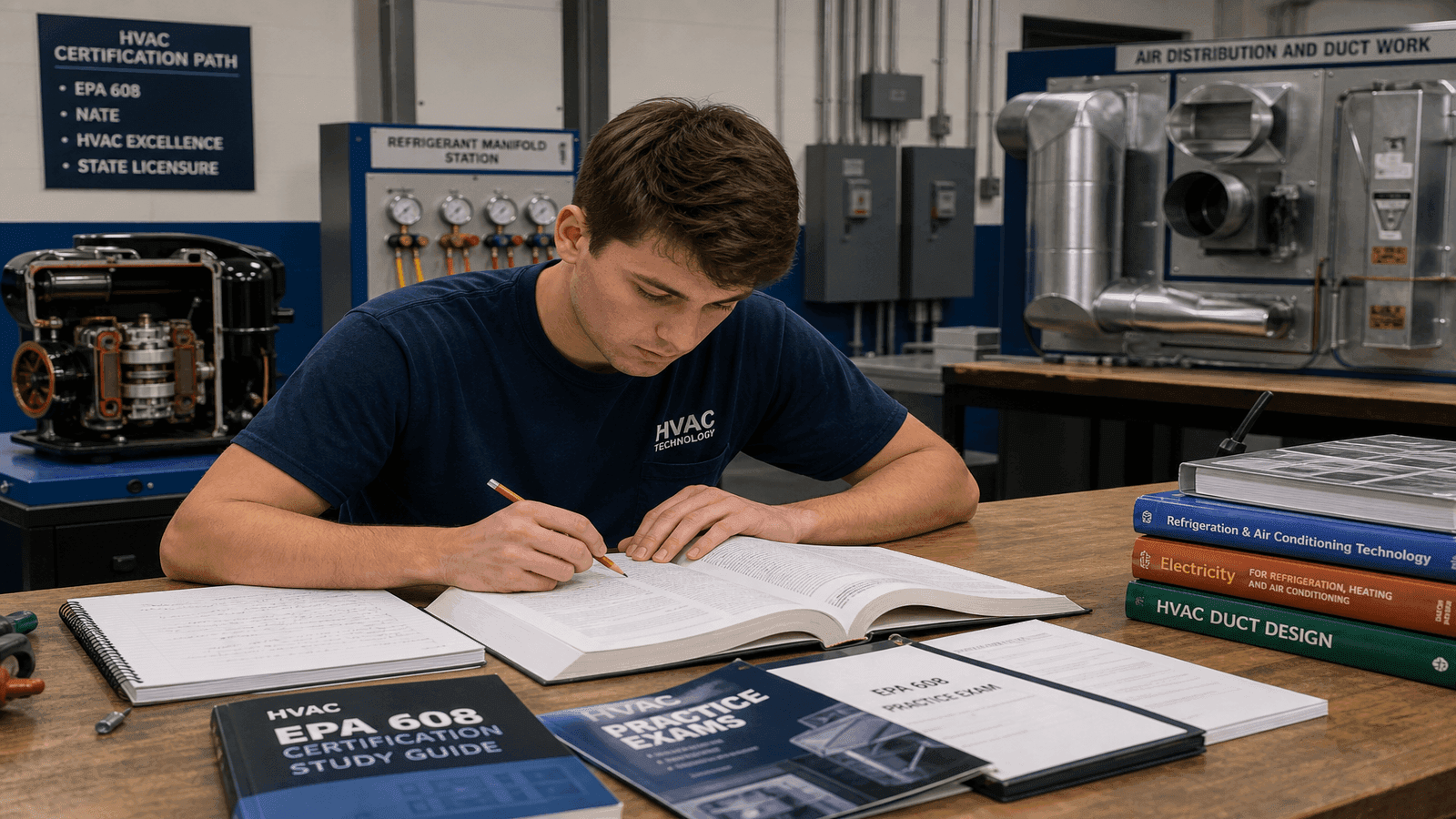
Photo: Young HVAC apprentice studying for certification exams at a trade school workbench, surrounded by study guides and HVAC training equipment in the background.
Conclusion
No single HVAC certification tells the full story. EPA 608 is the legal baseline. NATE demonstrates advanced diagnostic skills. State licensing confirms legal authorization and insurance. Manufacturer certifications qualify you for extended warranties. Together, they create a complete picture of a contractor's qualifications.
The verification process takes less than 30 minutes: check the state license database, search the NATE directory, ask for the EPA 608 card, and confirm manufacturer dealer status online. That half-hour protects a $7,000 to $12,000 investment and directly affects the comfort and efficiency of a system you will live with for 15 to 20 years.
How We Gathered This Data?: Sources include the U.S. EPA, OSHA, Department of Energy, NATE, HVAC Excellence, ESCO Institute, state licensing boards, Bureau of Labor Statistics, and firsthand experience from Daniel Torres (14+ years, EPA 608 Universal, NATE Certified) and the NearbyHunt network of licensed HVAC professionals. Reviewed by Christine Walters (17 years, EPA 608, NATE, OSHA 10-Hour, R-410A Safety Certified).
Disclaimer: This article provides general educational information about HVAC certifications and licensing. It is not intended as legal advice regarding specific state or local licensing requirements. Certification requirements, exam formats, and fees are subject to change by the issuing organizations. Always verify current requirements directly with the relevant certification body or state licensing board. NearbyHunt does not guarantee the accuracy of any contractor's claimed credentials; homeowners should independently verify certifications using the methods described in this article.
Sources & References
[1] U.S. Environmental Protection Agency. "Section 608 Technician Certification Requirements."
[2] North American Technician Excellence (NATE). "NATE Certification." U.S. Department of Energy. "North American Technician Excellence."
[3] Next Insurance. "HVAC License Requirements by State." FieldPulse. "HVAC License Requirements by State." HVAC Schools 411. "State-by-State Licensing Requirements for HVAC Technicians."
[4] ServiceTitan. "HVAC Technician Shortage." U.S. Bureau of Labor Statistics. "Heating, Air Conditioning, and Refrigeration Mechanics and Installers." SMACNA. "Beat the HVAC Technician Shortage."
[5] U.S. Department of Energy. "Heating and Cooling."
[6] Trane. "What is NATE Certification." Spencer Home Services. "Certified HVAC Installers."
[7] Refrigeration Service Engineers Society (RSES). "R-410A Certification." ESCO Institute. "Universal R-410A Safety & Training."
[8] Lennox. "2025 New Refrigerant Transition." ICC. "EPA's Technology Transitions Program."
[9] OSHA. "Construction Industry Outreach Training."
[10] HVAC Excellence / ESCO Group. "Specialty Certifications."
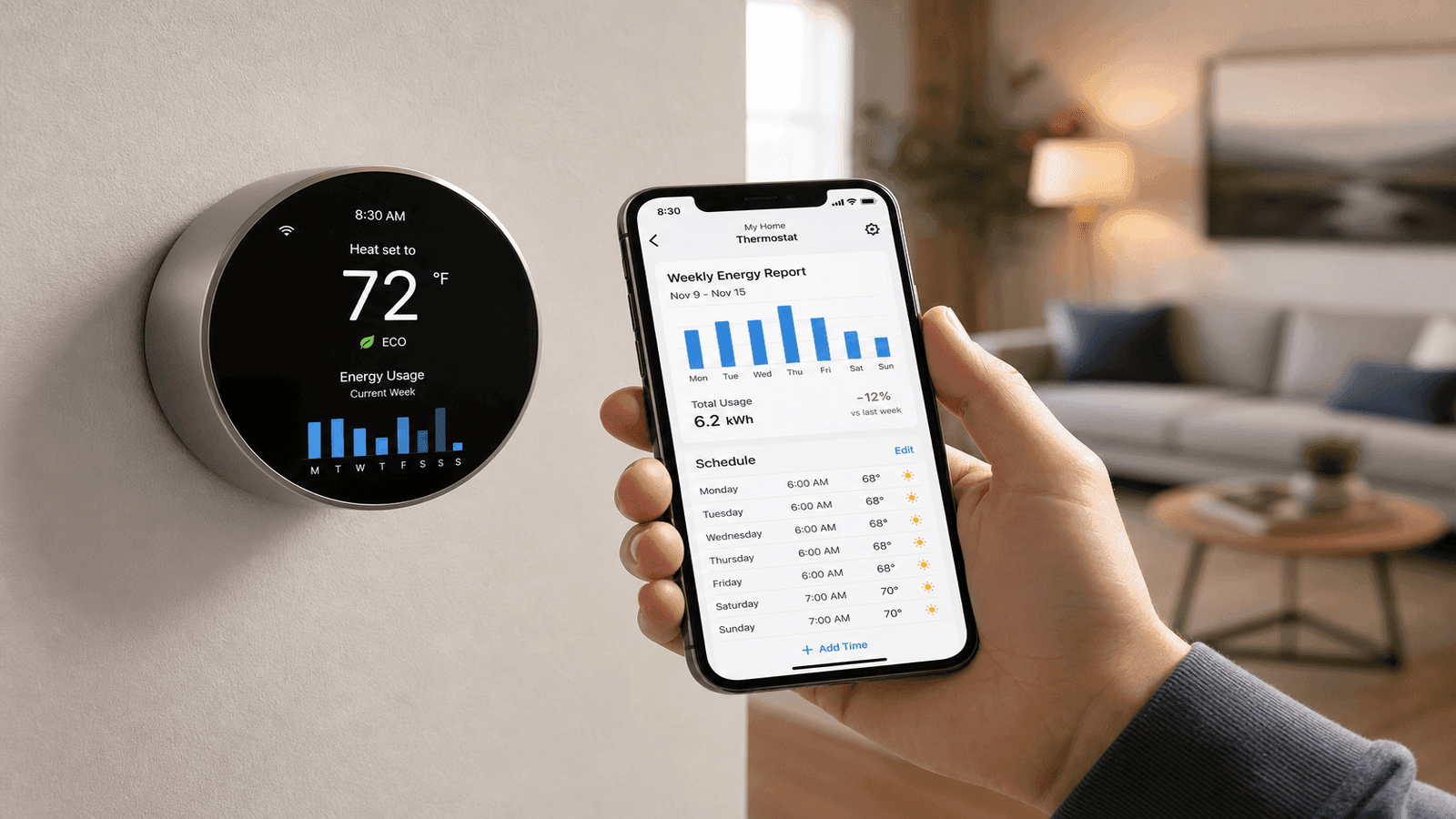

Daniel is an EPA-certified HVAC technician & Energy Efficiency Consultant with over 14 years of experience in maintaining and installing heating and cooling systems throughout the Midwest. Passionate about sustainability, Dan specialises in energy-efficient retrofits and intelligent climate control systems. He writes for NearbyHunt to help homeowners extend the lifespan of their HVAC units while lowering utility bills.

Christine is an EPA-certified HVAC professional with 17 years of experience in heating, cooling, and indoor air quality systems. She has managed large-scale residential installations and worked as a technical trainer for new HVAC apprentices. Chris’s reviews focus on accuracy, safety, and performance standards in modern HVAC practices.