- HVAC systems account for 43% of residential energy use, making efficiency upgrades the single highest-impact way to reduce utility bills [1].
- SEER2 replaced SEER as the federal efficiency standard, using realistic 0.5-inch static pressure testing instead of the old 0.1-inch lab conditions [2].
- Variable-speed inverter systems save 20-40% on annual heating and cooling costs compared to single-stage equipment [4].
- Federal Section 25C tax credits expired December 31, 2025 for air-source heat pumps. State HOMES Act rebates (up to $8,000) remain the primary incentive [3].
- Duct sealing alone recovers 20-30% of wasted conditioned air, often delivering better ROI than upgrading equipment [5].
- R-454B refrigerant is now required for all new residential installations as of January 2026, replacing R-410A with a 78% lower global warming potential [2].
- ENERGY STAR certified systems use 10-15% less energy than minimum-standard equipment, and ENERGY STAR Most Efficient models push savings higher [6].
Heating and cooling account for roughly 43% of the average American home's total energy consumption, according to the U.S. Department of Energy [1]. For a household spending $2,400 per year on energy, that translates to more than $1,000 going directly toward keeping indoor temperatures comfortable.
The gap between a standard-efficiency HVAC system and a high-efficiency one can mean $400 to $800 per year in operating cost savings, and that gap compounds over a system's 15- to 20-year lifespan. Energy-efficient HVAC is not a luxury upgrade. It is a financial decision with measurable returns.
The picture shifted in 2025 and 2026. SEER2 testing standards now reflect real-world duct conditions. The R-454B refrigerant transition took effect January 1, 2026 [2]. And the federal Section 25C tax credit for air-source heat pumps expired December 31, 2025, under the One Big Beautiful Bill Act [3].
State HOMES Act rebates remain active (up to $8,000), but the federal picture has changed. Homeowners shopping for HVAC in 2026 face different math than those who bought in 2024 or 2025.
For a broader context on HVAC system types and how heating and cooling work, visit the NearbyHunt All About HVAC guide.

Get quotes from top-rated pros.
The biggest misconception I see is homeowners chasing the highest SEER2 number without understanding what actually drives their energy bills. A 20 SEER2 system installed with leaky ductwork will underperform a 16 SEER2 system with sealed ducts and proper sizing. Efficiency starts with the building envelope and ductwork, then the equipment. Getting that order wrong wastes thousands of dollars.

Photo: Modern high-efficiency heat pump outdoor unit installed beside a suburban home with smart thermostat visible through window
Understanding Efficiency Ratings
Efficiency ratings drive every HVAC purchasing decision, but the 2023 shift from SEER to SEER2 created confusion because the new numbers are lower for identical equipment.
SEER2 and Cooling Efficiency
SEER2 measures cooling efficiency across an entire season using 0.5 inches of water gauge static pressure instead of the old 0.1-inch standard [2]. This simulates actual ductwork resistance, producing ratings approximately 4.7% lower than old SEER numbers for the same equipment.
Current federal minimums are 13.4 SEER2 in Northern states and 14.3 SEER2 in Southern states. Each additional SEER2 point above the minimum translates to roughly 7% lower cooling energy consumption. A system rated at 20 SEER2 uses approximately 33% less cooling energy than a 13.4 SEER2 baseline unit [7].
| Rating Tier | SEER2 Range | Best For | Typical Price Premium |
| Standard efficiency | 13.4-15.1 | Budget-conscious, mild climates | Baseline |
| High efficiency | 15.2-17.0 | Most homeowners, moderate climates | 15-25% above baseline |
| Premium efficiency | 17.1-20.0 | Hot climates, high cooling hours | 30-50% above baseline |
| Ultra-premium | 20.0+ | Maximum savings, long occupancy | 50-80% above baseline |
HSPF2 and Heating Efficiency
HSPF2 (Heating Seasonal Performance Factor 2) measures heat pump heating efficiency over an entire heating season. The federal minimum is 7.5 HSPF2. High-efficiency models reach 10-13 HSPF2, meaning they deliver 10 to 13 BTUs of heat for every watt-hour of electricity consumed. For homeowners in cold climates where heating dominates energy costs, HSPF2 matters more than SEER2 when evaluating system value.
AFUE for Furnaces
AFUE (Annual Fuel Utilization Efficiency) measures what percentage of fuel a gas or oil furnace converts to usable heat. Standard-efficiency furnaces operate at 80% AFUE, meaning 20% of combustion energy escapes up the flue. High-efficiency condensing furnaces reach 96-98.5% AFUE by extracting additional heat from exhaust gases through a secondary heat exchanger [8]. The difference between an 80% and 96% AFUE furnace on a $1,200 annual heating bill is approximately $200 per year in fuel savings.
ENERGY STAR Certification
ENERGY STAR certified systems must exceed DOE minimums by 10-15% [6]. The ENERGY STAR Most Efficient designation recognizes the top-performing models in each category.
>Expert Insight
> "I tell every customer to compare SEER2 to SEER2, never SEER to SEER2. Your neighbor's system rated at 16 SEER is roughly equivalent to 15.3 SEER2 under the new testing. If a contractor quotes you a '16 SEER2' unit, that is genuinely more efficient than the old 16 SEER, not the same thing with a different label."
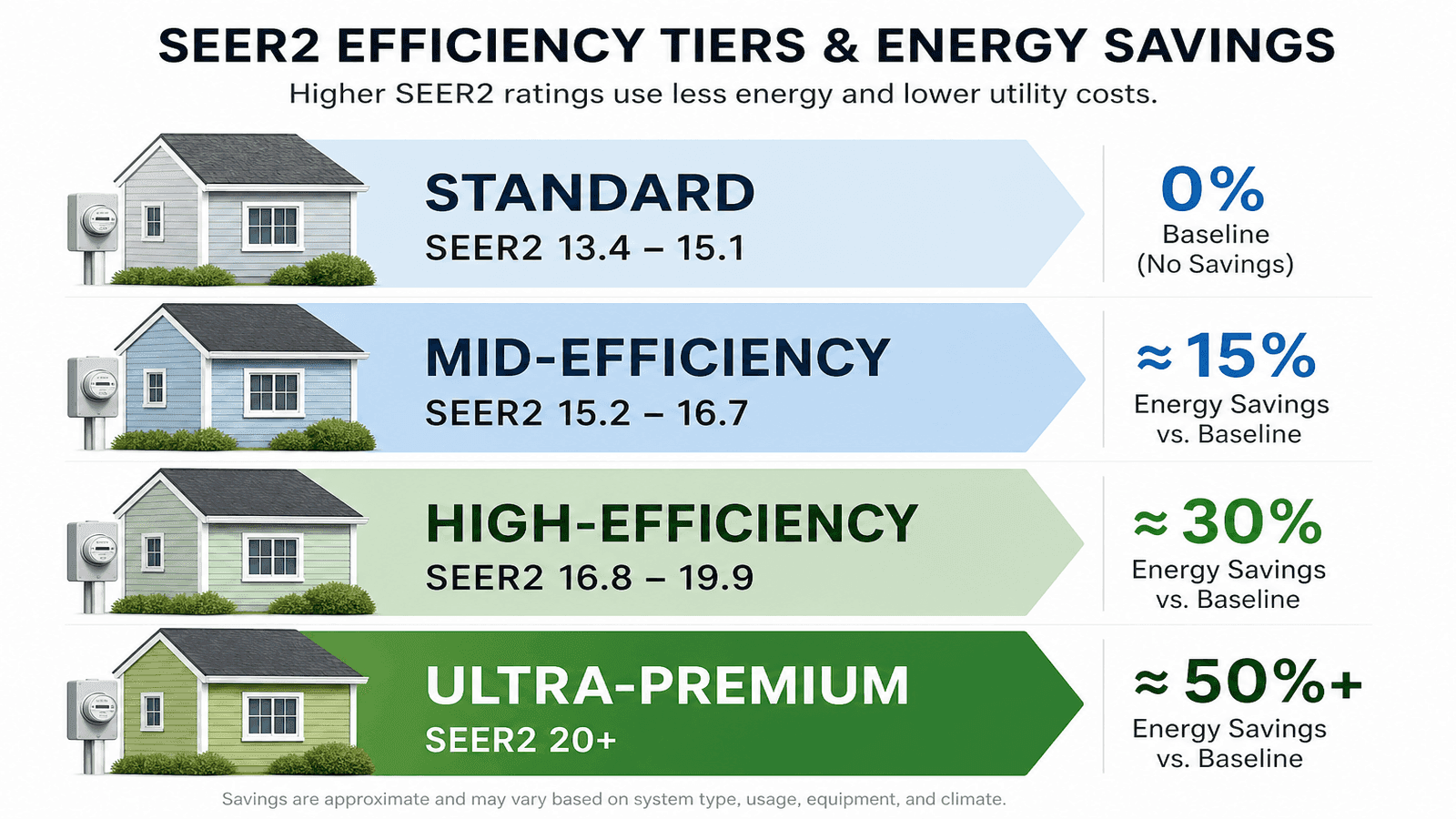
Photo: Chart comparing SEER2 efficiency tiers from standard to ultra-premium showing energy savings percentages at each level
High-Efficiency Technologies
Not all efficiency gains come from the same place. Some technologies reduce energy consumption through smarter compressor operation. Others eliminate waste in air distribution. Understanding which technologies address your specific efficiency losses determines whether an upgrade delivers real savings or just a higher price tag.
Get quotes from top-rated pros.
Variable-Speed Inverter Compressors
Variable-speed (inverter-driven) compressors are the single biggest efficiency advancement in residential HVAC over the past decade. Unlike single-stage systems that cycle between full power and off, inverter compressors continuously adjust output from approximately 30% to 100% of capacity, matching the exact cooling or heating load at any given moment [4].
The energy savings are substantial. Real-world testing shows variable-speed systems saving 20-40% annually compared to single-stage equipment. One 2026 field study documented an 18.6 SEER2-rated variable-speed unit performing at an effective 31.4 SEER2 during partial-load conditions, which represent 80-90% of actual operating hours [4]. The unit exceeded its rated efficiency by nearly 69% because it spent most of its time running at low speed, where efficiency is highest.
Beyond energy savings, variable-speed systems deliver noticeably better comfort. They maintain tighter temperature control (within 0.5 degrees of the thermostat setting versus 2-4 degrees with single-stage), run quieter at low speed, and provide better humidity removal because they operate for longer periods at lower airflow.
Other Efficiency Technologies
Two-stage systems offer a middle ground, operating at 65-70% capacity during mild conditions and full capacity only during peak demand. They achieve 15-20% savings over single-stage equipment at a lower premium than variable-speed.
ECM blower motors adjust speed based on demand, consuming 75-80% less electricity than standard single-speed motors during low-speed operation [8]. Over a year, this adds $100-$200 in fan energy savings.
Zoning systems use motorized dampers and multiple thermostats to control two to four zones independently. The DOE estimates zoning reduces energy consumption by 20-30% in homes with consistently unoccupied areas [1].
Smart thermostats with ENERGY STAR certification save an average of 8% on heating and cooling bills through occupancy detection and automatic setback [6].
The Ductwork Factor
The most common mistake in HVAC efficiency upgrades is focusing entirely on the outdoor unit while ignoring the duct system that delivers conditioned air throughout the home. According to ENERGY STAR, 20-30% of air moving through a typical residential duct system is lost to leaks, holes, and poorly connected joints [5]. That means even a top-tier 20 SEER2 system operates as if it were a 14-16 SEER2 system when connected to leaky ductwork.
Duct Leakage Impact
Ducts leaking just 20% of conditioned air force the HVAC system to work approximately 50% harder to maintain the desired temperature [5]. The system runs longer cycles, consumes more energy, and experiences accelerated wear on the compressor, blower motor, and electrical components. In unconditioned spaces like attics and crawl spaces, duct leaks also pull in hot, humid, or dusty outside air, degrading indoor air quality and increasing humidity loads.
Professional Duct Sealing
Professional duct sealing using mastic sealant or aerosol-based systems (such as Aeroseal) typically reduces duct leakage from 20-30% down to 3-5% [5]. The cost ranges from $1,500 to $3,500 for a typical home, with an average payback period of 2-4 years through energy savings. For homes with accessible ductwork, manual sealing with UL 181-rated mastic and fiberglass mesh tape is effective and less expensive. For duct systems buried in walls, floors, or finished ceilings, aerosol sealing provides access to joints that cannot be reached manually.
NearbyHunt Network Insight
HVAC professionals in the NearbyHunt network report that approximately 40% of "my system isn't keeping up" service calls are traced to duct problems rather than equipment failure. In many cases, sealing and insulating existing ductwork delivers better comfort improvement than replacing the outdoor unit, at one-third to one-half the cost. Before investing in a full system replacement, request a duct leakage test from a qualified HVAC contractor to establish your baseline.
I test ductwork on every efficiency consultation. Last month I inspected a home in Bloomington with a three-year-old 18 SEER2 system where the homeowner was complaining about $280 monthly cooling bills. The duct system was losing 28% of conditioned air through gaps at the plenum connections and branch takeoffs in the attic. After sealing, the same system dropped cooling costs to $185 per month. That is a 34% reduction without touching the equipment.
R-454B Refrigerant Transition
As of January 1, 2026, all newly manufactured residential air conditioners and heat pumps must use refrigerants with a global warming potential (GWP) below 700, per the EPA's AIM Act regulations [2]. The industry standard replacement for R-410A is R-454B, a blend of HFC-32 and HFO-1234yf with a GWP of 466, representing a 78% reduction from R-410A's GWP of 2,088.
Any new system purchased in 2026 will use R-454B. The refrigerant is not compatible with R-410A equipment, and existing systems cannot be retrofitted. However, homeowners with R-410A systems do not need to replace them. R-410A remains available for servicing, though prices will increase as production phases down. R-454B is classified as A2L (mildly flammable), requiring built-in leak detection sensors in new equipment. For homeowners, the practical difference is minimal: equipment looks the same, installs the same way, and performs comparably. The transition has added approximately $200-$500 to new system prices due to retooled manufacturing and updated safety components [2].
Rebates and Financial Incentives in 2026
The financial incentive picture for energy efficient HVAC changed substantially when the One Big Beautiful Bill Act eliminated the federal Section 25C Energy Efficient Home Improvement Credit effective December 31, 2025 [3]. Homeowners who installed qualifying heat pumps by that date can still claim the credit on their 2025 tax returns (filed in 2026), but new installations in 2026 receive no federal tax credit for air-source heat pump systems.
What Expired
The Section 25C credit (30% of costs, up to $2,000/year for air-source heat pumps and other HVAC equipment) and Section 25D (30% for geothermal, no annual cap) both expired December 31, 2025 [3]. Neither is available for 2026 installations.
What Remains Available
State HOMES Act Rebates (HEEHRA): Point-of-sale rebates up to $8,000 for households under 80% area median income, or $4,000 for 80-150% AMI [9]. Availability varies by state. California's program was fully reserved by February 2026, while Minnesota and Pennsylvania are still launching. Check your state energy office for current status.
Utility rebates of $200-$1,500 per unit remain available through local electric and gas companies, typically requiring ENERGY STAR certification. Use the ENERGY STAR Rebate Finder at energystar.gov to search by ZIP code [6].
Manufacturer rebates of $300-$1,500 are offered seasonally by major brands including Carrier, Trane, Lennox, and Daikin.
Get quotes from top-rated pros.
ROI Without Federal Credits
A variable-speed heat pump at $12,000 (versus $8,000 standard) saving $600/year has a 6.7-year payback on the $4,000 premium. With a $2,000 utility rebate, payback drops to 3.3 years. Over a 15-20 year lifespan, net savings reach $5,000-$8,000 even without federal credits.
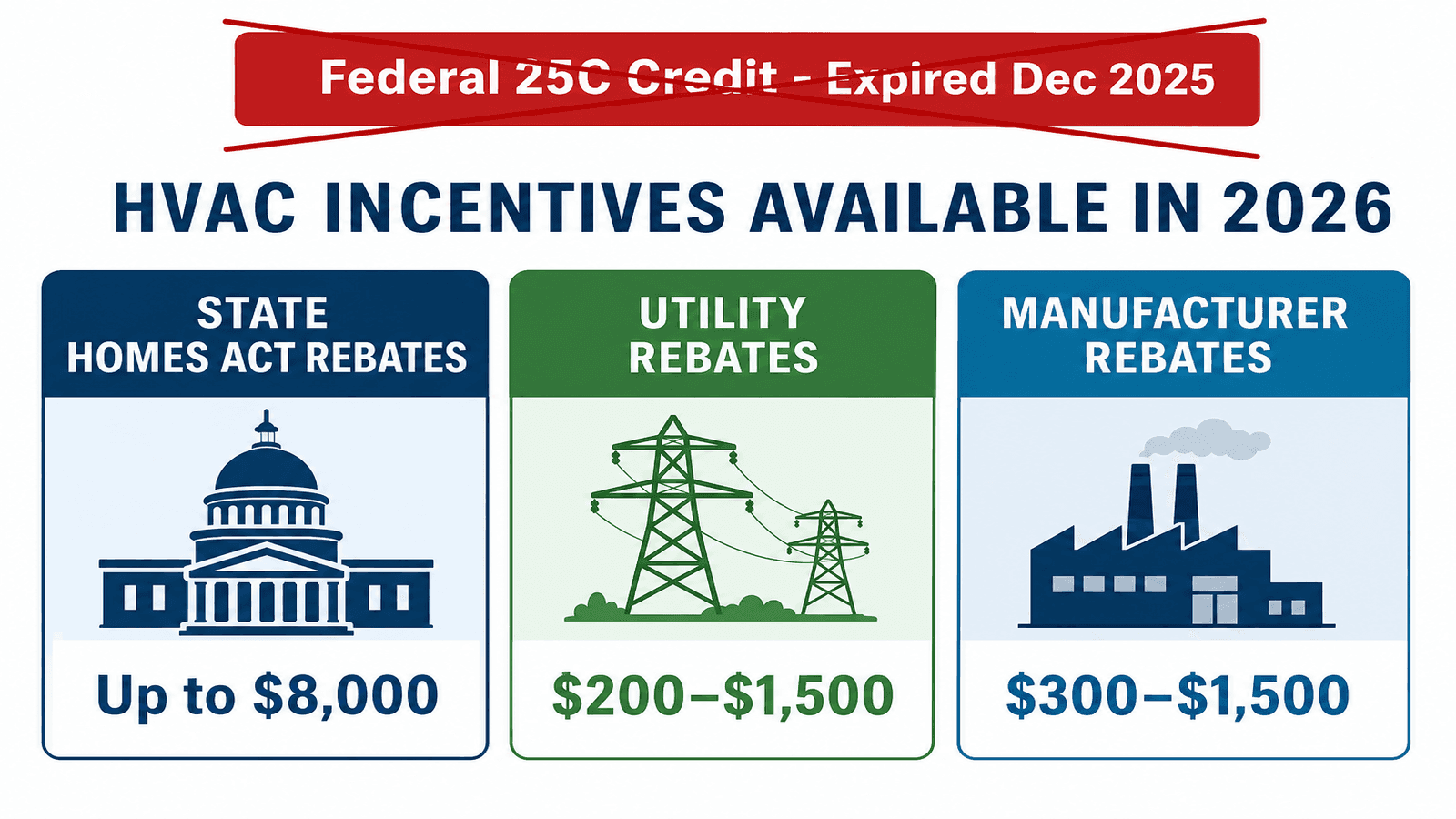
Photo: Infographic showing available HVAC incentives in 2026 including state rebates up to $8,000, utility rebates, and manufacturer offers with expired federal credit noted
Case Study: The Hernandez Family, Phoenix, AZ
Maria and Carlos Hernandez purchased a 2,100-square-foot Phoenix home in 2019, inheriting a builder-grade 13 SEER single-stage AC and 80% AFUE furnace from 2008. Summer electric bills exceeded $350/month, and upstairs bedrooms ran 4-6 degrees warmer than the thermostat reading.
In March 2026, they installed a 19.5 SEER2 variable-speed heat pump with two-zone ductwork and a smart thermostat. The contractor also sealed attic ductwork, reducing leakage from 24% to 4%. Total cost: $16,200.
Results: summer cooling bills dropped to $195/month (44% reduction). The zoning eliminated the upstairs temperature gap. Annual projected savings are $1,100. After a $1,200 Arizona utility rebate, the effective $15,000 investment has a 9.6-year payback with $6,000-$8,000 in estimated net lifetime savings.
Carlos noted: "The humidity control is noticeably better. Our old system would blast cold air and shut off, and the house always felt clammy. The new system runs at low speed for hours and keeps humidity around 45%."
Sizing and Installation Quality
The most efficient equipment on the market will underperform if it is incorrectly sized or poorly installed. The Air Conditioning Contractors of America (ACCA) estimates that 60-70% of residential HVAC systems in the United States are improperly sized [10]. Oversized systems short-cycle (turning on and off frequently), wasting energy and failing to remove humidity. Undersized systems run continuously without reaching the desired temperature, consuming excess energy and wearing out prematurely.
Proper sizing requires a Manual J load calculation, which accounts for square footage, insulation, window area, air infiltration, climate zone, and internal heat gains. Any contractor who sizes a replacement based solely on the existing unit's tonnage or a square-footage rule of thumb is cutting corners that cost you money for the system's entire lifespan.
Even correctly sized equipment loses performance through poor installation. Incorrect refrigerant charge reduces efficiency by 5-20% [10]. Airflow must deliver 350-450 CFM per ton. Every duct connection must be mechanically fastened and sealed with mastic or UL 181-rated tape (not cloth duct tape, which fails in 1-3 years). When evaluating contractors through the NearbyHunt network, request the Manual J calculation and ask whether the contractor verifies refrigerant charge and airflow at commissioning.
Maintenance for Sustained Efficiency
High-efficiency equipment degrades toward standard-efficiency performance without regular maintenance. The DOE estimates that a neglected HVAC system loses 5% of its rated efficiency per year of skipped maintenance [1]. After five years without service, a 20 SEER2 system may operate at 15-16 SEER2, eliminating the efficiency advantage that justified the higher purchase price.
Essential Maintenance Schedule
| Task | Frequency | Impact if Skipped |
| Replace/clean air filter | Every 1-3 months | Restricted airflow, frozen coils, 5-15% efficiency loss |
| Professional tune-up | Annually (spring for cooling, fall for heating) | Refrigerant drift, dirty coils, worn components |
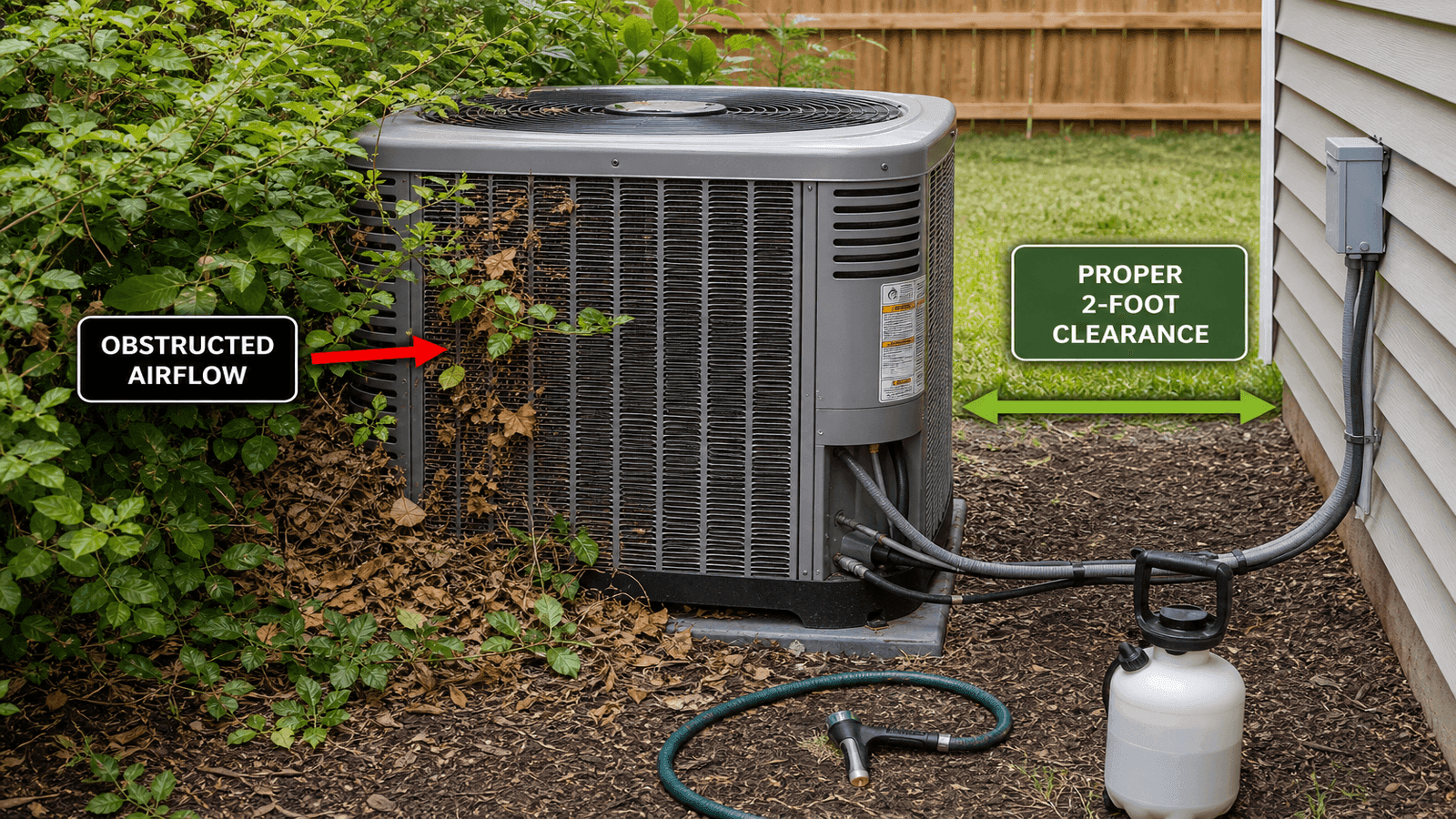
| Clean outdoor condenser coil | Annually | Reduced heat rejection, higher compressor temperatures |
| Check refrigerant charge | Annually | Efficiency loss of 5-20% per 10% charge deviation |
| Inspect and seal ductwork | Every 3-5 years | 20-30% conditioned air loss through leaks |
| Clean evaporator coil | Every 2-3 years | Reduced heat absorption, ice formation |
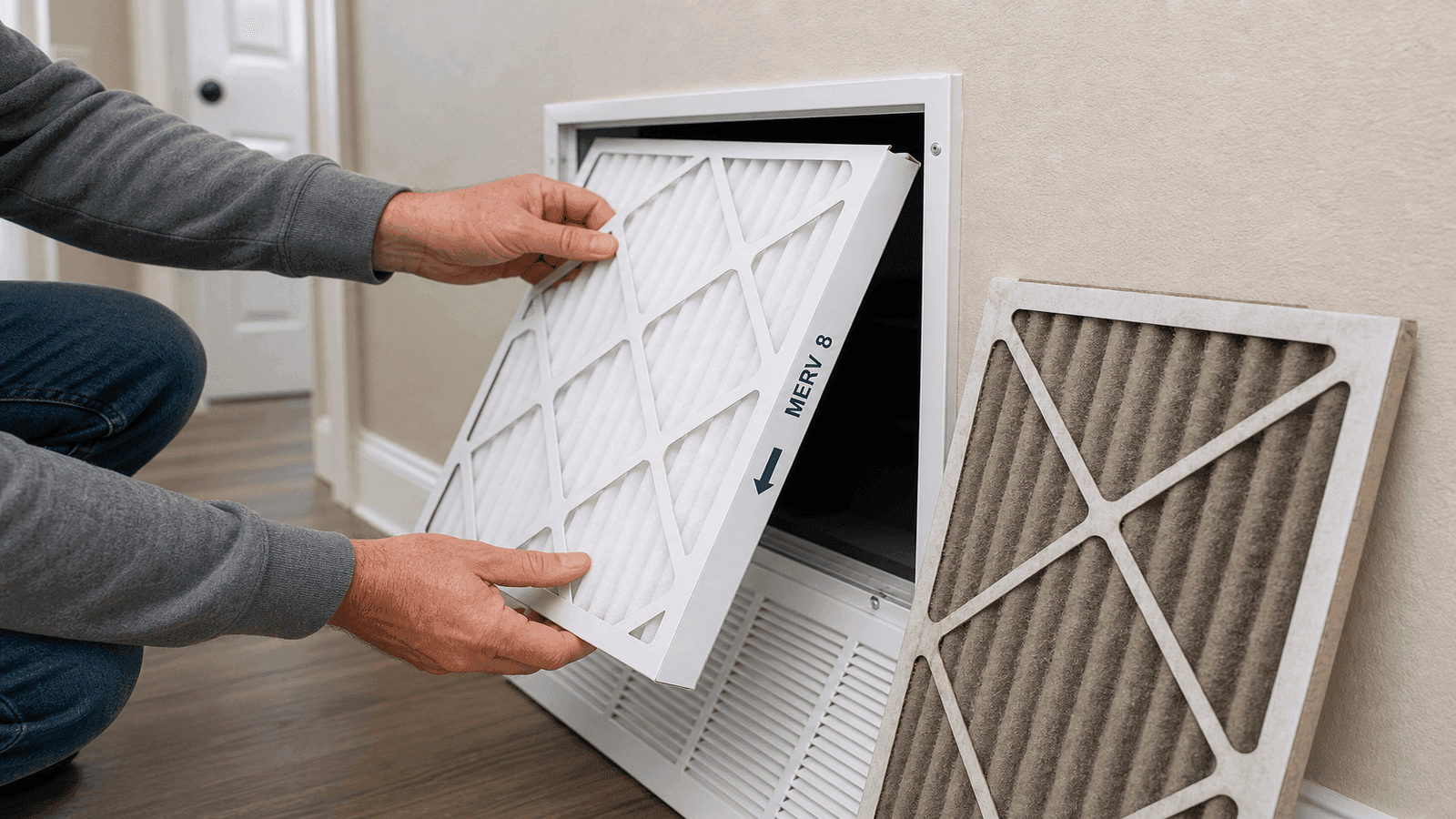
Filters rated MERV 8-13 provide the best balance between air quality and airflow. Filters above MERV 13 can restrict airflow in systems not designed for high-MERV filtration, reducing efficiency and causing coil icing. Always verify your equipment's maximum recommended MERV rating before upgrading.
The number one service call I respond to is restricted airflow from a clogged filter. A $5 filter replacement would have prevented a $250 service call. Set a phone reminder for the first of every other month. Pull the filter out, hold it up to a light source. If you cannot see light through it clearly, replace it.
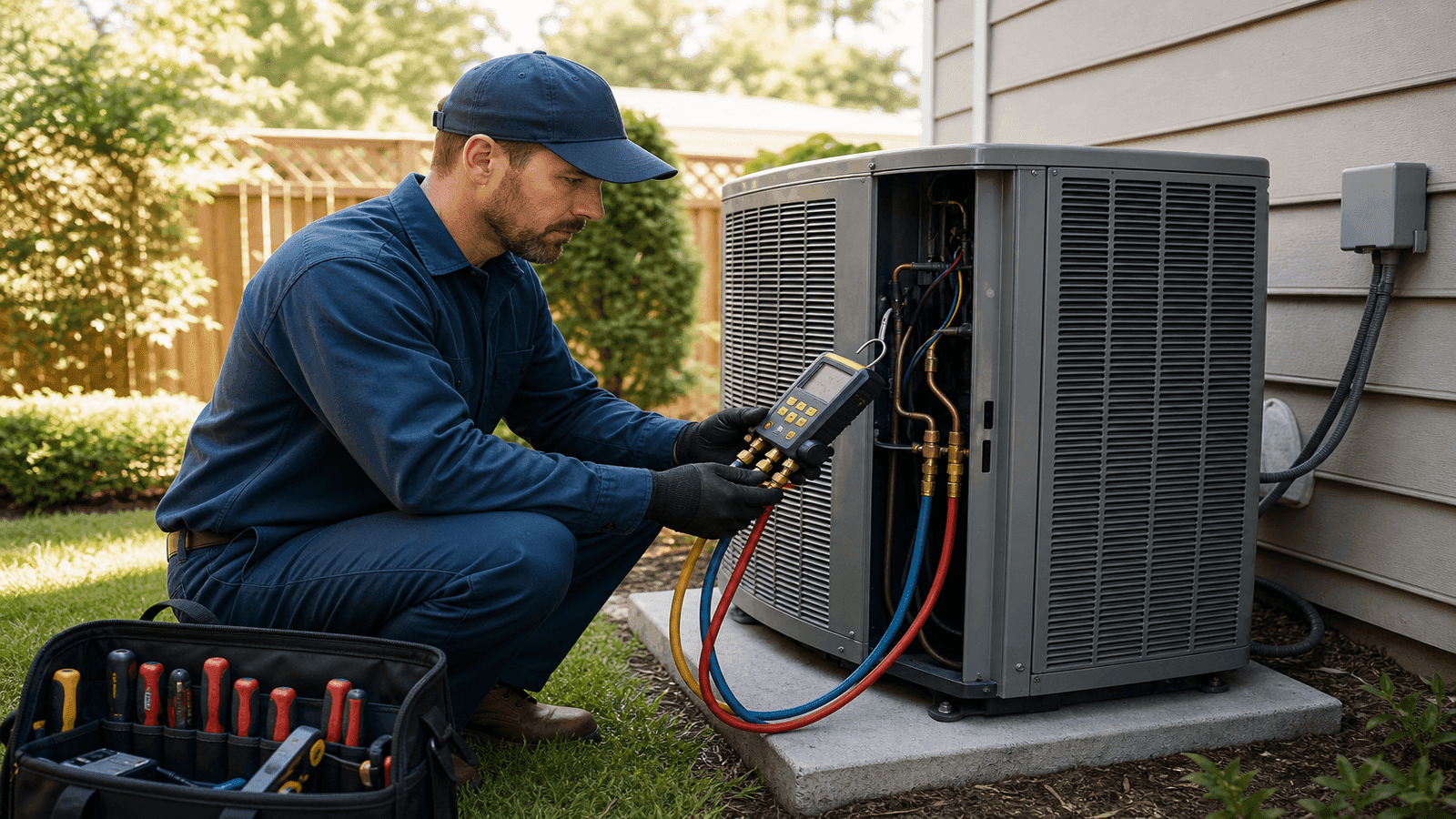
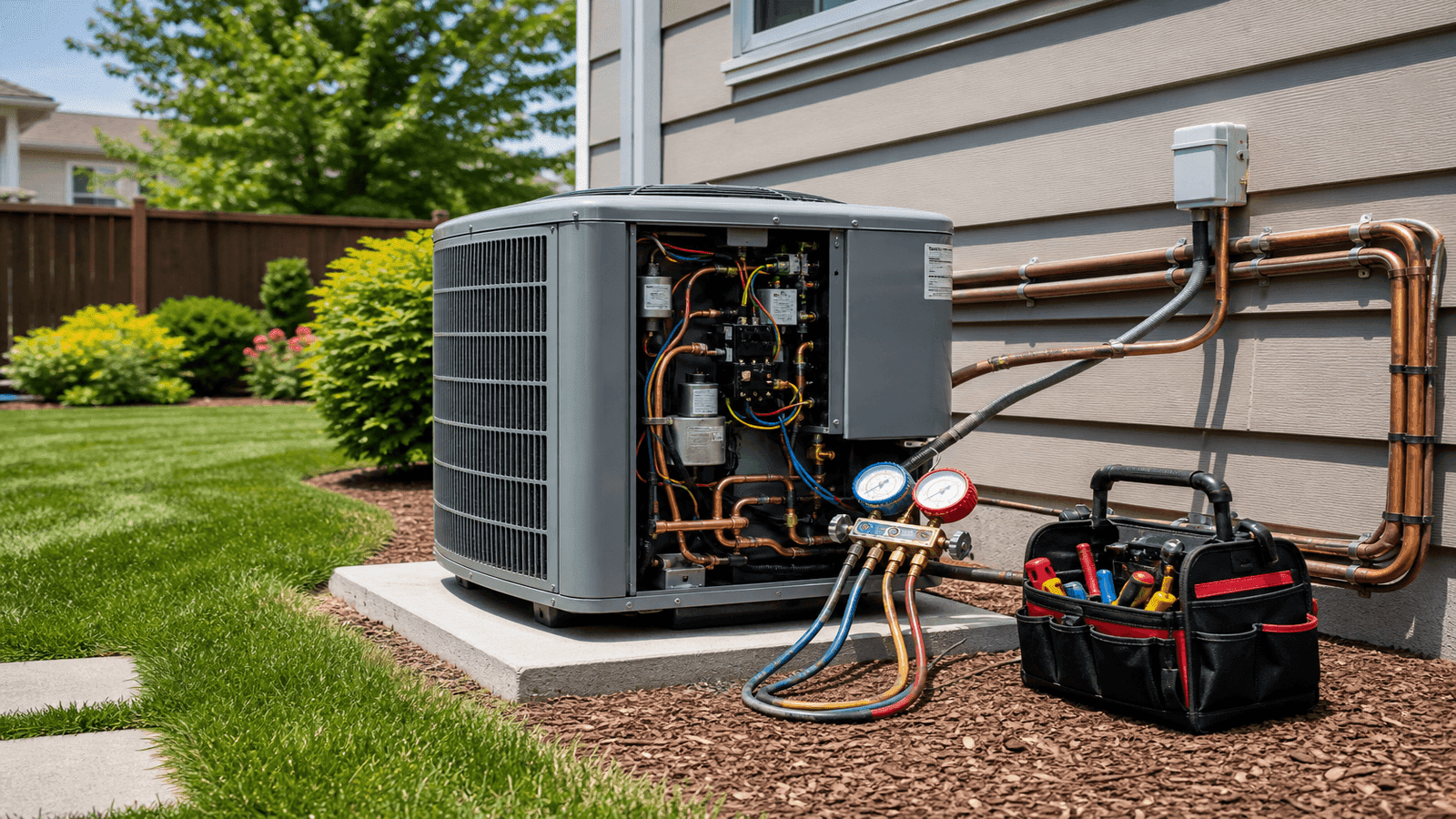
Photo: HVAC technician checking refrigerant pressure with digital gauges during annual maintenance on a residential heat pump outdoor unit
Disclaimer: This article provides general educational information about HVAC systems and services. It is not intended as professional HVAC advice for specific situations. Local building codes, climate conditions, and individual home characteristics vary significantly. Always consult a licensed, certified HVAC professional for system-specific recommendations, installations, and repairs. Cost estimates are national averages as of 2026 and may differ in your area.
Sources
- U.S. DOE. "Heating and Cooling."
- EPA. "AIM Act."
- IRS. "Sections 25C, 25D Modifications."
- Danfoss. "Inverter Compressors."
- ENERGY STAR. "Duct Sealing."
- ENERGY STAR. "Heat Pumps."
- SEER2.com. "SEER2 Standards."
- DOE. "Furnaces."
- DOE. "HOMES/HEAR Programs."
- ACCA. "Manual J."

Daniel is an EPA-certified HVAC technician & Energy Efficiency Consultant with over 14 years of experience in maintaining and installing heating and cooling systems throughout the Midwest. Passionate about sustainability, Dan specialises in energy-efficient retrofits and intelligent climate control systems. He writes for NearbyHunt to help homeowners extend the lifespan of their HVAC units while lowering utility bills.

Christine is an EPA-certified HVAC professional with 17 years of experience in heating, cooling, and indoor air quality systems. She has managed large-scale residential installations and worked as a technical trainer for new HVAC apprentices. Chris’s reviews focus on accuracy, safety, and performance standards in modern HVAC practices.