- A central AC replacement costs $3,500 to $14,000 installed in 2026, with most homeowners paying $6,000 to $9,500 for a mid-efficiency system [1].
- AC unit cost alone runs $1,800 to $5,500, while labor and materials account for 35-45% of the total project price [2].
- Each additional ton of cooling capacity adds $1,000 to $1,500 to the installed price. A 3-ton system (the most common residential size) averages $5,000 to $9,000 [1].
- SEER2 efficiency rating is the second-largest cost driver. Upgrading from 14.3 SEER2 to 18 SEER2 adds $2,000 to $4,000 but saves $200 to $400 per year in hot climates [3].
- The federal 25C tax credit expires December 31, 2026, providing up to $600 for qualifying central AC units. State HOMES/HEAR rebates of $2,000 to $8,000 remain available for income-qualifying households [4].
- Installation quality matters more than brand. A properly sized system with sealed ductwork outperforms a premium brand installed with rule-of-thumb sizing [2].
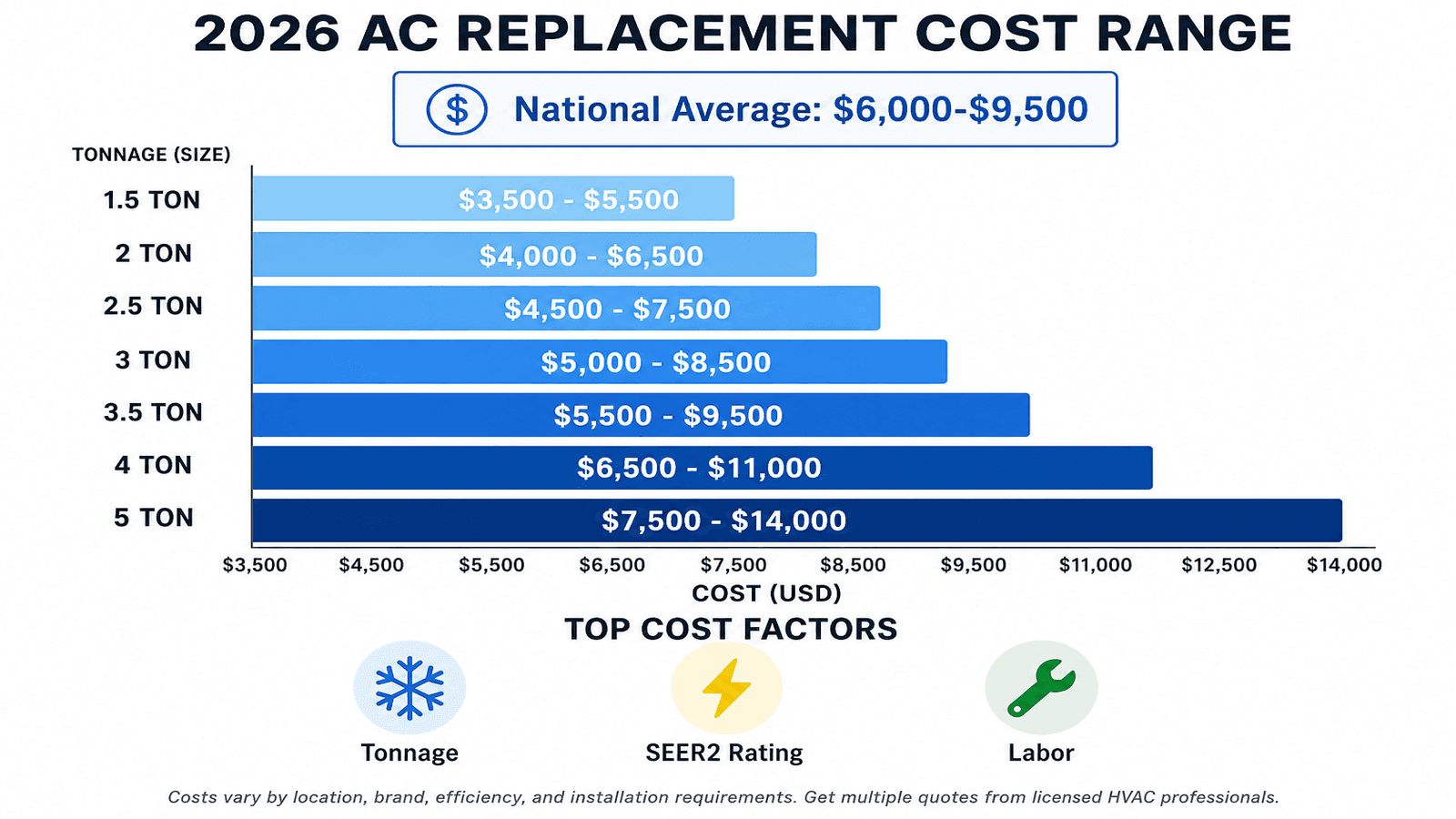
Photo: Infographic showing 2026 AC replacement costs by tonnage, ranging from $3,500 for 1.5-ton systems to $14,000 for 5-ton systems, with national average of $6,000 to $9,500
What Does AC Replacement Actually Cost?
Replacing a central air conditioner in 2026 costs $3,500 to $14,000 for most single-family homes with existing ductwork [1]. The national average lands between $6,000 and $9,500 for a standard 3-ton system at mid-range efficiency. That range covers the outdoor condenser unit, indoor evaporator coil (if needed), refrigerant, labor, permits, and disposal of the old system.
Daniel Torres, a Certified HVAC Technician and Energy Efficiency Consultant with 14+ years of field experience in Minneapolis, MN (EPA 608 Universal, NATE Certified, HVAC Excellence), provided the pricing data and expert analysis throughout this guide. His cost observations are drawn from hundreds of AC replacements across the upper Midwest, where system sizing and efficiency selection directly affect both comfort and long-term operating costs.

Get quotes from top-rated pros.
The $3,500-to-$14,000 range is real, but most homeowners end up in a much tighter window. For a typical 1,800 to 2,200 square foot home, I quote $6,500 to $9,000 for a 3-ton unit at 16 SEER2. The low end of the national range is usually a builder-grade 1.5-ton unit in a small condo, and the high end is a 5-ton, 20+ SEER2 system with ductwork modifications. Knowing your home's square footage and current system size narrows the range immediately.
The cost breaks down into two main components: the equipment and the installation labor. Understanding each one separately helps you evaluate quotes and spot where contractors pad their margins.
For a broader look at all HVAC system costs including furnaces, heat pumps, and ductwork, see our HVAC Costs Guide 2026.
AC Unit Cost by Tonnage
System size, measured in tons of cooling capacity, is the single largest factor in your total replacement cost. One ton of cooling equals 12,000 BTU per hour. Most residential systems range from 1.5 to 5 tons.
A proper sizing calculation (Manual J load calculation) accounts for square footage, insulation levels, window area, climate zone, and ductwork condition. Oversized units short-cycle and create humidity problems. Undersized units run constantly and never reach the set temperature.
| System Size | Home Size (Approx.) | Unit Cost | Installed Cost |
| 1.5 Ton | 600 to 1,000 sq ft | $1,800 to $2,800 | $3,500 to $5,500 |
| 2 Ton | 1,000 to 1,300 sq ft | $2,000 to $3,200 | $4,000 to $6,500 |
| 2.5 Ton | 1,300 to 1,600 sq ft | $2,200 to $3,800 | $4,500 to $7,500 |
| 3 Ton | 1,600 to 2,000 sq ft | $2,500 to $4,200 | $5,000 to $9,000 |
| 3.5 Ton | 2,000 to 2,200 sq ft | $2,800 to $4,800 | $5,500 to $10,000 |
| 4 Ton | 2,200 to 2,500 sq ft | $3,200 to $5,000 | $6,000 to $11,000 |
| 5 Ton | 2,500 to 3,500 sq ft | $3,800 to $5,500 | $7,000 to $14,000 |
I replaced a 4-ton system last March in a 2,400 sq ft home in Minnetonka, MN. The homeowner's old unit was a 5-ton that a previous contractor had installed without a load calculation. The oversized system was short-cycling every 8 to 10 minutes and leaving the upstairs humid in summer. After running a Manual J, we downsized to 4 tons. The equipment cost dropped by about $1,200, the system runs longer cycles, and the homeowner reported the first comfortable summer in the house. Bigger is not better with AC systems.
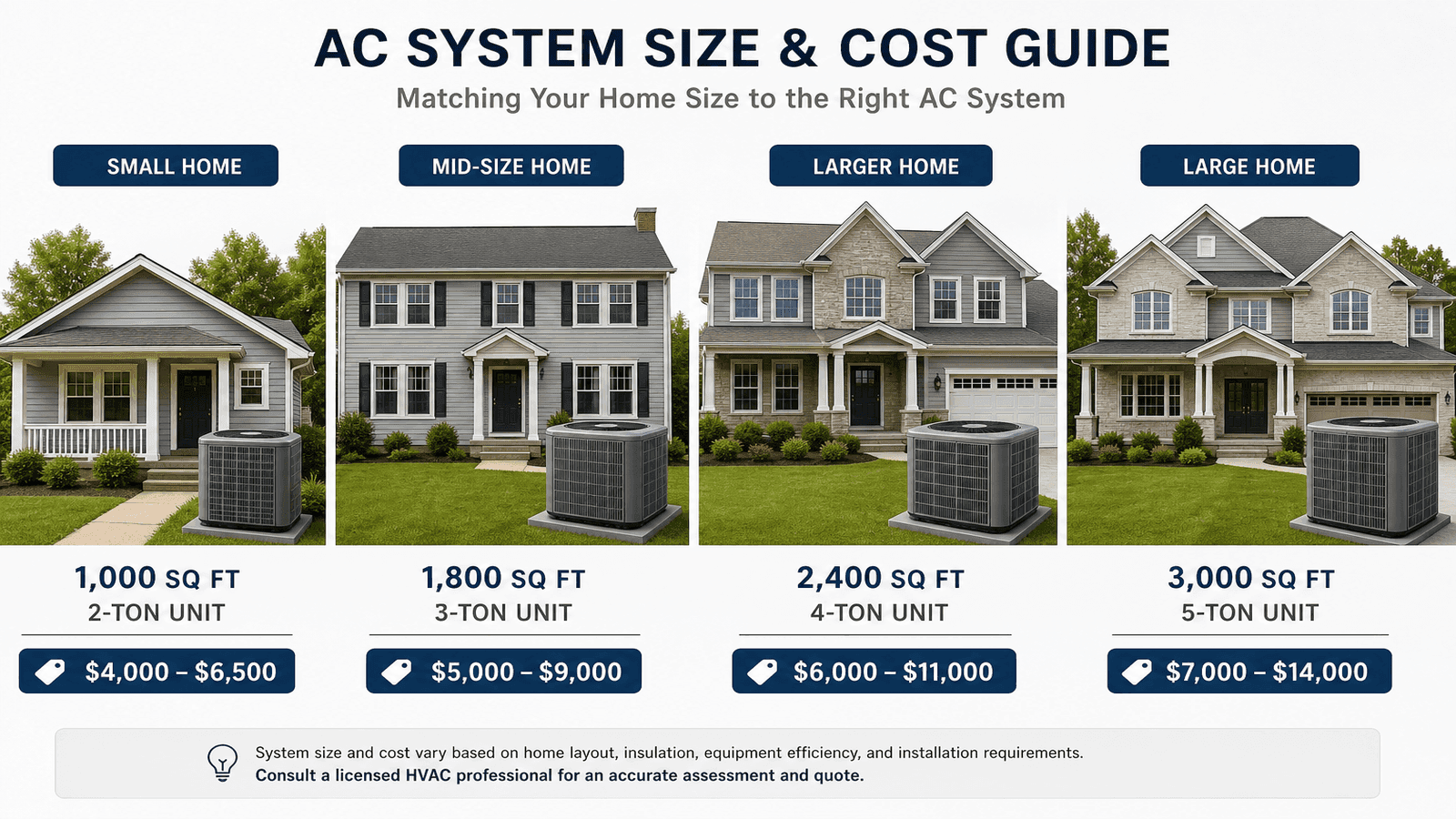
Photo: Side-by-side comparison of four homes from 1,000 to 3,000 square feet showing matching AC unit tonnage and installed cost range for each
Cost by SEER2 Efficiency Rating
SEER2 (Seasonal Energy Efficiency Ratio 2) measures how efficiently an AC unit converts electricity into cooling. Higher SEER2 numbers mean lower operating costs but higher upfront equipment prices. The current federal minimum is 14.3 SEER2 in the South and Southwest, and 13.4 SEER2 in the North [3].
| SEER2 Tier | Equipment Premium | Annual Savings vs. 14.3 SEER2 | Best For |
| 14.3 SEER2 (baseline) | $0 | $0 | Budget installations, mild climates |
| 15-16 SEER2 (mid-range) | +$800 to $1,500 | $150 to $250/year | Most homeowners, moderate climates |
| 17-18 SEER2 (high efficiency) | +$2,000 to $3,500 | $250 to $400/year | Hot climates, long cooling seasons |
| 20+ SEER2 (premium) | +$3,500 to $5,000 | $350 to $500/year | Southern states, maximum long-term savings |
The payback period depends entirely on your climate. In Phoenix or Houston, where AC runs 6 to 8 months per year, an 18 SEER2 system recoups its premium in 5 to 7 years [3]. In Minneapolis or Seattle, where cooling season is 3 to 4 months, a 16 SEER2 unit is the sweet spot because the premium for higher efficiency takes 10+ years to recover.
NearbyHunt Network Insight: Across NearbyHunt's network of licensed HVAC contractors, 16 SEER2 is the most frequently installed efficiency tier in 2026, accounting for roughly 45% of residential AC replacements. The 14.3 SEER2 baseline accounts for about 25%, and 18+ SEER2 units make up the remaining 30%, concentrated almost entirely in the Sun Belt states.
Get quotes from top-rated pros.
I tell every homeowner in Minnesota the same thing: 16 SEER2 is your best value here. You will save $150 to $200 per year over the baseline, and the $800 to $1,200 premium pays itself back in 5 to 7 years. Going to 20 SEER2 adds another $2,500 to $3,500 in equipment cost, but with our 3.5-month cooling season, the additional $100 to $150 per year in savings means a 20-year payback. That is longer than the unit's expected lifespan.
Installation Labor and Additional Costs
The AC unit is typically 55-65% of the total project cost. The remainder goes to labor, materials, permits, and disposal. Here is what the non-equipment portion includes:
Labor Cost: HVAC installation labor runs $1,500 to $3,500 for a standard replacement. A straightforward swap where the new system matches the old one's configuration takes 4 to 8 hours with a two-person crew [2]. Complex installations requiring ductwork modifications, electrical upgrades, or refrigerant line changes push into the 8 to 12 hour range.
Hourly rates for HVAC technicians vary by region: $22 to $30/hour in the Southeast, $28 to $38/hour in the Midwest, and $35 to $50/hour in the Northeast and West Coast [2].
Additional Cost Breakdown:
Additional Cost Breakdown
| Line Item | Typical Cost | Notes |
| Refrigerant (R-410A) | $150 to $400 | Systems require 6-12 lbs; price varies by region |
| Thermostat upgrade | $0 to $300 | Many contractors include a basic programmable model |
| Permits | $75 to $500 | Required in most jurisdictions; varies by municipality |
| Old system disposal | $50 to $150 | Refrigerant recovery is legally required (EPA mandate) |
| Concrete pad (if needed) | $75 to $200 | For outdoor condenser placement |
| Electrical work | $200 to $800 | Required if upgrading amperage or adding disconnect |
| Ductwork modifications | $500 to $3,000 | Only if existing ducts are damaged or incorrectly sized |
| Refrigerant line replacement | $300 to $1,000 | Needed if lines are corroded or wrong diameter |
The line items that catch homeowners off guard are refrigerant lines and electrical work. If you are replacing a 15-year-old system, there is a good chance the contractor will need new refrigerant lines because the old ones have degraded insulation or are the wrong diameter for the new unit. That is $300 to $1,000 that was not in the base quote. I always include line inspection in my quotes so there are no surprises on installation day.
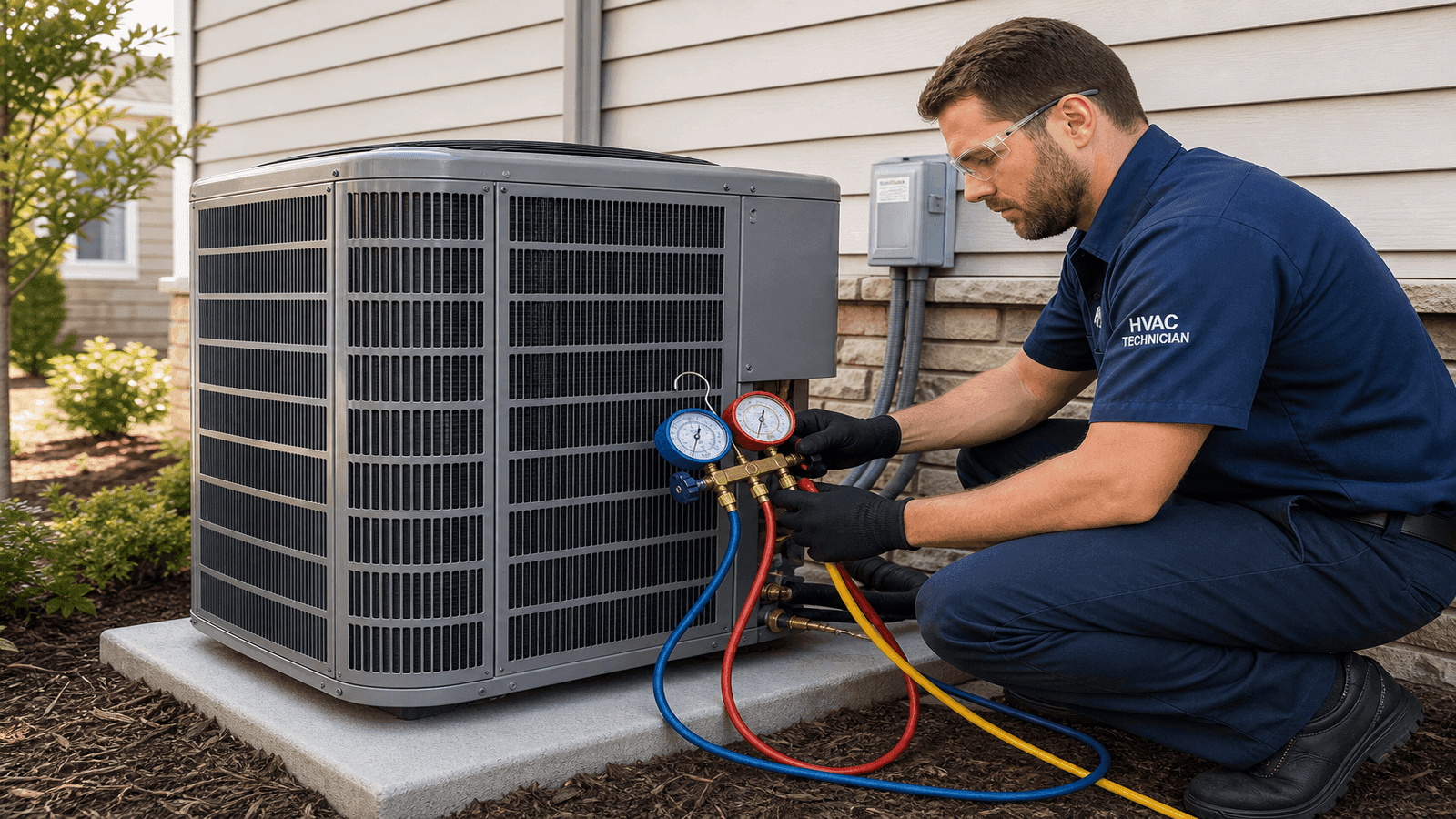
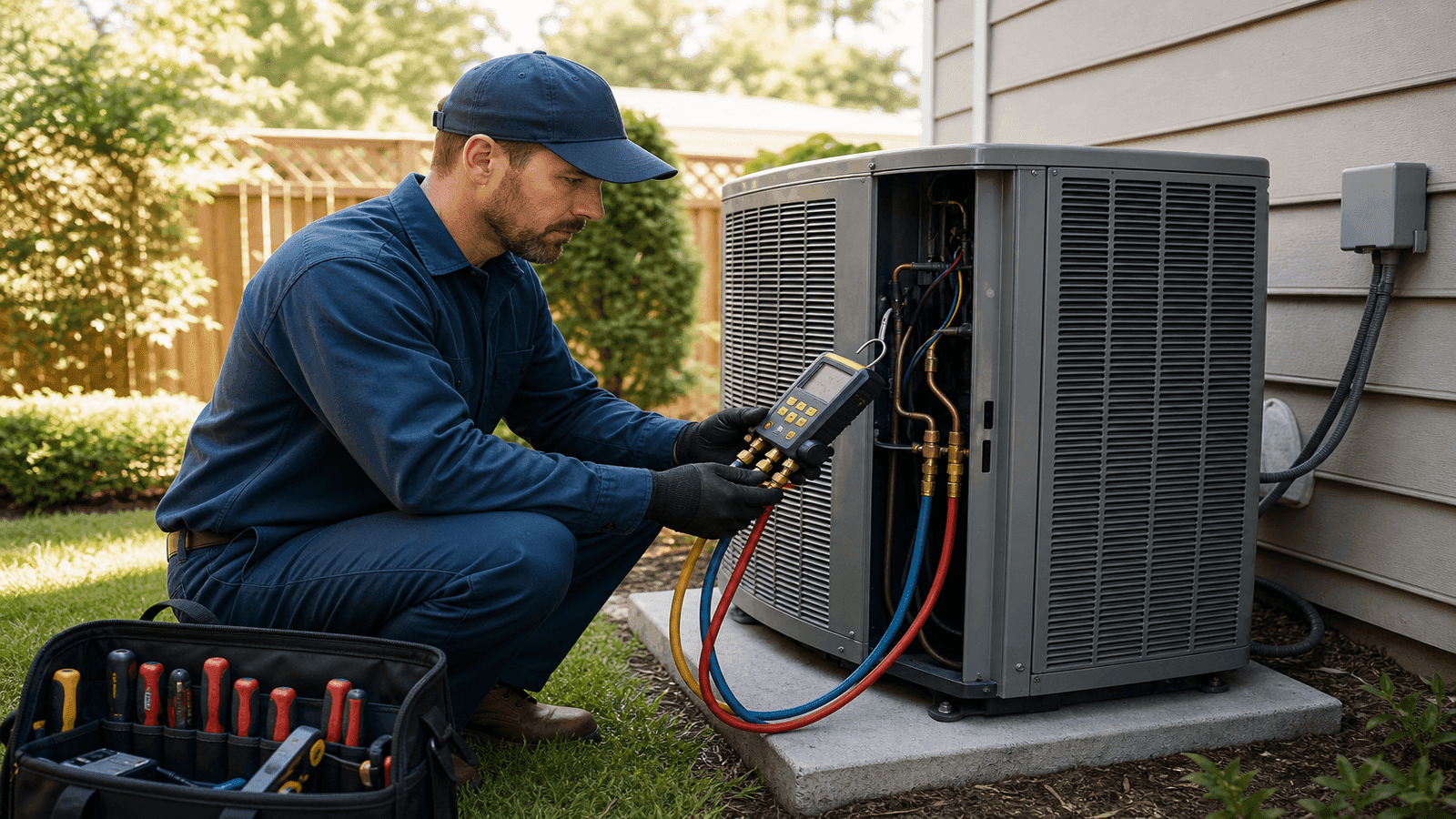
Photo: HVAC technician in uniform connecting refrigerant lines to a new outdoor AC condenser unit on a concrete pad next to a residential home
Cost by Brand
Brand selection affects both the upfront price and long-term reliability. Installation quality still accounts for about 80% of your system's performance over its lifetime, but brand determines warranty coverage, parts availability, and operating noise levels [5].
| Brand | Tier | 3-Ton Installed Cost | Warranty (Compressor) | Notable Feature |
| Goodman/Amana | Value | $4,800 to $7,200 | 10-year limited | Lowest upfront cost |
| Rheem/Ruud | Mid-range | $5,200 to $8,000 | 10-year limited | Good parts availability |
| Carrier | Premium | $6,000 to $9,500 | 10-year limited | Wide dealer network |
| Trane/American Standard | Premium | $6,200 to $10,000 | 12-year limited | Tested for extreme conditions |
| Lennox | Premium | $6,500 to $10,500 | 10-year limited | Highest SEER2 options (up to 28) |
The price difference between value and premium brands is typically $1,500 to $3,000 for the same tonnage and SEER2 rating. That premium buys you quieter operation, potentially better compressor longevity, and wider service network coverage [5].
Important note on warranties: Most manufacturer warranties require professional installation by a licensed contractor and registration within 60 to 90 days of installation. Unregistered systems often default to a 5-year parts warranty instead of 10-year. Always confirm that your contractor will register the warranty on your behalf.
Signs You Need AC Replacement
Not every AC problem requires a full replacement. But certain warning signs point toward replacement being the more cost-effective choice over repeated repairs [6].
Replace if:
- Your system is 12 to 15+ years old. The average central AC lifespan is 10 to 15 years. Units older than 15 are operating on borrowed time and running at reduced efficiency [6].
- Your system uses R-22 refrigerant. R-22 production ended in 2020. A single recharge now costs $150 to $250 per pound, with typical systems needing 5 to 10 pounds. One service call can exceed $1,500 [6].
- Repair costs exceed $2,000 or 50% of replacement cost. The "50% rule" is the industry standard threshold. If a compressor fails on a 12-year-old unit, replacement is almost always cheaper than repair.
- Energy bills have increased 20%+ with no rate change. Declining efficiency means the system is consuming more electricity to produce the same cooling output.
- The system short-cycles or fails to maintain temperature. Frequent on-off cycling or rooms that never reach the thermostat setting indicate a failing compressor or a system that was never properly sized.
Repair if:
- The system is under 8 years old and the repair costs under $800
- The issue is a capacitor, contactor, or fan motor (common, inexpensive parts)
- The system otherwise cools effectively and your energy bills are stable
Get quotes from top-rated pros.
Tom and Lisa Andersen had a 17-year-old 3.5-ton Carrier system that used R-22 refrigerant. In the summer of 2025, the evaporator coil developed a leak. The repair quote was $2,800 for the coil replacement plus $1,200 for R-22 refrigerant, totaling $4,000. I recommended full replacement instead. They chose a 3-ton, 16 SEER2 Carrier unit installed for $8,200, which included new refrigerant lines, a smart thermostat, and a 10-year parts-and-labor warranty. Their July 2025 electric bill dropped from $340 to $215 compared to July 2024. The $4,000 they would have spent on repairs covered nearly half the replacement cost, and they now have a system that will last another 15 years on affordable R-410A refrigerant. --- ## Rebates, Tax Credits, and Incentives Financial incentives can significantly reduce your out-of-pocket AC replacement cost in 2026, but the situation has changed since 2025. Here is what is currently available [4]:
Rebates, Tax Credits, and Incentives
Financial incentives can significantly reduce your out-of-pocket AC replacement cost in 2026, but the situation has changed since 2025. Here is what is currently available [4]:
Federal 25C Tax Credit (Expires December 31, 2026)
The Section 25C Residential Energy Efficiency Tax Credit provides up to $600 per year for qualifying central air conditioners. The unit must meet ENERGY STAR Most Efficient criteria (typically 16 SEER2 or higher). This is a tax credit, not a rebate, meaning it reduces your tax liability dollar-for-dollar when you file your return [4].
Important: The 25C credit is authorized through December 31, 2026. If you are planning an AC replacement, completing it before year-end preserves eligibility for this credit. There is currently no indication of renewal beyond 2026.
State HOMES and HEAR Rebates
The Inflation Reduction Act funded two state-administered rebate programs that remain active in 2026 [4]:
- HOMES Program: Up to $4,000 to $8,000 in whole-home energy efficiency rebates for income-qualifying households. Available in most states, though allocation varies.
- HEAR Program (formerly HEEHRA): Up to $8,000 for heat pump HVAC systems. This program favors heat pumps over traditional AC units, but some states include high-efficiency AC systems in qualifying measures.
Availability varies by state. California's HEEHRA allocations were fully reserved as of early 2026, while many Midwest and Southern states still have funding available. Check your state energy office for current program status [4].
Utility Rebates
Many local utilities offer $200 to $1,500 in rebates for high-efficiency AC installations. These stack with federal and state incentives. Your HVAC contractor should know which utility programs are active in your service area.
I helped a homeowner in Bloomington, MN stack a $600 federal 25C credit with a $500 Xcel Energy utility rebate on a 17 SEER2 Carrier system last April. That knocked $1,100 off a $9,200 installation. The 25C credit goes away after this year, so if you are on the fence about replacing a struggling system, 2026 is the year to do it.
How to Get the Best Price
Getting a fair deal on AC replacement is not about finding the cheapest contractor. It is about understanding what a complete, properly done installation includes and comparing quotes on equal terms.
Get three written quotes. This is the single most effective way to ensure a fair price. NearbyHunt connects you with licensed, reviewed HVAC contractors in your area who provide detailed written estimates. Get free AC replacement quotes from vetted local pros.
Compare quotes line by line. Every quote should specify:
- Exact equipment model number and SEER2 rating
- Whether a Manual J load calculation is included
- Warranty terms (both parts AND labor, not just parts)
- Permit cost and who pulls the permit
- Disposal of the old system
- Refrigerant line condition and whether replacement is included
Schedule in the off-season. Spring (March to May) and fall (September to November) are the slowest periods for HVAC contractors. Many offer 5 to 15% discounts or throw in thermostat upgrades during these windows. Avoid scheduling in July and August when demand peaks and prices firm up [2].
Ask about financing. Most HVAC contractors offer 0% financing for 12 to 60 months through manufacturer programs or third-party lenders. On an $8,000 installation, 0% for 36 months means payments of roughly $222/month with no interest cost.
Do not automatically pick the cheapest quote. If one quote is 25%+ below the others, ask what is being excluded. Missing items typically include the load calculation, permit, refrigerant line inspection, and labor warranty beyond one year.

Photo: Homeowner and HVAC contractor reviewing printed AC replacement quotes side by side on a kitchen table with equipment brochures
Disclaimer: AC replacement costs vary by region, home size, system configuration, and contractor. The prices in this article are national averages based on 2026 data from manufacturer pricing, contractor surveys, and NearbyHunt network data. They may not reflect costs in your specific area. Always get written estimates from multiple licensed HVAC contractors before making a decision. The federal 25C tax credit is authorized through December 31, 2026 and requires qualifying equipment meeting ENERGY STAR Most Efficient criteria. State and utility rebates vary by location and may have limited allocations. This article is for informational purposes only and does not constitute professional HVAC or financial advice.
Sources & References
[1] Carrier. "Air Conditioner Prices 2026." Sears Home Services. "Air Conditioner Replacement Cost 2026."
[2] Fire & Ice. "Cost of an Air Conditioner in 2026." HVAC Project Cost. "AC Replacement Cost 2026."
[3] Trane. "What's a Good SEER2 Rating?" South Mini Splits. "SEER vs SEER2 Guide 2026."
[4] AC Direct. "Federal Tax Credits for HVAC in 2026." AC Direct. "State-by-State HVAC Rebates in 2026." ENERGY STAR. "Federal Tax Credits."
[5] Jupitair HVAC. "9 Best AC Brands for 2026." Today's Homeowner. "Goodman vs Lennox 2026."
[6] American Standard Air. "Warning Signs: Replace Your AC." Trane. "Signs You Need AC Replacement."

Daniel is an EPA-certified HVAC technician & Energy Efficiency Consultant with over 14 years of experience in maintaining and installing heating and cooling systems throughout the Midwest. Passionate about sustainability, Dan specialises in energy-efficient retrofits and intelligent climate control systems. He writes for NearbyHunt to help homeowners extend the lifespan of their HVAC units while lowering utility bills.

Christine is an EPA-certified HVAC professional with 17 years of experience in heating, cooling, and indoor air quality systems. She has managed large-scale residential installations and worked as a technical trainer for new HVAC apprentices. Chris’s reviews focus on accuracy, safety, and performance standards in modern HVAC practices.