- Ancient Romans invented the first central heating system around 80 BC. The hypocaust circulated hot air beneath raised floors and through wall channels, heating entire buildings from a single furnace [1].
- Willis Carrier invented modern air conditioning on July 17, 1902, designing a humidity-control system for a Brooklyn printing plant that became the foundation of the entire AC industry [2].
- Residential air conditioning became mainstream in the 1950s and 1960s. By 1965, 10% of U.S. homes had window units or central air. By 2020, that figure reached 88% [3].
- The SEER efficiency rating system was introduced in 1992, setting minimum standards that have increased multiple times, with SEER2 replacing the original testing method in 2023 [4].
- R-454B replaced R-410A starting January 2025, reducing global warming potential by 78% compared to the previous standard refrigerant [5].
- Smart thermostats launched in 2011 with the Nest Learning Thermostat, creating an entirely new category of HVAC controls that now appears in over 35% of U.S. homes [6].
The desire to control indoor temperature is as old as civilization itself. Thousands of years before Willis Carrier filed his first patent, ancient Romans were circulating hot air beneath marble floors, and medieval Persians were using wind towers to cool desert homes.
The HVAC industry that exists today, a $31.7 billion market in the United States alone, grew from these early experiments with fire, water, and airflow [1]. Understanding where heating, ventilation, and air conditioning came from helps homeowners appreciate just how far the technology has come, and where it is heading next.
This article is part of our comprehensive All About HVAC resource, where we cover everything homeowners need to know about their heating and cooling systems. Daniel Torres, Certified HVAC Technician and Energy Efficiency Consultant with 14+ years of field experience across the Midwest, has traced these developments through his own career and training.

Get quotes from top-rated pros.
When I started in this trade 14 years ago, we were still installing R-22 systems and programming basic digital thermostats. Now I'm commissioning cold-climate heat pumps that operate at -15 degrees and communicate with smart home platforms. The pace of change in the last two decades has been faster than the previous century combined.
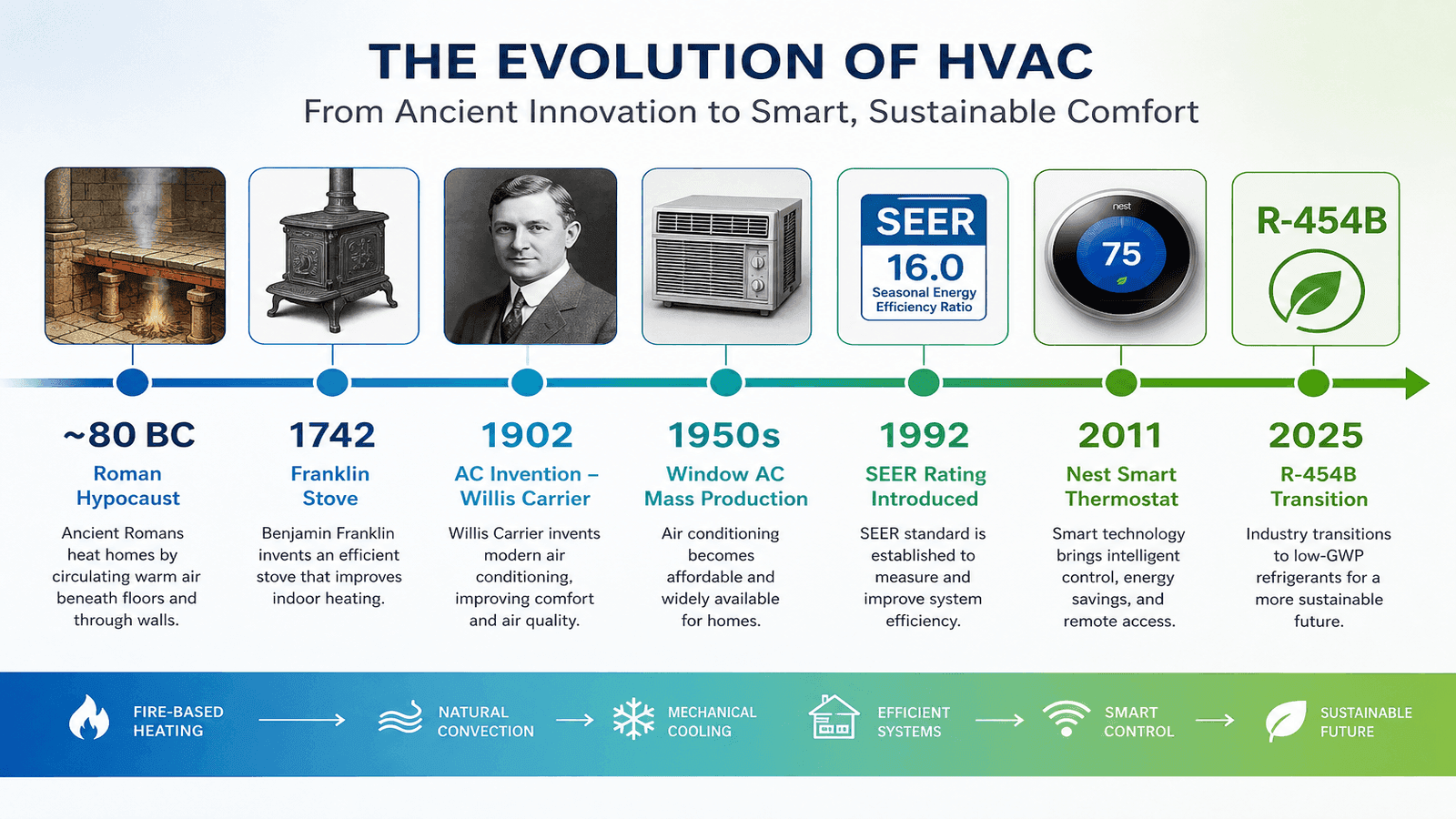
Photo: Timeline infographic showing major HVAC milestones from ancient Rome through 2025 including key inventions and standards changes
Ancient Climate Control (3000 BC to 500 AD)
Humans have been engineering indoor comfort for thousands of years. The solutions varied by geography, but the goal was always the same: stay warm in winter, stay cool in summer.
Egyptian and Persian Cooling
Ancient Egyptians hung wet reeds in windows around 2500 BC, cooling incoming air through evaporation. In Persia (modern-day Iran), wind towers called "badgirs" captured prevailing breezes and directed them into living spaces. Some designs combined wind towers with underground water channels called qanats, cooling air by as much as 15 degrees Fahrenheit before it entered a building [1].
Roman Hypocaust Systems
The most sophisticated ancient heating technology was the Roman hypocaust, developed around 80 BC and attributed to Sergius Orata [1]. The system raised building floors on stone pillars called "pilae stacks," creating a gap beneath the rooms above. A wood-burning furnace pushed hot air through this gap, then up through clay flues embedded in the walls. Rooms closest to the furnace received the most heat. The system was effective but expensive, requiring constant tending. Only wealthy families and public buildings like bathhouses could afford to operate one.
The hypocaust disappeared in Western Europe after the fall of the Roman Empire in 476 AD, though variations continued in the Eastern Empire and in Korean "ondol" floor heating systems.
The Age of Fire, Chimneys, and Steam (500 AD to 1900)
After the Roman Empire fell, heating technology regressed for centuries. Open fire pits with central roof vents were the standard until chimneys appeared in Norman castles around the 12th century [7].
In 1742, Benjamin Franklin designed his "Pennsylvania Fireplace" (the Franklin stove), a cast-iron insert that radiated heat in all directions rather than sending most of it up a chimney [7]. Franklin refused to patent his invention, believing it should benefit everyone. The Franklin stove remained the primary heating method in American homes until the late 1880s.
James Watt's steam engine work in the late 1700s led to steam-based heating systems. By the 1830s, boilers distributed heat through pipes and cast-iron radiators in commercial buildings [7]. In 1855, Franz San Galli patented the modern radiator. By the 1880s, mass-produced cast-iron radiators made central heating accessible to middle-class families.
The transition from individual room heating to central systems in the 1800s is remarkably similar to what we are seeing now with zoned smart systems. The industry moves in cycles: centralize, then decentralize with better zone control. Ductless mini-splits are essentially bringing us back to room-by-room control, but with 21st-century efficiency.
The Birth of Modern Air Conditioning (1902 to 1950)
Willis Carrier and the Printing Plant Problem
On July 17, 1902, a 25-year-old engineer named Willis Haviland Carrier designed the first modern air conditioning system while working for the Buffalo Forge Company [2]. His task had nothing to do with human comfort. A Brooklyn printing plant needed humidity control because moisture changes were misaligning colored inks. Carrier designed a system that blew air over chilled coils to control both temperature and humidity simultaneously.
On January 2, 1906, Carrier received U.S. Patent 808,897 for his "Apparatus for Treating Air" [2]. In 1911, he presented his "Rational Psychrometric Formulae" to the American Society of Mechanical Engineers, a document later called the "Magna Carta of Psychrometrics." He founded the Carrier Engineering Corporation in 1915, which still operates today as one of the largest HVAC manufacturers in the world.
Movie Theaters Spread Awareness
Air conditioning reached the public through movie theaters. In 1922, Carrier installed a centrifugal chiller at the Rivoli Theater in New York City [2]. Theaters began advertising "refrigerated air" as a major attraction. The phrase "summer blockbuster" comes from this era, when theaters drew block-long lines of people seeking cool air. By the 1930s, department stores, office buildings, and railroad cars were adding AC.
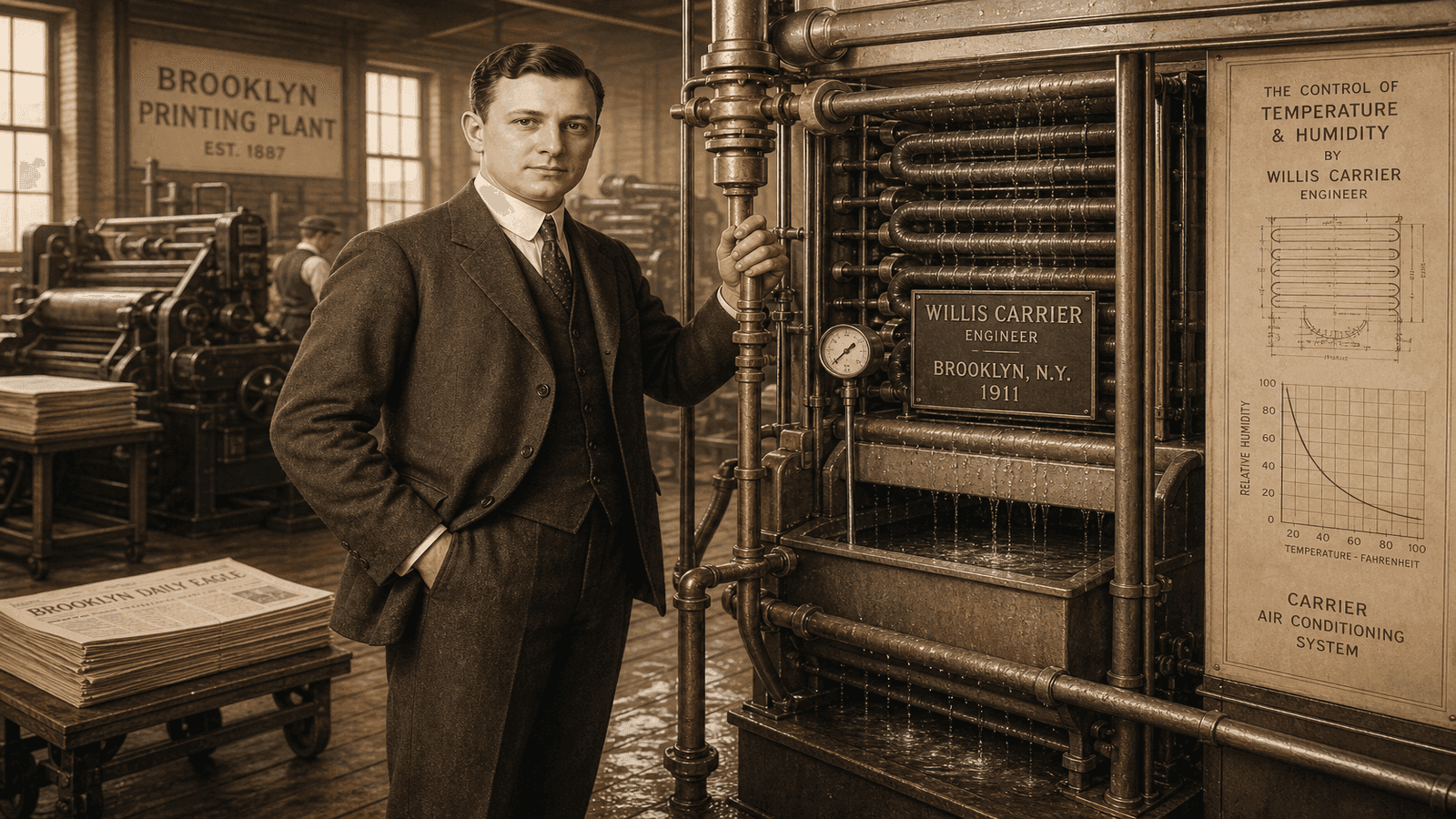
Photo: Illustration of Willis Carrier next to his original 1902 air conditioning apparatus at the Brooklyn printing plant
Air Conditioning Goes Home (1950 to 1980)
Get quotes from top-rated pros.
The Window Unit Revolution
The first window air conditioner was introduced in 1931, but early units cost $10,000 to $50,000 (over $120,000 today) [3]. By 1947, mass production brought prices to around $350. The post-war housing boom of the 1950s coincided with affordable window units: over one million sold in 1953 alone [3]. Central air followed quickly, with Sun Belt builders offering it as standard in new homes by the early 1960s.
The Case of Tom and Linda Garcia, Phoenix, AZ
Tom and Linda Garcia purchased their first home in Phoenix in 1968 with nothing but a window unit in the living room. "We slept in the living room from June through September," Tom recalls. In 1972, they invested $2,800 to install central air. "That system ran for 22 years. It changed how we used every room in the house." Their grandchildren now live in the same Phoenix neighborhood with a 20 SEER2 heat pump that costs less to operate than that original window unit.
Population Shifts
Affordable AC reshaped American geography. Phoenix grew from 107,000 residents in 1950 to over 789,000 by 1980 [3]. Historians credit residential air conditioning as a primary driver of the Sun Belt migration. By 1980, 55% of U.S. homes had AC. By 2020, that figure reached 88% [3].
The Energy Crisis and Efficiency Standards (1970 to 2000)
The 1973 Oil Embargo
The Arab oil embargo of 1973 quadrupled energy prices, and Americans suddenly cared about how much energy their HVAC systems consumed [4]. Before 1973, efficiency was barely a consideration. The crisis triggered federal legislation:
| Year | Regulation | Impact |
| 1975 | Energy Policy and Conservation Act | Created framework for appliance efficiency standards |
| 1987 | National Appliance Energy Conservation Act | Set first federal minimum efficiency standards for AC |
| 1992 | Energy Policy Act | Introduced SEER ratings, set minimum at 10 SEER |
| 2006 | SEER minimum raised to 13 | Eliminated least efficient systems from market |
| 2015 | Regional SEER standards | 14 SEER minimum in South, 13 SEER in North |
| 2023 | SEER2 replaces SEER | New testing method using realistic duct conditions |
The SEER Rating System
SEER (Seasonal Energy Efficiency Ratio) was introduced in 1992 with a minimum of 10 [4]. The most efficient systems in 2026 exceed 26 SEER2, using roughly 60% less electricity than early 1990s equipment. In 2023, the DOE replaced SEER with SEER2, which tests under realistic duct conditions [4]. Current minimums are 13.4 SEER2 in Northern states and 14.3 SEER2 in Southern states.
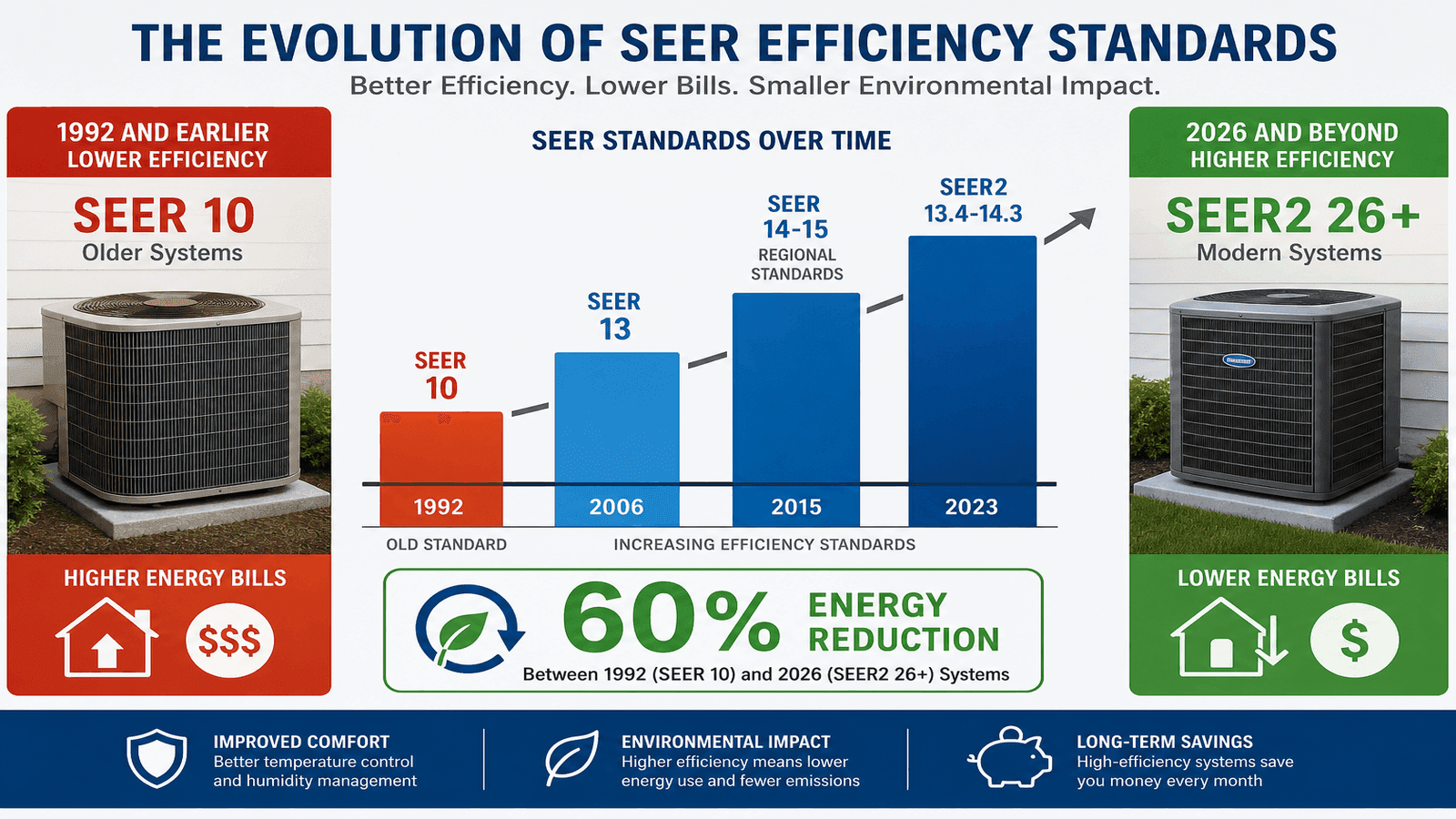
Photo: Comparison chart showing SEER efficiency standards evolution from 1992 to 2026 with corresponding energy savings percentages
The Refrigerant Revolution (1987 to 2025)
From CFCs to R-454B
Every major refrigerant transition was driven by environmental science. In 1974, researchers showed that CFCs like R-12 were destroying the ozone layer, leading to the 1987 Montreal Protocol [5]. R-22 replaced R-12 but still contained chlorine, so R-410A took over starting in 2010 with zero ozone depletion potential. However, R-410A has a GWP of 2,088. Starting January 2025, R-454B replaced R-410A with a GWP of just 466, a 78% reduction [5].
| Refrigerant | Era | ODP | GWP | Status |
| R-12 (CFC) | Pre-1987 | 1.0 | 10,900 | Banned |
| R-22 (HCFC) | 1990s-2020 | 0.055 | 1,810 | Production ended 2020 |
| R-410A (HFC) | 2010-2025 | 0 | 2,088 | No new systems after Jan 2025 |
| R-454B (HFO blend) | 2025+ | 0 | 466 | Current standard |
I have lived through three refrigerant transitions in my career. Each one required new tools, new certifications, and new installation practices. The R-454B transition is the smoothest so far because the industry had years of lead time. But homeowners should know that their existing R-410A system will keep working fine for its full lifespan. You do not need to rush out and replace equipment just because the refrigerant changed.
Get quotes from top-rated pros.
The Digital and Smart Home Era (2000 to Present)
From Dial Thermostats to Smart Controls
In 1883, Albert Butz patented the first automatic thermostat [6]. Honeywell introduced the iconic round dial thermostat in 1953. Digital programmable models arrived in the 1980s, but studies showed most homeowners never programmed them.
In 2011, Tony Fadell (creator of the iPod) launched the Nest Learning Thermostat, which learned household patterns automatically and connected to Wi-Fi for smartphone control [6]. Google acquired Nest for $3.2 billion in 2014. By 2026, smart thermostats are installed in over 35% of U.S. homes [6].
Variable-Speed Inverter Technology
Conventional HVAC systems operated on simple on/off cycles, creating temperature swings and energy waste. Variable-speed inverter compressors, pioneered by Daikin and Mitsubishi in the 1980s, adjust output continuously to match demand [8]. Benefits include 30-40% energy savings, tighter temperature control, and quieter operation. This technology arrived in U.S. homes in 2001 and now appears in virtually all premium residential systems.
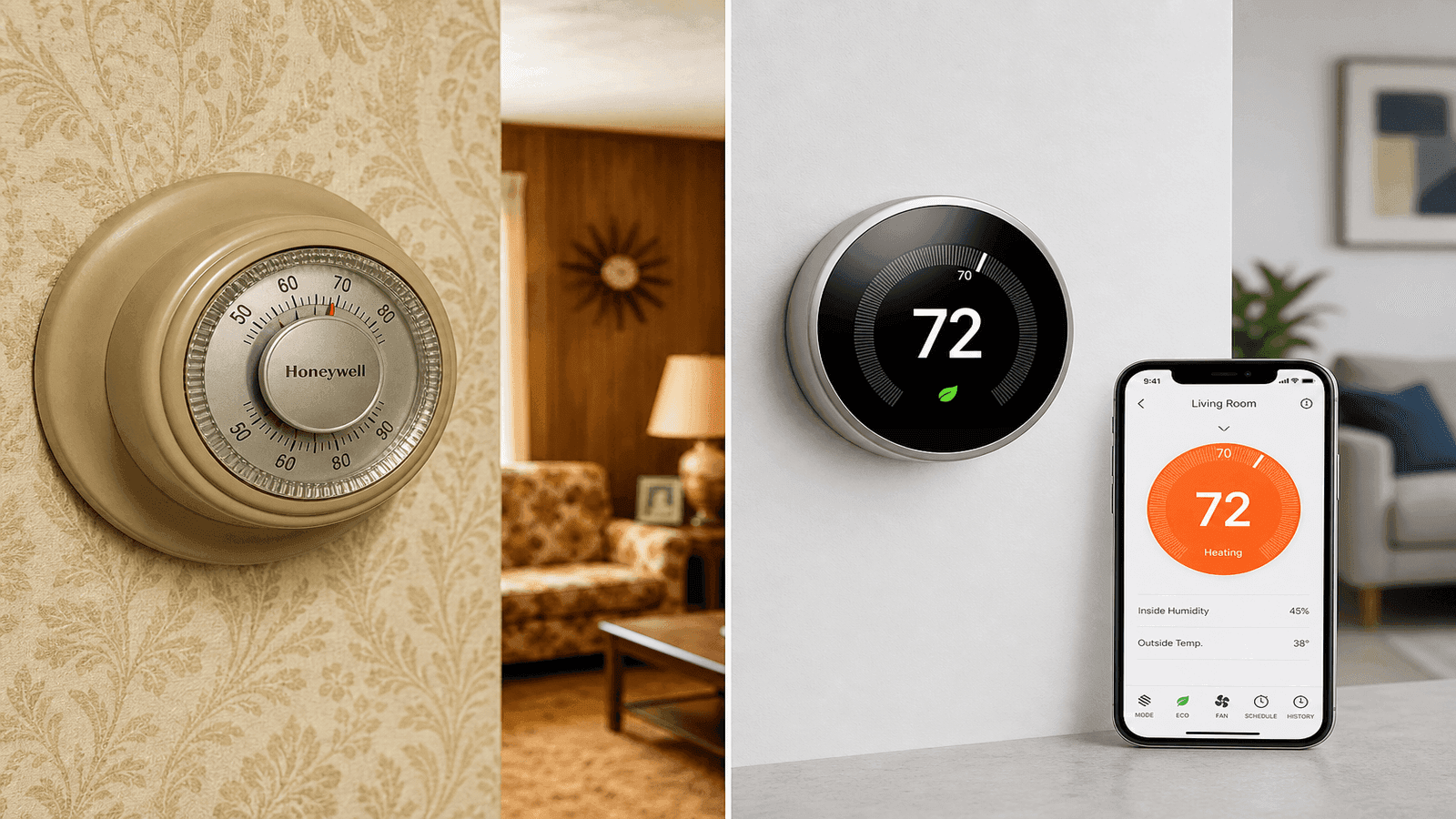
Photo: Modern smart HVAC control panel on wall showing temperature zones and energy usage alongside a vintage round Honeywell thermostat for comparison
Heat Pumps: The Biggest Shift Since Carrier
From Niche to Mainstream
The heat pump concept dates to the 1850s, when Austrian scientist Peter von Rittinger developed a system for salt mine dehydration. In 1937, Robert C. Webber accidentally discovered ground-source heating by using excess heat from a deep freezer to warm his home [8].
Early models lost effectiveness below 35 to 40 degrees Fahrenheit, limiting them to Southern climates. Cold-climate technology changed that: by 2015, models rated to -15 degrees became available, and by 2025, heat pump shipments outpaced gas furnace shipments by 12% [8]. The North American cold-climate heat pump market reached $3.25 billion in 2025 and is projected to hit $7.57 billion by 2034.
Real-World Example (Tom G., Phoenix, AZ): Tom's 1998 R-22 split system finally gave out in the summer of 2024 after years of increasingly expensive refrigerant top-offs. His last R-22 recharge cost $485 for just two pounds. A NearbyHunt-connected contractor replaced the entire system with an 18.5 SEER2 R-454B heat pump for $9,800. Tom's summer electric bills dropped from $380 per month to $215, and he no longer worries about sourcing a discontinued refrigerant.
What the Future Holds
Emerging Technologies
Solid-state cooling uses thermoelectric materials instead of compressors and refrigerants, with no moving parts and no refrigerant leaks. Geothermal costs are declining as new boring techniques reduce installation costs by roughly 30% since 2020. AI-driven optimization integrates weather forecasts, utility pricing, and occupancy data to reduce consumption 15-25% beyond smart thermostats. Grid-interactive systems respond to utility signals, pre-cooling homes during off-peak hours.
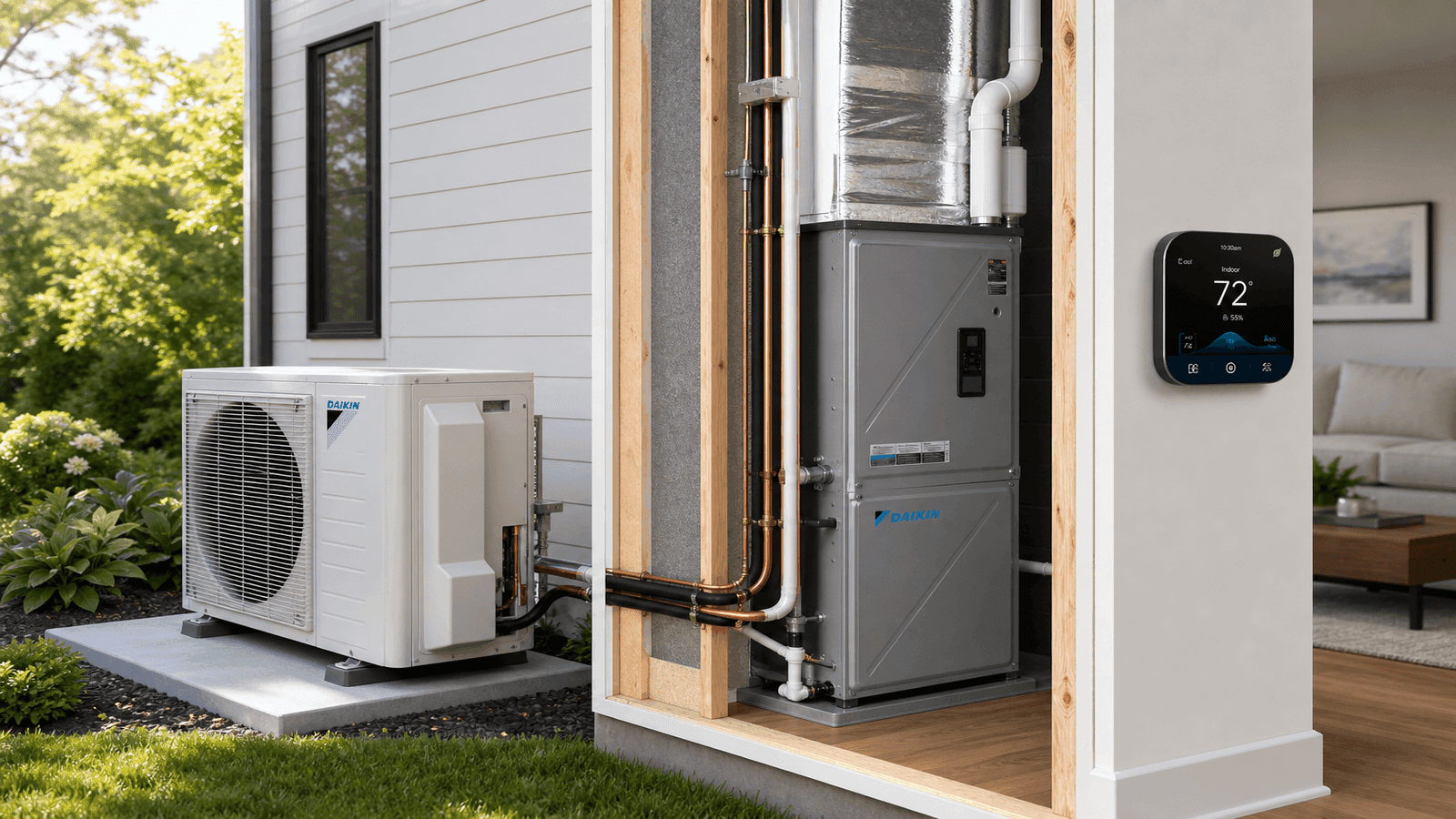
Photo: Modern residential HVAC system installation showing outdoor heat pump unit connected to indoor air handler with smart thermostat on wall
Complete HVAC History Timeline
| Year | Milestone |
| ~2500 BC | Egyptians use wet reed mats for evaporative cooling |
| ~80 BC | Romans develop the hypocaust underfloor heating system |
| 1742 | Benjamin Franklin invents the Pennsylvania Fireplace (Franklin stove) |
| 1830s | Steam heating with boilers and radiators enters commercial buildings |
| 1855 | Franz San Galli patents the modern radiator design |
| 1883 | Albert Butz patents the first automatic thermostat |
| 1902 | Willis Carrier invents modern air conditioning in Brooklyn, NY |
| 1906 | Carrier receives U.S. Patent 808,897 for air treatment apparatus |
| 1914 | First home air conditioning unit installed in Minneapolis |
| 1922 | Carrier installs centrifugal chiller at Rivoli Theater, NYC |
| 1931 | First self-contained window air conditioner introduced |
| 1937 | Robert C. Webber creates early ground-source heat pump |
| 1942 | Franklin stove variants remain primary home heating in rural U.S. |
| 1947 | Mass-produced window AC units bring prices to ~$350 |
| 1953 | Honeywell introduces the round dial thermostat |
| 1953 | Over 1 million window AC units sold in a single year |
| 1973 | Oil embargo sparks energy efficiency movement |
| 1987 | Montreal Protocol phases out CFC refrigerants |
| 1992 | SEER rating system introduced with minimum of 10 |
| 2006 | SEER minimum raised to 13 |
| 2010 | R-410A replaces R-22 as standard refrigerant |
| 2011 | Nest Learning Thermostat launches smart HVAC era |
| 2020 | R-22 production and import permanently banned |
| 2023 | SEER2 replaces SEER with stricter testing method |
| 2025 | R-454B replaces R-410A (78% lower GWP) |
Disclaimer: This article provides general educational information about HVAC systems and services. It is not intended as professional HVAC advice for specific situations. Local building codes, climate conditions, and individual home characteristics vary significantly. Always consult a licensed, certified HVAC professional for system-specific recommendations, installations, and repairs. Cost estimates are national averages as of 2026 and may differ in your area.
Sources & References
- "Hypocaust." Britannica. britannica.com
- "History of Air Conditioning." U.S. DOE. energy.gov
- "HVAC Statistics 2026." ServiceTitan. servicetitan.com
- "HVAC Efficiency History." Adams Air. adams-air.com
- "R-454B Guide." HVAC Calculator Hub. hvaccalculatorhub.com
- "History of Thermostats." Mysa. getmysa.com
- "History of Home Heating." AC Express. austinacexpress.com
- "Variable-Capacity Heat Pumps." Mitsubishi. mitsubishicomfort.com

Daniel is an EPA-certified HVAC technician & Energy Efficiency Consultant with over 14 years of experience in maintaining and installing heating and cooling systems throughout the Midwest. Passionate about sustainability, Dan specialises in energy-efficient retrofits and intelligent climate control systems. He writes for NearbyHunt to help homeowners extend the lifespan of their HVAC units while lowering utility bills.

Christine is an EPA-certified HVAC professional with 17 years of experience in heating, cooling, and indoor air quality systems. She has managed large-scale residential installations and worked as a technical trainer for new HVAC apprentices. Chris’s reviews focus on accuracy, safety, and performance standards in modern HVAC practices.