- Dirty air filters are the most common reason an AC stops cooling and can increase energy bills by 5-15%, yet a replacement filter costs under $25 and takes two minutes to swap [1].
- Refrigerant leaks reduce cooling output by 30-40% and now cost 2-3x more to repair due to the EPA's R-410A production phasedown, making early detection critical [2].
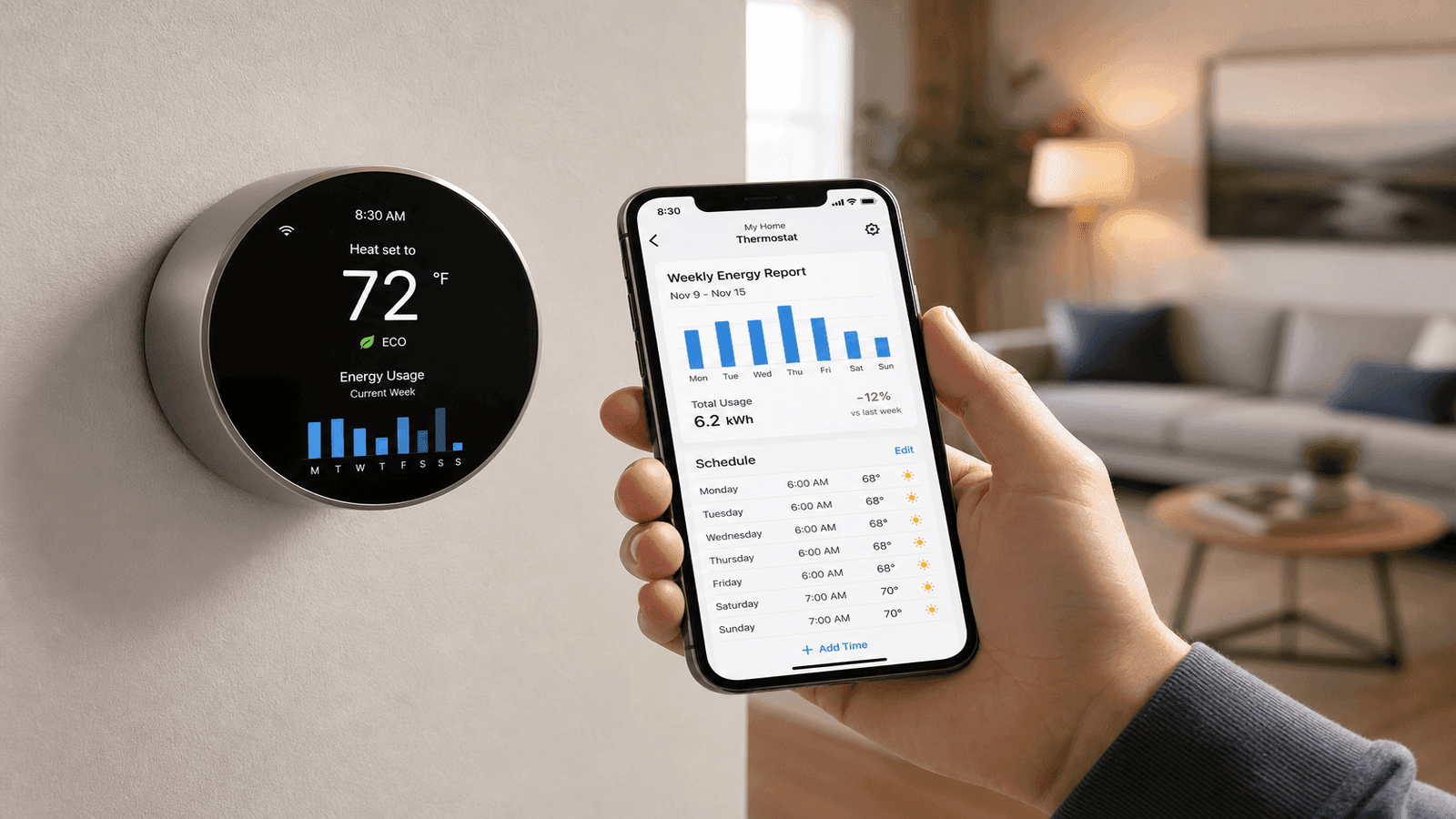
- Thermostat errors account for roughly 1 in 5 HVAC service calls, and half of those are solved by a battery change or settings correction [3].
- Leaky ductwork loses 20-30% of conditioned air before it reaches your rooms, meaning your AC may be cooling just fine but the air never arrives [4].
- A basic AC tune-up costing $100-$200 prevents most cooling failures and extends system life by 5-10 years according to ASHRAE maintenance standards [5].
Your air conditioner is running, but the house is still warm. This is the single most common HVAC complaint during cooling season, and it accounts for 28% of all residential HVAC service requests based on data from the NearbyHunt professional network. The good news: many causes are simple enough to diagnose and fix yourself before spending $150-$400 on a service call.
Daniel Torres, a Certified HVAC Technician with EPA 608 Universal and NATE certifications and 14 years of field experience in Minneapolis, walks through the most frequent causes from easiest to most complex. Each section tells you whether the fix is DIY or requires a licensed technician.

Get quotes from top-rated pros.
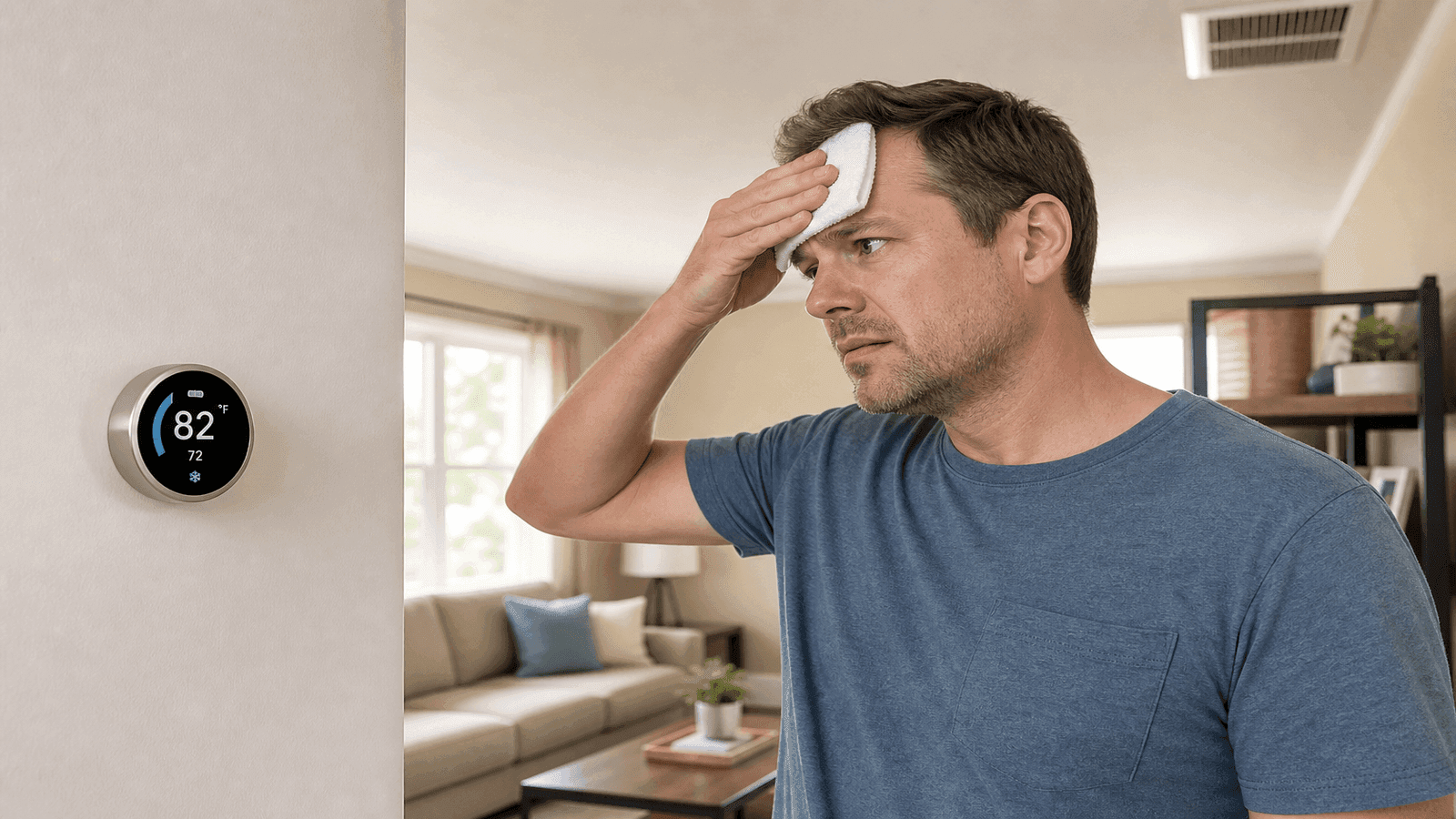
Photo: Homeowner standing near an AC thermostat checking temperature while the air conditioner runs but fails to cool the room
Check the Thermostat First
This is the fastest check and solves the problem more often than most homeowners expect. ACCA data shows thermostat-related issues represent about 20% of all residential HVAC service calls [3].
DIY steps (5 minutes):
- Verify the thermostat is set to COOL, not HEAT or FAN ONLY
- Set the temperature at least 3-5 degrees below the current room temperature
- Replace batteries if you have a battery-powered thermostat
- Make sure the thermostat is not in direct sunlight, near a lamp, or near a kitchen, all of which cause false temperature readings
- Check that no one accidentally bumped the mode switch
If the display is blank, the thermostat has lost power. Replace batteries first. If it still shows nothing, check the breaker panel for a tripped circuit.
Cost if this is the issue: $0-$10 for batteries. New thermostat installation runs $50-$150 for basic models or $200-$400 for smart thermostats.
Replace the Air Filter
A clogged filter is the number one mechanical cause of AC cooling failure. The Department of Energy confirms that a dirty filter forces the system to work harder and wastes energy, and ENERGY STAR recommends checking your filter monthly and replacing it at minimum every three months [1].
When the filter is blocked, airflow drops across the evaporator coil. Without enough warm air passing over the coil, two things happen: the refrigerant cannot absorb enough heat, and the coil temperature drops below freezing. Ice forms on the coil, which blocks airflow even further. Within hours, the system is blowing warm air or shutting down completely.
DIY steps (2 minutes):
- Locate the filter (usually at the return air grille or inside the air handler)
- Slide out the old filter and hold it up to a light source
- If you cannot see light through it, replace it immediately
- Match the size printed on the filter frame (common sizes: 16x20x1, 20x25x1, 16x25x1)
- Insert the new filter with the airflow arrow pointing toward the air handler
Cost: $5-$25 for a standard filter. Emergency service call for a frozen coil caused by a dirty filter: $150-$400.
I cannot overstate this one. Roughly 4 out of every 10 service calls I run come down to a filter that should have been changed weeks ago. Homeowners pay me $300 to walk in and pull out a filter that looks like dryer lint. Set a monthly reminder on your phone.
Inspect the Outdoor Unit
The condenser unit outside your home is where your AC dumps the heat it pulled from indoor air. If the condenser cannot release heat efficiently, the system runs continuously without cooling.
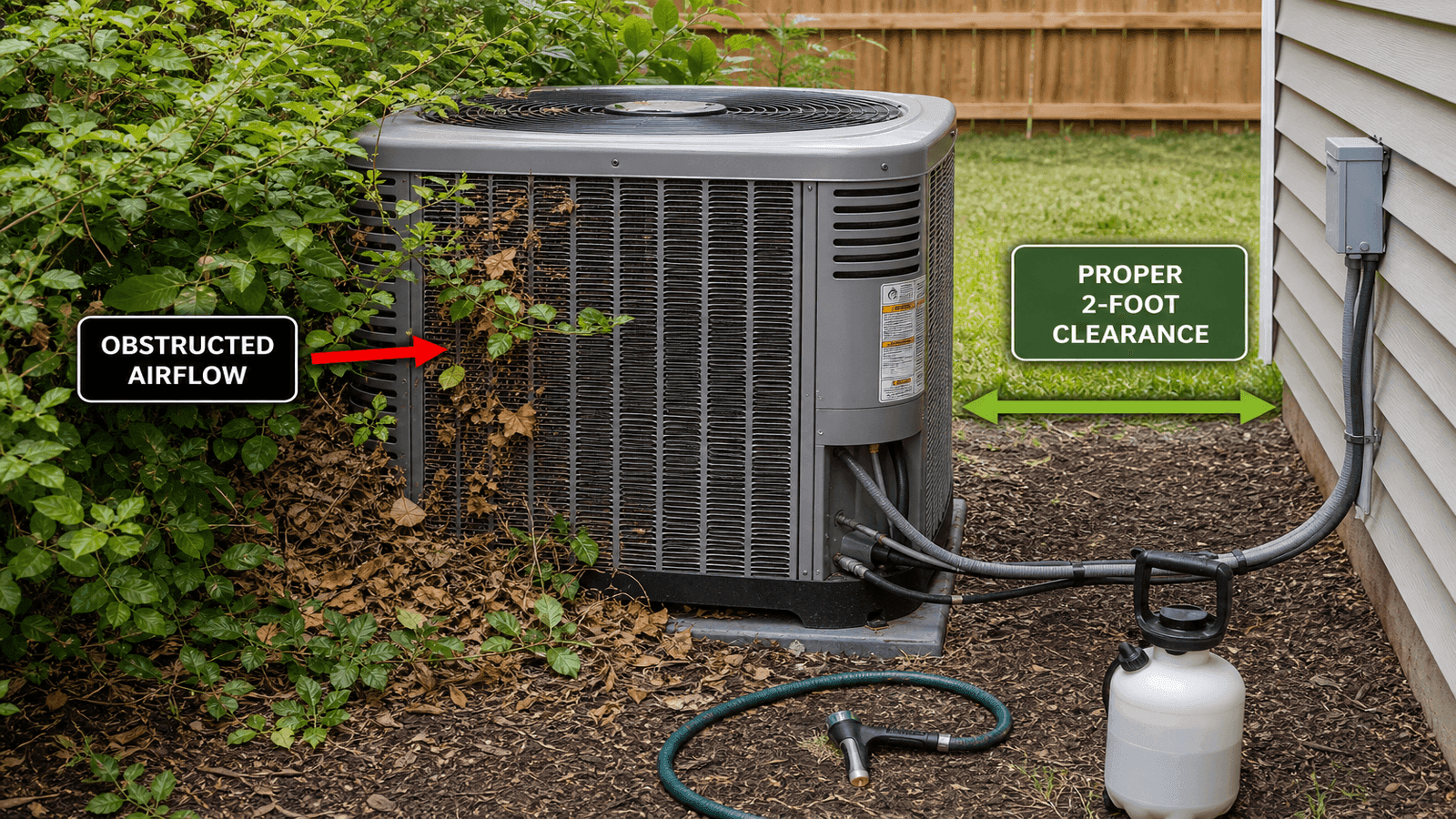
Photo: Close-up of a residential outdoor AC condenser unit surrounded by overgrown vegetation blocking airflow
DIY steps (15-30 minutes):
- Clear all vegetation, debris, and objects within 2 feet of the unit on all sides
- Gently spray the condenser fins with a garden hose (never a pressure washer) to remove dirt buildup
- Straighten any bent fins with a fin comb ($10 at hardware stores)
- Check that the condenser fan is spinning when the system is running
- Remove any leaves, grass clippings, or cottonwood seeds packed into the coil
If the fan is not spinning but the compressor hums, the fan motor or capacitor has likely failed. Shut the system off and call a technician. Running a compressor without condenser fan airflow can cause permanent compressor damage within minutes.
Cost: $0 for clearing debris. Professional condenser cleaning: $150-$400. Fan motor replacement: $300-$600.
Get quotes from top-rated pros.
Check for Frozen Evaporator Coils
Ice on the indoor evaporator coil is a clear sign something is wrong. According to Trane, restricted airflow is the leading cause of frozen coils, and a dirty filter is the most common source of that restriction [6].
Signs of a frozen coil:
- Warm air blowing from vents despite the system running
- Visible ice on the refrigerant lines (the insulated copper pipe near the indoor unit)
- Water pooling around the indoor air handler
- Reduced or no airflow from supply vents
DIY steps:
- Turn the AC off immediately at the thermostat
- Set the fan to ON (not AUTO) to circulate warm air over the coil
- Wait 2-4 hours for ice to melt completely
- Check and replace the air filter
- Make sure all return air vents are open and unblocked
- Restart the system and monitor for 30 minutes
If the coil freezes again after a clean filter is installed and vents are open, the cause is likely low refrigerant or a failing blower motor. Both require professional diagnosis.
Cost: $0 for thawing and filter replacement. Professional repair if the coil refreezes: $200-$700.
Refrigerant Issues
Refrigerant does not get "used up." If your system is low on refrigerant, there is a leak somewhere. The EPA reports that residential systems can leak 5-11% of their charge per year, and a system running 15-20% low delivers only 60-70% of its rated cooling capacity while consuming significantly more electricity [2].
Warning signs of low refrigerant:
- Warm air from vents even after the filter and thermostat are checked
- Ice forming on the evaporator coil or refrigerant lines
- A hissing or bubbling sound near the indoor unit
- Higher than normal electric bills during cooling season
- The system runs continuously without reaching the set temperature
This is never a DIY repair. Federal law (EPA Section 608) requires EPA 608 certification to handle refrigerants. Refrigerant handling without certification carries fines up to $44,539 per day per violation [2].
| Refrigerant Repair | Typical Cost (2026) |
| Leak detection and minor repair | $200-$600 |
| Refrigerant recharge (R-410A) | $400-$800 |
| Evaporator coil replacement | $900-$2,700 |
| Condenser coil replacement | $800-$2,400 |
With R-410A prices climbing every quarter, it makes less financial sense to keep recharging a leaking system. If your unit is over 10 years old and needs refrigerant, get a quote for replacement alongside the repair quote. The math often favors a new system with R-454B refrigerant that will cost far less to service going forward.
Ductwork Problems
Your AC might be cooling perfectly, but if the ductwork leaks, that cold air never reaches your living spaces. ENERGY STAR estimates that a typical home loses 20-30% of conditioned air through duct leaks, holes, and poorly connected joints [4]. In homes with ducts running through unconditioned attics or crawl spaces, losses can reach 60%.
Signs of duct problems:
- Some rooms cool normally while others stay warm
- Visible gaps or disconnected joints in accessible ductwork
- Excessive dust around supply registers
- The AC cools well near the air handler but poorly in distant rooms
- Higher energy bills without increased usage
DIY checks:
- Inspect visible ductwork in the attic, basement, or crawl space for obvious gaps
- Feel for air leaking from joints while the system runs
- Seal small gaps with mastic sealant or metal-backed UL 181 tape (never cloth duct tape, which degrades within 1-2 years)
- Make sure all supply registers are open and unblocked by furniture or rugs
Cost: DIY sealing of accessible joints: $20-$50 in materials. Professional duct sealing: $1,500-$3,500. Aeroseal technology: $2,000-$4,000.
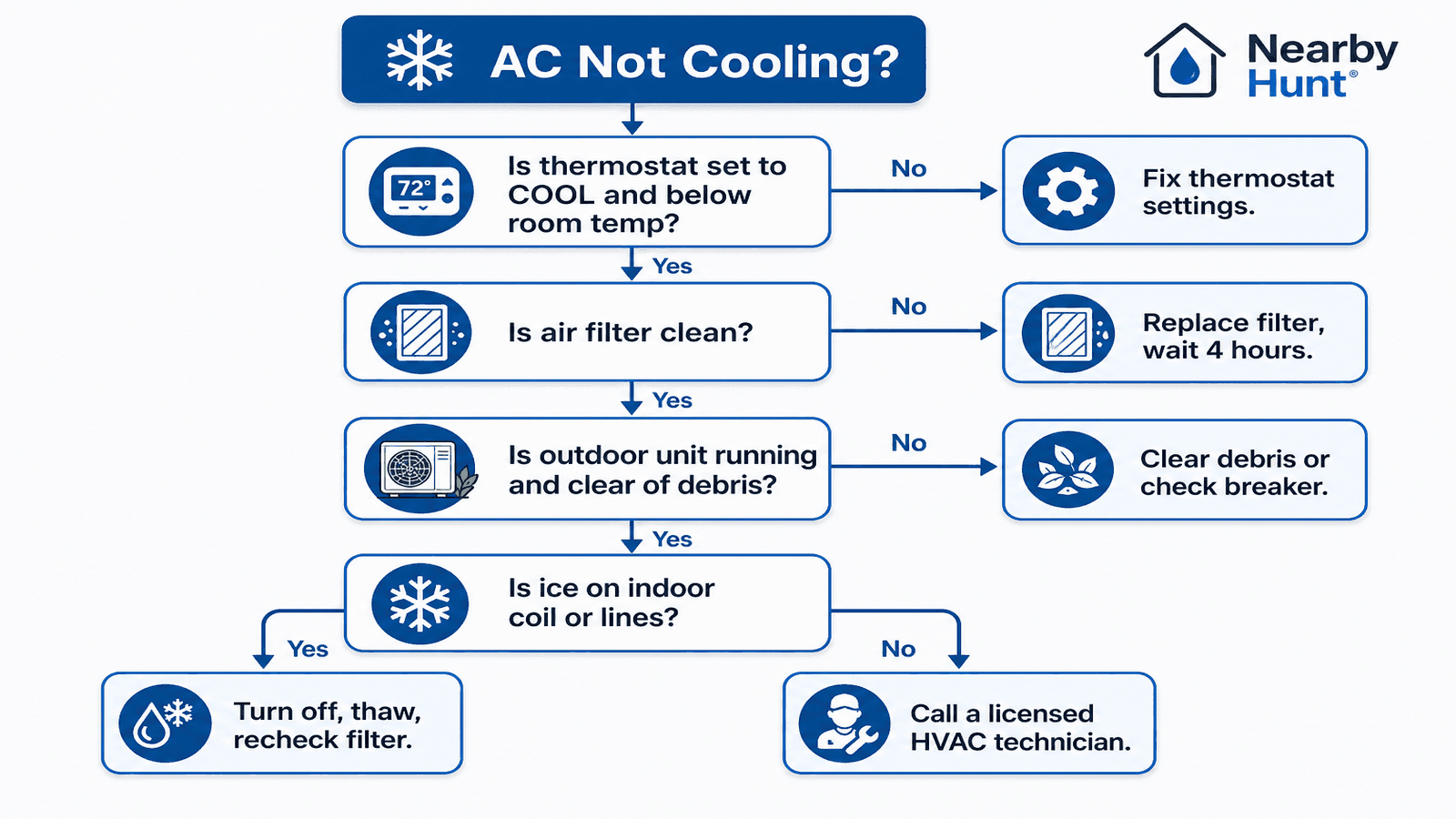
Photo: Infographic showing common AC not cooling causes with a diagnostic flowchart from thermostat check to professional service call
Electrical and Capacitor Failures
The compressor and fan motors in your outdoor unit rely on capacitors to start and run. Capacitors degrade over time, especially in hot climates where the outdoor unit bakes in direct sun for months.
Signs of capacitor failure:
- The outdoor unit hums but does not start
- The fan spins slowly or intermittently
- The system starts and then shuts off after a few seconds
- A clicking sound from the outdoor unit followed by silence
Capacitors store dangerous electrical charges even when the system is off. Never attempt DIY capacitor testing or replacement unless you have electrical training. Professional capacitor replacement costs $150-$400, making it one of the most affordable HVAC repairs.
Other electrical causes: A tripped breaker, a blown fuse in the disconnect box near the outdoor unit, or a faulty contactor relay can all prevent the system from cooling. Check the breaker panel before calling for service.
When to Call a Professional
Some AC problems require a licensed HVAC technician with proper tools and certifications. Call a professional when:
- The evaporator coil freezes repeatedly after filter replacement
- You suspect a refrigerant leak (hissing sounds, ice on lines, warm air)
- The outdoor unit makes grinding, screeching, or banging sounds
- The breaker trips repeatedly when the AC turns on
- Your electric bill has spiked without explanation
- The system is over 10 years old and has needed multiple repairs
What to expect from a service call: A standard diagnostic visit costs $100-$250 in 2026. The technician will check refrigerant pressures, electrical components, airflow, and thermostat calibration. Most minor repairs (capacitor, contactor, drain line) are completed the same visit for $150-$650 total [8].
Get quotes from top-rated pros.
Case Study: The Nguyen Family Saves $2,400
Tom and Sarah Nguyen of Eagan, Minnesota, contacted Daniel through NearbyHunt in July 2025 when their 8-year-old central AC stopped cooling during a 95-degree heat wave. They had already called one company that quoted $3,200 for a full refrigerant recharge and evaporator coil replacement.
Daniel's inspection found three problems working together: a severely clogged filter that had been in place for over six months, a condenser unit packed with cottonwood seeds reducing airflow by roughly 50%, and a slow refrigerant leak at a flare fitting on the lineset.
The filter and condenser cleaning restored significant cooling capacity immediately. The flare fitting leak repair and partial refrigerant top-off cost $385. Total bill: $535 compared to the $3,200 quote they received elsewhere. Daniel recommended setting a 30-day filter reminder and scheduling annual tune-ups to catch small leaks before they become expensive problems.
The system has run through two full cooling seasons since the repair with no further issues.
NearbyHunt Network Insight
Service request data from HVAC professionals in the NearbyHunt network reveals clear patterns in AC cooling complaints:
| Issue | % of "AC Not Cooling" Calls | Typical Resolution Cost |
| Dirty filter or blocked airflow | 35% | $0-$50 (DIY) |
| Refrigerant leak or low charge | 25% | $200-$800 |
| Thermostat error or malfunction | 18% | $0-$400 |
| Capacitor or electrical failure | 12% | $150-$400 |
| Ductwork leaks | 6% | $50-$3,500 |
| Compressor failure | 4% | $1,500-$3,000 |
The data shows that over half of all "AC not cooling" complaints are resolved for under $100, often by the homeowner. Annual preventive maintenance at $100-$200 per visit catches the majority of issues before they escalate into emergency calls.
Preventive Maintenance Checklist
Monthly (homeowner):
- Check and replace the air filter
- Clear debris from around the outdoor unit
- Verify the thermostat is reading accurately
- Listen for unusual sounds during startup
Seasonally (spring, before cooling season):
- Schedule a professional AC tune-up ($100-$200)
- Clean condenser coils with a garden hose
- Flush the condensate drain line with white vinegar
- Test the system before the first hot day
Annually:
- Professional refrigerant pressure check
- Electrical component inspection
- Duct inspection every 3-5 years
- Evaluate system age and plan for replacement if over 15 years old
For a deeper look at seasonal HVAC care and common system failures, see our complete guide to HVAC How-To and DIY.
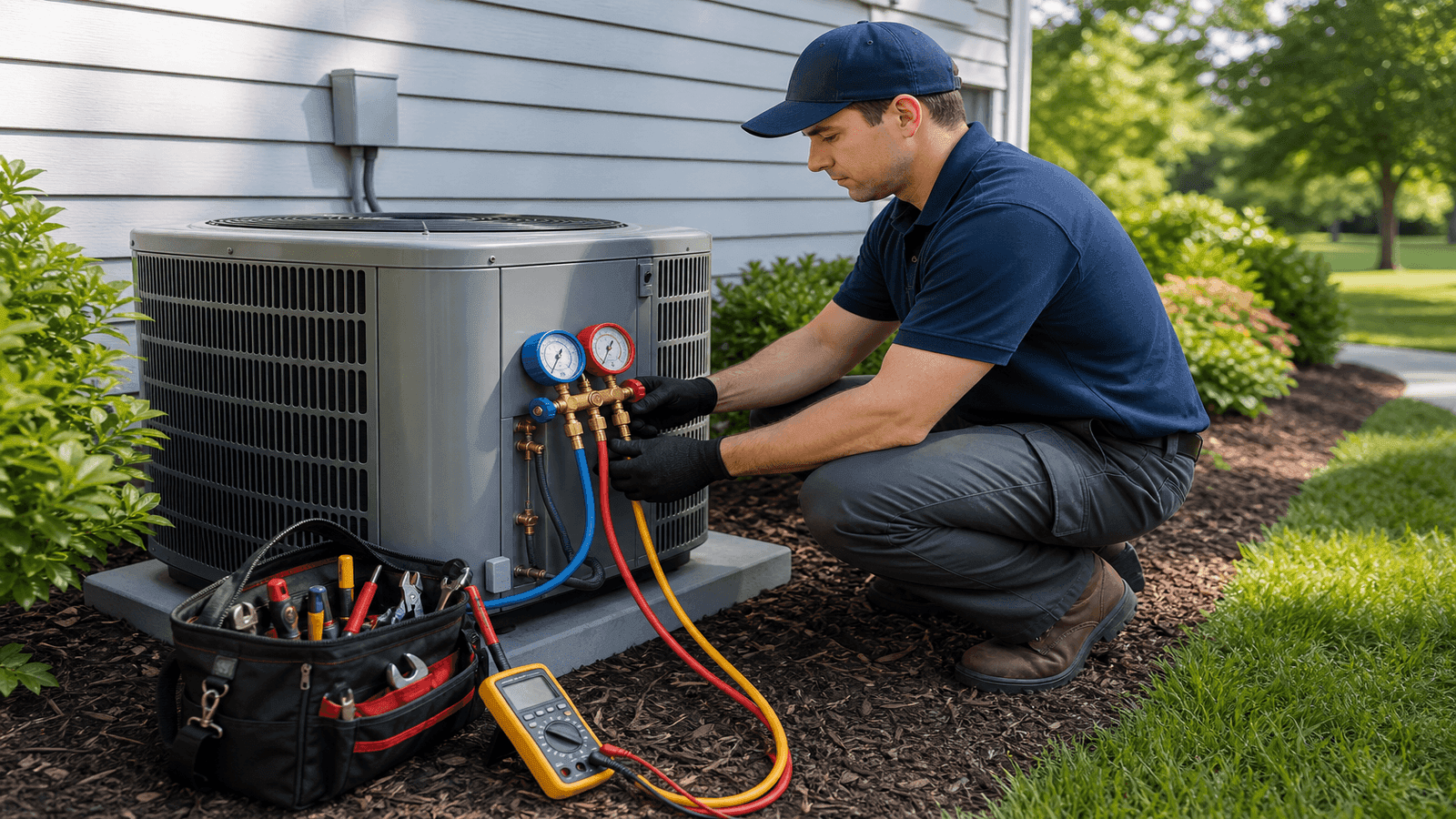
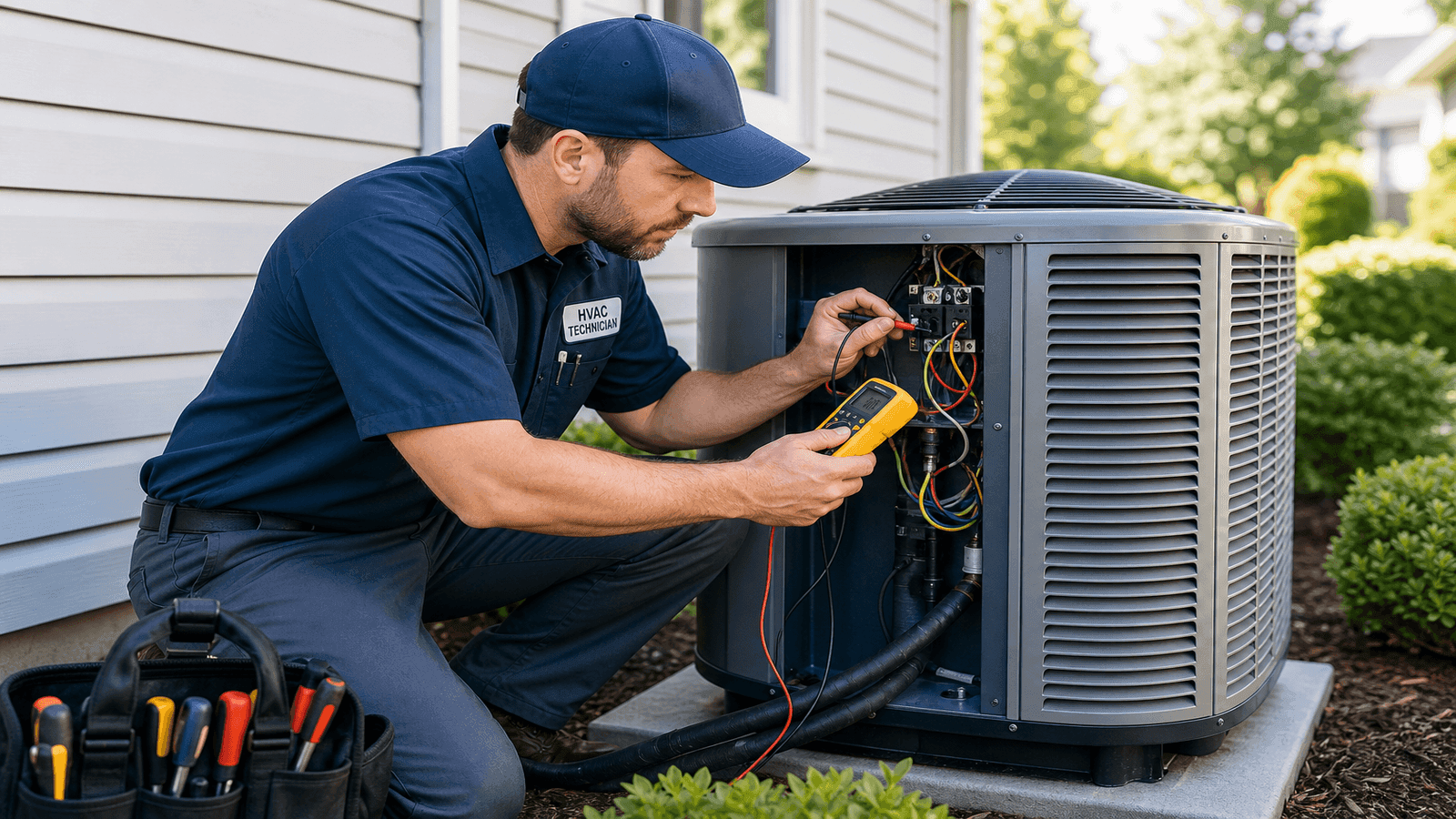
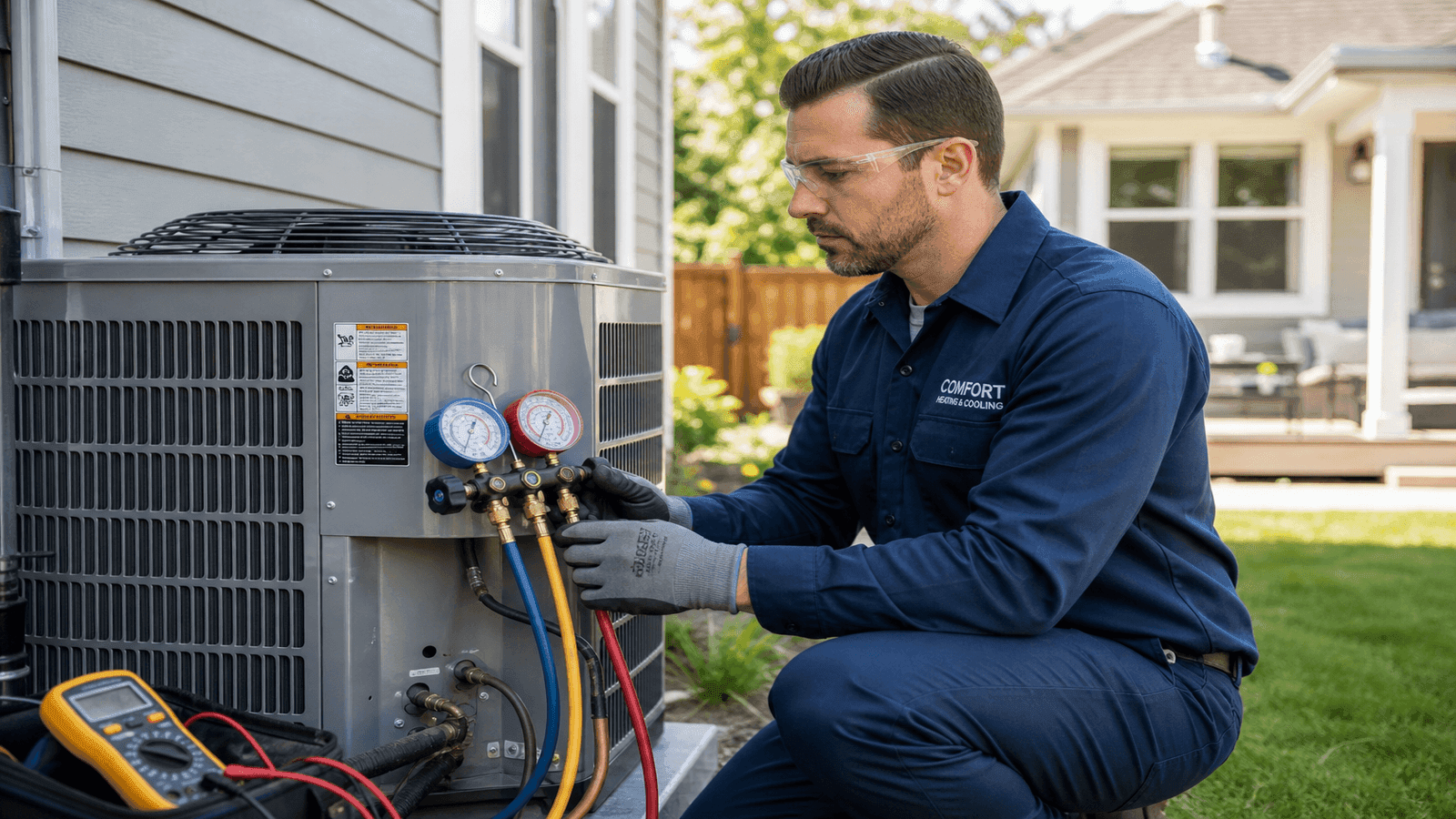
Photo: HVAC technician performing a professional AC tune-up on an outdoor condenser unit with gauges and diagnostic tools
Find HVAC Professionals on NearbyHunt
When your AC is not cooling and DIY troubleshooting has not solved the problem, NearbyHunt connects you with licensed, insured HVAC technicians who hold EPA 608 and NATE certifications. Compare verified reviews, get multiple quotes, and book service through one platform.
Sources and References
[1] U.S. Department of Energy. "Common Air Conditioner Problems."
[2] U.S. Environmental Protection Agency. "Section 608 of the Clean Air Act: Stationary Refrigeration and Air Conditioning."
[3] Air Conditioning Contractors of America (ACCA). "Residential HVAC Service Call Analysis."
[4] ENERGY STAR. "Duct Sealing."
[5] ASHRAE. "ANSI/ASHRAE/ACCA Standard 180: Inspection and Maintenance of HVAC Systems."
[6] Trane Technologies. "Air Conditioner Troubleshooting: 5 Common Issues."
[7] AC Direct. "R-410A in 2026: The Truth About Repairs, Rising Refrigerant Costs, and What Replaces It."
[8] This Old House. "Air Conditioner Repair Cost (2026 Pricing)."
Disclaimer: AC cooling problems vary based on equipment type, system age, home insulation, climate zone, and local conditions. The costs listed are national averages from 2025-2026 data and may not reflect pricing in your area. Always get written estimates from licensed, insured HVAC technicians before authorizing repairs. Refrigerant handling requires EPA 608 certification and is illegal for uncertified individuals. Some repairs require permits depending on local building codes. This article is for informational purposes only and does not replace professional HVAC diagnosis for your specific system.
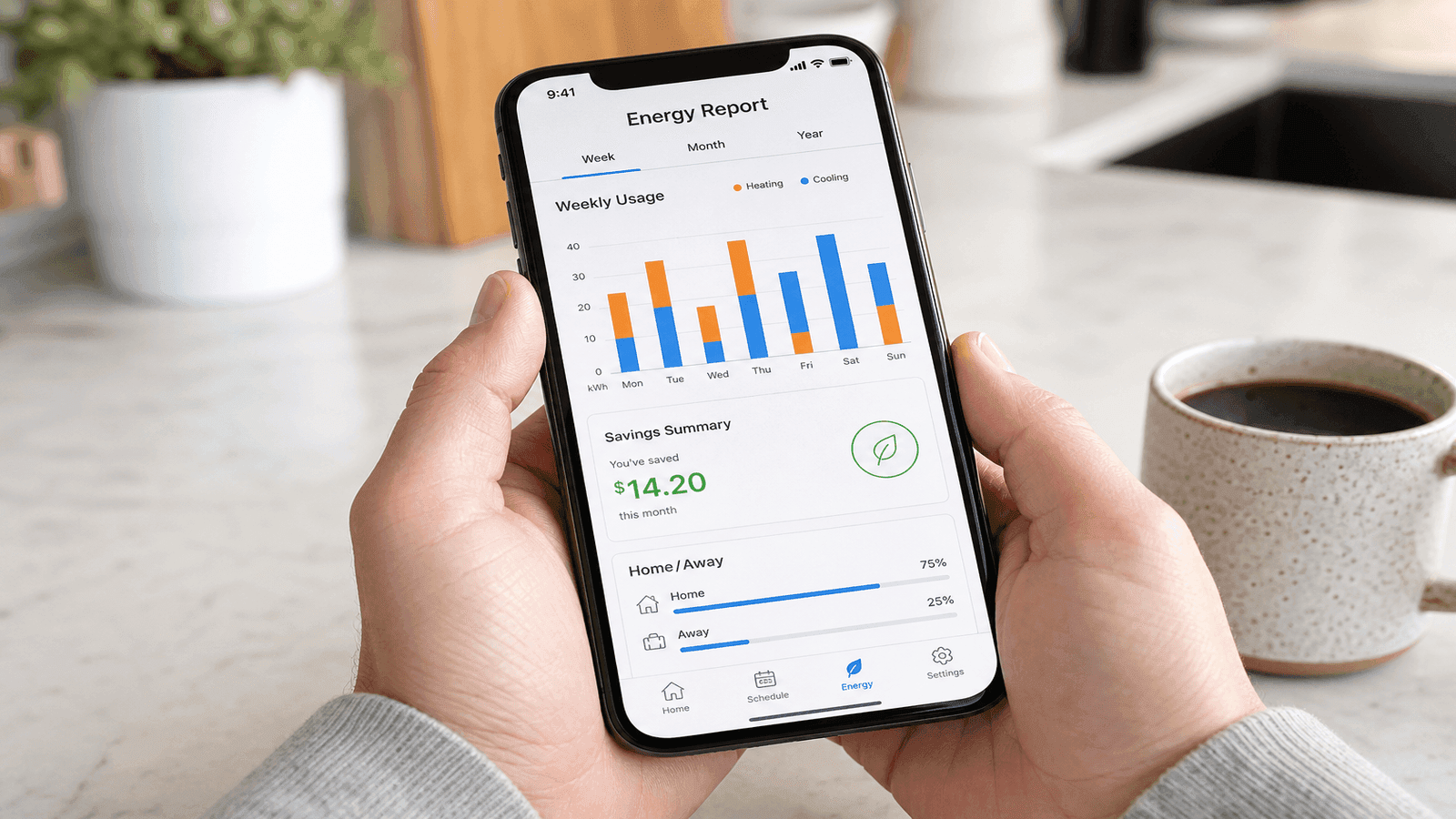

Daniel is an EPA-certified HVAC technician & Energy Efficiency Consultant with over 14 years of experience in maintaining and installing heating and cooling systems throughout the Midwest. Passionate about sustainability, Dan specialises in energy-efficient retrofits and intelligent climate control systems. He writes for NearbyHunt to help homeowners extend the lifespan of their HVAC units while lowering utility bills.

Christine is an EPA-certified HVAC professional with 17 years of experience in heating, cooling, and indoor air quality systems. She has managed large-scale residential installations and worked as a technical trainer for new HVAC apprentices. Chris’s reviews focus on accuracy, safety, and performance standards in modern HVAC practices.