- Average roof replacement costs $8,000-$20,000 with a national average around $11,500 for a 2,000 sq ft home with asphalt shingles; premium materials like slate or standing-seam metal can push totals past $75,000 [2].
- Roofing costs vary by material, pitch, size, and region: a metal roof costs 2-3x more than asphalt upfront but lasts 40-70 years compared to 20-30 years for asphalt [8].
- Repair vs. replace: repairs average $300-$1,500 for minor issues; replacement becomes the better value when a roof is 15 or more years old and the repair cost exceeds 30% of full replacement cost [5].
- Get 3 written quotes from licensed contractors; prices vary 20-40% for identical work based on overhead, insurance coverage, and local market conditions.
- James Carver has priced over 1,800 residential roofing projects across the U.S. South and Midwest; homeowners who understand the cost components routinely negotiate 10-15% better final prices.
Every homeowner faces a roofing decision eventually. The roof over a 2,000 sq ft home contains roughly 2,000 to 2,500 square feet of exposed surface, a significant asset that protects everything underneath it. When that asset starts failing, the cost conversation gets confusing fast.
Internet estimates range from $5,000 to $30,000 for a "typical" roof. Contractor quotes on identical homes sometimes differ by $5,000 or more. Homeowners who understand what drives roofing costs arrive at contractor conversations prepared. Those who don't often pay more than they need to, or choose the wrong material for their climate and budget.
This guide covers every cost factor in detail: material choices, labour rates by region, repair vs replacement decisions, inspection costs, financing options, and a real case study from Nashville. Whether you're comparing asphalt shingles against a metal roof upgrade or trying to decide whether a repair buys you another three years, the pricing context here applies directly to your decision.

Get quotes from top-rated pros.
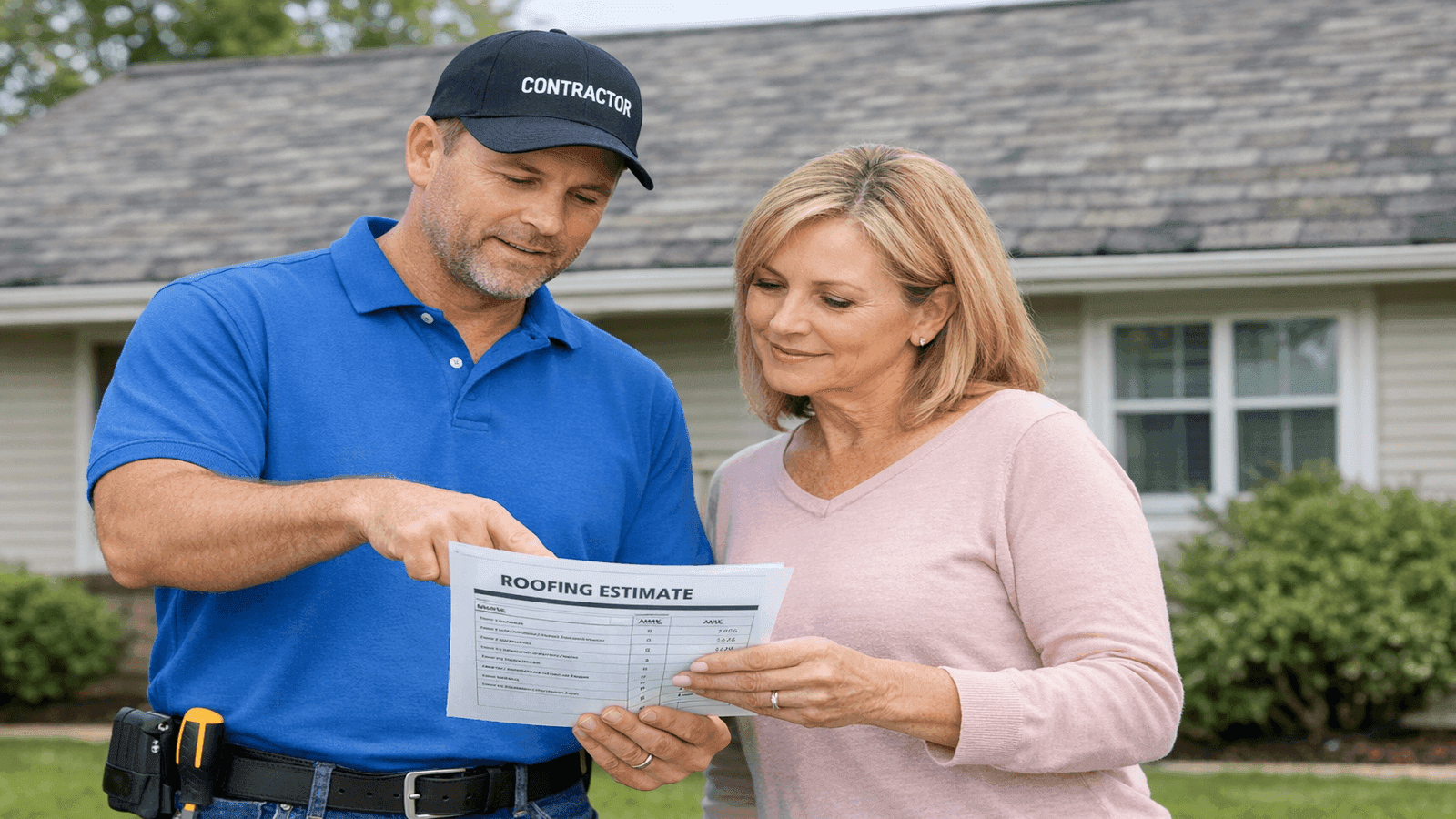
Photo: Roofing contractor reviewing itemized estimate with homeowner outside their home, roof visible in background showing aged asphalt shingles
What Affects Roofing Costs Most
Six factors account for the majority of price variation between quotes on comparable homes. Understanding each one lets you evaluate any quote intelligently.
Roof Size: Measured in Squares
Contractors price roofing by the "square" — one roofing square equals 100 square feet of roof surface. A 2,000 sq ft home with a moderately pitched roof typically covers 22 to 26 squares of actual roof surface once pitch is factored in. Larger homes, higher pitches, and complex roof geometries all increase square count.
Material Choice
Material is the single largest cost variable. Asphalt shingles are the entry point at $5,000-$12,000 installed for an average home. Metal roofing runs $10,000-$30,000 for most residential applications, while clay tile, concrete tile, and slate can reach $15,000-$75,000+ depending on home size and grade [3].
Pitch and Complexity
A simple gable roof on a ranch-style home costs less per square than a hip-and-valley roof with dormers. High-pitch roofs (above 8:12) require safety harnesses and slow the crew's pace significantly. Industry standard adds 15-25% to base labor costs for steeply pitched or geometrically complex roofs. Skylights, chimneys, and pipe penetrations each add 30 minutes to 2 hours of flashing labor.
Regional Labor Rates
Labor rates vary 30-50% across U.S. regions [9]. A roofing crew in rural Tennessee charges $150-$250 per square for installation labor. The same work in metro Boston or Seattle runs $300-$450 per square. Gulf Coast markets see premium pricing for hurricane-rated installations, and California's prevailing wage requirements add cost on any licensed contractor job.
Tear-Off vs. Overlay
Most building codes allow one overlay, applying new shingles over an existing layer, which saves $1-2 per square foot in tear-off and disposal costs. If a home already has two shingle layers, full tear-off is required by code, adding $1,000-$3,000 to the total project cost depending on size.
Permits
Roofing permits cost $150-$500 depending on municipality. Skipping a permit to save $200 creates a larger problem: unpermitted roofing work can trigger claim denials from homeowners insurance if the roof is ever involved in a water damage claim, and it creates disclosure requirements at resale.
| Factor | Typical Impact on Total Cost | Notes |
| Roof size (per square added) | +$350-$800 | Varies by material |
| Material upgrade (asphalt to metal) | +$8,000-$20,000 | For 2,000 sq ft home |
| High pitch (above 8:12) | +15-25% of base labor | Safety equipment + slower pace |
| Regional labor premium (Northeast vs. South) | +25-40% of labor | Same crew, different market |
| Full tear-off (2 existing layers) | +$1,000-$3,000 | Code-required when 2 layers exist |
| Complexity (dormers, valleys, skylights) | +10-20% of total | Per additional penetration/feature |
| Permit | +$150-$500 | Required in all jurisdictions |
Roof Replacement Costs by Material
Material selection determines the upper boundary of your roofing budget and the long-term maintenance trajectory for the next 20-75 years. Here is how the major residential roofing materials compare on cost, lifespan, and best-fit applications.
Asphalt Shingles: $5,000-$12,000
Asphalt shingles remain the most common residential roofing material in the U.S., covering roughly 70% of all homes. For a 2,000 sq ft home, architectural shingles installed professionally run $5,000-$12,000, with a national average around $8,500-$9,000 [2]. Three-tab shingles cost less at $5,000-$7,500, but most roofing contractors in 2026 recommend architectural (dimensional) shingles as the better value given their 30-year warranty vs. 20-year on 3-tab.
Cost per square foot installed: $3.50-$6.00. Lifespan: 20-30 years. Best for: most residential applications, any climate, any budget range.
For complete pricing detail, see our asphalt shingle cost guide.
Metal Roofing: $10,000-$30,000+
Metal roofing spans a wide price range depending on panel style. Corrugated steel and exposed-fastener panels run $10,000-$16,000 installed for an average home. Standing-seam steel or aluminum runs $15,000-$25,000. Copper and zinc roofing is the premium tier at $25,000-$45,000+ on an average home [8].
Metal roofing costs 2-3x more than asphalt upfront but lasts 40-70 years depending on material and coating, meaning a single metal roof may outlast two or three asphalt replacements. In hail-prone states (Texas, Oklahoma, Colorado), metal's Class 4 impact resistance can earn a 20-30% homeowners insurance discount.
Cost per square foot installed: $5-$16 for steel/aluminum; $20-$40+ for copper. Lifespan: 40-70 years. Best for: long-term ownership, high-wind and hail zones, modern architecture.
For complete pricing detail, see our metal roof cost guide.
Clay and Concrete Tile: $12,000-$30,000
Tile roofing is most common in the Southwest, Florida, and California markets. Concrete tile is the budget-friendly option at $12,000-$18,000 installed for a 2,000 sq ft home. Clay tile runs $18,000-$30,000 due to higher material cost. Both require structural verification: tile weighs 9-12 lbs per square foot compared to 2-4 lbs for asphalt, and older homes may need rafter reinforcement before tile installation.
Lifespan: 40-50 years for concrete tile; 50-100 years for clay. Best for: Mediterranean, Spanish, and Southwest architectural styles; hot and dry climates; coastal markets.
For complete pricing detail, see our tile roof cost guide.
Natural Slate: $15,000-$75,000+
Natural slate is the luxury tier of residential roofing. Soft slate (Pennsylvania black, Vermont green) costs $15,000-$35,000 installed for an average home. Hard slate (Pennsylvania blue-black) runs $35,000-$75,000+ due to higher material cost and specialized installation labor [4]. Synthetic slate, engineered rubber or composite tiles designed to replicate slate appearance, offers a middle ground at $12,000-$20,000 with a 40-50 year lifespan [6].
Natural slate requires experienced installers; poor installation voids manufacturer warranties and creates leak points at every nail hole. The payoff is a roof that can last 100-150 years when properly installed and maintained.
Lifespan: 75-150 years (hard slate); 50-100 years (soft slate); 40-50 years (synthetic). Best for: historic homes, high-value properties, owners with multi-generational ownership horizon.
For complete pricing detail, see our slate roof cost guide.
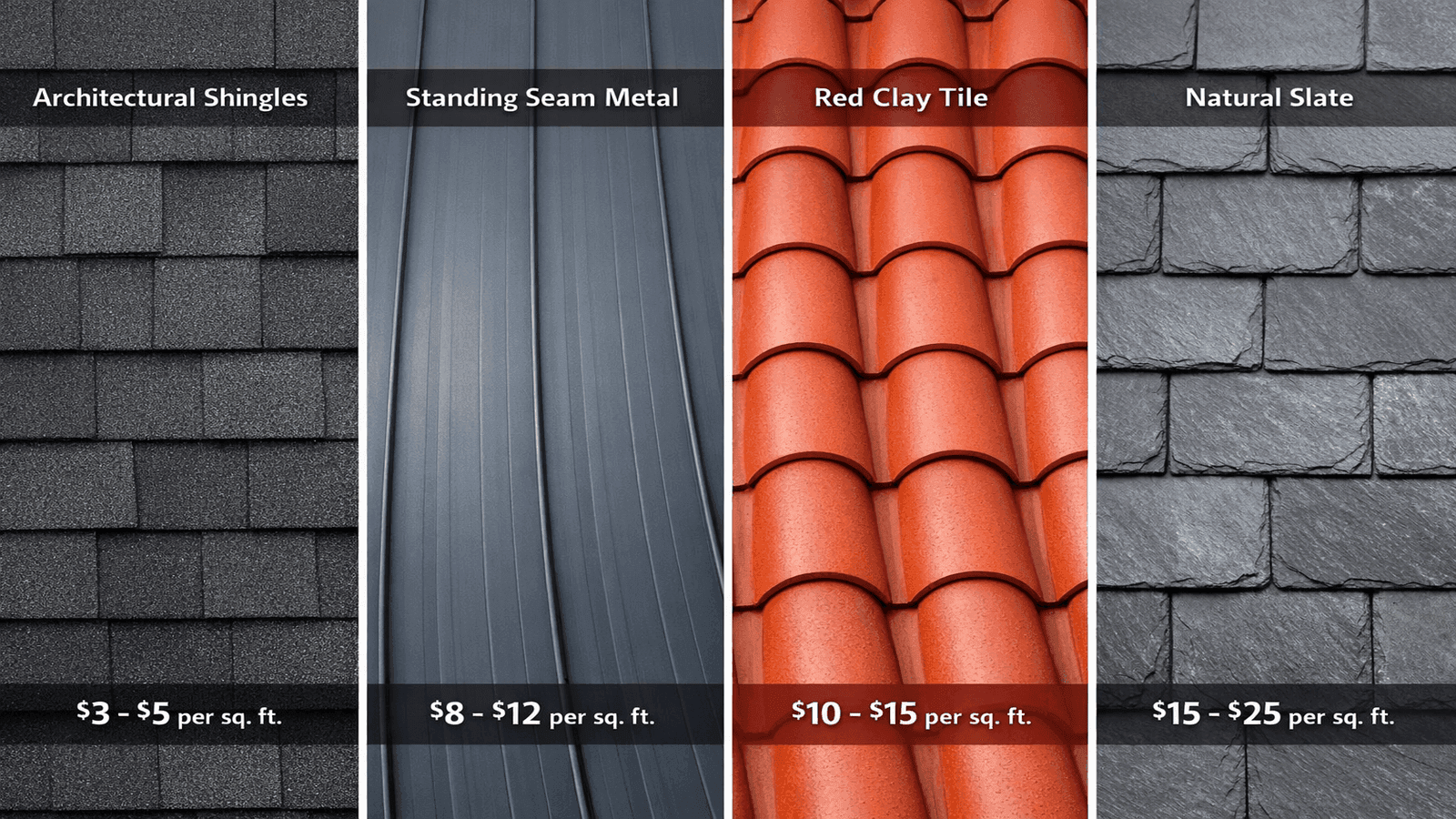
Photo: Side-by-side sections of asphalt shingle, standing-seam metal, clay tile, and natural slate roofing panels showing texture and color differences
| Material | Avg Cost (2,000 sq ft) | Lifespan | Warranty (Material) | Best For |
| 3-Tab Asphalt | $5,000-$7,500 | 20-25 years | 20-year limited | Budget replacement |
| Architectural Asphalt | $7,500-$12,000 | 25-30 years | 30-year limited | Most residential |
| Metal (steel/aluminum) | $10,000-$25,000 | 40-70 years | 40-50 year limited | Long-term value |
| Concrete Tile | $12,000-$18,000 | 40-50 years | 50-year limited | Southwest/Florida |
| Clay Tile | $18,000-$30,000 | 50-100 years | Lifetime limited | Mediterranean style |
| Synthetic Slate | $12,000-$20,000 | 40-50 years | 40-50 year limited | Slate look, lower cost |
| Natural Slate (soft) | $15,000-$35,000 | 75-100 years | Lifetime | Historic, premium |
| Natural Slate (hard) | $35,000-$75,000+ | 100-150 years | Lifetime | Ultra-premium |
Roof Repair Costs
Not every roofing problem requires full replacement. Understanding repair cost ranges helps you evaluate whether a repair extends the life of your current roof meaningfully, or whether the money is better put toward replacement.
Minor Repairs: $300-$800
Minor repairs cover 1-5 missing or damaged shingles, a small area of granule loss, nail pops, and simple pipe boot seal failures. Most minor repairs involve less than 2 hours of labor plus $50-$150 in materials. In 2026, the average minor roof repair runs $400-$600 through a licensed contractor [5].
Moderate Repairs: $500-$1,500
Moderate repairs involve flashing replacement around chimneys, skylights, or valleys; patch work covering 5-20 square feet of damaged decking; and pipe boot or vent flashing replacement. Flashing repairs alone run $200-$600 depending on location and material. Valley flashing replacement runs $500-$1,200 [7].
Get quotes from top-rated pros.
Major Repairs: $1,500-$8,000
Major repairs, such as partial section replacement, structural decking repair after a tree fall or ice dam damage, or complete chimney flashing removal and replacement, push into the lower range of full replacement costs. When a single repair quote exceeds $2,500 on a roof 15 or more years old, replacement economics often win.
The 30% Rule
The widely used industry heuristic: if a repair costs 30% or more of full replacement cost, replace. A $10,000 replacement quote with a $3,000+ repair needed signals that the roof is in systemic decline, not isolated damage. Partial repairs on an aging roof often trigger additional failures within 12-24 months as the stress redistributes to adjacent sections [5].
The most expensive repair mistake I see homeowners make is delay. A $400 flashing repair ignored for two years turns into $4,000 of decking replacement when water has rotted the sheathing and top plate. I have personally seen that sequence on over 200 projects in my 20 years of roofing work. A leak does not stay contained. Water finds every low point. The $400 repair window is almost always shorter than homeowners assume.
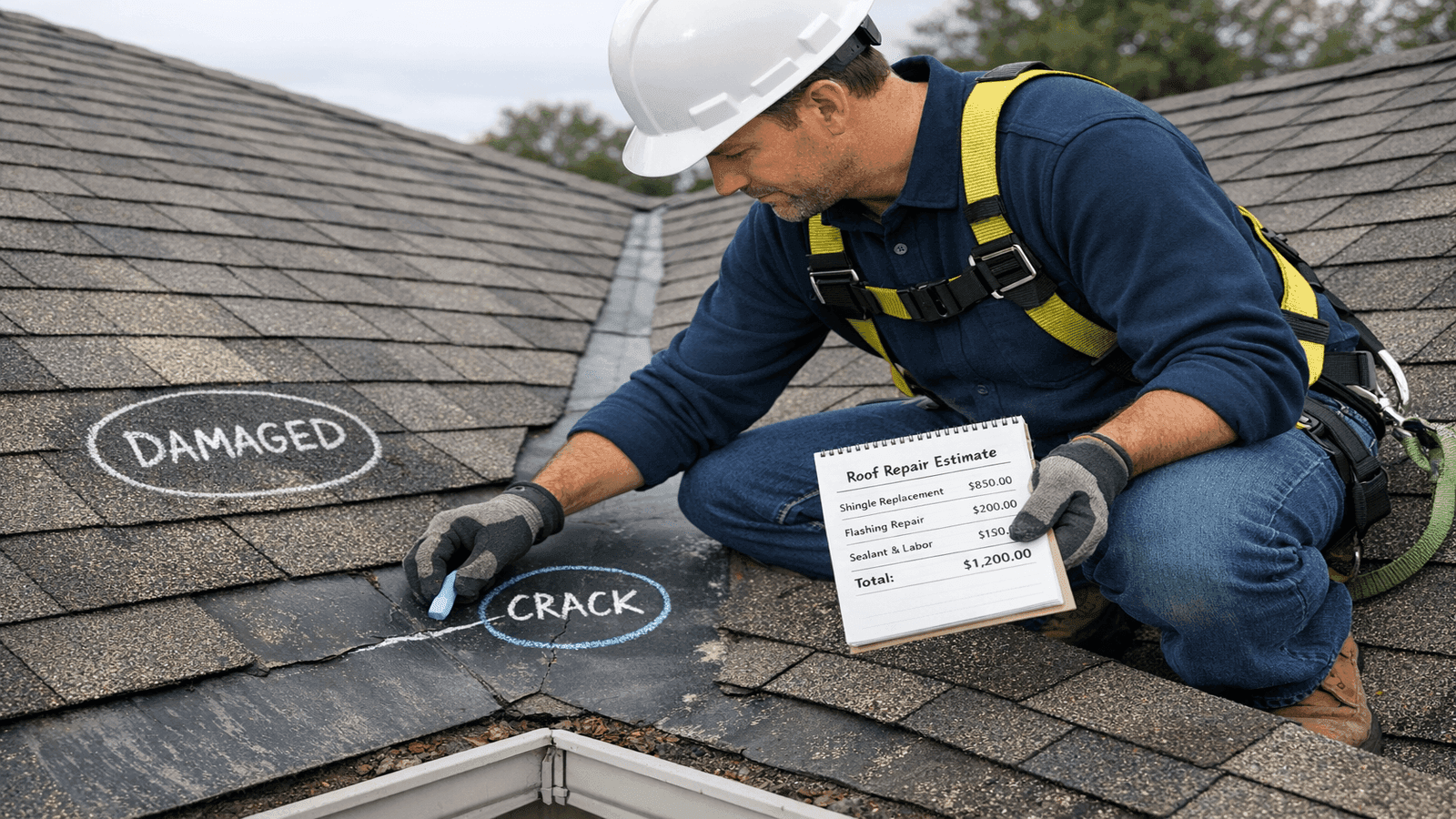
Photo: Roofing contractor on a residential roof in safety harness marking damaged shingles and flashing with chalk near the valley area
Emergency Roof Repair Costs
Storm damage, fallen trees, and severe weather events don't wait for business hours. Emergency roofing calls carry a premium over scheduled work.
Emergency Pricing Premiums
After-hours emergency calls on nights, weekends, and holidays typically run 1.5x to 2x the standard rate. A contractor who charges $350 for a scheduled repair quotes $500-$700 for the same work at 10 PM on a Sunday. Emergency mobilization fees of $150-$300 are standard and cover the cost of the contractor departing for a call immediately rather than scheduling efficiently.
In 2026, emergency roof repair costs run:
- Small storm damage (a few displaced shingles, minor flashing lift): $400-$900
- Moderate storm damage (section of missing shingles, exposed decking): $800-$2,500
- Major emergency (tree fall, structural damage, large section of open roof): $2,500-$8,000+
Temporary Tarping
When a storm opens a significant portion of the roof and a permanent repair isn't possible immediately, professional tarping is the correct protective step. Professional tarping, contractor-installed, weighted and secured, costs $300-$1,500 depending on the size of the area covered. DIY tarping with hardware store materials costs $50-$150 in materials but rarely creates a weatherproof seal; wind and water often defeat improperly tensioned tarps within hours.
Document Before Any Repairs
For any storm damage event, document the full extent before making temporary repairs. Photograph and video the damage from multiple angles. Note the date and time of the storm event. This documentation supports insurance claims; repairs made before documentation can complicate the claims process. The NRCA recommends homeowners notify their insurer before any permanent repairs begin on storm-damaged roofs [1].
For complete guidance, see our emergency roof repair cost guide.
Roof Inspection Costs
A professional inspection is the starting point for any roofing decision: repair, replacement, or "watch and wait." Inspections cost far less than guessing wrong.
Standard Visual Inspection: $150-$400
A licensed roofing contractor performs a visual inspection from the roof surface, checking shingle condition, flashing integrity, ridge cap condition, gutter attachment, and visible decking. Most standard inspections take 1-2 hours and include a written report with photographs. Cost range in 2026: $150-$400 for a standard residential inspection [7].
Drone Inspection: $200-$500
Drone inspections are increasingly common, particularly on steep-pitch roofs where walking the surface is risky. High-resolution drone photography creates a complete photographic record of the entire roof surface. Drone inspections typically cost $200-$500 and are especially valuable for insurance documentation after hail events.
Infrared and Thermal Scanning: $400-$600
Infrared scanning detects moisture trapped under the roof surface, water that hasn't yet caused a visible interior leak but is actively deteriorating decking and insulation. This technology identifies problems that visual inspection misses entirely. Infrared inspections run $400-$600 and are worth the cost for any home where a roof is being evaluated before purchase or before a major repair commitment.
When to Get a Roof Inspection
Four situations that warrant a professional inspection:
- Before purchasing any home, regardless of roof age
- After any hail storm (hail damage isn't always visible from the ground)
- Every 3-5 years on roofs older than 10 years
- Before filing an insurance claim, to document what a qualified professional observed
For complete pricing detail, see our roof inspection cost guide.
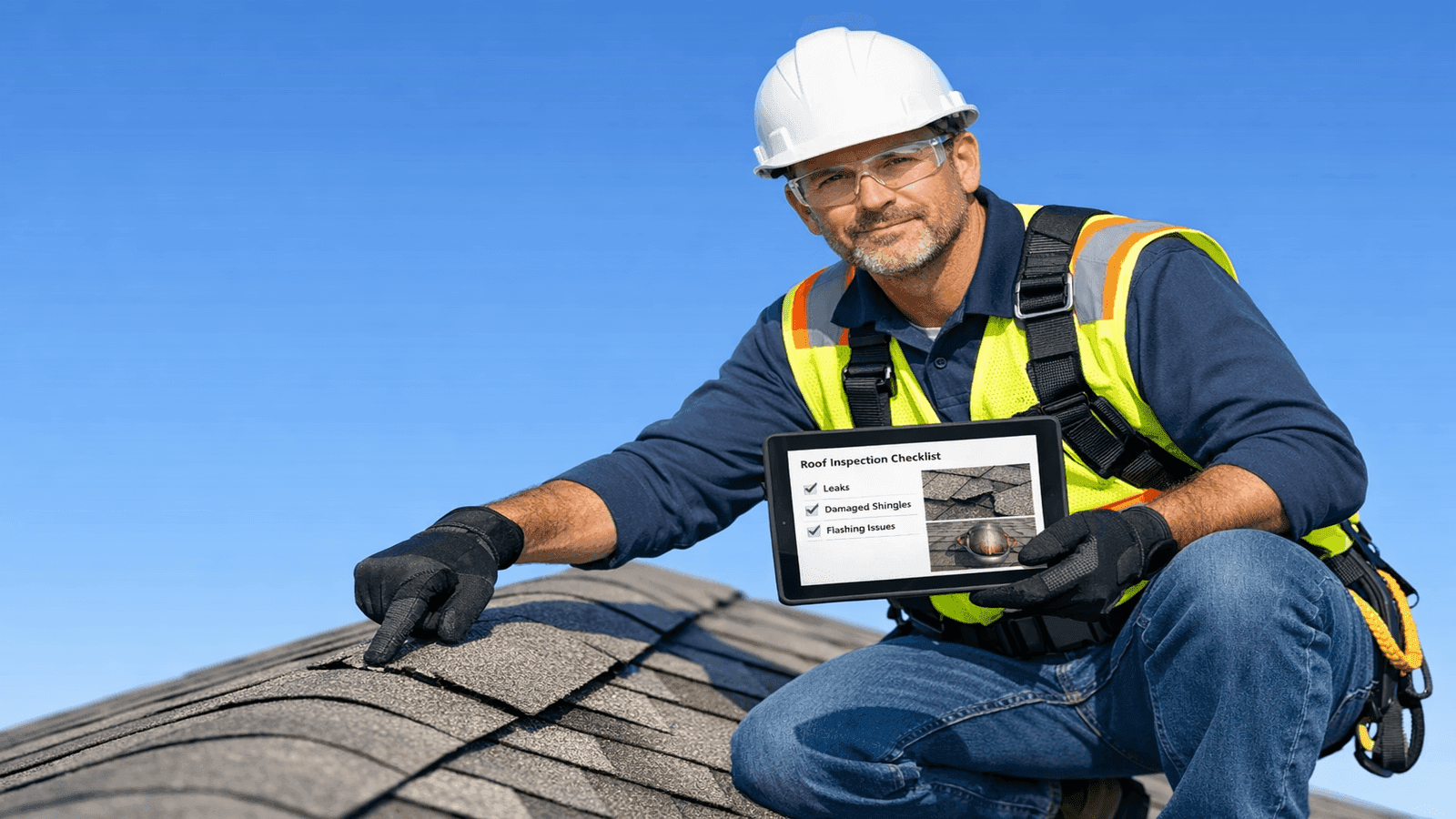
Photo: Roofing professional conducting inspection on a residential roof, holding a tablet with inspection checklist, photographing ridge cap damage
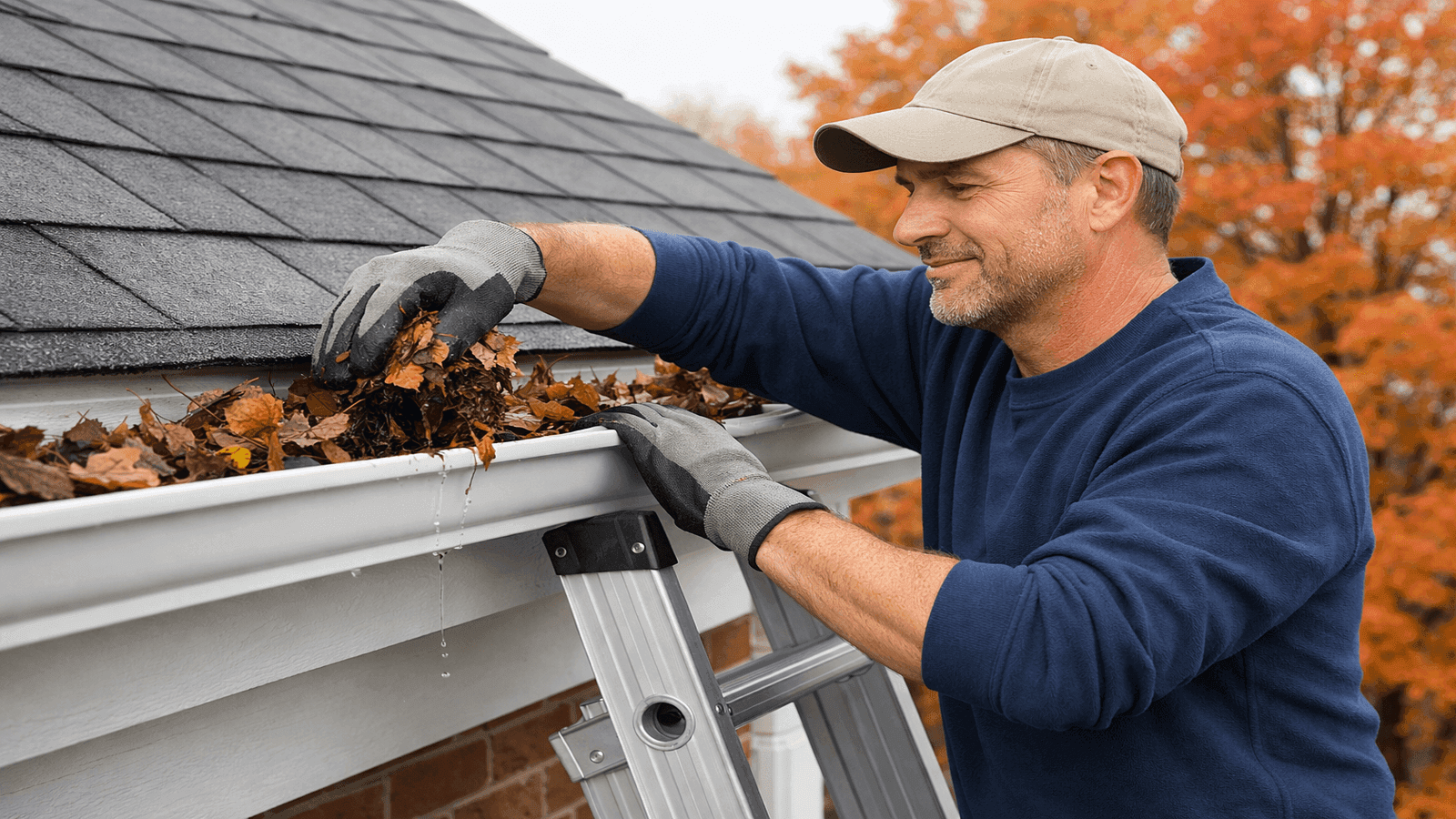
Gutter Replacement Costs
Gutters are part of the roofing system in function if not always in contract scope. A roof replacement without addressing gutters that are failing or undersized leaves the new roof's drainage system compromised from day one.
Seamless Aluminum Gutters: $1,000-$2,500
Seamless aluminum gutters are the industry standard for residential applications. Fabricated on-site from coil stock, seamless gutters eliminate mid-run seams that are the most common leak points. For an average home with 150-200 linear feet of gutter, seamless aluminum installation runs $1,000-$2,500 depending on height, complexity, and downspout count.
Sectional Gutters: $600-$1,500
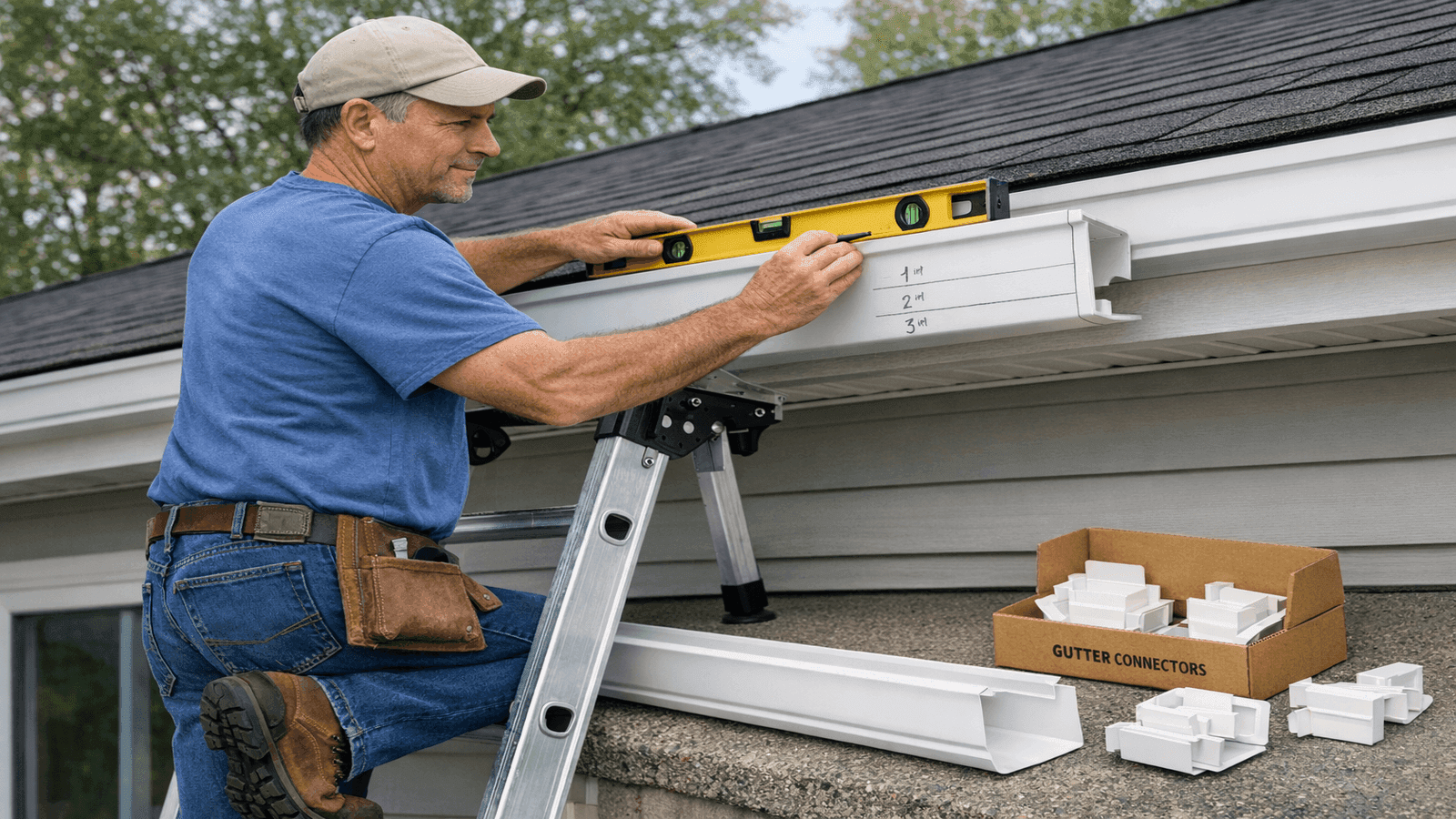
Sectional gutters come in pre-cut lengths joined by slip connectors and end caps. They're the most common DIY option: K-style aluminum sections cost $3-$6 per linear foot at hardware stores. A competent DIYer can install sectional gutters over a weekend. Total material cost for an average home: $600-$1,200. The trade-off is seam integrity over time; sectional gutter seams are the first failure point in aging systems.
Copper Gutters: $4,000-$10,000+
Copper gutters are the premium option, favored on high-end and historic homes. Copper never rusts, develops a natural patina over time, and carries a design appeal that aluminum can't replicate. Cost: $20-$40 per linear foot installed. Total installation on a typical home runs $4,000-$10,000+ depending on size and complexity.
Gutter Guards: $500-$2,000
Gutter guards, including mesh inserts, reverse-curve designs, and micro-filter covers, reduce the frequency of gutter cleaning and prevent leaf debris from creating overflow conditions that direct water against the fascia. Quality gutter guard installation adds $500-$2,000 to a gutter replacement project depending on guard type and linear footage.
For complete pricing detail, see our gutter replacement cost guide.
Get quotes from top-rated pros.
Roofing Cost by Home Size
Home square footage understates actual roof size because pitch adds surface area. A 2,000 sq ft single-story home with a 6:12 pitch covers more roof surface than a 2,000 sq ft home with a 4:12 pitch. The table below uses common multipliers for moderately pitched roofs [3].
| Home Size (sq ft) | Approx. Roof Squares | Asphalt Low | Asphalt High | Metal Low | Metal High |
| 1,000 sq ft | 12-14 squares | $4,500 | $7,000 | $8,000 | $16,000 |
| 1,500 sq ft | 17-20 squares | $6,000 | $10,000 | $11,000 | $22,000 |
| 2,000 sq ft | 22-26 squares | $8,000 | $13,000 | $14,000 | $28,000 |
| 2,500 sq ft | 27-32 squares | $10,000 | $16,000 | $17,000 | $34,000 |
| 3,000 sq ft | 32-38 squares | $12,000 | $20,000 | $20,000 | $40,000 |
Homeowners often compare quotes using square footage from their property listing. That number is the heated floor area, not the roof area. A 2,500 sq ft ranch-style home might have 28 roof squares. The same 2,500 sq ft on a two-story has fewer squares because the footprint is smaller. Pitch multiplies everything: a 10:12 pitch adds 30% more surface area over a 4:12 pitch on the same footprint. I always explain the pitch multiplier to homeowners before they see a quote, because 'my neighbor's 2,000 sq ft home cost $10,000 — why does mine cost $13,500?' often has a simple answer: pitch.
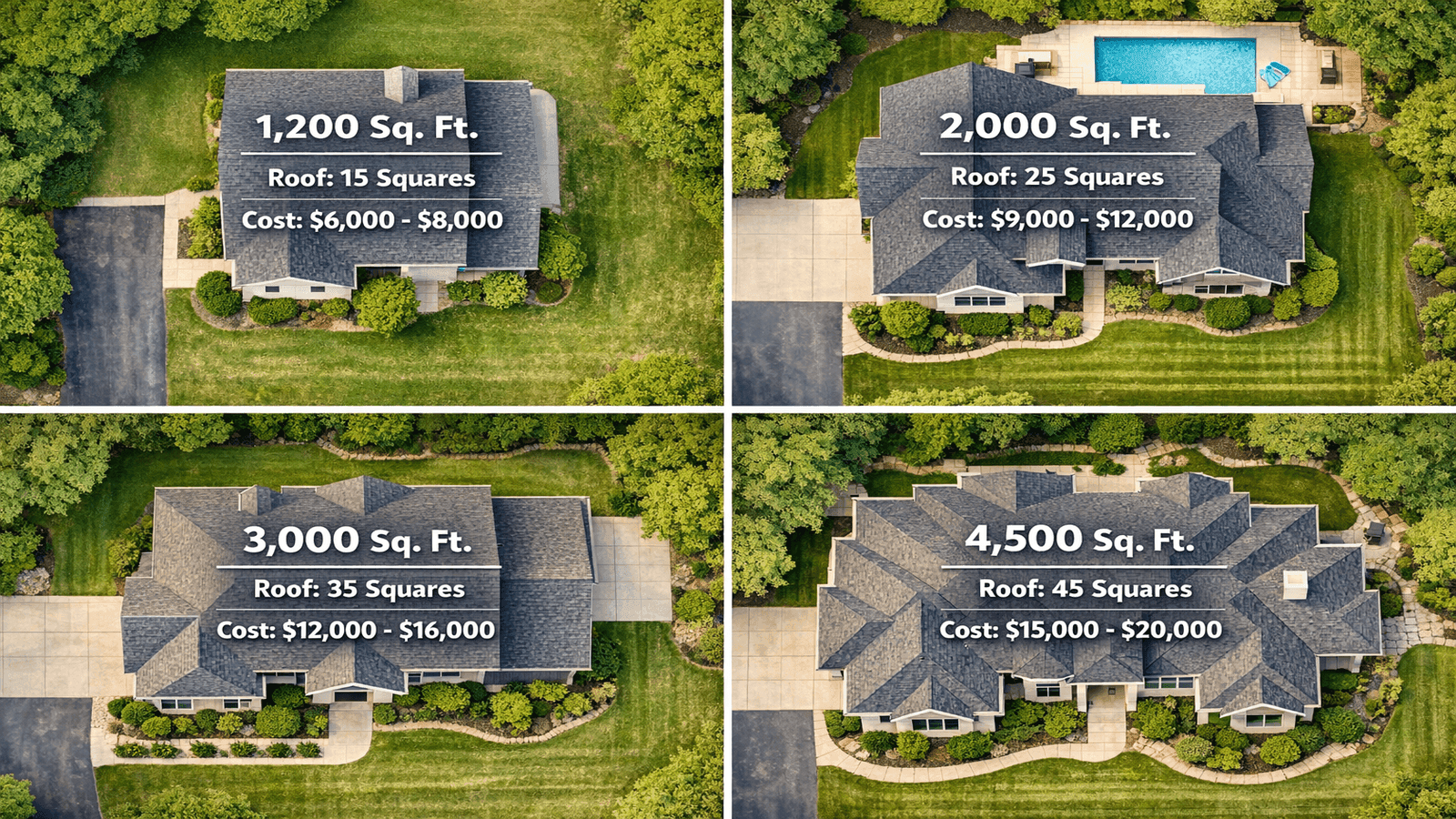
Photo: Aerial satellite view of four homes of different sizes with roof area annotations showing square footage and number of roofing squares
Roofing Costs by Region
Regional variation in roofing costs is significant. A $10,000 roof in one part of the country can cost $14,000 for identical scope in another. Four factors create regional pricing differences: labor market rates, building code requirements, material availability, and seasonal demand patterns [9].
Southeast and Gulf Coast
Texas, Louisiana, Florida, and Gulf Coast markets face elevated costs for hurricane-rated installations. Impact-resistant shingles (Class 4 rating) required or incentivized in many coastal counties add $500-$2,000 over standard 3-tab pricing. Demand spikes after named storm events can push contractor rates 20-30% above normal for 3-6 months following major storms. Average installed labor: $180-$280 per square for standard residential.
Northeast
Connecticut, Massachusetts, New York, New Jersey, and Pennsylvania markets face higher labor costs driven by union wages, higher contractor licensing fees, and stringent local code enforcement. Ice-and-water shield requirements in cold-climate markets add $500-$1,500 in materials compared to Southern installations. Average installed labor: $250-$400 per square.
Midwest
The Midwest occupies a middle ground on labor costs, lower than the Northeast and comparable to the Southeast in most markets. However, spring storm season creates demand spikes in Iowa, Illinois, Kansas, Nebraska, and Missouri that can delay project scheduling by 4-8 weeks and push prices upward during peak demand periods. Average installed labor: $180-$300 per square.
Pacific Northwest
Oregon and Washington add material premiums for moss-resistant shingles and coatings in markets with high annual rainfall. Copper-granule shingles or algae-resistant coatings add $500-$1,500 over standard shingle pricing. California's prevailing wage requirements in licensed-contractor work push Bay Area and Los Angeles labor rates to $350-$500 per square. Average installed labor: $280-$450 per square.
NearbyHunt network data from roofing contractors across the country confirms that homeowners in the Northeast and Pacific Coast consistently receive quotes 25-40% above the national average for identical scope, while the Southeast and Midwest remain closest to national averages.
| Region | Avg Labor Cost/Square | Common Code Requirement | Typical Notes |
| Southeast/Gulf Coast | $180-$280 | Impact-resistant shingles | Demand spikes post-storm |
| Northeast | $250-$400 | Ice-and-water shield | Union labor markets |
| Midwest | $180-$300 | Standard IRC | Seasonal demand swings |
| Pacific Northwest | $280-$450 | Moss-resistant required | Prevailing wage (CA) |
How to Get the Best Roofing Price
Getting the right price on a roofing project requires process discipline. The homeowners in James Carver's 1,800+ project history who paid the best prices didn't necessarily negotiate aggressively. They showed up prepared, asked the right questions, and used competitive quotes as leverage.
Get Three or More Written Quotes
Three quotes is the minimum. Roofing prices for identical scope vary 20-40% between contractors in the same market. On a $12,000 project, a 30% spread means $3,600 in potential savings for the same shingles and labor quality. Never accept a single quote; the first contractor you call has no pricing incentive without competition.
Schedule in Off-Peak Season
Late winter (January-March) and early fall are the off-peak months for roofing in most U.S. markets. Contractors who are scheduling ahead, not scrambling to meet storm season demand, are more willing to negotiate on price and timeline. Off-season scheduling can reduce pricing 5-10% versus summer peak rates.
Require Itemized Quotes
A one-line quote that says "Roof Replacement — $11,500" tells you nothing useful. Request quotes that break out: materials (manufacturer, product line, quantity), labor (per square), tear-off and disposal, permit, and all flashing work separately. Itemized quotes let you compare apples to apples across multiple bids and identify what any given contractor is including or omitting.
Check License and Insurance Before Accepting Any Bid
Every state maintains an online contractor license lookup. Verify that the roofing contractor holds a current, active license in your state before accepting any quote. Ask for a Certificate of Insurance and verify the policy is active. Unlicensed roofing contractors account for a significant share of complaint filings with state contractor boards, and their low bids reflect the cost of not carrying proper coverage, which shifts liability to you.
Negotiate Smart
Materials are a more flexible negotiation point than labor. Ask contractors about upgraded shingles (e.g., Class 4 impact-resistant) at cost, which they can often supply at near-material cost when labor is already committed. Extended workmanship warranties are another negotiable item. A contractor confident in their crew's work will often extend a 5-year workmanship warranty to 10 years on request.
The red flags I see most often in contractor quotes: no permit line item, which usually means they're planning to skip it; a quote with no manufacturer name on the shingles, which means they're leaving themselves the option to substitute to a cheaper product; and pressure to sign same-day. Any legitimate contractor bidding a $10,000+ job will give you time to compare quotes. Urgency tactics are a classic sign of a contractor who doesn't win on merit.

Photo: Homeowner at kitchen table comparing three contractor roofing quotes spread out side by side, laptop open to state contractor license lookup website
How to Finance a Roof
A full roof replacement is often an unplanned expense. Homeowners who need to replace a roof but don't have $10,000-$15,000 in liquid savings have several financing options, each with different rate structures and qualification requirements.
Home Equity Loan or HELOC
Home equity loans and home equity lines of credit (HELOCs) offer the lowest interest rates available for home improvement financing, typically 7-10% APR in the current rate environment compared to 15-25% for unsecured personal loans. Both products require equity in your home and a credit qualification process that takes 2-4 weeks. For homeowners who have equity, this is almost always the lowest-cost financing path.
Get quotes from top-rated pros.
Personal Loan
Unsecured personal loans fund in 1-3 business days, useful when a roof is actively failing and waiting weeks for a HELOC approval isn't practical. Rates in 2026 range from 10-28% APR depending on credit score. For strong-credit borrowers (720+), some lenders offer personal loan rates under 12%, which is competitive with shorter-term HELOC draws.
Contractor Financing
Most major roofing contractors and manufacturers (GAF, Owens Corning, CertainTeed) offer financing programs through lending partners. Contractor financing is convenient, approved during the quote process, but often carries higher APR than bank products. Read the terms carefully; deferred-interest promotional periods that convert to high rates at the end are common in contractor financing products.
Insurance Claim
For storm damage, hail damage, or other covered perils, homeowners insurance covers roof replacement up to the policy limits minus the deductible. Document all damage thoroughly, file the claim promptly, and do not begin permanent repairs until an adjuster inspects. The process from claim filing to completed replacement typically runs 2-6 months. For roofs 15+ years old, some policies pay actual cash value (depreciated) rather than replacement cost value; check your policy before assuming full coverage [10].
FHA Title I Program
The FHA Title I Loan Program provides government-backed financing for home improvements, including roofing, with loan amounts up to $25,000 for single-family homes. Title I loans are available through FHA-approved lenders and don't require equity in the property. Interest rates are fixed and typically competitive with or below unsecured personal loan rates. The application process takes 3-6 weeks.
For a complete breakdown of all financing options including pros, cons, and qualification requirements, see our roof financing options guide.
Real-World Case Study: Marcus T., Nashville, Tennessee
Marcus, a homeowner in Nashville, Tennessee, discovered during a routine gutter cleaning that his 17-year-old architectural shingle roof had significant granule loss in three valleys, two areas of lifting shingles near the ridge, and soft spots in the decking audible when walked on in one corner of the rear slope. He contacted three roofing contractors through NearbyHunt and received the following quotes:
- Quote A: $8,200 — Tear-off existing shingles, 30-year architectural shingles (manufacturer unspecified), new pipe boots and ridge cap, no mention of decking
- Quote B: $10,400 — Full tear-off, 30-year architectural shingles (Owens Corning Duration), replace 4 sheets of damaged decking, new aluminum flashing at chimney and both skylights, workmanship warranty 5 years, permit included
- Quote C: $13,800 — Full tear-off, 50-year architectural shingles (GAF Timberline HDZ), full ice-and-water shield underlayment, new aluminum drip edge, replace all pipe boots, 10-year workmanship warranty, permit and disposal included
James reviewed the three quotes and explained what made each different. Quote A's price looks attractive but uses an unspecified shingle product, omits decking replacement that Marcus had already identified as a problem, and doesn't include permit. That profile almost certainly indicates an unlicensed or under-insured operation. Quote B is the most straightforward: it names the product, includes the identified decking repairs, and covers both skylight flashings that are a known leak point on 17-year-old roofs. Quote C is legitimate premium work but quotes a 50-year shingle on a home Marcus plans to sell within 8-10 years; he's paying for longevity he won't capture.
Marcus chose Quote B at $10,400. The project was completed in two days. Decking replacement turned out to cover 6 sheets instead of 4, adding $320 to the final invoice, which the contractor had disclosed as a possibility during the quote process. Final cost: $10,720.
The lesson James draws from this case: "The cheapest quote wasn't safe. The most expensive quote was good value for someone keeping the house for 30 years. The middle quote fit the project — documented scope, named product, permit included, fair price for Nashville in 2026. Most homeowners end up in that same analysis if they look at three quotes with equal discipline."
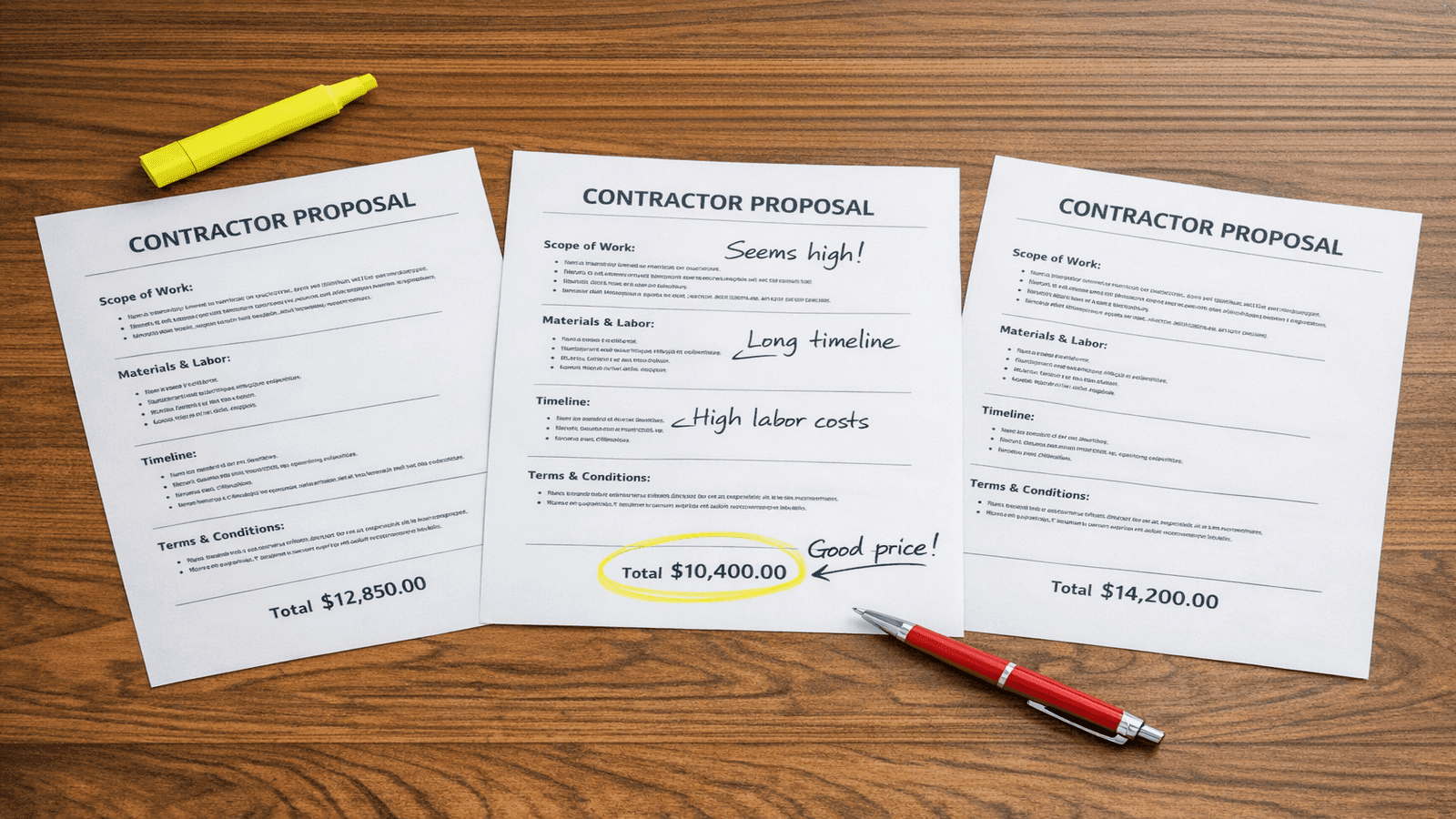
Photo: Three contractor proposal documents spread on a kitchen table with handwritten comparison notes, one document circled as the selected bid
DIY vs. Professional Roofing Costs
What DIY Actually Costs
Material-only cost for a DIY asphalt shingle replacement on a 2,000 sq ft home runs $2,000-$5,000 depending on shingle grade. That figure covers shingles, underlayment, ridge cap, roofing nails, and pipe boots. It does not cover the safety equipment required to work on a pitched roof: harnesses, rope anchors, and roof brackets add $300-$600 in rental or purchase costs. It also does not cover decking repairs, which require additional lumber and tools.
For an experienced DIYer who has roofed before, a 2,000 sq ft asphalt shingle replacement represents 3-5 full days of labor with a helper. For a first-time DIYer, plan for 5-8 days.
What You Give Up with DIY
Professional installation adds 40-60% to material cost but includes several things DIY cannot replicate:
- Manufacturer's labor warranty (requires certified installer on most premium shingle products)
- Contractor liability insurance (if a worker is injured on your roof during DIY work, your homeowner's insurance may be the only coverage available)
- Permit pulling and inspection (most municipalities require a licensed contractor to pull the permit)
- Workmanship warranty (2-10 years depending on contractor)
What DIY Is Practical For
Minor repairs, such as replacing 1-5 shingles, resealing lifted flashing, or replacing a pipe boot, are reasonable DIY work for homeowners comfortable on a roof. Gutter cleaning, gutter guard installation, and sectional gutter replacement are solid DIY projects that don't require roofing permits. Minor flashing resealing with roofing caulk is a legitimate DIY maintenance task.
I get called in to fix DIY full replacements several times a year. The most common problems: underlayment not lapped correctly, nail patterns wrong (overdriven, wrong zone), valley flashing installed backwards, and ridge cap stapled instead of nailed. Every one of those mistakes creates a leak point. The liability question matters too. If you fall off your own roof while working without a licensed crew, your homeowner's policy may cover the medical event, but the workmanship has no warranty, no recourse. I've seen homeowners think they saved $4,000 and then spend $6,000 18 months later fixing what they installed incorrectly the first time.
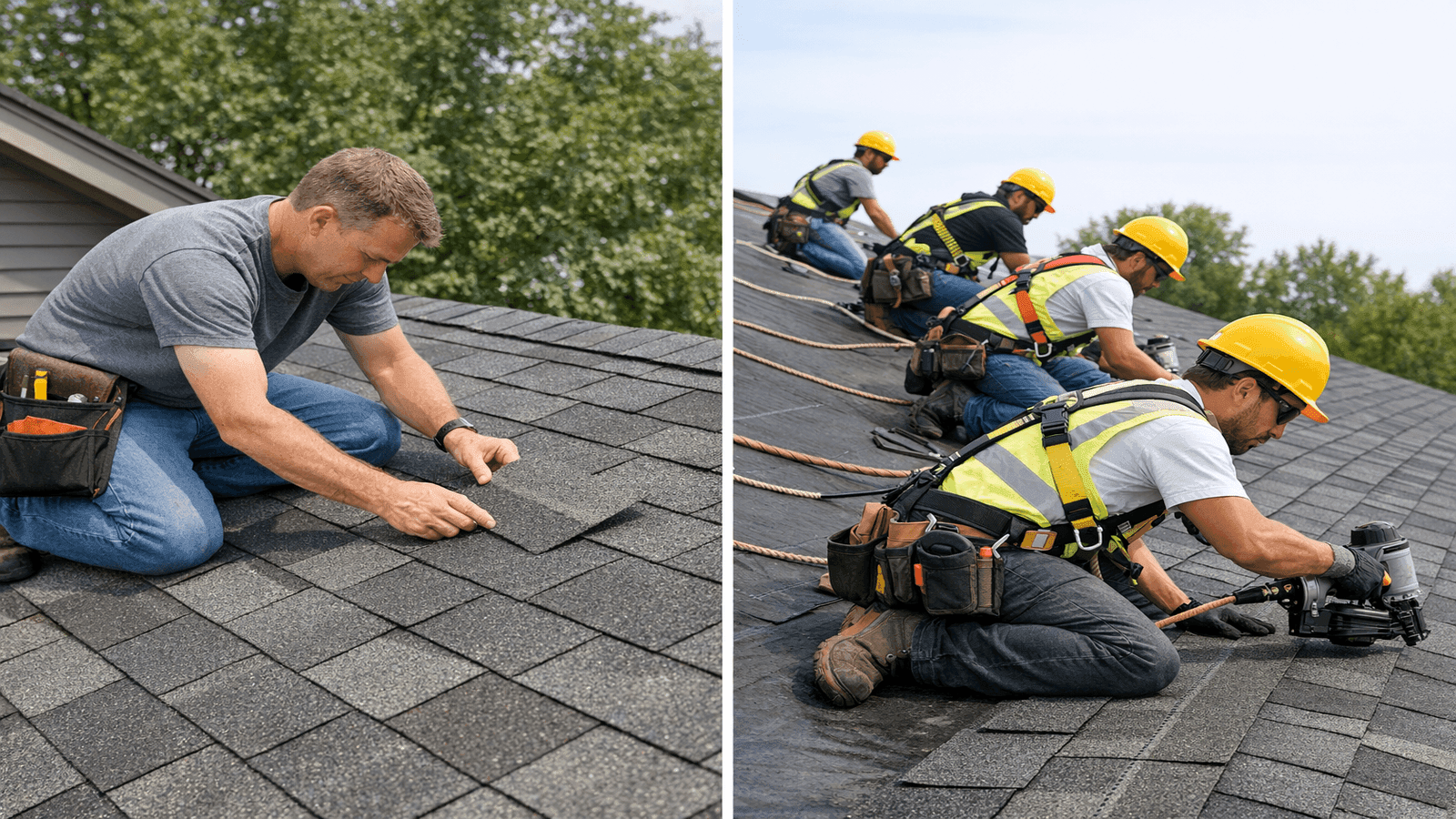
Photo: Split image showing homeowner replacing individual shingles on left and a professional four-person roofing crew with safety equipment installing full replacement on right
Roofing Insurance and Warranties
Contractor Workmanship Warranty
Workmanship warranties cover defects in how the roof was installed, not the material itself. A nail pattern error, improperly sealed valley flashing, or inadequate drip edge installation would be workmanship defects. Standard workmanship warranties run 2-5 years; premium contractors offer 10 years. When comparing quotes, a 10-year workmanship warranty from an established, bonded contractor provides significant value over a 2-year warranty from an operation you can't verify will still be in business.
Manufacturer Material Warranty
Material warranties cover defects in the shingle product itself. Standard architectural shingles carry a 30-year limited material warranty; premium products carry 40-50 year limited warranties. Read the fine print: "lifetime" warranties on shingles typically have tiered payout schedules that reduce coverage significantly after year 10-15. The full coverage period in the headline often applies only to the original homeowner and requires installation by a manufacturer-certified contractor [10].
Homeowners Insurance Coverage
Homeowners insurance covers sudden, accidental damage from named perils: hail, wind, fire, falling trees, and similar events. Insurance does not cover gradual wear and tear, deferred maintenance, or roofs that have simply exceeded their useful life. When an insurance adjuster inspects a storm-damaged roof and finds 15-year-old shingles with pre-existing granule loss alongside new hail damage, they may apportion the claim to cover only the hail damage on an actual cash value basis rather than full replacement cost.
Filing a claim for legitimate storm damage is appropriate and important. Filing a claim for wear and tear, or allowing a contractor to characterize wear-damaged areas as storm damage, constitutes insurance fraud and creates serious legal risk for the homeowner.
When to File a Claim vs. Pay Out of Pocket
Use the deductible as your baseline: if the repair cost is below or close to your deductible, pay out of pocket. A claim that results in a payout smaller than the deductible still goes on your insurance record and can affect your renewal premium. For significant storm damage that clearly exceeds your deductible by a meaningful margin, file the claim, document thoroughly, and engage a licensed contractor to document scope before accepting any adjuster settlement [1].
Conclusion
Roofing costs span an enormous range because the variables, including material, size, pitch, region, tear-off requirements, and contractor quality, combine differently for every home. The national average of $11,500 for a 2,000 sq ft asphalt shingle replacement is a reasonable starting point, but it's a center point in a range that genuinely runs from $5,000 to $75,000+ depending on the choices made.
The most reliable path to a fair price is process: three written, itemized quotes from licensed contractors; verification of license and insurance before signing; scheduling in off-peak months when possible; and a clear understanding of what repair vs. replacement math looks like for your specific roof's age and condition.
Use the cluster guides linked throughout this article for deep coverage on every topic. Material-specific cost breakdowns, financing options, inspection protocols, and emergency repair guidance are each covered in detail in their respective guides.
If you're ready to get quotes from licensed roofing contractors in your area, find vetted roofing contractors near you through NearbyHunt.
Disclaimer: Cost figures represent national averages and published data ranges for 2026. Actual costs vary significantly by region, project scope, material grade, and contractor. Always obtain 3 or more written, itemized quotes from licensed and insured roofing contractors before committing to any project. Verify contractor license status through your state's contractor licensing board. Insurance coverage details vary by policy; consult your insurance provider before filing any claim.
Sources & References
- [1] NRCA: National Roofing Contractors Association — Storm Damage Documentation Guidelines
- [2] This Old House: Shingle Roof Cost Guide 2026
- [3] This Old House: New Roof Cost Guide 2026
- [4] This Old House: Slate Roof Cost Guide 2026
- [5] This Old House: Cost of Roof Repair 2026
- [6] Fixr: Slate Roof Installation Cost 2026
- [7] Bob Vila: Roof Replacement Cost Guide
- [8] Forbes Home: Metal Roof vs Shingles Cost Comparison 2026
- [9] Bureau of Labor Statistics: Roofers Wages and Employment 2026
- [10] Consumer Reports: Roofing Material Ratings and Comparisons

James is a licensed roofing contractor with 20 years of experience in roof installation, inspection, and repair across the U.S. South and Midwest. He specialises in asphalt shingles, metal roofing, and storm damage restoration. On NearbyHunt, James offers practical advice on roof maintenance, insurance claims, and selecting the right materials for long-lasting protection.

Jacob is a licensed roofing contractor with over 18 years of experience in roof inspection, installation, and restoration. Based in Texas, he has led hundreds of successful roofing projects across residential and commercial properties. Jacob is also a certified storm damage specialist, ensuring that all NearbyHunt roofing content meets industry best practices and safety standards.