- Clay roof tiles emerged around 3,000 BC in China, making them one of the oldest manufactured building materials still in widespread use today.
- Ancient Greeks refined clay tile systems between 700-650 BC, developing the interlocking imbrex and tegula design that inspired modern concrete and clay tile profiles.
- Asphalt shingles were invented in 1903 by Henry Reynolds of Grand Rapids, Michigan, and by 1939 manufacturers were producing 11 million squares annually [1].
- EPDM rubber roofing appeared in the 1970s following the oil embargo that drove asphalt prices up, while TPO entered the commercial market in the early 1990s.
- Solar roof tiles convert up to 23% of sunlight into electricity as of 2026, and the solar roofing market is growing at 10.6% CAGR through 2033 [2].
- The licensed roofers in our NearbyHunt network report that over 65% of homeowner inquiries now include questions about impact-resistant or energy-efficient materials, reflecting how historical knowledge shapes modern choices.
Every shelter ever built started with one question: what goes on top? For tens of thousands of years, the answer to that question shaped how civilizations lived, how long their buildings survived, and even how prosperous a community became.
Roofing history is the story of human ingenuity. People across every continent experimented with available materials, refined techniques through trial and error, and passed knowledge down through generations. When you explore the complete guide to roofing systems and services, you quickly see that today's choices trace directly back to innovations made centuries or even millennia ago.
This article traces roofing from ancient thatch and clay tile through the Industrial Revolution and the invention of asphalt shingles, all the way to the solar tiles and cool roofs defining the 2026 market.

Get quotes from top-rated pros.

Photo: Timeline illustration showing roofing evolution from ancient thatched huts through clay tile, wood shingles, slate, asphalt shingles, and modern solar tiles across human history
Ancient Roofing: Nature's Materials and the First Tiles
Thatch: Humanity's First Roofing Material
Thatching is one of the oldest roofing methods on earth. Using dried plant materials such as straw, reed, heather, or palm frond, early builders created sloped roofs that shed rain effectively when installed at the correct pitch. Thatch appears in archaeological evidence across Europe, Africa, Asia, and the Americas going back to prehistoric times.
A well-installed thatch roof works through overlapping layers. Rain water hits the top layer and travels down and off the edge before penetrating to lower layers. The natural air pockets within the thatch also provide insulation, keeping interiors warmer in winter and cooler in summer. Despite being considered primitive, thatch roofs installed by skilled craftspeople could last 20 to 40 years in temperate climates.
People underestimate thatch. I've seen thatched buildings in photographs from England that were over 200 years old. The pitch, the layering, the drainage angle: those principles are the same ones I apply when I'm installing a metal standing-seam roof today. Good roofing is always about controlling where water goes.
The main weaknesses of thatch were fire risk and susceptibility to pests. As populations grew denser and fires spread more easily between structures, communities began seeking materials that would not ignite from a single stray spark.
Clay Tiles
The first manufactured roofing tiles emerged around 3,000 BC in China [3]. Chinese builders fired clay in kilns to create hard, water-resistant tiles that were far more durable than thatch or wood. The concept spread westward, reaching the Mediterranean world with significant influence.
Between 700 and 650 BC, ancient Greek builders developed their own system using fired clay tiles [4]. The Greek design featured two tile types working together: the flat tegula, which lay across the roof surface, and the rounded imbrex, which covered the joints between tegulae. This interlocking system shed water efficiently and resisted wind uplift in ways that flat tiles alone could not.
The Greek and Roman tile legacy:
- Tiles were formed from wet clay in four-sided moulds, then kiln-fired for hardness
- The imbrex-and-tegula system created a waterproof surface without sealants
- Roman builders adopted and spread the design throughout the empire
- Marble tiles were used on elite structures like the Parthenon as early as 620 BC
- Around 300 BC, the Loha Maha Paya Temple in Sri Lanka was roofed with copper shingles, one of the earliest documented uses of metal roofing [3]
Rome's expansion carried clay tile roofing across Europe, North Africa, and the Near East. Wherever Roman legions built forts and settlers established towns, clay tile replaced thatch and wood shingles. This cultural transfer is one reason Mediterranean-style clay tile roofing still thrives in Southern Europe, Latin America, and the American Southwest to this day.
When I'm working in Florida and installing a barrel tile roof, I'm essentially using the same design the Romans popularized 2,000 years ago. The profile, the overlap, the way the curved tile caps the joint between flat tiles: that's ancient technology. It's still used because it works in hot, wet climates. History validates it.
Stone Slabs and Early Metal Roofing
Beyond clay, ancient builders also used stone slabs where suitable rock was available nearby. Flat stone laid in overlapping rows created durable waterproof surfaces, though the weight required heavy timber framing. Copper roofing appeared in ancient Rome on public buildings, valued for its longevity and resistance to corrosion.
By the 1400s, flat copper sheeting was being used on churches across Europe, particularly for complex curved surfaces that clay tile could not easily accommodate [3]. Zinc followed in the 1700s as a lower-cost alternative to copper, and zinc roofing remains popular in parts of Europe today.
Medieval Europe and Colonial America
Medieval Europe
After the fall of Rome, the architectural knowledge required to fire and lay clay tiles at scale largely disappeared from Northern Europe. Thatch returned as the dominant roofing material for ordinary buildings, while wooden shingles became common in forested regions where timber was abundant.
Slate roofing emerged as a significant advancement during the medieval period. Cut from natural stone quarried in Wales, Spain, and France, slate tiles provided durability that wood and thatch could not match. Their fire resistance made them valuable in increasingly crowded towns and cities. Slate required skilled cutters and heavy structural support, which limited its early use to churches, castles, and wealthy residences.
Colonial America
When European colonists arrived in North America, they brought their roofing knowledge with them, but had to adapt to available materials. Dense American forests provided cedar, pine, oak, cypress, and redwood, which skilled hands split into wooden shingles using simple tools. Wood shingles were the dominant roofing material across most of the Colonies because they were lightweight, easy to install, and abundant [5].
Clay tile appeared in the Southwest, where Spanish mission builders replicated the barrel tile tradition of their homeland. In settlements along the Gulf Coast and in California, clay tile suited both the climate and the cultural heritage of Spanish colonizers.
Slate took longer to become widespread in the Northeast. Imported from Wales for fire-resistant roofs in Boston, Philadelphia, and New York, slate was considered a premium material into the 1800s. The licensed roofers in our NearbyHunt network who specialize in historic restoration report that genuine slate replacement jobs account for roughly 8% of their annual workload, a small but steady demand driven entirely by homeowners preserving 19th-century architecture. After 1830, railroad expansion transformed the situation: quarried Pennsylvania and Vermont slate could be shipped affordably to cities and suburbs across the Northeast, and growing prosperity made the investment attractive [5]. Greek Revival architecture of the mid-1800s drove significant demand for slate, and the material became strongly associated with quality northeastern construction.
The Industrial Revolution: Mass Production Changes Everything
Get quotes from top-rated pros.
Mass-Produced Slate and Early Metal Roofing
The Industrial Revolution brought machinery to quarrying and processing, making slate far more affordable by the mid-19th century. Steam-powered cutting equipment allowed quarries to produce finished tiles in greater volumes and at lower cost than hand-splitting could achieve. Slate roofing reached its peak popularity in the United States between roughly 1870 and 1910, before more affordable alternatives arrived.
Metal roofing also expanded significantly during this period. Tin plate (thin iron coated with tin) became widely available and was used for standing-seam roofs on commercial buildings, barns, and public structures. Corrugated iron roofing arrived in the 1840s, offering lightweight coverage for industrial buildings and agricultural structures. By the late 1800s, galvanized steel had begun replacing tin plate for most commercial metal roofing applications.
Sheet metal offered advantages that older materials could not: it was lightweight relative to slate, could cover long spans without complex framing, and could be factory-fabricated into panels that installed quickly in the field. Metal roofing for residential use carried an association with barns and industrial buildings that limited its status appeal, but its practical strengths were undeniable.
I've re-roofed Georgia farmhouses that still had 19th-century corrugated tin on them. That metal had outlasted multiple asphalt shingle replacements on neighboring houses. Standing-seam metal roofing is making a major comeback now because homeowners are rediscovering what contractors knew 150 years ago: metal costs more upfront but lasts two to three times as long as asphalt. The math works out clearly when you run the full 50-year cost.
Roll Roofing and the Asphalt Revolution
The petroleum industry's growth in the late 1800s introduced a new raw material to roofing: asphalt. Derived from the refining process, asphalt was cheap, waterproof, and flexible. Warren Brothers, who had been using asphalt in road paving, began coating fabric with asphalt for roofing applications.
In 1903, Henry Reynolds of Grand Rapids, Michigan, made the crucial innovation [1]. Rather than applying asphalt-coated fabric in continuous rolls, Reynolds cut the material into individual 8-by-16-inch pieces. These hand-cut shingles made installation more precise and the finished roof more attractive than roll roofing. By 1911 asphalt shingles were in general use across parts of the United States, and by 1915 machine-cutting had replaced hand-cutting in manufacturing [1].
By 1939, manufacturers were producing 11 million squares of asphalt shingles annually [1]. The material's combination of affordability, ease of installation, and reasonable performance made it the dominant roofing choice for American residential construction throughout the 20th century.
The 20th Century: Asphalt Matures and New Systems Emerge
Early Asphalt Shingle Evolution
The original asphalt shingles used a rag felt base saturated with asphalt and surfaced with crushed slate granules. The granules protected the asphalt from ultraviolet degradation and added color options beyond the natural blacks and dark grays.
By the 1920s, asphalt shingles had displaced wooden shingles as the default roofing choice for American homes. The 1930s and 1940s brought improvements in granule quality as ceramic granules began replacing natural slate, providing more consistent color and better UV protection. The three-tab shingle design emerged as the standard residential product: a single layer of material cut to simulate three separate shingles in appearance.
Fiberglass mat shingles arrived in the 1970s and became dominant through the 1980s. Replacing the organic felt base with a woven fiberglass mat improved fire resistance, dimensional stability, and resistance to moisture absorption. Fiberglass-based shingles now represent the vast majority of asphalt shingles sold in the United States.
I've torn off roofs with original organic asphalt shingles from the 1950s that were still doing their job after 60 years. The material had aged and was past its rated life, but it proved the concept worked. Modern fiberglass shingles are lighter, more fire-resistant, and carry better warranties. The core innovation of a granule-surfaced, layered shingle hasn't really changed in 120 years.
Flat Roof Systems: Tar and Gravel to Single-Ply Membranes
Low-slope and flat roofs presented challenges that asphalt shingles could not solve. The answer for most of the 20th century was the built-up roof (BUR): multiple alternating layers of bitumen and reinforcing fabric, topped with aggregate (gravel or slag). Built-up roofs were labor-intensive and heavy, but when properly installed they were remarkably durable, with many lasting 20 to 30 years.
The 1970s oil embargo disrupted asphalt supply chains and drove up prices, creating demand for alternative flat roof materials. EPDM (ethylene propylene diene monomer) rubber emerged from chemical research during the 1950s but entered roofing in earnest during the 1970s [6]. A single sheet of synthetic rubber could cover large areas without seams, resisted UV degradation, and could flex through temperature extremes without cracking.
EPDM became the dominant flat roofing material through the 1980s and remains widely used today, particularly for residential additions, commercial buildings, and industrial structures. Its service life can exceed 50 years with proper maintenance.
Thermoplastic polyolefin (TPO) entered the commercial roofing market in the early 1990s [6]. TPO offered the advantages of heat-welded seams (stronger than adhesive-bonded EPDM seams) and a white reflective surface that reduced cooling loads. TPO has become the fastest-growing segment in commercial roofing and is now the most commonly specified single-ply membrane for new low-slope commercial construction.
Architectural Shingles and the Late 20th Century Revival
The 1980s brought a significant upgrade to the basic three-tab asphalt shingle: the architectural (or laminated) shingle. By bonding two or more layers of shingle material together and cutting irregular bottom edges, manufacturers created a product that simulated the dimensional look of slate or wood shakes.
Architectural shingles offered longer warranties (25 to 50 years versus 20 to 25 for three-tab), better wind resistance, and a premium appearance at a cost only modestly above standard shingles. The market responded decisively, and architectural shingles displaced three-tab designs as the residential market standard by the early 2000s.
The late 20th century also saw renewed interest in metal roofing for residential applications. Standing-seam metal roofs in steel and aluminum, plus stone-coated steel tile panels that mimicked slate or barrel tile profiles, brought metal back to the residential market. For a deeper look at how these materials compare today, the guide to types of roofing materials covers performance data, cost ranges, and lifespan comparisons across every major material.
The Modern Era: 2000s to 2026
Impact-Resistant Shingles and Storm Science
Insurance industry data from the 1990s and early 2000s documented the enormous cost of hail damage to asphalt shingles. The roofing industry responded with impact-resistant shingles, tested under UL 2218 standards using steel balls dropped from specific heights to simulate hailstones of defined sizes. Class 4 impact-resistant shingles (the highest rating) can withstand simulated two-inch hailstones without cracking.
The licensed roofers in our NearbyHunt network report that over 65% of homeowner inquiries now include questions about impact-resistant or energy-efficient materials. Many insurance carriers in hail-prone states offer premium discounts of 20 to 30 percent for homes with Class 4-rated shingles, making the investment financially compelling beyond the obvious durability benefits.
Solar Tiles and Integrated Energy Production
The concept of combining roofing function with energy generation dates to the 1990s, but early solar panels mounted on conventional roofs created issues with water infiltration, aesthetics, and structural loading. The breakthrough came with photovoltaic cells designed to be installed as the roof surface itself, not mounted above it.
By 2026, solar roof tiles convert up to 23% of sunlight into usable electricity [2]. The solar roof tile market is growing at 10.6% CAGR through 2033, making it the fastest-expanding segment of the roofing industry [2]. Pricing has fallen significantly from early product generations, and grid interconnection has become simpler in most states.
Cool Roofs
Cool roofing materials reflect solar radiation rather than absorbing it. Conventional dark asphalt shingles absorb 80 to 95 percent of incoming solar energy, converting it to heat that transfers into the attic and living space below. Cool roof materials reflect 70 to 90 percent of solar energy away from the structure [2].
The technology appears in multiple forms: highly reflective white single-ply membranes on commercial flat roofs, light-colored metal panel systems, and specially formulated granule coatings on asphalt shingles that include infrared-reflective pigments. In hot climates, cool roofs can reduce air conditioning loads by 10 to 25 percent, a meaningful operating cost reduction over the life of the roof.
Green Roofs
Vegetated roofing systems, where a waterproofing membrane supports growing media and plants, represent a category that blends building function with ecological performance. Green roofs reduce stormwater runoff, provide insulation, extend membrane life by protecting it from UV and temperature extremes, reduce urban heat island effects, and create habitat for insects and birds.
Green roofs are growing at 14.1% CAGR from 2024 to 2030, the strongest growth of any roofing category [2]. The upfront cost remains higher than conventional roofing, but life-cycle analysis increasingly favors green roofs in urban environments where stormwater fees and energy costs are high. For homeowners interested in sustainable approaches, the guide to green roofing options covers installation requirements, plant selection, and cost-benefit analysis in detail.
Get quotes from top-rated pros.

Photo: Side-by-side comparison of ancient Roman clay tegula tiles from 650 BC on the left versus modern concrete barrel tile installation in 2026 on the right, showing identical profile design
The NearbyHunt network data on impact-resistant shingles lines up exactly with what I see in the field. Across the South and Midwest, I'm recommending Class 4 rated shingles on nearly every replacement job now. The insurance discount alone typically pays back the upgrade cost within five to seven years. That's before you account for the reduced chance of a claim after a hailstorm. Historical durability data plus current insurance incentives make this an easy call for most homeowners.
Smart Roofing Technology
The 2020s have brought sensor technology and data monitoring to roofing systems. IoT-enabled sensors embedded in or beneath roof assemblies can detect moisture intrusion, temperature differentials indicating insulation failures, and structural movement. Drone-based inspection technology allows thorough assessment of large commercial roofs without workers walking the surface. AI-powered design tools help contractors model material performance under local climate conditions before installation.
Modern Roofing Materials: Performance and Cost Comparison (2026)
| Material | Avg. Installed Cost (per sq.) | Expected Lifespan | Historical Origin | Climate Best-Suited |
| 3-Tab Asphalt Shingles | $80-$120 | 20-25 years | Invented 1903 | Mild/moderate climates |
| Architectural Asphalt Shingles | $120-$200 | 25-50 years | Developed 1980s | Most US climates |
| Class 4 Impact-Resistant Asphalt | $150-$250 | 30-50 years | Codified 2000s | Hail/storm-prone regions |
| Standing-Seam Metal (Steel) | $350-$700 | 40-70 years | Industrial Revolution | Coastal, snow, fire zones |
| Stone-Coated Steel Tile | $300-$600 | 40-70 years | Late 20th century | High-wind, coastal areas |
| Clay Barrel Tile | $600-$1,200 | 50-100+ years | Ancient Rome | Hot/dry, Mediterranean climates |
| Natural Slate | $600-$1,500 | 75-150+ years | Medieval Europe | Northeast, cold climates |
| TPO Membrane (flat roofs) | $200-$400 | 20-30 years | Early 1990s | Commercial/low-slope |
| EPDM Membrane (flat roofs) | $200-$350 | 30-50+ years | 1970s | Commercial/residential additions |
| Solar Roof Tiles | $800-$2,000+ | 25-30 years (warranty) | 2010s-2026 | High-sun states (Southwest, SE) |
- Cost per roofing square (100 sq. ft.). Prices vary by region, roof complexity, and contractor. Source: NearbyHunt contractor network data, 2026.*
Case Study: How History Informed One Homeowner's Decision
Margaret, a homeowner in Savannah, Georgia, was facing a full roof replacement after a severe storm damaged her 22-year-old architectural asphalt shingle roof. While researching options, she learned about the region's history with clay tile roofing, brought by Spanish and French colonists to the coastal South. She also discovered that stone-coated steel roofing panels could replicate the barrel tile profile she admired on historic Savannah architecture while offering the wind resistance and impact protection her coastal location demanded.
After connecting with a licensed roofer through NearbyHunt and reviewing the historical context alongside modern performance data, Margaret chose a Class 4 impact-resistant stone-coated steel system in a profile matching the historic barrel tile tradition of her neighborhood. Her insurer applied a 25 percent premium discount for the Class 4 rating. "Understanding why those old roofs looked the way they did made me appreciate what I was choosing," she said. "The style came from centuries of people figuring out what works in hot, humid climates."
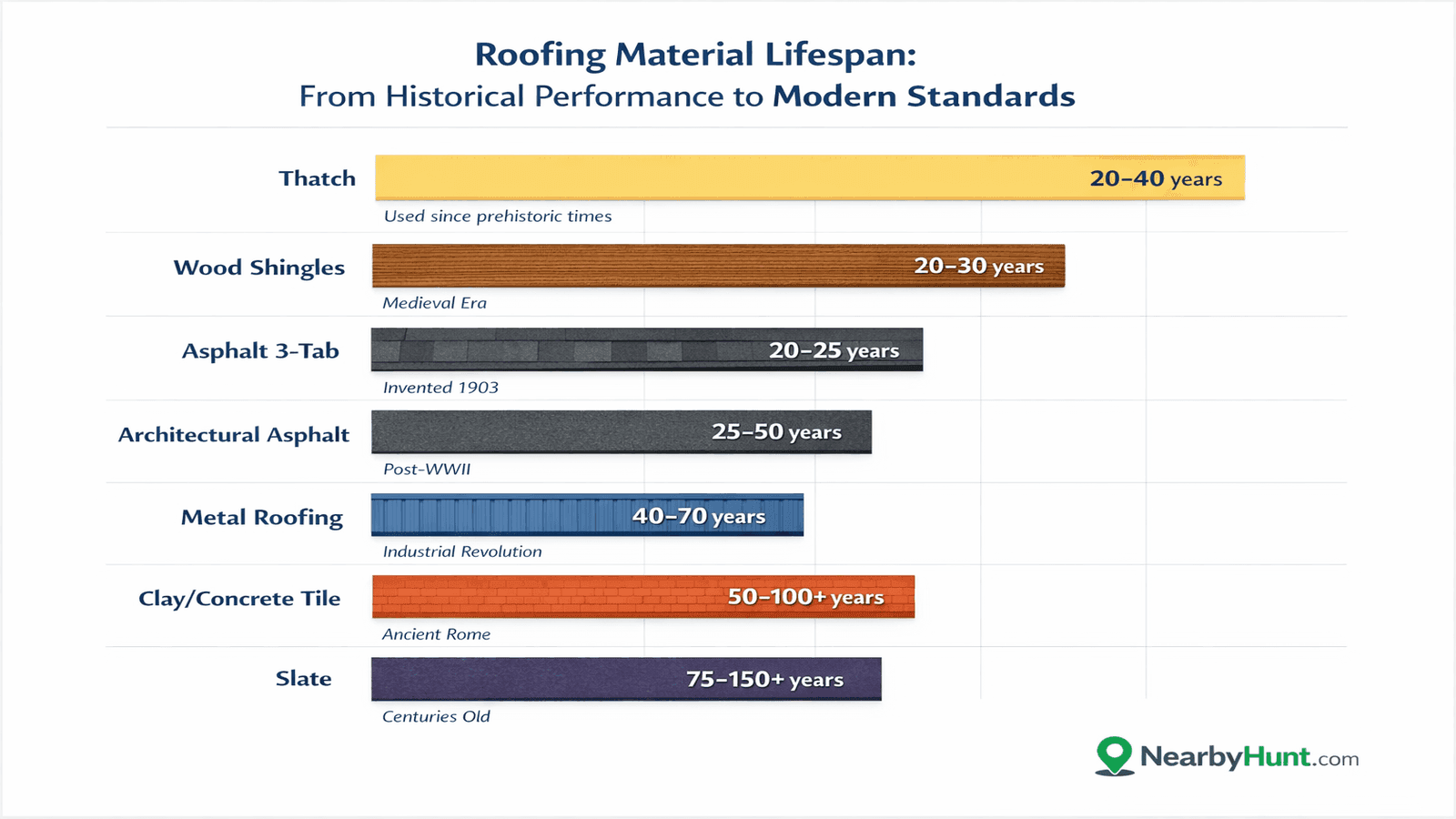
Photo: Horizontal bar chart comparing expected lifespans of roofing materials from thatch at 20-40 years through slate at 75-150 years, with historical era notations for each material
Why Roofing History Matters for Today's Decisions
Understanding how roofing materials evolved helps homeowners make better choices for their specific climate, budget, and aesthetic goals.
Roofing Material Evolution: Key Historical Milestones
Roofing Material Evolution: Key Historical Milestones
| Era | Primary Material | Region | Estimated Lifespan | Key Innovation |
| Prehistoric | Thatch (reed, straw, heather) | Global | 20-40 years | Overlapping layers for drainage |
| 3,000 BC | Kiln-fired clay tiles | China | 50-100+ years | First manufactured roofing |
| 700-650 BC | Imbrex-and-tegula clay tile | Greece/Rome | 75-150+ years | Interlocking waterproof system |
| Medieval era | Slate | Wales/Northern Europe | 75-150+ years | Fire-resistant cut stone |
| 1600s-1800s | Hand-split wooden shingles | Colonial America | 20-30 years | Local timber, simple tools |
| 1870-1910 | Mass-produced slate | Northeast USA | 75-150+ years | Steam-powered quarrying |
| 1903 | Asphalt shingles | USA | 20-50 years | Machine-cut, affordable production |
| 1970s | EPDM rubber membrane | USA/Commercial | 30-50+ years | Single-ply flat roof solution |
| 1980s | Architectural asphalt shingles | USA | 25-50 years | Laminated dimensional profile |
| 1990s | TPO single-ply membrane | USA/Commercial | 20-30 years | Heat-welded reflective seams |
| 2000s-2026 | Solar tiles, cool roofs, green roofs | USA/Global | 25-50+ years | Energy generation + weatherproofing |
Ancient materials offer longevity lessons: Properly installed slate roofs installed in the late 1800s Northeast are still functioning today, 120 to 140 years later [5]. Clay tile roofs in Mediterranean climates routinely outlast the buildings they cover. These historical performance records provide data points that no 30-year warranty on a modern product can match.
Climate drove regional traditions for good reasons: Spanish colonists chose clay tile in Florida and the Southwest because it shed tropical rain and withstood heat. New England colonists turned to slate and wood shingles because they performed in freeze-thaw cycles and heavy snow loads. These regional choices encoded knowledge about local climate performance. Reviewing the terminology around roofing systems helps homeowners understand the performance claims contractors make. The roofing terms glossary covers everything from decking and underlayment to eave and rake flashing, helping you ask the right questions during contractor consultations.
Innovation cycles repeat: Every major material disruption in roofing history (asphalt replacing slate, TPO challenging EPDM, solar tiles competing with conventional asphalt) followed the same pattern: a new material offered better performance or lower cost in specific applications, gained market share, matured technically, and then eventually faced its own challenger. Homeowners who understand this cycle recognize that materials marketed as revolutionary should be evaluated against historical performance data, not just manufacturer claims.

Photo: Two-panel image showing a modern residential solar tile roof on the left and a commercial cool roof with white reflective membrane and green roof section on the right
The Roof Above: An Evolving Story
Roofing's 5,000-year history is a record of continuous refinement rather than dramatic reinvention. Thatch established drainage principles that still apply in metal panel design. Clay tile profiles used in 650 BC survive in modern concrete tile. Asphalt shingles, invented in 1903, still cover the majority of American homes. The materials change, the manufacturing processes improve, and the performance standards rise, but the fundamental challenge remains constant: create a surface that sheds water, resists wind, and protects what's below.
In 2026, roofing stands at an interesting crossroads. Traditional materials, refined over centuries, compete with genuinely novel technologies such as solar tiles and smart monitoring systems. Across 1,800-plus projects in the U.S. South and Midwest, James Carver has watched homeowners watch homeowners navigate their options: "The best roofing decisions I've seen clients make always start with understanding what the roof has to do in their specific climate, then matching material properties to those demands. History helps with that. It tells you what actually works over the long run, not just what looks good in a manufacturer's brochure."
The next chapter of roofing history is being written on the rooftops being installed today. Solar integration, smart monitoring, and bio-based membrane materials are still proving themselves. But the ancient principle discovered by builders laying clay tiles in Greece 2,700 years ago has not changed: a well-designed, properly installed roof is one of the most valuable investments a property owner can make.
Disclaimer
The historical dates and technical information presented in this article are based on published historical records, industry research, and archaeological evidence. Exact dates and claims about ancient construction practices may vary across sources. Roofing material performance, lifespan, and warranty information reflect general industry data and will vary based on climate, installation quality, ventilation, and maintenance practices. This article is intended for educational and informational purposes only and does not constitute professional roofing advice. Always consult a licensed roofing contractor for specific recommendations regarding your property.
Sources & References
- The History of Asphalt Shingles - IKO - Comprehensive history of asphalt shingle development from 1903 through modern era.
- Top Roofing Materials for 2026: Cool Roofs and Sustainable Metal Solutions - FoxHaven Roofing - Analysis of modern roofing material performance data and market growth statistics.
- The History of Roofs - Gerard Roofs EU - Timeline of roofing materials from prehistoric thatch through ancient clay tile and metal.
- A Guide to the Roofs of Ancient Cultures and Roofing Technology - IKO - Detailed overview of ancient Greek and Roman clay tile systems including imbrex and tegula design.
- History of Wood Roofing from Ancient to Colonial Times - Cedur - Research on Colonial American wooden shingle and slate roofing traditions.
- A Brief History of Flat Roofing Systems - Benton Roofing - Development timeline for BUR, EPDM, and TPO flat roof membrane systems.
- 8 Roofing Industry Trends to Watch in 2025 - Cedur - Industry analysis covering solar tiles, cool roofs, green roofs, and impact-resistant systems.
- History of Roofing in America - Custom Shingles - Overview of American roofing material adoption from Colonial era through 20th century.

James is a licensed roofing contractor with 20 years of experience in roof installation, inspection, and repair across the U.S. South and Midwest. He specialises in asphalt shingles, metal roofing, and storm damage restoration. On NearbyHunt, James offers practical advice on roof maintenance, insurance claims, and selecting the right materials for long-lasting protection.

Jacob is a licensed roofing contractor with over 18 years of experience in roof inspection, installation, and restoration. Based in Texas, he has led hundreds of successful roofing projects across residential and commercial properties. Jacob is also a certified storm damage specialist, ensuring that all NearbyHunt roofing content meets industry best practices and safety standards.