- Seamless aluminum gutters cost $7-$15 per linear foot installed, the most popular choice for homes with 150-200 linear feet of gutters, totaling $1,050-$3,000 for a complete system
- Copper gutters run $25-$50 per linear foot: up to 5x the cost of aluminum but lasting 50-100 years; best for high-end historic homes
- Gutter guards add $1,500-$4,000 to a typical installation but reduce cleaning from twice per year to once every 3-5 years
- Replacing gutters takes 1-2 days for an average home; repairs and individual sections can often be done same-day without full replacement
- 45% of gutter replacement jobs include fascia repair averaging $400-$800 in additional work, according to contractors in our NearbyHunt network
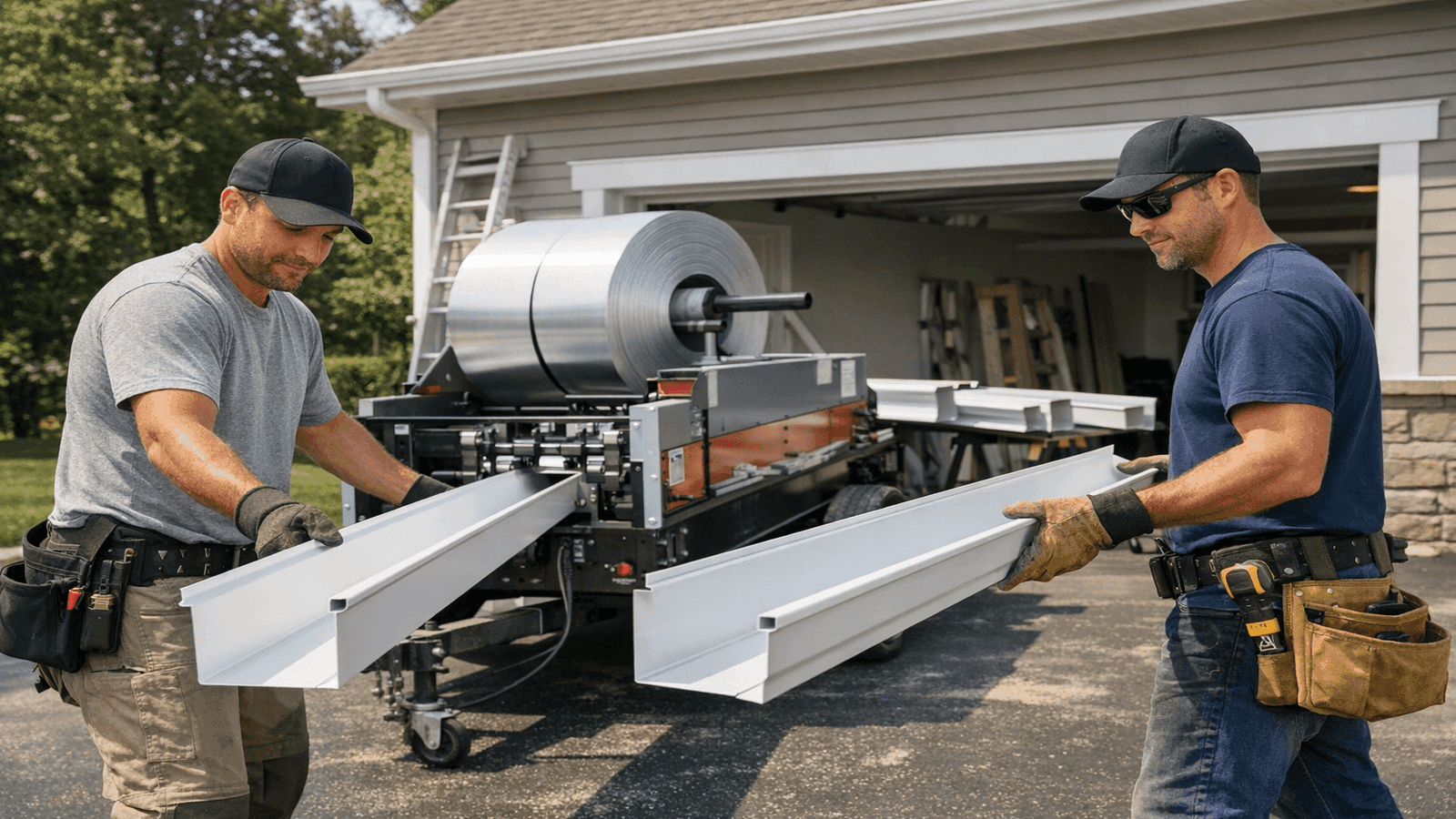
Photo: Seamless aluminum gutter installation in progress showing gutter machine forming on-site
Gutters are the unsung workhorse of your home's exterior. They channel thousands of gallons of rainwater away from your foundation, siding, and landscaping every year. When they fail, water pools against your fascia boards, seeps into the foundation, and erodes landscaping, creating damage that runs far more expensive than the gutters themselves. This guide breaks down exactly what gutter replacement costs in 2026, which materials deliver the best value, and when repair makes more sense than full replacement. For broader context on protecting your home's exterior, see the complete roofing costs guide for the full picture on what homeowners are spending on roof-related systems this year.
Gutter replacement is one of those projects where the upfront cost comparison between materials can be misleading. The cheapest option per foot isn't always the cheapest option over time, and the right choice depends heavily on your climate, roof pitch, and how much maintenance you want to manage going forward.

Get quotes from top-rated pros.
Gutter Types and Cost Comparison
The material you choose is the single biggest variable in your gutter replacement budget. Prices below are fully installed costs including labor and basic downspouts.
Seamless aluminum is the dominant choice across the country, representing roughly 80% of residential installations [1]. It's formed on-site by a roll-forming machine, which means the only seams are at inside corners and downspout connections. Installed cost runs $7-$15 per linear foot, with a typical lifespan of 20-30 years and very low maintenance requirements.
Sectional vinyl is the most budget-friendly option and the only gutter type realistically suited for DIY installation. It runs $4-$8 per linear foot installed by a pro. The trade-off is that joints every 10 feet create ongoing leak points, and vinyl becomes brittle in extreme cold. It's a reasonable choice in mild climates but a poor one in areas with hard freezes.
Galvanized steel makes sense in high-rainfall regions where gutter volume matters more than weight. Expect to pay $9-$16 per linear foot installed. Steel gutters last 20-25 years with proper maintenance but will rust if the coating is scratched and left untreated.
Stainless steel steps up the durability further at $18-$30 per linear foot. It's particularly well-suited to coastal climates where salt air degrades aluminum faster than normal. Lifespan runs 30-50 years with minimal care.
Copper is the premium option, installed at $25-$50 per linear foot and often higher for custom work [2]. It develops a natural patina over time and can last 50-100 years when properly installed with soldered seams. The cost is hard to justify on a standard home, but for historic properties or high-end custom homes where appearance and longevity matter equally, copper is genuinely the best long-term value.
Zinc is popular in European architecture and increasingly seen on premium American homes. It runs $20-$35 per linear foot installed and shares copper's 50-plus year lifespan with similarly low maintenance demands.
| Material | Installed Cost (per linear ft) | Lifespan | Maintenance | Best Climate |
| Vinyl (sectional) | $4-$8 | 10-15 years | Low-medium | Mild, low freeze |
| Aluminum (seamless) | $7-$15 | 20-30 years | Low | Most climates |
| Galvanized steel | $9-$16 | 20-25 years | Medium | High rainfall |
| Stainless steel | $18-$30 | 30-50 years | Low | Coastal/salt air |
| Zinc | $20-$35 | 50+ years | Low | Most climates |
| Copper | $25-$50 | 50-100 years | Very low | Historic/premium homes |
Total Gutter Replacement Cost by Home Size
The number of linear feet of guttering on your home drives the total project cost more than any other single factor. A basic rule of thumb: add up the linear footage of all roofline edges that need gutters (typically the eaves, not the rakes or gable ends).
Most homes fall in the 150-200 linear foot range for gutters, though a house with complex rooflines, multiple dormers, or a wraparound porch can push that significantly higher.
Small home (under 1,500 sq ft): typically 100-125 linear feet of guttering. Budget $700-$1,875 for seamless aluminum, or $2,500-$6,250 for copper.
Medium home (1,500-2,500 sq ft): typically 150-175 linear feet. Budget $1,050-$2,625 for seamless aluminum and $3,750-$8,750 for copper. This is the most common project size and where most national averages are calculated.
Large home (2,500-4,000 sq ft): typically 200-250 linear feet. Budget $1,400-$3,750 for seamless aluminum and $5,000-$12,500 for copper.
Two-story homes: add 20-30% above material costs for the extra setup time, taller ladder staging, and additional safety requirements. Some contractors charge this as a flat surcharge; others build it into the per-foot rate.
These figures assume standard 5-inch K-style gutters. Upgrading to 6-inch K-style (recommended for larger rooflines or high-rainfall areas) adds roughly $1-$2 per linear foot.
| Home Size | Linear Feet | Aluminum Total | Steel Total | Copper Total |
| Small (under 1,500 sq ft) | 100-125 ft | $700-$1,875 | $900-$2,000 | $2,500-$6,250 |
| Medium (1,500-2,500 sq ft) | 150-175 ft | $1,050-$2,625 | $1,350-$2,800 | $3,750-$8,750 |
| Large (2,500-4,000 sq ft) | 200-250 ft | $1,400-$3,750 | $1,800-$4,000 | $5,000-$12,500 |
What Drives Gutter Replacement Cost
Beyond material choice, several other factors can meaningfully shift your final quote. Understanding them helps you evaluate contractor bids and avoid surprise line items.
Gutter size and profile is a common hidden cost. The standard 5-inch K-style gutter handles most homes fine, but any roofline draining more than 500 square feet of surface area benefits from 6-inch gutters. Half-round gutters, common on historic and Colonial-style homes, cost slightly more per foot because they require different hangers and aren't produced as efficiently as K-style.
Downspout count adds up quickly. The standard recommendation is one downspout per 40 linear feet of gutter. Each downspout runs $80-$200 installed depending on height, extensions, and whether it ties into an underground drain. A typical home needs 4-6 downspouts, adding $320-$1,200 to the base gutter cost.
Fascia condition is the most common budget-breaker on older homes. Gutters attach to the fascia board, and if that board is rotted or soft, it must be replaced before new gutters go on. Fascia replacement runs $8-$20 per linear foot for materials and labor [3]. On a home with 60 feet of damaged fascia, that's an extra $480-$1,200.
Regional labor rates swing significantly. Contractors in the Southeast typically charge $4-$7 per linear foot for labor alone; in the Northeast and West Coast, labor runs $7-$12 per linear foot. That single variable can add $450-$750 to an identical job based purely on geography.
Most homes built before 2000 with standard 5-inch gutters are now undersized for what we're seeing in rainfall intensity. I've replaced 1,800-plus gutter systems across the U.S. South and Midwest, and the number one call-back I get from neighbors who didn't replace theirs is overflow flooding against the foundation. If your roofline is draining more than 500 square feet to one section of gutter, put in 6-inch. The cost difference is $1-$2 per foot and it solves the problem permanently.
Get quotes from top-rated pros.
The gutter contractors in our NearbyHunt network report that 45% of gutter replacement jobs include fascia repair averaging $400-$800 in additional work. That figure lines up exactly with what James sees in the field: rotted fascia often isn't visible from the ground, and homeowners get a surprise line item once the old gutters come down.
Gutter Guards: Cost and Are They Worth It
Gutter guards sit over your gutters and keep debris out, reducing or eliminating the need for professional cleaning twice a year. Quality matters enormously here. The price range spans from $400 to over $4,000 for the same home, and the performance gap between the cheapest and best options is substantial.
Micro-mesh guards are the most effective option on the market. They use a very fine stainless steel mesh that blocks seeds, shingle grit, and pine needles while letting water flow through freely. Installed cost runs $3-$8 per linear foot, or $450-$1,600 for a 150-foot home when DIY-style brands are used. Professional installations from companies like LeafFilter typically run $12-$25 per linear foot, or $1,800-$3,750 for a standard home [4]. The price difference reflects the warranty (LeafFilter offers a lifetime transferable warranty), professional installation guarantee, and post-install cleaning included in the quote.
Reverse-curve guards use surface tension to direct water into the gutter while debris falls off the edge. They work well for pine needle-heavy environments but can let small debris in during heavy rainfall. Cost runs $4-$10 per linear foot installed.
Foam inserts drop directly into the gutter channel and physically block debris. They're inexpensive at $1-$3 per linear foot, but they deteriorate in 3-5 years, absorb moisture, and can actually encourage moss growth inside the gutter.
Brush guards use a cylindrical brush that sits in the gutter. They're easy to DIY-install but require regular cleaning to remove the debris that gets tangled in the bristles, somewhat defeating their purpose.
I've seen foam inserts turn into solid moss blocks after three years in a humid climate. If you're going to do guards, do micro-mesh or skip them entirely. The $50 foam option will cost you more in cleaning and replacement than you saved up front. Quality micro-mesh pays back in 5-7 years just on cleaning costs alone.
The ROI calculation is straightforward: professional gutter cleaning typically costs $150-$300 per visit, done twice a year. Quality micro-mesh guards essentially eliminate that cost. A $1,800 guard installation pays for itself against $250 per year in cleaning in about 7 years and lasts 20-plus years.
| Guard Type | Installed Cost | Maintenance | Effectiveness | Warranty |
| Foam insert | $150-$450 | High | Low | 1-3 years |
| Brush | $300-$750 | Medium-high | Low-medium | 1-5 years |
| Reverse curve | $600-$1,500 | Low | Medium | 10-25 years |
| Micro-mesh (DIY brands) | $450-$1,600 | Low | High | 5-25 years |
| Micro-mesh (pro install) | $1,800-$3,750 | Very low | Very high | Lifetime |
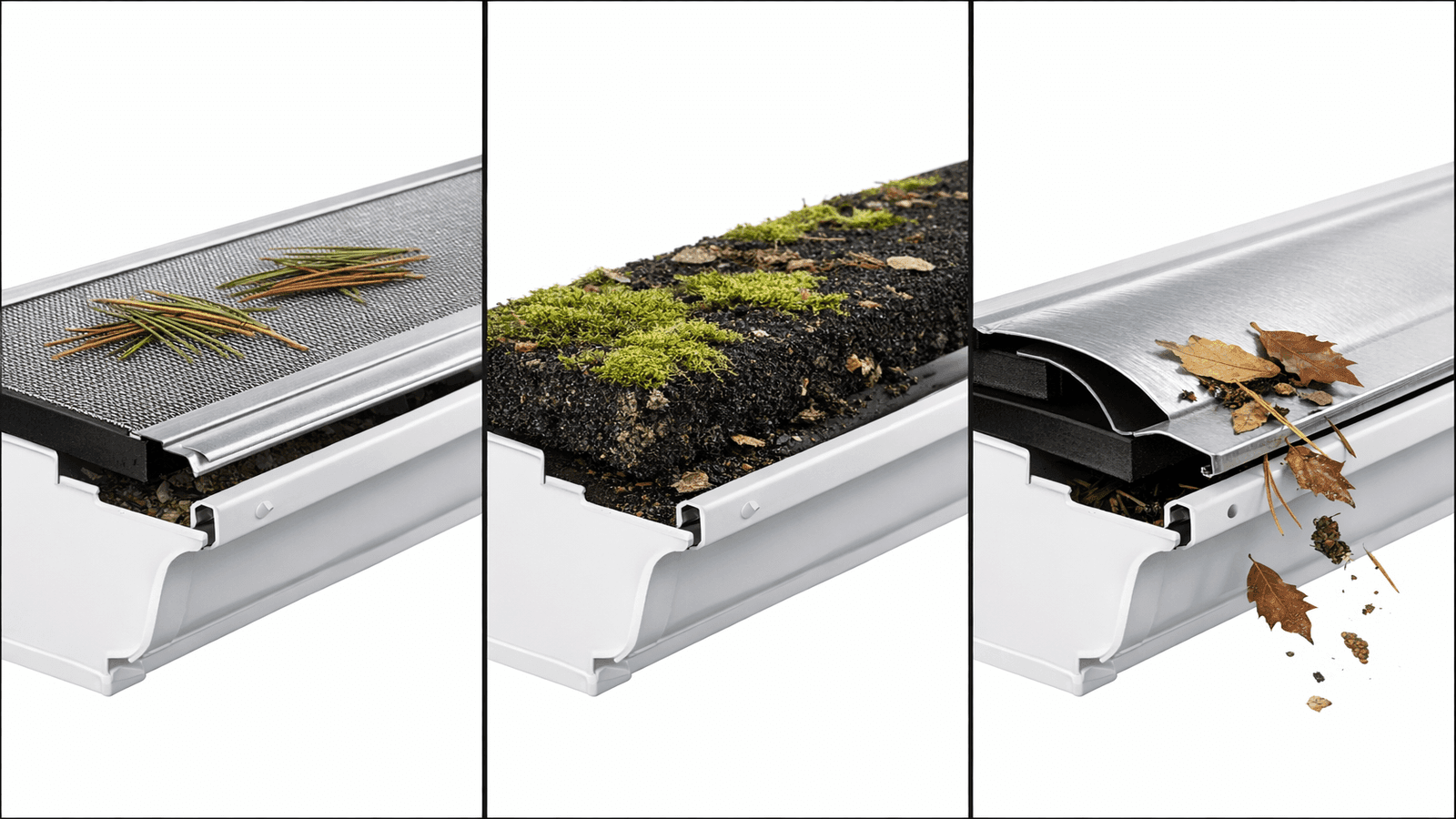
Photo: Close-up comparison of micro-mesh guard versus foam insert versus reverse-curve showing clog prevention mechanism
Gutter Repair vs. Full Replacement
Not every gutter problem requires a full replacement. A straightforward repair evaluation can save you $1,000 or more if your gutters are fundamentally sound.
Repair makes sense when:
- You have 1-3 leaking joints that can be re-sealed with gutter sealant
- One section has sagged and just needs a new hanger re-set
- A single panel has a hole or crack but the rest of the system is in good shape
- Your gutters are fewer than 15 years old and made from aluminum or steel
Repair costs break down as follows: a DIY patch kit from a hardware store runs $20-$50. A professional joint re-seal on a sectional gutter system costs $150-$350 for the full perimeter, worth doing if your system is otherwise solid and less than 10 years old. Replacing one damaged section runs $100-$250 per section for professional work.
Replacement is the better call when:
- Gutters show widespread sagging due to improper slope (a systematic problem, not a spot fix)
- Steel gutters show rust throughout the system
- Your gutters are 20-plus years old and repairs are becoming frequent
- The fascia needs replacement, which requires removing the gutters anyway
- You're upgrading to seamless to eliminate ongoing sectional joint leaks
One distinction homeowners often miss: sectional gutters have a joint every 10 feet, and each joint is a potential leak. A 150-foot sectional system has 15 joints. Once 4-5 of them start leaking, you're fighting a losing battle with repairs. Seamless gutters have joints only at corners and downspout connections, creating dramatically fewer failure points.
Full joint re-sealing of a sectional system (applying fresh butyl sealant to every joint) costs $150-$350 and buys 3-5 more years of life. It's a reasonable middle step if you're not ready for full replacement.
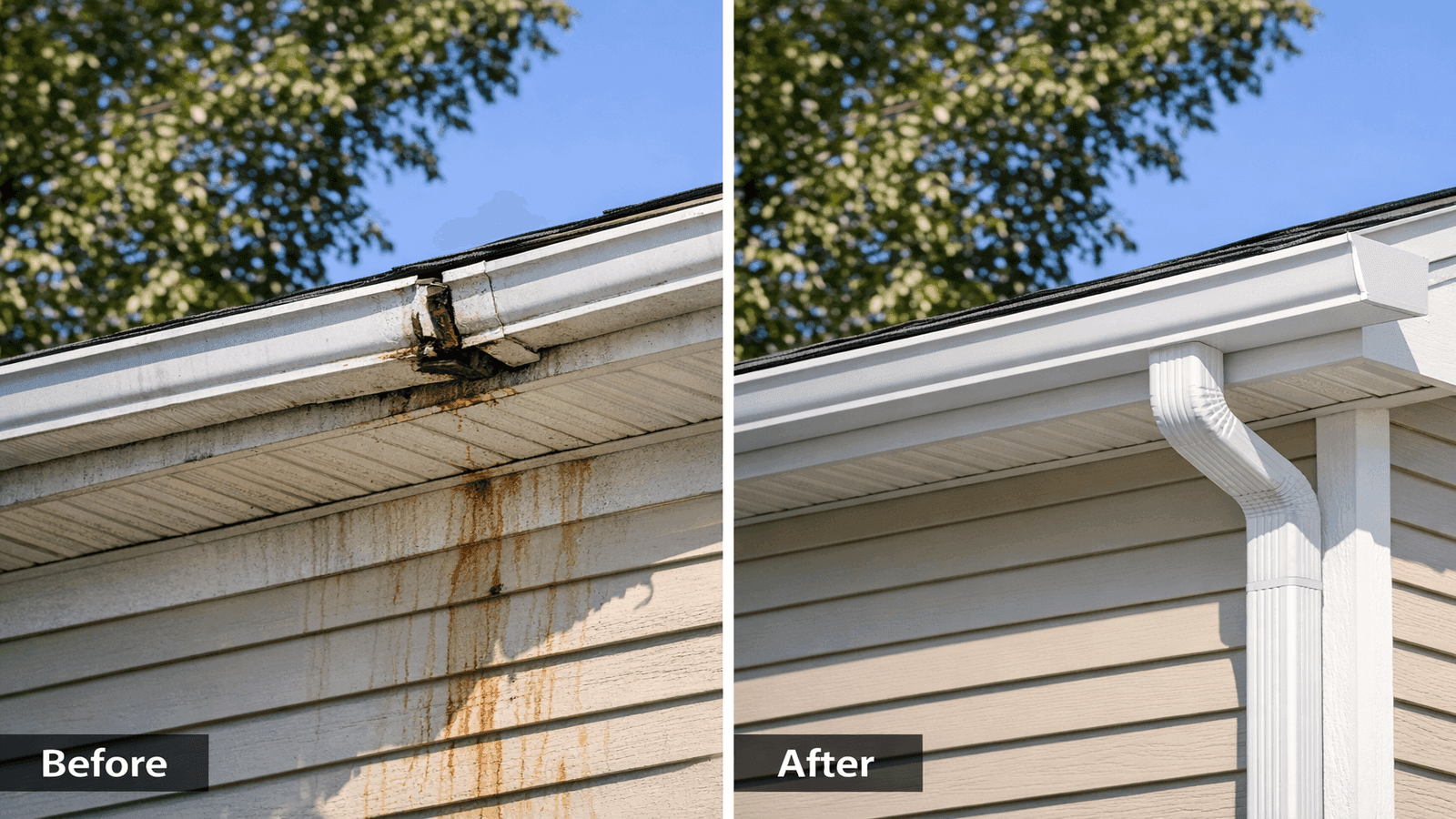
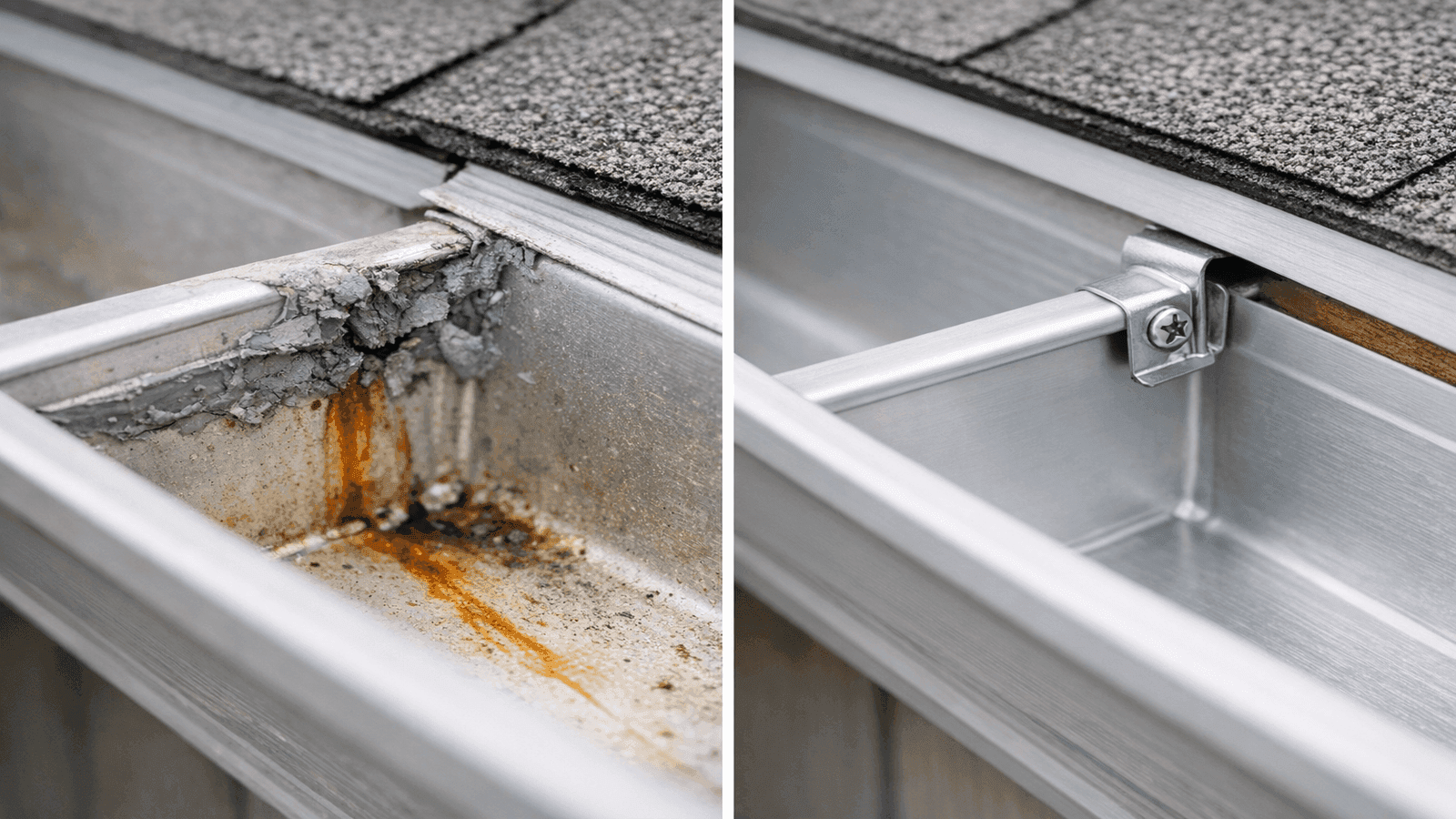
Photo: Split image showing sagging damaged gutters on left versus newly installed seamless system with proper slope on right
DIY Gutter Installation
Sectional vinyl gutters are the one scenario where DIY gutter installation is genuinely practical. The sections snap together, they're sold at major home improvement stores in standard 10-foot lengths, and the installation requires only a miter saw, level, hacksaw, and a sturdy ladder. The labor savings run $3-$6 per linear foot, which translates to $450-$900 saved on a 150-foot home.
The trade-offs are significant:
- Every joint is a potential leak, and you'll have 15 of them on a 150-foot home
- Vinyl becomes brittle in temperatures below 20 degrees F and can crack
- Proper slope (1/4 inch of drop per 10 feet of run, toward the downspout) is critical and difficult to set accurately without experience
- Most manufacturer warranties on premium vinyl are voided if not professionally installed
Seamless gutters are not a DIY option. The roll-forming machine that creates a continuous piece of aluminum from a coil costs $3,000-$8,000 and requires training to operate. Any contractor offering "seamless" gutters from pre-cut sections is not offering true seamless gutters.
Two-story gutter work involves serious fall risk. A ladder standoff (stabilizer) is essential to keep the ladder away from the gutter, and scaffolding is the safer choice for extended work. Falls from ladders are among the leading causes of home improvement injuries, and gutter height on a two-story home typically puts you 18-24 feet off the ground.
Get quotes from top-rated pros.
The money homeowners save on labor is almost always spent on callbacks. I get calls every spring from people who DIY'd their gutters the year before and now have standing water against their foundation because the slope is off by half an inch. Get the slope right: 1/4 inch drop per 10 feet, toward the downspout. That's the single most important thing, and it's surprisingly hard to nail on your first install.
If you do tackle sectional gutter installation yourself, also read our guide on how to clean gutters safely. The same ladder safety principles apply during both installation and maintenance.
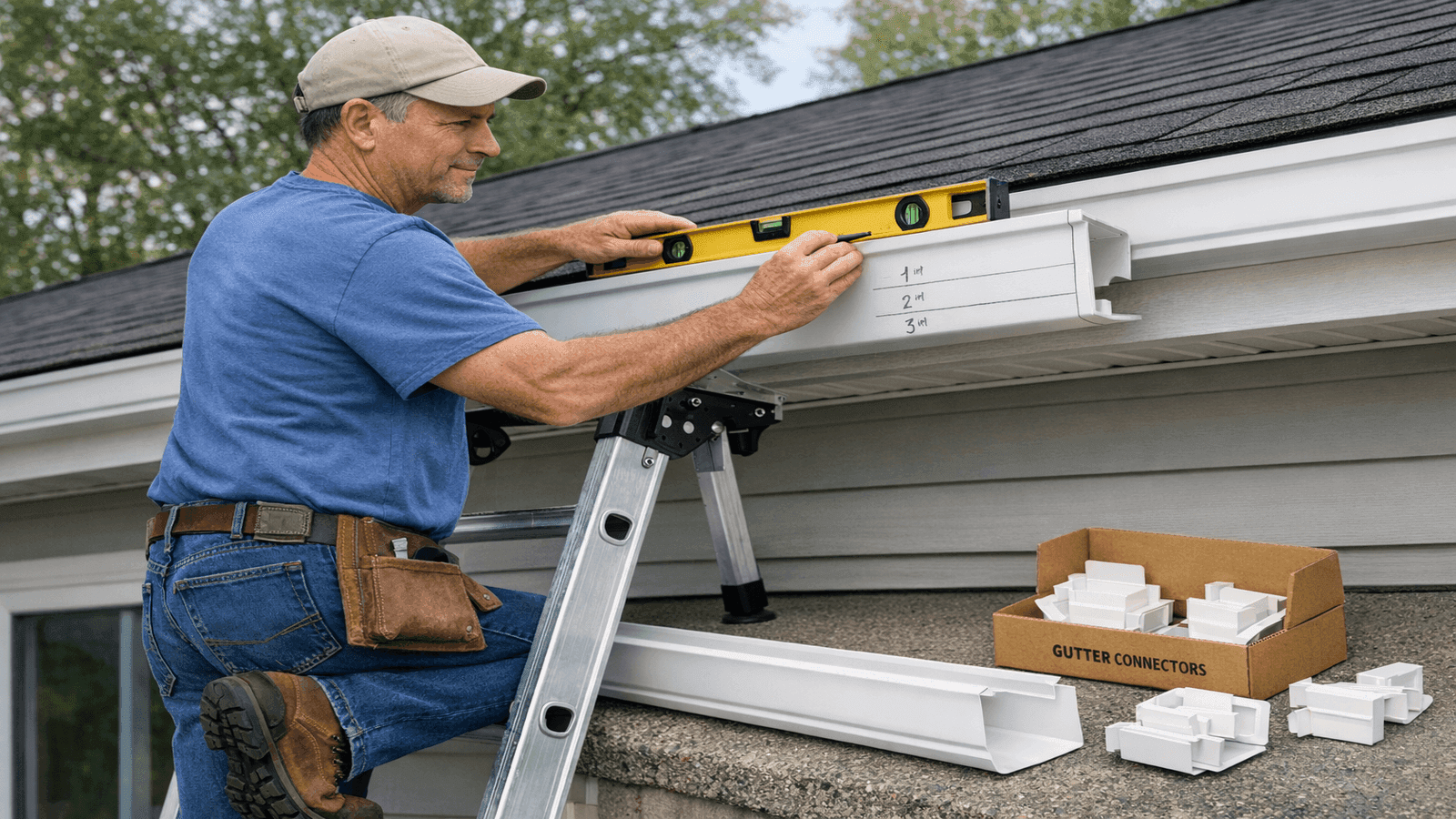
Photo: DIY sectional gutter installation showing homeowner setting slope with level and marking fascia before securing hangers
Real-World Case Study: Patricia W., Richmond, VA
Patricia W. owns a 1985 Colonial in Richmond, Virginia. The house still had its original sectional aluminum gutters, which had been developing new leaks every season for the past few years. Three of the downspouts had also been patched multiple times.
James inspected the gutters and found that the joints had failed throughout the system, the north-side fascia showed active rot from years of water backing up, and the existing 5-inch K-style was undersized for the home's roof pitch and square footage.
His recommendation: full seamless aluminum replacement at 6-inch K-style for the entire 168 linear feet, with micro-mesh guards installed at the same time.
Total project cost breakdown:
- 168 linear ft of seamless 6-inch aluminum gutters: $2,352 (at $14/ft installed)
- Micro-mesh guards for full perimeter: $1,890 (at $11.25/ft)
- Replacement of rotted north-side fascia (60 linear ft at $14/ft): $840
- Total: $5,082
Patricia had been paying $280 per year for professional gutter cleaning. The micro-mesh guards eliminated that cost entirely. At $280/year savings, the $1,890 guard investment breaks even in 6.75 years. The guards are rated for 25 years.
The fascia repair was the part she hadn't budgeted for, but James showed her the soft spots by hand before quoting. Replacing rotted fascia proactively, before it damages the roof sheathing behind it, is always cheaper than waiting.
"I wish I'd done this ten years ago," Patricia told James at the end of the job. "I spent probably $2,800 in cleaning bills over the years before the guards, and the gutters were still leaking by the end."
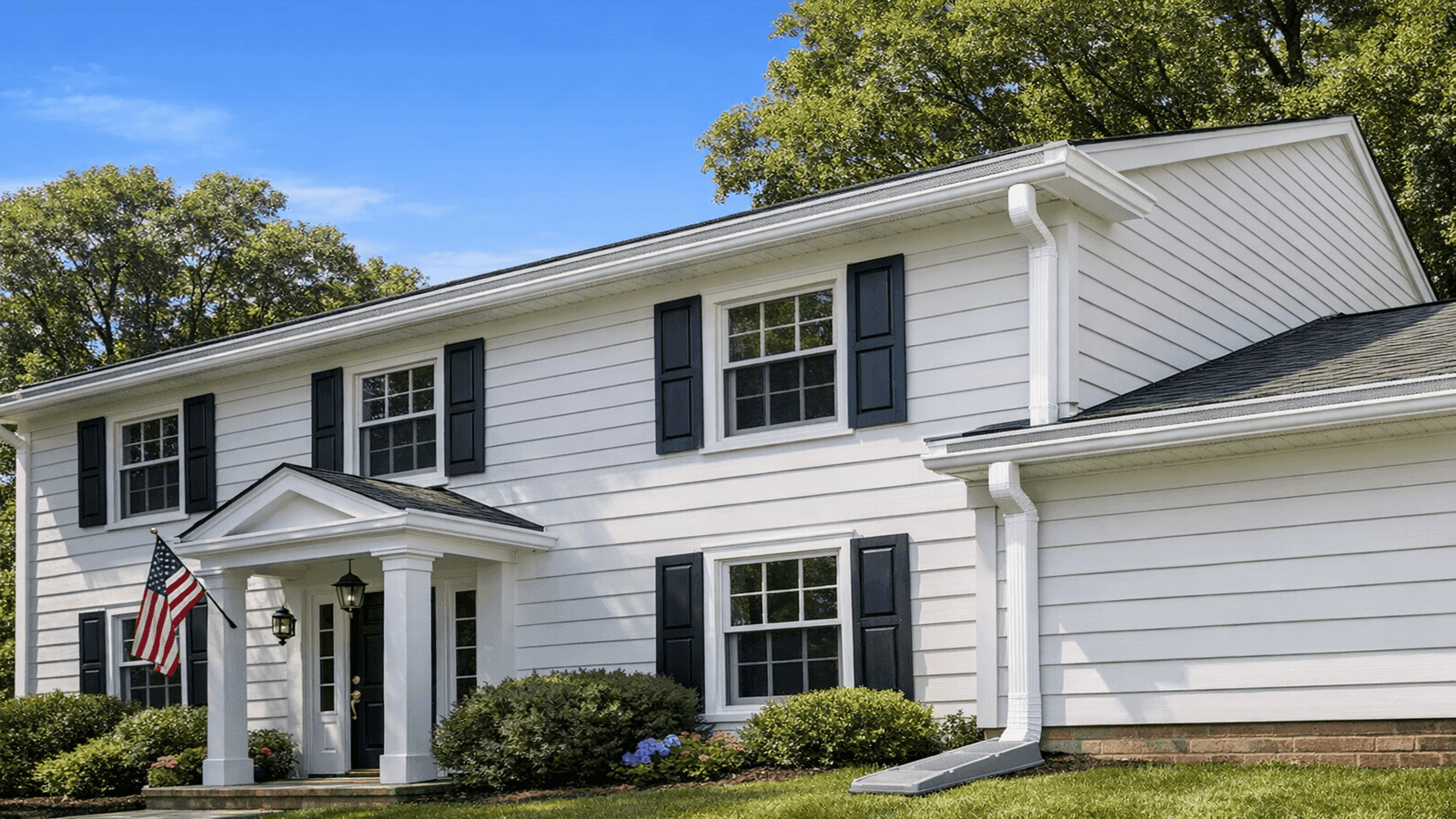
Photo: Before-and-after photo of Richmond Colonial home showing original damaged gutters replaced with new seamless system and micro-mesh guards installed
Conclusion
Gutter replacement costs in 2026 span from $700 for a simple, small-home aluminium job to $12,500-plus for premium copper on a large home. For most homeowners, seamless aluminium gutters in the $1,050-$2,600 range represent the best balance of cost, durability, and performance. Adding micro-mesh guards at the same time is almost always the right financial decision when you run the numbers on cleaning costs and guard lifespan.
Get at least three written quotes. Verify that contractors are using fully seamless aluminium formed on-site, not pre-cut sections. Ask specifically about the condition of the fascia before committing to a price. And factor in whether guards are worth adding while the crew is already set up. The incremental labour cost to add guards during a full replacement is lower than coming back for a separate install.
Disclaimer: Cost figures are national averages for 2026 and vary significantly by region, project complexity, and contractor availability. Always obtain 2-3 written quotes from licensed roofing or gutter contractors before committing to any gutter replacement project. Fascia and soffit conditions should be inspected on-site before accepting any price estimate, as concealed rot is common and not visible from the ground.
Find Licensed Roofing Contractors Near You
Sources & References
- This Old House: Gutter Installation Cost in 2026
- This Old House: Seamless Gutter Cost 2026
- This Old House: Gutter Guard Installation Cost 2026
- This Old House: Gutter Repair Cost 2026
- This Old House: LeafFilter Cost 2026
- Fixr: Gutter Installation Cost Guide
- Bob Vila: How Much Does Gutter Installation Cost?
- Bankrate Home: Gutter Replacement Cost

James is a licensed roofing contractor with 20 years of experience in roof installation, inspection, and repair across the U.S. South and Midwest. He specialises in asphalt shingles, metal roofing, and storm damage restoration. On NearbyHunt, James offers practical advice on roof maintenance, insurance claims, and selecting the right materials for long-lasting protection.

Jacob is a licensed roofing contractor with over 18 years of experience in roof inspection, installation, and restoration. Based in Texas, he has led hundreds of successful roofing projects across residential and commercial properties. Jacob is also a certified storm damage specialist, ensuring that all NearbyHunt roofing content meets industry best practices and safety standards.