- Average roof replacement costs $8,000-$20,000 for a 2,000 sq ft home -- the national average lands near $11,500 with standard 3-tab asphalt shingles in 2026 [1]
- Architectural shingles cost only $500-$1,500 more than 3-tab but last 5-10 years longer -- James Carver recommends them as the best value upgrade for most homeowners
- Tear-off of old shingles adds $1-$2 per square foot to total project cost, and most local codes allow only two shingle layers before a full tear-off is required
- Getting 3 quotes instead of 1 saves homeowners an average of $1,200-$2,500 on a full replacement
- James Carver has priced 1,800-plus residential roofing projects across the U.S. South and Midwest -- the single biggest cost variable is labor, which swings 30-50% by region
A new roof is one of the largest single-line investments a homeowner makes, yet the quotes you receive can vary by $5,000 or more for the same house. Material grade, roof complexity, regional labor rates, and what contractors discover once they tear off your old shingles all drive that spread. Understanding these variables before you accept a single bid puts you in control of the outcome.
This guide is part of our complete overview of roofing costs, where you'll find additional breakdowns for specific repair and material upgrades. Here, the focus is full replacement: what it costs, what drives those costs, and how to evaluate competing quotes with confidence.

Get quotes from top-rated pros.
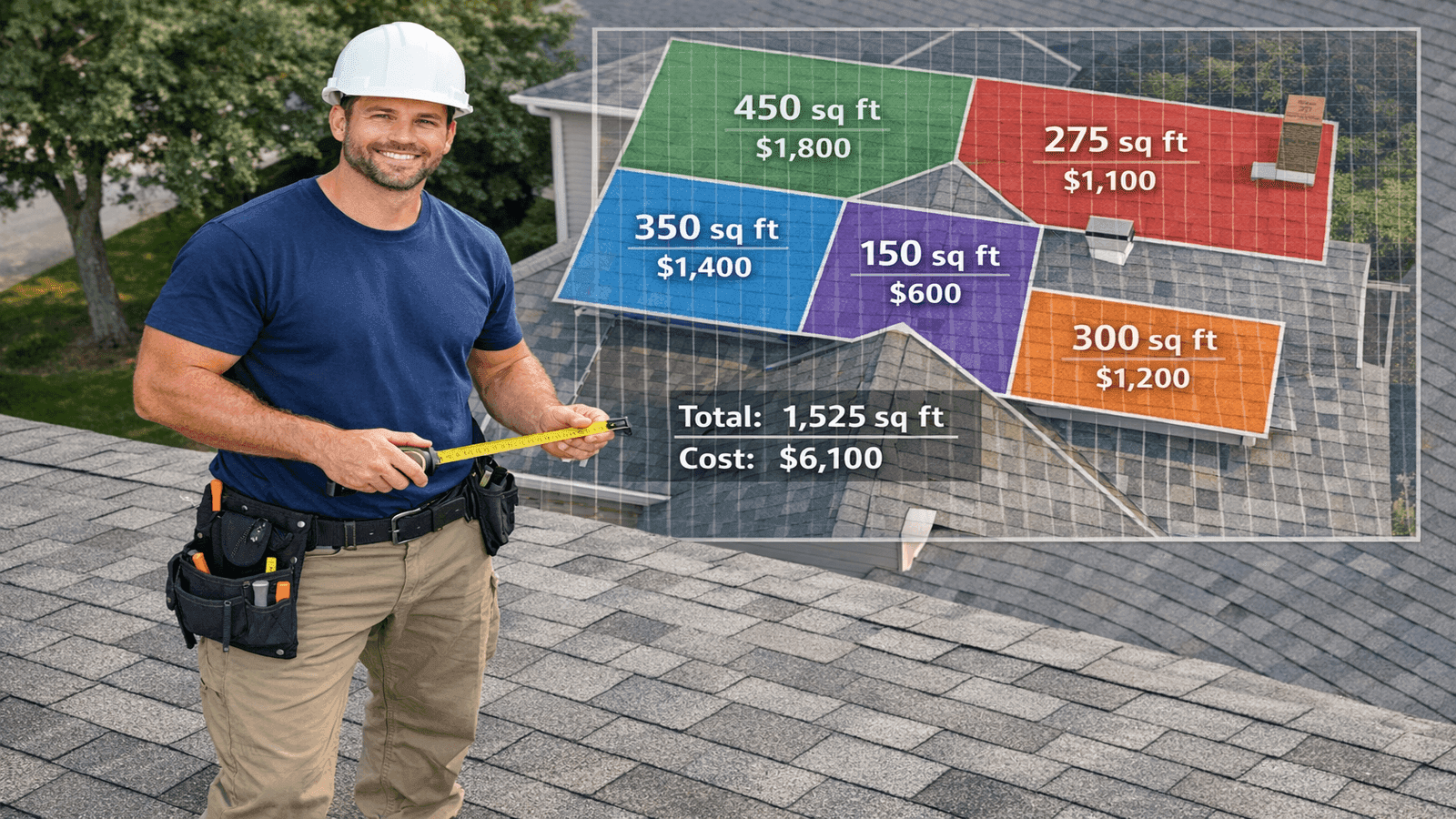
Photo: Roofing contractor measuring roof area with aerial view overlay showing square footage calculations and cost breakdown
Roof Replacement Cost by Home Size
The roofing industry prices work by the "square" -- 100 square feet of roof surface. Your roof square footage is not the same as your home's footprint because the pitch (slope) adds surface area. A 2,000 sq ft ranch home with a moderate 6:12 pitch has roughly 22-24 roof squares once you account for the pitch multiplier. For context on how replacement costs compare to repair costs across different roofing scenarios, see our guide to roofing repair costs.
How to estimate your squares: Multiply your home's footprint square footage by the pitch multiplier for your slope (1.00 for flat, 1.08 for 4:12, 1.12 for 5:12, 1.19 for 6:12, 1.28 for 7:12, 1.41 for 8:12), then divide by 100. A 2,000 sq ft home with a 6:12 pitch equals approximately 23.8 squares.
Estimated Replacement Cost by Home Size (3-Tab vs. Architectural Asphalt, 2026)
| Home Size | Approx. Squares | 3-Tab Low | 3-Tab High | Architectural Low | Architectural High |
| 1,000 sq ft | 11-13 | $4,000 | $7,000 | $5,000 | $9,500 |
| 1,500 sq ft | 16-18 | $6,000 | $10,000 | $7,500 | $13,500 |
| 2,000 sq ft | 22-24 | $8,000 | $13,500 | $10,000 | $18,000 |
| 2,500 sq ft | 28-30 | $10,000 | $17,000 | $12,500 | $22,500 |
| 3,000 sq ft | 33-36 | $12,000 | $20,500 | $15,000 | $27,000 |
Costs reflect full tear-off, new underlayment, standard flashing, and installation. They do not include decking repairs, skylight re-flashing, or chimney work. All ranges are national -- your region and roof complexity will push you toward one end or the other [2].
Roof Replacement Cost by Material
Material choice is the second-biggest cost lever after home size. The table below compares installed costs per square foot, total estimated cost for a 2,000 sq ft home (approximately 22 squares), expected lifespan, and typical manufacturer warranty [1][3][5].
Material Cost Comparison (2026)
| Material | Installed Cost/Sq Ft | Total (2,000 sq ft home) | Lifespan | Warranty |
| 3-Tab Asphalt | $3.50-$5.50 | $8,000-$13,500 | 15-20 years | 20-25 years |
| Architectural Asphalt | $4.50-$7.00 | $10,000-$17,500 | 25-30 years | 30-50 years |
| Metal (Standing Seam) | $10.00-$18.00 | $22,000-$40,000 | 40-70 years | 30-50 years |
| Concrete Tile | $9.00-$18.00 | $20,000-$40,000 | 40-50 years | 30-50 years |
| Clay Tile | $12.00-$25.00 | $26,000-$55,000 | 50-100+ years | 30-50 years |
| Natural Slate | $20.00-$50.00 | $44,000-$110,000 | 75-150+ years | Lifetime |
3-Tab Asphalt remains the entry-level option. It costs less upfront but carries the shortest lifespan of any common roofing material. Many homeowners who choose it plan to sell within 10 years; others choose it because budget constraints leave no other option.
Architectural (Dimensional) Asphalt is the standard recommendation for most homeowners who plan to stay in their home long-term. The thicker, layered construction resists wind and hail better than 3-tab, carries a substantially longer warranty, and adds measurable resale value. The cost difference over a typical quote is $500-$1,500 total.
Metal roofing has gained significant market share in the Southeast and Gulf Coast, where insurance carriers are now offering premium discounts for Class 4 impact-rated metal panels. Standing seam metal is the most durable option in hail-prone or hurricane-risk zones. According to Bob Vila, metal roofing accounts for an increasing share of residential re-roofing projects in storm-prone states due to its wind and impact resistance [6].
Get quotes from top-rated pros.
In 1,800-plus residential roofing projects across the U.S. South and Midwest, I've seen homeowners regret choosing 3-tab far more often than they regret choosing architectural. The math is simple: you're paying an extra $700 on a $12,000 project to get a roof that lasts a decade longer. On a per-year basis, architectural shingles are almost always the less expensive choice over time. The only case where 3-tab makes sense is when the homeowner knows they're selling the house within five years and the buyer will see new shingles regardless of grade.
What Is Included in a Replacement Quote
A legitimate roofing quote is not just a line item for "new shingles." Understanding what should appear in any quote you receive helps you spot contractors who are cutting corners or hiding costs in change orders. Here is what a complete replacement quote should itemize [3]:
Standard inclusions in a full replacement:
- Tear-off and disposal of existing shingles (cost: $1.00-$2.00 per square foot)
- Ice and water shield along eaves, valleys, and penetration areas
- Synthetic felt underlayment across the full field
- New shingles of the specified material and grade
- Ridge cap shingles (dimensional cap matched to shingle brand)
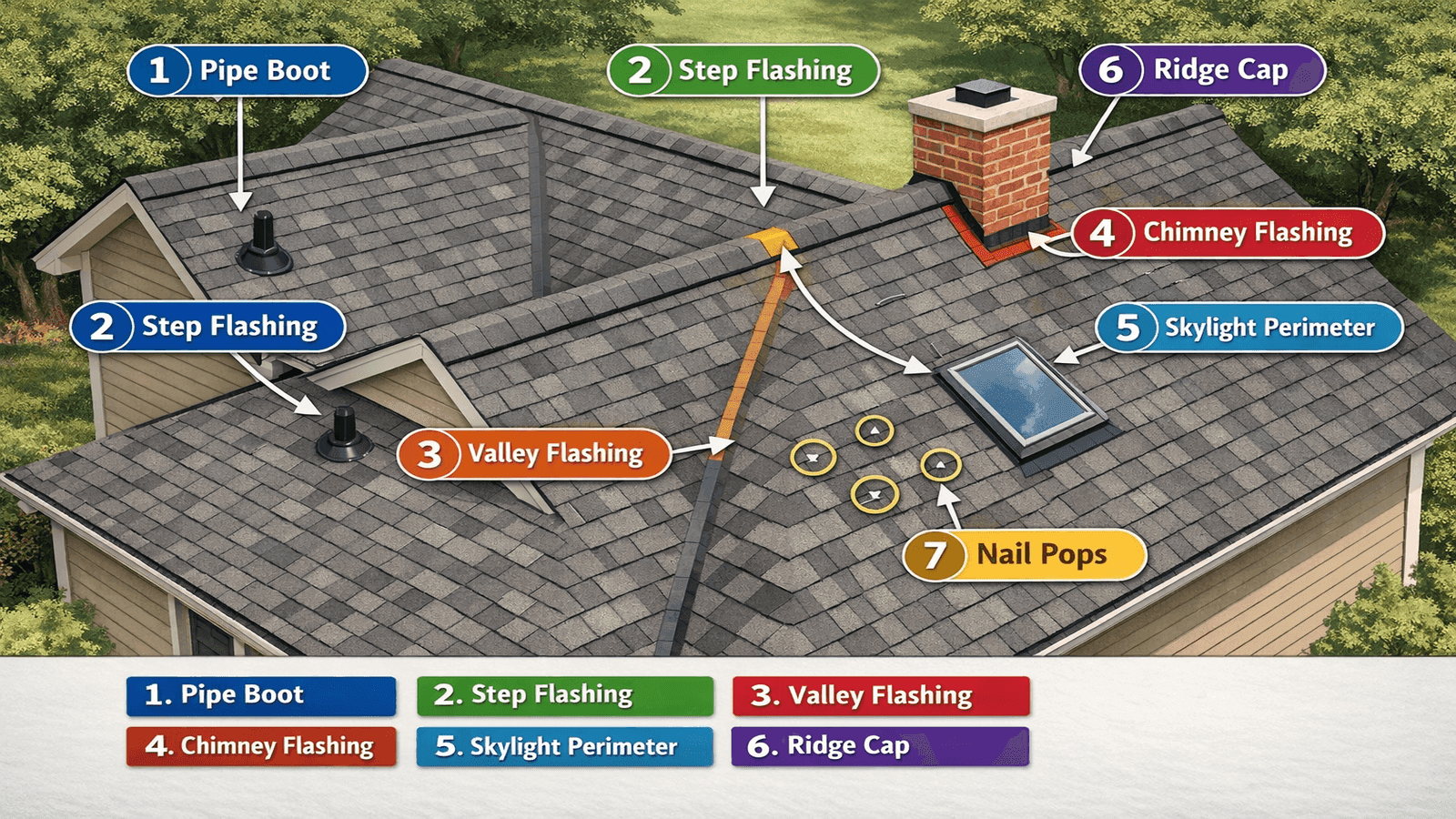
- Step flashing, pipe boots, and chimney flashing
- Drip edge (metal or aluminum, required by code in most jurisdictions)
- All fasteners, caulk, and pipe boot sealant
- Permit fee (varies by jurisdiction -- $75-$300 in most areas)
- Post-job cleanup, magnet sweep for nails, and debris removal
- Contractor overhead and profit margin (standard range: 20-30%)
What is NOT standard and may be added as a change order:
- Replacement of rotted or damaged decking (OSB or plywood sheathing)
- Chimney flashing rebuild (vs. simple re-flash)
- Skylight re-flashing or replacement
- Satellite dish removal and reinstall
- Ventilation upgrades (ridge vent, soffit vent)
- Gutter cleaning or replacement
When comparing quotes from multiple contractors, verify that each quote includes the same scope. A $9,000 quote that excludes permits and disposal against a $12,000 quote that includes them is not a $3,000 savings -- it may be a $300 savings with a $2,700 surprise on change orders.
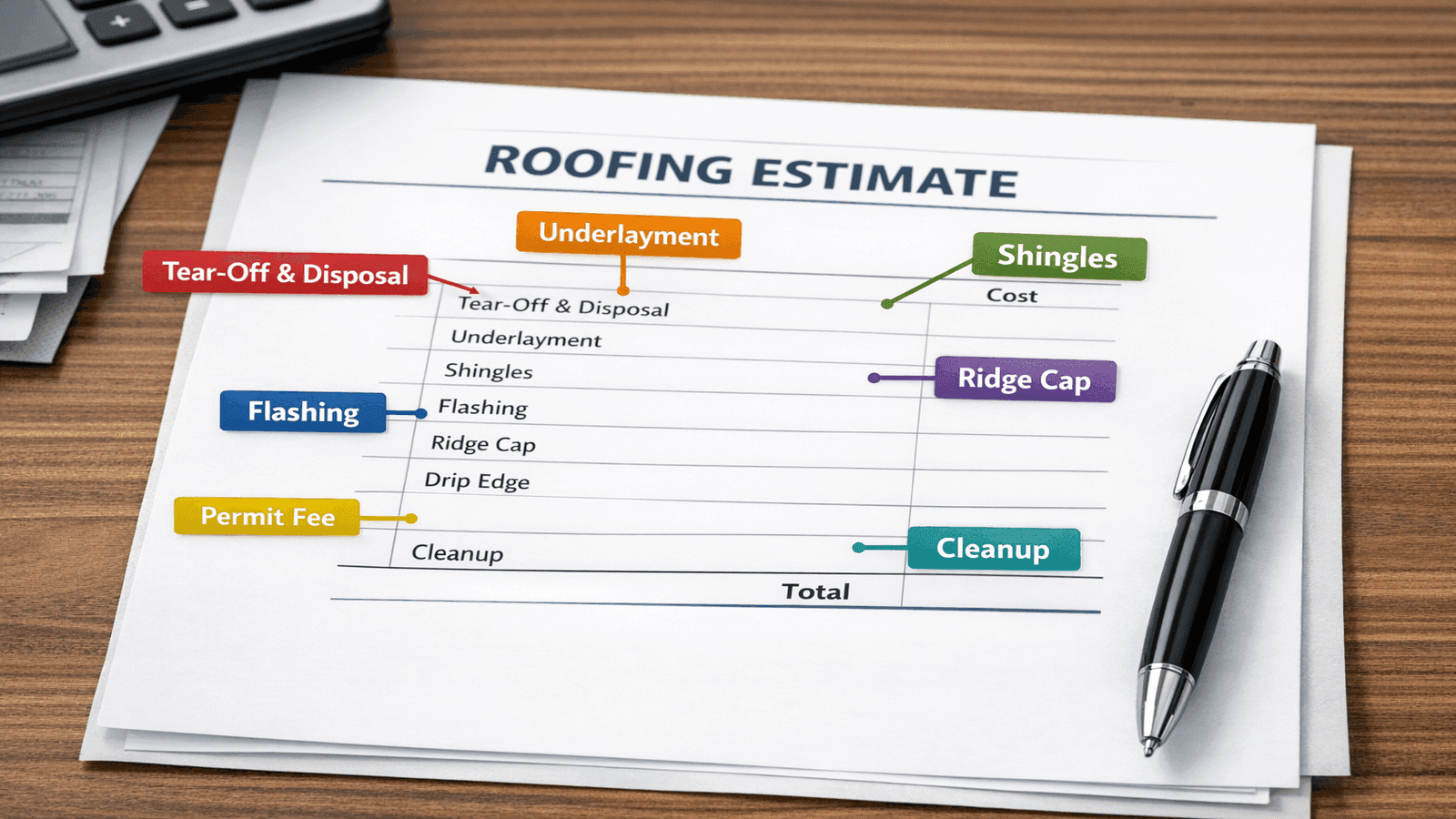
Photo: Itemized roofing replacement quote with line items labeled: tear-off, underlayment, shingles, flashing, ridge cap, drip edge, permit, and disposal
Labor Costs by Region
Labor is the largest single variable in any roofing quote. The same 22-square architectural shingle job can cost $4,500 in labor in central Tennessee and $9,000 in labor in San Francisco, not because either contractor is gouging, but because their overhead, wage market, and insurance costs are fundamentally different. Fixr.com reports that labor accounts for 40-60% of total roof replacement cost in 2026 [1].
Regional Labor Cost Breakdown (2026)
| Region | Avg Labor Cost/Sq Ft | Total Labor (2,000 sq ft home) | Notes |
| Southeast | $2.50-$4.00 | $5,500-$9,000 | Lower cost of living; competitive market |
| Midwest | $2.50-$4.00 | $5,500-$9,000 | Seasonal demand spikes after storm events |
| Northeast | $3.50-$5.50 | $7,700-$12,000 | Union labor markets; higher overhead |
| West Coast | $4.00-$7.00 | $8,800-$15,400 | California seismic requirements; high wages |
| Gulf Coast | $3.00-$5.00 | $6,600-$11,000 | Hurricane-prone demand; insurance scrutiny |
NearbyHunt network insight: Across roofing contractors in the NearbyHunt network, labor rate variation between the lowest- and highest-cost regions exceeds 60% for identical projects. Homeowners in the Southeast and Midwest consistently see the lowest total replacement costs. Contractors in storm-impacted markets (Gulf Coast, tornado corridor) often see labor rates rise 15-25% in the weeks following a major weather event as demand surges and traveling crews enter the local market at premium rates.
Additional Cost Factors
Several line items affect final project cost that do not appear in the base square footage calculation.
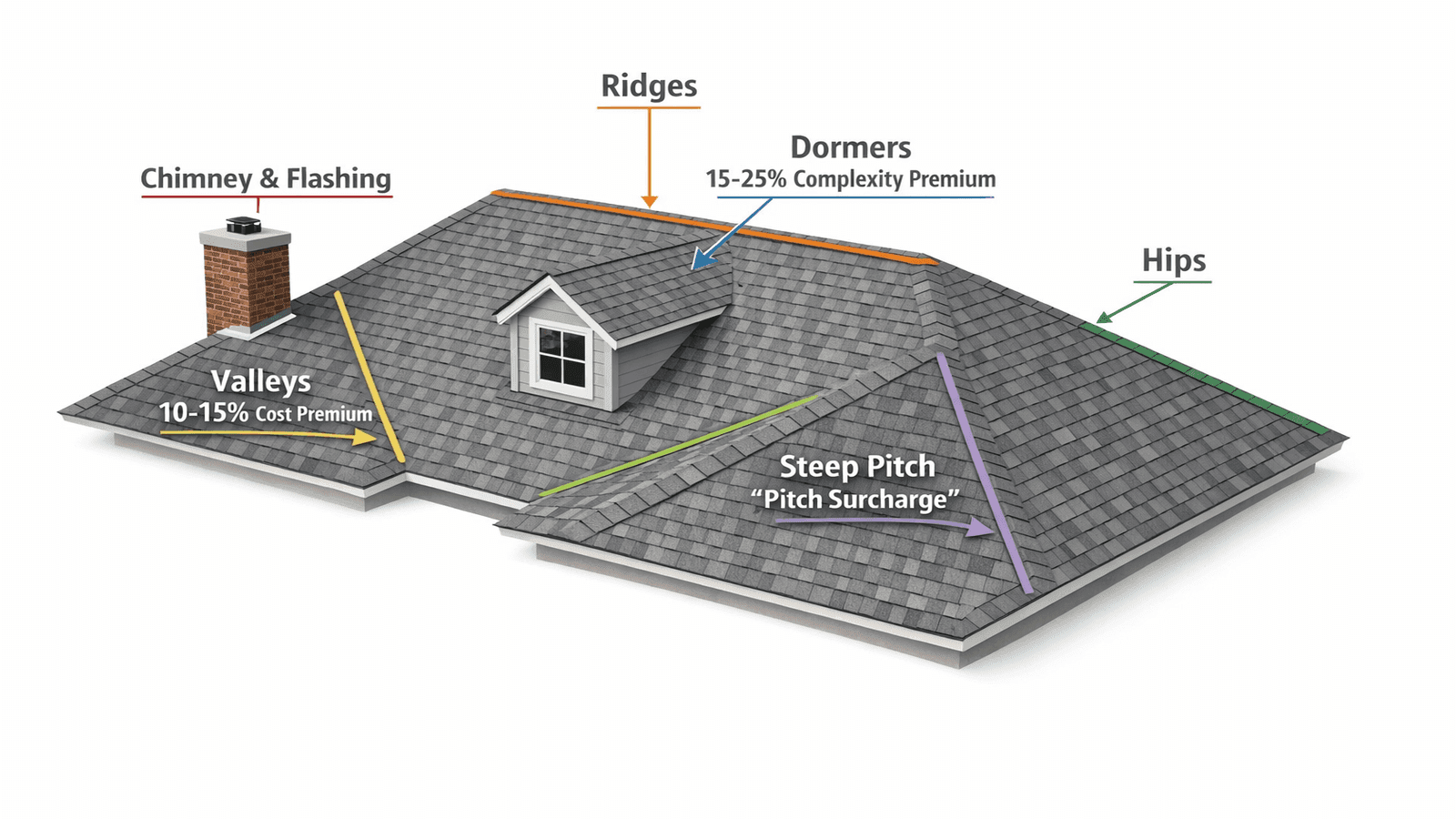
Roof pitch surcharge: Steep roofs with a pitch of 8:12 or greater require additional safety equipment, slower installation pace, and greater physical risk for crews. Expect to pay a premium of $1.00-$2.00 per square foot on steeper roofs [2].
Roof complexity: Simple gable roofs with one or two planes are the fastest to install. Each additional hip, valley, dormer, or penetration adds labor time. Complex roofs typically cost 15-25% more in labor than a simple gable of identical square footage.
Decking replacement: Rotted, soft, or damaged OSB or plywood sheathing cannot support new shingles and must be replaced before installation proceeds. Decking damage is often invisible until tear-off begins. Replacement runs $2.00-$3.00 per square foot for materials and labor, and a full decking replacement on a 2,000 sq ft home adds $4,400-$6,600 to your project cost [2].
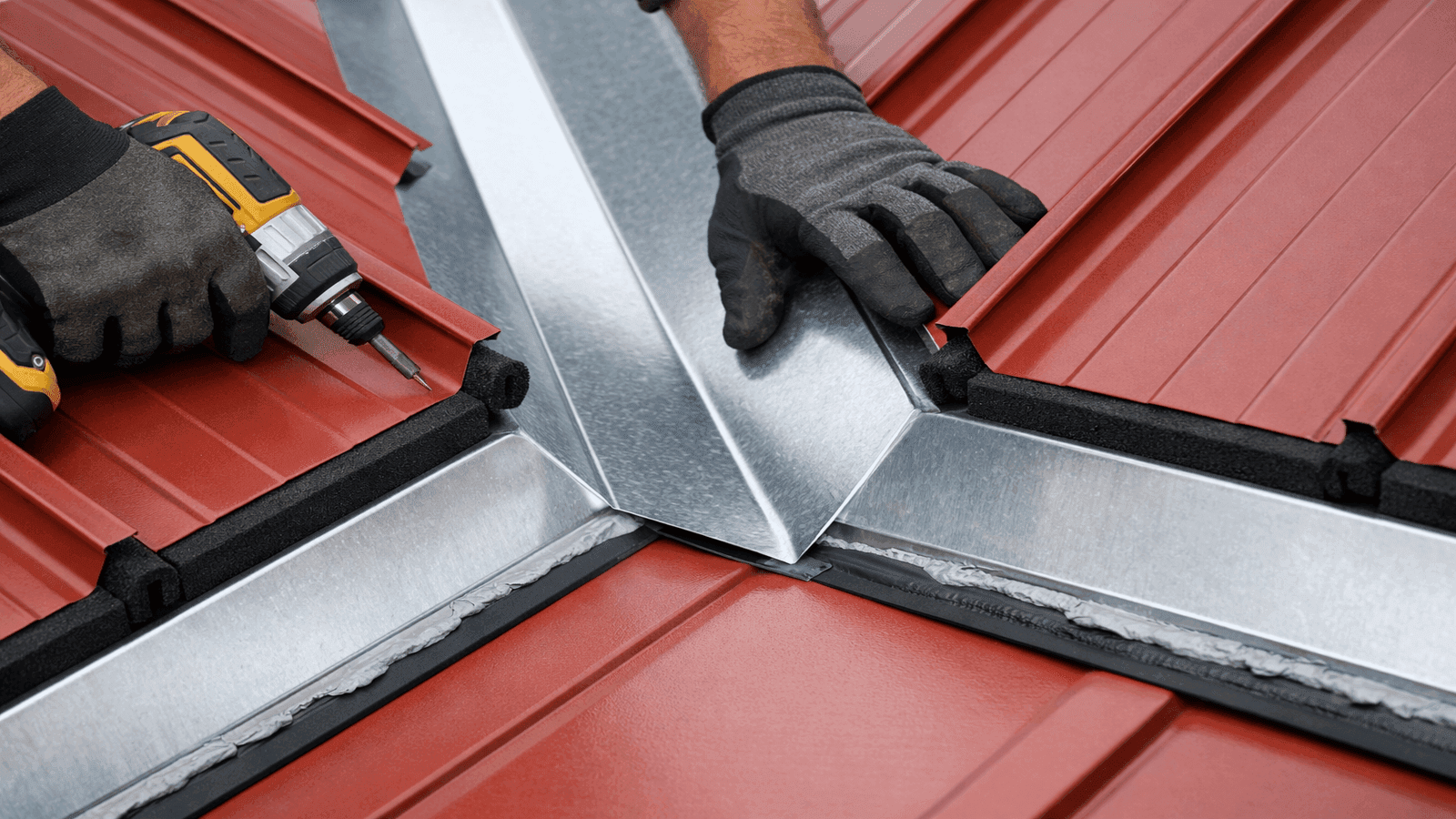
Chimney flashing: A basic chimney re-flash using the existing counter-flashing costs $200-$400. A full step-flash and counter-flash rebuild on an older chimney runs $400-$600 or more. Some older homes require caulk-only repairs that will not pass inspection; verify your contractor is using proper stepped metal flashing.
Skylight re-flashing: Each skylight requires re-flashing at tear-off time. Budget $300-$700 per skylight for re-flashing alone. If the skylight frame is damaged or the unit is more than 15 years old, replacement during the roofing project saves money on future re-entry labor.
Satellite dish removal and reinstall: Small dish: $50-$100 to remove and set aside. If the dish must be re-mounted to the new roof, plan for $100-$200 plus new lag bolt penetrations sealed by the roofer. Streaming alternatives have made this cost less common, but it remains a real change-order line item on older homes.
At tear-off, the most common hidden cost I find is decking. On homes built before 1990, roughly 40% of the jobs I price have at least some decking that fails the nail-through test once I pull the shingles. I always include a per-sheet price for decking in my quotes so homeowners are not blindsided. If a contractor does not include a per-sheet decking price in their written quote, ask specifically what they charge per sheet and get it in writing before signing anything. A change order for decking after demo has started is not the time to negotiate.
Get quotes from top-rated pros.
When to Replace vs. Repair
Not every roofing problem requires full replacement. The decision depends on the age of your current roof, the nature and extent of the damage, and the cost comparison between repair and replacement.
The 30% threshold: If the estimated repair cost exceeds 30% of the cost of a full replacement, replacement is almost always the better financial decision. You are spending significant money on a deteriorating system rather than resetting the clock with a new one.
Age as a deciding factor: Most asphalt shingle roofs carry a functional lifespan of 15-25 years. A roof over 15 years old that requires substantive repair -- not just replacing a few wind-lifted shingles -- is a strong candidate for replacement rather than repair. Insurance carriers increasingly limit coverage on roofs older than 15-20 years [4].
Signs that replacement is the right call:
- Multiple active leaks or recurring leaks after prior repairs
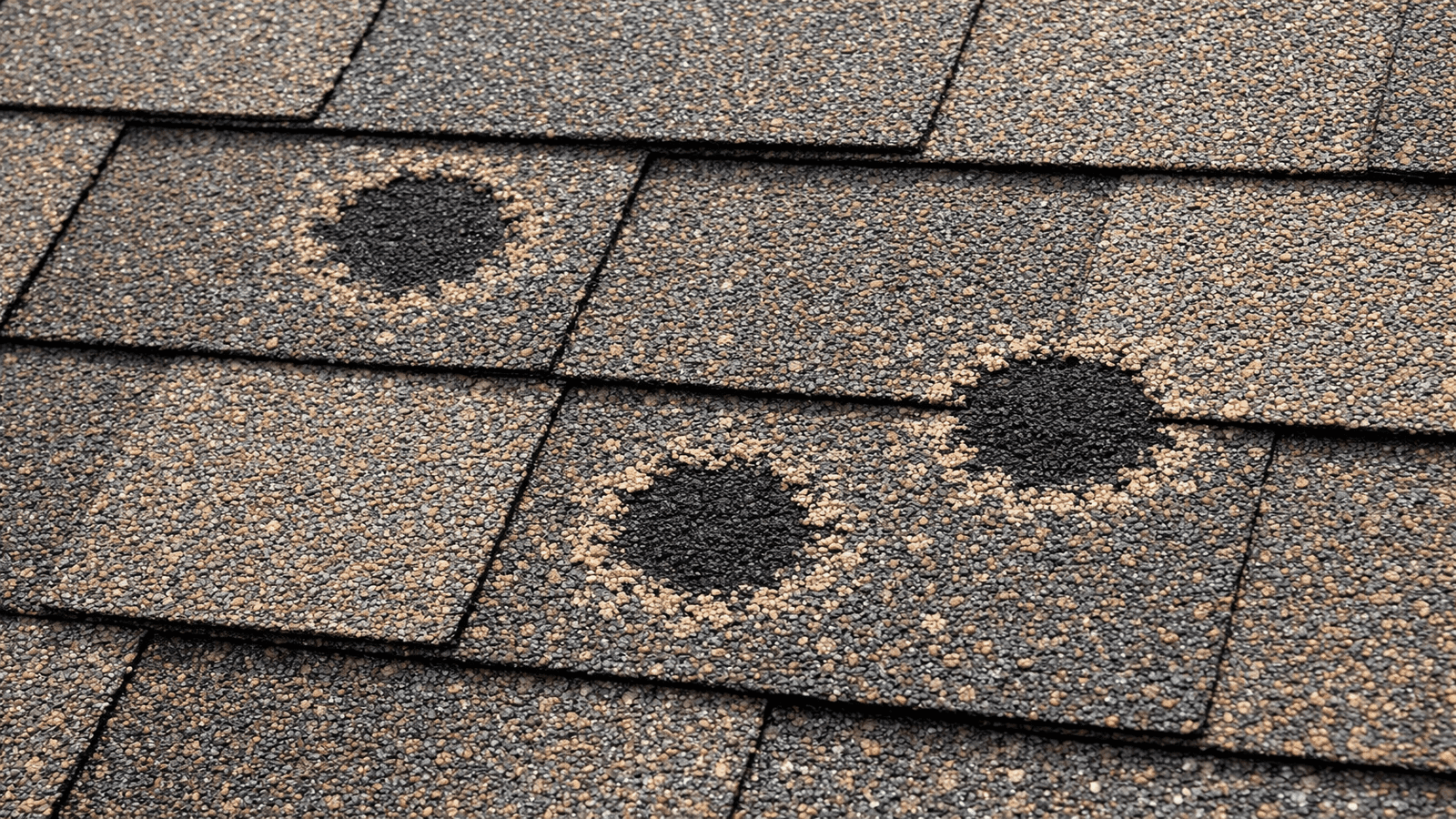
- Visible granule loss leaving bare, gray shingle substrate
- Widespread cracking, curling, or cupping across more than 30% of shingles
- Sagging between rafters indicating decking or structural failure below the shingles
- A roof older than 20 years that has never been replaced
Signs that repair can extend the roof's life:
- Isolated wind damage affecting fewer than 10-15 shingles
- A single area of flashing failure with no systemic shingle deterioration
- A roof under 10 years old with localized storm damage
- Insurance payout for hail or wind on a roof that is otherwise in good condition (see your carrier's actual-cash-value vs. replacement-cost policy language before deciding)
The insurance path deserves specific attention: if a hail or wind event is significant enough, your carrier may cover the full replacement cost minus your deductible. A Certified Storm Damage Specialist inspection -- the credential held by reviewer Jacob Hollis -- can document damage to a standard that satisfies most insurance carrier requirements and convert a potential out-of-pocket expense into an insurance claim.
How to Get the Best Price
The difference between an expensive roof and a fairly priced one is rarely the product -- it is the process of finding and evaluating contractors.
Get three quotes, minimum: Comparing three written quotes for an identical scope of work consistently reveals the local price range for your project. NearbyHunt data shows that homeowners who collect only one quote pay an average of $1,200-$2,500 more than those who collect three. The comparison also reveals which contractors are including scope that others are omitting.
Compare line by line, not total to total: A quote that is $2,000 lower may exclude tear-off disposal, permits, and drip edge. Verify that every quote covers the same scope before comparing the bottom line.
Time your project for late winter or early spring: Demand for roofing contractors peaks in summer and in the weeks after storm events. Late winter (January-March) and early spring (March-April) typically represent the slowest booking periods for most roofing companies. Contractors who are actively seeking projects are more likely to sharpen their pencils on price during these windows [4].
Ask about material-grade upgrades at cost: When a contractor is already ordering materials for your job, ask what the upcharge would be to move from 3-tab to architectural, or from standard architectural to a premium Class 4 impact-resistant shingle. The labor cost is identical; you are only paying the material difference. Some contractors will pass through the upgrade at their actual cost rather than their retail markup when asked directly.
Verify credentials before signing: Every roofer you consider should be able to provide (1) a current state contractor's license number, (2) a certificate of general liability insurance, (3) a workers' compensation certificate or a written exemption, and (4) at least two or three local references from jobs completed within the last 12 months. A contractor who cannot produce these immediately is a material risk.
The cheapest quote on a roofing job often costs the most in the end. I have followed behind contractors who used three-nail patterns instead of four on a shingle that specifies four nails -- it voids the manufacturer warranty and fails in the first significant wind event. I have fixed flash work that was caulk-only on a chimney that required metal step flashing by code. Price pressure creates shortcut pressure. When I review a quote that is 30% below my own for identical scope, I ask the homeowner to find out specifically what that contractor is paying per square for labor. In most cases, the answer reveals a crew being paid below the market rate -- which means inexperienced installers on your roof.

Photo: Homeowner seated at kitchen table reviewing three contractor proposal documents side by side, highlighting line items with a pen
Real-World Case Study: Linda K., Birmingham, Alabama
Linda K. owns a 2,100 sq ft home in Birmingham, Alabama. Her roof was 22 years old -- original 3-tab asphalt from when the house was built. After two consecutive spring storms caused minor leaks near the chimney and in one valley, she decided to get quotes on full replacement rather than continue patching a roof that had already exceeded its expected lifespan.
She received three written quotes within 10 days:
Quote 1: $9,800 -- local company, one crew, no itemization beyond "remove and replace roof, 22 squares, 3-tab." No permit line item. No mention of decking. Verbal assurance that "we take care of everything."
Quote 2: $12,400 -- regional roofing company. Itemized: tear-off ($1,760), synthetic underlayment ($440), architectural shingles ($5,940), flashing ($520), ridge cap ($390), drip edge ($280), permit ($175), disposal ($680), labor overhead ($2,215). Decking at $68/sheet if needed. Three-year workmanship warranty.
Quote 3: $15,200 -- national franchise. Premium shingle brand, full decking replacement included, 10-year workmanship warranty, financing available. Assigned project manager, daily photo updates.
James reviewed the quotes alongside Linda. Quote 1 raised two red flags: no permit line item (meaning either no permit would be pulled, which is a code violation, or the cost was buried without disclosure) and no decking contingency on a 22-year-old home (statistically, some decking replacement was almost certain). Quote 3 priced in a full decking replacement that the home may not have needed, adding $4,000-$5,000 in scope that should have been conditional.
Quote 2 represented the fairest pricing for the actual scope of work. Linda chose Quote 2, upgraded to architectural shingles for an additional $480, and had five sheets of decking replaced at $68/sheet during tear-off -- a $340 change order that was expected and already priced in writing. Final cost: $13,220. The permit was pulled, the job was inspected and passed, and the manufacturer warranty is valid because the contractor is a certified installer of that shingle brand.
Financing a Roof Replacement
A full roof replacement is rarely a planned purchase. When the decision must be made before savings are available, several financing paths exist:
Home equity loan: Uses your home as collateral. Rates in 2026 typically range from 6.5% to 9.5% APR for qualified borrowers. Fixed payments, fixed rate, and interest may be tax-deductible. Requires equity and a clean credit profile. Best option if you have equity and time to go through the approval process.
Home equity line of credit (HELOC): Variable rate, revolving credit against home equity. Useful if cost is uncertain (common with roofing, where decking damage can increase scope). Risk: variable rates can increase after draw period.
Personal loan (unsecured): No collateral required. Rates range from 8% to 18% APR depending on credit score and lender. Approval is faster than home equity products -- some lenders fund within 48 hours. Use only if home equity is unavailable or the loan term is short enough to limit interest accumulation.
Contractor financing: Many roofing companies partner with third-party financing providers. Convenient and fast, but interest rates frequently range from 15% to 24% APR on deferred-interest products. Read the promotional period terms carefully -- many deferred-interest offers become fully retroactive if the balance is not paid in full before the promotional period ends.
Insurance claim path: If the damage is weather-related, file a claim before agreeing to out-of-pocket financing. Hail, wind, and storm damage are covered under most standard homeowners policies. Review your policy for actual-cash-value (ACV) vs. replacement-cost-value (RCV) coverage -- RCV pays the full replacement cost; ACV pays current market value minus depreciation. A qualified storm damage specialist inspection documents damage in the format carriers require. For more on financing options and lender comparison, see our guide to roof financing options.
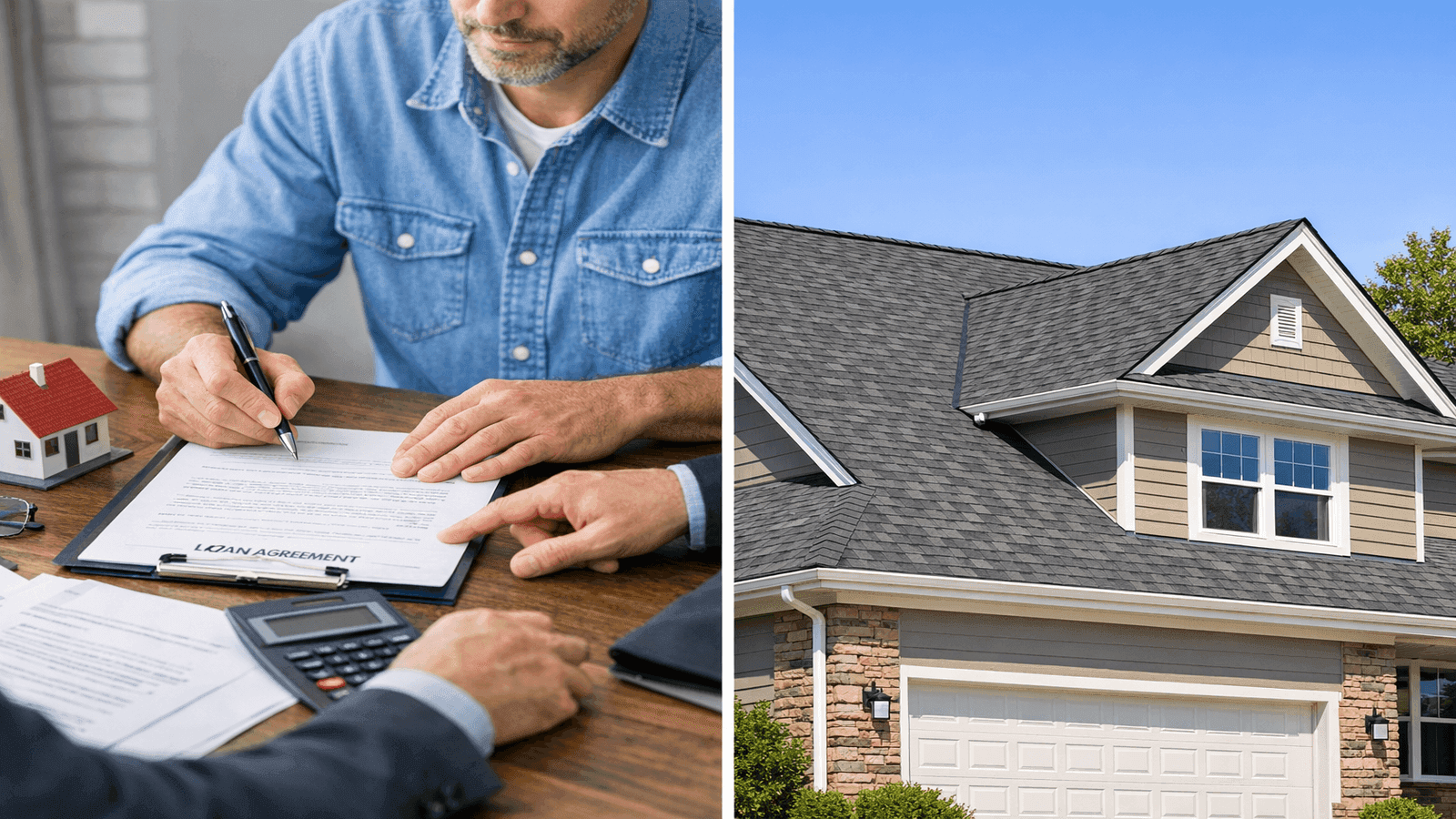
Photo: Split image: left side shows homeowner reviewing roof financing paperwork with a lender; right side shows completed new architectural shingle roof on the same home
Conclusion
Replacing a roof in 2026 costs most homeowners $8,000-$20,000 depending on home size, material selection, regional labor rates, and what is found at tear-off. The national average for a 2,000 sq ft home with architectural shingles lands near $12,000-$14,000 when all standard components are included. The single best move any homeowner can make before accepting a quote is collecting at least three written, itemized bids -- the comparison consistently reveals both the fair market price and the contractors who are hiding costs or cutting scope.
Architectural shingles remain the best value choice for most homeowners: the per-year cost over a 25-30 year lifespan is lower than 3-tab despite the higher upfront price. For homes in hail-prone regions, Class 4 impact-resistant options can offset their premium cost through insurance discounts within five years.
Understanding what drives the cost -- size, material, labor market, pitch, and hidden conditions like decking -- puts you in a position to evaluate any quote with confidence rather than accepting the first number you receive. Use the NearbyHunt contractor network to find licensed, insured roofing contractors in your area and request multiple quotes before committing.
Disclaimer: Cost figures in this article represent national ranges compiled from industry sources and are provided for general informational purposes only. Actual costs vary by geographic location, roof complexity, material availability, and local labor market conditions. Always obtain multiple written quotes from licensed and insured contractors before making any financial decisions related to roofing projects. NearbyHunt does not guarantee the accuracy of pricing and is not responsible for costs incurred based on estimates in this guide.
Sources & References
[1] Fixr.com, "How Much Does a Roof Replacement Cost in 2026?" https://www.fixr.com/costs/roof-replacement
[2] This Old House, "New Roof Cost Guide (2026)" https://www.thisoldhouse.com/roofing/new-roof-cost
[3] Fixr.com, "How Much Does an Asphalt Shingle Roof Cost in 2026?" https://www.fixr.com/costs/asphalt-roof-shingles-installation
[4] This Old House, "When Should You Replace Your Roof?" https://todayshomeowner.com/roofing/guides/when-to-replace-roof/
[5] Fixr.com, "How Much Does a Metal Roof Cost?" https://www.fixr.com/costs/metal-roofing-installation
[6] Bob Vila, "Metal Roof Cost Guide" https://www.bobvila.com/articles/metal-roof-cost/

James is a licensed roofing contractor with 20 years of experience in roof installation, inspection, and repair across the U.S. South and Midwest. He specialises in asphalt shingles, metal roofing, and storm damage restoration. On NearbyHunt, James offers practical advice on roof maintenance, insurance claims, and selecting the right materials for long-lasting protection.

Jacob is a licensed roofing contractor with over 18 years of experience in roof inspection, installation, and restoration. Based in Texas, he has led hundreds of successful roofing projects across residential and commercial properties. Jacob is also a certified storm damage specialist, ensuring that all NearbyHunt roofing content meets industry best practices and safety standards.