- Smart water heaters save $400–$600 per year on energy costs — tankless and heat pump systems pay for themselves in 3–5 years.
- Matte black and warm metallics (brushed gold, champagne bronze) are the two dominant fixture finish trends in 2026, replacing chrome and polished nickel across bathrooms and kitchens.
- Small bathrooms under 50 square feet can gain 30–40% more usable space with wall-mounted fixtures and floating vanities alone.
- Outdoor kitchen plumbing runs $1,500–$4,000 installed — positioning the kitchen close to the house supply line saves $500–$1,500 in material and trenching costs.
- ADA-compliant curbless showers, comfort-height toilets, and grab bar blocking add measurable resale value and future-proof any home for aging in place.
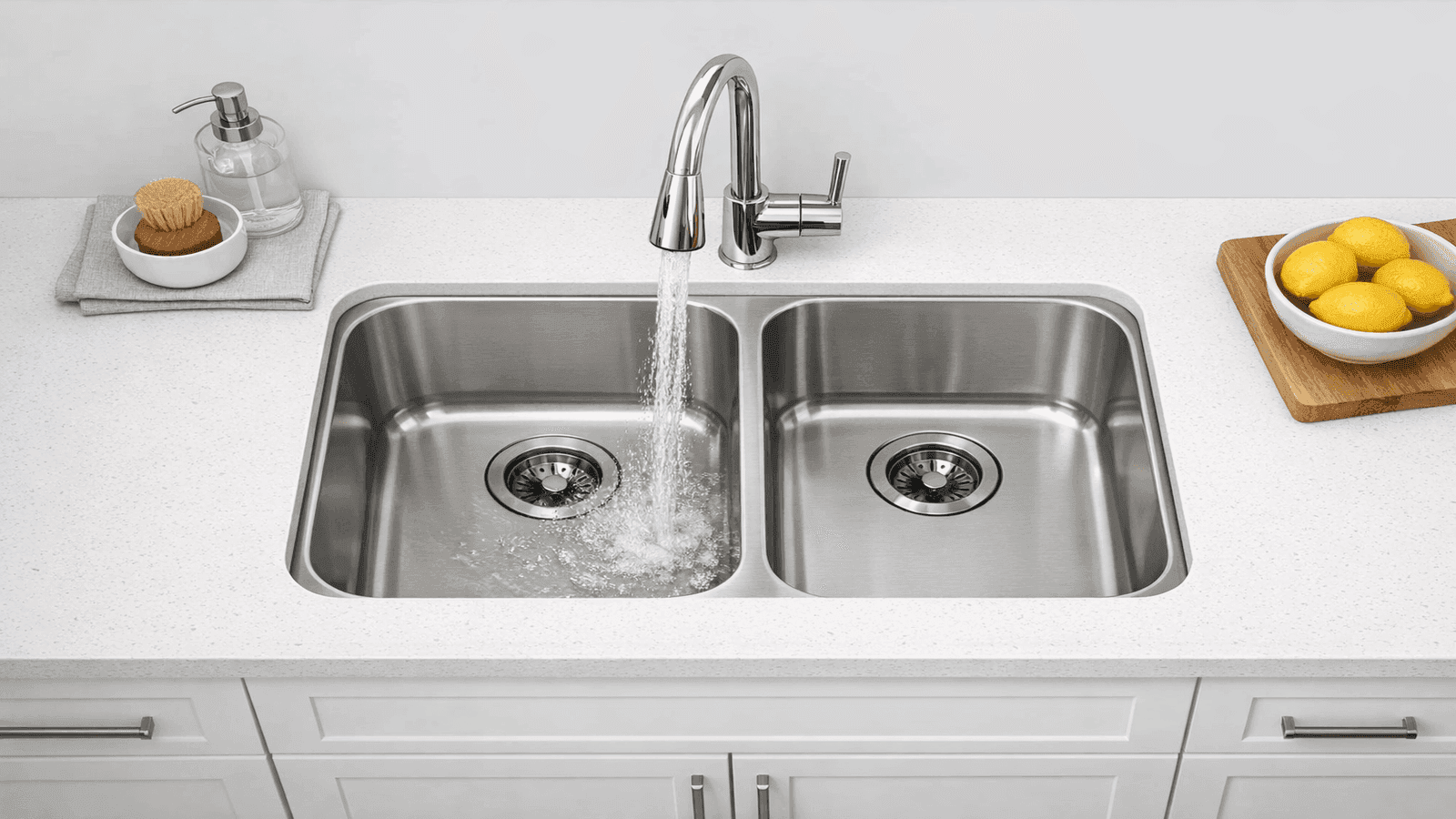
- Farmhouse apron sinks remain the #1 requested kitchen fixture upgrade, ranging from $300 to $1,500 depending on material and configuration.
Plumbing used to be the part of a home you hoped to never think about. That has changed. Homeowners today treat fixtures, finishes, and water technology as central design decisions, not afterthoughts. The right faucet sets the tone for an entire bathroom. The right water heater cuts a utility bill by hundreds of dollars a year. The right pipe layout makes a tiny bathroom feel twice as large. This guide covers every major area of plumbing design and inspiration, from modern bathroom trends to outdoor kitchens to accessible retrofits, so you can approach any project knowing exactly what is possible. For a deeper look at the installation side of any upgrade covered here, see our complete plumbing installation guide.

Get quotes from top-rated pros.
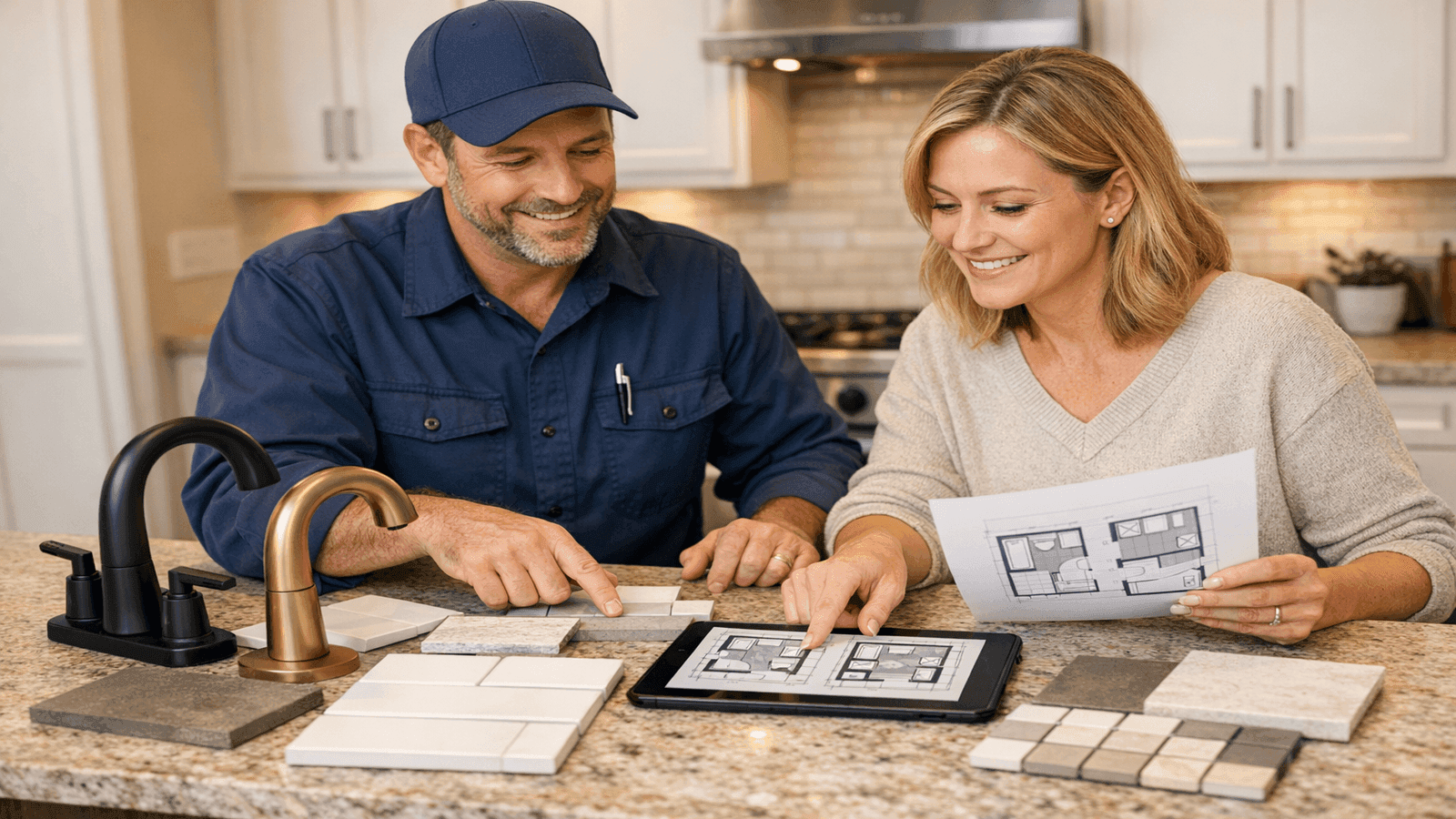
Photo: Licensed plumber and homeowner reviewing fixture samples and design plans at a kitchen counter, tile samples and faucet finishes spread out between them
Modern Bathroom Fixture Trends in 2026
The bathroom fixture market shifted decisively toward two finish families in 2025 and 2026: matte black and warm metallics such as brushed gold, champagne bronze, and brushed brass. Chrome and polished nickel have not disappeared, but they no longer lead new installation requests. The shift is partly aesthetic and partly practical. Matte black hides water spots and fingerprints far better than any polished finish, which matters in hard-water markets across Texas, Arizona, and the Southwest.
Warm metallics bring a sense of warmth that chrome never delivered. Brushed gold pairs naturally with white marble, warm wood tones, and the soft neutral palettes that dominate bathroom design right now. Champagne bronze sits between gold and brass, warm enough to feel rich without reading as dated. Both finishes hold up well to daily use when the PVD (physical vapor deposition) coating is properly applied by the manufacturer.
Beyond finishes, fixture form has changed significantly:
- Wall-mounted faucets are gaining ground in luxury remodels and modern master baths. They eliminate the deck plate, simplify cleaning, and allow more flexibility in vanity top material and design.
- Smart toilets with bidet seats, heated seats, and auto-flush are no longer specialty items. Mid-range smart toilet seats now retail for $300–$600, and full smart toilet units with integrated bidets start around $700.
- Rainfall showerheads (10 to 16 inches) paired with a handheld slide bar have become the standard expectation for primary bathroom shower upgrades, replacing the single fixed showerhead as the default.
- Furniture-style vanities with fluted fronts, integrated toe-kick lighting, and open lower shelves are replacing traditional box-style vanity cabinets in remodels above $15,000.
| Finish | Style Profile | Maintenance | Hard-Water Performance | Price Premium vs Chrome |
| Matte black | Modern, industrial, bold | Low (hides spots) | Excellent | +15–25% |
| Champagne bronze | Warm, transitional | Moderate | Good | +20–30% |
| Brushed gold | Luxury, warm modern | Low to moderate | Good | +25–40% |
| Brushed nickel | Classic, neutral | Moderate | Moderate | +5–15% |
| Polished chrome | Traditional, clean | High (shows spots) | Poor | Baseline |
Homeowners in Dallas and the surrounding DFW markets ask me about matte black constantly. My honest advice: it is the right choice if you have hard municipal water and do not want to polish your faucets every week. I have had clients in California coastal markets switch to champagne bronze for the same reason. The finish trend is also the practical trend right now.
For a full breakdown of fixture types by bathroom style and budget, see our guide to modern bathroom fixtures.
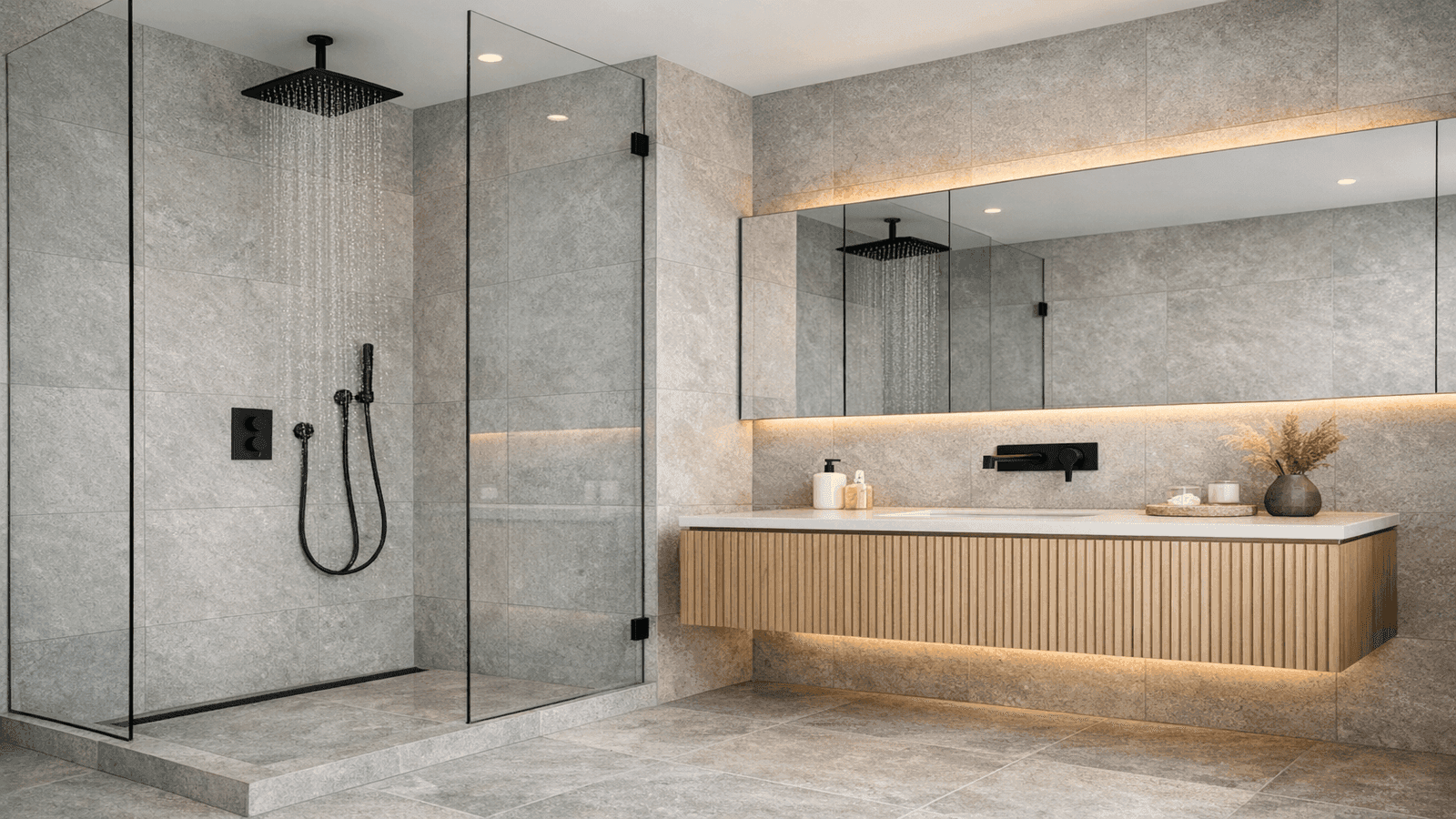
Photo: Modern primary bathroom with matte black rainfall showerhead, wall-mounted faucet, floating vanity with fluted wood fronts, and warm ambient lighting
Smart Plumbing
Smart plumbing technology has moved from novelty to mainstream in the last three years. The category is now broad enough that almost every homeowner, regardless of budget, can add at least one smart plumbing device that measurably reduces energy use, water waste, or damage risk.
Heat pump water heaters are the single most impactful upgrade available. They use 60% less electricity than conventional electric resistance water heaters [1] by pulling heat from ambient air rather than generating it directly. The federal government extended a 30% tax credit (up to $600) for qualifying heat pump water heater installations through 2032 under the Inflation Reduction Act. Many utilities also offer rebates of $200–$500 on top of that credit. For a homeowner replacing an aging electric tank heater, the net out-of-pocket cost after incentives frequently falls below $800 for a unit that will last 15–20 years.
Tankless water heaters (gas or electric) eliminate standby heat loss entirely. The U.S. Department of Energy estimates that tankless units save $400–$600 per year for average households compared to conventional storage tank heaters [2]. They also eliminate the risk of a catastrophic tank failure flooding a utility room.
Smart leak detection is the category where Michael sees the biggest gap between what technology can do and what homeowners actually have installed. Whole-home water monitoring devices (Flo by Moen, Phyn Plus, and similar) install on the main supply line, run microphone and pressure tests continuously, and can automatically shut off the water supply the moment they detect a leak signature. The devices cost $350–$700 installed, and most insurance carriers now offer policy discounts of 5–12% for homes with automatic leak shutoff.
The licensed plumbers in our NearbyHunt network report that over 65% of homeowners who upgrade to a heat pump water heater in California and Texas qualify for federal or state rebates that cover 30–50% of total installation cost [3]. Many are unaware of the rebates until their plumber mentions them at the estimate stage.
| Device | Installed Cost | Annual Savings | Payback Period |
| Heat pump water heater | $1,200–$2,500 | $300–$500 | 3–5 years |
| Tankless water heater (gas) | $1,000–$3,500 | $400–$600 | 3–6 years |
| Smart leak detector (whole-home) | $350–$700 | Insurance discount + damage prevention | 1–3 years |
| Hot water recirculation pump | $400–$900 installed | 8,000–15,000 gal/year water savings | 2–4 years |
| Smart irrigation controller | $150–$400 installed | $100–$300/year water bill | 1–3 years |
In my 2,400-plus residential projects across Dallas-Fort Worth and California over 18 years, the single most common regret I hear is not upgrading to tankless when the walls were already open during a renovation. The incremental cost at rough-in time is $600–$1,000 over a standard tank. After the walls are closed and finished, the same upgrade costs $3,000–$4,500. The math is obvious in hindsight.
Get quotes from top-rated pros.
For full installation details on tankless and heat pump units, see our water heater installation guide.
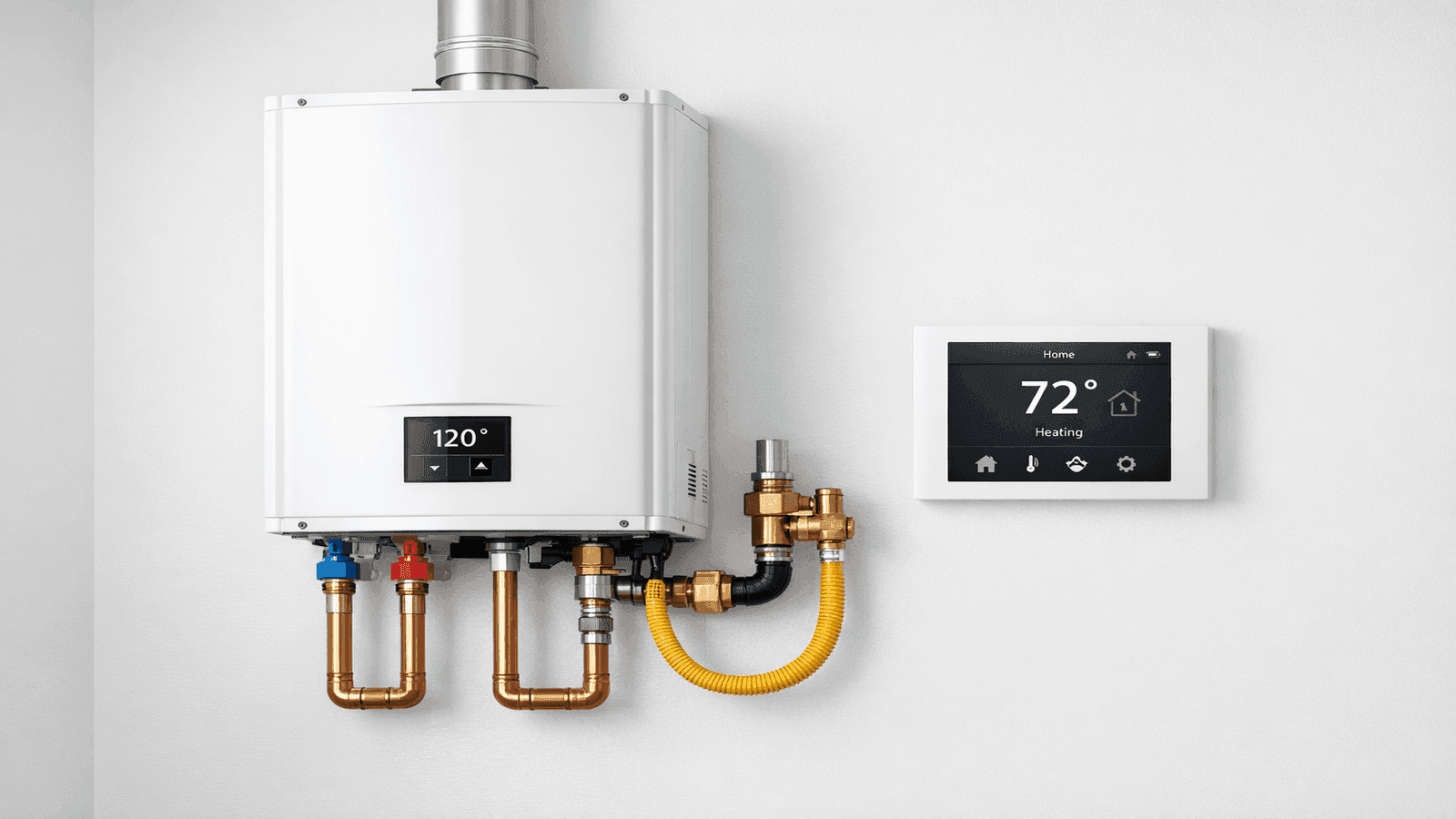
Photo: Modern tankless water heater mounted cleanly on a utility room wall beside a smart home control panel, copper supply connections visible
Kitchen Plumbing Design Ideas
Kitchen plumbing is about function first, but the decisions made at the sink and faucet level define the visual character of the entire kitchen. The trends in 2026 favor depth, utility, and finish coordination.
Sink selection has a bigger impact on kitchen workflow than almost any other fixture decision. Deep single-basin undermount sinks (9 to 10 inches deep, 30 to 33 inches wide) accommodate large pots and sheet pans without splashing, and the sliding accessory systems offered by manufacturers like Kohler, Franke, and Kraus transform the basin into a prep station. A built-in cutting board rail, colander, and drying rack can replace three square feet of counter space.
Fireclay farmhouse sinks have become the prestige pick for kitchen remodels. They are heavy (100–200 lbs), require cabinet reinforcement during installation, and cost $400–$1,200 for the sink alone, but their durability and visual impact justify the investment in kitchens where the sink is a design focal point.
Faucet trends mirror bathroom shifts: warm metallic finishes (brushed gold, champagne bronze, matte black) are replacing polished chrome as the dominant choice. Touchless faucets have moved from commercial kitchens into residential as the default choice in new construction. Pull-down spray heads dominate over pull-out designs because the spray head returns to its dock more reliably.
Dedicated filtered cold water taps and instant hot water dispensers alongside the main faucet are now requested on roughly one in three kitchen remodels in the markets where Michael works. They eliminate the need for a countertop water filter or an electric kettle and add $400–$800 to the plumbing cost.
The most common kitchen plumbing mistake I see is mismatching sink size to cabinet size. A 33-inch undermount sink in a 36-inch base cabinet leaves almost no counter lip on either side. The sink takes over the work zone. I always ask to see the cabinet run before we spec the sink. A 30-inch basin in a 36-inch cabinet gives you usable counter on one side and a proper reveal on the other.
For full kitchen sink installation guidance, see our kitchen sink installation guide.
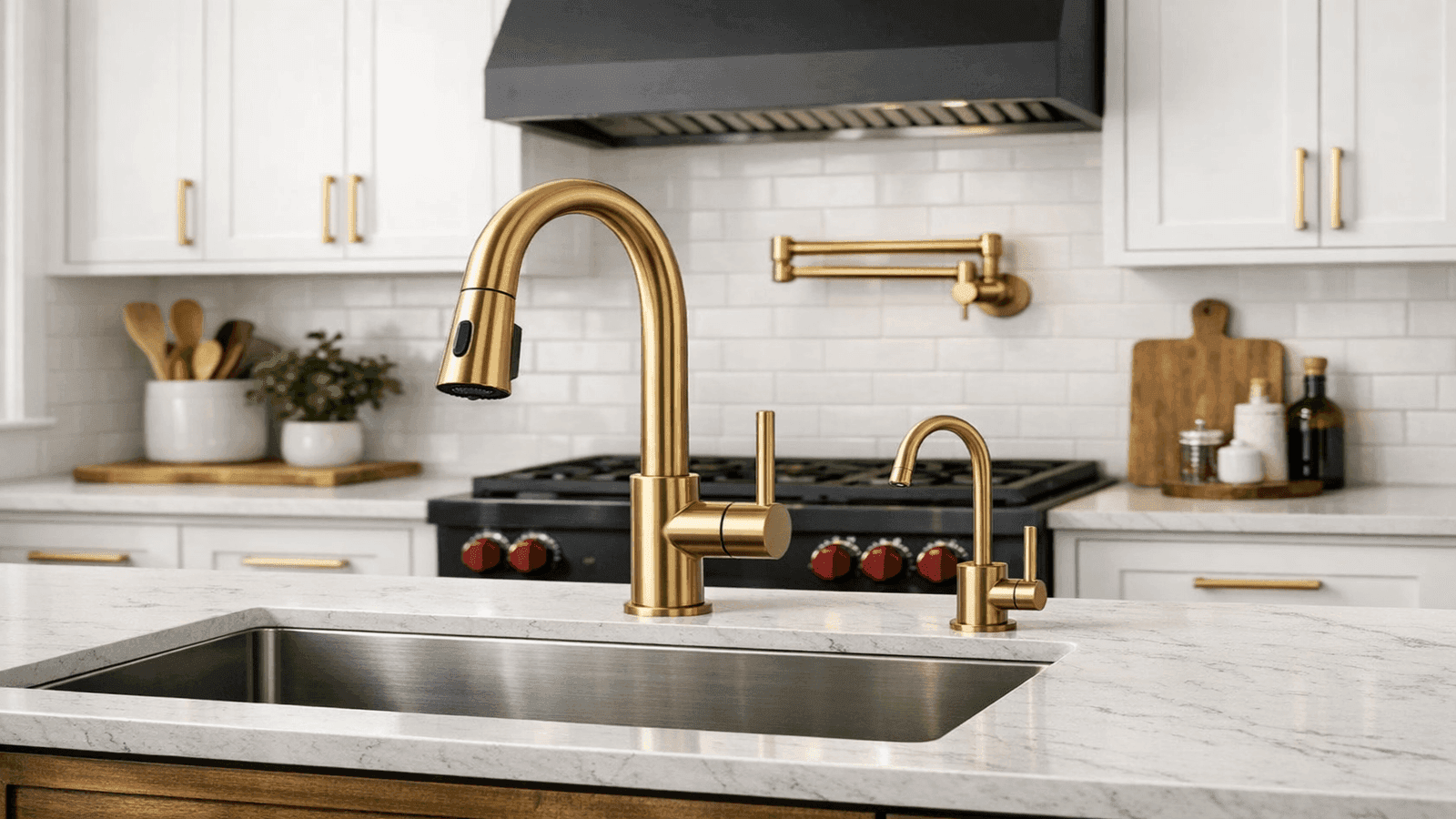
Photo: Modern kitchen with a deep single-basin undermount stainless sink, brushed gold touchless pull-down faucet, dedicated filtered water tap, and pot filler above the range
Small Bathroom Plumbing
Bathrooms under 50 square feet present a genuine engineering challenge: you need a toilet, a sink, and either a tub or shower in a space the size of a walk-in closet. The plumbing decisions made at rough-in determine whether the finished bathroom feels cramped or surprisingly functional.
Wall-mounted (wall-hung) toilets are the single most impactful upgrade in a small bathroom. The concealed tank sits inside the wall cavity, and the bowl projects out from the wall on a carrier frame. The result is 6–10 inches of visible floor space that a floor-mounted toilet would occupy. That gap makes a 40-square-foot bathroom read significantly larger. Installed cost runs $800–$1,800 depending on carrier frame, toilet model, and wall framing required.
Floating vanities achieve the same visual effect: floor-to-wall visibility expands the perceived size of the room. They require in-wall blocking at the correct height during rough-in (typically 32–34 inches to counter surface). A small floating vanity with a rectangular undermount basin and a single-hole faucet can fit in 18 inches of wall width, which is impossible with any pedestal or cabinet vanity.
Corner sinks solve the problem of bathrooms where two walls meet at the sink location and neither gives enough clearance for a standard vanity. A properly specified corner sink occupies 18–22 inches on each adjacent wall, leaving the center of the room completely open.
For shower design in tight spaces, a curbless walk-in shower with a fixed glass panel outperforms a tub-shower combo in bathrooms under 45 square feet. The continuous tile floor reads as one uninterrupted surface, which expands the room visually. The glass panel lets light pass through rather than stopping it.
I get calls from homeowners who bought a wall-mounted toilet before calling me. The toilet is right; the wall is not. A wall-hung carrier frame needs a minimum 4-inch stud-to-stud cavity. Many older homes have 3.5-inch framing. Retrofitting the wall to accept the carrier adds $400–$800 to the job. Always confirm wall depth before you purchase the fixture.
For a complete guide to maximizing small bathroom layouts, see our small bathroom plumbing guide.
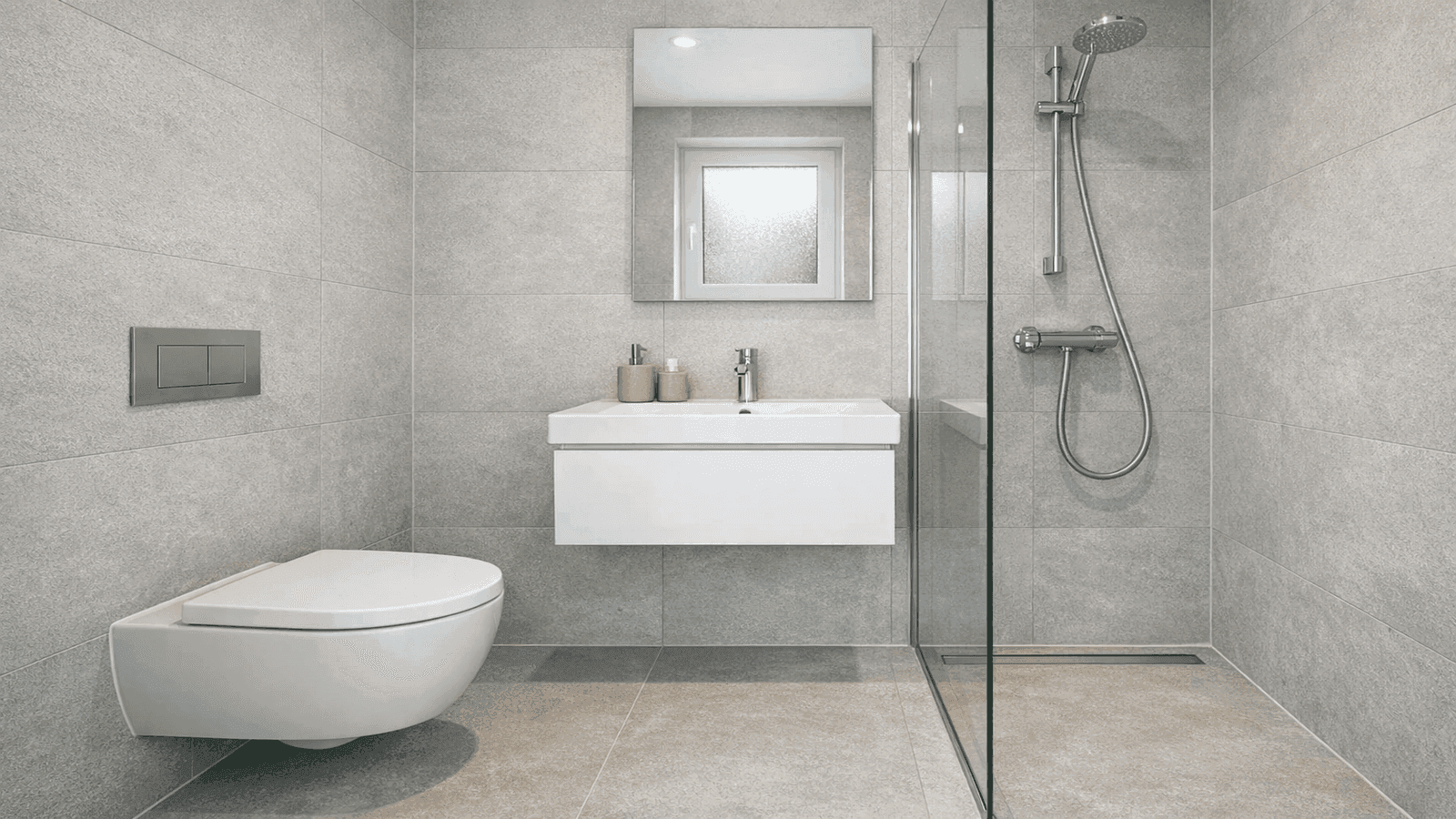
Photo: Compact modern bathroom with wall-hung toilet, single-basin floating vanity, frameless glass curbless walk-in shower, and large-format light gray tile on floor and walls
Outdoor Plumbing: Kitchens, Gardens, and Pools
Outdoor plumbing has graduated from a garden hose bib and a pool fill line to a fully functional category that includes outdoor kitchen sinks, wet bars, outdoor showers, irrigation systems, and water features. The planning decisions made before a shovel goes in the ground determine whether the system works reliably for 20 years or causes problems every winter.
Outdoor kitchen supply lines can be sourced two ways: a T-valve tap off an existing exterior hose bib, or a dedicated MDPE (medium-density polyethylene) line trenched from the house to the outdoor kitchen location. The T-valve approach costs $200–$500 and works for low-demand setups. The dedicated line costs $1,000–$2,500 for the trenching and connections, but it delivers full pressure independently and allows a properly located frost-proof shutoff. For any outdoor kitchen more than 25 feet from the house, a dedicated line is the only practical option [4].
Drainage is where outdoor kitchen plumbing most often fails. Light rinse water can drain into a bubble-pot system: a 4-inch PVC drain line running to a 12x12 gravel-filled basin that disperses gray water into the surrounding soil. For a full-service outdoor kitchen with a garbage disposal or heavy food-prep drainage, the line must connect to the main sewer. Most jurisdictions require a permit for any connection to the sanitary sewer system.
Outdoor showers are required to drain to grade or to an approved dry well in virtually every jurisdiction. Pool rinse showers commonly use a simple pop-up drain through a concrete pad to a subsurface gravel pit. More elaborate outdoor shower enclosures connected to a hot water line need their own shutoff and drain provision for winterization.
Get quotes from top-rated pros.
Real-World Case Study
James T. of Plano, Texas wanted a full outdoor kitchen 40 feet from his house. Two options were on the table: a T-valve tap off the existing hose bib ($380) versus a dedicated MDPE line to a frost-proof outdoor shutoff ($1,200). The T-valve would have left insufficient water pressure to run both the garden hose and the outdoor sink simultaneously during summer months. Michael installed the dedicated line with a frost-proof ball valve shutoff accessible from the utility room. Two winters later, the system has never frozen, and the outdoor kitchen runs at full pressure independent of any other outdoor fixtures. The homeowner said the $820 price difference was the best money spent on the entire project.
Every outdoor plumbing line in a freeze zone needs either a frost-proof shutoff or a drain provision, period. I see homeowners skip this on garden hose bibs, outdoor shower supply lines, and irrigation manifolds. A burst pipe in a finished outdoor kitchen wall costs $800–$1,500 in repairs. The frost-proof fitting costs $40.
For a complete outdoor plumbing planning guide, see outdoor plumbing ideas.
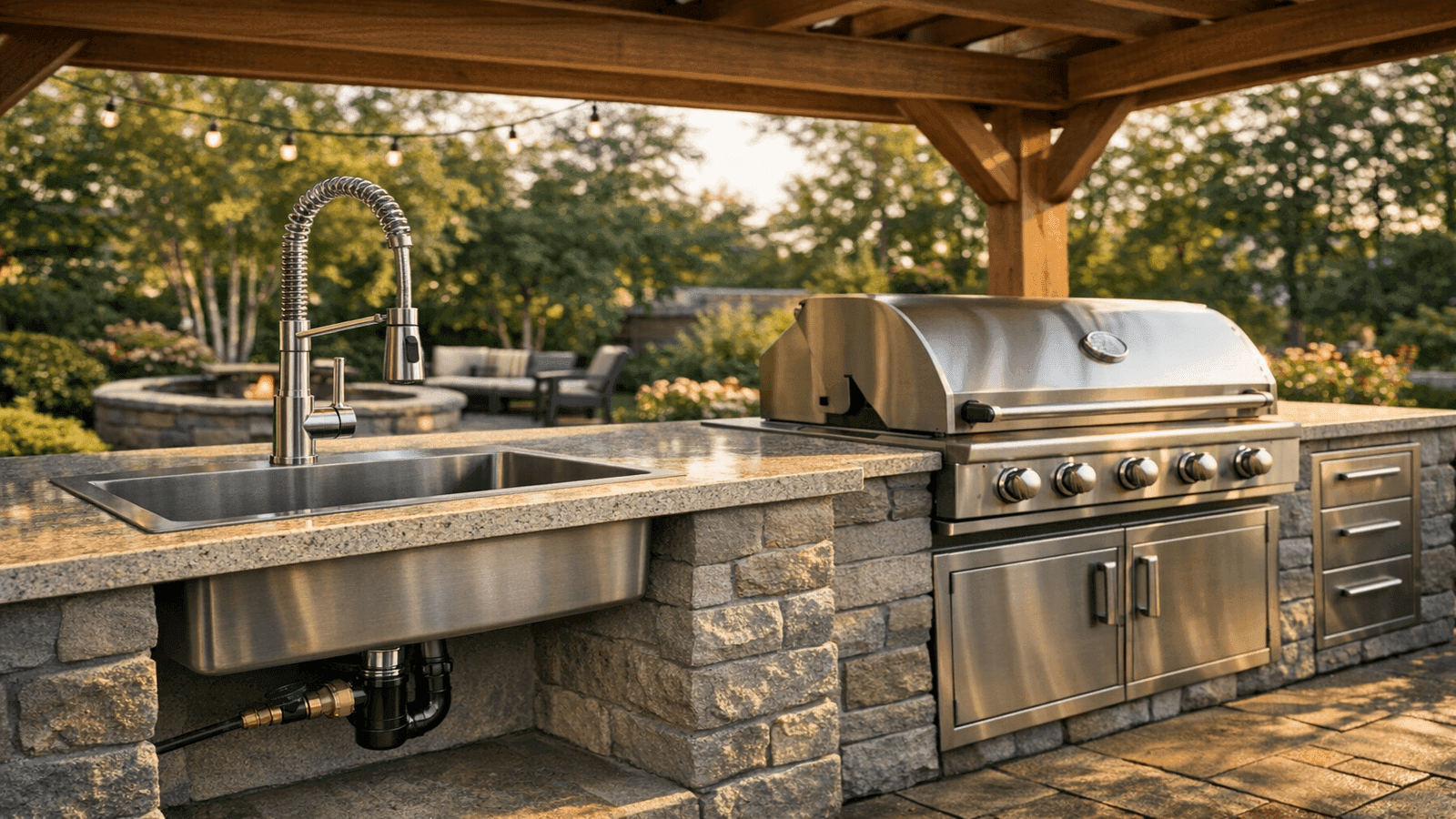
Photo: Covered outdoor kitchen with deep stainless sink, brushed steel pull-down faucet, dedicated supply shutoff visible at the base cabinet, and a landscaped backyard beyond
Universal Design: Plumbing for Every Ability
Universal design is the practice of designing spaces that work for people of all ages and ability levels without requiring specialized equipment. In plumbing, it means fixtures and layouts that serve an 8-year-old, a 78-year-old, and anyone with mobility limitations equally well. The demand for universal design plumbing has grown steadily as the population ages: the U.S. Census Bureau projects that adults over 65 will make up 22% of the U.S. population by 2040.
Grab bars are the most commonly requested accessibility upgrade. The ADA specifies horizontal grab bar placement 33–36 inches above the floor beside the toilet and 36-inch diagonal bar placement in the shower. The critical planning step is installing in-wall blocking during rough-in: a horizontal 2x8 backer board between studs at the correct height. The blocking costs $50 in materials and 30 minutes of labor during framing. Retrofitting blocking after tile is set requires opening the wall, adding $400–$800 to the project.
Comfort-height toilets (16–18 inches seat height versus the standard 14–15 inches) are ADA-compliant and significantly easier for adults with knee or hip issues. They install identically to standard-height toilets. See our toilet installation guide for complete replacement instructions.
Curbless showers eliminate the step-over threshold that causes most bathroom falls. A properly sloped curbless shower floor (minimum 1/4-inch per foot slope to the drain) works identically to a curbed shower for ambulatory users and accommodates a wheelchair or shower chair for users with mobility needs. The installation cost for a curbless tile shower runs $2,500–$6,000 depending on tile selection and waterproofing method.
Lever-style faucet handles replace round knobs across the bathroom and kitchen. They require no grip or twist, which matters for users with arthritis or reduced hand strength. The cost difference versus knob-style is typically $0–$50; most modern faucets now come with lever handles as standard.
I recommend blocking for grab bars in every new bathroom rough-in, regardless of the homeowner's age. It costs almost nothing at framing stage and it is there if they ever need it. I have had homeowners call me three years after a bathroom remodel asking to add grab bars because a parent moved in. Opening finished tile work to add blocking is always a painful conversation.
For a complete accessible bathroom planning resource, see our universal design plumbing guide.
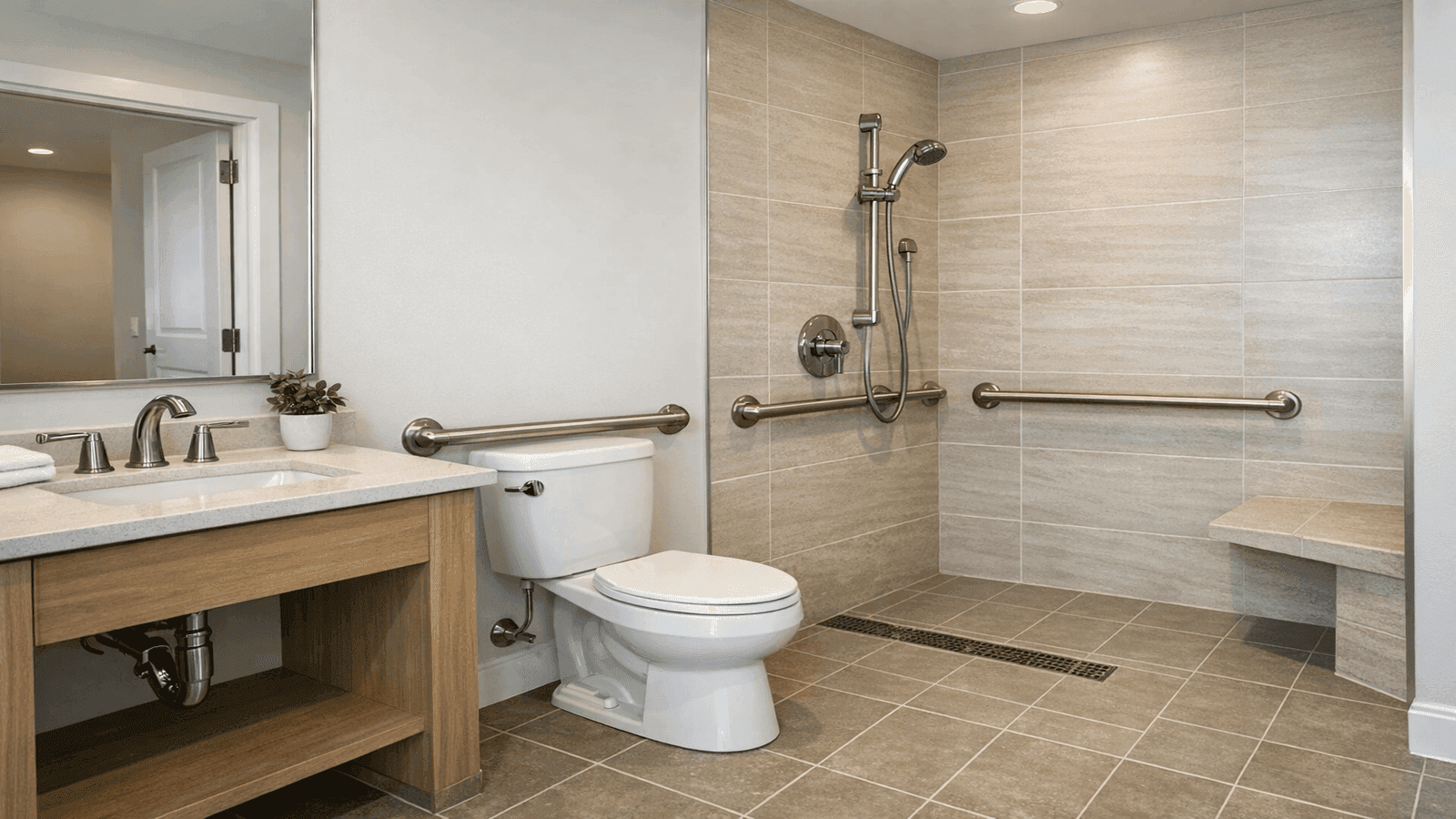
Photo: Accessible curbless tiled shower with grab bars, comfort-height toilet, lever-style faucet handles, and clean modern design in a light neutral palette
Farmhouse and Rustic Bathroom Style
The farmhouse bathroom trend has held its ground for nearly a decade because it delivers something genuinely different from the minimalist aesthetic that dominates new construction: warmth, texture, and a sense that the room was designed by a person rather than a specification sheet.
The defining plumbing element of the farmhouse bathroom is the apron-front (farmhouse) sink, either in fireclay, cast iron, or stainless. Fireclay is the authentic material: fired at over 1,800 degrees Fahrenheit, it produces a dense, chip-resistant surface with a slightly irregular glaze that cannot be replicated by stamped steel. Prices run $400–$900 for 30-inch single-basin models. Cast iron with porcelain enamel coating gives a similar look at $500–$1,200 and adds significant weight (180–220 lbs), requiring reinforced cabinet support.
Clawfoot tubs are the second signature element. A standard cast-iron clawfoot weighs 200–300 lbs empty. Filled with water and a person, the total load on the floor can reach 800–900 lbs concentrated on four small claw feet. Standard residential floor joists are designed for 40 lbs per square foot of distributed load. Before any clawfoot tub purchase, a structural assessment of the floor framing is non-negotiable [5].
Fixture and finish choices for the farmhouse style:
- Cross-handle faucets in oil-rubbed bronze, matte black, or antique brass
- Bridge faucets for farmhouse sinks (both hot and cold supply enter through a single bridge unit)
- Exposed supply lines with properly wrapped insulation in any unconditioned space
- Skirted or two-piece elongated toilets with chrome or antique brass trip levers
Get quotes from top-rated pros.
I have had two clawfoot tub installations where the homeowner bought the tub before we assessed the floor. In both cases, the joists needed sistering before the tub could go in. That is an extra $600–$1,200 in framing work that would not have been necessary if we had talked first. Buy the tub after the floor is confirmed, not before.
For a complete guide to farmhouse bathroom fixtures and installation, see farmhouse bathroom ideas.
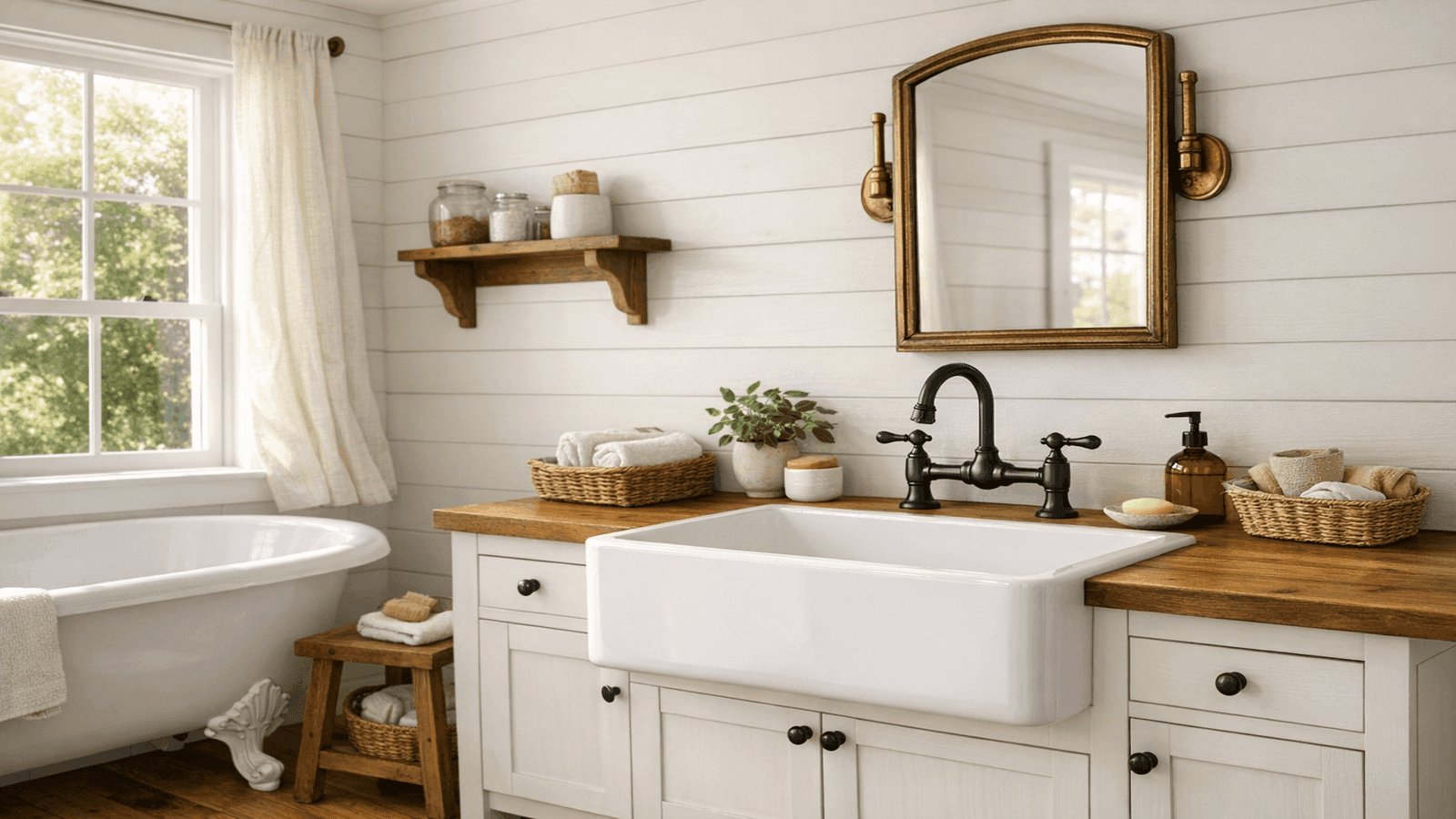
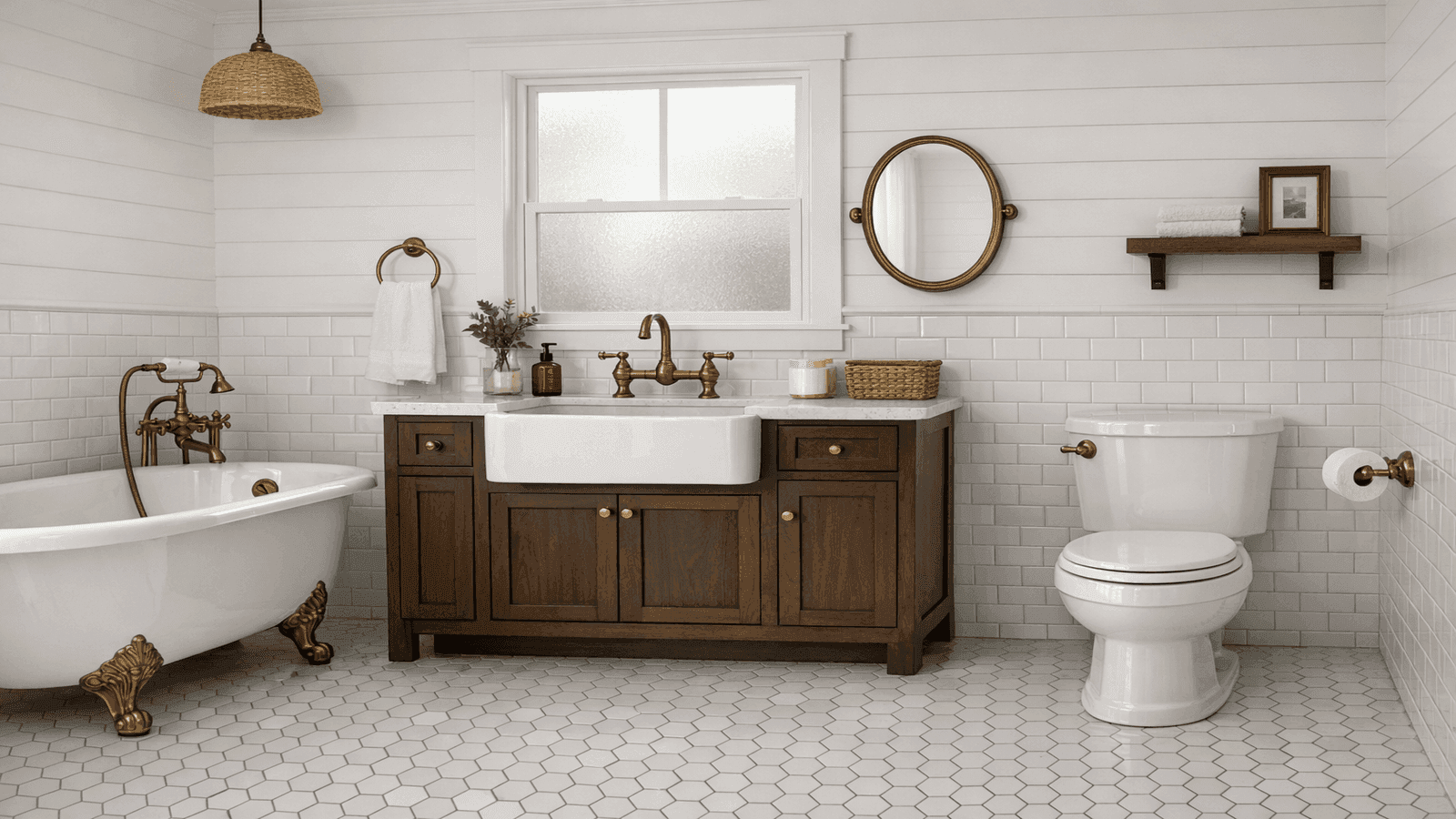
Photo: Farmhouse bathroom with white fireclay apron-front sink, bridge faucet in oil-rubbed bronze, clawfoot tub, shiplap wall, and warm wood floor
Eco-Friendly Plumbing and Water Conservation
Water conservation has shifted from a voluntary preference to a financial necessity in many U.S. markets. Average residential water and sewer bills have increased 41% over the last decade according to the U.S. Circle of Blue Water Price Index. The good news is that the most effective water-saving upgrades also cost the least to install.
WaterSense-labeled fixtures are the starting point. WaterSense toilets use 1.28 gallons per flush versus 3.5 gallons in pre-1994 toilets, a 64% reduction per flush [6]. WaterSense faucets cap at 1.5 GPM versus 2.2 GPM standard. WaterSense showerheads deliver 2.0 GPM versus 2.5 GPM. A household replacing all fixtures with WaterSense equivalents typically saves 20–30% on total indoor water use.
Hot water recirculation pumps address a different kind of waste: the water that runs down the drain while waiting for the hot water to arrive. In homes where the water heater is far from the bathroom or kitchen, this wait can consume 2–4 minutes and 3–5 gallons per use. A demand-controlled recirculation pump (activated by a push button or motion sensor) maintains hot water within the supply line during occupied hours, eliminating that wait entirely. Installed cost runs $400–$900; water savings range from 8,000 to 15,000 gallons per year depending on household size and usage patterns [7].
Greywater reuse is legal in most states for laundry-to-landscape applications (dishwasher and laundry water routed to subsurface garden irrigation). Basic gravity-fed systems cost $200–$800 in materials. Permitted systems with proper filtration and distribution run $1,500–$3,000 but may qualify for utility rebates in California, Arizona, and several Western states.
For a detailed look at eco-friendly plumbing upgrades and rebates, see our green plumbing solutions guide.
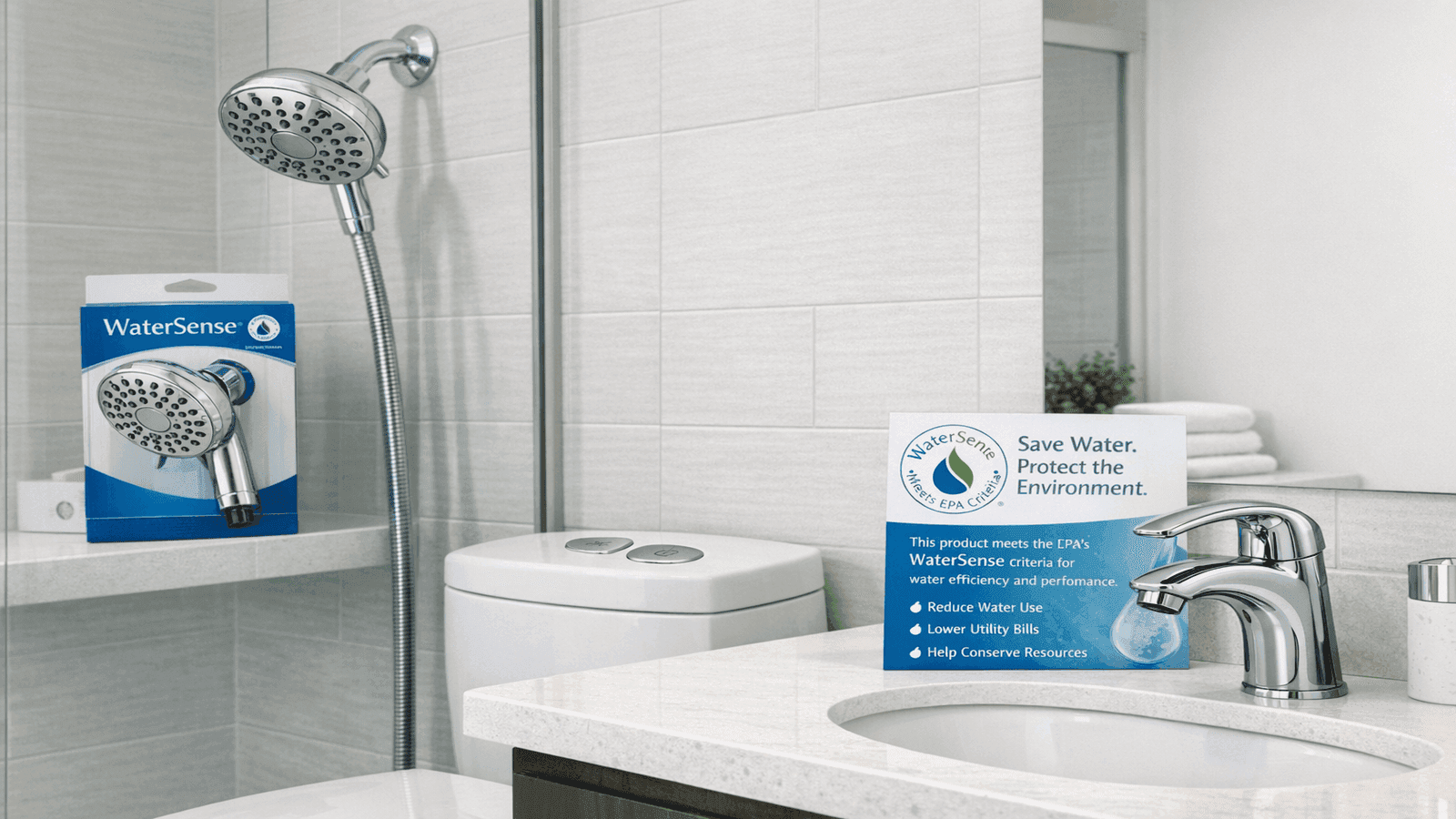
Photo: Modern bathroom with WaterSense-certified low-flow showerhead, dual-flush toilet, and water-efficient faucet; EPA WaterSense label visible on showerhead packaging nearby
What These Projects Actually Cost in 2026
Plumbing design projects span an enormous cost range depending on scope, location, and whether structural work is involved. The table below reflects national averages for 2026 [8].
| Project | DIY Cost | Professional Cost | Typical Timeframe |
| Faucet or showerhead swap | $50–$350 (parts) | $150–$450 | 1–4 hours |
| Wall-mounted toilet installation | Not recommended | $800–$1,800 | 1 day |
| Tankless water heater (gas) | $600–$1,200 (parts) | $1,000–$3,500 installed | 1 day |
| Heat pump water heater | $900–$1,600 (parts) | $1,200–$2,500 installed | 1 day |
| Outdoor kitchen plumbing | $200–$800 (T-valve) | $1,200–$4,000 (dedicated line) | 1–3 days |
| Curbless shower conversion | Not recommended | $2,500–$6,000 | 2–4 days |
| Farmhouse sink installation | $100–$300 (swap only) | $400–$900 | 2–6 hours |
| Whole-home leak detector | $200–$500 (parts) | $350–$700 installed | 2–4 hours |
| Hot water recirculation pump | $150–$350 (parts) | $400–$900 installed | 2–4 hours |
Labor rates vary significantly by region. California, New York, and the Pacific Northwest run 25–40% above national average [8]. Rural markets in the South and Midwest typically run 15–25% below. For a complete regional cost breakdown, see our plumbing costs guide.
Conclusion
Plumbing design in 2026 sits at the intersection of style, technology, and practicality. The finish you choose for a faucet determines how much time you spend cleaning it. The water heater you install this year determines your energy bill for the next 15 to 20 years. The grab bar blocking you add during a renovation now is the difference between a $50 project and a $600 wall repair later. Every decision covered in this guide has a cost implication, a design implication, and a long-term livability implication.
The five cluster guides linked throughout this article go deeper on each specific area: modern bathroom fixtures, small bathroom layouts, outdoor plumbing, accessible design, and farmhouse style. Start with the area most relevant to your current project and work outward from there. When any project moves beyond a simple fixture swap, a licensed plumber is the right partner to have involved from the planning stage.
Disclaimer: Cost figures are national averages for 2026 and vary significantly by region, project complexity, and contractor availability. Always obtain 2–3 written quotes from licensed plumbers before committing to any plumbing project. Permit requirements vary by jurisdiction; confirm with your local building department before beginning any work beyond simple fixture replacement.
Sources & References
- U.S. Department of Energy: Heat Pump Water Heaters
- U.S. Department of Energy: Tankless or Demand-Type Water Heaters
- ENERGY STAR: Federal Tax Credits for Energy Efficiency
- Forbes Home: Outdoor Kitchen Cost Guide 2026
- This Old House: Freestanding Tub Installation Guide
- U.S. EPA WaterSense: Toilets
- U.S. EPA WaterSense: Hot Water Recirculation
- Bob Vila: Plumbing Cost Guide 2026
- NAHB: Remodeling Cost vs Value Report 2026
- This Old House: Farmhouse Sink Buying Guide
- Bankrate: Home Improvement Cost Estimates 2026
- ServiceTitan: Plumbing Technology Trends 2026

Michael Jennings is a licensed master plumber & water systems specialist with over 18 years of hands-on experience in residential and commercial plumbing, serving clients across California and Texas. At NearbyHunt, he shares practical advice on pipe installations, water heater maintenance, and home plumbing upgrades. Michael has helped thousands of homeowners prevent costly water damage and improve water efficiency through modern plumbing solutions.

Robert is a licensed master plumber with over 20 years of experience serving both residential and commercial clients across the Midwest. Specialising in advanced plumbing systems and sustainable water technologies, Rob brings deep technical insight and hands-on expertise to every project. As a reviewer for NearbyHunt, he ensures all plumbing content reflects the highest standards of safety, compliance, and practicality.