- Fireclay apron-front sinks are fired at 1,800 degrees F, producing a glass-like, chip-resistant finish that outperforms standard ceramic — but fireclay weighs 80–120 lbs and requires a reinforced base cabinet that can handle the load.
- Cast iron apron sinks weigh 180–220 lbs, which requires cabinet reinforcement and two-person installation minimum; the porcelain enamel surface is repairable with touch-up kits if chipped.
- Clawfoot tubs weigh 200–300 lbs empty and 800–900 lbs filled — a standard residential floor rated at 40 lbs per square foot distributed load may not safely support the concentrated point load from four claw feet without sistering the floor joists.
- Bridge faucets define the farmhouse fixture style — both hot and cold supply lines connect through a single arched bridge unit, and the most period-accurate finishes are oil-rubbed bronze, antique brass, and matte black.
- Skirted toilets with elongated bowls and trip levers in antique brass maintain the period-appropriate look while meeting current code; two-piece models cost $350–$700 versus $600–$1,200 for one-piece skirted versions.
- Exposed chrome or matte black P-traps under apron sinks are permitted in most jurisdictions when properly installed; they read as an intentional design detail in a farmhouse bathroom rather than a plumbing compromise.
Farmhouse bathroom design is built on a specific set of plumbing fixture decisions — and getting those decisions right requires understanding the structural and technical requirements behind the aesthetic. The apron sink, the clawfoot tub, the bridge faucet, the cross-handle valve, the skirted toilet: each of these fixtures has real weight, real installation complexity, and real costs that differ from standard bathroom fixture choices. This guide is part of the broader plumbing ideas and inspiration guide, focused specifically on the farmhouse style and the plumbing considerations that determine whether a renovation delivers the look that photos promise. Michael R. Jennings has completed 2,400-plus residential plumbing projects across Dallas-Fort Worth and California over 18 years, and farmhouse bathroom requests have increased sharply each year since 2020 — enough that a dedicated guide is warranted.

Get quotes from top-rated pros.
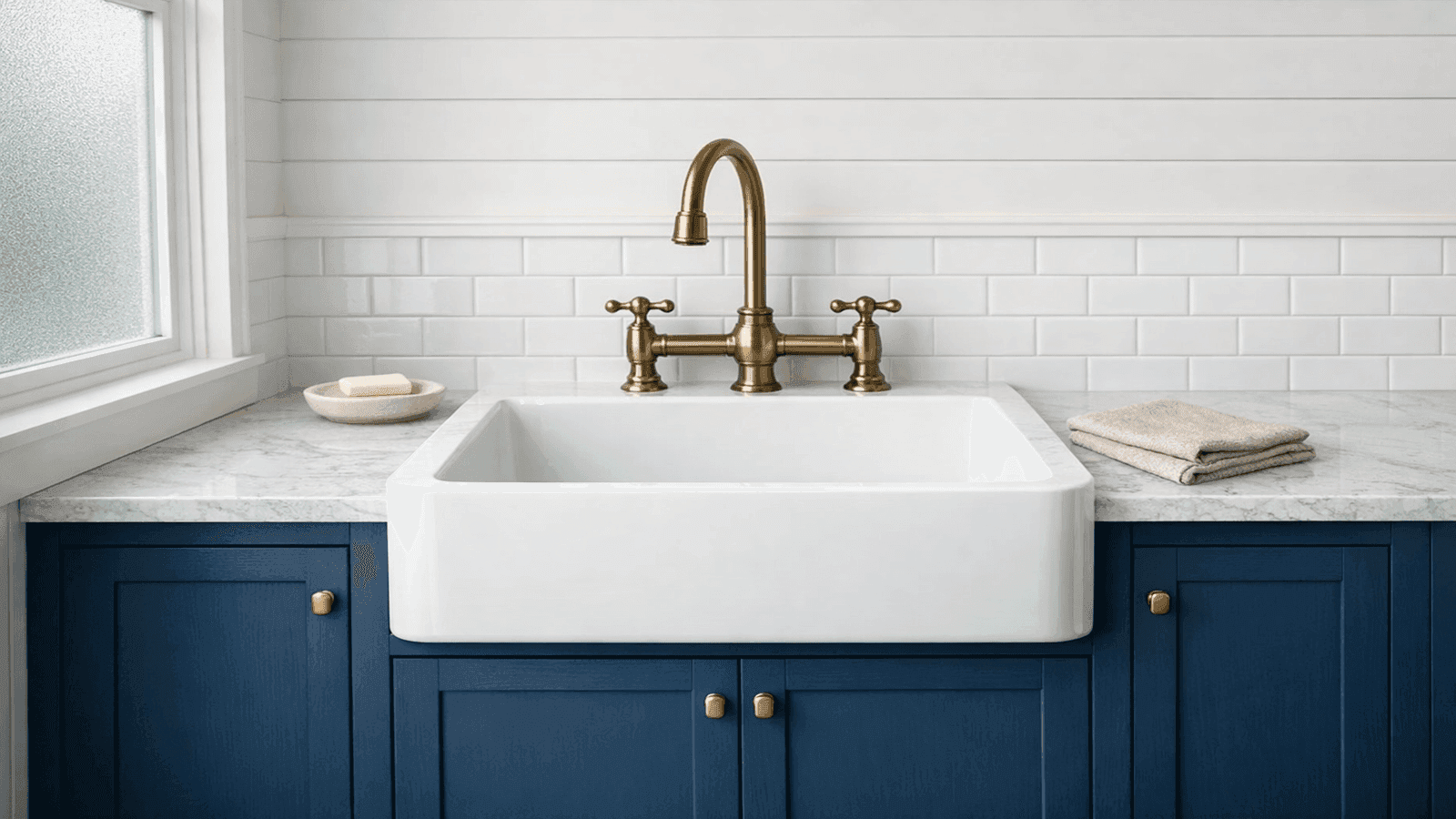
Photo: White fireclay apron-front farmhouse sink with antique brass bridge faucet in a navy shaker vanity with subway tile wainscoting
Apron-Front Sinks
The apron-front sink (also called a farmhouse sink) is the anchor fixture of any farmhouse bathroom vanity. The defining characteristic is the exposed front apron that replaces the standard cabinet face, allowing the sink basin to extend to the front edge of the countertop. Three materials dominate the market: fireclay, cast iron with porcelain enamel, and stainless steel. Each behaves differently in a bathroom environment.
Fireclay
Fireclay is a dense, vitrified ceramic product fired at approximately 1,800 degrees F. At that temperature, the clay body and the glaze fuse into a single continuous material rather than a clay base with a glaze applied on top. The result is a surface that resists chips, stains, and thermal shock better than standard ceramic. Color holds without fading because it is fired into the material rather than coated on [1].
A standard 30-inch fireclay apron sink costs $400–$900. Larger 33-inch and 36-inch versions run $600–$1,400 depending on brand. The weight is significant — 80–120 lbs for most 30-inch basins — but manageable with two installers. The base cabinet must be reinforced; a standard 3/4-inch plywood floor in a stock vanity is usually adequate if the cabinet itself is solid, but the front face of the cabinet must be removed to accommodate the apron.
Cast Iron with Porcelain Enamel
Cast iron apron sinks are the traditional choice in period-accurate farmhouse design. The porcelain enamel surface has warmth and depth that fireclay cannot fully match. But the weight is the primary installation challenge: a 30-inch cast iron apron sink weighs 180–220 lbs. That requires two strong installers, full base cabinet removal, and a structural assessment of the floor below the vanity position.
Cost for cast iron apron sinks runs $500–$1,200 for the 30-inch size. The porcelain enamel can chip if a heavy object is dropped directly into the basin — but touch-up kits are available, and a chip in cast iron porcelain enamel is repairable in a way that fireclay is not. When planning a bathroom sink installation with a cast iron apron sink, the cabinet must be custom-fitted or purpose-built to handle the load and the apron opening.
Cast iron apron sinks are beautiful and I understand why clients want them. But I've had to refuse installation when the floor isn't right. One project in Frisco, Texas — the client had already purchased a 220-pound cast iron sink before calling me. The vanity was over a crawl space with 2x8 floor joists spanning 14 feet. We had to sister the joists before we could set the sink. That added $600 to the job the client hadn't budgeted for. Buy the sink after you've had a plumber and a contractor look at the floor.
Stainless Steel
Stainless steel apron-front sinks cost $300–$600 for 30-inch versions and weigh 20–40 lbs, making them by far the easiest to install. The look is less period-accurate but works in industrial-farmhouse hybrid designs. 16-gauge stainless is the minimum thickness recommended — thinner gauges flex noticeably under hand pressure and conduct more noise. The finish will develop a patina of fine scratches over time that most owners consider a natural look [2].
Farmhouse Sink Cost Comparison
| Sink Material | 30" Cost Range | Weight | Cabinet Modification | Best For |
| Fireclay | $400–$900 | 80–120 lbs | Remove face, reinforce base | Period-authentic, low-maintenance |
| Cast Iron / Porcelain | $500–$1,200 | 180–220 lbs | Full structural assessment needed | Classic look, repairable surface |
| Stainless Steel | $300–$600 | 20–40 lbs | Remove face only | Industrial-farmhouse, budget |
| Composite Granite | $250–$500 | 40–60 lbs | Remove face only | Color options, durable |
Clawfoot Tubs
A clawfoot tub is the defining statement fixture in a farmhouse bathroom, and it is also the fixture most likely to cause serious structural problems when homeowners skip the load assessment step. The physics are straightforward: an empty cast iron clawfoot tub weighs 200–300 lbs. A standard 60-inch model filled with water holds approximately 45–55 gallons. Water weighs 8.34 lbs per gallon. Add an adult bather at 150–200 lbs and the total load on the four claw feet reaches 800–1,000 lbs, concentrated on four small contact points spread over roughly a 20-square-foot footprint.
Floor Joist Assessment
Standard residential floor construction is designed for a distributed load of 40 lbs per square foot (live load) under residential building codes [4]. A clawfoot tub places concentrated point loads on four feet rather than distributing weight across the floor evenly. The actual stress at each foot contact point can exceed what the joist below that point is rated to carry, particularly in older homes with 2x8 or 2x10 joists spanning 12–16 feet.
The assessment process: measure the span of the floor joists below the planned tub location, check joist size (2x8 vs 2x10 vs 2x12), and evaluate whether any joists have been notched, bored, or damaged. If the joists span more than 12 feet or are 2x8s with any visible damage, sistering (adding a second joist alongside each existing one) is the standard reinforcement method. For a bathtub installation involving cast iron, this structural step is non-negotiable.
I require a written sign-off from a general contractor or structural engineer before I'll rough-in the plumbing for a clawfoot tub in a second-floor or above-crawlspace bathroom. I've seen floors sag noticeably after clawfoot tub installations done without assessment. The tub doesn't fall through — but a sagging floor means cracked tile, a door that won't close, and eventually a very expensive repair. The assessment takes two hours and costs $150–$300. It's cheap insurance.
Get quotes from top-rated pros.
Clawfoot Tub Plumbing
Unlike a built-in tub that connects to supply lines through the wall or deck, a clawfoot tub sits freestanding in the room and requires visible supply line risers running from the floor to the tub deck. These supply lines are an intentional design feature in farmhouse bathrooms — floor-mounted tub filler faucets in oil-rubbed bronze or antique brass are a signature farmhouse element.
Plumbing a clawfoot tub requires relocating the hot and cold supply rough-ins to floor penetrations positioned precisely below the tub's deck-mounted faucet holes (typically a 3.5-inch spread for deck-mount or a floor-mounted standpipe filler). The drain connection uses a flexible or rigid P-trap running through the floor, with an overflow attached to the tub body.
Plumbing installation for a clawfoot tub costs $800–$2,000 for the plumbing work alone, excluding floor reinforcement if needed. This covers supply line relocation, floor penetrations, drain rough-in, and connection of the floor-mount filler and showerhead (if a clawfoot shower conversion is included).
Clawfoot Tub Cost Summary
| Item | Cost Range |
| Cast iron clawfoot tub (60") | $800–$2,500 |
| Acrylic clawfoot tub (60") | $400–$1,200 |
| Floor-mount tub filler faucet | $200–$600 |
| Clawfoot shower conversion ring + curtain | $150–$400 |
| Plumbing installation (labor only) | $800–$2,000 |
| Floor joist sistering (if required) | $600–$1,800 |
| Installed total (cast iron, reinforcement needed) | $2,350–$7,300 |
Bridge Faucets
A bridge faucet connects both hot and cold supply lines through a single arched bridge unit mounted between two separate handle posts. The bridge design traces to early 20th century kitchen plumbing and became a defining visual element of farmhouse and Edwardian interiors. In modern farmhouse bathrooms, bridge faucets appear on apron sinks, on pedestal sinks, and occasionally on console sinks mounted on legs.
Standard vs Tall Bridge Options
Standard bridge faucets measure 8 inches in height from deck to spout arc. Tall bridge versions reach 12–14 inches, which is the correct proportion for a deep apron sink basin (typically 9–10 inches deep). Using a standard-height bridge faucet on a 10-inch-deep apron sink results in water hitting the basin wall rather than the center — a functional problem as well as a visual one.
Bridge faucets require a deck with two pre-drilled holes on an 8-inch center spread (standard bathroom sink spacing), plus the bridge unit itself spans across the top connecting the two handles. Installation requires connecting two supply stop valves to the two inlet ports of the bridge unit and mounting the spout-bridge assembly.
Finish Selection for Period Accuracy
The finish choice on a bridge faucet has outsized visual impact because the bridge arc is prominently visible above the basin.
- Oil-rubbed bronze: The most popular farmhouse finish. Warm brown-black with subtle highlights. Requires gentle cleaning — abrasive cleaners will damage the living finish. Period-appropriate for early 20th century farmhouse design.
- Antique brass: Warm gold with a deliberately aged appearance. Works best in bathrooms with warm wood tones and subway tile. Avoid mixing with polished chrome.
- Matte black: Contemporary farmhouse and industrial-farmhouse applications. The most forgiving finish for water spots and fingerprints. Works with gray, white, and dark-stained wood palettes.
- Unlacquered brass: Develops a natural patina over time that deepens from bright gold to warm amber. Requires owners willing to accept finish evolution — cannot be cleaned back to original brightness. Highly period-accurate for 1900–1930 farmhouse aesthetics.
Finish mixing is the mistake I see most often in farmhouse bathrooms. A client will choose oil-rubbed bronze for the bridge faucet and then use polished chrome for the toilet trip lever and towel bars because they're cheaper. The result looks like an unfinished job. I tell clients to pick one metal finish family and buy everything in that finish at the same time — faucet, towel bars, toilet hardware, shower hardware, door hardware. It costs more upfront but it's the only way the room reads as designed rather than assembled.
Cross-Handle Faucets and Compression vs Cartridge Valves
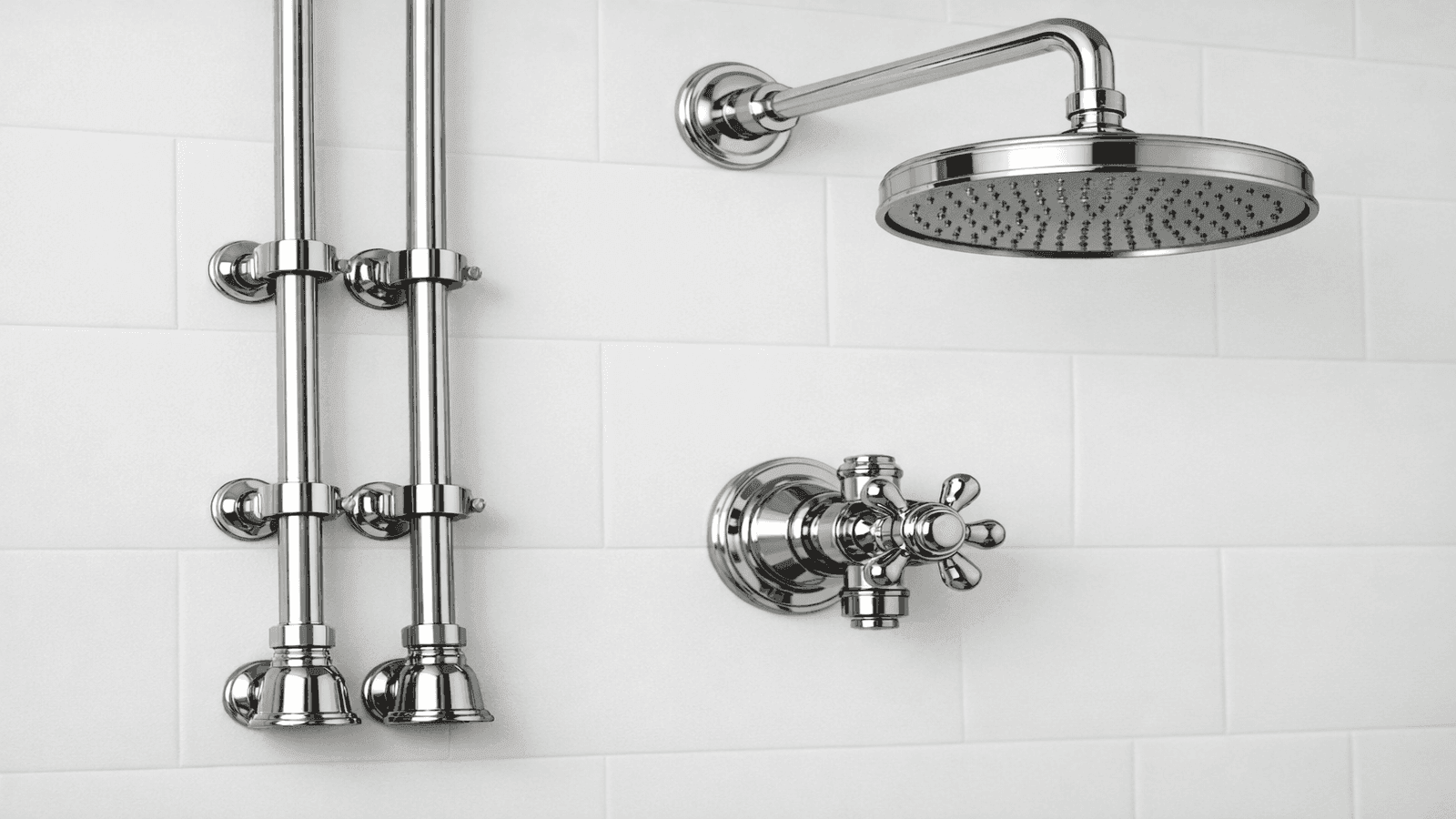
Cross-handle faucets are the period-appropriate handle style for farmhouse bathrooms — the four-spoke cross shape dates to Victorian and Edwardian plumbing. Modern cross-handle faucets use either cartridge valves or compression valves internally, and the choice matters for long-term maintenance.
Compression valves use a rubber seat washer that presses against a brass seat to stop flow. They were the standard valve type through the early 20th century and are available in exact period-replica designs. The downside: compression valves require periodic washer replacement (every 3–8 years of typical use) and will develop slow drips as the washer wears. They are repairable in place by a homeowner comfortable with basic plumbing.
Cartridge valves use a replaceable plastic or ceramic cartridge that controls flow. They require no adjustment for drip prevention — when they fail, you replace the cartridge (usually $15–$30). Most modern cross-handle faucets, even those designed to look period-accurate, use cartridge valves internally. This is the right choice for most homeowners.
When specifying cross-handle faucets for a farmhouse bathroom, confirm whether the internal valve is cartridge or compression before purchase. Most reputable brands (Rohl, Kingston Brass, Watermark Designs) clearly state this [3].
Cross-handle faucets look identical whether they use cartridge or compression valves — you cannot tell from looking at the handle. I always ask the supplier before I spec a faucet for a client, because the labor cost to replace a compression washer every few years adds up. Cartridge faucets cost a bit more upfront but save the homeowner service calls. In 18 years across Dallas-Fort Worth and California, I've replaced compression washers in bathroom faucets hundreds of times. Most of those calls could have been avoided with a cartridge valve at the time of install.
Shiplap, Subway Tile, and Hex Floors
The wall and floor finish choices in a farmhouse bathroom frame the plumbing fixtures. Three combinations dominate authentic farmhouse bathrooms:
Shiplap above wainscoting: White-painted shiplap boards (typically 1x6 or 1x8 horizontal boards with a 1/4-inch reveal gap) applied from 36–48 inches above the floor to the ceiling, sitting on top of tile wainscoting below. The shiplap must be primed and sealed thoroughly before painting in a bathroom — unprotected wood in a high-humidity environment will develop mold behind the boards within two to three years.
Subway tile wainscoting: Classic 3x6 subway tile with a 1/3 offset brick pattern set in white or off-white is the standard farmhouse wainscoting. Modern 4x8 and 4x12 subway tile formats reduce grout line frequency and look slightly more contemporary. Grout color choice matters: bright white grout reads as clean and modern; gray or warm white grout reads as more period-appropriate.
Hex tile floors: 1-inch or 2-inch white hex tile with gray grout is the most period-accurate farmhouse floor tile choice. The pattern requires more labor to install (approximately 30–40 percent more installation time than large-format tile) but the visual result is distinctive. Sealing the grout after installation and annually thereafter is required in a wet bathroom environment.
Exposed Supply Lines and P-Traps
In a farmhouse bathroom, visible plumbing components can be intentional design elements rather than concealed necessities. The most common application is leaving the P-trap and supply lines under an apron sink or pedestal sink exposed rather than hiding them inside a cabinet.
When code permits exposed plumbing: Most U.S. jurisdictions permit exposed P-traps and supply lines in bathrooms as long as the materials are approved for the application and the connections are accessible for inspection. ABS or PVC drain lines painted or wrapped in a contrasting finish work but look less intentional than polished chrome or matte black metal P-traps.
Exposed P-trap material choices:
- Chrome P-traps: Bright chrome reads as classic, visible period plumbing. The most affordable exposed option ($15–$30 for the trap assembly).
- Matte black P-traps: Contemporary farmhouse. Several brands offer full matte black drain and trap assemblies at $60–$120 for the complete assembly.
- Brushed nickel: Understated. Works when the faucet finish is also brushed nickel.
Pipe wrapping for supply lines: Floor-mounted supply lines to a clawfoot tub are typically left as bare chrome-plated copper or brass risers. If the floor-mount filler package does not include matching supply line covers, copper pipe can be polished and lacquered or wrapped in leather for an intentional design look.
Skirted Toilets
A skirted toilet uses a smooth decorative skirt panel that covers the trapway and base of the toilet, creating a cleaner profile that reads as period-appropriate in farmhouse design while also being easier to clean than standard exposed-trapway two-piece toilets. The trip lever — the flush handle — is the key finish detail for farmhouse bathrooms.
Two-piece skirted toilets cost $350–$700. One-piece skirted versions cost $600–$1,200. The elongated bowl is the standard choice for farmhouse bathrooms; round bowls are less common and less comfortable [6]. See our complete toilet installation guide for the full installation process.
For finish selection, trip levers in antique brass, oil-rubbed bronze, or matte black are available from most manufacturers. The lever finish should match the other fixture hardware in the bathroom.
Get quotes from top-rated pros.
Complete Farmhouse Fixture Cost Reference Table
| Fixture | Budget Option | Mid-Range | Premium | Pro Recommended? |
| Fireclay apron sink (30") | $400 | $650 | $900 | Pro install required |
| Cast iron apron sink (30") | $500 | $850 | $1,200 | Pro mandatory (weight) |
| Bridge faucet (oil-rubbed bronze) | $180 | $350 | $650 | DIY possible |
| Cross-handle faucet (cartridge) | $120 | $280 | $500 | DIY possible |
| Clawfoot tub (acrylic, 60") | $400 | $750 | $1,200 | Pro for plumbing |
| Clawfoot tub (cast iron, 60") | $800 | $1,500 | $2,500 | Pro + structural |
| Floor-mount tub filler | $200 | $400 | $600 | Pro for supply lines |
| Skirted toilet (two-piece) | $350 | $500 | $700 | DIY possible |
| Shiplap wall installation (per 100 sq ft) | $300 | $550 | $900 | DIY possible |
| Subway tile wainscoting (per 100 sq ft installed) | $450 | $750 | $1,200 | Pro recommended |
| Hex tile floor (per 100 sq ft installed) | $600 | $900 | $1,400 | Pro recommended |
Real Farmhouse Bathroom Renovation: Claire B., Granbury TX
Claire B. in Granbury, Texas undertook a full farmhouse bathroom renovation in a 1958 ranch house with a second-floor bathroom directly above the garage. The bathroom measured 8x10 feet, with original floor joists spanning 18 feet. Her goals: apron sink, clawfoot tub, shiplap walls, hex tile floor, and all fixtures in antique brass finish.
The first challenge was structural. Before any fixtures were purchased, Michael R. Jennings assessed the floor joists and found 2x8 joists spanning the full 18-foot garage span with one notched joist near the planned tub position. The sistering recommendation covered three joists (approximately $900 in materials and labor) and was completed before the tub was ordered.
The second challenge was cabinet fit. The 30-inch fireclay sink Claire selected weighed 95 lbs and required full removal of the existing vanity cabinet face frame and installation of a custom-width base unit with a reinforced plywood base shelf.
Completed costs: fireclay sink $680, cabinet modification $340, bridge faucet in antique brass $420, cast iron clawfoot tub (used, excellent condition) $950, tub plumbing and filler $1,750, floor joist sistering $900, hex tile floor $1,100, shiplap and subway tile walls $1,850, skirted toilet with antique brass lever $580. Total project cost: $8,570 including labor for all professional work.
Claire's assessment after four months: "The structural work was the part I hadn't planned for. I'm glad we did it before we bought anything. The rest of the renovation is exactly what I wanted."
The licensed plumbers in our NearbyHunt network report that approximately 68 percent of farmhouse bathroom projects they complete involve at least one structural assessment or modification — most commonly for clawfoot tub floor reinforcement or cast iron sink cabinet reinforcement — and that homeowners who skip the assessment step spend an average of $1,200–$2,400 more in corrective work after installation than they would have spent addressing the issue proactively.
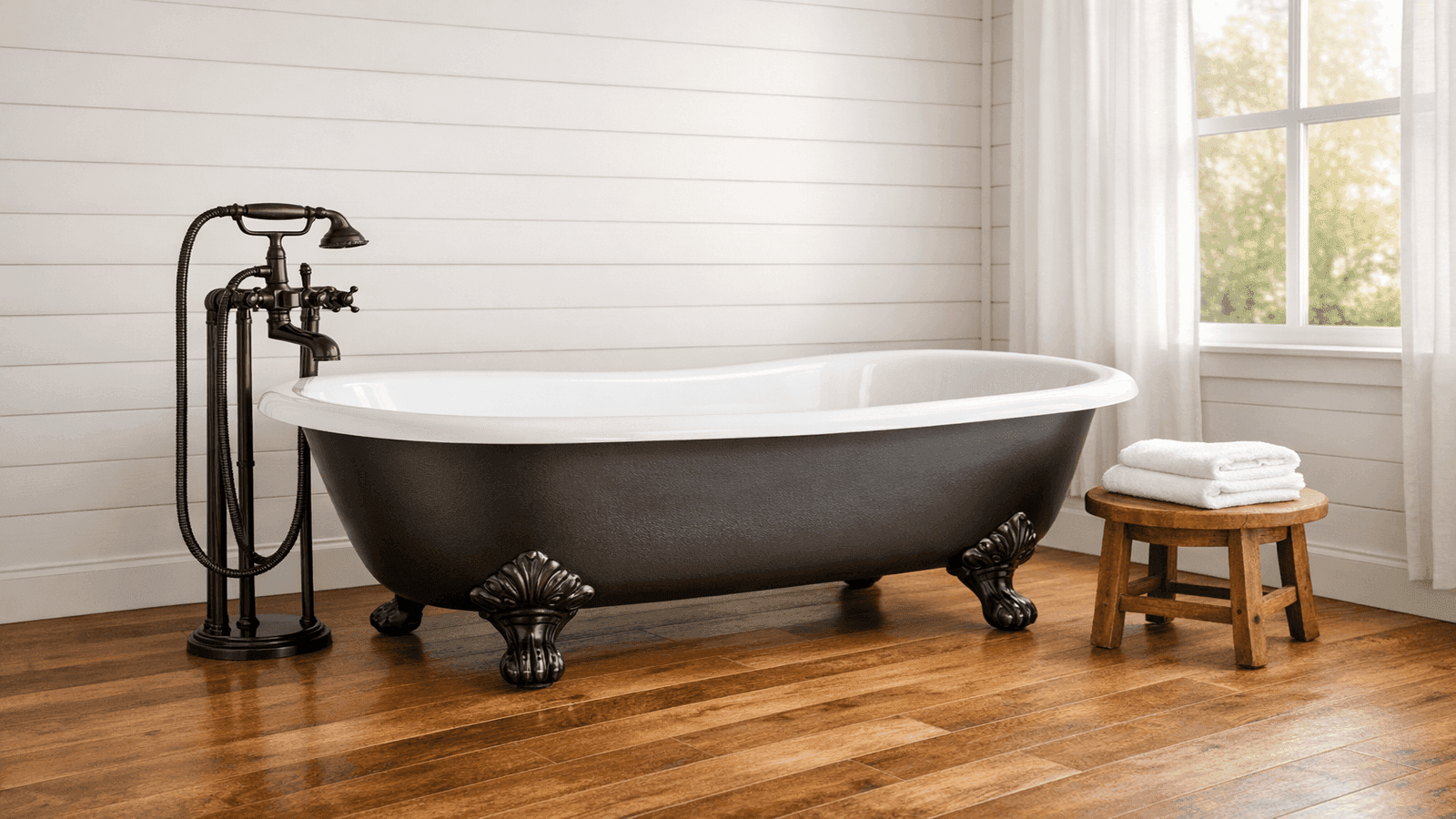
Photo: Cast iron clawfoot bathtub with oil-rubbed bronze floor-mount filler faucet on hardwood floor with white shiplap walls
Plumbing Costs and Budgeting for Farmhouse Renovations
Understanding where plumbing labor costs concentrate in a farmhouse renovation helps with budget planning. The plumbing costs guide covers full cost data, but farmhouse-specific installations have some distinct cost drivers.
Supply line relocation: Moving supply stub-outs from their original positions to accommodate an apron sink or freestanding tub costs $200–$600 per fixture location in a typical renovation where walls are open. If walls are finished, add $300–$800 for wall access and patching.
Drain rough-in for clawfoot tub: Relocating the drain opening through the floor to position it correctly under a freestanding tub drain costs $300–$600 in most cases.
Venting for new fixtures: If a new apron sink is added to a bathroom that previously had no sink (conversion of a half-bath or powder room), proper venting through the wall or ceiling is required by code. This adds $200–$500 depending on routing complexity.
Floor reinforcement: Sistering floor joists costs $100–$200 per joist (materials plus labor), and most clawfoot tub reinforcement projects require sistering 2–4 joists. Budget $400–$1,000 for this work.
For kitchen sink installation involving farmhouse-style apron sinks — which follow the same fireclay vs cast iron vs stainless decision framework — the cost data is similar but cabinet modifications may be more extensive since kitchen base cabinets are typically more complex than bathroom vanities.
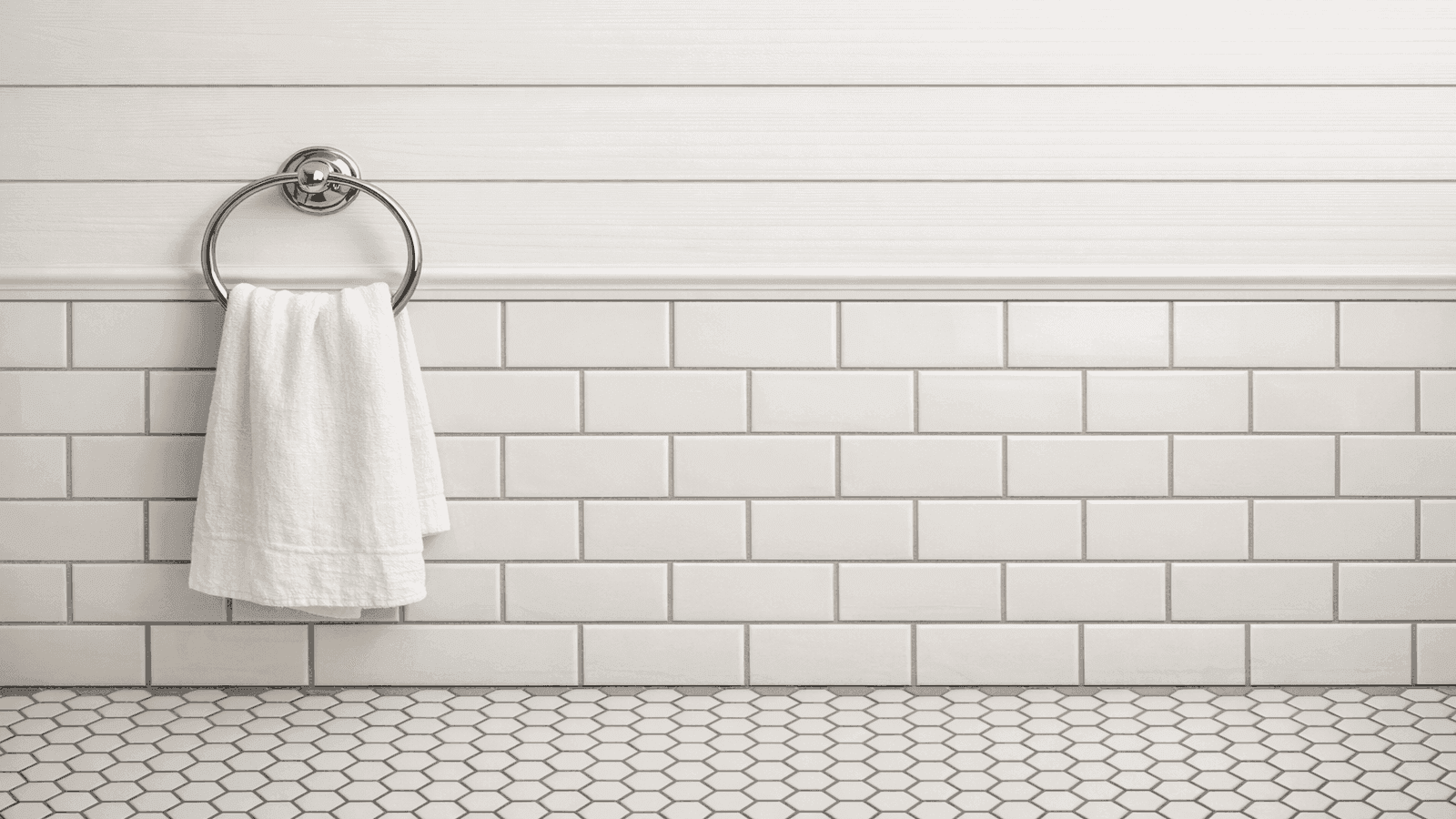
Photo: Farmhouse bathroom with white shiplap above subway tile wainscoting and white hex tile floor with gray grout
Fixture Finishes: Maintenance Guide by Metal
The finish on bathroom fixtures determines both the visual character of a farmhouse bathroom and the maintenance commitment required. Farmhouse bathrooms using unlacquered or "living" finishes need more regular care than standard polished chrome or brushed nickel.
Oil-rubbed bronze: Clean with mild soap and water only. Dry after cleaning. No abrasive cleaners, no vinegar, no citric acid cleaners. The "living finish" coating is a surface treatment that develops subtle highlights over time. Aggressive cleaning removes the surface treatment and exposes the raw bronze underneath.
Antique brass (lacquered): Most mass-market "antique brass" fixtures have a lacquer coating over the base brass. Wipe clean with a damp cloth. Avoid prolonged water contact. If the lacquer chips, the brass below can tarnish unevenly — at that point, stripping the lacquer and treating as unlacquered is the practical solution.
Unlacquered brass: Develops a natural patina (verdigris and darkening) over months of use. Clean periodically with a mild brass cleaner to slow the patina process, or leave it to develop naturally. Soap and water cleaning will not harm it. The patina is irreversible without professional polishing and re-finishing.
Matte black: The most forgiving finish in terms of water spots and fingerprints. Clean with mild soap and water. Avoid oil-based cleaners that can leave a sheen on the matte surface. The PVD (physical vapor deposition) coating used by quality manufacturers is highly durable.
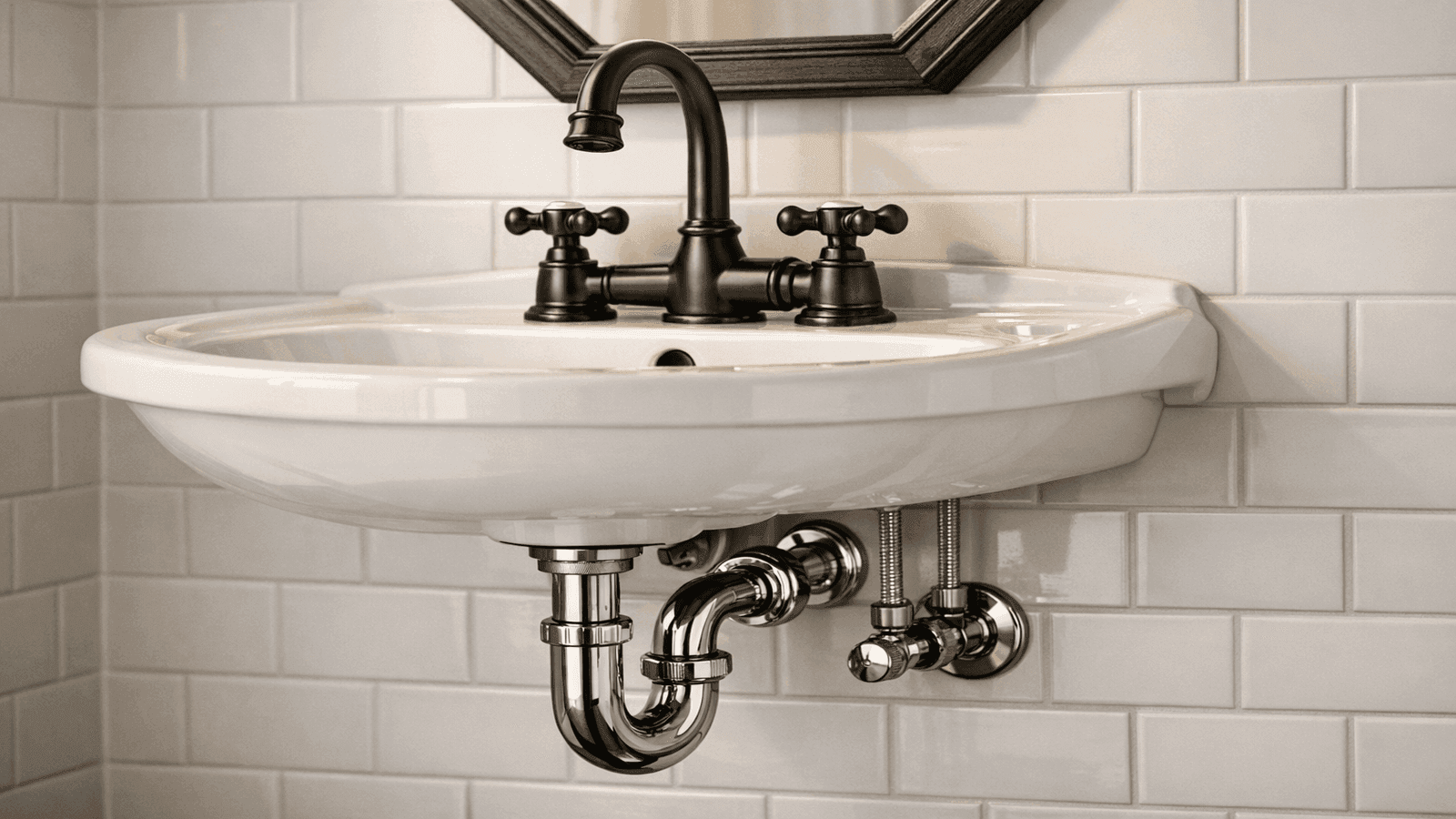
Photo: Oil-rubbed bronze cross-handle faucet on pedestal sink with exposed chrome P-trap and subway tile wall in farmhouse bathroom
Modern Plumbing Systems Behind the Farmhouse Aesthetic
A farmhouse bathroom achieves its look through visible fixtures, but the plumbing behind the walls should be completely modern. This distinction matters for long-term reliability and code compliance.
Supply lines: PEX (cross-linked polyethylene) is the current standard for supply line rough-in in new construction and renovation. PEX is flexible, resists freezing better than copper, and costs less than copper to install. The farmhouse aesthetic is entirely in the visible fixtures — the supply line material makes no visual difference.
Drain lines: ABS or PVC plastic is the current standard. Cast iron drain pipe was the historical standard in pre-1960 construction; if a farmhouse renovation involves a house built before 1960, old cast iron drain lines may need assessment for deterioration (sulfuric acid from drain bacteria corrodes the interior of cast iron over decades).
Pressure-balancing valves: If the farmhouse bathroom includes a clawfoot tub with a shower conversion or a separate shower, a pressure-balancing or thermostatic shower valve is required by code in most jurisdictions built after 1990 [5]. Period-accurate cross-handle trim is available for all major pressure-balancing valve brands (Moen, Delta, Kohler), so the code-required valve can be dressed in period-appropriate hardware.
Water heater capacity: A deep cast iron clawfoot tub holds 55–65 gallons of water. A standard 40-gallon water heater will not fill a cast iron clawfoot tub with hot water in a single fill cycle. A 50-gallon tank minimum is recommended; a 60-gallon tank or an on-demand (tankless) heater is the correct long-term solution. See the water heater installation guide for capacity planning details.
For homeowners planning full bathroom updates including outdoor plumbing ideas in a farmhouse property, consistent finish selection across interior and exterior fixtures ties the overall design together. For modern bathroom alternatives to compare against farmhouse approaches, see modern bathroom fixtures.
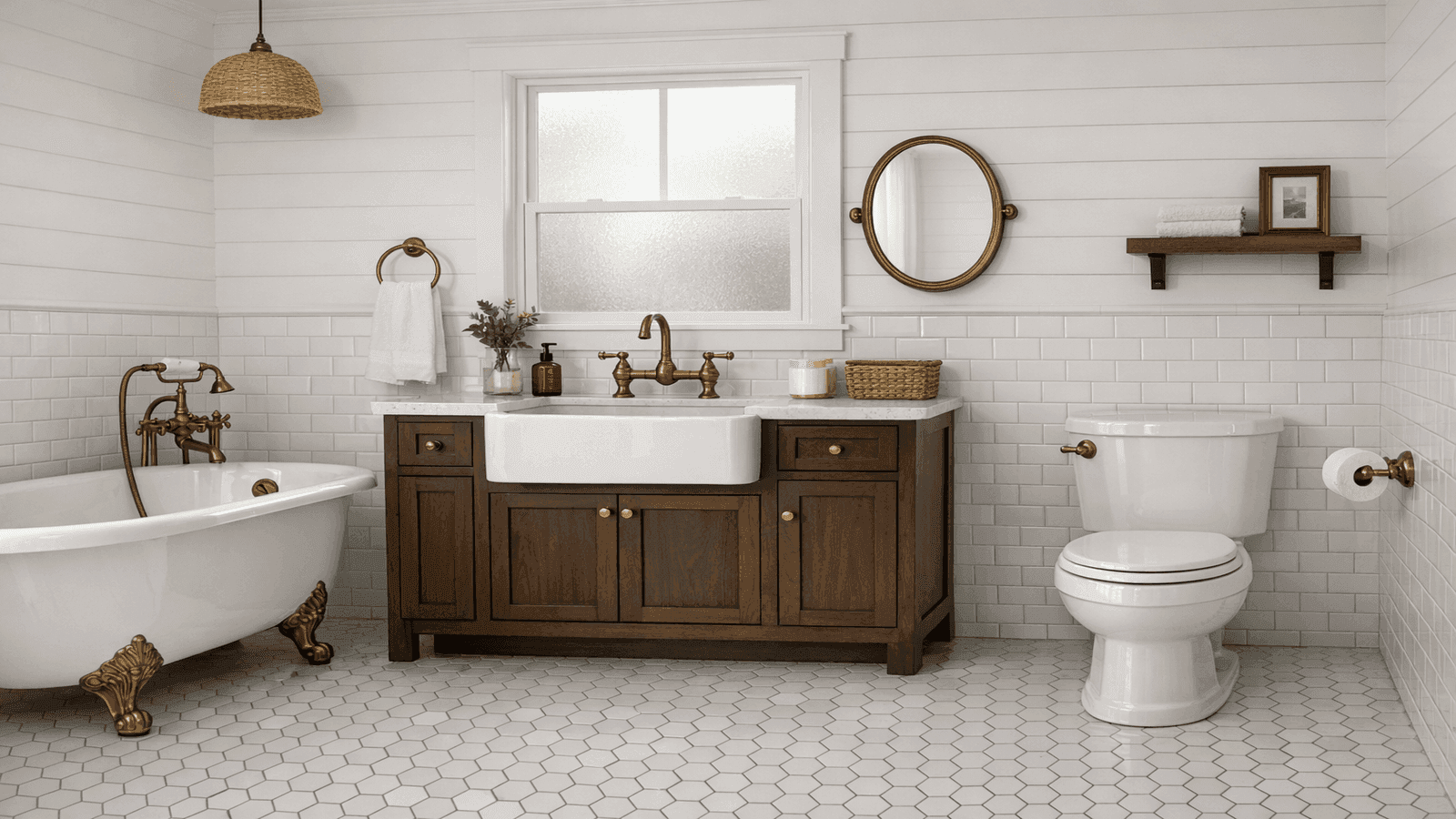
Photo: Complete farmhouse bathroom renovation with clawfoot tub, fireclay apron sink, skirted toilet, and antique brass fixtures throughout
Conclusion
A farmhouse bathroom renovation is a plumbing project before it is a design project. The apron sink weighs up to 220 lbs and requires a cabinet that can hold it. The clawfoot tub filled with water weighs 900 lbs and requires floor joists that can carry it. The bridge faucet needs to be tall enough for the basin depth it serves. The fixture finishes need to match across every hardware piece in the room. Getting these fundamentals right is the difference between a renovation that delivers on the photographs and one that requires expensive corrections six months after completion.
Michael R. Jennings and the licensed plumbers in the NearbyHunt network have completed farmhouse bathroom renovations at every budget level. The consistent finding across 2,400-plus residential projects is that the homeowners most satisfied with the outcome are the ones who did the structural assessment, chose one finish and stuck with it, and involved a licensed plumber in the fixture selection process before purchasing anything.
Find a Licensed Plumber for Your Farmhouse Bathroom Project
Disclaimer: This article is for informational and planning purposes only. Plumbing work involving supply line relocation, drain rough-in, and structural floor assessment should be performed by or supervised by a licensed plumbing contractor. Requirements vary by jurisdiction. Obtain permits where required.*
Sources & References
[1] Forbes Home — Farmhouse Sink Cost Guide. https://www.forbes.com/home-improvement/bathroom/farmhouse-sink-cost/
[2] This Old House — Farmhouse Sink Materials and Installation. https://www.thisoldhouse.com/kitchens/farmhouse-sinks
[3] Bob Vila — Cross-Handle Faucet Buyer's Guide. https://www.bobvila.com/articles/farmhouse-faucets/
[4] International Residential Code (IRC) — Floor Live Load Requirements, Section R301.5. https://codes.iccsafe.org/content/IRC2021P2
[5] Plumbing-Heating-Cooling Contractors Association (PHCC) — Residential Fixture Installation Standards. https://www.phccweb.org/resources/
[6] National Kitchen and Bath Association (NKBA) — Bathroom Planning Guidelines 2025. https://www.nkba.org/guidelines

Michael Jennings is a licensed master plumber & water systems specialist with over 18 years of hands-on experience in residential and commercial plumbing, serving clients across California and Texas. At NearbyHunt, he shares practical advice on pipe installations, water heater maintenance, and home plumbing upgrades. Michael has helped thousands of homeowners prevent costly water damage and improve water efficiency through modern plumbing solutions.

Robert is a licensed master plumber with over 20 years of experience serving both residential and commercial clients across the Midwest. Specialising in advanced plumbing systems and sustainable water technologies, Rob brings deep technical insight and hands-on expertise to every project. As a reviewer for NearbyHunt, he ensures all plumbing content reflects the highest standards of safety, compliance, and practicality.