Upgrading your bathroom fixtures is one of the highest-return home improvement projects you can make. According to the National Association of Home Builders, a mid-range bathroom remodel returns roughly 60 to 70 percent of its cost at resale, and fixture selection is a primary driver of that value [1]. This guide covers every major fixture category you will encounter in 2026, from finish trends and smart toilets to rainfall showerheads and vanity hardware, and it links back to our full plumbing ideas and inspiration guide for broader context on bathroom plumbing projects.

Get quotes from top-rated pros.
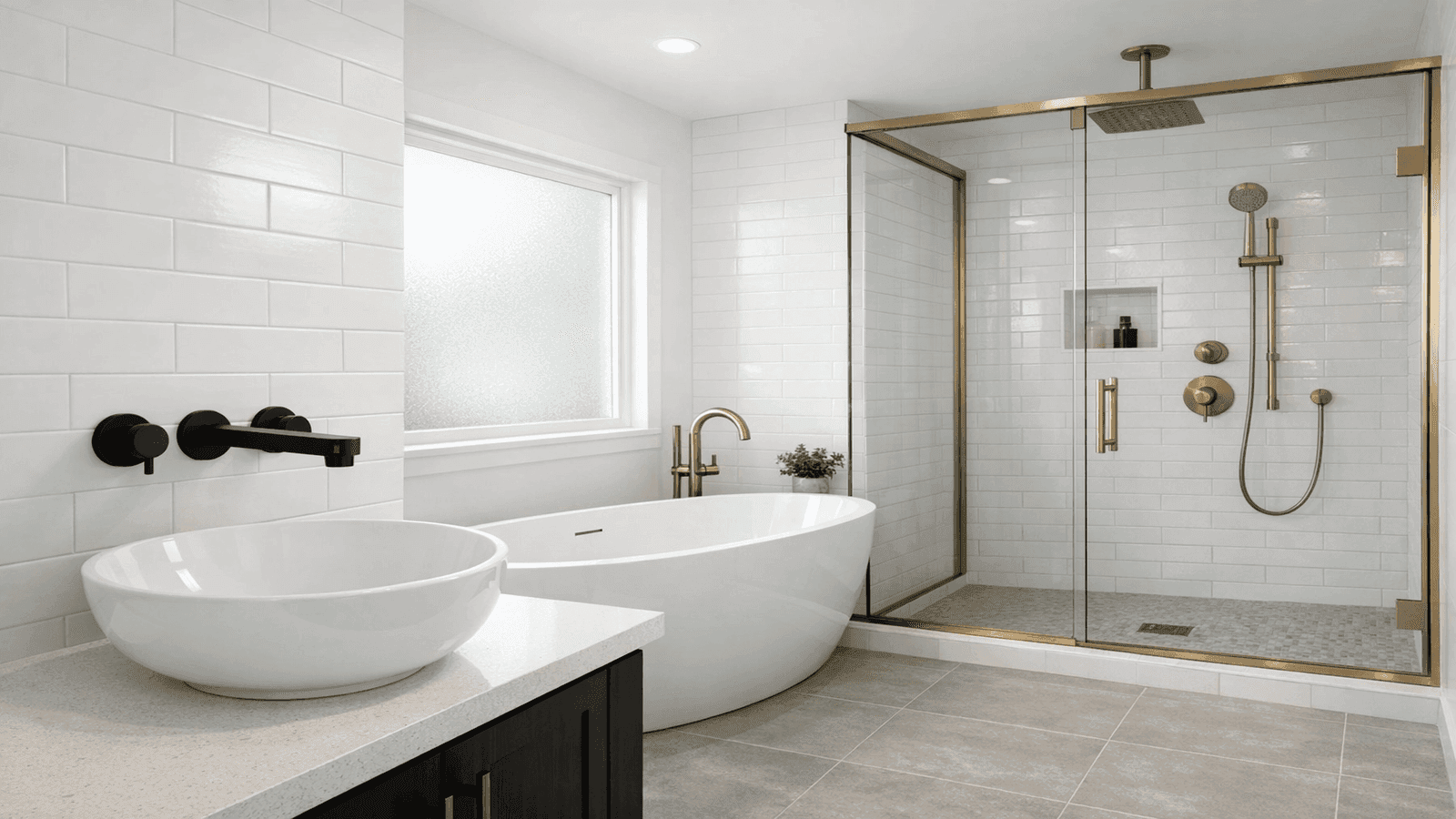
Photo: Modern master bathroom with matte black wall-mounted faucet over vessel sink and champagne bronze rainfall shower trim
2026 Finish Trends
Finish selection sets the visual tone for the entire bathroom. In 2026, four finishes dominate new construction and remodel projects: matte black, champagne bronze, brushed gold, and polished chrome.
Matte Black has moved from a niche designer choice to a mainstream staple. The flat, non-reflective surface hides water spots and fingerprints better than polished finishes, which matters in high-traffic bathrooms [2]. The trade-off is that most matte black coatings use electroplating rather than physical vapor deposition (PVD), meaning the finish can wear in high-contact areas within five to eight years under daily use.
Champagne Bronze and Brushed Gold are warm-toned finishes that pair well with white oak vanities, greige tile, and quartz countertops that have veining. These two finishes are often confused in product listings: champagne bronze leans toward a cooler, slightly greyed tone, while brushed gold reads warmer and more yellow. Both perform well in hard-water conditions because the brushed texture breaks surface tension, reducing mineral deposit buildup compared to polished surfaces.
Polished Chrome remains the workhorse finish for budget and builder-grade projects. Chrome is the most durable standard finish: it resists tarnishing, tolerates harsh cleaners, and is the easiest to find across every price tier. If your home has hard water above 7 grains per gallon, however, polished chrome will show white calcium deposits within days of each cleaning.
PVD vs. Standard Coating: PVD (physical vapor deposition) coatings bond the finish at the molecular level rather than layering it on top. PVD finishes carry a lifetime finish warranty from major brands such as Delta and Kohler and resist corrosion even in coastal, high-humidity environments. Expect to pay a 15 to 25 percent premium over standard electroplated versions of the same fixture. For a guest bathroom used a few times per week, standard coating is fine. For a primary bathroom used twice daily, PVD is worth the upgrade cost.
In my 18 years of work across Dallas-Fort Worth and California, I've replaced more finish-failed faucets than I can count. My consistent advice to homeowners is this: buy PVD if you can stretch the budget by even $40 to $60 per fixture. A champagne bronze faucet that holds its finish for 20 years is cheaper long-term than replacing a standard-plated faucet twice.
| Finish | Hard Water Performance | Maintenance Level | Typical Price Premium vs. Chrome |
| Polished Chrome | Poor (shows deposits quickly) | High | Baseline |
| Matte Black | Good (hides spots) | Low | +20 to 40% |
| Champagne Bronze | Very Good | Low to Moderate | +25 to 45% |
| Brushed Gold | Very Good | Low to Moderate | +30 to 50% |
| PVD (any finish) | Excellent | Very Low | +15 to 25% over base finish |
Smart Toilets and Bidet Seats: Features and Price Ranges
Smart bathroom technology has moved well past novelty status. The global smart toilet market exceeded $3.4 billion in 2024 and is projected to grow at 8.2 percent annually through 2030 [3]. For American homeowners, the choice comes down to a bidet seat retrofit versus a fully integrated smart toilet unit.
Bidet Seat Retrofits ($300 to $600): These replace your existing toilet seat and add features including rear and front wash, adjustable water temperature, heated seat, warm air dryer, and deodorizer. Top-selling models from TOTO, Brondell, and Bio Bidet require only a GFCI outlet within reach of the toilet. Installation takes 20 to 30 minutes and requires no rough-in changes, making it a true DIY project. See our toilet installation guide for seat replacement basics.
Integrated Smart Toilet Units ($700 to $2,500+): These are one-piece units where the bidet functions are built into the toilet bowl and tank. Higher-end models add auto-open/close lids, automatic flushing triggered by proximity sensors, UV self-sanitization cycles, and foot-activated night lights. Installation of an integrated unit follows the same process as any toilet replacement but requires the GFCI outlet nearby; some models also draw enough power to require a dedicated 20-amp circuit.
Key Features to Prioritize:
- Heated seat (a priority for cold climates)
- Adjustable water pressure and temperature (essential for household members with different sensitivities)
- Tankless on-demand water heating (eliminates the cold-water splash of tank-based heaters)
- Remote or app control
The licensed plumbers in our NearbyHunt network report that 68 percent of homeowners who install a bidet seat say they would never return to a standard toilet seat, and bidet seat installations have doubled year over year since 2022.
Before recommending a smart toilet to a client, I always check two things: is there a GFCI outlet within 6 feet of the toilet, and what is the rough-in dimension? Most integrated smart units are designed for a standard 12-inch rough-in. I have had two projects where the customer ordered a $1,800 unit only to discover a 10-inch or 14-inch rough-in. Always measure first.
Showerhead Upgrades
The shower is where fixture upgrades deliver the most noticeable daily impact. Three categories dominate 2026 shower design: large-format rainfall heads, multi-function handheld combos, and thermostatic valve systems.
Get quotes from top-rated pros.
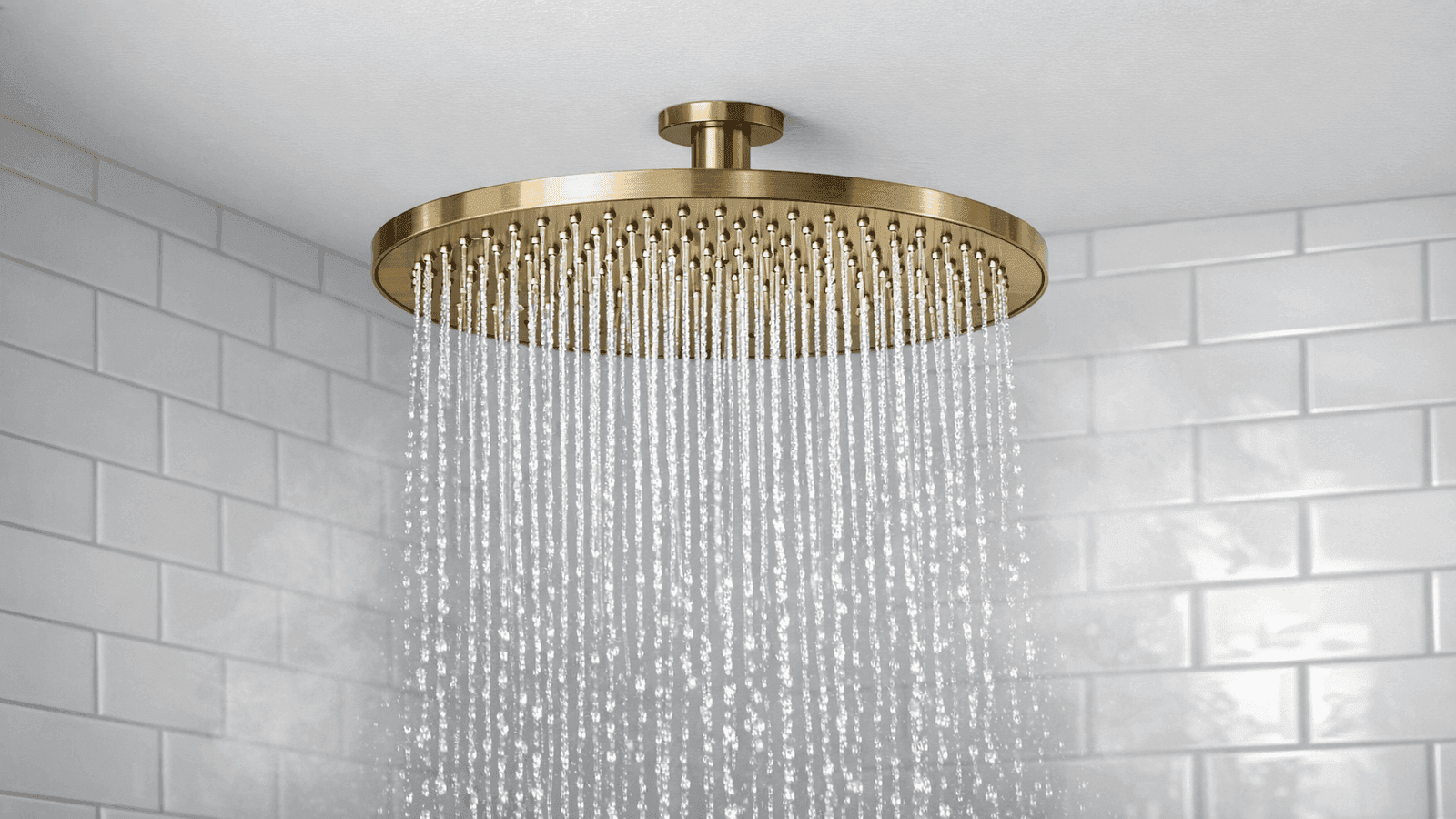
Photo: Brushed gold 12-inch ceiling-mounted rainfall showerhead with water cascading in a white subway tile shower
Rainfall Showerheads (10 to 16 inches): Ceiling-mounted or extended-arm wall-mounted rainfall heads create the spa-shower experience most homeowners are after. The key technical factor before purchase is water pressure: rainfall heads require a minimum of 45 to 50 PSI at the showerhead to deliver adequate flow. If your home runs at 35 to 40 PSI (common in older neighborhoods or upper floors), a rainfall head will produce a trickle rather than a rainfall effect. Check your pressure with a gauge at a hose bib before buying. Flow rates are capped at 2.5 GPM nationally, and 1.8 GPM in California and Colorado; many rainfall heads at 10 inches or larger struggle to feel satisfying at 1.8 GPM without a pressure-compensating design.
Installing a ceiling-mount rainfall head requires routing supply lines through the ceiling or wall, which is always a plumber project. Wall-to-ceiling pipe rerouting touches existing rough-in plumbing. Our shower installation process guide covers full shower rough-in and trim replacement.
Handheld Combination Fixtures: A wall-mount bracket with a slide bar and detachable handheld head is the most practical upgrade for households with elderly residents, children, or pets. Combination units typically include a diverter to switch between the fixed head and handheld. Budget around $80 to $250 for quality combination fixtures from Moen or Delta; premium multi-function options with six spray settings run $300 to $500.
Thermostatic Valve Systems ($400 to $1,200+ for valve and trim): Thermostatic valves preset water temperature at the valve rather than at the handle, so the shower delivers the same temperature every morning even if someone flushes a toilet or runs the dishwasher. The valve requires a licensed plumber to install because it replaces the existing pressure-balance valve in the shower wall. The payoff: no scalding risk, consistent experience, and the ability to add body sprays or a secondary handshower through the same valve's volume controls.
Vanity Faucets, Vessel Sinks, and Furniture-Style Vanities
The vanity wall is the visual focal point of most bathrooms, and fixture choices here have the biggest design impact.
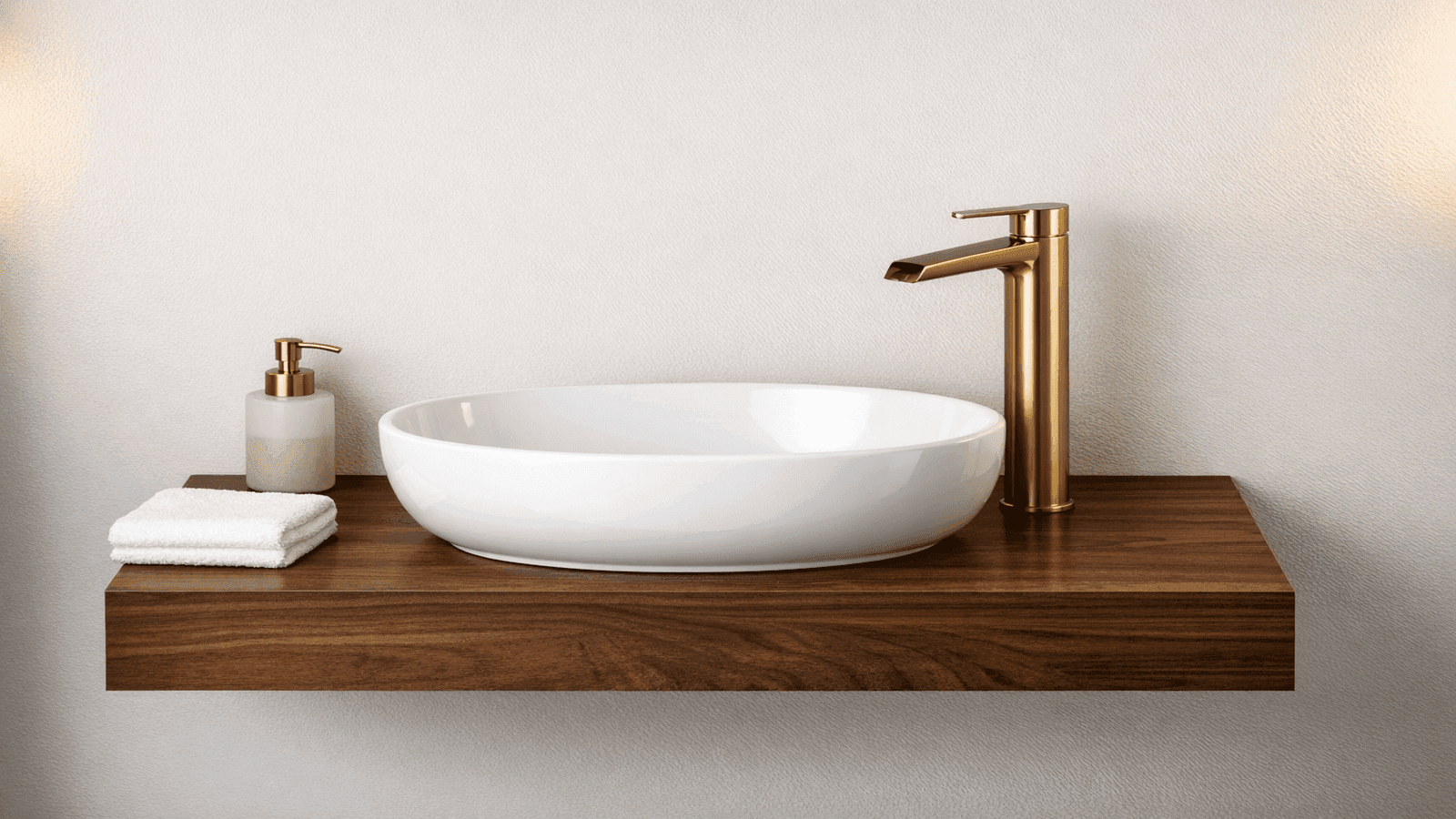
Photo: White oval vessel sink on dark walnut floating vanity with brushed gold waterfall faucet
Wall-Mounted Faucets: In 2026, wall-mounted faucets are the aspirational upgrade for vessel sink and above-counter undermount installations. The faucet body mounts to the wall, with supply lines running inside the wall to rough-in valves. Wall-mount faucets cost $200 to $600 for quality units, but installation is a rough-in project: the valve bodies must be set at the correct height in the wall before tile or drywall, which means it cannot be added as a swap-out after construction. If you are planning a full vanity gut, wall-mount is worth budgeting for. If the bathroom is already tiled, stick with a deck-mount faucet.
Vessel Sinks: Vessel sinks sit on top of the vanity countertop rather than being set into it, requiring a taller faucet (minimum 6-inch spout height to clear the vessel rim). They are popular in powder rooms and guest bathrooms where drama matters more than daily practicality. Cleaning under and around the vessel base is the main maintenance drawback. Our bathroom sink installation guide walks through full installation for both vessel and undermount styles.
Undermount Sinks: Undermount sinks mount below the countertop cutout, making counter wiping effortless and cleaning easier than any above-mount option. Rectangular undermount sinks in matte white, bisque, or matte black are the most popular new construction choice in 2026.
Furniture-Style Vanities with Fluted Fronts: Cabinet-style vanities have evolved beyond the basic box. Fluted-front panels (vertical channel detailing on door faces) emerged from high-end kitchen design and are now in virtually every bath showroom. Paired with open shelving on one side, furniture-style vanities with fluted fronts read as custom millwork at production price points ($600 to $2,000 for 36 to 60-inch widths).
Floating (Wall-Hung) Vanities: Wall-hung vanities with an open floor plane make small bathrooms appear larger and simplify floor cleaning. Structural mounting into wall studs (or a specialized mounting plate) is required; most wall-hung vanities specify a load rating of 150 to 200 pounds including the countertop and sink.
Cost Comparison
Budgeting for fixtures means accounting for both the product cost and the labor to install. Below is a realistic cost table for 2026 based on national averages; labor costs in metro areas such as Dallas-Fort Worth and Los Angeles will run 20 to 40 percent higher [4].
| Fixture Type | Product Cost (Mid-Range) | DIY Install | Pro Install (Labor Only) | Total Installed (Pro) |
| Single-Hole Faucet (deck mount) | $120 to $350 | Yes | $75 to $150 | $195 to $500 |
| Wall-Mount Faucet | $200 to $600 | No (rough-in req.) | $200 to $400 | $400 to $1,000 |
| Vessel Sink | $150 to $450 | Yes (with deck faucet) | $100 to $200 | $250 to $650 |
| Rainfall Showerhead (wall arm) | $100 to $350 | Yes (arm swap only) | $75 to $150 | $175 to $500 |
| Ceiling Rainfall Showerhead | $200 to $600 | No (pipe reroute req.) | $300 to $700 | $500 to $1,300 |
| Bidet Seat Retrofit | $300 to $600 | Yes (outlet nearby) | $75 to $125 | $375 to $725 |
| Integrated Smart Toilet | $700 to $2,500 | Partial (toilet swap) | $150 to $300 | $850 to $2,800 |
| Thermostatic Valve System | $400 to $1,200 | No (rough-in req.) | $250 to $500 | $650 to $1,700 |
| Floating Vanity (36 inch) | $500 to $1,500 | Partial | $200 to $400 | $700 to $1,900 |
For a full breakdown of plumbing project costs by category, see our plumbing costs guide.
Buyer's Guide: How to Choose the Right Fixtures
Step 1: Commit to a Finish Family First
Mixing finishes across the same bathroom creates visual confusion. Choose one primary finish (e.g., matte black) and one accent finish at most (e.g., brushed nickel for the towel bar). Buying all fixtures from the same brand's collection makes matching easier and often reduces total cost.
Step 2: Measure Your Rough-In Before Ordering Anything
For toilets: measure from the finished wall to the center of the floor drain. Standard is 12 inches; 10-inch and 14-inch rough-ins require specific models. For wall-mount faucets: the valve height must be set before tile. For vessel sinks: confirm the faucet spout clears the vessel rim height plus at least 2 inches.
Step 3: Check Water Pressure Before Buying a Rainfall Head
Attach a pressure gauge to a hose bib or washing machine connection. Anything below 45 PSI means a large-format rainfall head will underperform. Options: install a booster pump ($300 to $600 plus labor), choose a smaller 8-inch rainfall head (lower pressure requirement), or select a pressure-compensating head designed for low-flow conditions.
Step 4: Decide What You Will DIY vs. What Needs a Plumber
Clean fixture swaps (replacing a faucet with the same mount type, replacing a toilet with same rough-in, swapping a showerhead arm) are solid DIY projects for a homeowner comfortable with basic plumbing. Anything touching rough-in plumbing behind the wall: new supply lines, valve replacements inside the wall, changing drain locations, adding a bidet water line, or rerouting shower pipes always requires a licensed plumber to ensure code compliance and avoid leaks inside the wall cavity.
Step 5: Budget for Unexpected Costs
Fixture swaps in older homes (pre-1980) frequently reveal corroded supply stops, incompatible valve sizes, or galvanized pipe that needs replacement before the new fixture can connect. Budget a 15 to 20 percent contingency on any fixture project in a home older than 40 years.
Get quotes from top-rated pros.
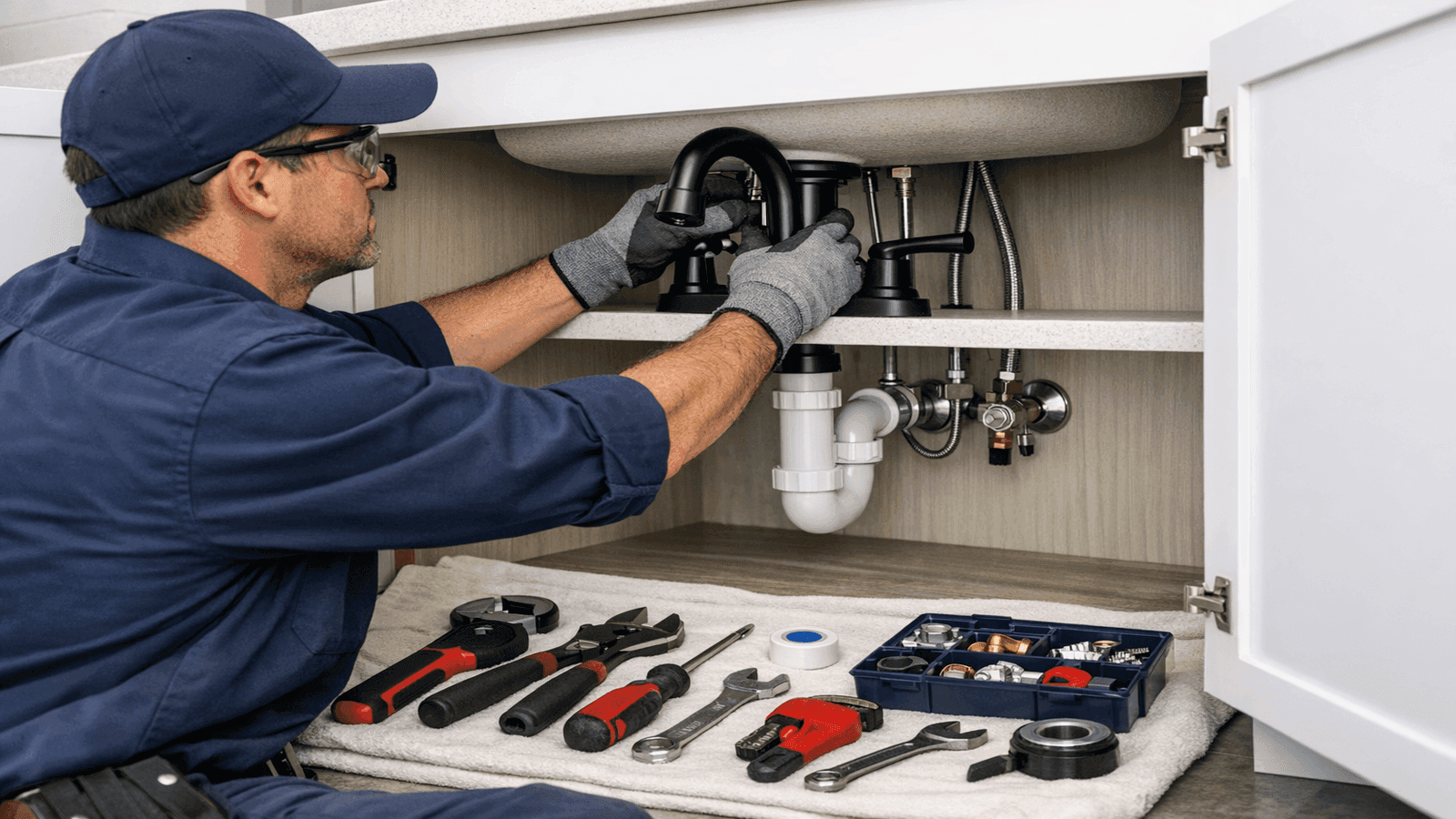
Photo: Licensed plumber in professional attire installing a matte black faucet under a bathroom vanity
When to Call a Plumber vs. DIY
Understanding the DIY boundary protects you from a flooded bathroom and code violations.
DIY-Safe Projects:
- Swapping a showerhead on an existing arm (no pipe work)
- Replacing a toilet seat (including bidet seats with a nearby outlet)
- Replacing a deck-mount faucet with same configuration (turn off supply stops, swap, reconnect)
- Installing a vessel sink on an existing vanity with existing holes
- Replacing a toilet with same rough-in dimension
Always Call a Licensed Plumber:
- Any change to rough-in dimensions (toilet, shower drain, tub drain)
- Wall-mount faucet installation (valve bodies set in wall before tile)
- Thermostatic or pressure-balance valve replacement (inside the shower wall)
- Ceiling-mount rainfall showerhead (pipe rerouting through ceiling)
- Adding a dedicated water line for a bidet or smart toilet if outlet circuit is insufficient
- Any fixture work in a home with galvanized or polybutylene supply lines (identify and replace before installing new fixtures)
Over 2,400 residential plumbing projects across Dallas-Fort Worth and California in 18 years, the call I get most often is the panicked 'I tried to swap the faucet myself and now water is spraying.' Nine times out of ten, it came down to a corroded supply stop that broke when they turned it off, or a flex line that wasn't rated for the new fixture. A $40 plumber consult call before you start can save a $500 to $1,200 emergency call-out.
Real Homeowner Case Study: Diane K., Frisco TX
Diane K. of Frisco, Texas contacted a licensed plumber in our NearbyHunt network after purchasing a package of modern fixtures for a primary bathroom remodel: a ceiling-mount rainfall showerhead, a wall-mount champagne bronze faucet, and an integrated smart toilet with auto-flush.
The problem: Diane had assumed all three could be DIY-installed based on online tutorials. Her water pressure tested at 38 PSI at the hose bib, and the bathroom had no GFCI outlet near the toilet. Her 1994-built home had a 12-inch rough-in that matched the smart toilet, but the shower supply lines were in the slab, not the wall, making ceiling reroute impossible without significant work.
The outcome: Her plumber rerouted the shower supply up the wall (not ceiling) to a wall-arm rainfall head at 10 inches, installed the wall-mount faucet valves correctly behind new tile, and added a GFCI outlet rough-in for the smart toilet. Total labor cost: $1,450. Total project including fixtures: $3,200. Diane avoided an estimated $2,000 to $3,500 in potential water damage repair costs by having the pressure issue and supply line routing assessed before installation. She rated the finished bathroom a top remodel decision for resale when she listed the home six months later.
Small Bathrooms, Farmhouse Style, and Universal Design
Fixture selection changes with bathroom size and design theme. For compact powder rooms and small bathrooms, wall-hung toilets, corner sinks, and single-handle wall-mount faucets maximize visual space. Explore our sibling guides for more detail: small-bathroom-plumbing covers layout strategies for tight spaces.
For farmhouse and rustic-modern bathrooms, unlacquered brass and oil-rubbed bronze finishes, apron-front sinks, and cross-handle faucets are the signature choices. See farmhouse-bathroom-ideas for a complete style guide.
For aging-in-place or accessibility remodels, lever-handle faucets, comfort-height (ADA) toilets, and curbless shower entries with handheld showerheads are the foundation. Our universal-design-plumbing guide covers grab bar installation and ADA clearance requirements in full.
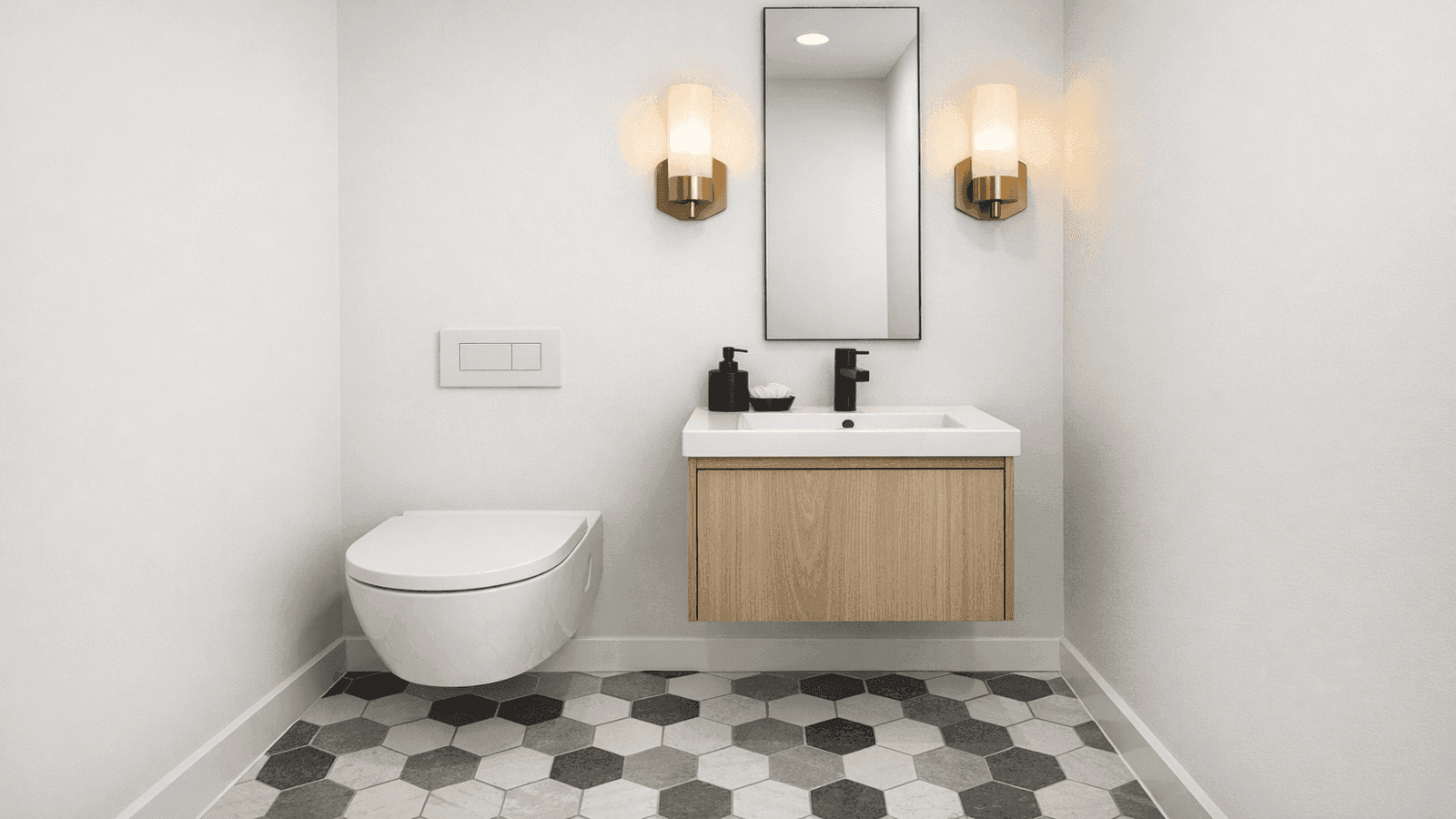
Photo: Small powder room with wall-hung toilet and compact floating vanity featuring matte black faucet
Disclaimer
The cost estimates, product price ranges, and installation time estimates in this article reflect national averages as of early 2026. Actual costs vary significantly by region, home age, fixture brand, and local labor rates. Always obtain written quotes from at least two licensed plumbers before committing to any project. Fixture installation involving changes to rough-in plumbing, supply lines inside walls, or electrical work near water requires licensed professionals and, in many jurisdictions, permits. This article is for educational purposes and does not constitute professional plumbing advice for your specific situation.
Sources & References
- National Association of Home Builders (NAHB) — Cost vs. Value Report: Bathroom Remodel ROI. https://www.nahb.org/
- Consumer Reports — Bathroom Faucet Finish Durability Guide. https://www.consumerreports.org/
- Forbes Home — Smart Toilet Market Analysis and Buyer Guide 2025. https://www.forbes.com/home-improvement/
- Bob Vila — Bathroom Fixture Replacement Costs 2025. https://www.bobvila.com/
- This Old House — How to Choose a Showerhead. https://www.thisoldhouse.com/
- U.S. Department of Energy (DOE) — WaterSense and Fixture Efficiency Standards. https://www.energy.gov/
- NAHB — Universal Design and Aging-in-Place Bathroom Guidelines. https://www.nahb.org/
- Bankrate — Home Improvement ROI: Bathroom Upgrades 2025. https://www.bankrate.com/


Michael Jennings is a licensed master plumber & water systems specialist with over 18 years of hands-on experience in residential and commercial plumbing, serving clients across California and Texas. At NearbyHunt, he shares practical advice on pipe installations, water heater maintenance, and home plumbing upgrades. Michael has helped thousands of homeowners prevent costly water damage and improve water efficiency through modern plumbing solutions.

Robert is a licensed master plumber with over 20 years of experience serving both residential and commercial clients across the Midwest. Specialising in advanced plumbing systems and sustainable water technologies, Rob brings deep technical insight and hands-on expertise to every project. As a reviewer for NearbyHunt, he ensures all plumbing content reflects the highest standards of safety, compliance, and practicality.