- Home plumbing operates on three critical subsystems (water supply, drainage, venting) governed by IPC 2024 codes updated in 2026.
- PEX dominates 60% of residential installations while copper remains the gold standard for commercial—material choice impacts 50+ year lifespan.
- IPC 2024 sets minimum requirements, but local amendments add 15-40% more restrictions—always check jurisdiction-specific codes.
- Green plumbing tech cuts water use 30-50% vs pre-2010 fixtures—EPA WaterSense certification now standard for new builds.
- State licensing requires 4-5 years of apprenticeship in this $130 billion industry, distinguishing pros from unlicensed operators.
- Preventive maintenance extends lifespan 40-60%—pro inspections catch issues before failures, costing 5-10x more to fix.

Get quotes from top-rated pros.
Every time you turn on a faucet, flush a toilet, or take a shower, you're relying on one of modern civilisation's most sophisticated yet invisible infrastructure systems—your plumbing. This complex network of pipes, fixtures, and mechanical systems operates silently behind your walls and beneath your floors, delivering clean water and safely removing waste. Yet most homeowners know surprisingly little about how it all works until something goes wrong.
Plumbing systems represent 10-15% of new home construction costs, a significant investment that protects your health and property value. The global plumbing industry reached $130 billion in 2026, supporting millions of jobs and preventing the waterborne diseases that affected millions before modern sanitation became standard. Understanding plumbing basics empowers better decision-making for repairs, upgrades, and new construction—whether you're maintaining your current home, planning a renovation, or considering a career in the trades.
This comprehensive guide covers the foundational knowledge every homeowner needs about plumbing systems and services. You'll learn about:
- Fundamental plumbing system components and operation
- Types of pipes and when to use each material
- Building codes and safety standards
- Professional plumbing services and career pathways
- Green and sustainable plumbing solutions
- Common terminology and historical context
- How plumbing differs from other home systems, like electrical and HVAC
What this guide does NOT cover: step-by-step DIY repair instructions, specific product recommendations or reviews, emergency troubleshooting procedures, or regional pricing guides. Our focus is educational, providing the foundational knowledge you need to make informed decisions and communicate effectively with professionals.
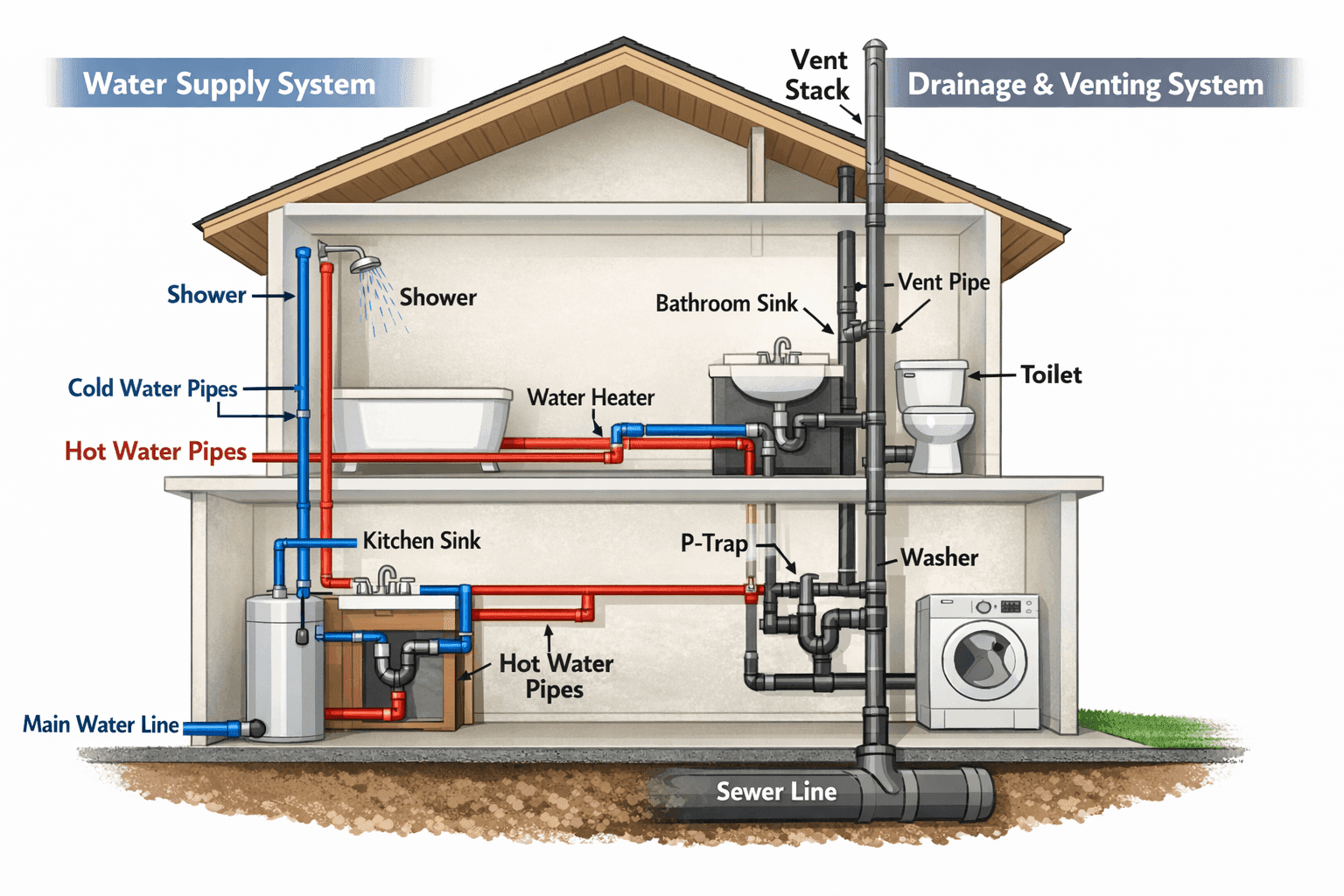
Photo: Overview of modern plumbing systems in residential home
In my 23 years as a master plumber, I've seen plumbing technology evolve dramatically—from copper-only installations to PEX dominance, from water-wasting fixtures to ultra-efficient WaterSense models. But the fundamentals haven't changed: proper venting, correct slope on drains, and adherence to code. Understanding these basics is the foundation for any homeowner or aspiring professional.
Plumbing System Fundamentals
Before diving into specific components and services, it's essential to understand what a plumbing system actually does and how its three core subsystems work together. Modern plumbing operates on principles refined over thousands of years, combining water supply, waste removal, and air circulation in a coordinated system that most homeowners never see.
The three core subsystems work in harmony to keep your home functioning properly:
These systems operate under different physical principles. Water supply operates under pressure provided by municipal systems or well pumps, pushing water upward and throughout your home. Drainage relies on gravity and proper slope—typically a minimum of 1/4 inch drop per foot of horizontal pipe—to move waste downward and out of your home. Vents equalize pressure and allow gases to escape safely, preventing the vacuum conditions that would slow or stop drainage.
Understanding these fundamentals helps homeowners:
- Recognize when problems affect specific subsystems
- Communicate more effectively with plumbers
- Make informed decisions about upgrades and repairs
- Understand code requirements and inspection findings
When a plumber explains that your slow drain is caused by improper venting rather than a clog, you'll understand why simply snaking the drain won't solve the underlying problem.
How Plumbing Works: Water Supply, Drainage & Venting
Modern plumbing systems operate on centuries-old principles enhanced by modern materials and engineering. The water supply system brings municipal or well water into your home at 40-80 PSI, distributing it through a network of pipes to fixtures and appliances. Meanwhile, the drainage system uses gravity and carefully calculated slopes to move wastewater away, while the venting system prevents vacuum conditions and sewer gas intrusion.
- The water supply system begins at the property line where municipal water enters through a meter, or at the wellhead for homes with private wells. A main shutoff valve allows you to stop all water flow to the home in emergencies. From there, cold water branches to fixtures throughout the house, with one line splitting off to the water heater to create your hot water supply. Modern systems use either trunk-and-branch configurations (one main line with branches to each fixture) or manifold systems (individual lines from a central distribution point to each fixture).
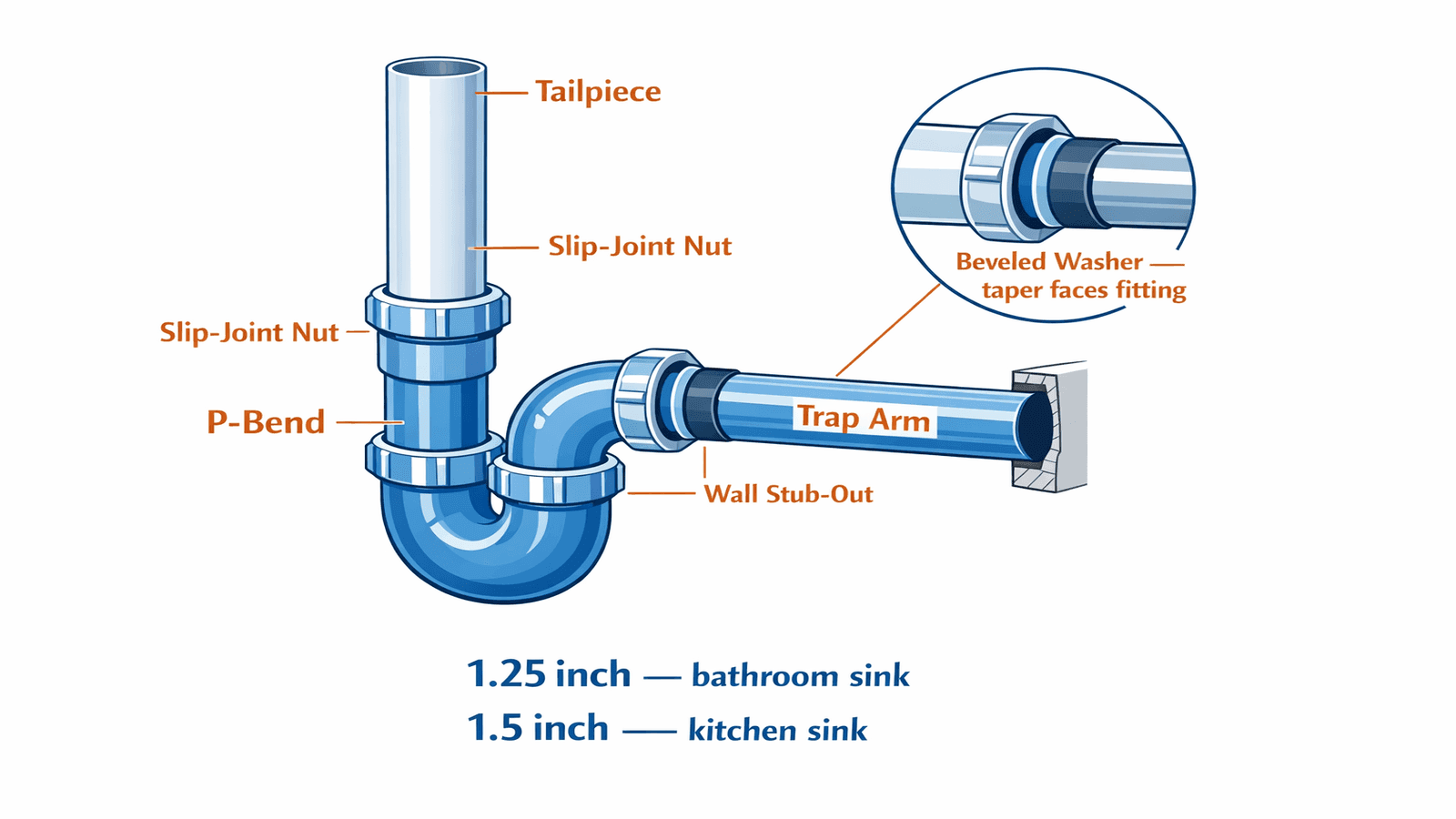
- The drainage system works entirely differently, relying on gravity rather than pressure. Every fixture connects to a drain line sloped at least 1/4 inch per foot, carrying wastewater to progressively larger pipes that eventually connect to your main sewer line or septic system. P-traps and S-traps beneath fixtures create water seals that block sewer gases from entering your home while allowing wastewater to pass through.
- The venting system is the least understood but equally critical component. Every drain needs air circulation to function properly, preventing vacuum conditions that slow drainage and cause siphoning in traps. Vent pipes typically run upward through your roof, allowing air to enter the drainage system and sewer gases to escape harmlessly above your home. Without proper venting, you'll experience slow drains, gurgling sounds, and potentially dry traps that allow dangerous sewer gases into living spaces.
For a complete technical breakdown of plumbing system operation, see our dedicated guide: How Plumbing Works: Complete System Guide. This comprehensive article covers step-by-step water flow diagrams, pressure and gravity principles, vent system configurations, common system layouts for different building types, and troubleshooting decision trees for when to call a professional.
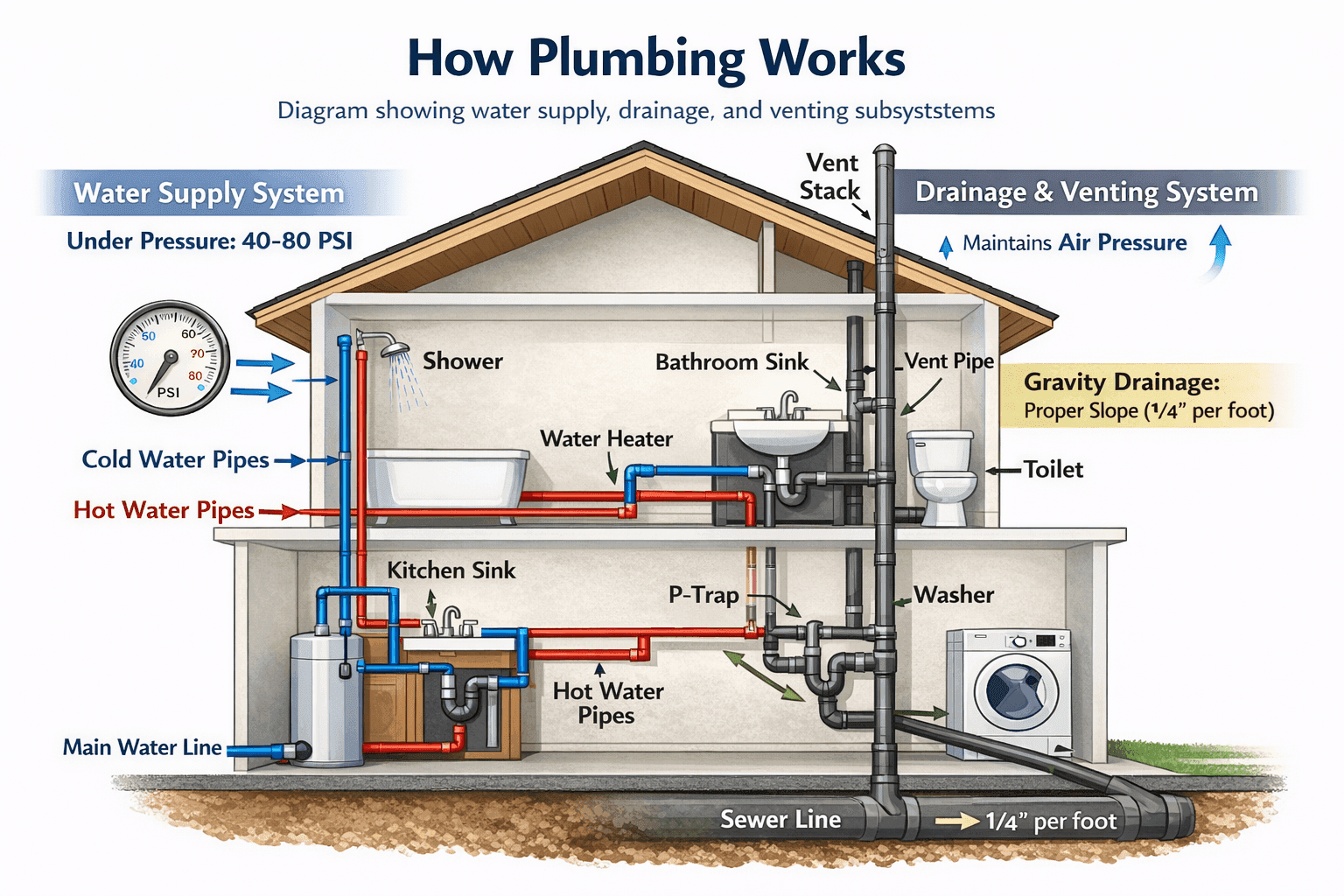
Photo: Diagram showing water supply, drainage, and venting subsystems
Types of Plumbing Pipes
The pipes in your plumbing system are not one-size-fits-all. Different materials offer distinct advantages for water supply versus drainage, hot versus cold water, and residential versus commercial applications. Choosing the wrong pipe material can lead to premature failure, code violations, or health hazards—making material selection one of the most important decisions in any plumbing project.
Water supply pipes have evolved dramatically over the past century:
- CPVC (Chlorinated Polyvinyl Chloride): Offers a cost-effective alternative to copper for both hot and cold water
- PVC (Polyvinyl Chloride): Works only for cold water applications
Drainage and waste pipes use different materials optimized for different requirements:
- ABS (Acrylonitrile Butadiene Styrene): Allowed in some jurisdictions but banned in others due to concerns about chemical resistance and joining methods
- Corrugated HDPE (High-Density Polyethylene): Serves exterior drainage and sewer lines where flexibility and chemical resistance matter more than appearance
Key comparison factors include:
- Lifespan: Ranges from 25 years for some plastics to 100+ years for copper and cast iron
- Temperature and Pressure Ratings: Determine which materials work for hot water and high-pressure applications
- Corrosion Resistance: Affects longevity in different water chemistries
- Ease of Installation: Determines whether homeowners can tackle projects themselves or must hire professionals
For detailed specifications, installation requirements, and material comparisons, see our comprehensive guide: Types of Plumbing Pipes: Complete Material Guide. This in-depth article includes material comparison tables showing lifespan, cost, and code compliance, guidance on when to use each pipe type, regional code variations, compatibility charts for mixed-material systems, and considerations for professional versus DIY installation.
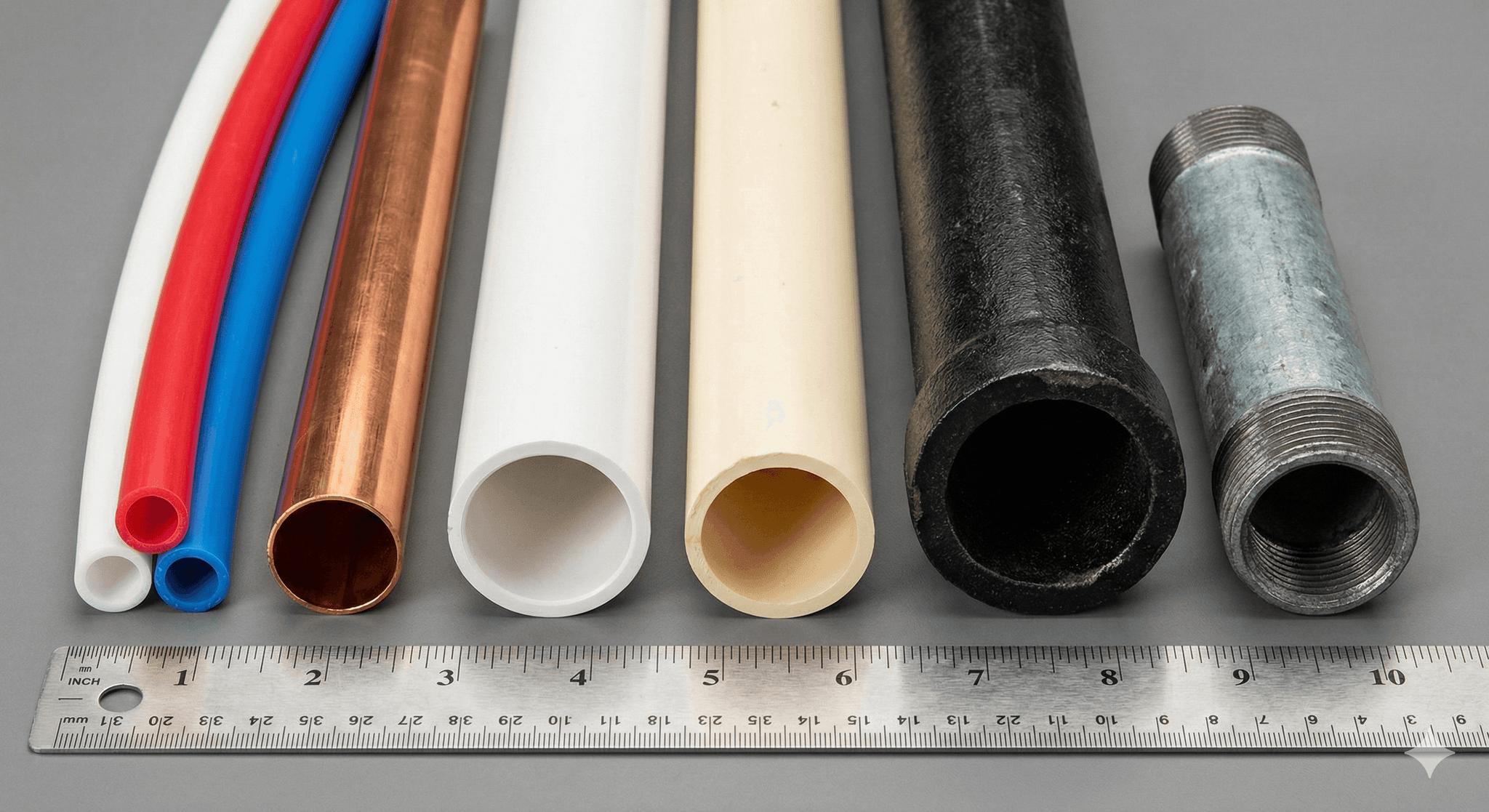
Photo: Comparison of different plumbing pipe materials
I started my career working exclusively with copper, and I was skeptical when PEX emerged. Twenty years later, I'm a complete convert for residential work. PEX installs 3-4x faster, costs 30-40% less, and I've seen zero failures on my installations. But in commercial settings with higher pressures and temperatures, copper is still king. Material selection isn't about 'best'—it's about 'best for this specific application.'
Plumbing Code Requirements & Building Standards
Plumbing codes are legally enforceable regulations that establish minimum standards for plumbing system design, installation, and materials. These codes exist to protect public health, ensure system reliability, and standardize construction practices across jurisdictions. Far from being bureaucratic red tape, building codes represent lessons learned from decades of failures and innovations, codified to prevent repeating past mistakes.
The primary code frameworks in 2026 include the International Plumbing Code (IPC) 2024, the most widely adopted model code in the United States. Published by the International Code Council (ICC) and updated every three years, the IPC covers residential, commercial, and industrial plumbing with a performance-based approach that allows some flexibility in meeting requirements.
The Uniform Plumbing Code (UPC) 2024 predominates in Western states, published by IAPMO (International Association of Plumbing and Mechanical Officials). The UPC tends to be more prescriptive than IPC in some areas, specifying exact methods rather than performance standards.
State and local amendments add another layer of complexity, often adding 15-40% more requirements beyond base codes to address regional issues like freezing temperatures, seismic activity, or water scarcity. Some jurisdictions restrict materials permitted under model codes—for example, several municipalities ban ABS pipe despite its approval in both the IPC and the UPC. Understanding which code applies in your area and what local amendments exist is essential for any plumbing project.
Key code requirements cover every aspect of plumbing installation:
- Minimum Pipe Sizes: Different fixture types require specific sizes to ensure adequate water supply and drainage capacity
- Drainage Slope Requirements: Typically 1/4 inch per foot to guarantee gravity flow without standing water
- Vent Sizing and Configuration: Rules prevent drainage problems and sewer gas intrusion
- Backflow Prevention: Device placement protects drinking water from contamination
- Water Heater Safety: Requirements mandate temperature and pressure relief valves
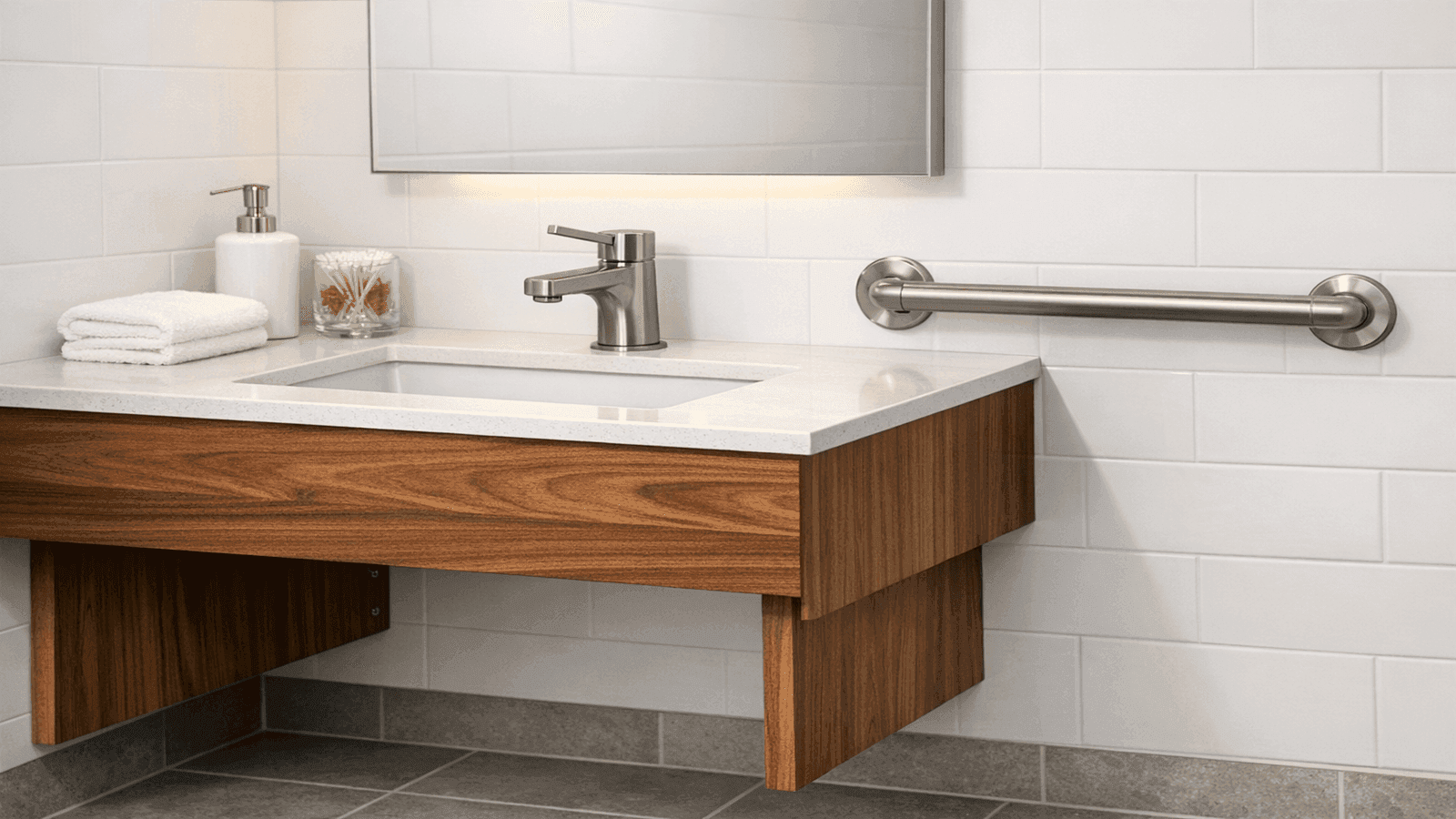
- Fixture Clearances and Accessibility: Standards ensure ADA compliance in commercial buildings and accessible features in residential construction
- Cross-Connection Control: Prevents contamination pathways between potable water and potential pollution sources
- Testing and Inspection Protocols: Verify proper installation before concealing work behind walls
The permit and inspection process typically requires permits for any work beyond simple fixture replacement. Inspections occur at rough-in (before concealing pipes) and final (after completion) stages.
Consequences of unpermitted work include:
- Legal liability in case of system failures
- Complications when selling or refinancing your home
- Insurance claim denials
- Public health risks from improper installation
For comprehensive coverage of code differences, state-by-state variations, permit processes, and code update cycles, see our guide: Plumbing Code Requirements & Building Standards.
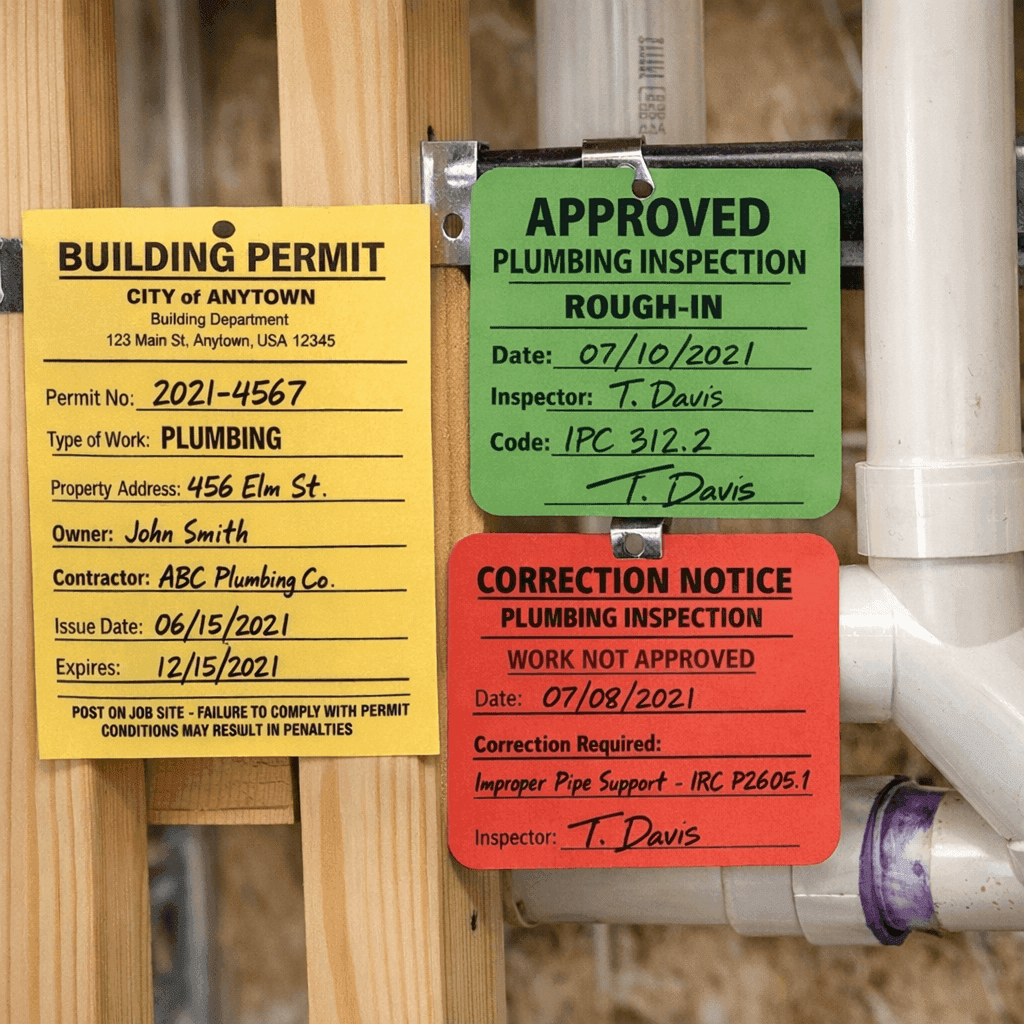
Photo: Example of building permit and inspection tags
The most common mistake I see homeowners make is hiring unlicensed 'handymen' for plumbing work to save money. When they go to sell the house, the inspection reveals unpermitted work, and now they're paying me twice—once to rip it all out, and again to reinstall it correctly with permits. Code compliance isn't red tape; it's the difference between a system that works for 50 years and one that fails catastrophically in 5.
| Aspect | IPC 2024 | UPC 2024 | Typical Local Amendments |
|---|---|---|---|
| Primary Adoption | Eastern/Central US | Western US | Varies by jurisdiction |
| Vent Sizing | Prescriptive tables | Prescriptive + engineered | May require larger sizes |
| ABS Pipe | Allowed for DWV | Allowed for DWV | Some states ban entirely |
| Trap Arm Length | Varies by fixture | More restrictive limits | Often more restrictive |
| Backflow Prevention | Required for specific hazards | More comprehensive requirements | May exceed model code |
| Water Heater Seismic | Not required (unless local) | Required in seismic zones | Mandatory in CA, WA, OR |
| Greywater Systems | Limited provisions | Detailed appendix | Increasingly required |
Get quotes from top-rated pros.
Plumbing Terminology
Plumbing has its own technical vocabulary that can sound like a foreign language to homeowners. Understanding basic terminology helps you communicate clearly with plumbers and inspectors, understand estimates and invoices, research problems and solutions, and avoid miscommunication that leads to wrong repairs or unnecessary work.
Essential system component terms:
- Fitting: Connectors joining pipes
- Valve: Flow control devices
- Trap: Curved pipe section holding water to block gases
- Vent: Air circulation pipes
- Stack: Vertical drain pipe
- Branch: Horizontal drain pipe
- Riser: Vertical supply pipe
- Manifold: Central distribution point
Distinguishing between supply lines (bringing clean water in) and drain lines (taking waste water out) helps clarify which system you're discussing.
Understanding water categories:
- Potable Water: Safe for drinking
- Blackwater: From toilets
Installation terms you'll hear from plumbers:
- Rough-In: Installing pipes before walls are closed
- Finish Plumbing: Installing fixtures and trim
- Backfill: Filling excavations around pipes
Installation methods vary by material:
- Soldering: For copper pipes
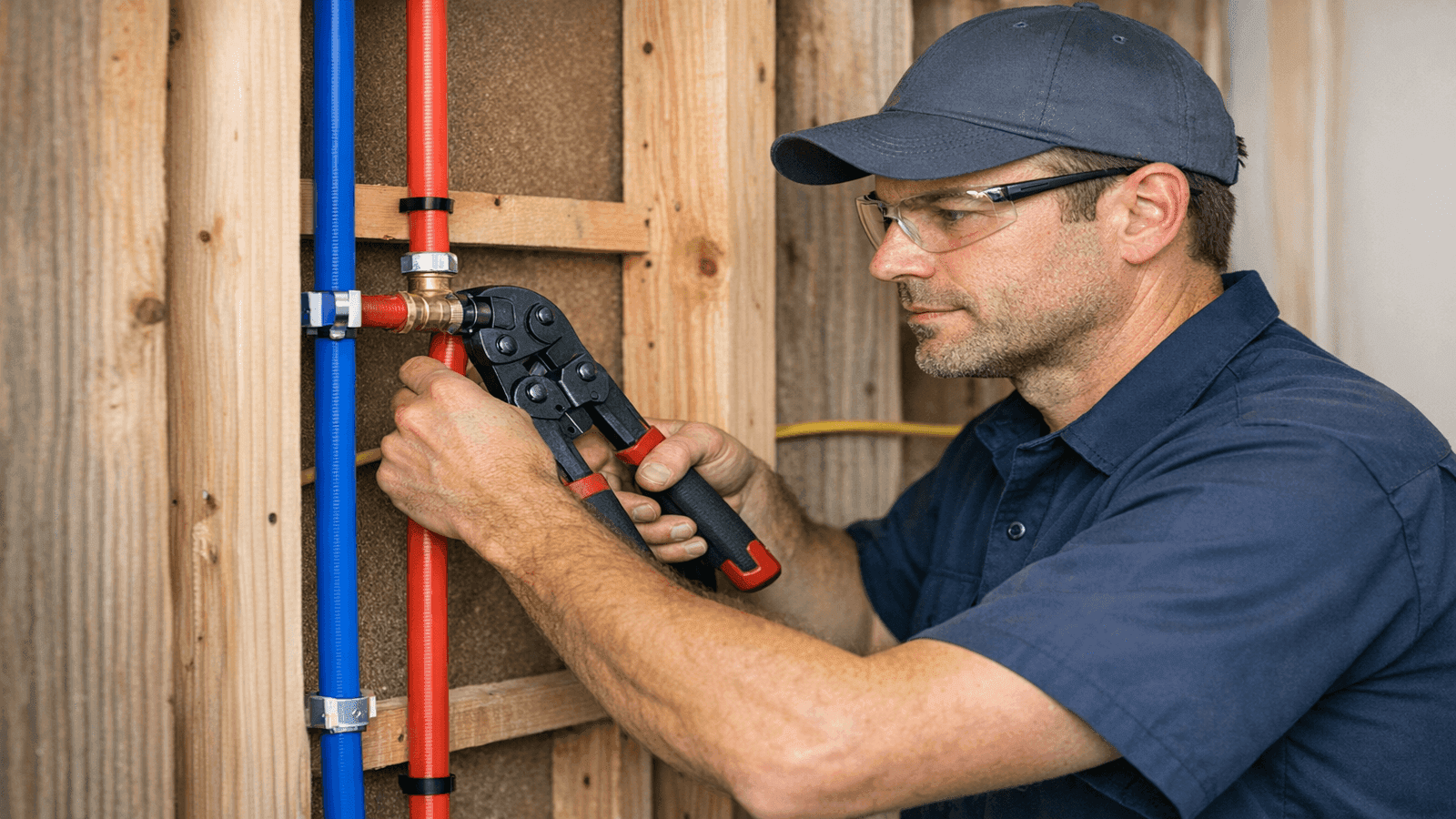
- Crimping: For PEX systems
- Glueing: For PVC/CPVC pipes
- Threading: For galvanised steel and black iron
Testing methods include pressure testing and drain testing to verify system integrity before concealing work.
Measurement and specification terminology can confuse homeowners unfamiliar with plumbing conventions:
- Nominal Pipe Size: Differs from actual diameter—a pipe called "1/2 inch" has an inside diameter closer to 5/8 inch due to historical sizing conventions
- PSI (Pounds Per Square Inch): Measures water pressure
- GPM (Gallons Per Minute): Rates flow capacity
- GPF (Gallons Per Flush): Measures toilet water consumption
- Schedule 40: Indicates PVC pipe wall thickness
Problem diagnosis terminology helps you understand what plumbers identify during inspections:
- Water Hammer: A banging sound when the water flow stops suddenly
- Cross-Connection: Any physical connection between potable and non-potable water
- Hydrostatic Pressure: Pressure from standing water
- Thermal Expansion: Occurs when water volume increases as it heats
- Sweating Pipes: Condensation on cold pipes
- Weeping Joints: Slow leaks at connection points
For a comprehensive alphabetical reference with 100+ terms, definitions, visual diagrams, and usage examples, see our resource: Plumbing Terms Glossary
The History of Plumbing
Understanding plumbing's evolution helps contextualise modern practices and appreciate the engineering achievements we take for granted. Many "modern" plumbing principles were actually discovered thousands of years ago, then forgotten during dark ages before being rediscovered and improved with new materials and technologies.
Ancient plumbing from 3000 BCE to 500 CE included some remarkably sophisticated systems. The Indus Valley civilisation built advanced drainage systems around 2600 BCE, with covered drains running beneath streets and sophisticated waste removal in cities like Mohenjo-Daro. Roman aqueducts and lead pipes (the Latin word plumbum, meaning lead, gives us "plumbing") brought water from sources up to 60 miles away, supplying public baths and private homes. The ancient Chinese developed bamboo pipe systems for transporting water and natural gas. Greek and Roman public baths and latrines demonstrated an understanding of sanitation and communal facilities.
The Medieval and Renaissance era, from 500 to 1700, saw a dramatic decline in sanitation after the Roman Empire's fall. Chamberpots and "night soil" collection became standard in European cities as centralised sewage systems disappeared. Early flush toilets appeared in 16th century England but remained rare luxuries. Disease and plague outbreaks were directly linked to poor sanitation, though the connection wasn't scientifically understood until the 19th century.
The Industrial Revolution from 1700 to 1900 brought rapid advances. Sir John Harington invented a flush toilet in 1596, but practical versions didn't appear until Alexander Cummings improved the design with an S-trap in 1775. Thomas Crapper's flush-valve innovations in the 1880s improved reliability and water efficiency, though, contrary to popular belief, he didn't invent the toilet. Cast iron pipe manufacturing enabled the standardisation of plumbing materials. Germ theory and the sanitation movement finally connected disease to contaminated water, driving investment in public water and sewer systems.
The modern era from 1900 to 2000 saw copper pipe standardisation from the 1930s through 1960s, establishing the material as the gold standard for water supply. National plumbing codes were developed starting in the 1920s, reducing disease and improving consistency across regions. The introduction of PVC in the 1960s and 1970s revolutionised drainage systems with affordable, corrosion-resistant materials. The water conservation movement in the 1980s and 1990s began reducing flush volumes and flow rates. PEX adoption from the 1990s through the 2000s enabled faster, cheaper installation for residential water supply systems.
Contemporary innovation from 2000 to 2026 has focused on efficiency and smart technology. Smart plumbing systems with leak detection prevent an average of $9,000 in water damage by automatically shutting off water when leaks are detected. Touchless fixtures and voice-activated controls reduce contamination and improve accessibility. Greywater recycling systems reuse water from showers and sinks for irrigation. EPA WaterSense certification, launched in 2006, has driven 30-50% reductions in fixture water consumption. Low-flow mandates now require 1.28 GPF toilets and 1.8 GPM showerheads in most new construction.
For a detailed timeline covering ancient innovations, key inventors, code development, and technology evolution with historical photos and diagrams, see our article: History of Plumbing.
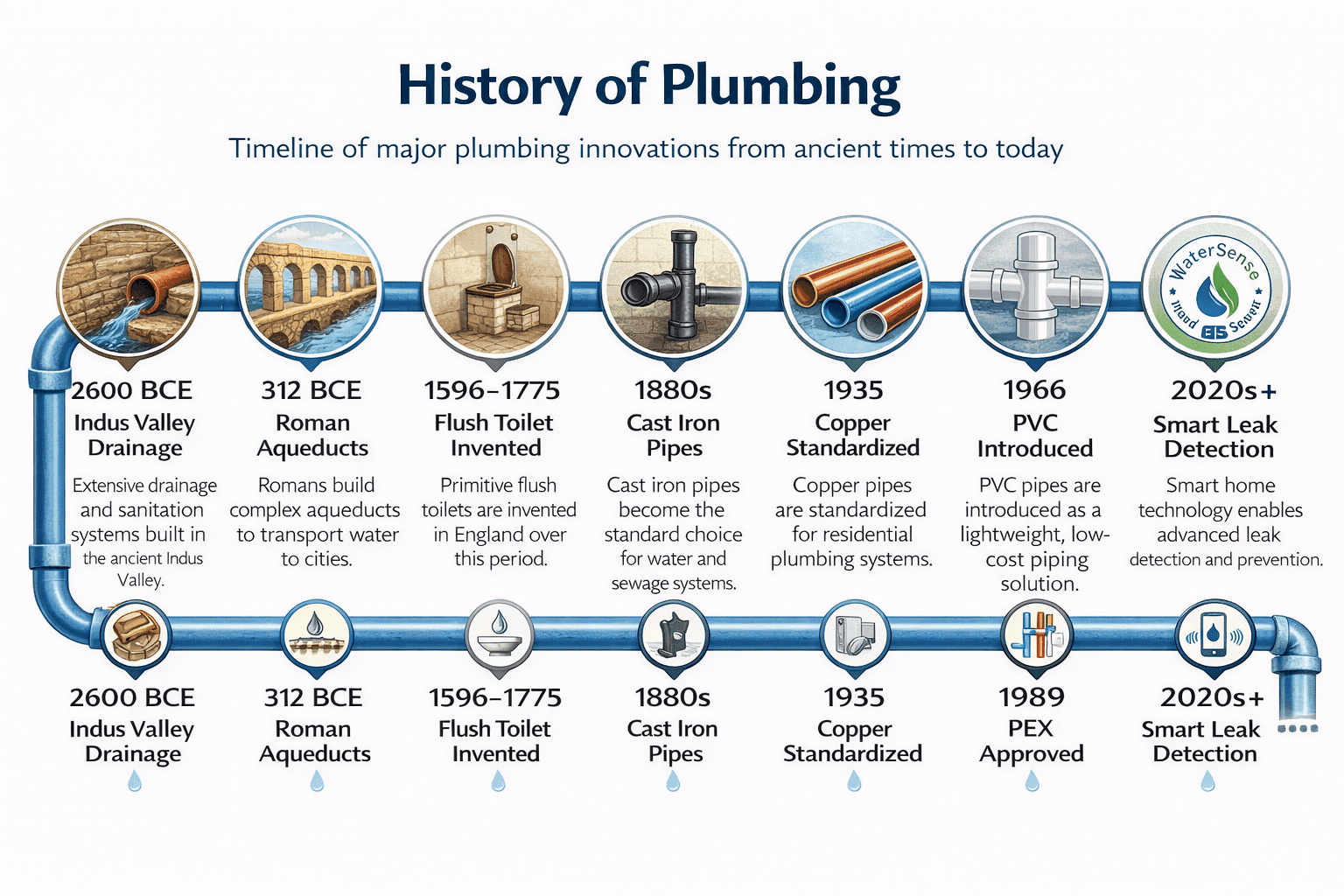
Photo: Historical plumbing timeline visualization
| Era | Key Innovation | Impact |
|---|---|---|
| 2600 BCE | Indus Valley drainage | First urban sanitation systems |
| 312 BCE | Roman aqueducts | Long-distance water transport (up to 60 miles) |
| 1596 | Harington flush toilet | Modern toilet concept introduced |
| 1775 | S-trap invention | Sewer gas blocking enabled indoor toilets |
| 1880s | Cast iron pipe mass production | Standardized plumbing materials |
| 1935 | Copper tube standardization | Reliable water supply systems |
| 1966 | PVC pipe introduction | Cost-effective, corrosion-proof drainage |
| 1989 | PEX approved for US use | Faster, cheaper residential installations |
| 2006 | EPA WaterSense program | 30-50% water use reduction |
| 2020s | Smart leak detection | Prevent $9,000 average water damage claims |
Plumbing vs. Electrical & Other Home Systems
Homeowners often confuse which tradesperson they need for different projects. Understanding the differences between plumbing, electrical, HVAC, and gas systems helps you:
- Hire the correct licensed professional
- Understand jurisdictional permit requirements
- Recognise when multiple trades need coordination
- Avoid dangerous DIY mistakes that could damage your home or injure your family
Plumbing and electrical systems share several similarities. Both require licensed professionals for major work, involve concealed systems within walls and ceilings, are governed by strict building codes, and have serious safety implications if done incorrectly. Both trades require years of training and apprenticeship before licensing. However, the key differences are substantial and important.
Plumbing transports water and waste using pressure and gravity, with leaks that are immediate and visible. Water damage from plumbing failures shows up as flooding, water stains, and mould growth—obvious problems that demand immediate attention. Electrical systems distribute power using voltage and amperage, with hazards that are often invisible until they cause shock or fire. Electrical failures may smoulder inside walls for hours before flames appear, making them potentially more dangerous despite being less immediately obvious.
The materials differ fundamentally. Plumbing uses pipes and fittings made from copper, PEX, PVC, or other materials designed to contain liquids and gases. Electrical uses wires and conduits designed to safely carry current while preventing shock and fire. Testing methods reflect these differences—plumbers use pressure tests to verify there are no leaks, while electricians use multimeters to measure voltage, amperage, and resistance.
DIY-friendliness varies between the trades. Plumbing is slightly more accessible for minor repairs, such as replacing faucet cartridges or clearing simple clogs, though major work still requires professionals. Electrical work is generally less DIY-friendly due to the risk of shock and fire, and many jurisdictions prohibit unlicensed electrical work entirely. Emergency risks differ dramatically—electrical failures cause fires that can destroy homes and kill occupants in minutes, while plumbing failures cause floods that damage property but rarely threaten lives directly.
Systems often overlap in ways that require multiple trades:
- Water Heaters: Need both plumbing and electrical or gas connections
- Sump Pumps: Combine plumbing drainage with electrical pumps
- Garbage Disposals: Connect to both drain lines and electrical circuits
- Well Pumps: Require plumbing and electrical coordination
Plumbing and HVAC systems both distribute fluids through buildings—HVAC systems move air and refrigerant, while plumbing systems move water and waste. Both use ducting or piping systems concealed in walls and ceilings. Both affect indoor comfort and health: HVAC controls temperature and air quality, while plumbing provides water and sanitation. Some technicians cross-train in both trades, especially for radiant floor heating systems that use hot water pipes to heat spaces.
Gas fitting often requires a separate license from plumbing, though many plumbers obtain both certifications. Gas and water systems use similar pipe materials and installation techniques, but different code requirements and testing methods apply. Safety hazards differ dramatically—gas leaks create explosion risks while water leaks cause flood damage.
For detailed comparisons covering licensing differences, code jurisdictions, when to hire which professional, and multi-trade coordination for complex projects, see our guide: Plumbing vs. Electrical & Other Home Systems.
Green Plumbing & Water Conservation Solutions
Green plumbing refers to practices, materials, and technologies that reduce water waste, lower energy consumption, and minimise environmental impact while maintaining or improving performance.
The green plumbing market reached $18 billion in 2026, driven by:
- Water scarcity in Western states
- LEED certification requirements for commercial buildings
- Growing consumer environmental awareness
Water-efficient fixtures deliver 30-50% savings over older models:
- EPA WaterSense Certification: Fixtures meet strict performance and efficiency criteria verified through independent testing
- Low-Flow Showerheads: Deliver satisfying pressure at 1.8 GPM versus old 2.5+ GPM models
- Faucet Aerators: Reduce flow to 1.5 GPM versus old 2.2 GPM standards while maintaining pressure through air injection
- Touchless Fixtures: Sensor-activated to prevent water waste from taps left running
Hot water efficiency improvements can reduce energy costs by 24-34% or more:
- Tankless Water Heaters: Operate 24-34% more efficiently by heating water only when needed rather than maintaining a 40-50 gallon reservoir at a constant temperature
- Heat Pump Water Heaters: Operate 2-3 times more efficiently than electric resistance heaters by moving heat rather than generating it
- Solar Water Heating Systems: Can deliver 40-80% energy savings in sunny climates with proper system sizing
Greywater Systems
Reuse water from laundry, showers, and bathroom sinks for landscape irrigation, reducing outdoor water use by 30-50%.
- Code Requirements: Increasingly required in drought-prone regions
Rainwater Harvesting
Captures roof runoff for toilet flushing and irrigation.
- Commercial systems can offset 40-60% of total water use with proper tank sizing
Leak Detection Technology
Smart water monitors have advanced dramatically in recent years:
- Detection Capability: Detect leaks as small as a few drops per minute
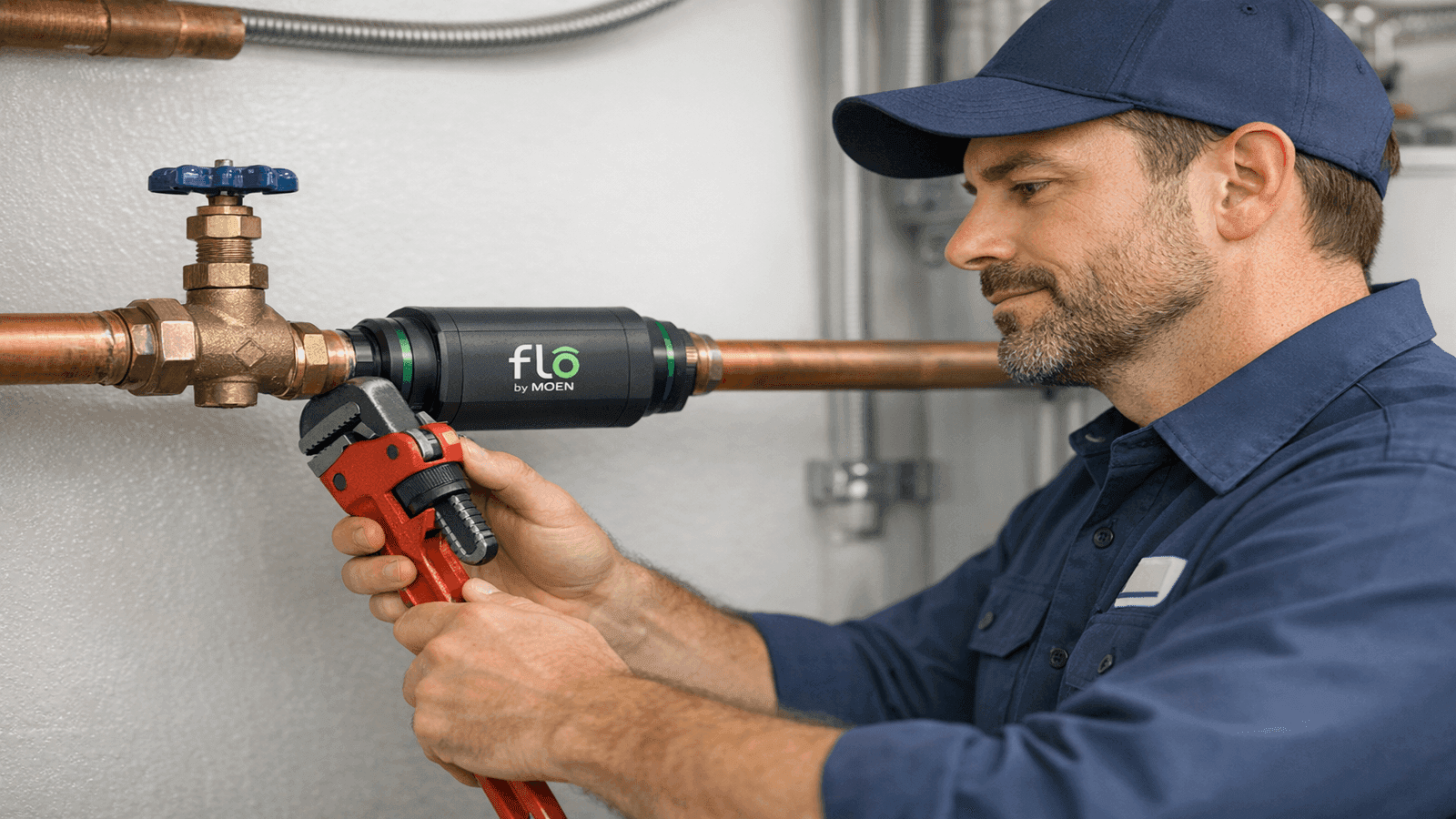
- Conservation Impact: EPA estimates 10-14% of home water use comes from leaks
Environmental and financial benefits:
- Annual Savings: Average household saves $380 per year with WaterSense fixtures
- Reduced Infrastructure Costs: Lower municipal water treatment demand benefits entire communities
- Lower Energy Bills: Heating water accounts for 14-25% of home energy use
- Drought Resilience: Helps communities manage water scarcity
- Increased Property Value: Green certifications and lower operating costs attract buyers
Code Requirements in 2026
Requirements vary by jurisdiction:
- California: Mandates WaterSense fixtures for all new construction and remodels
- Colorado: Requires greywater-ready plumbing in new homes with stub-outs for future system installation
- National Standards: Energy Policy Act of 1992 (updated 2016) sets maximum flow rates for fixtures sold in the United States
For comprehensive coverage of fixture specifications, greywater system design, ROI calculations, rebate programs, and installation requirements, see our resource: Green Plumbing Solutions.
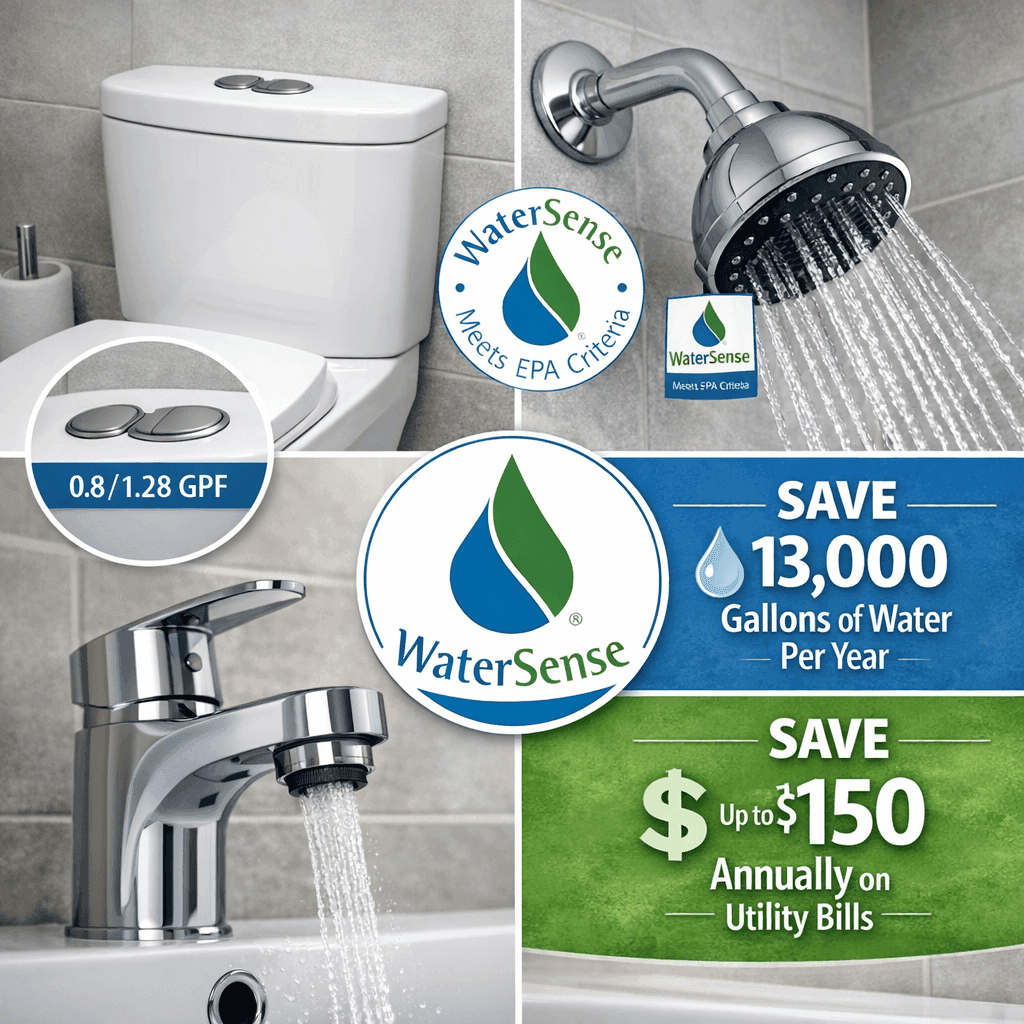
Photo: WaterSense certified fixtures and water savings
| Fixture Type | Old Standard | Current Standard | WaterSense/Best | Annual Savings (4-person household) |
|---|---|---|---|---|
| Toilet | 3.5 GPF | 1.6 GPF | 1.28 GPF (dual: 0.8/1.28) | 12,000 gal / $45 |
| Showerhead | 2.5 GPM | 2.5 GPM | 1.8 GPM | 7,300 gal / $27 |
| Bathroom Faucet | 2.2 GPM | 2.2 GPM | 1.5 GPM | 3,650 gal / $14 |
| Kitchen Faucet | 2.2 GPM | 2.2 GPM | 1.8 GPM | 2,400 gal / $9 |
| Washing Machine | 40 gal/load | 27 gal/load | 15 gal/load (ENERGY STAR) | 6,000 gal / $23 |
| TOTAL SAVINGS | — | — | — | **31,350 gal / $118** |
*Note: Savings calculated at $3.75 per 1,000 gallons (national average water/sewer rate, 2026)*
I've installed thousands of WaterSense toilets, and I've never had a customer complain about performance. The myth that low-flow means weak flushing died 15 years ago. Modern dual-flush toilets clear better than old 3.5-gallon models while using 70% less water. And when I show customers their water bills dropping $40-60 per month after upgrading fixtures, they wonder why they waited so long.
Common Plumbing Problems
While this guide doesn't provide DIY repair instructions, understanding common plumbing problems helps homeowners recognise early warning signs before catastrophic failures, communicate issues clearly to plumbers, understand whether problems require emergency service, make informed decisions about repair versus replacement, and anticipate costs and project timelines.
Survey data from 2026 reveals the most common residential plumbing problems:
Dripping Faucets (37% of service calls)
- Repairs range from simple fixture replacement to complex valve work
Running Toilets (29% of service calls)
- Waste 200+ gallons per day
- Add $150-300 to annual water bills
Clogged Drains (24% of service calls)
- Kitchen clogs typically involve grease and food debris
- Bathroom clogs come from hair and soap scum
- Main line clogs often result from tree roots or collapsed pipes
- Chemical drain cleaners can damage pipes—professional cleaning recommended
Low Water Pressure (18% of service calls)
Can indicate:
- Aerator clogs
- Pressure reducing valve failure
- Pipe corrosion
- Municipal supply issues
Diagnosis is essential to determine whether you have a system problem or a fixture problem.
Water Heater Issues (15% of service calls)
Common problems include:
- No hot water
- Insufficient hot water
- Strange noises
- Leaks
Average lifespan: 8-12 years for tanks, 15-20 years for tankless (requires periodic descaling)
Leaking Pipes (12% of service calls)
Types of leaks:
- Joint leaks
- Pinhole leaks from copper corrosion
- Burst pipes from freezing
Consequences: Average insurance claim reaches $9,000. Leaks can cause mould growth and structural damage if left unaddressed.
Sewer Line Problems (8% of service calls):When to Call a Professional Immediately
Situations requiring emergency service:
- No water throughout the house (main line issue)
- Sewage backup into the house
- Gas odor near a gas water heater
- Water heater leaking or hissing
- Burst pipes or flooding
- Frozen pipes before they burst
These create immediate health hazards or property damage risks.
When Professional Service Can Wait (But Shouldn't Be Ignored)
Issues to address promptly:
- Slow drains before they become full clogs
- Minor faucet drips
- Running toilets
- Slightly low pressure
- Water heaters making noise but still functioning
Addressing these issues promptly prevents more expensive emergency repairs later.
Average Problem Resolution Costs (2026)
- Faucet repair: $150-300
- Toilet repair: $180-350
- Drain cleaning: $225-450
For detailed coverage of problem diagnosis, emergency versus non-emergency classification, what to expect during service calls, and preventive maintenance schedules, see our guide: Common Plumbing Problems.
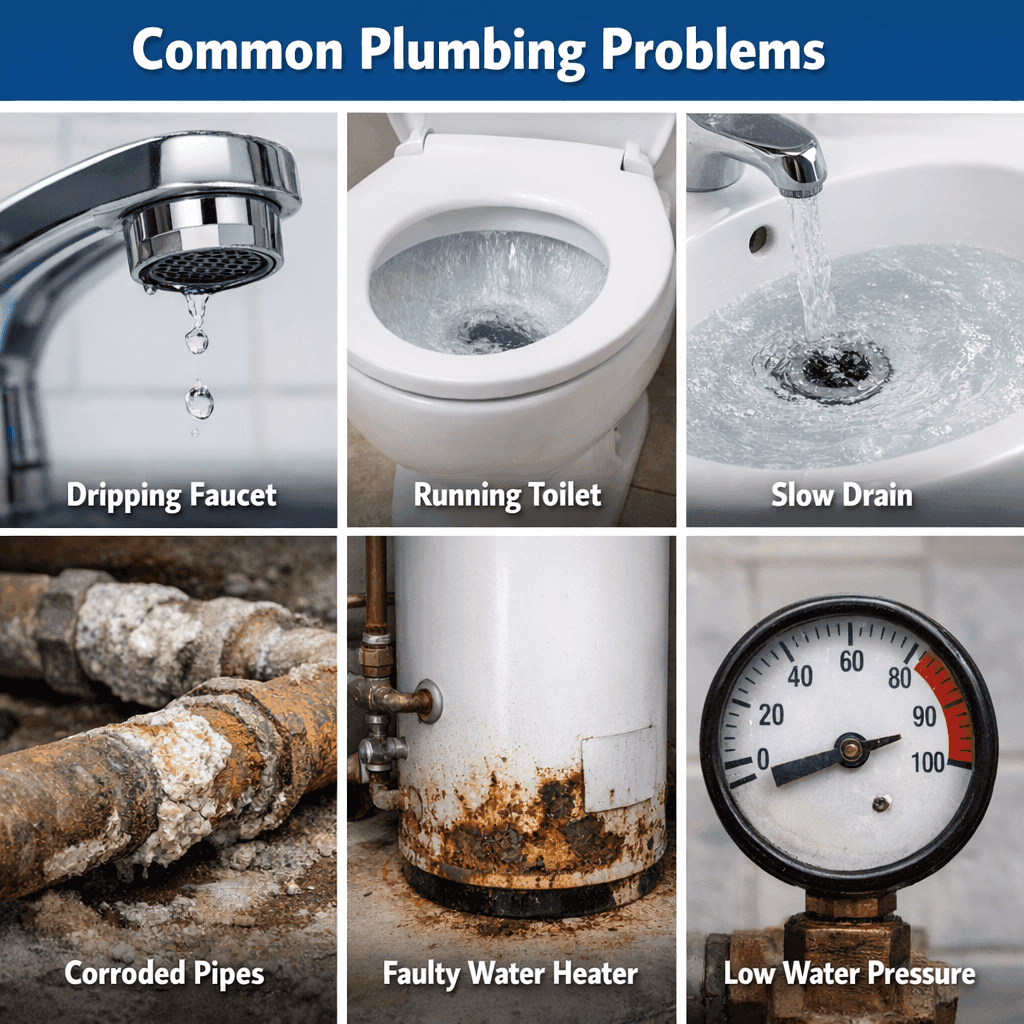
Photo: Common plumbing problems and warning signs
Get quotes from top-rated pros.
| Issue | Emergency? | Response Time | Average Cost | Consequences of Delay |
|---|---|---|---|---|
| Burst pipe/flooding | YES | Immediate | $800-2,500 | $5,000-50,000 water damage |
| Sewage backup | YES | Same day | $500-2,000 | Health hazard, property damage |
| No hot water (winter) | YES | Same day | $300-1,500 | Frozen pipes, health risk |
| Gas odor | YES | Immediate | $200-1,000 | Explosion, CO poisoning |
| Slab leak | YES | 24 hours | $2,000-10,000 | Foundation damage |
| Slow drain | NO | 1-3 days | $150-400 | Full clog, backup risk |
| Running toilet | NO | 1-5 days | $180-350 | High water bills |
| Dripping faucet | NO | 1-7 days | $150-300 | Water waste, $50+/year cost |
| Low pressure | NO | 1-5 days | $200-800 | Inconvenience, possible pipe issue |
| Water heater noise | NO | 1-14 days | $200-3,500 | Reduced efficiency, eventual failure |
Plumbing Careers: Licensing, Training & Professional Pathways
Plumbing is a skilled trade offering stable, well-paying careers that can't be outsourced or automated. The U.S. Bureau of Labor Statistics projects 6% growth in plumbing jobs through 2032, faster than average for all occupations. With an aging workforce (median plumber age: 42), the industry faces a skilled labor shortage creating opportunities for new professionals.
Career Statistics for 2026
The licensing pathway follows a structured progression. Apprentice plumbers spend 4-5 years completing 8,000-10,000 hours of on-the-job training combined with 550-1,000 hours of classroom instruction. They work under licensed journeyman or master plumber supervision while earning $28,000-$45,000 per year. This "earn while you learn" model avoids the student debt burden of four-year college degrees.
Journeyman plumbers have passed state licensing exams including written and practical components. They can work independently on most projects but cannot pull permits or supervise others in most states. Typical earnings range from $45,000-$70,000 per year depending on experience and location.
Master plumbers have completed an additional 2-4 years of experience as journeymen and passed master plumber exams. They can supervise other plumbers, pull permits, and own plumbing contracting businesses. Master plumber licenses are required for contracting in most states. Typical earnings range from $65,000-$150,000 or more, with business owners at the higher end.
Educational Requirements and Training Paths
- Minimum Requirement: High school diploma or GED
- Apprenticeship Programs: Through unions or non-union contractors (primary training path)
- Trade and Technical Schools: 6-month to 2-year programs teaching fundamentals
- Community Colleges: Associate of Applied Science degrees combining academic coursework with hands-on training
Specialization Options
Plumbers can focus on particular market segments:
- Residential vs Commercial: Different scale systems and code requirements
- Service and Repair vs New Construction: Distinct skill sets and work environments
- Green and Sustainable Plumbing: Growing rapidly with water conservation focus
- Medical Gas Systems: Hospitals require additional certification
- Industrial and Process Piping: High-pressure systems and specialized materials
- Fire Sprinkler Systems: Often require separate licensing
Skills Beyond Plumbing
Essential for career success:
- Customer Service and Communication: Determine customer satisfaction and referrals
- Business Management: Crucial for contractors running their own companies
- Code Interpretation: Ensures compliant installations
- Blueprint Reading: Translates architectural plans into plumbing systems
- Problem Diagnosis: Separates average plumbers from excellent ones
Career Benefits Beyond Salary
- Job Security: Essential trade that can't be eliminated or outsourced
- Geographic Flexibility: Work anywhere you want to live
- Low Student Debt: Financial freedom earlier compared to four-year degrees
- Entrepreneurship Opportunities: Build your own business
- Tangible Results: See and be proud of your work
- Continuous Learning: Codes and technology keep careers interesting
For comprehensive coverage including state-by-state licensing requirements, apprenticeship program directories, exam preparation resources, salary surveys, and career advancement strategies, see our guide: Plumbing Careers Guide.
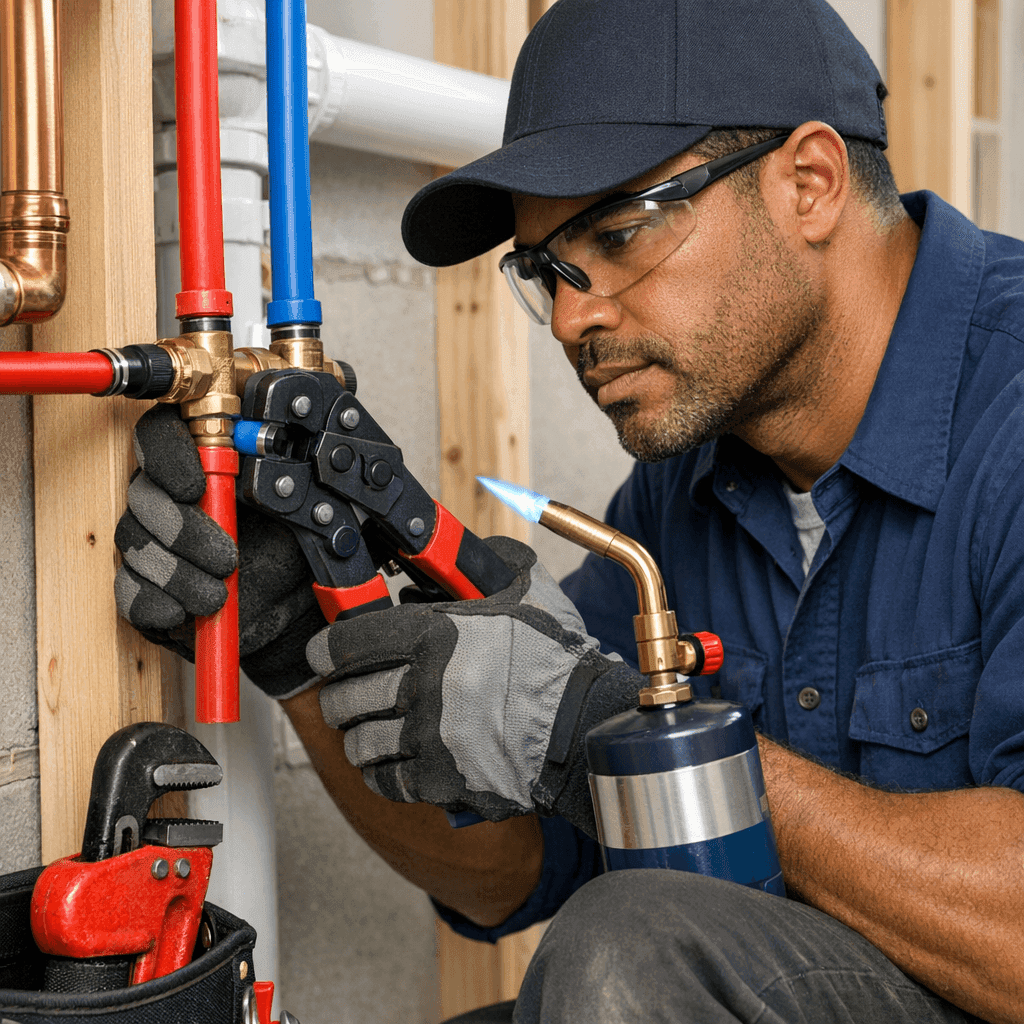
Photo: Plumber at work showing professional tools and skills
I started as an apprentice making $12/hour in 2001. By the time I got my master license in 2008, I was earning $65,000 as a journeyman. I started my own business in 2012, and now I run a team of 8 plumbers with annual revenue over $1.2 million. My nephew just graduated with a computer science degree and $80,000 in student loans—he's making less than my third-year apprentices. The trades offer a path to financial stability that more young people should consider.
Plumbing Safety Standards & Best Practices
Improperly installed or maintained plumbing creates serious hazards:
- Health Risks: Cross-contamination between potable water and waste or chemicals
- Scalding: Water heaters set too high (water over 120°F causes burns in under one minute)
- Fire and Explosion: Risks from gas water heater installations
- Environmental Harm: Sewage contamination of groundwater
Backflow Prevention
Prevents contaminated water from entering the drinking water supply.
Code requires backflow prevention devices for:
- Irrigation systems that might draw fertilizers or pesticides into supply lines
- Commercial kitchens where hoses might contact dirty water
- Medical facilities with potential chemical contamination
- Any system where non-potable water could reverse flow
Device types:
- Air Gaps: Physical separation preventing backflow
- Vacuum Breakers: Allow air in to prevent siphoning
- Mechanical Backflow Preventers: Use check valves and springs
Annual testing required for commercial installations, performed by certified technicians.
Water Heater Safety Systems
Prevent catastrophic failures:
- Combustion Air Supply: Ensures gas heaters have adequate oxygen for complete combustion
- Carbon Monoxide Detectors: Provide early warning of incomplete combustion or venting problems near gas heaters
- Proper Venting: Prevents carbon monoxide poisoning by directing combustion gases outside
- Expansion Tanks: Prevent thermal expansion damage by providing a cushion for water volume increases
Drainage and venting safety systems prevent dangerous gas intrusion. Traps create water seals preventing sewer gas entry—methane and hydrogen sulfide gases that are toxic, flammable, and foul-smelling. Proper venting prevents siphoning that would drain traps and maintains trap seals. Air Admittance Valves (AAVs) provide vent alternatives where conventional venting is impractical, though not all jurisdictions allow them.
Material Safety Requirements
Protect health and system integrity:
- PEX Certification: Cross-linked PEX must meet NSF/ANSI 61 certification for potable water contact
- Proper Pipe Support: Prevents sagging and stress fractures that lead to leaks
Gas System Safety
Requires specialized knowledge and equipment:
- Leak Detection: Soap solutions or electronic sniffers find even tiny leaks
- Proper Sizing Calculations: Ensure adequate gas delivery at correct pressure
- Pressure Testing: Verifies system integrity before activation
- CSST Bonding: Corrugated Stainless Steel Tubing bonding prevents lightning damage and potential leaks
- Earthquake Shutoff Valves: Automatically close gas lines when seismic activity detected
Professional Safety Standards
- OSHA Regulations: Trenching and confined spaces standards prevent worker injuries and deaths
- Safe Tool Handling: Proper handling of tools and materials prevents injuries
Homeowner Safety Practices
- Know Your Main Water Shutoff: Be able to access and operate it quickly in emergencies
- Annual Water Heater Inspections: Catch problems before failures occur
- Winterization Procedures: Protect plumbing in freezing climates
- Chemical Safety: Never mix chemical drain cleaners with each other or with other chemicals
- Earthquake Preparedness: Know gas shutoff valve location and have a wrench available
For detailed coverage of backflow prevention testing, TPR valve operation, gas system safety, lead-free compliance, and emergency shutoff procedures, see our guide: Plumbing Safety Standards.
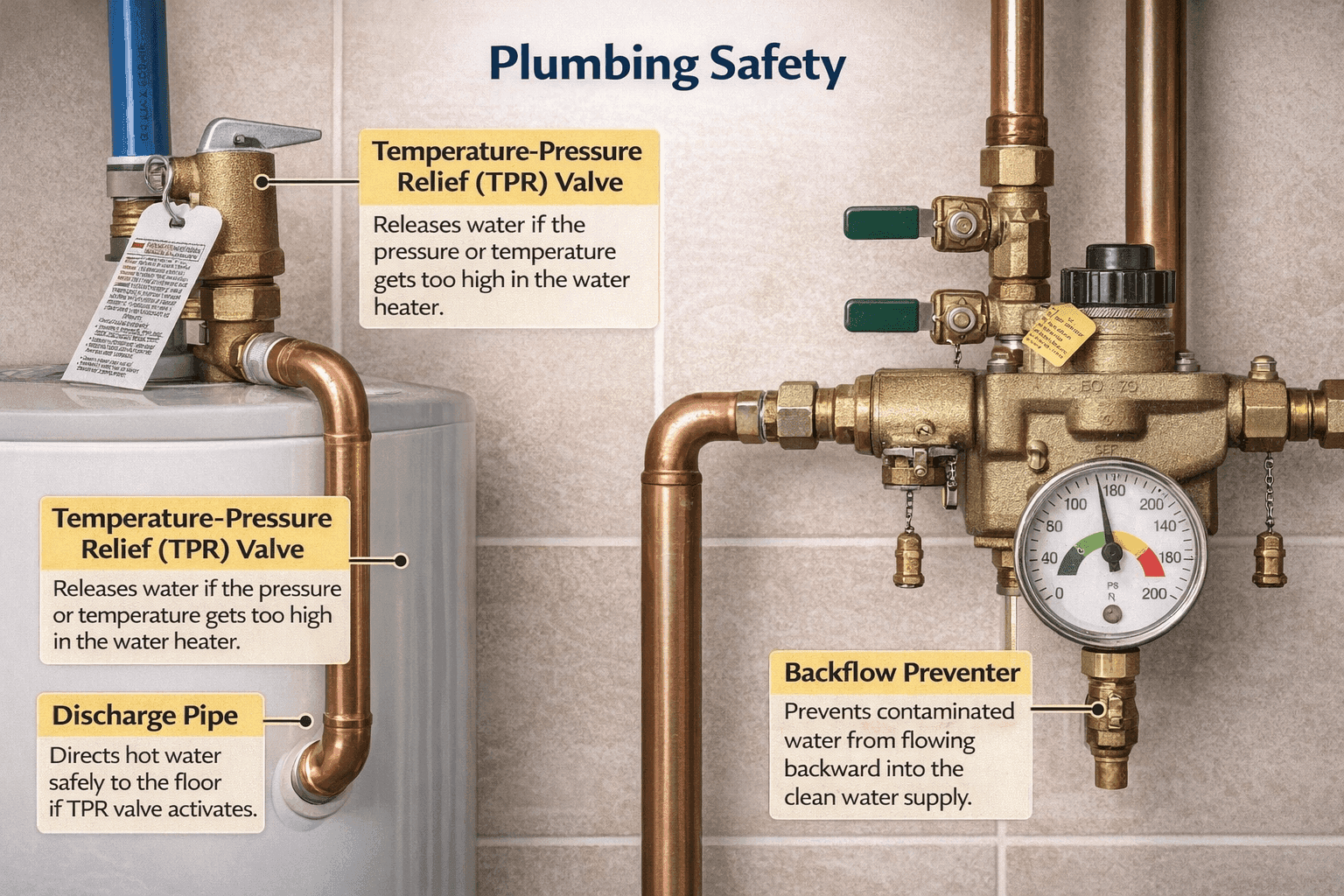
Photo: Plumbing safety devices including TPR valve and backflow preventer
The scariest call I ever responded to was a DIY water heater installation where the homeowner didn't install a TPR valve. The tank built up so much pressure it launched through their garage ceiling like a rocket—missed killing someone by 10 feet. That $40 valve exists for a reason. Plumbing safety devices aren't optional 'extras'—they're the difference between a functioning system and a catastrophe.
Conclusion
Throughout this comprehensive guide, we've explored the foundational knowledge every homeowner and aspiring professional should understand about plumbing systems and services.
The three core subsystems—water supply, drainage, and venting—work together to deliver clean water and safely remove waste, creating the invisible infrastructure that makes modern life possible.
Pipe selection significantly impacts system longevity: PEX dominates residential installations, while copper remains the commercial standard, and each material offers specific advantages for particular applications.
After 23 years in this trade, I've learned that good plumbing is invisible. Nobody notices it when it works perfectly—they only notice when something goes wrong. That's the mark of quality work: a system so reliable you forget it exists. Whether you're a homeowner maintaining your property or considering a plumbing career, remember this: plumbing isn't glamorous, but it's essential. Every civilization that's prospered has had one thing in common—clean water in, waste water out. Everything else is built on that foundation.
Get quotes from top-rated pros.
Sources & References
- U.S. Bureau of Labor Statistics. (2026). "Plumbers, Pipefitters, and Steamfitters - Occupational Outlook Handbook." https://www.bls.gov/ooh/construction-and-extraction/plumbers-pipefitters-and-steamfitters.htm
- Environmental Protection Agency. (2026). "WaterSense: An EPA Partnership Program." https://www.epa.gov/watersense
- International Code Council. (2024). "International Plumbing Code (IPC)." https://www.iccsafe.org/products-and-services/i-codes/2024-i-codes/ipc/
- International Association of Plumbing and Mechanical Officials (IAPMO). (2024). "Uniform Plumbing Code (UPC)." https://www.iapmo.org/upc
- Plumbing-Heating-Cooling Contractors Association (PHCC). (2025). "Industry Insights and Statistics Report." https://www.phccweb.org/
- HomeAdvisor. (2026). "True Cost Guide: Plumbing Installation and Repair." https://www.homeadvisor.com/cost/plumbing/
- American Society of Plumbing Engineers (ASPE). (2025). "Plumbing Engineering Design Handbook." https://www.aspe.org/
- U.S. Department of Energy. (2026). "Energy-Efficient Water Heating." https://www.energy.gov/energysaver/water-heating
- National Association of Home Builders (NAHB). (2025). "Residential Construction Cost Data." https://www.nahb.org/
- Michael R. Jennings, Licensed Master Plumber. Personal communication and expert insights based on 23+ years of professional experience and 2,400+ completed plumbing projects in residential and commercial settings (Austin, TX, 2003-2026).
Disclaimer: The information provided in this guide is for educational purposes only and should not be considered professional plumbing advice for your specific situation. Plumbing codes, costs, and requirements vary significantly by location, jurisdiction, and project scope. Always consult with licensed, insured plumbing professionals in your area before undertaking any plumbing work. Prices mentioned are national averages as of 2026 and may not reflect costs in your specific market. DIY plumbing work may void warranties, violate local codes, or create safety hazards. NearbyHunt and the article authors are not liable for any damages, injuries, or code violations resulting from the use of this information.

Michael Jennings is a licensed master plumber & water systems specialist with over 18 years of hands-on experience in residential and commercial plumbing, serving clients across California and Texas. At NearbyHunt, he shares practical advice on pipe installations, water heater maintenance, and home plumbing upgrades. Michael has helped thousands of homeowners prevent costly water damage and improve water efficiency through modern plumbing solutions.

Robert is a licensed master plumber with over 20 years of experience serving both residential and commercial clients across the Midwest. Specialising in advanced plumbing systems and sustainable water technologies, Rob brings deep technical insight and hands-on expertise to every project. As a reviewer for NearbyHunt, he ensures all plumbing content reflects the highest standards of safety, compliance, and practicality.