- Electricians earn $69,630 median annually vs plumbers at $62,970 (BLS 2026), but union plumbers out-earn union electricians ($87,000 vs $78,000).
- Electrician jobs grow 9% through 2034 with 81,000 annual openings vs plumber growth of 4% with 44,000 openings—nearly double the opportunity.
- Both trades require 4-5 year apprenticeships earning $35,000-$55,000, but electricians need more technical/code knowledge while plumbers face more physical demands.
- Top-paying states differ: electricians thrive in New York ($81,650) and Hawaii ($79,280), while plumbers dominate Alaska ($88,150) and Illinois ($87,880).
- Electricians average 10-15% fewer work-related injuries than plumbers, with lower long-term physical toll on knees and back.
Choosing between plumbing and electrical work isn’t just about which wrench you prefer—it’s a $7,000 annual salary difference, vastly different working conditions, and two distinct career trajectories.
Both are essential skilled trades with exceptional demand. According to the Bureau of Labour Statistics 2026 data, electricians earn a median salary of $69,630, compared to plumbers at $62,970. Electricians are projected to see 9% job growth, versus plumbers at 4%, through 2034. Yet both offer apprenticeships instead of student debt, six-figure earning potential, and labour shortages that guarantee decades of job security.
This comprehensive comparison covers salary by experience level and location, job outlook and demand drivers, training requirements, daily work differences, pros and cons of each trade, and decision factors to help you choose the right path.
For a complete overview of plumbing systems—including pipe materials, code requirements, professional plumbing services, and maintenance schedules—visit our Complete Guide to Plumbing Systems & Services
As a licensed master plumber with 18 years in the trade, I’m asked constantly: ‘Should I choose plumbing or electrical?’ The honest answer? It depends on your strengths, risk tolerance, and long-term goals. My electrician friends earn slightly more on average, but union plumbers out-earn union electricians. Electricians deal with more code complexity; we deal with more physical wear. Both are excellent careers—but they’re not interchangeable.

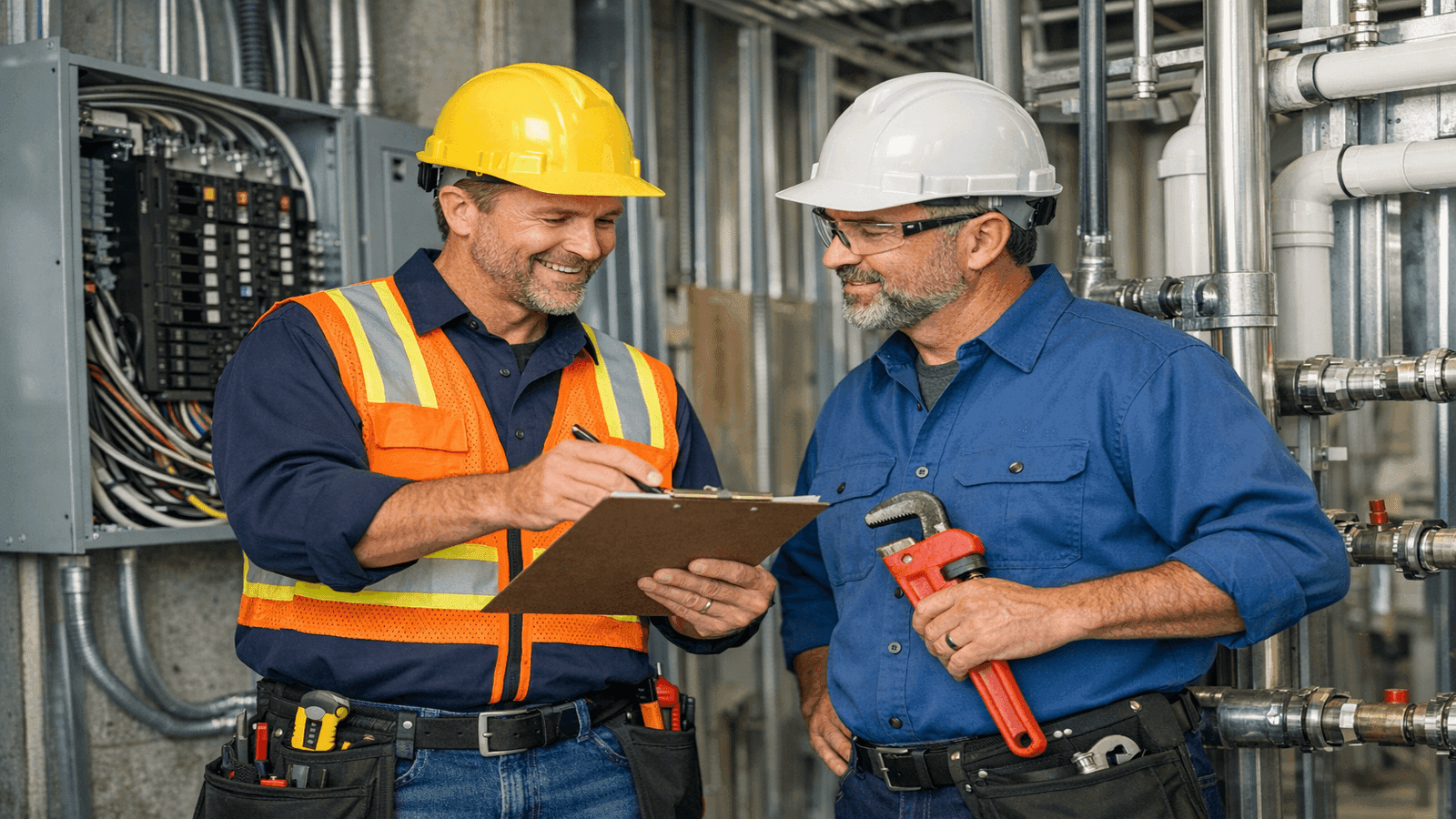
Photo: Licensed electrician and master plumber working side-by-side on commercial construction job site wearing safety gear
National Median Salaries: Electricians Edge Ahead
The salary question has a nuanced answer that changes based on union status and location.
BLS 2026 national median data:
- Electricians: $69,630 annually ($33.48/hour)
- Plumbers: $62,970 annually ($30.27/hour)
- Difference: $6,660 per year (10.6% higher for electricians)
Salary by experience level:
Entry-level (Years 1-2 of apprenticeship):
- Electricians: $45,000-$50,000
- Plumbers: $40,000-$45,000
- Electricians start $5,000 higher
Mid-career (Years 5-7, journeyman level):
- Electricians: $65,000-$75,000
- Plumbers: $60,000-$70,000
- Gap narrows to $5,000
Senior/Master (10+ years experience):
- Electricians: $75,000-$95,000
- Plumbers: $70,000-$90,000
- Difference remains consistent
Union vs Non-Union: The Game Changer
Union membership completely reverses the salary advantage:
- Union electricians: $78,000 average ($39/hour)
- Union plumbers: $87,000 average ($43.67/hour)
- Union plumbers out-earn union electricians by $9,000 annually
Union markets (Chicago, New York, Boston, Philadelphia) shift the financial equation dramatically. If you're entering a trade in a strong union state, plumbing typically pays better. In right-to-work states, electricians maintain their salary edge.
Top-Paying States: Geography Matters
The highest-paying states differ significantly by trade
| State | Electrician Median | Plumber Median | Winner |
| Alaska | $76,280 | $88,150 | Plumbers (+$11,870) |
| Illinois | $81,650 | $87,880 | Plumbers (+$6,230) |
| New York | $81,340 | $75,200 | Electricians (+$6,140) |
| Hawaii | $79,280 | $72,450 | Electricians (+$6,830) |
| Massachusetts | $76,950 | $80,860 | Plumbers (+$3,910) |
| Oregon | $76,040 | $84,920 | Plumbers (+$8,880) |
Geographic salary patterns:
States where electricians earn more:
- Hawaii (+$6,830)
- New York (+$6,140)
- Connecticut (+$5,200)
- Washington D.C. (+$4,900)
States where plumbers earn more:
- Alaska (+$11,870)
- Oregon (+$8,880)
- Illinois (+$6,230)
- Massachusetts (+$3,910)
- Minnesota (+$3,500)
Tied markets (both trades $75,000-$82,000):
- Washington
- California
- New Jersey
Research your specific market before choosing. A plumber in Illinois earns more than an electrician in Texas, despite Texas having lower living costs.
Business Ownership Potential
Self-employed earnings vary by specialization:
Residential contractors:
- Electrician contractors: $80,000-$150,000
- Plumber contractors: $85,000-$180,000
- Plumbing service businesses scale faster with recurring revenue
Commercial contractors:
- Electrician contractors: $120,000-$250,000
- Plumber contractors: $100,000-$200,000
- Electrical commercial projects have higher margins
Self-employed earnings vary by specialization:
Residential contractors:
- Electrician contractors: $80,000-$150,000
- Plumber contractors: $85,000-$180,000
- Plumbing service businesses scale faster with recurring revenue
Commercial contractors:
- Electrician contractors: $120,000-$250,000
- Plumber contractors: $100,000-$200,000
- Electrical commercial projects have higher margins
The salary question isn't simple. Non-union electricians typically out-earn non-union plumbers by $5,000-$10,000. But in union markets like Chicago or New York, plumbers can earn $10,000-$15,000 more. I've watched electrician friends start businesses and struggle with licensing complexity, while plumbing businesses scale faster with service work. Both can hit six figures—the path just differs.
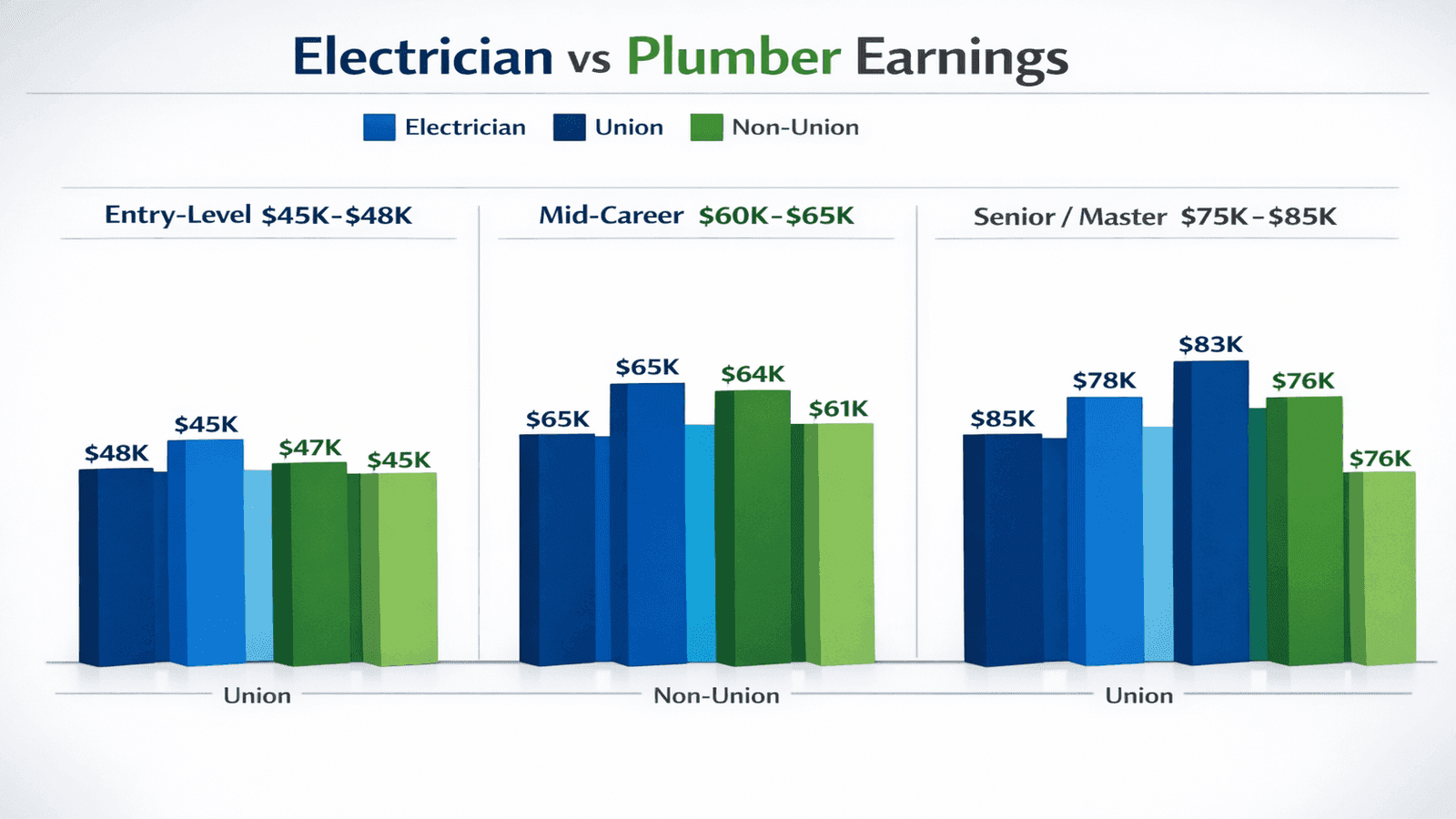
Photo: Bar chart comparing electrician and plumber salaries by experience level showing entry, mid-career, and senior wages for union and non-union workers
Job Outlook: Electricians See Faster Growth
Employment projections through 2034 favor electricians significantly.
BLS 2026-2034 growth projections:
- Electrician growth: 9% (much faster than average)
- Plumber growth: 4% (about average)
- Electricians have 2.25x faster growth rate
Annual job openings:
- Electricians: 81,000 openings per year
- Plumbers: 44,000 openings per year
- Nearly double the opportunities for electricians
Demand Drivers Differ by Trade
Electricians benefit from emerging technology trends:
- Renewable energy installations (solar panels, wind systems)
- EV charging infrastructure buildout (homes, businesses, public)
- Smart home technology adoption (automation, security, energy management)
- Data center expansion (cloud computing, AI infrastructure)
- Green building electrical requirements (energy efficiency standards)
Plumbers see steady demand from traditional infrastructure:
- Aging infrastructure replacement (lead pipes, corroded systems)
- Water conservation mandates (low-flow fixtures, greywater systems)
- Green plumbing systems (tankless heaters, efficient fixtures)
- New construction baseline demand (steady residential/commercial)
- Lead pipe removal requirements (federal infrastructure funding)
Labor Shortage Reality: Both Trades Critical
Current workforce shortages (2026 data):
- Electricians: 400,000 shortage projected by 2028
- Plumbers: 550,000 shortage projected by 2026
Both trades face severe labor shortages = exceptional job security for 20+ years.
Retirements accelerate the shortage. The average electrician is 55 years old; the average plumber is 54. As Baby Boomers exit these trades, demand for young workers intensifies. Both industries desperately need apprentices.
Job security verdict: Both excellent. Electricians edge ahead with faster growth (9% vs 4%) and more openings (81k vs 44k annually), but plumbers face even more severe shortages (550k vs 400k). You can't make a wrong choice for job security.
Current workforce shortages (2026 data):
- Electricians: 400,000 shortage projected by 2028
- Plumbers: 550,000 shortage projected by 2026
Both trades face severe labor shortages = exceptional job security for 20+ years.
Retirements accelerate the shortage. The average electrician is 55 years old; the average plumber is 54. As Baby Boomers exit these trades, demand for young workers intensifies. Both industries desperately need apprentices.
Job security verdict: Both excellent. Electricians edge ahead with faster growth (9% vs 4%) and more openings (81k vs 44k annually), but plumbers face even more severe shortages (550k vs 400k). You can't make a wrong choice for job security.
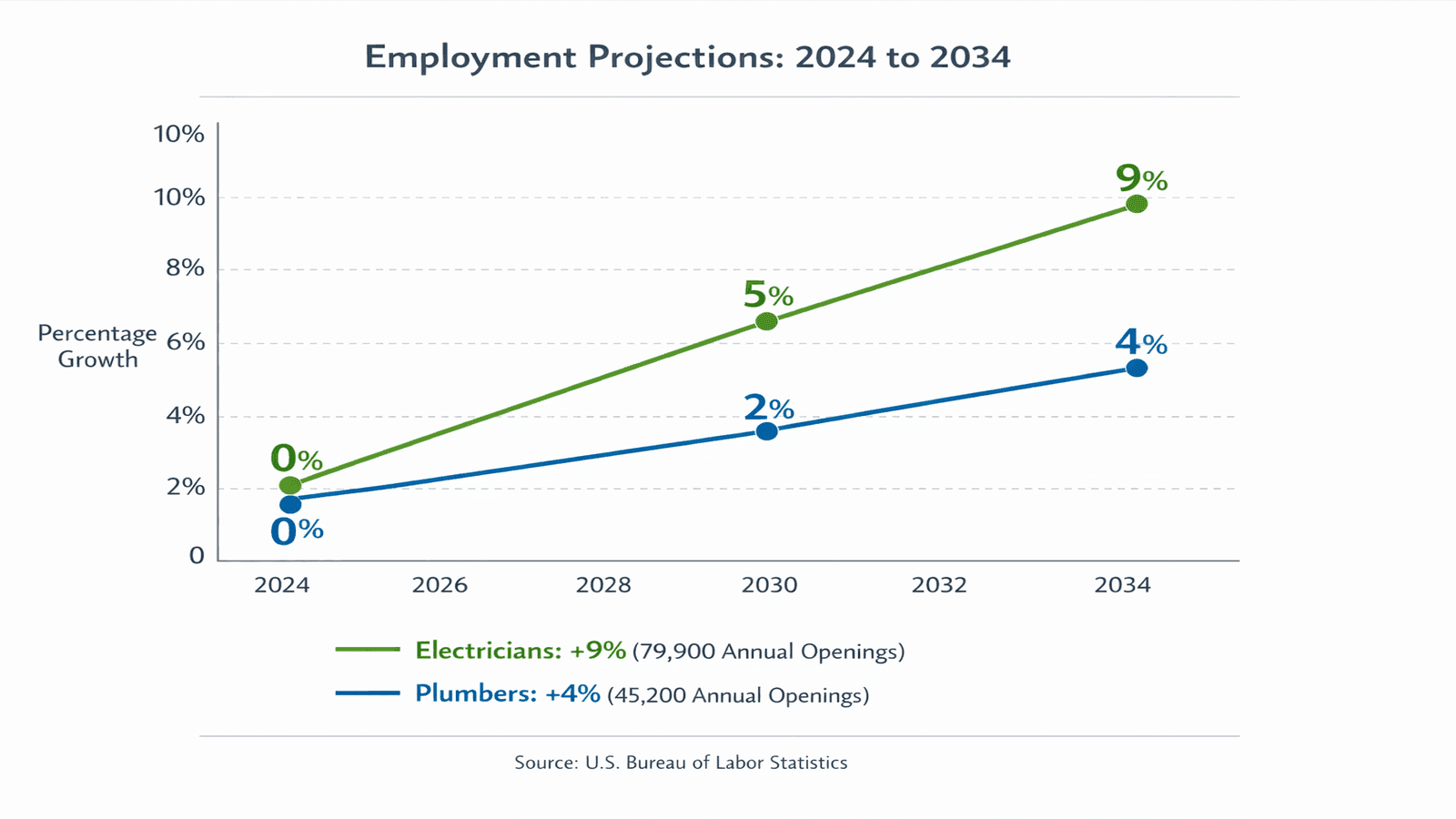
Photo: Line graph showing electrician vs plumber job growth projections through 2034 with electricians at 9% growth and plumbers at 4% growth
Training & Licensing
Both trades require 4-5 year apprenticeships with similar total hours but different emphases.
Get quotes from top-rated pros.
Apprenticeship Structure Comparison
Electrician apprenticeship requirements:
- 144 hours classroom instruction per year
- 2,000 hours on-the-job training annually
- Total: 8,000-10,000 hours over 4-5 years
- Classroom topics: NEC code, electrical theory, circuitry, safety protocols, blueprint reading, load calculations
- Math-heavy curriculum (voltage, amperage, resistance calculations)
Plumber apprenticeship requirements:
- 246 hours classroom instruction per year
- 1,700 hours on-the-job training annually
- Total: 8,000-10,000 hours over 4-5 years
- Classroom topics: IPC/UPC codes, pipe fitting, drainage systems, water distribution, venting, gas lines
- More hands-on focused curriculum
Key difference: Electricians need more on-the-job hours annually but less classroom time. Plumbing emphasizes classroom learning more heavily, with 100+ more hours per year than electrical.
Licensing Complexity: Electrical More Technical
Both trades follow apprentice → journeyman → master progression, but complexity differs.
Electrician licensing pathway:
- More complex code book (NEC has 1,000+ pages vs IPC/UPC 300-400 pages)
- Multiple specialty licenses available:
- Residential electrician
- Commercial electrician
- Industrial electrician
- Low-voltage systems
- Fire alarm systems
- Continuing education required in most states (8-16 hours annually)
- Journeyman exam pass rate: 65-70%
- Master exam pass rate: 55-60%
Plumber licensing pathway:
- Less complex code requirements (IPC/UPC 300-400 pages total)
- Fewer specialty branches:
- Residential plumber
- Commercial plumber
- Medical gas installer (specialized certification)
- Continuing education varies by state (4-12 hours annually)
- Journeyman exam pass rate: 70-75%
- Master exam pass rate: 60-65%
Verdict: Electrical licensing is more technically demanding with steeper code requirements, more calculations, and more extensive continuing education. Plumbing licensing is more straightforward conceptually.
Physical vs Technical Demands
The trades require different strengths and aptitudes.
Electricians need:
- Strong technical problem-solving skills (circuit troubleshooting, fault finding)
- Extensive code memorization (NEC updates every 3 years)
- Mathematical aptitude (voltage drop, amperage, load calculations, conduit fill)
- Less heavy lifting (wire spools lighter than pipe bundles)
- Precision work with tight tolerances (panel wiring, device spacing)
- Comfort working at heights (running conduit, installing panels)
Plumbers need:
- Physical strength (lifting 50-75 lbs regularly, moving water heaters, cast iron pipe)
- Heavy demolition capability (breaking concrete, cutting through walls)
- Tolerance for tight spaces (crawlspaces, under sinks, attics)
- Messier work environment acceptance (sewage, water damage, flooded areas)
- More straightforward problem-solving (water flows downhill, pressure systems)
- Less calculation-intensive work
I chose plumbing partly because I'm not a math guy. My electrician buddy chose his path because he hated crawling through sewage. Both of us are successful, but we're playing to our strengths. If you love calculations and code books, choose electrical. If you're physically strong and hate sitting at a desk studying theory, choose plumbing. Match the trade to your aptitude.
Daily Work: What You Actually Do
Understanding typical daily tasks helps clarify which trade suits you.
Typical Day Comparison
Electrician's daily tasks:
- Install/repair electrical wiring, outlets, switches, panels
- Troubleshoot circuit issues and electrical failures
- Read and interpret blueprints and electrical schematics
- Test circuits, connections, and ground fault protection
- Install lighting systems (indoor, outdoor, landscape)
- Follow NEC code requirements for all installations
- Coordinate with general contractors and other trades
- Install specialized systems (generators, solar, EV chargers)
Plumber's daily tasks:
- Install/repair pipes, fixtures, faucets, drains
- Clear clogs and diagnose leak sources
- Install water heaters (tank and tankless)
- Follow IPC/UPC code requirements
- Handle emergency service calls (burst pipes, sewage backups)
- Work in crawlspaces, under sinks, in basements
- Read blueprints for rough-in installations
- Install gas lines for appliances
Work Environment Differences
Where you spend your day varies significantly by trade.
Electrician work environments:
- New construction sites (residential, commercial)
- Existing commercial buildings (offices, retail, industrial)
- Residential service calls (homes, apartments)
- Industrial facilities (manufacturing, warehouses)
- Mostly clean, dry environments
- Heights common (ladders, scaffolding, lifts for conduit runs)
- Temperature-controlled when working indoors
- Outdoor work in all weather (service upgrades, meter installations)
Plumber work environments:
- Residential service calls (majority of work for service plumbers)
- New construction rough-in and finish work
- Commercial buildings (offices, restaurants, hospitals)
- Crawlspaces, basements, attics (tight spaces routine)
- Often wet, dirty conditions (nature of water/drain work)
- Sewage and wastewater exposure common
- Temperature extremes (hot attics, cold crawlspaces)
- Emergency calls at all hours (burst pipes, flooding)
Injury Risk & Physical Toll
Both trades carry risks, but the nature and severity differ.
Electrician injury data (OSHA 2025):
- Electrocution risk: 32 deaths annually nationwide
- Falls from ladders/heights: Most common non-fatal injury
- Lower back strain from prolonged standing/bending
- Hand and finger injuries from tools and sharp wire
- Eye injuries from arc flash incidents
- Burns from arc flash and electrical contact
- Overall injury rate: Moderate compared to other construction trades
Plumber injury data:
- Burns from hot water and pipes (most common)
- Back injuries from heavy lifting (chronic issue)
- Knee damage from prolonged kneeling (long-term toll)
- Cuts from sharp tools, metal burrs, broken pipes
- Chemical exposure (drain cleaners, solvents)
- Slip and fall in wet environments
- Overall injury rate: 10-15% higher than electricians
Long-term physical toll comparison:
Plumbers commonly experience:
- Chronic knee problems (bursitis, arthritis)
- Lower back pain and disc issues
- Shoulder wear from overhead pipe work
- Hand/wrist arthritis from repetitive pipe threading
Electricians commonly experience:
- Vision strain from precision work
- Occasional shock injuries (usually minor)
- Shoulder issues from overhead conduit work
- Finger/hand dexterity problems from repetitive wiring
Both trades carry risks, but the nature and severity differ.
Electrician injury data (OSHA 2025):
- Electrocution risk: 32 deaths annually nationwide
- Falls from ladders/heights: Most common non-fatal injury
- Lower back strain from prolonged standing/bending
- Hand and finger injuries from tools and sharp wire
- Eye injuries from arc flash incidents
- Burns from arc flash and electrical contact
- Overall injury rate: Moderate compared to other construction trades
Plumber injury data:
- Burns from hot water and pipes (most common)
- Back injuries from heavy lifting (chronic issue)
- Knee damage from prolonged kneeling (long-term toll)
- Cuts from sharp tools, metal burrs, broken pipes
- Chemical exposure (drain cleaners, solvents)
- Slip and fall in wet environments
- Overall injury rate: 10-15% higher than electricians
Long-term physical toll comparison:
Plumbers commonly experience:
- Chronic knee problems (bursitis, arthritis)
- Lower back pain and disc issues
- Shoulder wear from overhead pipe work
- Hand/wrist arthritis from repetitive pipe threading
Electricians commonly experience:
- Vision strain from precision work
- Occasional shock injuries (usually minor)
- Shoulder issues from overhead conduit work
- Finger/hand dexterity problems from repetitive wiring
At 38, my knees hurt every morning. My electrician buddy the same age? His knees are fine, but he's paranoid about arc flash after seeing a coworker get burned. Both trades have risks—mine are more cumulative physical wear, his are less frequent but higher severity acute risks. Choose based on which risk profile you can live with.
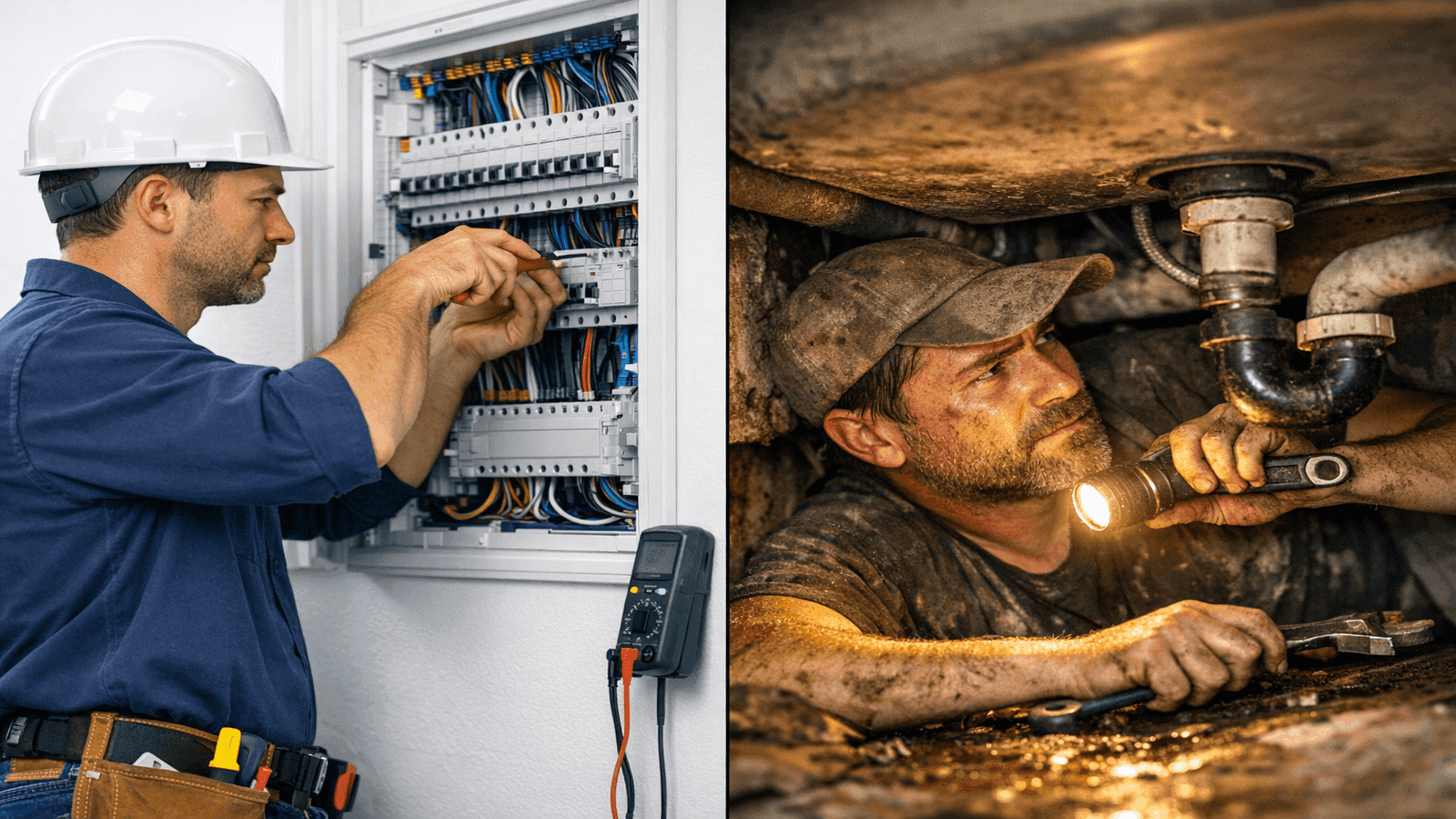
Photo: Split image comparing electrician's clean panel work in well-lit space with plumber's cramped crawlspace work under sink
Plumbing Advantages
Plumbing offers distinct benefits that make it the right choice for many.
Financial Advantages
Union markets favor plumbers significantly:
- Union plumbers: $87,000 average vs union electricians $78,000
- $9,000 annual premium in organized labor markets
- Strong union presence in: Illinois, New York, Massachusetts, Minnesota, California, Oregon
Service work business model:
- Emergency calls command premium rates ($150-$300/hour)
- Recurring revenue from maintenance contracts
- Lower customer price sensitivity (water damage urgency)
- Faster business scaling potential
Lower business startup costs:
- Initial investment: $40,000-$60,000
- Lower insurance costs than electrical
- Less expensive specialized tools
- Simpler contractor licensing process
Job Characteristics
Simpler technical requirements:
- Less complex code books (300-400 pages vs 1,000+ for NEC)
- Fewer calculations required daily
- More intuitive problem-solving (water flows downhill, pressure systems straightforward)
- Less continuing education burden (4-12 hours vs 8-16 for electricians)
Strong residential service demand:
- Every home needs plumbing maintenance
- Emergency calls more frequent than electrical
- Repeat customer relationships easier to build
- Less seasonal variation (plumbing fails year-round)
Get quotes from top-rated pros.
Career Flexibility
Multiple specialization paths:
- Residential service plumbing (most common)
- Commercial plumbing (offices, restaurants, hospitals)
- Industrial plumbing (manufacturing, processing plants)
- Medical gas installation (specialized, high-paying)
- Green plumbing specialist (water conservation systems)
Construction vs service choice:
- New construction plumbing (predictable hours)
- Service plumbing (higher earnings, less predictable schedule)
- Easy transition between specializations
Plumbing Disadvantages
Plumbing's drawbacks are substantial and shouldn't be minimized.
Physical Demands
Heavy manual labor requirements:
- Regular lifting of 50-75 lbs (water heaters, pipe bundles, fixtures)
- Physically demanding pipe installation (cutting, threading, fitting)
- Demolition work common (breaking concrete, cutting walls)
- Chronic physical wear accumulates over career
Higher injury rates:
- 10-15% more work-related injuries than electricians
- Chronic knee issues extremely common (30+ years of kneeling)
- Lower back problems nearly universal among veteran plumbers
- Shoulder and rotator cuff wear from overhead work
Work Environment Challenges
Dirty conditions routine:
- Sewage exposure regular occurrence
- Water damage sites (mold, contamination)
- Crawlspaces and basements (insects, rodents, mold)
- Wet work environments daily
Physical work conditions:
- Tight crawlspaces more common than electrical work
- Weather exposure for outdoor repairs (winter pipe bursts)
- Unpleasant smells (sewage, stagnant water, gas leaks)
- Emergency calls disrupt personal time (nights, weekends)
Career Growth Limitations
Slower industry growth:
- 4% job growth vs 9% for electricians
- 44,000 annual openings vs 81,000 for electricians
- Less exposure to emerging technology sectors
Lower non-union wages:
- $62,970 median vs $69,630 for electricians
- Right-to-work states pay plumbers $5,000-$10,000 less than electricians
- Gap widens in high-tech metros (Seattle, San Francisco, Austin)
Electrical Advantages
Electrical work offers compelling benefits for the right person.
Financial Advantages
Higher median salary nationwide:
- $69,630 vs $62,970 for plumbers ($6,660 premium)
- 10.6% higher earnings in non-union markets
- Gap consistent across experience levels
- Better baseline earnings in right-to-work states
Faster job growth and more openings:
- 9% growth vs 4% for plumbers (2.25x faster)
- 81,000 annual openings vs 44,000 for plumbers
- More career mobility and job choices
Emerging technology opportunities:
- Renewable energy sector expanding (solar, wind, battery storage)
- EV charging infrastructure boom (federal investment)
- Smart home technology integration
- Data center growth (AI, cloud computing)
- Energy efficiency upgrades (commercial, residential)
Physical Benefits
Less heavy lifting:
- Wire spools lighter than pipe bundles
- Water heaters weigh 50-150 lbs (plumbers lift regularly)
- Conduit lighter than steel/cast iron pipe
Lower overall injury rates:
- 10-15% fewer work-related injuries than plumbers
- Less chronic knee damage
- Lower back problems less frequent
- Less cumulative physical wear over career
Cleaner work environments:
- Dry work conditions typical
- No sewage exposure
- Less crawlspace work
- More temperature-controlled environments
Career Growth Opportunities
Multiple high-growth specializations:
- Renewable energy electrician (solar, wind)
- Industrial electrician (manufacturing, processing)
- Commercial electrician (high-rise, offices)
- Low-voltage systems (security, data, automation)
- Fire alarm systems specialist
- EV charging infrastructure
Technology integration:
- Smart home systems
- Building automation
- Energy management systems
- Emerging sectors constantly opening
Electrical Disadvantages
Electrical work has significant challenges that deter many candidates.
Technical Complexity
Extensive code requirements:
- NEC code book: 1,000+ pages (updated every 3 years)
- Complex calculations required (voltage drop, load calculations, conduit fill)
- Stricter continuing education mandates (8-16 hours annually)
- More difficult licensing exams (55-60% master pass rate vs 60-65% for plumbers)
Steeper learning curve:
- Electrical theory more abstract than plumbing concepts
- Math-intensive work daily
- Blueprint reading more complex
- More specialization required for career advancement
Safety Risks
Electrocution hazard:
- 32 electrician deaths annually from electrocution
- Fatal risk exists every day on the job
- Arc flash burns can be catastrophic
- One mistake can be fatal (vs plumbers' injuries rarely fatal)
Working at heights:
- Falls from ladders/scaffolding common
- Conduit runs often at ceiling height
- Panel installations 6-8 feet high typical
- Height work nearly daily in commercial settings
Business Challenges
Higher startup costs for contractors:
- Initial business investment: $60,000-$100,000
- More expensive insurance (liability, workers comp)
- More complex contractor licensing
- Higher bonding requirements
Code compliance complexity:
- Permit process more involved
- Inspections more stringent
- Violation consequences more severe
- Customer complaints more technical
Side-by-Side Trade Comparison
Here's how plumbing and electrical stack up across key factors:
Get quotes from top-rated pros.
Here's how plumbing and electrical stack up across key factors:
| Factor | Plumbing | Electrical | Winner |
| Median Salary (Non-Union) | $62,970 | $69,630 | Electrical (+11%) |
| Union Salary | $87,000 | $78,000 | Plumbing (+12%) |
| Job Growth (2024-2034) | 4% | 9% | Electrical (2.25x) |
| Annual Job Openings | 44,000 | 81,000 | Electrical (84% more) |
| Physical Demands | High | Moderate | Electrical |
| Code Complexity | Moderate | High | Plumbing (simpler) |
| Injury Rate | Higher | Lower | Electrical |
| Work Cleanliness | Lower | Higher | Electrical |
| Business Startup Cost | $40k-$60k | $60k-$100k | Plumbing (cheaper) |
| Fatal Risk | Very Low | Moderate | Plumbing (safer) |
| Licensing Difficulty | Moderate | High | Plumbing (easier) |
| Math Requirements | Low | High | Plumbing (less math) |
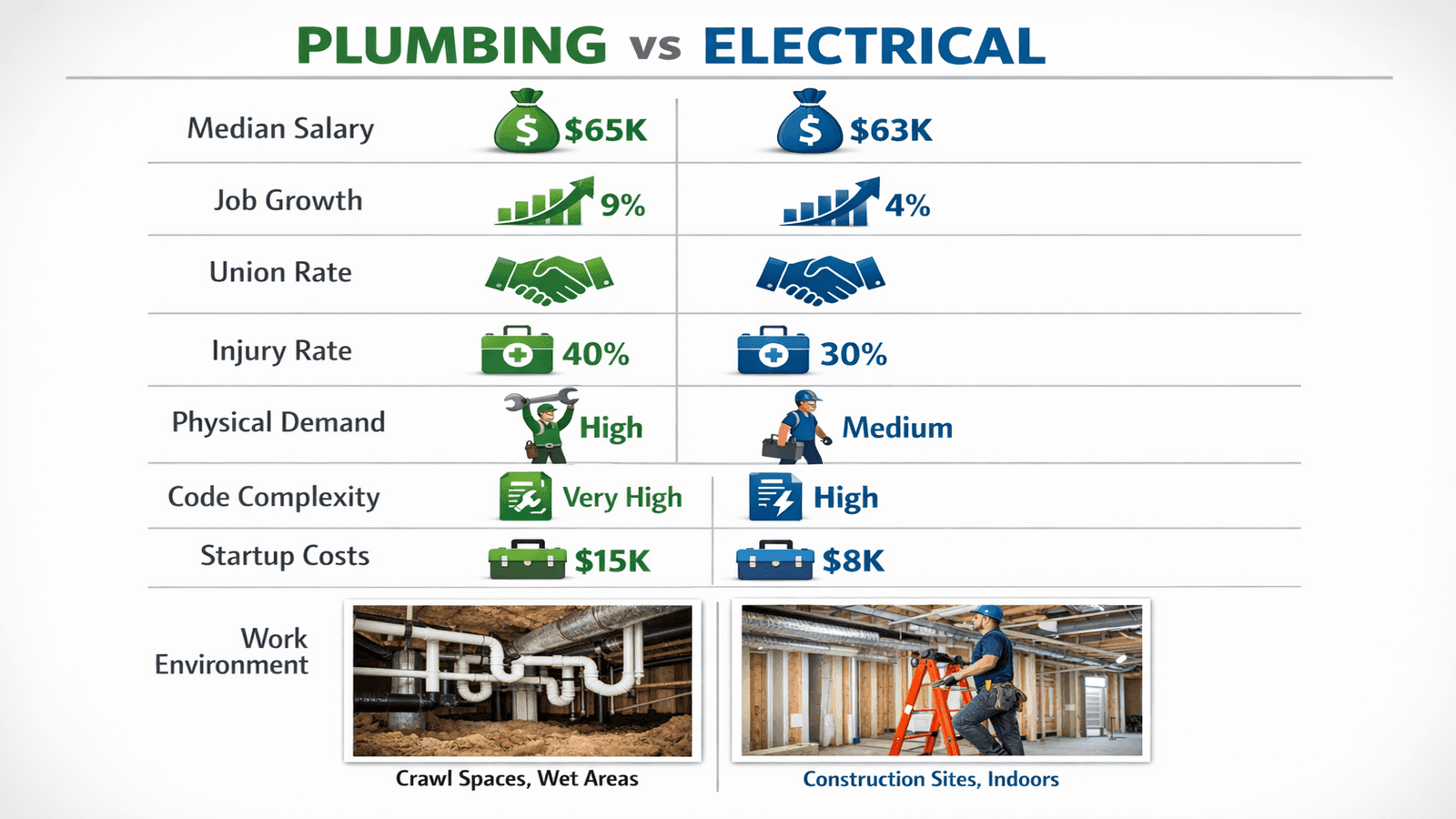
Photo: Comprehensive infographic comparing plumbing and electrical trades across salary, job growth, physical demands, code complexity, injury rates, and startup costs
Choose Plumbing If...
Plumbing is the better choice when these factors align with your strengths and preferences.
You prefer hands-on physical work:
- Direct problem-solving appeals to you (find leak, fix leak)
- You enjoy using your body more than calculations
- Working with your hands satisfies you more than technical theory
- You're comfortable with heavy lifting regularly
You want simpler licensing path:
- Less complex code requirements (300-400 pages vs 1,000+)
- Fewer calculations and less math daily
- More straightforward licensing exams
- Less continuing education burden
You value service business model:
- Emergency calls and premium rates appeal
- Recurring customer relationships
- Faster business scaling potential
- Lower startup investment ($40k-$60k)
You can handle physical demands:
- Heavy lifting doesn't intimidate you
- Dirty work environments acceptable
- Crawlspaces and tight spaces tolerable
- Physical wear on body is acceptable trade-off
- Occasional sewage work doesn't deter you
You're in a union market:
- Illinois, New York, Massachusetts, Oregon, Minnesota, California
- Union plumbers earn $9,000 more than union electricians
- Strong union presence guarantees better wages
Best candidates for plumbing:
- Physically strong individuals
- Those who dislike extensive book learning and calculations
- Service-oriented personalities (enjoy helping homeowners directly)
- Union market workers
- Self-employment aspirations (faster business scaling)
Choose Electrical If...
Electrical work is the better choice when these factors match your profile.
You prefer technical problem-solving:
- Electrical theory and calculations interest you
- Circuit troubleshooting appeals more than fixing leaks
- You enjoy learning complex code requirements
- Blueprint reading comes naturally
- Technology integration excites you
You want cleaner work conditions:
- Dry work environments preferred
- Sewage exposure unacceptable
- Less crawlspace work desired
- Temperature-controlled settings valued
You prioritize long-term physical health:
- Want to avoid chronic knee damage
- Concerned about lower back problems long-term
- Less heavy lifting preferred
- Physical career longevity important (work into 60s)
You can handle technical complexity:
- Comfortable with extensive code books (1,000+ pages)
- Math and calculations don't intimidate you
- Willing to pursue continuing education regularly
- Higher exam difficulty acceptable
You want faster career growth:
- 9% job growth vs 4% for plumbers
- 81,000 annual openings vs 44,000 for plumbers
- Emerging technology sectors (solar, EV, smart homes)
- More geographic mobility
You accept electrocution risk:
- Fatal risk exists but manageable with safety protocols
- Arc flash danger acceptable with proper training
- Height work (ladders, scaffolding) tolerable
Best candidates for electrical:
- Technically-minded individuals
- Those comfortable with math and physics
- Safety-conscious workers (protocol followers)
- Career growth seekers (faster advancement)
- Technology enthusiasts (smart homes, renewable energy)
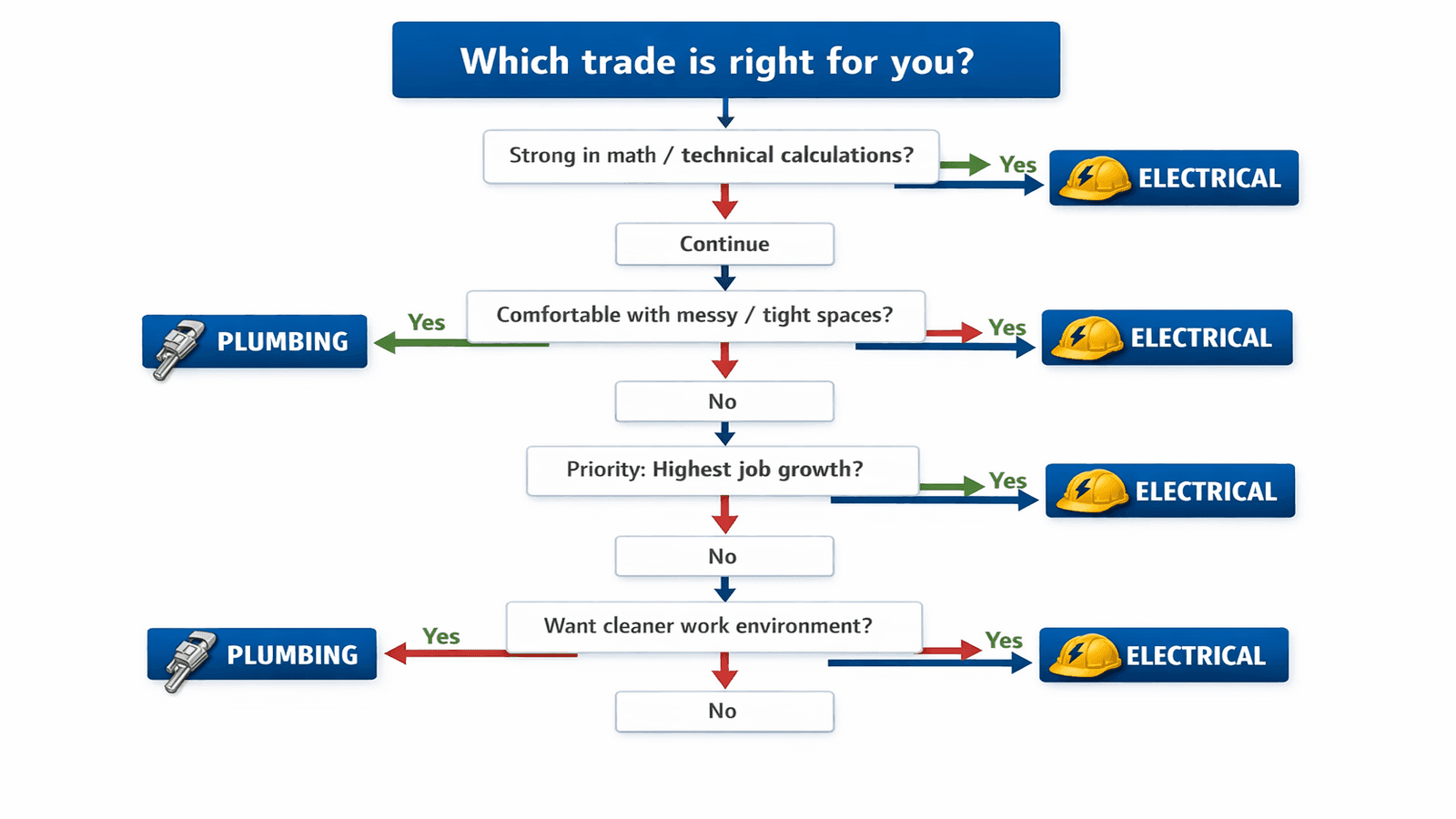
Photo: Decision tree flowchart helping readers choose between plumbing and electrical careers based on skills, preferences, and priorities
The Honest Verdict: No Single "Better" Trade
After analyzing salaries, job growth, training, work conditions, and long-term prospects, here's the truth: neither trade is objectively "better." Each suits different people with different strengths and priorities.
Choose electrical if you want:
- Higher median salary ($7,000 more non-union)
- Better job growth (9% vs 4%)
- Cleaner work conditions
- Emerging technology opportunities
- Lower long-term physical toll
- More annual job openings (81k vs 44k)
Accept these trade-offs:
- Complex code requirements (1,000+ pages)
- Electrocution risk (32 annual deaths)
- Extensive continuing education
- Higher business startup costs
- Math-intensive daily work
Choose plumbing if you want:
- Higher union wages ($9,000 more)
- Lower startup costs for business
- Simpler licensing requirements
- Direct hands-on problem-solving
- Faster business scaling
- Less technical complexity
Accept these trade-offs:
- Heavy physical demands daily
- Messier work environments
- Higher injury rates (10-15% more)
- Chronic knee and back issues
- Slower job growth (4% vs 9%)
The real winners in either trade:
Union markets offer better wages, benefits, and pensions for both trades. Strong union states (Illinois, New York, Massachusetts) provide exceptional compensation regardless of trade choice. Both trades in shortage markets give workers negotiating power, multiple job offers, and job security for life.
I chose plumbing because I'm hands-on, physically strong, and don't love complex calculations. My electrician friends chose their path because they're technically minded, prefer clean work, and can handle code complexity. Both of us earn great livings, have zero student debt, and will never worry about job security. The 'better' trade is whichever matches your strengths and tolerances. Shadow both before deciding—one will feel right when you experience the actual work.
Sources & References
- U.S. Bureau of Labor Statistics. (2026). "Occupational Outlook Handbook: Electricians." https://www.bls.gov/ooh/construction-and-extraction/electricians.htm
- U.S. Bureau of Labor Statistics. (2026). "Occupational Outlook Handbook: Plumbers, Pipefitters, and Steamfitters." https://www.bls.gov/ooh/construction-and-extraction/plumbers-pipefitters-and-steamfitters.htm
- ServiceTitan. (2026). "Trades Salary Data: HVAC, Electrical, Plumbing Comparison." https://www.servicetitan.com/blog/trades-salary-data
- PTT Edu. (2026). "Who Makes More Money: Electricians or Plumbers?" https://ptt.edu/who-makes-more-money-electricians-or-plumbers/
- Ultimate Electrician's Guide. (2026). "Electrician vs Plumber: Which Career Is Right For You?" https://www.ultimateelectriciansguide.com/electrician-vs-plumber/
- Construction Coverage. (2025). "Best-Paying U.S. Cities for Electricians [2025 Edition]." https://constructioncoverage.com/research/best-paying-cities-for-electricians
- NTI Training. (2026). "Electrician vs. Plumbing: Which Career Is Best?" https://www.ntitraining.com/electrician-vs-plumber-careers/
- OSHA. (2025). "Workplace Injury Statistics: Construction Trades." https://www.osha.gov
Disclaimer
Plumbing and electrical career comparisons are based on national averages from 2026 Bureau of Labor Statistics data and may not reflect your specific location, union availability, or individual circumstances. Salary figures, job growth projections, and training requirements vary significantly by state, city, and employer. Always verify current licensing requirements with your state licensing board and contact local apprenticeship programs for specific program details. Union availability and wages differ dramatically by region—research your local market thoroughly. Both trades offer excellent career prospects, but the "better" choice depends on your individual strengths, physical capabilities, risk tolerance, and local market conditions. This article is for informational purposes only and does not constitute professional career counseling for your specific situation. Consult with local apprenticeship coordinators and working professionals in both trades before making your final decision.

Michael Jennings is a licensed master plumber & water systems specialist with over 18 years of hands-on experience in residential and commercial plumbing, serving clients across California and Texas. At NearbyHunt, he shares practical advice on pipe installations, water heater maintenance, and home plumbing upgrades. Michael has helped thousands of homeowners prevent costly water damage and improve water efficiency through modern plumbing solutions.

Robert is a licensed master plumber with over 20 years of experience serving both residential and commercial clients across the Midwest. Specialising in advanced plumbing systems and sustainable water technologies, Rob brings deep technical insight and hands-on expertise to every project. As a reviewer for NearbyHunt, he ensures all plumbing content reflects the highest standards of safety, compliance, and practicality.