- The Indus Valley Civilization built the world's first flush toilets and copper water pipes between 4000-3000 BC—2,000 years before Rome's famous aqueducts.
- Roman aqueducts transported 300 million gallons of water daily into Rome by 200 AD using gravity-fed engineering that influenced modern systems.
- Indoor plumbing didn't become common in US homes until the 1930s-1950s—in 1940, only 55% of American homes had complete plumbing.
- The 1858 "Great Stink" in London forced the creation of modern sewage systems, with Joseph Bazalgette's network completed in under a decade.
- Modern water-saving innovations like dual-flush toilets (1980s) and low-flow fixtures save 20-60% more water than mid-20th century plumbing.
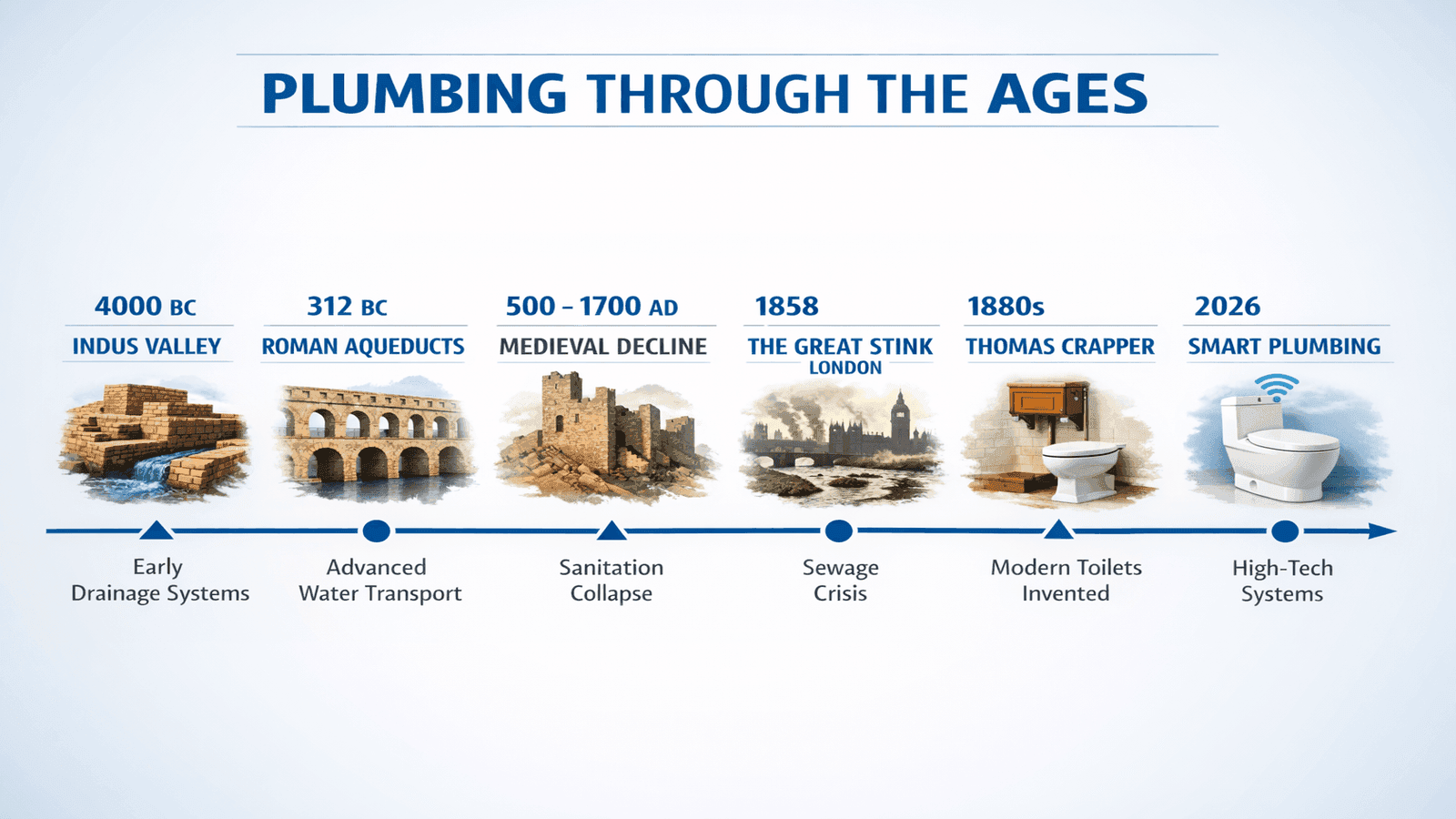
Photo: History of Plumbing
Every time you flush a toilet or turn on a faucet, you’re using technology that took 6,000 years to perfect—from ancient copper pipes buried in India to the smart plumbing systems in modern homes.
Plumbing shaped civilisation more than almost any other technology. Access to clean water and sanitation prevented disease, extended lifespans, and made modern cities possible. Ancient innovations were lost for centuries during the Dark Ages, then rediscovered and improved during the Renaissance and Industrial Revolution.
This article traces plumbing’s fascinating evolution from ancient civilisations through medieval decline to the modern revolution that brought running water into every home.
For a deeper understanding of plumbing systems, including materials, compliance standards, service options, and maintenance planning, refer to our Complete Guide to Plumbing Systems & Services
As a plumber, I think about history every time I solder a copper pipe or install a drain. The Romans used lead (plumbum in Latin—where ‘plumber’ comes from). The Indus Valley had indoor toilets 4,000 years ago. We’re standing on the shoulders of ancient engineers who solved the same problems I solve today—just with different materials and code requirements.

Ancient Plumbing: The First Engineers
The world's earliest plumbing systems demonstrate that ancient civilizations understood hygiene, public health, and sophisticated engineering.
Indus Valley Civilisation (4000-3000 BC)
The Indus Valley Civilisation in modern-day Pakistan and India created the world's first documented plumbing infrastructure:
Groundbreaking innovations:
- Copper water pipes in palace ruins (oldest evidence of plumbing on record)
- Indoor flush toilets—the earliest known examples in history
- Sophisticated drainage systems with precise slopes for gravity flow
- Wastewater collection networks direct waste away from cities
- Public sanitation infrastructure serving entire urban populations
These 6,000-year-old systems prove that ancient engineers understood the connection between clean water, waste removal, and public health long before modern germ theory.
Ancient Rome (500 BC - 500 AD)
Rome perfected plumbing on a massive scale, creating infrastructure that served over one million people.
Roman aqueduct systems:
Engineering marvels that supplied water to cities:
- Transported 300 million gallons of water daily into Rome by 200 AD
- Built with precise gradients enabling gravity-fed water flow
- Brought water across distances exceeding 50 miles
- 11 major aqueducts served Rome at its peak
- Some aqueducts still function after 2,000+ years
Sewage infrastructure:
The Cloaca Maxima (Rome's main sewer system):
- Originally built around 600 BC as open drainage channels
- Evolved into extensive underground passages carrying waste
- Directed sewage from the city to the Tiber River
- Still partially functional today (2,600+ years old)
- Created template for modern urban sewage systems
Public bath complexes (thermae):
Sophisticated water systems for hygiene and leisure:
- Hot, cold, and lukewarm water pools with temperature control
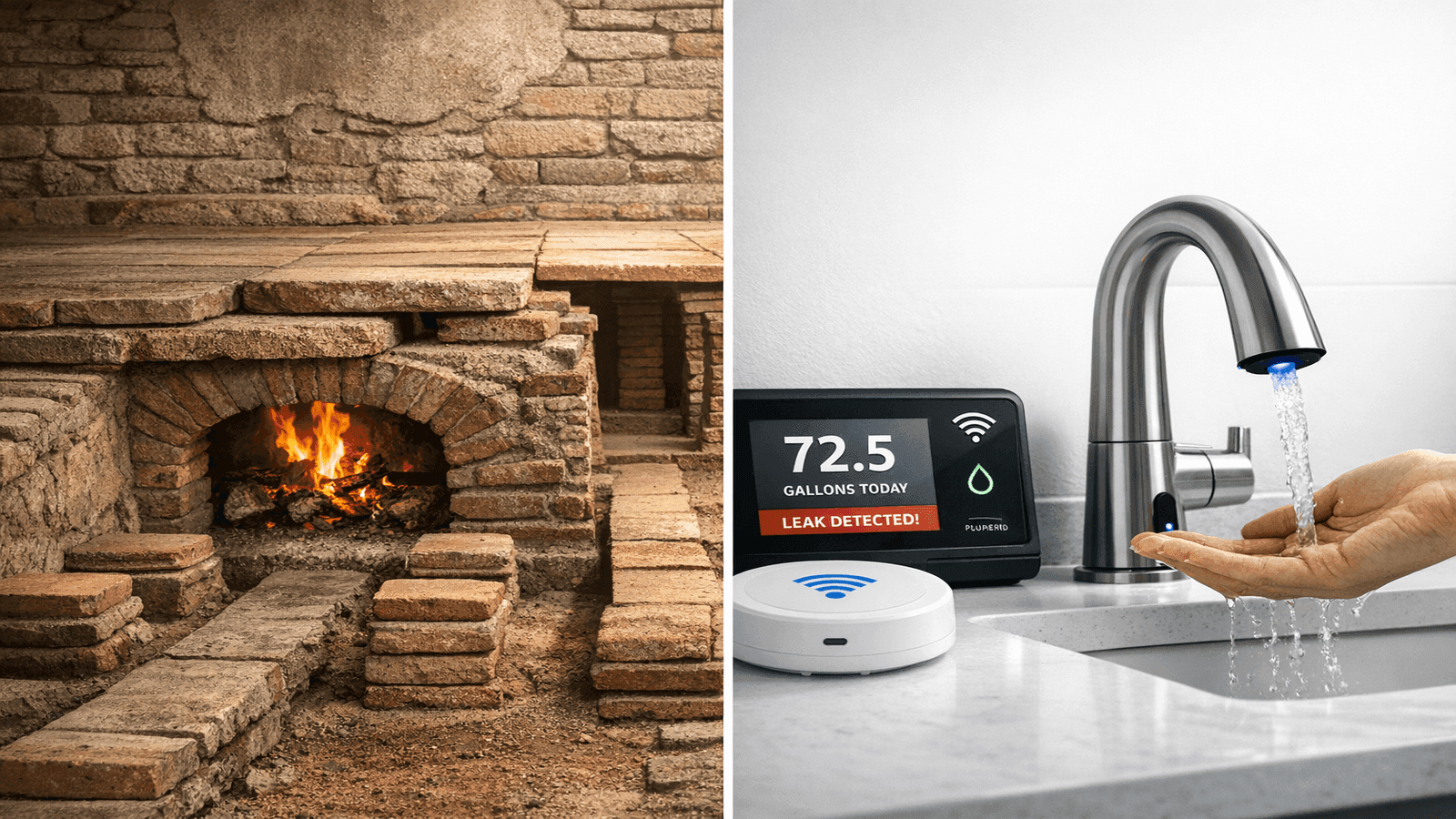
- Heated floors using hypocaust (underfloor heating) technology
- Complex pipe networks circulating water throughout facilities
- Served thousands of citizens daily
The origin of "plumber": Romans used lead (plumbum in Latin) extensively for water pipes. Workers who installed lead pipes were called "plumbarius" (lead worker), which evolved into the modern word "plumber."
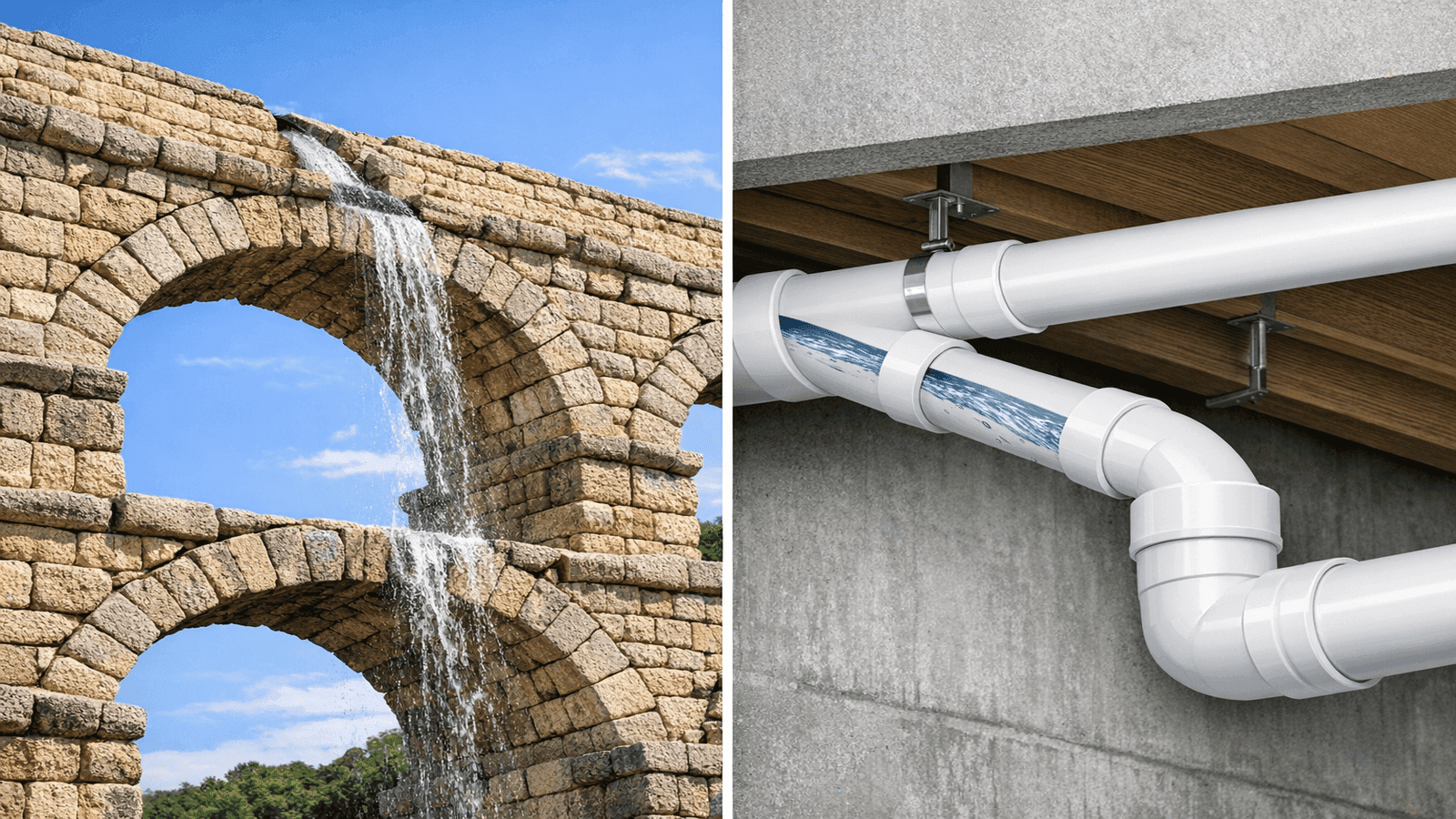
The Romans were incredible engineers. Their aqueducts used gravity so precisely that water flowed naturally for miles. We use the same principle today—water flows downhill. They figured out drainage slopes 2,000 years ago that match modern code requirements. The Cloaca Maxima is still standing. How many of today's plastic pipes will last 2,600 years?
Medieval Decline and Renaissance Innovation
The fall of Rome triggered centuries of regression in sanitation technology.
The Dark Ages (500-1500 AD)
After the Roman Empire collapsed, plumbing knowledge was largely lost across Europe.
Sanitation regression:
- Roman aqueducts and sewers fell into disrepair and abandonment
- Engineering knowledge disappeared as literacy declined
- Chamber pots became standard (contents dumped into streets)
- No organised sewage disposal in most medieval cities
- Unsanitary conditions contributed to plague outbreaks and disease
Public health consequences were catastrophic. Contaminated water sources and poor waste disposal created conditions for epidemics that killed millions throughout medieval Europe.
Renaissance Innovations (1500s-1700s)
As civilization recovered, inventors began rediscovering and improving ancient plumbing concepts.
1596: Sir John Harington's flush toilet
An English courtier invented the first modern flush toilet design:
- Installed prototype for Queen Elizabeth I
- Featured water reservoir and valve system
- Design ahead of its time (no infrastructure to support it)
- Not widely adopted for another 200 years
1775: Alexander Cumming's patent
An English watchmaker created the technical blueprint for modern toilets:
- Replaced the S-shaped trap with a P-shaped water trap
- Created a more stable seal, preventing sewer gas entry
- Improved water flow and reduced clogging
- Refined tank valve for smoother flushing
Cumming's patent established the fundamental design still used in toilets today: water tank + seat + trap pipe creating a water seal.
The Modern Plumbing Revolution
The 19th and 20th centuries transformed plumbing from a luxury for the wealthy into a standard feature of every home.
The Great Stink of 1858
A public health crisis in London catalyzed the modern sewage revolution.
The breaking point:
- Hot summer of 1858 intensified sewage smells from Thames River
- Human waste dumped directly into river (London's primary water source)
- Overwhelming stench reached Parliament, forcing government action
- Public recognized connection between sewage and disease
Joseph Bazalgette's solution:
An engineer designed comprehensive sewer system for London:
- Construction began in 1859
- Created a coherent underground sewer network beneath city
- Bulk of system completed in under a decade
- Established template for modern urban sewage worldwide
Bazalgette's system transformed London from a disease-ridden city into a model of modern sanitation. Other cities worldwide copied his approach.
Get quotes from top-rated pros.
American Plumbing Development (1900-1950)
The United States experienced rapid plumbing adoption during the first half of the 20th century.
Timeline of indoor plumbing in America:
- 1840s: Wealthy homes began installing basic indoor plumbing
- Early 1900s: Cities started providing municipal clean water
- 1920s-1930s: Plumbing became common in urban and suburban homes
- 1930s: Government programs brought indoor plumbing to rural America
- 1940: Only 55% of American homes had complete plumbing
- 1950s-1960s: Indoor plumbing became standard in all new construction
Material innovations changed the industry:
Post-WWII developments:
- Copper piping replaced lead pipes (health concerns about lead poisoning)
- Galvanized steel phased out due to corrosion problems
- 1966: Plastic pipes (PVC) introduced during copper shortage
- Material choices expanded dramatically
Public health transformation: Widespread indoor plumbing virtually eliminated waterborne diseases like cholera and typhoid in developed nations. Life expectancy increased as clean water became accessible to all economic classes.
Standardization Era (1950s-1980s)
The plumbing industry developed unified standards ensuring safety and reliability.
National plumbing codes established:
- Uniform Plumbing Code (UPC) created for Western states
- International Plumbing Code (IPC) developed for broader adoption
- Standards specified pipe materials, fixture requirements, drainage rules
- Professional licensing requirements implemented nationwide
Fixture improvements:
Major developments in toilet design:
- 1885: Thomas Twyford created first all-ceramic toilet
- 1950s-1970s: Modern toilet designs standardized across industry
- Water-saving innovations began emerging
The plumbing industry developed unified standards ensuring safety and reliability.
National plumbing codes established:
- Uniform Plumbing Code (UPC) created for Western states
- International Plumbing Code (IPC) developed for broader adoption
- Standards specified pipe materials, fixture requirements, drainage rules
- Professional licensing requirements implemented nationwide
Fixture improvements:
Major developments in toilet design:
- 1885: Thomas Twyford created first all-ceramic toilet
- 1950s-1970s: Modern toilet designs standardized across industry
- Water-saving innovations began emerging
Modern Innovations and Water Conservation
The late 20th and early 21st centuries focused on efficiency and sustainability.
Water Conservation Era (1980s-Present)
Environmental concerns drove development of water-saving technologies.
Dual-flush toilets (introduced 1980s):
Revolutionary water-saving design:
- Two flushing options: low volume for liquid waste, high volume for solid
- Saves 20-30% water compared to single-flush toilets
- Now standard or required in many countries
- Typical volumes: 0.8 GPF (liquid) and 1.6 GPF (solid)
Low-flow fixture requirements:
Dramatic reductions in water consumption:
- Faucets reduced from 2.2 GPM to 1.5 GPM (32% reduction)
- Showerheads reduced from 5 GPM to 2.0 GPM (60% reduction)
- Toilets reduced from 3.5 GPF to 1.28 GPF (63% reduction)
A family of four saves approximately 16,000 gallons annually with modern low-flow fixtures.
Modern pipe materials:
New materials replaced traditional copper:
- PEX (cross-linked polyethene): Flexible, freeze-resistant, easier installation
- PVC and CPVC: Durable plastic for drainage and supply lines
- Composite materials: Blend the benefits of multiple materials
Smart Plumbing Technology (2010s-Present)
Digital technology integrated with traditional plumbing systems.
Intelligent monitoring systems:
- Leak detection sensors alert homeowners via smartphone
- Smart water meters track usage patterns and detect anomalies
- Automated shutoff valves prevent water damage
- Remote monitoring for vacation homes
Advanced fixtures:
- Touchless faucets and toilets (hygiene and water savings)
- Tankless water heaters (on-demand hot water, energy efficient)
- Recirculation pumps (instant hot water without waste)
- Point-of-use water filtration systems
Future innovations on the horizon:
- Greywater recycling systems (reuse shower/sink water for toilets)
- AI-powered leak prevention predicts failures before they occur
- Sustainable materials replacing petroleum-based plastics
- Integration with smart home systems
I install smart leak detectors now that would've seemed like science fiction 20 years ago. They send alerts to your phone when they detect moisture. But the fundamentals haven't changed—water still needs proper slope to drain, pipes still need venting, and gravity still works the same way the Romans used it 2,000 years ago. We just have better materials and technology to prevent problems.
Why Plumbing History Matters Today
Understanding plumbing's evolution provides valuable lessons for modern challenges.
Ancient innovations remain relevant:
Roman engineering principles still applied today:
- Gravity-fed drainage (fundamental to all modern plumbing systems)
- Water trap designs preventing sewer gases (P-traps descended from ancient concepts)
- Public health priority (clean water access remains critical globally)
Lost knowledge teaches caution:
Medieval regression demonstrated risks:
- Infrastructure requires continuous maintenance and investment
- Lost expertise takes generations to recover
- Public health depends on functional sanitation systems
- Cutting corners on plumbing leads to disease and societal decline
Modern challenges echo ancient problems:
Issues ancient civilisations faced:
- Water scarcity management (Rome distributed limited water to millions)
- Infrastructure longevity (Roman aqueducts lasted centuries with maintenance)
- Public health protection (sanitation prevents disease in any era)
- Urban planning around water access
Get quotes from top-rated pros.
Understanding plumbing's evolution provides valuable lessons for modern challenges.
Ancient innovations remain relevant:
Roman engineering principles still applied today:
- Gravity-fed drainage (fundamental to all modern plumbing systems)
- Water trap designs preventing sewer gases (P-traps descended from ancient concepts)
- Public health priority (clean water access remains critical globally)
Lost knowledge teaches caution:
Medieval regression demonstrated risks:
- Infrastructure requires continuous maintenance and investment
- Lost expertise takes generations to recover
- Public health depends on functional sanitation systems
- Cutting corners on plumbing leads to disease and societal decline
Modern challenges echo ancient problems:
Issues ancient civilizations faced:
- Water scarcity management (Rome distributed limited water to millions)
- Infrastructure longevity (Roman aqueducts lasted centuries with maintenance)
- Public health protection (sanitation prevents disease in any era)
- Urban planning around water access
History teaches us that good plumbing is never about cutting corners. The Romans built aqueducts that lasted 2,000+ years. Modern builders use plastic pipes with 50-year lifespans and call it 'good enough.' I respect the ancient engineers who built systems that outlasted empires. That's the standard we should aim for today.
The Evolution Continues
Plumbing technology keeps evolving to address contemporary challenges in water conservation, sustainability, and public health.
Current industry focus areas:
Water conservation technologies:
- Pressure-assisted toilets using 1.28 GPF or less
- Greywater recycling systems reusing shower and sink water
- Rainwater harvesting integration for irrigation and toilets
- Smart irrigation controllers preventing water waste
Sustainability initiatives:
- Lead-free brass fixtures (mandatory since 2014 Safe Drinking Water Act)
- Recyclable pipe materials reducing environmental impact
- High-efficiency water heaters (tankless, heat pump models)
- Solar water heating systems
Health and safety improvements:
- Backflow prevention devices protecting water supply
- Anti-scald valves preventing burn injuries (especially for children/elderly)
- Point-of-use water filtration removing contaminants
- Lead-free drinking water systems nationwide
Technology integration:
- Smart leak detection systems with smartphone alerts
- Remote monitoring for vacation homes and rental properties
- Automated shutoff valves prevent catastrophic water damage
- Usage tracking helps homeowners reduce consumption
The fundamentals remain unchanged—gravity drainage, proper venting, and water pressure management—but materials, monitoring capabilities, and efficiency continue to improve. Today's plumbers combine 6,000 years of accumulated knowledge with cutting-edge technology to solve the same basic problems ancient civilisations faced: delivering clean water and removing waste safely.
Sources & References
- Parker & Sons. (2024). "A Look Back at Plumbing Through the Ages: From Ancient Civilisations to Modern Homes." https://www.parkerandsons.com/blog/plumbing-systems-of-the-ancient-world
- Wikipedia. (2024). "History of water supply and sanitation." https://en.wikipedia.org/wiki/History_of_water_supply_and_sanitation
- Sanitary Plumbing NYC. (2024). "Plumbing in Ancient Civilisations: Modern Technology Ahead of Its Time." https://sanitary.nyc/plumbing-in-ancient-civilizations-modern-technology-ahead-of-its-time/
- 1-Tom-Plumber. (2024). "When Did Indoor Plumbing Start? You Might be Surprised." https://www.1tomplumber.com/indoor-plumbing-a-brief-history/
- Logical Rooter LA. (2024). "When Indoor Plumbing was Invented? A Timeline From Ancient Baths to Smart Toilets." https://www.logicalrooterla.com/post/when-indoor-plumbing-was-invente
- Science Museum. (2024). "Flushed away: Sewers through history." https://www.sciencemuseum.org.uk/objects-and-stories/everyday-wonders/flushed-away-sewers-through-history
- Ritz Plumbing. (2024). "Plumbing History: The Evolution of Toilets." https://ritzplumbing.com/plumbing-history-evolution-of-toilets/
- OnPoint Plumbing. (2024). "Modern Plumbing: A Look at When It Became Widespread." https://www.onpointplumbingandheating.com/when-did-plumbing-become-common
Disclaimer
This historical overview is based on archaeological evidence and historical records, which may contain uncertainties about exact dates and details of ancient plumbing systems. Plumbing technology evolution varied significantly by geographic region, civilization, and time period. Modern plumbing codes, materials, and installation methods differ substantially from historical systems—always consult licensed plumbers for current installations, repairs, and code compliance. This article is for educational and informational purposes only and does not constitute professional advice for plumbing system installation, modification, repair, or maintenance.


Michael Jennings is a licensed master plumber & water systems specialist with over 18 years of hands-on experience in residential and commercial plumbing, serving clients across California and Texas. At NearbyHunt, he shares practical advice on pipe installations, water heater maintenance, and home plumbing upgrades. Michael has helped thousands of homeowners prevent costly water damage and improve water efficiency through modern plumbing solutions.

Robert is a licensed master plumber with over 20 years of experience serving both residential and commercial clients across the Midwest. Specialising in advanced plumbing systems and sustainable water technologies, Rob brings deep technical insight and hands-on expertise to every project. As a reviewer for NearbyHunt, he ensures all plumbing content reflects the highest standards of safety, compliance, and practicality.