- 35 essential plumbing terms cover 90% of terminology homeowners encounter during repairs, estimates, and DIY projects.
- Knowing just 10 key terms (shut-off valve, P-trap, GPM, PSI) can save 20-30% on unnecessary service calls.
- "Water closet" means toilet—the WC stamped on most toilets stands for this 150-year-old industry term.
- GPM measures flow rate (faucets, showers) while GPF measures flush volume (toilets)—mixing them up costs money.
- IPC dominates 37 states while UPC governs Western states—terminology varies slightly between code systems.
- Understanding plumbing abbreviations prevents costly miscommunication when ordering parts or reading contractor estimates.
You're getting a quote from a plumber who mentions needing to "replace the closet flange and wax ring under your water closet." You nod along, but inside you're thinking: What closet? I called about my toilet.
This confusion happens thousands of times daily across America. Plumbers use technical terminology that sounds like a foreign language to most homeowners. The result? Miscommunication leads to wrong parts purchases, inflated estimates you can't evaluate, and DIY disasters that cost more to fix than the original problem.
Michael R. Jennings, our Licensed Master Plumber with 18 years of experience across 2,400+ projects, puts it simply: "Homeowners who understand basic plumbing terms get better service, more accurate quotes, and make smarter repair-or-replace decisions. You don't need to know everything—just the 35 terms you'll actually hear during common plumbing situations."
This glossary covers those 35 essential terms, organised A-Z for quick reference. Bookmark this page. You'll need it the next time a plumber starts talking about trap weirs, sanitary tees, or GPF ratings.
If you want a detailed overview of plumbing components, installation standards, professional services, and maintenance schedules, visit our Complete Guide to Plumbing Systems & Services
Last month, a homeowner called me out for an 'emergency closet repair.' She'd spent $200 on closet organizing parts before realizing her plumber's estimate was about the toilet flange, not her bedroom closet. Five minutes explaining 'water closet' would've saved her time, money, and frustration.

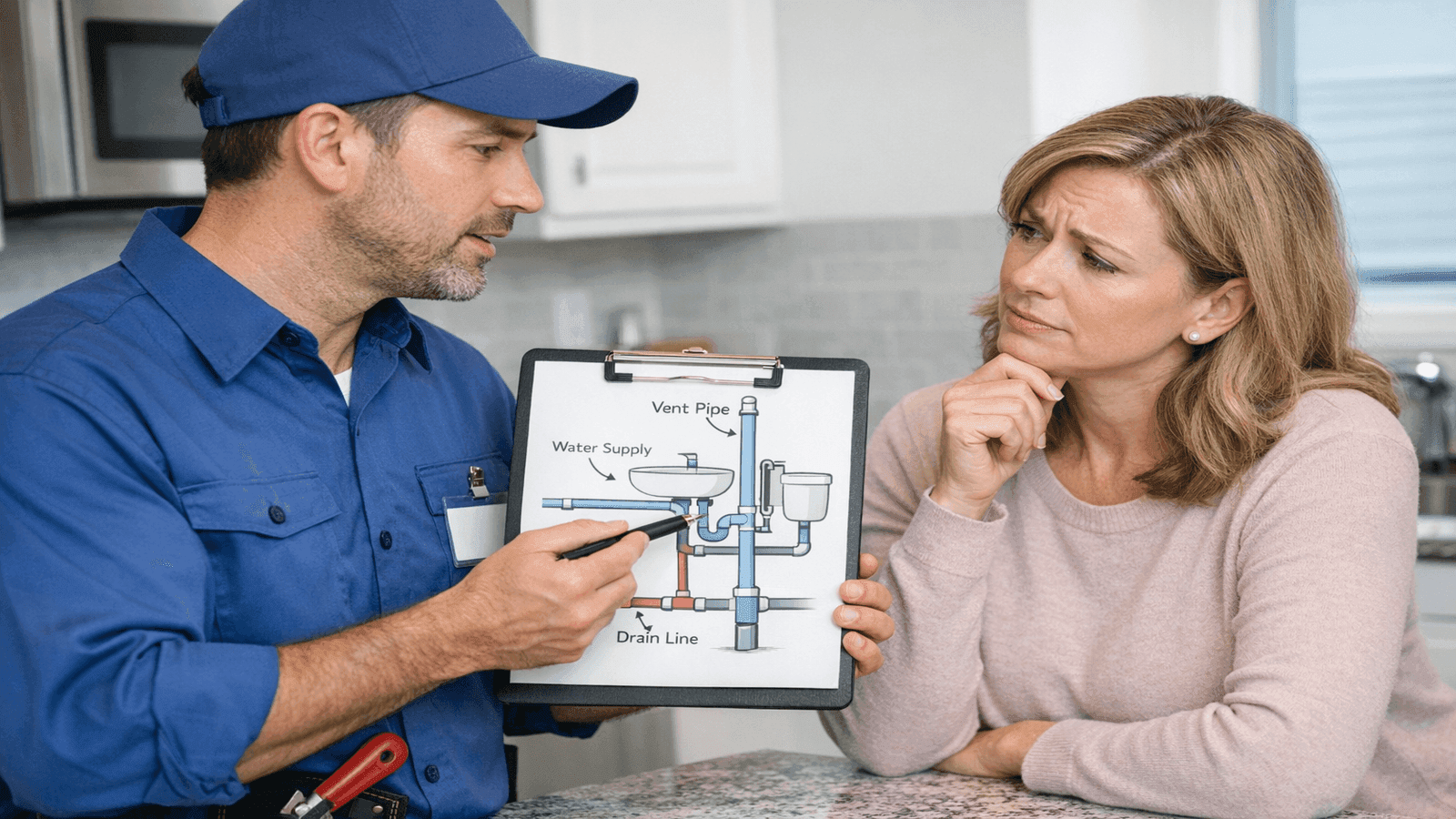
Photo: Licensed plumber explaining technical plumbing terms to homeowner using diagram on clipboard in modern home
Plumbing Terminology Basics
Plumbers aren't trying to confuse you with technical jargon. Industry terminology exists for three critical reasons:
- Code compliance standardisation
- Precise part identification
- Safety communication during repairs
When a plumber says, "I need a 3/4-inch CPVC male adapter with a compression fitting," that specific language ensures the right part gets installed. Say "plastic pipe connector" instead, and you might get PVC (wrong for hot water), the wrong diameter, or incompatible thread types.
Plumbing terms fall into five categories that homeowners encounter most:
- Fixtures and devices: Toilets, sinks, faucets, and showers
- Pipes and materials: PEX, PVC, copper, and CPVC
- Valves and controls: Shut-offs, angle stops, and ball valves
- Drainage components: Traps, vents, and drains
- Tools and equipment: Augers to basin wrenches
Regional code variations add another layer. The International Plumbing Code (IPC) governs 37 states, while the Uniform Plumbing Code (UPC) dominates Western states. Some terminology differs slightly between these systems, though most core terms remain universal.
In my 18 years, I've found that homeowners who understand just 10 key terms can save 20-30% on unnecessary service calls. They know exactly when to DIY and when to call us. More importantly, they ask better questions during estimates, which leads to more accurate quotes and fewer surprise charges.
Essential Plumbing Terms A-Z
A
ABS (Acrylonitrile Butadiene Styrene)Black plastic pipe used for drain, waste, and vent (DWV) systems. You'll encounter ABS in older homes or regions where code permits it as an alternative to white PVC. It's recognizable by its black color and is joined using special ABS cement.
AeratorThe small screen device screwed onto your faucet spout that mixes air into the water stream. Aerators reduce water flow (saving water and money) while maintaining pressure feel. When your faucet flow weakens, a clogged aerator is often the culprit—unscrew it, clean the screen, and flow returns.
Air GapThe vertical space between a water outlet (like your faucet) and the flood rim of a fixture (like your sink). This gap prevents contaminated water from back-siphoning into your clean water supply. You'll see air gaps required for dishwashers and some commercial applications.
Angle StopThe small shut-off valve between your water supply line and plumbing fixture, typically found under sinks and behind toilets. Turn this valve clockwise during fixture repairs to stop water flow without shutting off your whole house. It's called an "angle" stop because the valve body turns 90 degrees.
Auger (Plumbing Snake)A flexible metal cable tool used to clear clogs in drains and toilets. While plungers handle most surface clogs, augers reach deep blockages 15-25 feet down the line. Closet augers are specifically designed for toilets, while drum augers tackle sink and shower drains.
B
Backflow Preventer
A valve that prevents contaminated water from flowing backward into your clean water supply. Code requires backflow preventers on sprinkler systems, commercial buildings, and some residential applications. If you have an irrigation system, you'll see this device near your water meter or hose connection.
Ball Valve
A shut-off valve using a ball with a hole through it to control water flow. Turn the handle 90 degrees and water stops completely. Ball valves are more reliable than gate valves for full shut-off situations, which is why plumbers prefer them for main line applications.
Ballcock
The fill valve inside your toilet tank that controls water refilling after each flush. When you hear running water long after flushing, a faulty ballcock is usually to blame. Modern toilets use improved fill valve designs, but the term "ballcock" persists from older float-ball mechanisms.
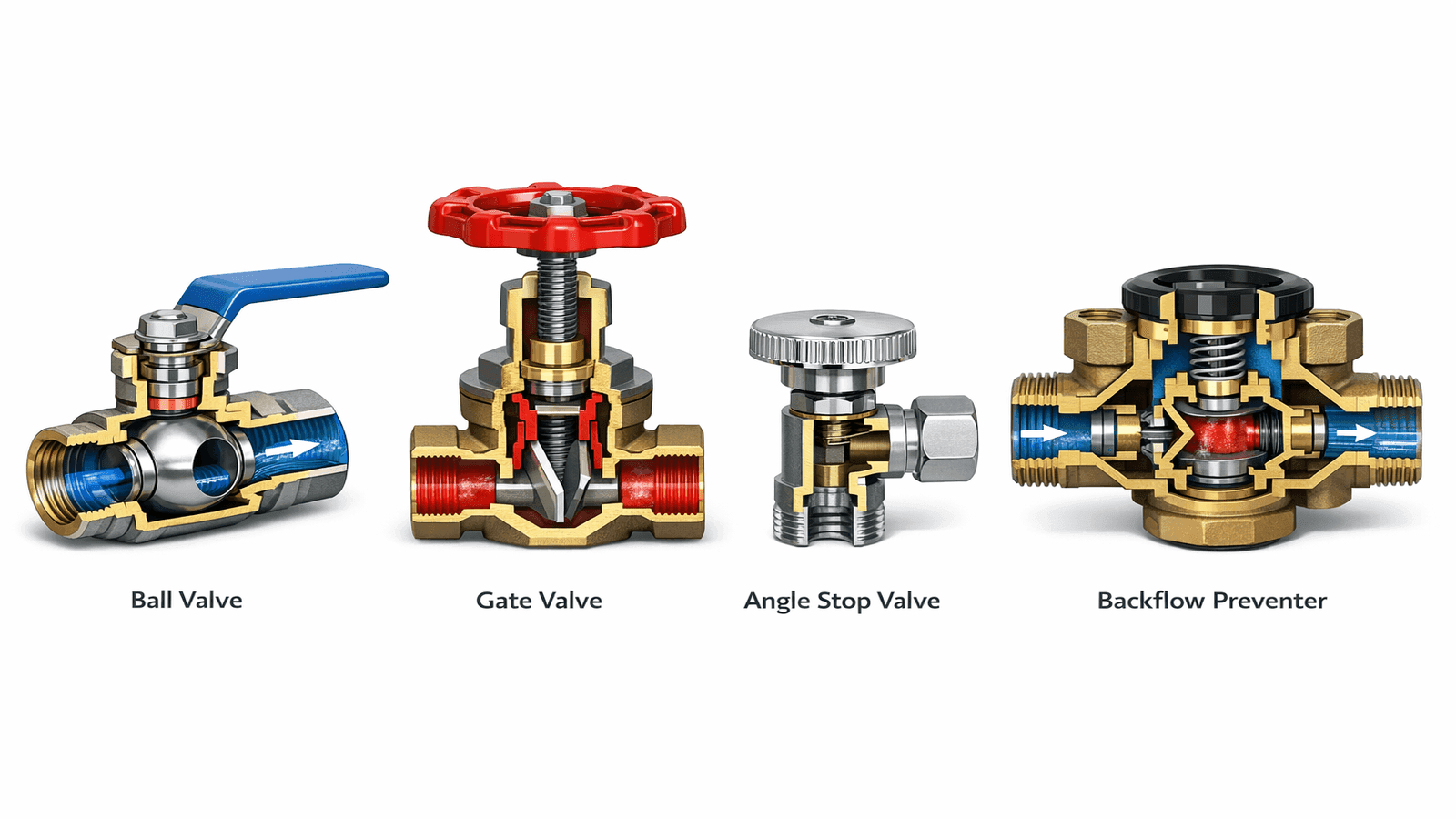
Photo: Cutaway diagram showing internal mechanisms of ball valve, gate valve, angle stop, and backflow preventer with visible components
C
CPVC (Chlorinated Polyvinyl Chloride)
Cream-colored plastic pipe rated for hot water supply lines. CPVC costs less than copper and installs faster, making it popular for water heater connections and hot water distribution. Unlike regular PVC (white), CPVC won't melt or deform when hot water flows through it.
Closet Flange
The fitting that secures your toilet to the floor and connects it to the drain pipe. This circular flange has bolt slots that hold the toilet in place. Broken closet flanges cause toilet leaks and wobbling—a common repair that runs $150-300 when the flange sits in concrete.
Compression Fitting
A pipe connection method using a compression nut and ferrule (metal ring) to create a watertight seal without soldering. You'll find compression fittings under sinks connecting supply lines to shut-off valves. They're perfect for situations where open flame soldering is impractical or dangerous.
D
Drain Trap (P-trap, S-trap)
The curved section of pipe under your sink that holds water to block sewer gases from entering your home. P-traps are shaped like the letter "P" (most common), while S-traps form an "S" shape (now prohibited by most codes). Every drain fixture needs a trap—no exceptions.
DWV (Drain-Waste-Vent)
The system of pipes that removes wastewater and sewage from your home while allowing air into drain lines to prevent suction. DWV pipes are typically larger diameter (1.5 to 4 inches) than supply pipes and rely on gravity rather than pressure.
F
Flapper
The rubber valve at the bottom of your toilet tank that lifts during flushing to release water into the bowl. A worn flapper is the number one cause of running toilets. These $8 parts typically last 3-5 years before the rubber degrades, causing slow leaks that waste 50-200 gallons daily.
Fixture
Any plumbing device that provides water and drainage. Common fixtures include toilets, sinks, tubs, showers, and dishwashers. When plumbers talk about "fixture count," they're calculating how many devices connect to your plumbing system—important for sizing water heaters and supply lines.
Flow Rate (GPM - Gallons Per Minute)
The volume of water a fixture delivers per minute. Modern faucets flow at 1.5-2.2 GPM, while older models pushed 3-5 GPM. Showerheads are limited to 2.5 GPM by federal law. Higher GPM means more water use but not necessarily better performance—aerators maintain pressure feel at lower flow rates.
G
Gate Valve
A shut-off valve that raises or lowers a metal gate to control water flow. Unlike ball valves (quarter-turn), gate valves require multiple handle rotations to fully close. They're prone to failure after years of disuse, which is why plumbers now prefer ball valves for main shut-offs.
GPF (Gallons Per Flush)
The volume of water your toilet uses per flush. Pre-1994 toilets used 3.5-7 GPF. Current federal standards mandate 1.6 GPF maximum, with high-efficiency models using 1.28 GPF or less. Dual-flush toilets offer two options: typically 0.8 GPF for liquid waste and 1.6 GPF for solids.
Gray Water
Wastewater from sinks, showers, washing machines, and dishwashers—distinct from "black water" (toilet waste). Some states allow gray water recycling for landscape irrigation, though code requirements are strict. Gray water still contains contaminants and isn't safe for drinking without treatment.
Get quotes from top-rated pros.
H
Hammer Arrestor (Water Hammer Arrestor)
A device that absorbs pressure shock when water flow suddenly stops, preventing that loud banging noise (water hammer) in your pipes. Modern codes require arrestors near quick-closing valves like dishwashers and washing machines. Installing arrestors costs $150-300 but protects pipes from pressure damage.
Hose Bib (Hose Bibb, Sillcock)
The outdoor faucet where you connect garden hoses. In cold climates, frost-free hose bibs extend 6-12 inches into your home's warm interior so the valve seat sits where it can't freeze. Always disconnect hoses before winter—trapped water can burst even frost-free models.
I
IPC (International Plumbing Code)
One of two major plumbing codes used in the United States, adopted by 37 states plus Washington D.C. The IPC is published by the International Code Council and updated every three years. If you live east of the Rockies, your jurisdiction likely follows IPC standards.
M
Main Line (Main Drain, Main Water Line)
The primary pipe bringing fresh water into your home from the street (supply main line) or carrying all wastewater out to the sewer or septic (drain main line). Knowing your main shut-off valve location is critical—it's the first thing to close during plumbing emergencies.
Manifold (PEX Manifold)
A distribution hub in PEX plumbing systems where one supply line splits into multiple dedicated lines, each serving a single fixture. Manifold systems allow individual fixture shut-offs and reduce the chance of pressure drops when multiple fixtures run simultaneously.
O
O-Ring
A circular rubber seal used in faucet valves, cartridges, and hose connections to prevent leaks. These inexpensive parts (25 cents to $2) wear out over time, causing drips and leaks. Replacing O-rings is among the simplest DIY plumbing repairs—just match the exact size.
P
PEX (Cross-Linked Polyethylene)
Flexible plastic tubing used for water supply lines, color-coded red (hot), blue (cold), or white (either). PEX revolutionized plumbing installation because it bends around corners, resists freezing better than copper, and installs 40% faster. It's now used in 65% of new home construction.
Potable Water
Water that's safe for human consumption. Your supply lines carry potable water, while drain lines remove non-potable wastewater. Cross-connections between potable and non-potable systems violate code and create serious health hazards—hence backflow preventer requirements.
PSI (Pounds Per Square Inch)
The measurement of water pressure in your plumbing system. Normal home water pressure ranges from 40-80 PSI, with 50-60 PSI being ideal. Pressure above 80 PSI stresses pipes and fixtures, requiring a pressure-reducing valve. Below 40 PSI, showers feel weak and appliances underperform.
PVC (Polyvinyl Chloride)
White plastic pipe used primarily for cold water supply, drain lines, and vent stacks. PVC is inexpensive, easy to install, and doesn't corrode like metal pipes. However, it's not rated for hot water—that's where CPVC or PEX come in.
R
Reducer
A fitting that connects pipes of different diameters, stepping down from larger to smaller or vice versa. You'll encounter reducers when replacing fixtures that require different supply line sizes or when your home's main line transitions to branch lines.
Rough-In
The initial plumbing installation phase when pipes are run through walls, floors, and ceilings before drywall installation. Rough-in plumbing includes all supply lines, drain lines, and vents, leaving stub-outs where fixtures will eventually connect. Inspectors check rough-in work before walls close up.
S
Sanitary Tee
A T-shaped fitting used specifically in drain lines where a branch drain connects to a vertical stack. Unlike regular tees, sanitary tees have a gentle curve that directs waste flow downward without creating turbulence that could cause clogs. The name doesn't imply an "unsanitary" alternative exists—it's just drain-specific.
Septic System
An on-site wastewater treatment system used in rural areas without municipal sewer connections. Septic systems include a buried tank where solids settle and a drain field where liquid waste percolates into the soil. They require pumping every 3-5 years and careful maintenance.
Shut-Off Valve
Any valve that stops water flow to a fixture or section of plumbing. Every fixture should have individual shut-offs (angle stops) for repairs. Your home also has a main shut-off valve—usually near the water meter or where the supply line enters the house. Know where it is before emergencies strike.
Supply Line
The pipe or flexible hose that delivers fresh water from a shut-off valve to a fixture. Under-sink supply lines are typically braided stainless steel flex lines (easy replacement) or chrome-plated copper (traditional). Supply lines should be replaced every 10 years to prevent burst failures.
T
Tailpiece
The straight section of pipe that extends down from a sink drain to the P-trap below. Tailpieces are adjustable by cutting to length during installation. If your sink drains slowly, the tailpiece-to-trap connection might have debris buildup or a faulty gasket seal.
Trap Weir
The highest point inside a drain trap where water flows over before heading down the drain. The trap weir creates the water seal that blocks sewer gases. Proper trap weir height is code-specified—too low and gases escape, too high and the drain flows sluggishly.
Trip Lever
The flush handle and connected arm mechanism inside your toilet tank that lifts the flapper when you push it. Trip levers can also refer to bathtub drain mechanisms. When your toilet won't flush fully, a bent or corroded trip lever might not be lifting the flapper high enough.
U
UPC (Uniform Plumbing Code)
The plumbing code adopted primarily in Western states including California, Oregon, Washington, Nevada, and Arizona. Published by IAPMO (International Association of Plumbing and Mechanical Officials), the UPC differs slightly from the IPC in certain requirements and terminology.
V
Vent Stack
A vertical pipe that extends through your roof, allowing air into your drain system and sewer gases to escape outside. Proper venting prevents drain suction and enables waste to flow freely. Every drain fixture needs venting—either through a dedicated vent stack or via adjacent fixture vents.
W
Water Closet (WC)
Industry term for a toilet. The abbreviation "WC" appears stamped on most toilet tanks, a holdover from when indoor toilets were literally closets with plumbing. Related terms include closet flange (the floor mounting ring) and closet auger (the toilet-specific drain snake).
Water Hammer
The loud banging noise that occurs when fast-flowing water suddenly stops, creating a pressure wave that rattles pipes. Opening or closing faucets quickly can cause water hammer, as can washing machine and dishwasher valves. Water hammer arrestors or secured pipe straps solve the problem.
Wax Ring
The wax seal between your toilet base and the closet flange that prevents water and sewer gases from leaking. Wax rings compress when you set the toilet, creating an airtight seal. Failed wax rings cause leaks, odors, and floor damage—replacement is a messy but essential repair.
Water Closet (WC)
Industry term for a toilet. The abbreviation "WC" appears stamped on most toilet tanks, a holdover from when indoor toilets were literally closets with plumbing. Related terms include closet flange (the floor mounting ring) and closet auger (the toilet-specific drain snake).
Water Hammer
The loud banging noise that occurs when fast-flowing water suddenly stops, creating a pressure wave that rattles pipes. Opening or closing faucets quickly can cause water hammer, as can washing machine and dishwasher valves. Water hammer arrestors or secured pipe straps solve the problem.
Wax Ring
The wax seal between your toilet base and the closet flange that prevents water and sewer gases from leaking. Wax rings compress when you set the toilet, creating an airtight seal. Failed wax rings cause leaks, odors, and floor damage—replacement is a messy but essential repair.
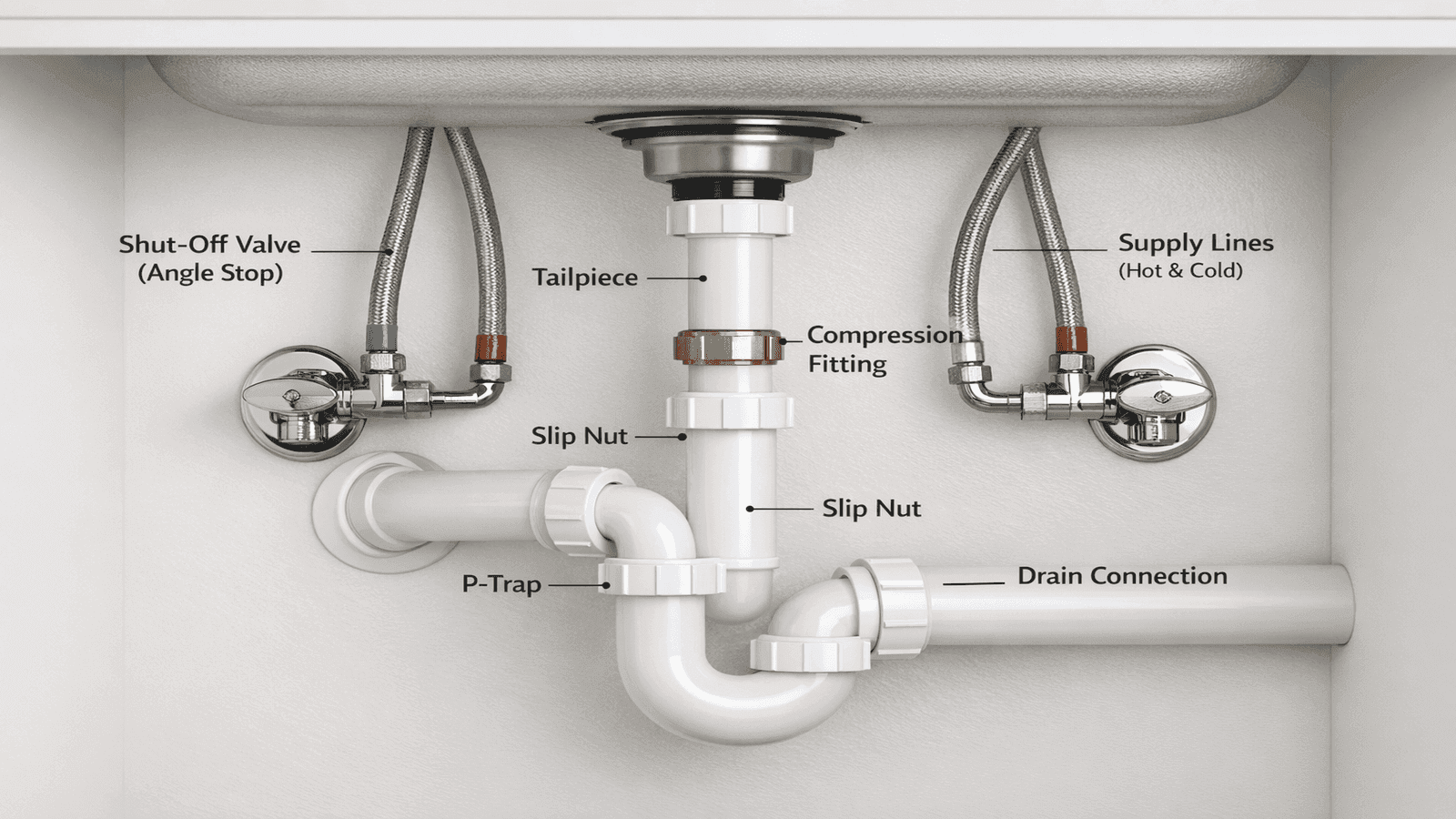
Photo: Detailed diagram showing labeled plumbing components under a kitchen sink including P-trap, shut-off valves, supply lines, tailpiece, and compression fittings
The three terms that confuse homeowners most? Water closet (sounds like a closet, but it's your toilet), trap weir (the technical name for that curved part under your sink), and GPF versus GPM. I've seen people order 2.5 GPF showerheads thinking it's the flow rate—that would flush 2.5 gallons every time you turn it on!
Get quotes from top-rated pros.
Common Plumbing Abbreviations
Plumbers and suppliers use abbreviations on estimates, diagrams, and invoices. Here's what they mean:
| Abbreviation | Full Term | What It Means | Where You'll See It |
| GPM | Gallons Per Minute | Water flow rate | Faucets, showerheads, specifications |
| GPF | Gallons Per Flush | Toilet flush volume | Toilet labels, efficiency ratings |
| PSI | Pounds Per Square Inch | Water pressure | Pressure gauges, valve ratings |
| DWV | Drain-Waste-Vent | Drainage system | Plumbing diagrams, code references |
| IPC | International Plumbing Code | Code standard (37 states) | Permit applications, inspections |
| UPC | Uniform Plumbing Code | Code standard (Western states) | Permit applications, inspections |
| ABS | Acrylonitrile Butadiene Styrene | Black plastic pipe | Material specifications |
| PVC | Polyvinyl Chloride | White plastic pipe | Cold water supply, drains |
| PEX | Cross-Linked Polyethylene | Flexible plastic pipe | Supply line installations |
| CPVC | Chlorinated PVC | Hot water plastic pipe | Water heater connections |
| WC | Water Closet | Toilet | Plumbing fixtures, estimates |
| FIP | Female Iron Pipe | Threaded female fitting | Fitting specifications |
| MIP | Male Iron Pipe | Threaded male fitting | Fitting specifications |
Professionals use these shortcuts for efficiency—they save space on diagrams and speed up communication between plumbers and suppliers. Print this table and keep it near your main shut-off valve for quick reference during plumbing issues.
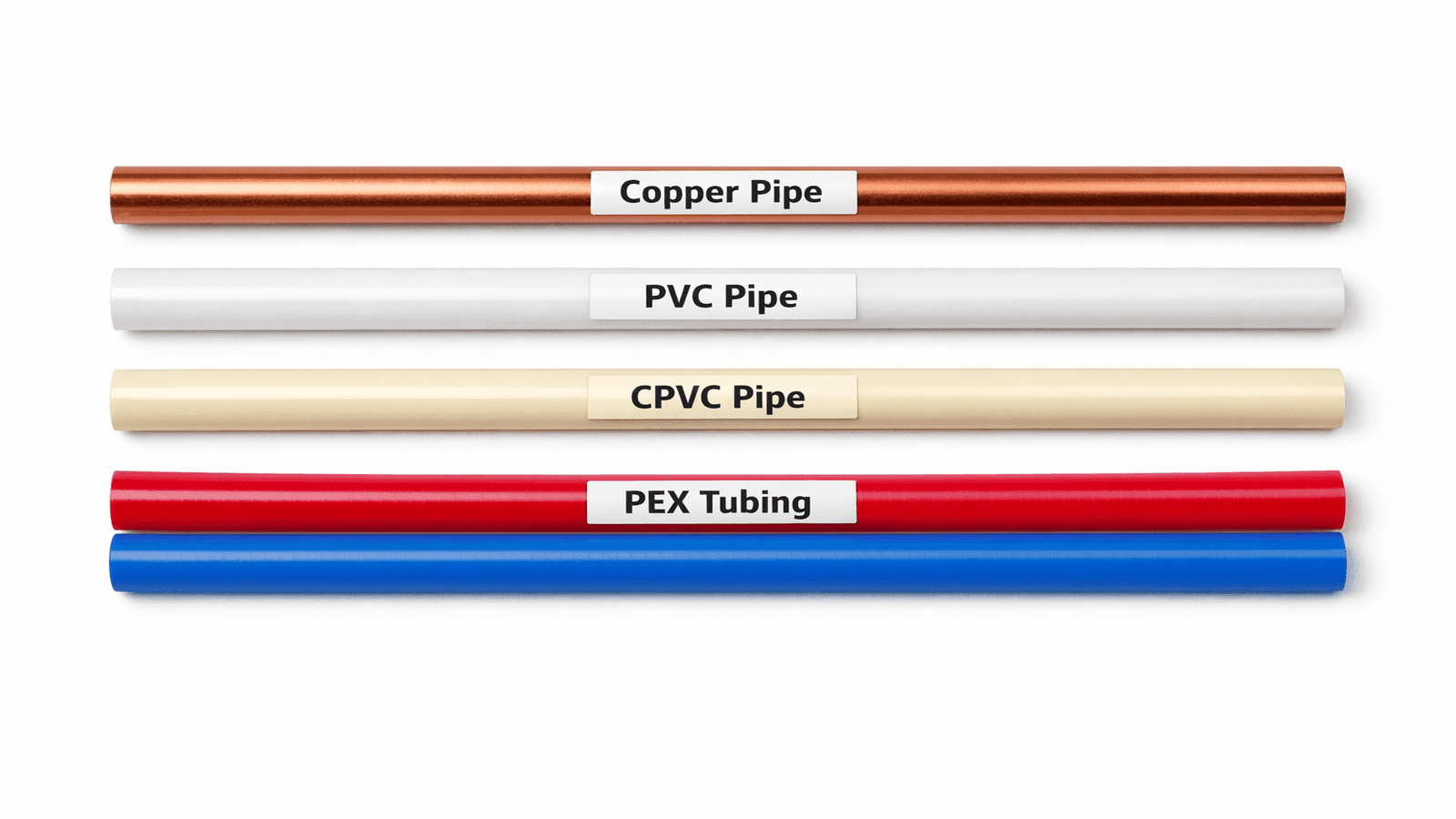
Photo: Comparison photo showing different pipe materials side-by-side: copper pipe, white PVC, cream CPVC, and colored PEX with clear labels
How to Use This Glossary
Keep this glossary accessible for maximum value. Here's how to make it work for you:
- Bookmark this page for instant access during plumbing emergencies. When your plumber mentions unfamiliar terms, pull up this glossary on your phone and follow along.
- Print the abbreviations table and tape it inside the cabinet where your main water shut-off valve is located. During emergencies, you'll have a quick reference without hunting for your phone.
- Share relevant terms with contractors during estimates. If they say, "I need to replace your ballcock and flapper," confirm: "So you're replacing the toilet tank fill valve and the rubber flush valve?" This shows you're informed and reduces miscommunication.
- Use correct terminology when calling for quotes. Saying "My water closet has a leak at the closet flange" gets faster, more accurate service than "My toilet is leaking somewhere on the floor."
- Reference during DIY projects to buy the correct parts on the first trip. Knowing you need a "3/4-inch CPVC male adapter with compression fitting" saves the frustration of returning mismatched parts three times.
Before any plumber visit, review the terms related to your issue. If it's a toilet problem, read up on flapper, ballcock, wax ring, and closet flange. You'll ask better questions, understand the diagnosis clearly, and catch it quickly if a less-than-honest plumber tries to upsell unnecessary repairs.
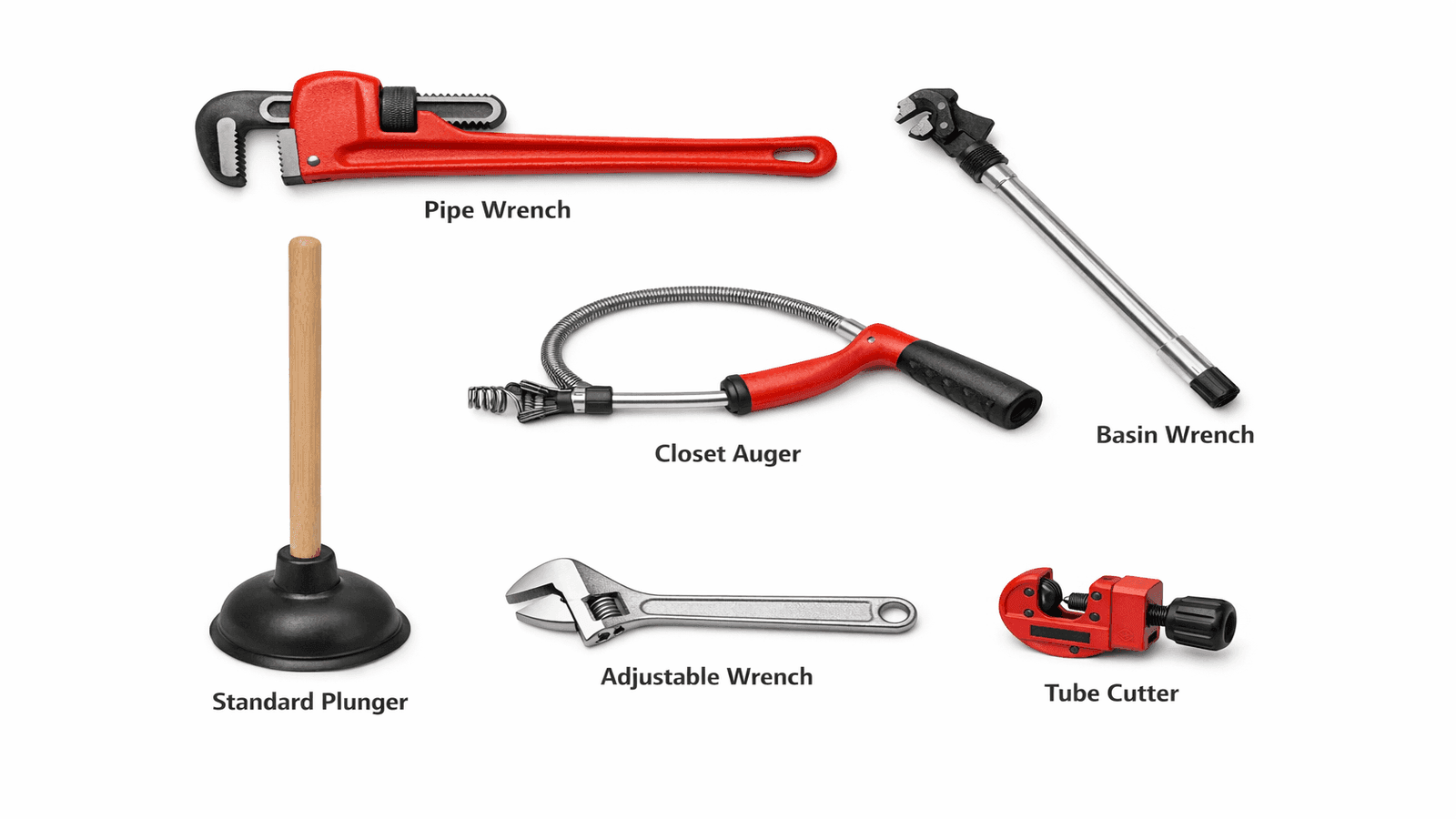
Photo: Collection of common plumbing tools laid out with labels: pipe wrench, basin wrench, closet auger, plunger, adjustable wrench, and tube cutter
Sources & References
This glossary draws from industry-standard sources and Michael R. Jennings' 18 years of professional plumbing experience:
Plumbing-Heating-Cooling Contractors Association (PHCC)
National trade association providing industry standards, professional terminology, and continuing education for licensed plumbing contractors. https://www.phccweb.org/
International Code Council - International Plumbing Code (IPC)
The publisher of the IPC, adopted by 37 states plus Washington D.C., for plumbing code compliance and standardised terminology. https://codes.iccsafe.org/content/IPC2021P3
IAPMO - Uniform Plumbing Code (UPC)
International Association of Plumbing and Mechanical Officials, publisher of the UPC governing Western states and providing National Standard Plumbing Code terminology. https://iapmo.org/codes-standards-development/code-development/uniform-plumbing-code
Today's Homeowner - Plumbing Terminology Guide
Comprehensive homeowner resource for understanding basic plumbing terms and concepts. https://todayshomeowner.com/plumbing/guides/plumbing-terminology/
Michael R. Jennings' Field Experience
18 years as a Licensed Master Plumber, 2,400+ residential and commercial projects completed across California and Texas, specialising in homeowner education and clear communication.
EPA WaterSense Program
Federal water efficiency standards for GPM and GPF ratings on fixtures and appliances. https://www.epa.gov/watersense
Disclaimer: This glossary provides general plumbing terminology for educational purposes only. Plumbing work is subject to health and safety codes that vary by jurisdiction. For specific plumbing repairs, installations, or renovations in your home, always consult a licensed professional plumber who understands local code requirements. Definitions may vary slightly between IPC and UPC regions.

Michael Jennings is a licensed master plumber & water systems specialist with over 18 years of hands-on experience in residential and commercial plumbing, serving clients across California and Texas. At NearbyHunt, he shares practical advice on pipe installations, water heater maintenance, and home plumbing upgrades. Michael has helped thousands of homeowners prevent costly water damage and improve water efficiency through modern plumbing solutions.

Robert is a licensed master plumber with over 20 years of experience serving both residential and commercial clients across the Midwest. Specialising in advanced plumbing systems and sustainable water technologies, Rob brings deep technical insight and hands-on expertise to every project. As a reviewer for NearbyHunt, he ensures all plumbing content reflects the highest standards of safety, compliance, and practicality.