- Falls caused 351 construction deaths in 2023, making them the #1 plumbing hazard requiring PPE and proper ladder protocols
- OSHA's 2026 priorities include heat illness prevention and workplace violence standards affecting all plumbing contractors
- EPA SDWA mandates 0.25% weighted lead average for pipes/fittings installed after June 1986 to protect water quality
- California requires SWRCB-recognised backflow tester certification starting July 1, 2026, with ANSI accreditation by 2027
- Confined space work requires oxygen monitoring and H₂S detection—buildup kills faster than you can react
- OSHA 30-Hour certification demonstrates contractor commitment to safety and may reduce insurance premiums 15-20%
Nine plumbers get hurt on the job every single day in the United States—3,300+ workplace injuries annually, with 1,400 requiring days off work.
In an industry where professionals routinely work in confined spaces, handle hazardous materials, and operate at heights, understanding and following safety standards isn't optional—it's lifesaving.
Whether you're governed by OSHA's general industry standards (29 CFR Part 1910) for service work or construction standards (29 CFR Part 1926) for new builds, 2026 brings updated priorities and enhanced enforcement. From heat illness prevention to workplace violence protocols, plumbing contractors face evolving compliance requirements that directly impact worker safety and business operations.
This guide breaks down current OSHA regulations, common workplace hazards, PPE requirements, plumbing code safety standards, and the training needed to keep plumbers safe while maintaining compliance. We'll cover 2026's regulatory changes, including California's new backflow tester certification requirements and OSHA's expanded heat illness standards that affect every outdoor plumber in southern states.
For a comprehensive plumbing system overview—including infrastructure, materials, licensed services, and maintenance planning—explore our Complete Guide to Plumbing Systems & Services

Get quotes from top-rated pros.
In my 18 years as a licensed master plumber, I've seen how proper safety protocols save lives. I earned my OSHA 30-Hour certification early in my career, and it's changed how I approach every job—from checking oxygen levels in crawl spaces to ensuring my crew wears proper respiratory protection around mold. The 2026 heat illness standards are especially important here in Texas, where summer temps regularly exceed 100°F during outdoor rough-in work.
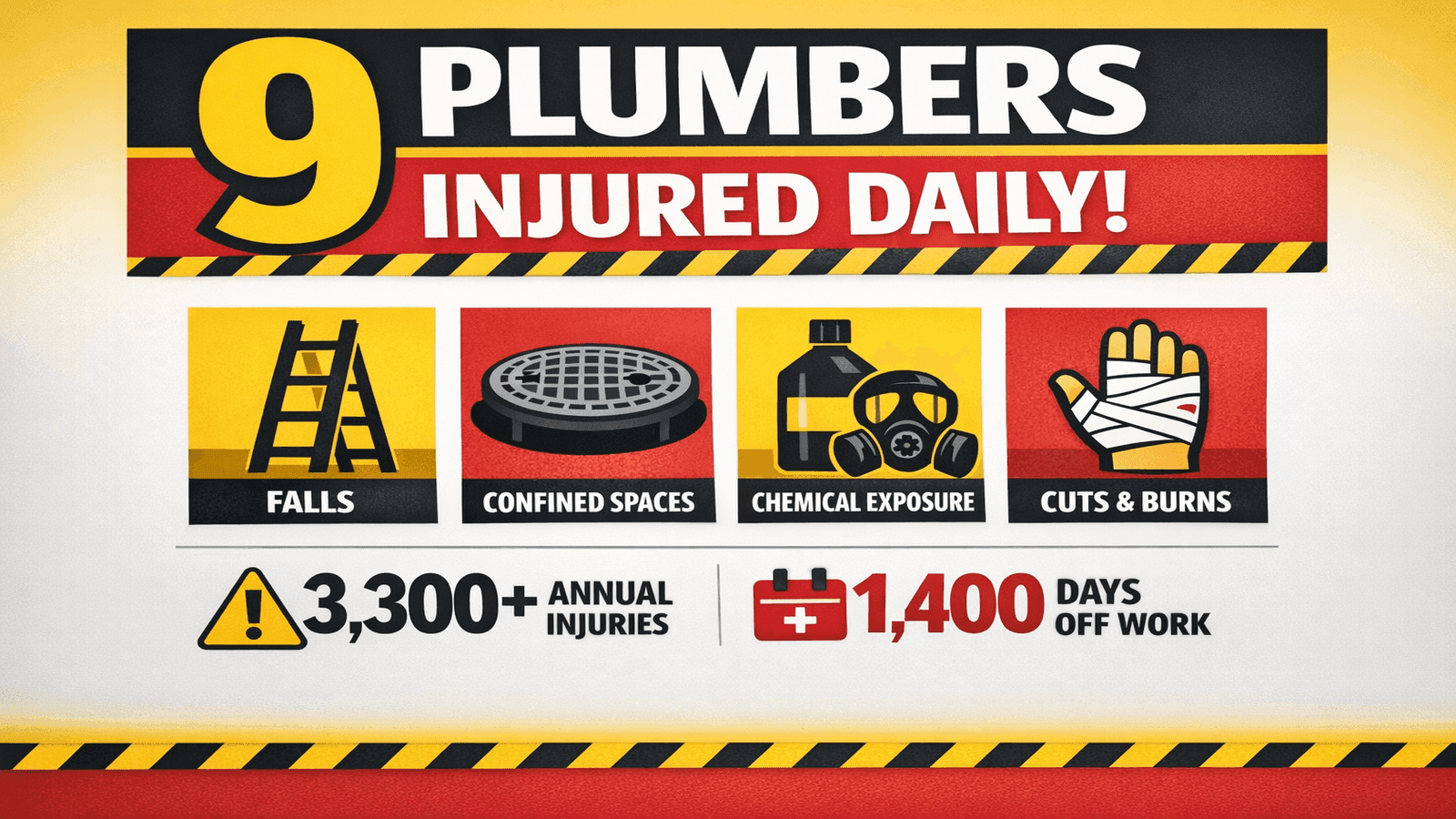
Photo: Infographic showing 9 plumbers injured daily statistic with icons representing fall hazards, confined spaces, chemical exposure, and cuts/burns
OSHA Safety Standards for Plumbing Work
OSHA doesn't have plumbing-specific regulations—instead, plumbing work falls under either general industry standards (29 CFR Part 1910) or construction standards (29 CFR Part 1926) depending on the job type.
Understanding which regulations apply to your work determines everything from fall protection requirements to recordkeeping obligations. Misidentifying your regulatory category can result in citations even when you think you're compliant.
General Industry vs. Construction Standards
The distinction between these two regulatory frameworks comes down to what you're doing, not who you are.
General Industry (29 CFR Part 1910) covers:
- Service calls to existing buildings
- Maintenance and repair work
- Fixture replacements in occupied structures
- Drain cleaning and water heater servicing
- Emergency leak repairs
- Most residential service plumbing
- Plumbing inspections and troubleshooting
Construction Standards (29 CFR Part 1926) cover:
- New construction rough-in work
- Major renovations and structural additions
- Site work and underground utility installation
- Commercial building projects from ground-up
- Demolition involving plumbing system removal
- Trenching and excavation for new lines
- Multi-unit residential new builds
The key distinction: if you're building or significantly altering a structure, you're likely under construction standards. If you're servicing existing systems without major structural changes, general industry applies.
Some plumbers work under both standards depending on the project. A contractor who does service calls during the week but rough-ins new homes on weekends must understand both regulatory frameworks.
2026 OSHA Priority Standards
OSHA's 2026 enforcement priorities reflect evolving workplace hazards and increased focus on proactive prevention rather than reactive citations.
New enforcement focus areas:
- Heat illness prevention: Expanded requirements for outdoor work include mandatory water breaks every 2 hours when temperatures exceed 90°F, shade access within 200 feet of work areas during extreme heat, employer-provided electrolyte drinks, acclimatization periods for new workers during hot months, and emergency response plans for heat exhaustion symptoms
- Workplace violence prevention: New standards address plumbers working alone in homes, vehicle safety protocols (GPS tracking, check-in systems), client interaction de-escalation training, background screening for residential service calls, and panic button/communication requirements for solo technicians
- Hazard communication: Updated SDS (Safety Data Sheets) requirements mandate digital accessibility, QR code linking to current versions, multilingual availability for diverse workforces, real-time updates when formulations change, and training documentation that proves comprehension
- Expanded recordkeeping: Enhanced injury/illness reporting for companies with 10+ employees now requires electronic submission, incident root cause analysis documentation, corrective action tracking with completion dates, near-miss reporting systems, and quarterly trend analysis
- Increased data transparency: Public access to workplace injury statistics by company through OSHA's online database, allowing customers to verify contractor safety records before hiring
Compliance timeline:
- January 1, 2026: Heat illness standards take effect
- March 1, 2026: Workplace violence prevention requirements begin
- July 1, 2026: Enhanced recordkeeping and electronic submission required
- October 1, 2026: Full public transparency database goes live
Most 2026 standards took effect January 1, with enforcement ramp-up throughout the year. OSHA increased inspection frequency by 22% for construction trades and doubled penalties for repeat heat illness violations.
The 2026 heat illness standards are game-changers for plumbing contractors in southern states. I've already updated our company protocols to include mandatory 15-minute shade breaks every 2 hours when temps exceed 90°F, plus cooling towels and electrolyte drinks in every work truck. It sounds like extra hassle, but I've seen three apprentices avoid heat exhaustion in the past year alone. OSHA's serious about this—penalties for heat illness violations start at $15,625 per incident.
Common Workplace Hazards for Plumbers
Plumbers face unique occupational hazards that result in more injuries than nearly any other profession.
The Bureau of Labor Statistics reports that maintenance workers, including plumbers, experience higher injury and illness rates than almost every other occupation category. Understanding these eight primary hazards is the first step to preventing the 9 daily injuries that keep plumbers off the job.
Falls from Heights
Falls remain the leading cause of plumbing fatalities year after year.
The statistics tell a sobering story:
- 351 construction worker fall deaths in 2023 (BLS data)
- Falls account for 33% of all construction fatalities
- Average fall distance resulting in death: 11 feet
- Most plumbing falls occur from 6-10 feet (ladders, roofs, scaffolding)
Most common plumbing fall scenarios:
- Ladder work for water heater access in garages or attics
- Roof vent stack installation or repairs
- Attic rough-in work on joists without flooring
- Scaffolding during multi-story commercial projects
- Trench work without proper shoring or ladder access
- Step ladder overreach while installing ceiling fixtures
- Wet surface slips on concrete slab rough-ins
Fall protection requirements:
- Three-point contact on ladders at all times (two hands and one foot, or two feet and one hand)
- Ladder must extend 3 feet above landing surface for roof access
- Fall protection required at 6 feet in construction work, 4 feet in general industry
- Proper scaffolding assembly with guardrails, toe boards, and stable footing
- Trench boxes or shoring for excavations deeper than 5 feet, with safe access/egress
- Personal fall arrest systems (harness, lanyard, anchor) for work above protection heights
- Hole covers or guardrails around floor openings
Never use the top two rungs of a step ladder. Never stand on a toilet, bathtub, or sink to reach overhead work—use proper scaffolding or a stable work platform.
Falls remain the leading cause of plumbing fatalities year after year.
The statistics tell a sobering story:
- 351 construction worker fall deaths in 2023 (BLS data)
- Falls account for 33% of all construction fatalities
- Average fall distance resulting in death: 11 feet
- Most plumbing falls occur from 6-10 feet (ladders, roofs, scaffolding)
Most common plumbing fall scenarios:
- Ladder work for water heater access in garages or attics
- Roof vent stack installation or repairs
- Attic rough-in work on joists without flooring
- Scaffolding during multi-story commercial projects
- Trench work without proper shoring or ladder access
- Step ladder overreach while installing ceiling fixtures
- Wet surface slips on concrete slab rough-ins
Fall protection requirements:
- Three-point contact on ladders at all times (two hands and one foot, or two feet and one hand)
- Ladder must extend 3 feet above landing surface for roof access
- Fall protection required at 6 feet in construction work, 4 feet in general industry
- Proper scaffolding assembly with guardrails, toe boards, and stable footing
- Trench boxes or shoring for excavations deeper than 5 feet, with safe access/egress
- Personal fall arrest systems (harness, lanyard, anchor) for work above protection heights
- Hole covers or guardrails around floor openings
Never use the top two rungs of a step ladder. Never stand on a toilet, bathtub, or sink to reach overhead work—use proper scaffolding or a stable work platform.
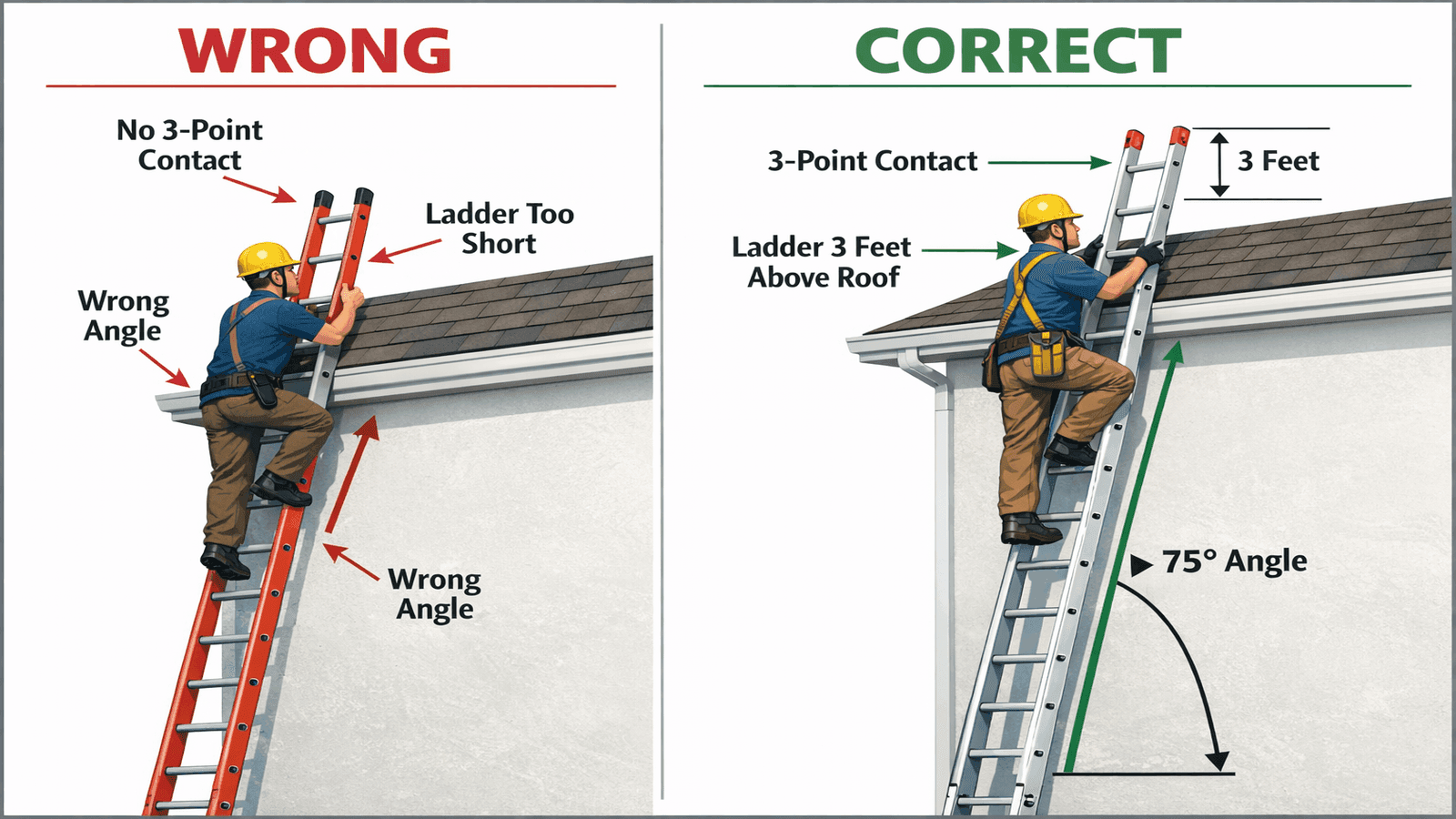
Photo: Side-by-side comparison image of improper vs. proper ladder setup showing 3-point contact and 3-foot extension above landing surface
Confined Space Dangers
Confined spaces kill faster than almost any other plumbing hazard—and they often claim multiple victims when untrained rescuers attempt to help.
Atmospheric hazards in confined spaces:
- Hydrogen sulfide (H₂S) buildup in sewer systems, septic tanks, and manholes
- Methane accumulation in septic tanks and sewer lines
- Oxygen levels below 19.5% cause unconsciousness within seconds
- H₂S at 100 ppm can be immediately fatal
- Oxygen displacement from welding, nitrogen purging, or decomposition
- Carbon monoxide from gasoline-powered pumps or vehicles near entry points
H₂S smells like rotten eggs at low concentrations but paralyzes your sense of smell at dangerous levels—you literally can't smell it when it's killing you. Never trust your nose in confined spaces.
OSHA-required confined space entry procedures (1910.146):
- Atmospheric testing before entry: oxygen (19.5-23.5%), LEL below 10%, H₂S below 10 ppm, CO below 35 ppm
- Continuous gas monitoring during work with audible alarms
- Mechanical ventilation equipment when needed to maintain safe atmosphere
- Written entry permit system for permit-required spaces
- Trained attendant stationed outside maintaining constant visual or communication contact
- Rescue plan and retrieval equipment readily available (tripod, winch, harness)
- Prohibition of entry rescue attempts without proper training and SCBA
- Lockout/tagout of equipment that could release hazards into space
Common plumbing confined spaces:
- Septic tanks and pump chambers
- Sewer manholes and wet wells
- Deep utility trenches (4+ feet with limited egress)
- Crawlspaces with restricted entry/exit
- Water tanks and reservoirs
- Underground vaults and valve chambers
Get quotes from top-rated pros.
Confined spaces kill faster than almost any other plumbing hazard—and they often claim multiple victims when untrained rescuers attempt to help.
Atmospheric hazards in confined spaces:
- Hydrogen sulfide (H₂S) buildup in sewer systems, septic tanks, and manholes
- Methane accumulation in septic tanks and sewer lines
- Oxygen levels below 19.5% cause unconsciousness within seconds
- H₂S at 100 ppm can be immediately fatal
- Oxygen displacement from welding, nitrogen purging, or decomposition
- Carbon monoxide from gasoline-powered pumps or vehicles near entry points
H₂S smells like rotten eggs at low concentrations but paralyzes your sense of smell at dangerous levels—you literally can't smell it when it's killing you. Never trust your nose in confined spaces.
OSHA-required confined space entry procedures (1910.146):
- Atmospheric testing before entry: oxygen (19.5-23.5%), LEL below 10%, H₂S below 10 ppm, CO below 35 ppm
- Continuous gas monitoring during work with audible alarms
- Mechanical ventilation equipment when needed to maintain safe atmosphere
- Written entry permit system for permit-required spaces
- Trained attendant stationed outside maintaining constant visual or communication contact
- Rescue plan and retrieval equipment readily available (tripod, winch, harness)
- Prohibition of entry rescue attempts without proper training and SCBA
- Lockout/tagout of equipment that could release hazards into space
Common plumbing confined spaces:
- Septic tanks and pump chambers
- Sewer manholes and wet wells
- Deep utility trenches (4+ feet with limited egress)
- Crawlspaces with restricted entry/exit
- Water tanks and reservoirs
- Underground vaults and valve chambers
I've personally responded to a confined space emergency where a plumber passed out in a septic tank from hydrogen sulfide. The homeowner didn't realize the dangers and went in to help—both died before rescue arrived. After that, I invested $850 in a four-gas monitor that clips to my shirt and screams if oxygen drops or H₂S rises. It's gone off twice in crawlspaces where I otherwise would've kept working. That $850 has saved my life—and it's tax-deductible.
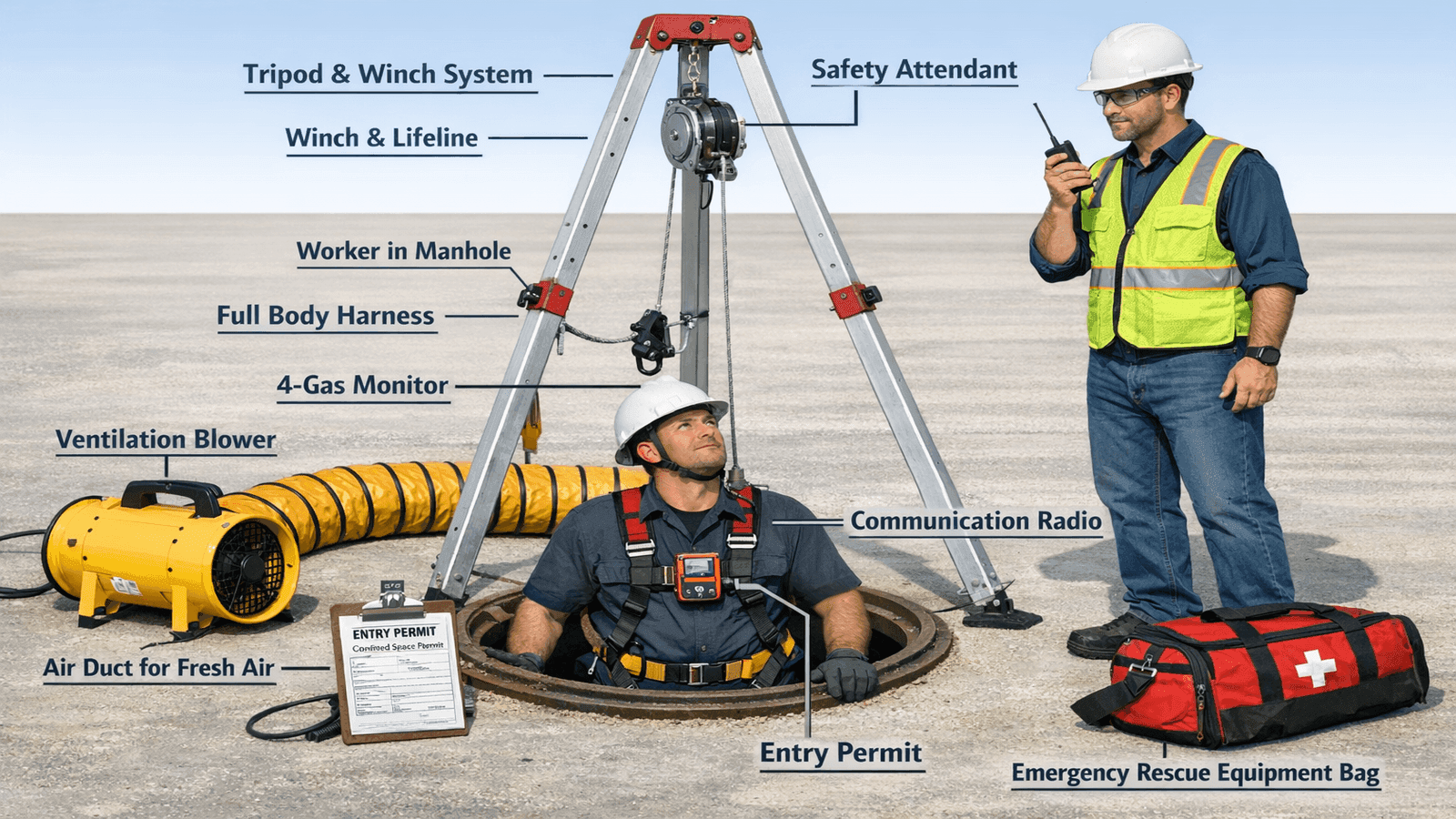
Photo: Diagram of permit-required confined space entry setup showing gas monitor, ventilation fan, tripod retrieval system, attendant position, and entry permit
Chemical and Material Exposures
Plumbers encounter more hazardous substances than most construction trades realize.
Common hazardous exposures in plumbing work:
- Asbestos in older pipe insulation, joint compound, and floor tiles (pre-1980 buildings)
- Lead paint and pipes in pre-1986 buildings requiring EPA RRP compliance
- Mold in water-damaged walls, ceilings, and crawlspaces
- Sewage-borne pathogens, including bacteria (E. coli, Salmonella), viruses (Hepatitis A, Norovirus), and parasites (Giardia)
- PVC cement and primer fumes containing tetrahydrofuran and acetone
- Soldering flux and lead-free solder produce irritant fumes
- Drain cleaners containing sodium hydroxide or sulfuric acid
- Thread sealants and pipe dope with petroleum distillates
- Vermiculite insulation potentially containing asbestos
Protection requirements by exposure type:
Respirators rated for specific hazards:
- N95 for nuisance dust and non-toxic particles
- P100 for lead, asbestos, and mould (HEPA filtration)
- Half-face with organic vapour cartridges for PVC cement, solvents
- Full-face or supplied air for high-concentration chemical exposure
- SCBA (self-contained breathing apparatus) for immediately dangerous atmospheres
Lead-safe work practices per EPA RRP Rule:
- Plastic sheeting containment of work area
- HEPA vacuum for cleanup (no dry sweeping)
- Wet methods for cutting/sanding
- Prohibited work methods (open flame burning, machine sanding without HEPA)
- Waste disposal in sealed containers
- Cleaning verification and documentation
Bloodborne pathogen training for sewage exposure:
- Annual training on transmission risks
- Hepatitis B vaccination offered free to at-risk workers
- Post-exposure medical evaluation protocols
- Hand washing and hygiene procedures
Proper ventilation when using adhesives and solvents:
- Natural ventilation (open windows/doors) when possible
- Mechanical ventilation (fans) for confined areas
- Work positioning to stay upwind of fumes
Safety Data Sheets (SDS) available for all chemicals:
- Accessible on job site (paper or mobile device)
- Workers trained to read and understand SDS
- Emergency contact information readily available
Fit testing is required annually for all workers using tight-fitting respirators. A beard or even heavy stubble breaks the seal and makes respirators useless—clean-shaven faces are mandatory for respiratory protection.
Cuts, Burns, and Physical Injuries
Hand and body injuries from tools and materials account for thousands of plumber injuries annually.
Sharp tool hazards:
- Pipe cutters and hacksaws with exposed blades
- Reamers and deburring tools
- Utility knives and razor scrapers
- Sheet metal edges on ductwork and flashing
- Broken cast iron pipe with sharp edges
- Threading dies and pipe threaders
Hot surface hazards:
- Recently soldered copper joints (up to 750°F)
- Water heater flues and exhaust pipes
- Steam pipes and condensate lines
- Propane torch tips and cylinders
- Heated PEX expansion tools
- Hot water from system draining
Pinch point and crushing hazards:
- Pipe wrenches and adjustable wrenches
- Pipe threading machines
- PEX crimping and expansion tools
- Power threaders and groovers
- Bathtubs, water heaters, and heavy fixtures during installation
Heavy lifting injuries:
- Water heaters (40-120 lbs) up/down stairs
- Cast iron bathtubs (250-500 lbs)
- Sections of cast iron soil pipe (50-80 lbs each)
- Commercial water softeners and filtration systems
- Portable threading machines and equipment
Protection requirements:
- Cut-resistant gloves rated ANSI A2 or higher for sharp tool work
- Heat-resistant gloves (Kevlar, leather, or Nomex) for soldering and brazing
- Proper lifting techniques: Bend knees, keep back straight, lift with legs
- Mechanical aids: Hand trucks, carts, shoulder dollies, lifting straps
- Tool guards and shields on power equipment (threaders, grinders)
- First aid kits on all job sites with burn gel, bandages, eye wash
Two-person lift requirements vary by state, but industry best practice is team lifting for anything over 50 lbs or awkward loads regardless of weight.
Hearing Loss from Prolonged Noise
The World Health Organization reports that nearly 50% of plumbers suffer from hearing loss—a preventable injury that's permanent once it occurs.
Common noise sources in plumbing:
- Jackhammers for concrete demolition: 95-115 dB
- Angle grinders cutting pipe: 90-100 dB
- Impact wrenches and power threaders: 85-95 dB
- Drain cleaning machines: 80-90 dB
- Reciprocating saws: 85-95 dB
- Air compressors: 80-90 dB
For context, normal conversation measures about 60 dB, while a rock concert reaches 110-120 dB. Hearing damage begins at 85 dB for extended exposure.
OSHA hearing protection requirements:
Hearing protection required at 85 dB time-weighted average (8-hour exposure)
Higher noise levels require protection at shorter durations:
- 90 dB: 8 hours
- 95 dB: 4 hours
- 100 dB: 2 hours
- 105 dB: 1 hour
- 110 dB: 30 minutes
- 115 dB: 15 minutes
Annual hearing tests (audiograms) for noise-exposed workers
Noise monitoring when exposure levels are uncertain
Hearing conservation program for employees at 85+ dB exposure
Protection options:
- Foam earplugs: 20-30 dB reduction when properly inserted
- Pre-moulded reusable earplugs: 20-25 dB reduction
- Earmuffs: 25-35 dB reduction
- Electronic earmuffs: Same reduction but allow conversation while blocking impulse noise
- Custom-moulded earplugs: 25-30 dB reduction with superior comfort
Earplugs must be inserted correctly—roll foam plugs between clean fingers, pull the ear up and back, insert deeply, and hold until expanded. Improperly inserted plugs provide minimal protection.
Electrical Hazards
Wet environments amplify electrical shock risk exponentially—water and electricity are a lethal combination in plumbing work.
Common electrical hazards for plumbers:
- Power tools used near water sources or in damp locations
- Extension cords with worn, cracked, or missing insulation
- Improper or missing equipment grounding
- Work near electrical panels during rough-in
- Metal pipes contacting energized wiring in walls
- Makeshift repairs using electrical tape instead of proper connections
- Overloaded circuits from multiple power tools
Water reduces your body's resistance to electricity from about 100,000 ohms (dry skin) to as low as 1,000 ohms (wet skin)—meaning a 120-volt shock that might tingle when dry can kill when you're wet.
Electrical safety requirements:
- GFCI (Ground Fault Circuit Interrupter) protection on all temporary power and tools in wet/damp locations
- Double-insulated or grounded power tools with three-prong plugs
- Regular cord and tool inspections before each use
- Lockout/tagout procedures when working near electrical panels or equipment
- Qualified electrician consultation for work within panel clearance zones
- Arc flash PPE for work on energized electrical equipment
GFCI protection specifics:
- Trips in 4-6 milliseconds when ground fault detected
- Required in bathrooms, kitchens, garages, outdoors, and all wet locations
- Portable GFCI adapters available for tools used on non-GFCI circuits
- Test monthly using test button—replace if it doesn't trip
- GFCI breakers or receptacles, not just standard outlets with GFCI downstream
Never bypass or remove the ground pin on three-prong plugs. That pin is the only thing standing between you and electrocution when a tool's internal wiring fails.
Wet environments amplify electrical shock risk exponentially—water and electricity are a lethal combination in plumbing work.
Common electrical hazards for plumbers:
- Power tools used near water sources or in damp locations
- Extension cords with worn, cracked, or missing insulation
- Improper or missing equipment grounding
- Work near electrical panels during rough-in
- Metal pipes contacting energized wiring in walls
- Makeshift repairs using electrical tape instead of proper connections
- Overloaded circuits from multiple power tools
Water reduces your body's resistance to electricity from about 100,000 ohms (dry skin) to as low as 1,000 ohms (wet skin)—meaning a 120-volt shock that might tingle when dry can kill when you're wet.
Electrical safety requirements:
- GFCI (Ground Fault Circuit Interrupter) protection on all temporary power and tools in wet/damp locations
- Double-insulated or grounded power tools with three-prong plugs
- Regular cord and tool inspections before each use
- Lockout/tagout procedures when working near electrical panels or equipment
- Qualified electrician consultation for work within panel clearance zones
- Arc flash PPE for work on energized electrical equipment
GFCI protection specifics:
- Trips in 4-6 milliseconds when ground fault detected
- Required in bathrooms, kitchens, garages, outdoors, and all wet locations
- Portable GFCI adapters available for tools used on non-GFCI circuits
- Test monthly using test button—replace if it doesn't trip
- GFCI breakers or receptacles, not just standard outlets with GFCI downstream
Never bypass or remove the ground pin on three-prong plugs. That pin is the only thing standing between you and electrocution when a tool's internal wiring fails.
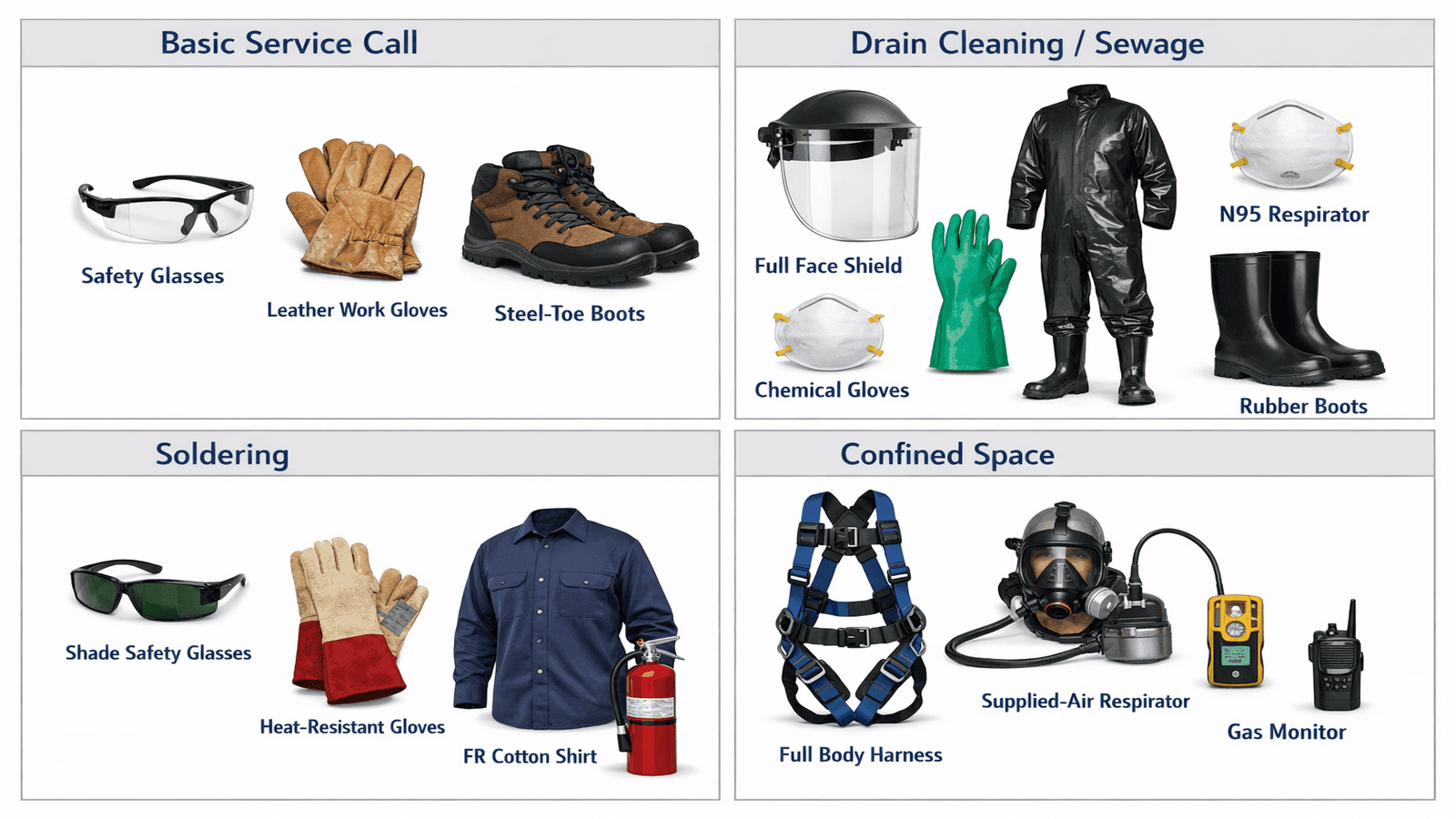
Photo: Photo array showing complete PPE for different plumbing tasks: basic service call, drain cleaning, soldering, and confined space entry
Personal Protective Equipment (PPE) Requirements
OSHA requires employers to provide PPE at no cost to employees when hazards cannot be eliminated through engineering or administrative controls.
The key phrase is "at no cost"—employers cannot require workers to buy their own required PPE, and they cannot deduct PPE costs from paychecks. Voluntary PPE upgrades (like premium brand safety glasses) can be employee-purchased, but baseline compliant PPE must be employer-provided.
Minimum PPE for All Plumbing Work
Every plumbing job site requires base-level protection regardless of specific tasks.
Base requirements for every job site:
Safety glasses with side shields (ANSI Z87.1 rated):
- Must have impact-rated lenses
- Side shields prevent lateral debris entry
- Available in prescription versions
- Anti-fog coating for humid environments
- Replace when scratched—impaired vision creates other hazards
Work boots with safety toe (ASTM F2413-11):
- Steel toe or composite toe rated for 75 lbs impact, 2,500 lbs compression
- Electrical hazard (EH) rating for protection against open circuits up to 600 volts
- Slip-resistant soles for wet environments
- Waterproof construction for plumbing applications
- Ankle support for uneven surfaces and ladder work
Work gloves appropriate for the task:
- General-purpose leather or synthetic for material handling
- Cut-resistant for sharp tool work
- Chemical-resistant for drain cleaning or adhesive work
- Heat-resistant for soldering
- Waterproof for wet work
High-visibility clothing when working near traffic:
- ANSI/ISEA 107-2020 Class 2 or 3
- Fluorescent yellow, orange, or red-orange background
- Retroreflective striping
- Required for roadway work, parking lots, anywhere vehicular traffic is present
Hard hat when overhead hazards exist (ANSI Z89.1):
- Type I for top impact protection
- Type II for top and lateral impact protection
- Class E for electrical work up to 20,000 volts
- Replace every 5 years from the manufacture date (check inside)
- Replace immediately after any impact
Get quotes from top-rated pros.
Task-Specific PPE
Different plumbing tasks require additional specialized protection beyond base PPE.
Soldering and brazing:
- Heat-resistant gloves (Kevlar or leather palm) rated to 400°F minimum
- Safety glasses with shade 3-5 lens for silver brazing or welding
- Fire-resistant long-sleeve shirt (cotton or FR-rated fabric, not synthetic)
- Welding curtains or shields for confined areas to protect others
- Fire extinguisher within 10 feet of hot work
- Fire watch for 30 minutes after work completion
Drain cleaning and sewage work:
- Waterproof gloves (nitrile or neoprene) extending past wrist
- Face shield or chemical goggles for splash protection
- Disposable coveralls (Tyvek) or waterproof apron
- Rubber boots with chemical-resistant material
- N95 respirator minimum (half-face with P100 for heavy sewage exposure)
- Consider Hepatitis A vaccination (OSHA requires offer, not mandate)
Demolition and renovation in older buildings:
- Half-face respirator with P100 filters (HEPA) for lead, asbestos, mold
- Full-face respirator for high-concentration exposure
- Tyvek disposable suit with hood
- Double-glove (nitrile under work gloves) for easy contaminated glove removal
- Hearing protection (earplugs or earmuffs)
- Dust control measures (HEPA vacuum, wet methods)
Confined space entry:
- Full-body harness with D-ring positioned for overhead retrieval
- Tripod and winch system for vertical entry (manholes, tanks)
- Supplied-air respirator if atmosphere cannot be maintained safe
- Two-way radio or communication system (cell phones may not work underground)
- Intrinsically safe flashlight (explosion-proof for flammable atmospheres)
- Continuous gas monitor with audible/visual alarms
PPE Inspection and Replacement
PPE doesn't last forever, and damaged PPE provides false security while offering no actual protection.
Daily inspection requirements:
- Safety glasses: Check for scratches, cracks, loose side shields
- Hard hats: Inspect for cracks, dents, brittleness (flex test)
- Gloves: Look for holes, tears, chemical degradation, loss of waterproofing
- Boots: Check sole attachment, steel toe integrity, lace condition
- Fall protection: Inspect webbing for cuts, frays, burns, chemical damage
- Respirators: Check valves, straps, seal, filter condition/expiration
Replacement schedules:
- Hard hats expire 5 years from manufacture date (stamped inside)
- Respirator cartridges expire per package date or when breathing becomes difficult
- Fall protection must be replaced after any fall or if damage detected
- Safety glasses when scratched or damaged
- Gloves when torn, punctured, or degraded
- Hearing protection when crushed, torn, or loses pliability
Respirator fit testing:
- Required annually for all tight-fitting respirators
- Also required when worker gains/loses 20+ lbs or has dental work
- Qualitative fit test (sweet or bitter smoke) or quantitative fit test (machine measurement)
- Clean-shaven faces mandatory (even stubble breaks seal)
- Different respirator models/sizes may be needed for proper fit
Record keeping requirements:
- PPE inspection logs (daily checklist)
- Fit test documentation (name, date, respirator type, pass/fail)
- Training records showing PPE use instruction
- Replacement logs for expiring equipment (hard hats, cartridges)
- Cleaning and maintenance logs for reusable PPE
Replace damaged PPE immediately and tag it "Do Not Use" until replaced. Damaged PPE puts workers at risk and creates OSHA liability for employers.
Plumbing Code Safety Standards
While OSHA protects plumbers during work, plumbing codes (IPC and UPC) protect building occupants and water supply safety.
The 2024 code editions include significant safety updates being adopted by states and municipalities throughout 2026-2027. Code compliance isn't just about passing inspections—it's about preventing property damage, water contamination, and public health hazards that can last decades.
2024 IPC/UPC Safety Updates
The International Plumbing Code and Uniform Plumbing Code update on 3-year cycles, with the 2024 editions released in August 2023.
Key changes affecting safety:
Backflow prevention enhancements:
- Strengthened cross-connection control requirements at all service connections
- California mandates SWRCB-recognized tester certification starting July 1, 2026
- California requires ANSI accreditation for certification programs by July 1, 2027
- Annual testing of all backflow assemblies by certified testers (was "periodic" in some jurisdictions)
- Enhanced documentation and reporting to water purveyors
- Specific assembly requirements based on hazard level (high, moderate, low)
- Pressure testing at all four test cocks with documented differential pressures
Buried piping support:
- New provisions for buried piping beneath buildings where expansive soil conditions exist
- Required soil testing and engineering analysis in problem soil regions
- Specific bedding and backfill requirements
- Allowable pipe materials in expansive soil applications
- Prevents costly foundation damage from pipe movement
Tracer wire requirements:
- Mandatory 14 AWG insulated copper tracer wire for buried plastic sewer piping
- Wire must run continuously with buried plastic pipe
- Accessible at each end for future electronic location
- Prevents accidental excavation damage by future contractors
- Estimated to prevent 30% of sewer line damage during excavation
Showerhead flow limits:
- Maximum 2.0 GPM at 80 PSI (down from 2.5 GPM)
- Aligns with EPA WaterSense high-efficiency requirements
- Also reduces scald risk with lower flow volumes
- Exceptions for certain health care and safety shower applications
The International Plumbing Code and Uniform Plumbing Code update on 3-year cycles, with the 2024 editions released in August 2023.
Key changes affecting safety:
Backflow prevention enhancements:
- Strengthened cross-connection control requirements at all service connections
- California mandates SWRCB-recognized tester certification starting July 1, 2026
- California requires ANSI accreditation for certification programs by July 1, 2027
- Annual testing of all backflow assemblies by certified testers (was "periodic" in some jurisdictions)
- Enhanced documentation and reporting to water purveyors
- Specific assembly requirements based on hazard level (high, moderate, low)
- Pressure testing at all four test cocks with documented differential pressures
Buried piping support:
- New provisions for buried piping beneath buildings where expansive soil conditions exist
- Required soil testing and engineering analysis in problem soil regions
- Specific bedding and backfill requirements
- Allowable pipe materials in expansive soil applications
- Prevents costly foundation damage from pipe movement
Tracer wire requirements:
- Mandatory 14 AWG insulated copper tracer wire for buried plastic sewer piping
- Wire must run continuously with buried plastic pipe
- Accessible at each end for future electronic location
- Prevents accidental excavation damage by future contractors
- Estimated to prevent 30% of sewer line damage during excavation
Showerhead flow limits:
- Maximum 2.0 GPM at 80 PSI (down from 2.5 GPM)
- Aligns with EPA WaterSense high-efficiency requirements
- Also reduces scald risk with lower flow volumes
- Exceptions for certain health care and safety shower applications
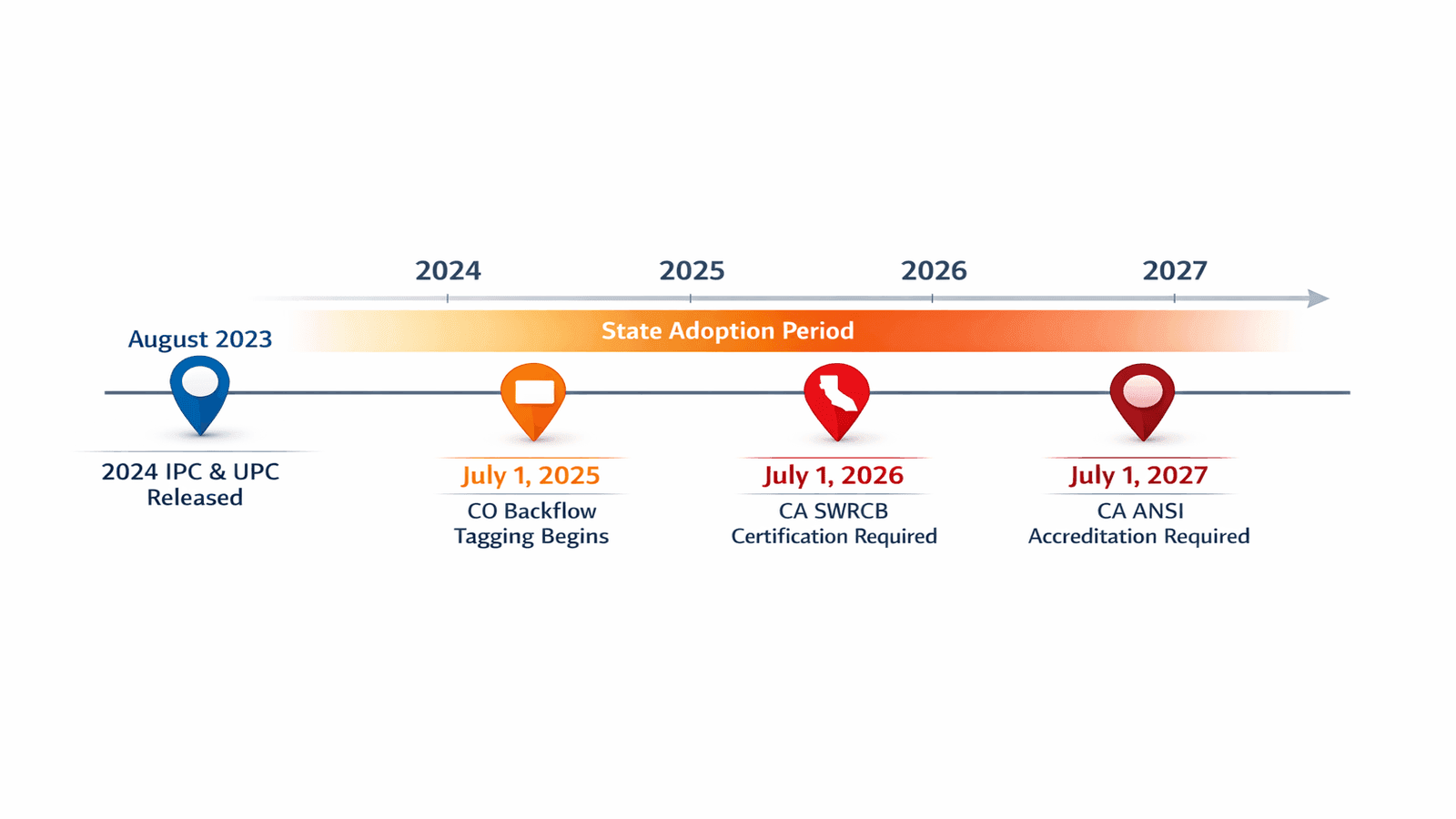
Photo: Timeline infographic showing code adoption schedule 2024-2027 with California backflow certification deadlines and Colorado tagging requirements
EPA Safe Drinking Water Act Requirements
Section 1417 of the Safe Drinking Water Act establishes national lead-free standards that supersede local plumbing codes.
Lead-free plumbing standards (enacted 2014, continuously enforced):
0.25% maximum weighted lead average for pipes, pipe fittings, plumbing fittings, and fixtures
- "Weighted average" means average lead content across all wetted surfaces
- Does not apply to surface coatings or linings
- Calculation method specified in NSF/ANSI Standard 372
0.2% maximum lead for solder and flux
- Applies to tin-based and other solder types
- Flux must be lead-free as well
Prohibition after June 1986: No lead pipe, solder, or flux in the installation or repair of:
- Public water systems
- Residential plumbing providing water for human consumption
- Non-residential facilities providing water for human consumption
- NSF/ANSI 61 certification: All components must be certified for drinking water contact
- NSF/ANSI 372 certification: Verifies lead-free status through independent testing
Enforcement and penalties:
- Federal violations carry up to $25,000 per day per violation
- State enforcement varies but typically mirrors federal standards
- Lifetime liability for lead contamination (60+ year latency on health effects)
- Contractors installing non-compliant materials share liability with manufacturers
Always verify NSF certification marks on packaging before installation. "Lead-free" claims without NSF/ANSI 61 and 372 certifications are legally insufficient.
State-Specific Safety Requirements
Some states enhance model code safety requirements based on regional hazards or public health priorities.
Examples of enhanced local standards:
Colorado backflow device tagging (effective July 1, 2025):
- Licensed plumbers must affix a permanent tag on all backflow prevention devices
- Tag must include: installation date, tester name and certification number, test date, next test due date
- Applies to installation, testing, inspection, repair, and reinstallation
- Facilitates compliance tracking and overdue test identification
California earthquake-resistant water heater strapping:
- Required in Seismic Zones 3-4 (most of California)
- Upper strap within 12 inches of top, lower strap 18 inches above floor
- Straps must be 24-gauge minimum or commercial strapping products
- Prevents water heater tip-over during earthquakes (fire and flood risk)
Texas double-check valve assemblies on irrigation:
- Required on all lawn irrigation systems connected to potable water
- Prevents backflow of fertilisers, pesticides, and stagnant water
- Must be a testable backflow assembly, not just anti-siphon valves
Florida wind-resistant vent terminations:
- Enhanced requirements in hurricane-prone regions
- Minimum height above the roof surface
- Secured cap or cowl rated for wind uplift
- Prevents rain entry and wind-driven water intrusion
Lead-free standards seem straightforward until you're specifying fixtures. I learned the hard way in 2019 when an inspector red-tagged a whole bathroom rough-in because the shutoff valves weren't NSF/ANSI 61 certified—the manufacturer's 'lead-free' claim wasn't enough. Now I verify NSF certification marks on every single component before purchase. Takes an extra 10 minutes per order, but I haven't failed an inspection since. California inspectors are especially strict about this.
Safety Training and Certification
While master plumber licensing requires technical knowledge, specialized safety certifications demonstrate commitment to workplace safety and may reduce insurance costs by 15-20%.
Many plumbing companies report workers' compensation premium reductions when all field personnel complete OSHA training. The improved safety culture reduces claims, which insurers reward with lower rates.
OSHA Safety Certifications
OSHA offers two levels of construction safety training through authorized training organizations.
10-Hour vs. 30-Hour Construction Safety:
OSHA 10-Hour Construction:
- Target audience: Entry-level workers, apprentices, helpers
- Focus: Basic hazard recognition and workers' rights
- Duration: 10 hours over 2 days or 1-2 weeks
- Cost: $50-$125 per student
- Validity: Card expires after 5 years (though knowledge retention is lifetime)
- Requirements: No prerequisites, open to anyone
- Card issuance: Within 3-4 weeks of course completion from U.S. Department of Labor
OSHA 30-Hour Construction:
- Target audience: Supervisors, foremen, lead plumbers, safety coordinators
- Focus: In-depth safety management and compliance
- Duration: 30 hours over 4 days or 2-4 weeks
- Cost: $150-$300 per student
- Validity: 5 years
- Requirements: No prerequisites, but intended for those with some field experience
- Card issuance: Within 3-4 weeks of course completion
Topics covered in both:
- Introduction to OSHA and worker rights (1926.20)
- Fall protection and prevention (1926.500)
- Electrical safety basics (1926.400)
- Personal protective equipment (1926.95)
- Hazard communication and Safety Data Sheets (1926.59)
- Confined space entry (1910.146)
- Excavation and trenching (1926.650)
- Ladder and scaffolding safety (1926.1050, 1926.450)
- Hand and power tool safety (1926.300)
- Materials handling and storage (1926.250)
Additional 30-Hour topics:
- Stairways and ladders advanced (1926.1050-1060)
- Cranes and rigging (1926.1400)
- Steel erection safety (1926.750)
- Concrete and masonry (1926.700)
- Safety and health program development
- Incident investigation and root cause analysis
Some states require OSHA 10 or 30 for contractor licensing or to work on public projects. Check your state licensing board requirements.
Get quotes from top-rated pros.
OSHA offers two levels of construction safety training through authorized training organizations.
10-Hour vs. 30-Hour Construction Safety:
OSHA 10-Hour Construction:
- Target audience: Entry-level workers, apprentices, helpers
- Focus: Basic hazard recognition and workers' rights
- Duration: 10 hours over 2 days or 1-2 weeks
- Cost: $50-$125 per student
- Validity: Card expires after 5 years (though knowledge retention is lifetime)
- Requirements: No prerequisites, open to anyone
- Card issuance: Within 3-4 weeks of course completion from U.S. Department of Labor
OSHA 30-Hour Construction:
- Target audience: Supervisors, foremen, lead plumbers, safety coordinators
- Focus: In-depth safety management and compliance
- Duration: 30 hours over 4 days or 2-4 weeks
- Cost: $150-$300 per student
- Validity: 5 years
- Requirements: No prerequisites, but intended for those with some field experience
- Card issuance: Within 3-4 weeks of course completion
Topics covered in both:
- Introduction to OSHA and worker rights (1926.20)
- Fall protection and prevention (1926.500)
- Electrical safety basics (1926.400)
- Personal protective equipment (1926.95)
- Hazard communication and Safety Data Sheets (1926.59)
- Confined space entry (1910.146)
- Excavation and trenching (1926.650)
- Ladder and scaffolding safety (1926.1050, 1926.450)
- Hand and power tool safety (1926.300)
- Materials handling and storage (1926.250)
Additional 30-Hour topics:
- Stairways and ladders advanced (1926.1050-1060)
- Cranes and rigging (1926.1400)
- Steel erection safety (1926.750)
- Concrete and masonry (1926.700)
- Safety and health program development
- Incident investigation and root cause analysis
Some states require OSHA 10 or 30 for contractor licensing or to work on public projects. Check your state licensing board requirements.
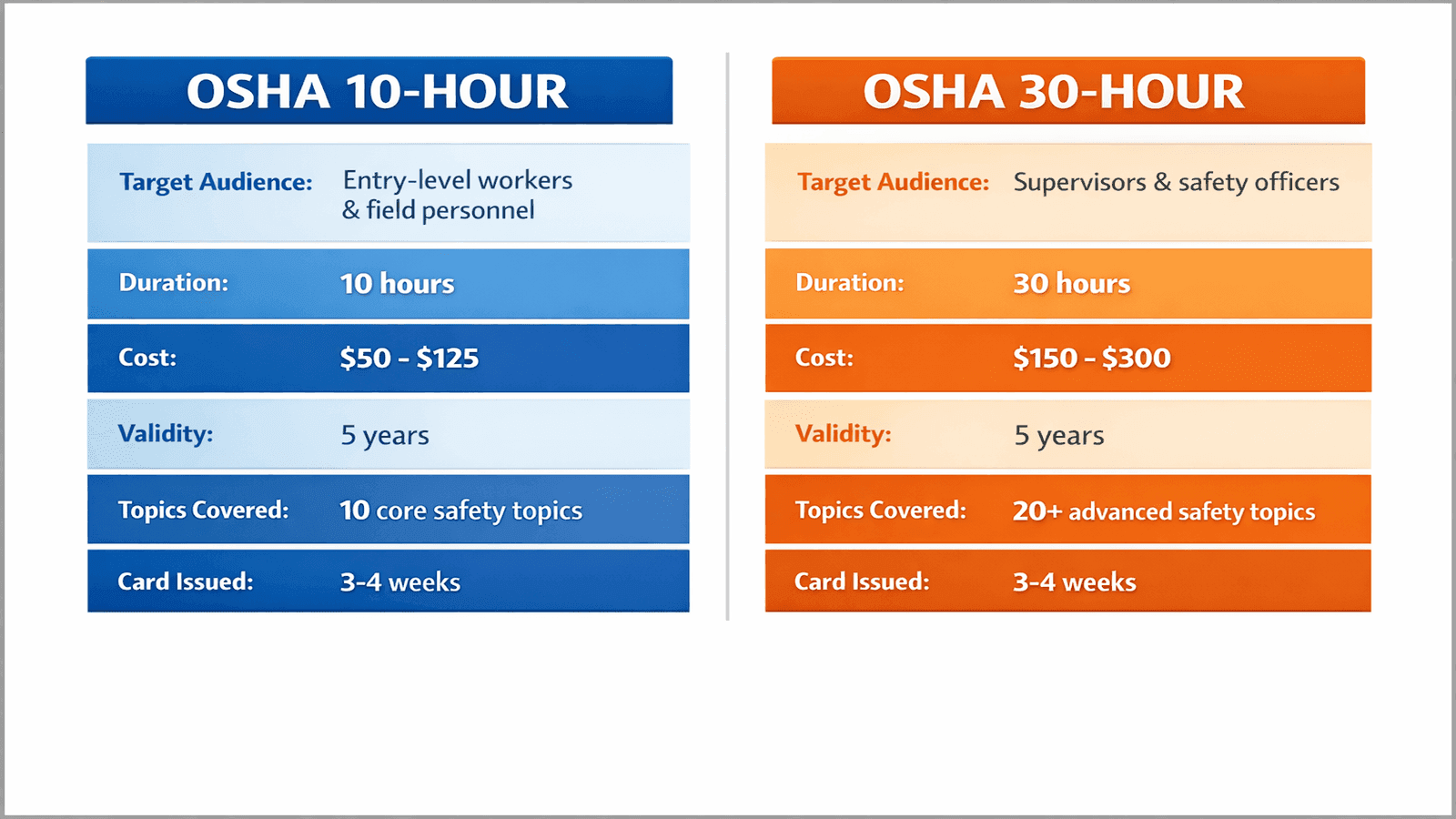
Photo: Comparison table image showing OSHA 10-Hour vs. 30-Hour training (cost, duration, topics, validity, who needs it)
Specialised Plumbing Safety Training
Beyond general OSHA training, plumbers need specialised certifications for certain hazardous work.
EPA Lead-Safe Certification (RRP - Renovation, Repair, and Painting):
Required for: Pre-1978 renovation, repair, or painting work in residential or child-occupied facilities
Course length: 8-hour initial course with hands-on training
Refresher: 4-hour refresher every 5 years
Cost: $200-$350 initial, $150-$200 refresher
Topics covered:
- Lead poisoning health effects
- Lead-safe work practices (containment, wet methods, cleanup)
- Pre-renovation notification requirements
- Lead testing protocols
- Prohibited practices (open-flame burning, dry sanding)
- Waste disposal requirements
- Post-renovation cleaning verification
Confined Space Entry Training:
Required for: Permit-required confined spaces (1910.146)
Course length: 8-16 hours, depending on depth
Refresher: Annual refresher recommended (not legally required but best practice)
Cost: $300-$600 initial
Topics covered:
- Confined space identification (permit-required vs. non-permit)
- Atmospheric testing procedures (oxygen, LEL, H₂S, CO)
- Ventilation requirements
- Entry procedures and permits
- Attendant duties and emergency response
- Rescue procedures and equipment
- Lockout/tagout integration
Backflow Prevention Tester Certification:
Required for: Testing and maintaining backflow prevention assemblies
Course length: 32-40 hours with a written exam and a practical test
Refresher: Annual recertification in most states
Cost: $600-$1,200 initial, $150-$300 renewal
New California requirements (July 1, 2026):
- Certification program must be SWRCB-recognised
- Must be ANSI-accredited by July 1, 2027
- Specific pressure documentation at each test cock
Topics covered:
- Backflow theory and hydraulics
- Cross-connection hazard assessment
- Backflow assembly types (RP, DC, PVB, AVB)
- Testing procedures and documentation
- Repair and maintenance requirements
- State/local code requirements
Bloodborne Pathogen Training:
Required for: Workers with potential exposure to sewage, bodily fluids, or other potentially infectious materials (OPIM)
Course length: 1-hour online or in-person
Refresher: Annual training required by OSHA
Cost: $25-$75
Topics covered:
- Hepatitis B, Hepatitis C, HIV transmission
- Exposure control plan review
- PPE selection and use
- Handwashing and hygiene
- Post-exposure medical evaluation
- Recordkeeping requirements
First Aid and CPR:
OSHA requires first aid-trained personnel on sites without quick medical access (3-4 minutes). Recommended for all field plumbers regardless of site proximity to medical care.
Certification bodies: American Red Cross, American Heart Association
Course length: 4 hours (combined First Aid/CPR/AED)
Validity: 2 years
Cost: $50-$100
Topics covered:
- Scene safety and assessment
- CPR for adults, children, and infants
- AED (automated external defibrillator) use
- Choking relief
- Severe bleeding control
- Shock management
- Burns and scalds
- Heat and cold emergencies
Creating a Plumbing Safety Program
Whether you're a solo plumber or run a 50-person company, a written safety program reduces injuries by up to 40% and may lower workers' compensation premiums significantly.
Insurance industry data shows companies with documented safety programs experience 30-50% fewer lost-time injuries and 20-30% lower workers' comp costs compared to companies without programs.
Essential Components of a Safety Program
A compliant safety program doesn't need to be a 200-page binder. Effective programs are clear, concise, and actually used by workers.
Written safety policy structure:
Management commitment statement:
- Company owner or president's signature
- Demonstrates top-down safety culture
- States that safety is of equal priority with productivity and profit
- Assigns ultimate safety responsibility to ownership
Safety responsibilities by role:
- Owner/Management: Provide resources, training, PPE; enforce policies; lead by example
- Supervisors/Foremen: Conduct job hazard analysis; ensure PPE use; correct unsafe acts; document incidents
- Workers: Follow safe work procedures; use PPE; report hazards; attend training
Hazard identification procedures:
- Pre-job safety planning (Job Hazard Analysis)
- Weekly safety inspections
- Worker hazard reporting system
- Incident investigation process
Safe work procedures (task-specific instructions):
- Confined space entry procedure
- Trenching and excavation procedure
- Hot work (soldering/brazing) procedure
- Ladder and scaffolding use procedure
- Lockout/tagout procedure
- Heavy lifting and material handling procedure
Training requirements:
- New hire safety orientation (first day)
- OSHA 10 or 30 within 90 days of hire
- Task-specific training before assignment
- Annual refreshers (bloodborne pathogens, hazard communication)
- Documentation of all training (date, topics, attendees, instructor)
Incident reporting:
- All injuries reported within 24 hours
- Near-miss reporting system (no discipline for reporting)
- Investigation within 48 hours of the incident
- Corrective action implementation tracking
Emergency procedures:
- First aid kit locations and contents
- Emergency contact numbers (911, poison control, nearest hospital)
- Evacuation procedures for fires or hazmat releases
- Confined space rescue plan
Disciplinary policy:
- Progressive discipline for safety violations (verbal warning → written warning → suspension → termination)
- Immediate termination offences (working under the influence, removing safety guards)
- Documented and consistently applied
Record keeping:
- OSHA Form 300/301/300A (companies with 10+ employees)
- Training records (duration of employment + 1 year)
- Exposure records (30 years for chemical/noise)
- PPE inspection logs
- Safety meeting minutes
Daily Safety Practices
Safety programs succeed or fail based on daily implementation, not binder thickness.
Job site safety protocols:
Morning safety huddle (5-10 minutes before work starts):
- Discuss day's tasks and specific hazards
- Review weather conditions (heat, lightning, cold)
- Confirm PPE availability and proper use
- Address worker questions or concerns
- Identify the designated first aider and the nearest hospital
Job Hazard Analysis (JHA) for non-routine tasks:
- Break task into steps
- Identify hazards at each step
- Determine controls and PPE for each hazard
- Document on a simple 1-page form
Daily tool and equipment inspections:
- Ladders, scaffolding, and power tools checked before use
- Damaged equipment tagged out immediately
- Inspection documented on checklist
PPE compliance checks:
- Supervisor verifies proper PPE before work starts
- Correct violations immediately
- Document repeated violations for disciplinary action
Housekeeping and trip hazard control:
- Clear walking paths of debris, cords, and tools
- Stack materials safely
- Clean up spills immediately
- Proper waste disposal
Weather monitoring:
- Heat index above 90°F: Enforce shade breaks and hydration
- Lightning within 10 miles: Cease outdoor work
- Wind above 20 mph: Evaluate ladder/scaffolding stability
- Cold below 32°F: Monitor for hypothermia, provide warming area
Documentation and Record Keeping
OSHA can request safety records at any time, and missing documentation can result in citations even if safety practices were followed.
OSHA-required records (for companies with 10+ employees):
- OSHA Form 300 (Log of Work-Related Injuries and Illnesses):
- All recordable injuries/illnesses listed with date, employee, description, outcome
- Maintained for 5 years
- Updated within 7 days of learning about recordable incident
OSHA Form 301 (Injury and Illness Incident Report):
- Detailed information about each incident from Form 300
- How the incident occurred, body part affected, object/substance involved
- Maintained for 5 years
- Can substitute workers' comp first report of injury if all required info included
OSHA Form 300A (Summary of Work-Related Injuries and Illnesses):
- Annual summary of Form 300
- Posted February 1 - April 30 each year, where employees can see it
- Company executive must certify accuracy
- Maintained for 5 years
Training records:
- Date of training
- Topics covered
- Trainer name and qualifications
- Employee names and signatures
- Kept for duration of employment + 1 year
Exposure records:
- Chemical exposure monitoring results
- Noise monitoring data
- Confined space atmospheric testing results
- Kept for 30 years after employment ends
Best practices beyond OSHA minimums:
- Digital backup of all safety documents (cloud storage)
- Quarterly safety committee meetings with documented minutes
- Monthly safety inspection checklists for tools, vehicles, PPE
- Near-miss reporting system to prevent future incidents (1 injury occurs for every 10 near-misses)
- Annual safety program review and update with all employees
Safety Compliance Inspections
OSHA conducted over 32,000 construction inspections in 2023, with plumbing-related violations among the most common.
Knowing what inspectors look for helps you stay compliant and avoid the costly citations that can follow a single inspection.
OSHA Inspection Triggers
OSHA inspections don't happen randomly—specific events trigger their arrival.
How inspections happen:
Imminent danger complaints: OSHA responds within 24 hours (often same day) for reports of immediate risk of death or serious injury
Severe injury reports: Employers must report to OSHA within 24 hours any work-related:
- Fatality
- Hospitalisation (inpatient admission)
- Amputation
- Loss of an eye
- Worker complaints: Employees can file anonymous complaints triggering inspections (OSHA protects complainant's identity)
- Referrals: From other government agencies, media reports, or local authorities
- Programmed inspections: Random targeting of high-hazard industries using industry injury rates and employer history
OSHA prioritises inspections in this order: imminent danger, fatality/catastrophe, complaints, referrals, and then programmed inspections.
Common Plumbing Violations
The same citations appear year after year in plumbing contractor inspections.
Top 10 OSHA citations for plumbing contractors:
Fall protection (1926.501):
- Failure to provide fall protection at 6+ feet
- Improper guardrails or personal fall arrest systems
- Typical penalty: $7,000-$15,000 per violation
Hazard communication/SDS (1910.1200):
- Missing Safety Data Sheets
- Failure to train workers on chemical hazards
- Typical penalty: $3,000-$8,000
Respiratory protection (1910.134):
- Lack of fit testing
- Wrong respirator for hazard
- No written program
- Typical penalty: $5,000-$12,000
Scaffolding (1926.451):
- Missing guardrails or toe boards
- Improper planking
- Unstable base or insufficient tie-offs
- Typical penalty: $8,000-$14,000
Ladders (1926.1053):
- Improper ladder use (top-stepping, wrong angle)
- Damaged ladders in service
- Extension not 3 feet above landing
- Typical penalty: $4,000-$10,000
Lockout/tagout (1910.147):
- Working on energised equipment without a lockout
- No written LOTO procedures
- Typical penalty: $6,000-$15,000
PPE requirements (1910.132):
- Failure to assess hazards and provide PPE
- No PPE training
- Typical penalty: $3,000-$7,000
Eye and face protection (1910.133):
- Not wearing safety glasses in hazard areas
- Wrong protection for hazard (no side shields)
- Typical penalty: $2,500-$6,000
Confined space entry (1910.146):
- Entry without permit
- No atmospheric testing
- Missing attendant
- Typical penalty: $10,000-$20,000 (willful violations up to $161,323)
Excavation and trenching (1926.651):
- No protective system (shoring, sloping, trench box) for 5+ feet depth
- No safe egress (ladder) within 25 feet
- Spoil piles within 2 feet of trench edge
- Typical penalty: $8,000-$18,000
Updated penalty amounts (as of 2026):
- Other-than-serious violations: Up to $16,131 per violation
- Serious violations: $16,131 per violation (typical range $5,000-$15,000)
- Willful violations: $16,131 to $161,323 per violation
- Repeat violations: Up to $161,323 per violation (each repeat violation doubles penalty)
- Failure to abate: $16,131 per day beyond abatement date
Penalties adjust annually for inflation. Willful violations (where employer knowingly violated standard or showed plain indifference) carry the highest penalties and potential criminal charges.
Preparing for Inspections
Proactive compliance beats reactive scrambling when the OSHA inspector arrives.
Compliance steps to take now:
Conduct self-inspections monthly:
- Use OSHA's construction industry checklists (free downloads)
- Document findings and corrective actions
- Assign responsibility and deadlines for fixes
Fix violations immediately:
- Don't wait for OSHA—fix hazards as soon as identified
- Document with before/after photos
- Update safety program if procedure gaps are identified
Train workers on inspector interactions:
- Be respectful and cooperative
- Answer questions honestly
- Don't volunteer extra information
- Don't sign anything without understanding it
- Call the supervisor or the safety coordinator immediately
Designate safety officer to accompany the inspector:
- Owner, safety director, or knowledgeable supervisor
- Take notes and photos of everything the inspector documents
- Ask for clarification on any violations cited
- Request an informal conference for violations you dispute
Keep safety records organised:
- OSHA 300 logs, training records, and inspection logs are readily available
- Digital copies backed up off-site
- Designated person who knows where everything is
Never hide violations:
- Covering up hazards during inspection = willful violation (highest penalty)
- Fix them before inspection, don't hide them during
During the inspection:
- Opening conference: Inspector explains reason for visit, scope, and process
- Walk-through: Inspector tours work sites, takes photos, and interviews workers
- Closing conference: Inspector summarises findings, discusses potential violations
- Citation issuance: Within 6 months of inspection (usually 2-8 weeks)
You have the right to accompany the inspector and have worker representatives join as well. Use this opportunity to understand exactly what the inspector sees as violations so you can correct them if citations are issued.
Sources & References
- SoloProtect. (2026). "OSHA 2026 Safety Standards: What Employers Must Know." https://www.soloprotect.com/blog/the-future-of-workplace-safety-inside-oshas-2026-worker-protection-standards
- OSHA Outreach Courses. (2026). "Workplace Injury Statistics You Should Know In 2026." https://www.oshaoutreachcourses.com/blog/insights-workplace-injuries/
- Artisan Insurance Solutions. (2024). "8 Common Occupational Hazards Faced by Plumbers." https://www.artisanins.com/blog/8-common-occupational-hazards-faced-by-plumbers/
- PHCC Pros. (2024). "Comparison of the 2024 UPC and 2024 IPC Model Codes." https://www.phcppros.com/articles/21555-comparison-of-the-2024-upc-and-2024-ipc-model-codes
- U.S. Environmental Protection Agency. (2026). "Safe Drinking Water Act (SDWA)." https://www.epa.gov/sdwa
- Pacific Backflow. (2026). "Understanding California's Backflow Testing Requirements: A 2026 Update." https://www.pacificbackflow.com/post/understanding-californias-backflow-testing-requirements-a-2026-update---new-regulations-explained
- U.S. Bureau of Labor Statistics. (2025). "Plumbers, Pipefitters, and Steamfitters: Occupational Outlook Handbook." https://www.bls.gov/ooh/construction-and-extraction/plumbers-pipefitters-and-steamfitters.htm
- Occupational Safety and Health Administration. (2026). "Laws and Regulations." https://www.osha.gov/laws-regs
Disclaimer: This article provides general information about plumbing safety standards and OSHA compliance requirements current as of February 2026. Safety regulations vary by state, municipality, and specific job site conditions. Always consult your state licensing board, local OSHA office, and occupational safety professionals for requirements applicable to your specific situation. This content is educational and should not replace professional safety training, legal advice, or site-specific hazard assessments. Plumbing work involves inherent risks—proper training, certification, and adherence to all applicable safety standards are essential to prevent injuries and fatalities.


Michael Jennings is a licensed master plumber & water systems specialist with over 18 years of hands-on experience in residential and commercial plumbing, serving clients across California and Texas. At NearbyHunt, he shares practical advice on pipe installations, water heater maintenance, and home plumbing upgrades. Michael has helped thousands of homeowners prevent costly water damage and improve water efficiency through modern plumbing solutions.

Robert is a licensed master plumber with over 20 years of experience serving both residential and commercial clients across the Midwest. Specialising in advanced plumbing systems and sustainable water technologies, Rob brings deep technical insight and hands-on expertise to every project. As a reviewer for NearbyHunt, he ensures all plumbing content reflects the highest standards of safety, compliance, and practicality.