- Emergency HVAC service costs $140 to $600 per hour in 2026, compared to $75 to $150 for standard daytime repairs.
- After-hours weeknight calls typically run 1.5 times the normal rate, while weekend and holiday calls can reach 2 to 3 times standard pricing.
- Most emergency HVAC companies charge a service call fee of $150 to $500 on top of hourly labor, with some crediting this fee toward the total bill.
- Holiday emergency HVAC repairs can exceed $500 per hour in major metro areas during peak demand periods like extreme cold snaps.
- Preventive maintenance costing $150 to $300 per year eliminates up to 75 percent of emergency breakdowns, according to Department of Energy research.
- Getting 2 to 3 quotes before authorizing work and asking about fee structures up front can reduce your final bill by $200 to $500.
Your furnace dies at 1 a.m. during a January cold snap in Minneapolis. The indoor temperature is dropping fast, and you have children sleeping upstairs. That call to an HVAC technician is going to cost significantly more than a Tuesday afternoon appointment, and understanding exactly how much more is the difference between a fair bill and a painful one.
Daniel Torres, a certified HVAC technician with EPA 608, NATE, and HVAC Excellence certifications and 14 years of field experience in Minneapolis, has handled over 400 emergency calls across Minnesota winters. His project data shows that homeowners who understand emergency pricing structures pay an average of 22 percent less than those who call the first company they find.
This guide breaks down 2026 emergency HVAC costs by time of call, repair type, and region so you can budget accurately when it matters most. For a broader view of HVAC pricing, see our HVAC Costs Guide.

Get quotes from top-rated pros.
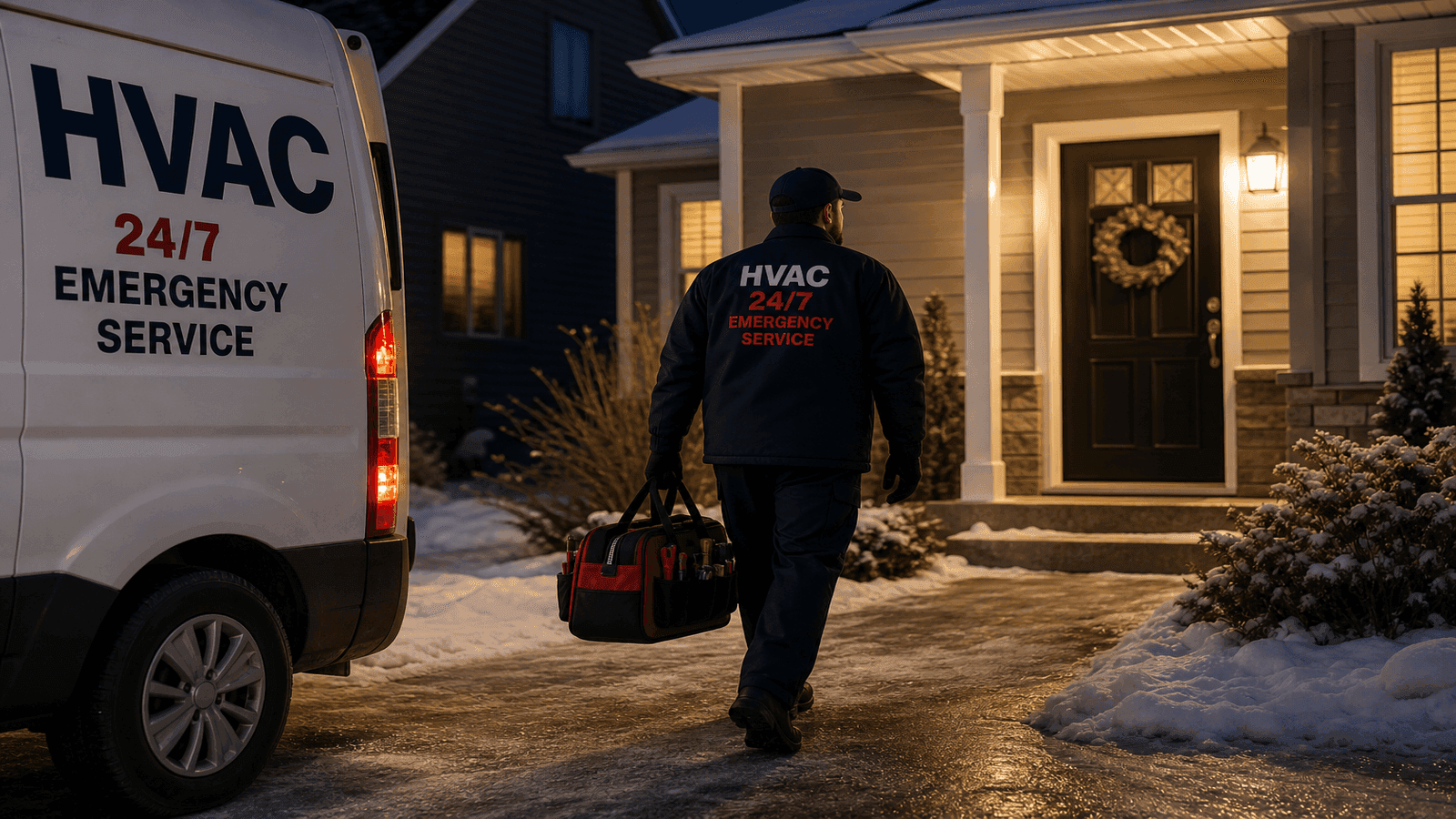
Photo: Emergency HVAC technician arriving at a residential home at night during winter with a service van and diagnostic equipment, representing 24/7 emergency HVAC service
What Qualifies as an Emergency HVAC Call?
An HVAC emergency is any heating or cooling failure that creates an immediate safety risk or makes a home uninhabitable. Common scenarios include a furnace failure during freezing temperatures, a complete AC shutdown during a heat wave, a gas leak or carbon monoxide alarm linked to your heating system, a refrigerant leak creating health concerns, and a total system failure when vulnerable household members (infants, elderly, medically fragile) are present.
Situations that do not qualify as true emergencies include a slightly noisy blower motor, a thermostat that needs recalibration, uneven heating between rooms, or a system running longer cycles than normal. These issues should be scheduled during regular business hours to avoid surcharges. Understanding common HVAC problems and their severity helps you determine whether you need a midnight dispatch or a Monday morning appointment.
About 35 percent of the emergency calls I respond to in Minneapolis could have waited until the next business day. A furnace cycling on and off every 10 minutes is frustrating, but it is still producing heat. A furnace that will not ignite at all when it is 5 degrees outside is a genuine emergency. That distinction saves homeowners $300 to $800 per call in after-hours surcharges.
> Daniel Torres, EPA 608, NATE Certified
Emergency vs Standard HVAC Rates
The time you call is the single largest factor in what you pay. Emergency rates increase in tiers based on when service is needed, reflecting overtime wages, on-call roster costs, and reduced parts availability.
| Time of Call | Rate Multiplier | Hourly Rate Range | Service Call Fee |
| Standard business hours (M-F, 8am to 5pm) | 1x | $75 to $150 | $70 to $150 |
| Weeknight after-hours (5pm to midnight) | 1.5x | $115 to $225 | $150 to $250 |
| Late night / early morning (midnight to 6am) | 2x | $150 to $300 | $200 to $350 |
| Weekend daytime (Saturday and Sunday) | 1.5 to 2x | $115 to $300 | $175 to $300 |
| Weekend overnight | 2 to 2.5x | $190 to $375 | $200 to $400 |
| Federal holidays | 2.5 to 3x | $250 to $600 | $225 to $500 |
Standard HVAC repair rates run $75 to $150 per hour for daytime residential work, according to the Forbes Home 2026 HVAC Repair Cost Guide. Emergency rates at night and on weekends reflect overtime pay requirements and the cost of maintaining on-call technician rosters. Holiday rates are the steepest: Thanksgiving, Christmas, New Year's Day, and the Fourth of July command the highest surcharges because fewer technicians are available and overtime pay reaches double or triple time.
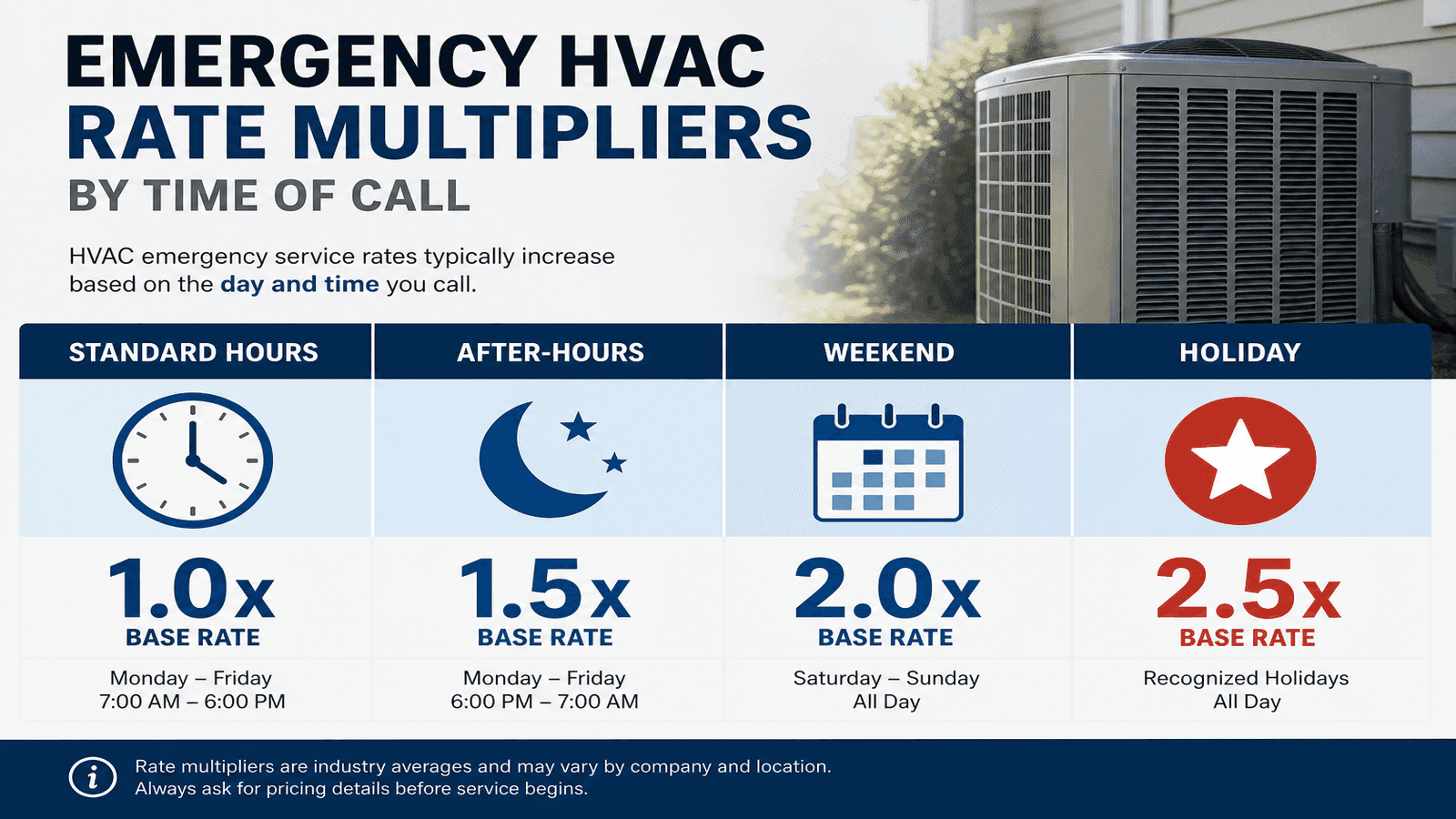
Photo: Infographic showing emergency HVAC rate multipliers by time of call, comparing standard hours, after-hours, weekend, and holiday pricing tiers
Emergency HVAC Cost by Repair Type
The specific component that failed determines your total cost on top of the after-hours surcharge. Here are common emergency HVAC repairs and their 2026 cost ranges across different calling windows.
Get quotes from top-rated pros.
| Emergency Repair Type | Standard Hours Cost | After-Hours Cost | Holiday Cost |
| Furnace igniter replacement | $150 to $350 | $275 to $600 | $400 to $900 |
| Blower motor replacement | $400 to $900 | $650 to $1,400 | $900 to $2,000 |
| AC compressor replacement | $1,800 to $2,800 | $2,500 to $4,000 | $3,200 to $5,500 |
| Capacitor replacement | $200 to $300 | $350 to $550 | $500 to $800 |
| Refrigerant recharge | $250 to $600 | $400 to $950 | $600 to $1,300 |
| Control board replacement | $300 to $700 | $500 to $1,100 | $700 to $1,600 |
| Heat exchanger replacement | $1,500 to $3,000 | $2,200 to $4,200 | $3,000 to $5,500 |
| Thermostat replacement | $150 to $400 | $275 to $650 | $400 to $900 |
These ranges reflect total job cost including the after-hours rate multiplier, service call fee, and materials. Capacitor replacement is the single most common AC emergency repair, accounting for roughly 30 percent of service calls according to industry data from Bob Vila. For a deeper look at overall system costs, see the HVAC costs pillar guide.
Furnace igniter failures are the most common winter emergency. The part itself costs $30 to $80, but the labor, service call fee, and after-hours surcharge bring the total to $275 to $600 on a weeknight. AC compressor replacements carry the highest total cost and often require a second visit if the specific compressor model is not stocked on the truck, adding a return trip charge of $100 to $200.
The most expensive emergency call I have handled cost $5,100. It was a heat exchanger crack discovered on New Year's Eve in a 16-year-old furnace. We had to condemn the furnace for carbon monoxide risk and install a temporary electric heater while the replacement unit was sourced. The holiday surcharge, two-visit labor, and emergency equipment sourcing added up fast. Annual furnace inspections cost $80 to $150 and catch cracked heat exchangers before they become safety hazards.
Types of Emergency HVAC Surcharges
Beyond the hourly rate adjustment, most HVAC companies layer additional surcharges onto emergency calls. Understanding each fee before you authorize service prevents billing surprises.
Service call or dispatch fee: This flat charge covers the technician's travel time and initial diagnostic assessment. In 2026, standard service call fees run $70 to $150 during business hours and $150 to $500 for after-hours and holiday dispatches. Some companies credit this fee toward your total bill if you proceed with the repair; others charge it as a standalone fee. Always ask before they dispatch.
Minimum labor charge: Many HVAC companies bill a minimum of one to two hours regardless of actual repair time. At emergency rates, a two-hour minimum at $225 per hour means $450 in labor before any parts are included, even if the repair takes 40 minutes.
Diagnostic fee: Separate from the service call fee, some companies charge $75 to $200 for the diagnostic assessment itself. This fee may or may not be waived if you proceed with the recommended repair.
Parts markup: HVAC parts are typically marked up 25 to 50 percent above wholesale cost. A $60 capacitor may appear as $90 to $120 on your invoice. This is standard industry practice, but it compounds quickly on expensive components like compressors and control boards.
After-hours fuel or travel surcharge: Companies serving suburban and rural areas may add $30 to $100 for after-hours travel, particularly when the technician drives 20 or more miles to reach your home.
Case Study: The Hendersons' Holiday Furnace Failure
Mark and Lisa Henderson of St. Paul, Minnesota, woke up to a 48-degree home at 4 a.m. on Christmas morning in 2025. Their 12-year-old gas furnace had stopped igniting. With two young children and overnight temperatures dropping to minus 8 degrees, waiting until the next business day was not an option.
They called the first HVAC company they found online. The company quoted a $350 holiday service call fee, $275 per hour labor (holiday triple-time), and estimated one to two hours for diagnosis and repair. The technician arrived at 5:30 a.m., diagnosed a failed igniter and a cracked flame sensor, and completed both replacements in 90 minutes. The total bill came to $1,180: $350 service call fee, $412.50 in labor (1.5 hours at $275), $165 for the igniter, and $252.50 for the flame sensor including parts markup.
Mark later told Daniel Torres during a maintenance visit that he wished he had called a second company for comparison. A NearbyHunt network technician in the same area would have charged a $225 holiday service call fee credited toward the total, $200 per hour at holiday rates, and cost-plus-25-percent on parts, bringing the estimated total to approximately $780 for the same repair. The difference: $400 saved by comparing one additional quote, even on Christmas morning.
The Hendersons' story is common. Most homeowners call the first number that appears in a panic search. Even in a genuine emergency, spending five minutes getting a second quote by phone saves hundreds. I tell every client: call two companies minimum, ask if the service call fee is credited, and get the hourly rate confirmed before they dispatch.
When Emergency HVAC Service Is Worth the Cost
Not every after-hours HVAC issue justifies the surcharge. Here is a practical framework for deciding whether to call now or wait.
Call immediately if:
- Indoor temperature is below 50 degrees F and outdoor temperature is below freezing
- You smell gas or your carbon monoxide detector is alarming
- The AC has failed during a heat advisory and vulnerable household members are present
- You see water actively leaking from the HVAC system or ceiling near the unit
- The system is making loud banging, screeching, or electrical arcing sounds
Wait until business hours if:
- The system is running but not reaching the set temperature by a few degrees
- One zone in the house is warmer or cooler than others
- The system cycles on and off more frequently than normal but still produces heating or cooling
- A non-essential component like a humidifier or air purifier has stopped working
- The thermostat display is blank but you have portable heaters or fans available
Bridge strategies while you wait: Space heaters (electric, placed safely away from combustibles) can maintain livable temperatures in bedrooms overnight. Closing interior doors concentrates heat in occupied rooms. Ceiling fans on low speed with blades rotating clockwise push warm air down in winter. These strategies buy time until morning rates apply and can save $200 to $500 in surcharges.
Get quotes from top-rated pros.
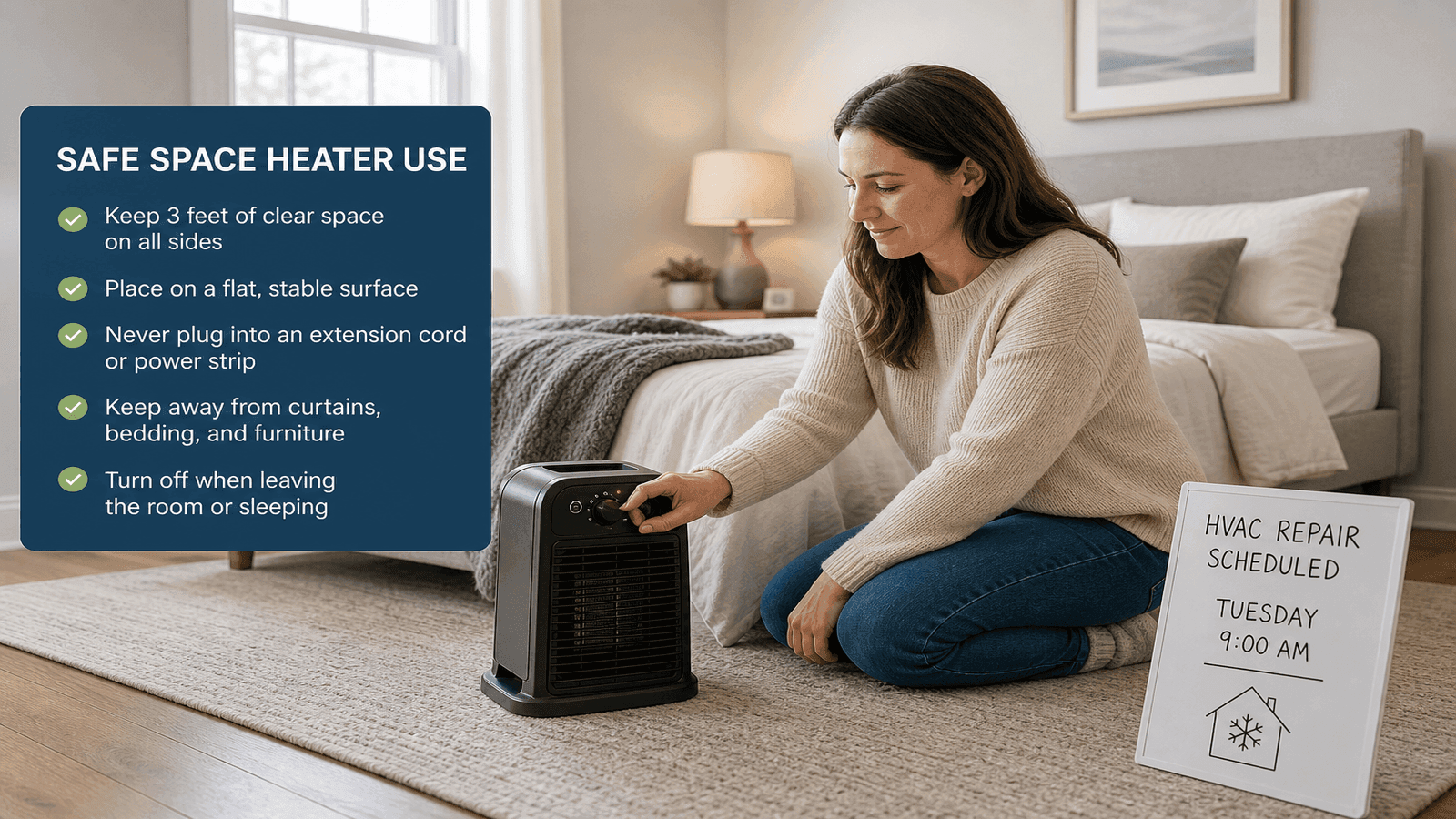
Photo: Homeowner using a space heater safely in a bedroom as a temporary measure while waiting for standard-hours HVAC repair, representing bridge strategies
How to Avoid Emergency HVAC Calls
Preventive maintenance is the most reliable way to reduce emergency HVAC costs. Department of Energy research shows that comprehensive maintenance programs result in a 50 percent reduction in total maintenance costs compared to reactive-only approaches, and predictive maintenance algorithms have documented a 70 to 75 percent reduction in system breakdowns.
Schedule biannual maintenance: A professional tune-up in spring (cooling) and fall (heating) costs $150 to $300 per year combined. During these visits, technicians inspect ignition systems, clean coils, check refrigerant levels, test electrical connections, and identify worn components before they fail. NearbyHunt network data from 2025 shows that homeowners with active maintenance plans filed 68 percent fewer emergency service requests than those without.
Change filters on schedule: A clogged filter forces your system to work harder, increasing wear on the blower motor, compressor, and other components. Replace standard 1-inch filters every 30 to 60 days and 4-inch media filters every 6 to 12 months. This single habit prevents the most common cause of premature component failure.
Know your system's age and history: The average HVAC system lasts 15 to 20 years with proper maintenance and 10 to 12 years without it. If your system is over 12 years old, schedule a comprehensive inspection annually. Replacing a failing system on your terms during a planned installation costs $5,000 to $12,000, compared to an emergency replacement that can exceed $15,000 with holiday surcharges and rush sourcing fees.
Learn basic troubleshooting: Knowing how to check your thermostat settings, reset a tripped circuit breaker, and inspect your air filter eliminates a surprising number of "emergency" calls. See how HVAC systems work for a foundational understanding of your equipment. Learn to check refrigerant levels, clean your furnace, and change your AC filter as basic homeowner maintenance.
Every dollar spent on maintenance prevents four dollars in emergency repair costs. That is not a guess. I have tracked my client data for 14 years in Minneapolis. Clients on my biannual maintenance plan have a 3 percent emergency call rate. Clients I see only when something breaks have a 22 percent emergency call rate in any given year. The math is clear.
How to Reduce Your Emergency HVAC Bill
Even in a genuine emergency, several strategies lower what you pay.
Get at least two quotes by phone: Even at 2 a.m., calling a second company takes five minutes and can save $200 to $500. Ask for the hourly rate, service call fee, whether the service call fee is credited, and the minimum labor charge. Licensed technicians in the NearbyHunt network are required to disclose their full fee structure before dispatch.
Ask whether the service call fee is credited toward the total: A $250 fee that counts toward labor is effectively free if you proceed. A $250 fee charged on top of labor adds $250 to your bill immediately. This single question is the highest-value negotiation point in emergency HVAC service.
Request a written estimate before authorizing repairs: After the diagnostic assessment, a reputable technician provides a written scope and cost estimate. If the estimate exceeds what you expected, you can authorize only the minimum work needed to restore safe operation and schedule the full repair during business hours.
Check your home warranty or HVAC maintenance plan: Many home warranty plans cap emergency service calls at $75 to $150 regardless of time of day. HVAC maintenance contracts often include priority scheduling and reduced or waived after-hours surcharges. Review your coverage before calling an outside company.
Bundle deferred maintenance into the emergency visit: If the technician is already on-site at emergency rates, ask about addressing any minor deferred items like a filter change, thermostat battery replacement, or condensate drain cleaning. You pay the service call fee only once.
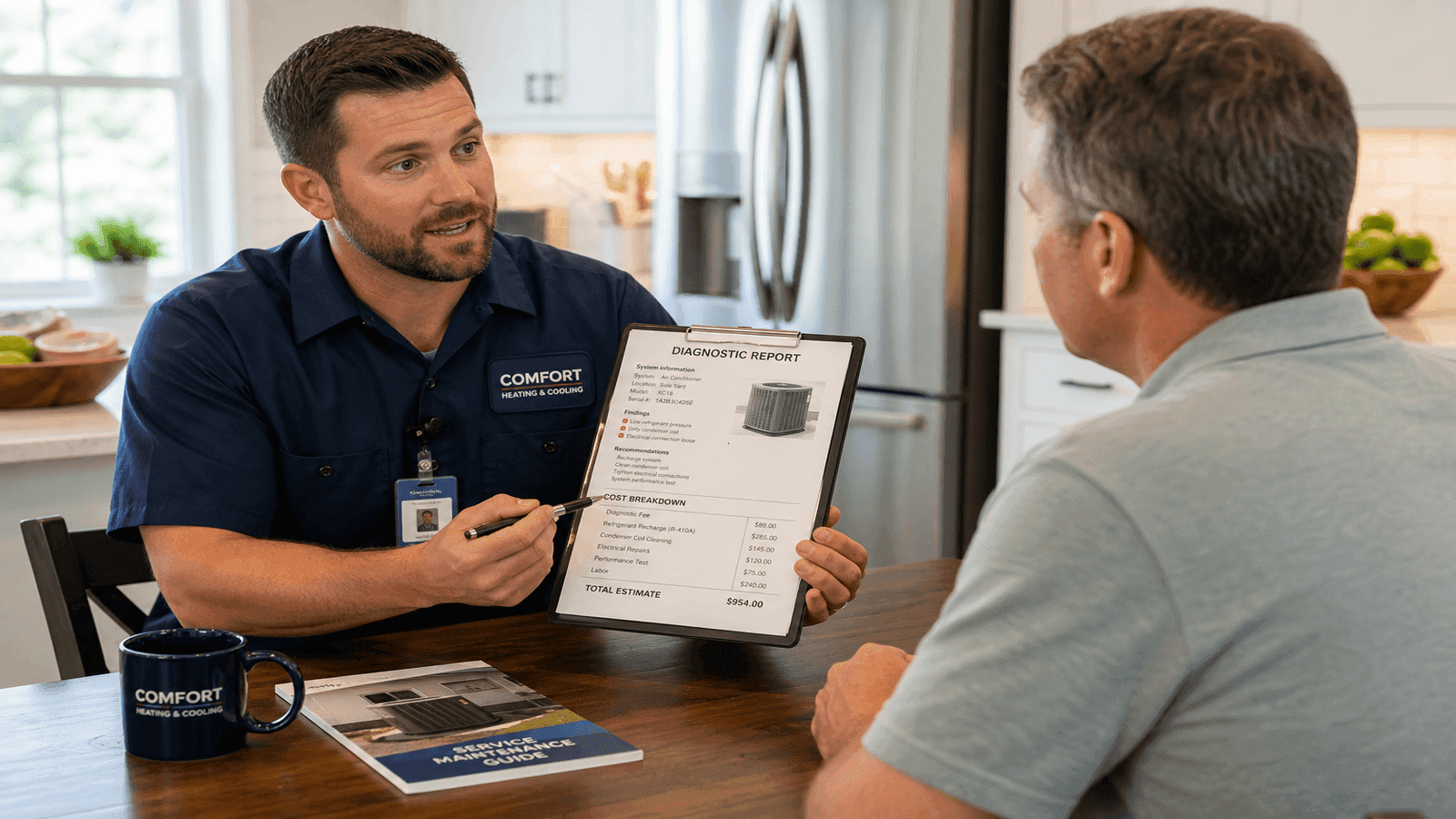
Photo: HVAC technician explaining a repair estimate to a homeowner at a kitchen table, with a diagnostic report and cost breakdown visible
Regional Pricing Differences
Emergency HVAC costs vary significantly by region due to labor rates, cost of living, demand patterns, and climate severity.
| Region | Standard Hourly Rate | Emergency Hourly Rate | Holiday Rate |
| Northeast (NYC, Boston, Philadelphia) | $100 to $175 | $200 to $450 | $350 to $600 |
| Southeast (Atlanta, Miami, Charlotte) | $75 to $130 | $150 to $325 | $250 to $500 |
| Midwest (Chicago, Minneapolis, Detroit) | $85 to $150 | $170 to $375 | $300 to $550 |
| Southwest (Phoenix, Dallas, Houston) | $80 to $140 | $160 to $350 | $275 to $500 |
| West Coast (LA, San Francisco, Seattle) | $100 to $180 | $200 to $475 | $350 to $650 |
| Rural / small town (national average) | $65 to $110 | $130 to $275 | $200 to $400 |
The Northeast and West Coast consistently command the highest emergency rates due to higher technician wages and cost of living. The Midwest sees sharp seasonal spikes: Minneapolis and Chicago emergency HVAC rates can increase 20 to 30 percent above their annual average during January and February cold snaps when demand surges. The Southeast sees a parallel spike during July and August heat waves.
Conclusion
Emergency HVAC service in 2026 costs $140 per hour on the low end for a weeknight call to $600 per hour for holiday overnight emergencies in major metro areas. The rate structure follows predictable tiers: standard hours are the baseline, after-hours adds 50 percent, weekends add 50 to 100 percent, and holidays add 150 to 200 percent. Service call fees, minimum labor charges, diagnostic fees, and parts markup compound these surcharges further.
The most effective strategy is prevention. A $150 to $300 annual maintenance plan reduces emergency call risk by 68 to 75 percent based on both NearbyHunt network data and Department of Energy research. When an emergency does occur, getting two quotes, asking about fee structures before dispatch, and knowing whether the service call fee is credited can reduce your bill by $200 to $500. Bookmark this guide and the HVAC costs pillar page so the information is at hand when you need it most.
Find a Licensed Emergency HVAC Technician Near You
Disclaimer: Costs cited in this article are national averages based on 2025-2026 industry data and may vary by location, system type, and contractor. Always obtain written estimates from licensed, insured HVAC professionals before authorizing work. NearbyHunt does not perform HVAC services directly; we connect homeowners with licensed local professionals.*
Sources & References
- Forbes Home. "How Much Does HVAC Repair Cost? (2026)." 2026. https://www.forbes.com/home-improvement/hvac/hvac-repair-cost/
- HouseCall Pro. "2026 HVAC Pricing Guide: Flat Rate, Service Pricing & More." 2026. https://www.housecallpro.com/resources/how-to-price-hvac-services/
- Bob Vila. "How Much Does HVAC Repair Cost? (2026)." 2026. https://www.bobvila.com/articles/hvac-repair-cost/
- U.S. Department of Energy. "Operations and Maintenance Best Practices Guide." https://www.energy.gov/eere/femp/operations-and-maintenance-best-practices-guide
- Fixurge. "How Much Does HVAC Repair Cost in 2026 (Price + Calculator)." 2026. https://fixurge.com/blog/hvac-repair-cost-2026/
- American Standard. "Average HVAC Repair Cost: Furnace, AC, and Heat Pump." 2026. https://www.americanstandardair.com/resources/blog/hvac-repair-cost/
- HVAC Group. "Do HVAC Companies Charge More on Weekends? Cost Guide." 2026. https://hvac-group.com/blog/do-hvac-companies-charge-more-on-weekends/
- WorkTrek. "HVAC Maintenance Statistics: What the Numbers Reveal." 2026. https://worktrek.com/blog/hvac-maintenance-statistics/

Daniel is an EPA-certified HVAC technician & Energy Efficiency Consultant with over 14 years of experience in maintaining and installing heating and cooling systems throughout the Midwest. Passionate about sustainability, Dan specialises in energy-efficient retrofits and intelligent climate control systems. He writes for NearbyHunt to help homeowners extend the lifespan of their HVAC units while lowering utility bills.

Christine is an EPA-certified HVAC professional with 17 years of experience in heating, cooling, and indoor air quality systems. She has managed large-scale residential installations and worked as a technical trainer for new HVAC apprentices. Chris’s reviews focus on accuracy, safety, and performance standards in modern HVAC practices.