- Low refrigerant cuts cooling capacity by 30-40% and can nearly double your electricity consumption, yet the system may keep running for weeks before you notice the problem [1].
- Five homeowner-observable symptoms point to low refrigerant: warm air from vents, ice on the evaporator coil, hissing sounds near refrigerant lines, rising electric bills, and short cycling [2].
- Only EPA 608-certified technicians can legally handle refrigerants. Federal penalties reach $44,539 per day per violation under the Clean Air Act, making DIY refrigerant work both illegal and dangerous [3].
- Professional leak detection and recharge costs $200-$600 on average, while ignoring low refrigerant leads to compressor failure costing $1,500-$3,000 [4].
- New equipment manufactured after January 1, 2025, uses R-454B refrigerant instead of R-410A, but existing R-410A systems remain fully serviceable [5].
Your air conditioner does not consume refrigerant the way a car burns gasoline. Refrigerant circulates in a sealed loop between the indoor evaporator coil and the outdoor condenser, absorbing heat inside your home and releasing it outside. When levels drop, there is only one explanation: a leak somewhere in that sealed system [1].
The U.S. Department of Energy reports that heating and cooling accounts for roughly 48% of energy use in a typical American home [1]. A system running low on refrigerant works harder, runs longer, and still fails to reach the temperature you set on the thermostat. Catching the problem early saves hundreds in wasted electricity and prevents the kind of compressor damage that turns a $300 repair into a $3,000 replacement.
This guide covers how to identify low refrigerant symptoms, what pressure readings mean when a technician connects gauges, and when to call a professional for diagnosis and recharge. It is part of our HVAC How To and DIY series designed to help homeowners understand their systems and make informed decisions about service.

Get quotes from top-rated pros.
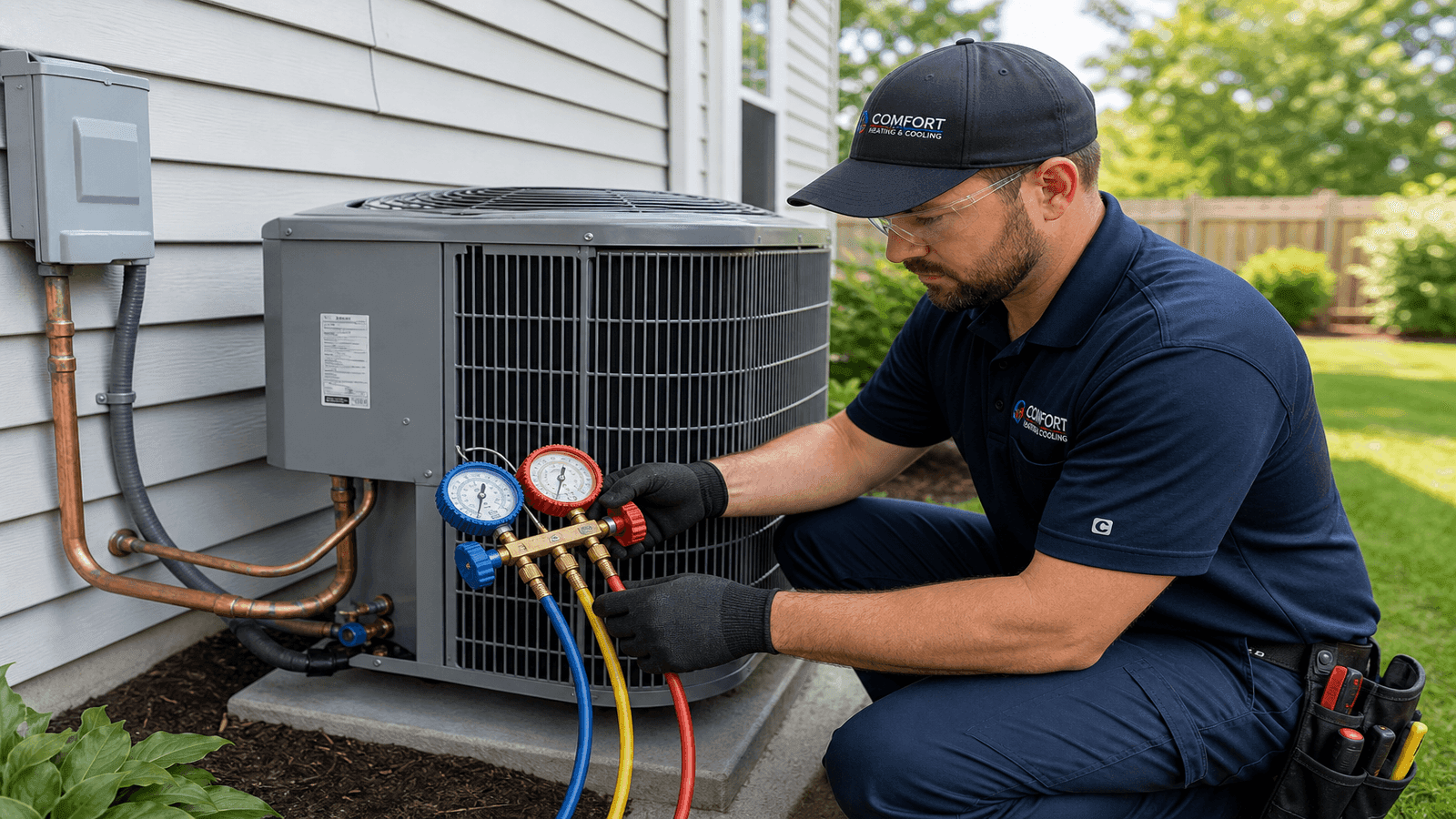
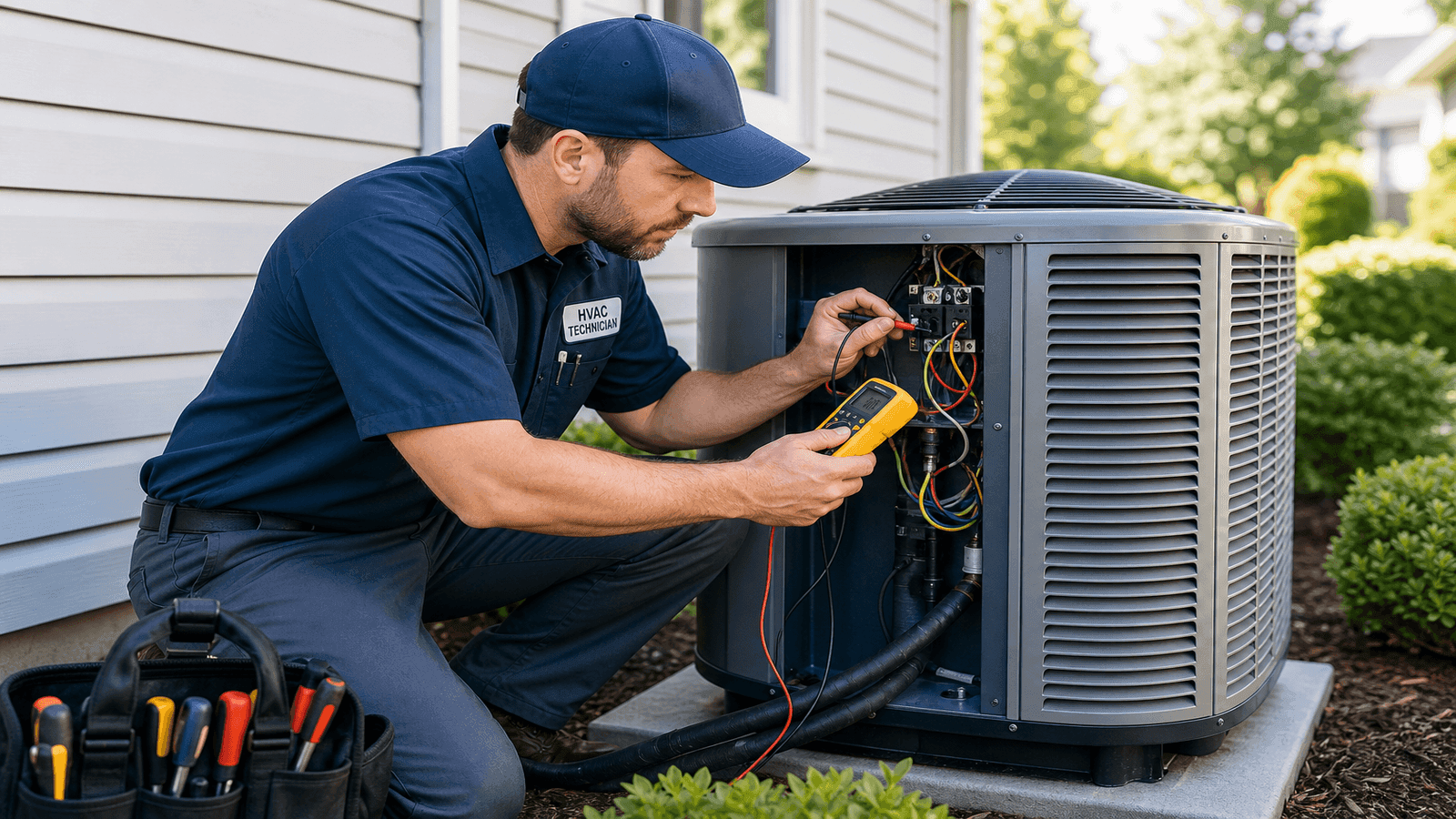
Photo: HVAC technician connecting refrigerant manifold gauges to a residential air conditioning outdoor unit for pressure testing
What Refrigerant Does in Your AC
Refrigerant is a chemical compound that changes between liquid and gas states at temperatures useful for cooling your home. As it evaporates inside the indoor coil, it absorbs heat from the air passing over it. As it condenses in the outdoor coil, it releases that heat outside.
The most common residential refrigerants in 2026 are R-410A (used in systems manufactured from 2010 through 2024) and the newer R-454B (required in new equipment manufactured after January 1, 2025) [5]. Older systems built before 2010 may still use R-22, which was phased out of production in 2020 and now costs $90-$150 per pound when available [4].
Key point: Your system was charged with the correct amount of refrigerant at installation. That charge should last the lifetime of the equipment. If levels are low, there is a leak that needs to be found and repaired before adding more refrigerant.
5 Signs Your AC Is Low on Refrigerant
Homeowners cannot measure refrigerant directly without professional gauges, but these five symptoms reliably indicate a low charge. The more symptoms you observe simultaneously, the higher the likelihood of a refrigerant issue.
1. Warm Air From Vents
The most obvious sign. Your thermostat is set to cool, the system is running, but the air coming from supply registers feels lukewarm or barely cool. Place a thermometer at the supply register closest to the indoor unit. The air should be 15-20 degrees cooler than your room temperature [2]. If the gap is less than 10 degrees, low refrigerant is a likely cause.
2. Ice on the Evaporator Coil or Lines
When refrigerant levels drop, pressure in the evaporator coil falls below normal. That lower pressure causes the remaining refrigerant to get colder than designed, and moisture from the air freezes on the coil surface. You may see ice on the copper refrigerant lines running from the indoor unit to the outdoor unit [2].
If you see ice, turn off the AC immediately and set the fan to ON (not AUTO). Let the ice melt completely over 2-4 hours before calling a technician. Running the system with a frozen coil risks compressor damage.
3. Hissing or Bubbling Sounds
A hissing sound near the indoor unit or along refrigerant lines typically indicates refrigerant escaping through a small leak in the form of gas. A bubbling or gurgling sound suggests a larger leak where refrigerant is escaping in liquid form [2]. Either sound warrants a professional inspection.
4. Rising Electric Bills
A system running 15-20% low on refrigerant can consume nearly twice the normal electricity because the compressor runs longer cycles trying to reach the set temperature [1]. If your electric bill increases 20-30% compared to the same month the previous year without an obvious explanation, low refrigerant is one possible cause.
5. Short Cycling
Short cycling occurs when the system turns on and off rapidly, running only 2-5 minutes per cycle. Low refrigerant triggers the compressor's low-pressure safety switch, shutting the system down. The pressure slowly equalizes, the system restarts, and the cycle repeats. This pattern stresses the compressor and shortens its lifespan dramatically [2].
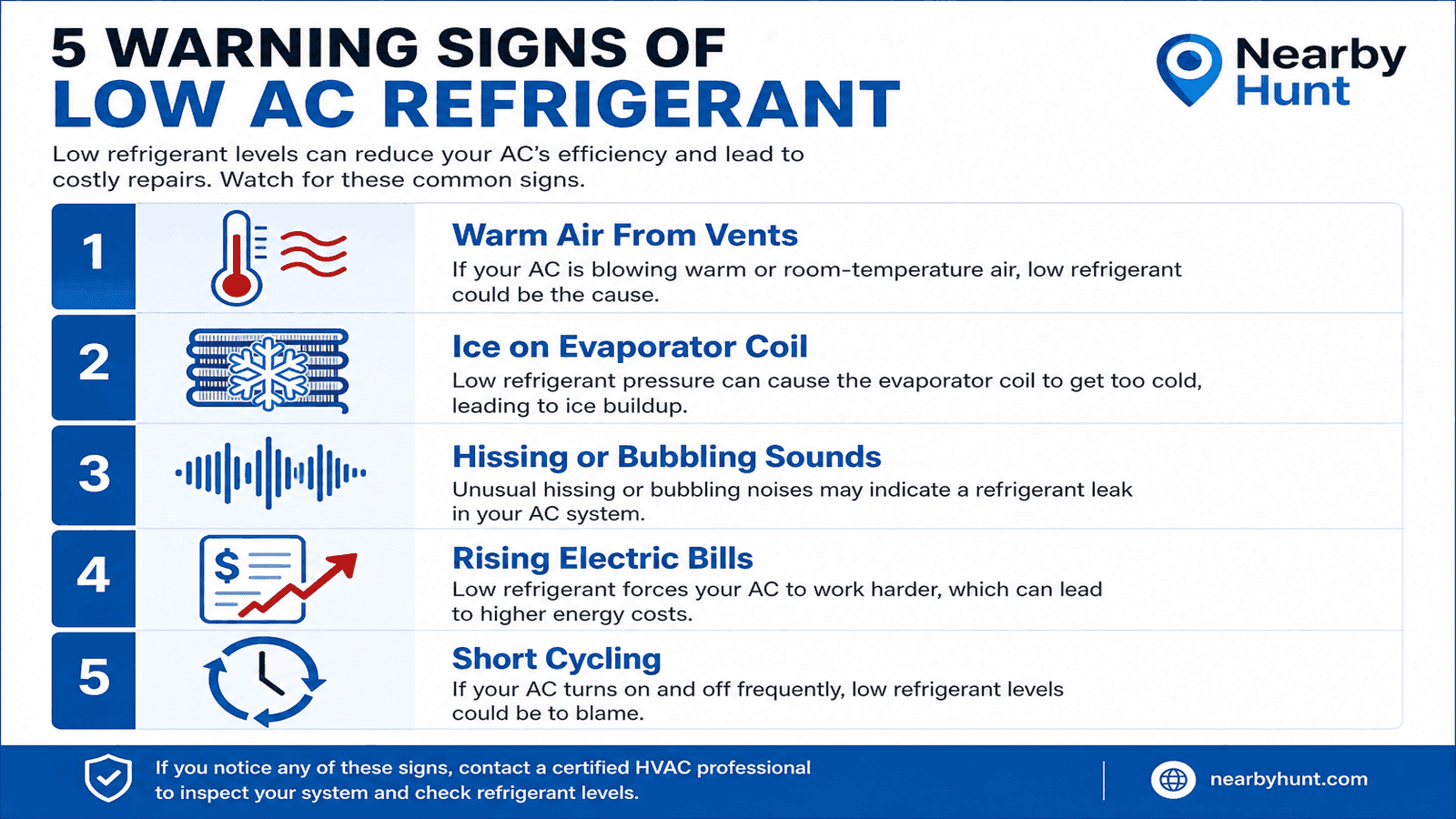
Photo: Infographic showing five warning signs of low AC refrigerant with icons for warm air, ice buildup, hissing sounds, high bills, and short cycling
How Technicians Check Refrigerant Levels
When you call a professional, here is what happens during a proper refrigerant diagnostic. Understanding this process helps you evaluate the quality of service you receive.
Get quotes from top-rated pros.
Gauge Connection and Pressure Readings
The technician connects a manifold gauge set to the service valves on your outdoor unit. The blue (low-pressure) gauge reads suction pressure, and the red (high-pressure) gauge reads discharge pressure [6].
For R-410A systems on a typical 85-degree day, normal readings fall approximately in these ranges:
| Measurement | Normal Range | Low Refrigerant Indicator |
| Low-side (suction) pressure | 118-135 psi | Below 100 psi |
| High-side (discharge) pressure | 370-420 psi | Below 300 psi |
| Supply air temperature split | 15-20 degrees F | Less than 10 degrees F |
These numbers shift based on outdoor temperature, humidity, and the specific equipment. Your technician should reference the manufacturer's specifications on the rating plate of your unit [6].
Superheat and Subcooling
Pressure readings alone do not tell the full story. Certified technicians also measure superheat (the temperature of refrigerant gas above its boiling point at the evaporator) and subcooling (the temperature of liquid refrigerant below its condensing point at the condenser) [7].
- Normal superheat: 10-15 degrees F
- Normal subcooling: 8-12 degrees F (varies by manufacturer)
- High superheat + low subcooling = strong indicator of low refrigerant charge
For systems with a thermostatic expansion valve (TXV), subcooling is the primary charging method. For systems with a fixed orifice, superheat is used [7]. A qualified technician knows which method applies to your equipment.
Leak Detection Methods
If readings confirm a low charge, the next step is finding the leak. Technicians use several methods:
- Electronic leak detectors: Handheld devices that sense refrigerant vapor. Cost-effective and fast for accessible components.
- UV dye injection: Fluorescent dye is added to the system and circulated. The technician returns after 1-2 weeks to scan with UV light for dye traces at leak points.
- Nitrogen pressure testing: The system is pressurized with dry nitrogen and monitored for pressure drop over time. The most definitive method for confirming leaks [3].
Professional leak detection costs $100-$330 for the diagnostic alone [4]. Many companies include the detection fee in the total repair cost.
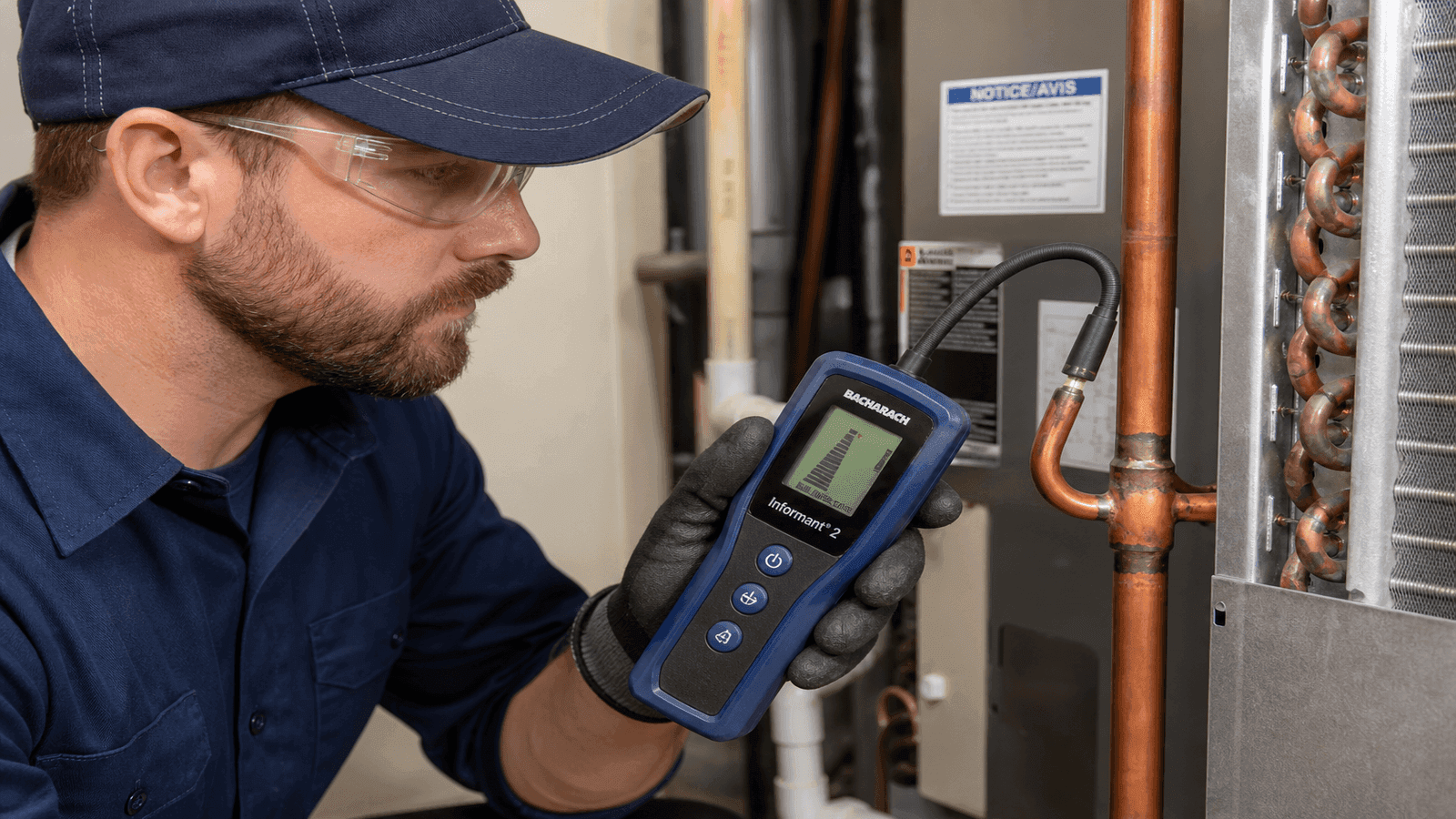
Photo: HVAC technician using an electronic leak detector along copper refrigerant lines near an indoor evaporator coil
Refrigerant Recharge: What It Costs
Once the leak is located and repaired, the technician recharges the system to the manufacturer's specified level. Here is what to expect on cost:
| Service | Typical Cost Range |
| Leak detection (diagnostic) | $100-$330 |
| Minor leak repair (accessible fitting or valve) | $200-$600 |
| Major leak repair (evaporator or condenser coil) | $600-$1,500 |
| R-410A refrigerant per pound | $50-$80 |
| R-22 refrigerant per pound (if available) | $90-$150+ |
| Full recharge (2-4 lbs typical residential) | $200-$500 |
| Evaporator coil replacement | $900-$2,700 |
The total cost for a typical leak detection, minor repair, and recharge runs $300-$800 [4]. A technician who simply "tops off" refrigerant without finding and fixing the leak is providing a temporary patch, not a real repair. The refrigerant will leak out again, and you will pay for another service call.
Any HVAC company that offers to just add refrigerant without looking for the leak is selling you a band-aid. I have seen homeowners pay for three or four recharges in a single summer before someone finally traced a pinhole leak in the evaporator coil. That is $1,500 in recharges when a $400 repair would have solved it the first time.
The R-454B Transition: What Homeowners Should Know
As of January 1, 2025, all new residential air conditioning and heat pump equipment manufactured in the United States must use refrigerants with a global warming potential (GWP) of 700 or less. R-454B, the primary replacement for R-410A, has a GWP approximately 75% lower than R-410A [5].
What this means for you:
- Existing R-410A systems remain fully serviceable. R-410A is still manufactured and available for system recharges and repairs. No action is required on current equipment.
- New equipment purchases after January 2025 use R-454B. This refrigerant operates at slightly different pressures, and the equipment is not cross-compatible with R-410A systems.
- R-454B is classified as A2L (mildly flammable) by ASHRAE, which means installation requires updated safety practices, but normal operation poses no additional risk to homeowners [5].
- R-22 systems are the most expensive to maintain. If your system uses R-22, replacement is often more cost-effective than continued repairs given refrigerant prices exceeding $90 per pound [4].
Get quotes from top-rated pros.
Why You Cannot Check or Add Refrigerant Yourself
This is not a cost-saving area for DIY. Federal law under Section 608 of the Clean Air Act requires EPA 608 certification for anyone who purchases, handles, or recovers refrigerants [3]. The reasons are both legal and practical:
Legal consequences: The EPA can levy fines of up to $44,539 per day per violation. In 2024, refrigerant recovery violations accounted for over 30% of all EPA penalties in the HVAC industry [3]. Purchasing refrigerant without certification and adding it to your system exposes you to significant legal liability.
Safety risks: Refrigerants displace oxygen in enclosed spaces. R-454B is mildly flammable. Improper handling can cause frostbite from liquid refrigerant contact, chemical burns, and asphyxiation in confined areas. Professional technicians carry proper safety equipment and understand ventilation requirements [3].
System damage: Overcharging a system (adding too much refrigerant) causes liquid slugging in the compressor, which destroys compressor valves and bearings. The repair cost for compressor replacement runs $1,500-$3,000, far exceeding the cost of professional service [2].
I respond to at least two calls per summer where a homeowner bought R-410A online and tried to add it themselves. In both cases last year, they overcharged the system and the compressor failed within weeks. One had a 3-year-old system with a $200 leak that turned into a $2,400 compressor replacement. The other got a $44,000 fine notice from the EPA after a neighbor reported it.
Case Study: The Nguyen Family's Slow Leak
Tran and Mai Nguyen of Bloomington, Minnesota, contacted Daniel through NearbyHunt in July 2025 after their 8-year-old R-410A system started blowing lukewarm air during a heat wave.
The system had been cooling poorly for about three weeks, but the family assumed it was struggling with the 95-degree outdoor temperatures. Their June electric bill came in at $387, up from $240 the previous June. When the indoor temperature would not drop below 78 degrees despite the thermostat set to 72, they called for service.
Daniel's diagnostic found suction pressure at 88 psi (normal: 118-135 psi for R-410A) and superheat reading 38 degrees F (normal: 10-15 degrees F). The system was approximately 2.5 pounds low on refrigerant. Using an electronic leak detector, he traced the leak to a brazed joint on the evaporator coil where vibration had caused a hairline crack over years of operation.
The repair took about 3 hours: leak repair at the brazed joint ($380), nitrogen pressure test to confirm the seal ($85), evacuation and recharge with 2.5 pounds of R-410A at $65 per pound ($162.50), plus the diagnostic fee ($150). Total cost: $777.50.
Daniel estimates the Nguyens had been losing refrigerant slowly for 4-5 months based on the rate of the leak. During that time, the overworked compressor consumed approximately $400-$500 in excess electricity. An earlier service call at the first sign of warm air would have caught the leak when less refrigerant had escaped, reducing the recharge cost by roughly half.
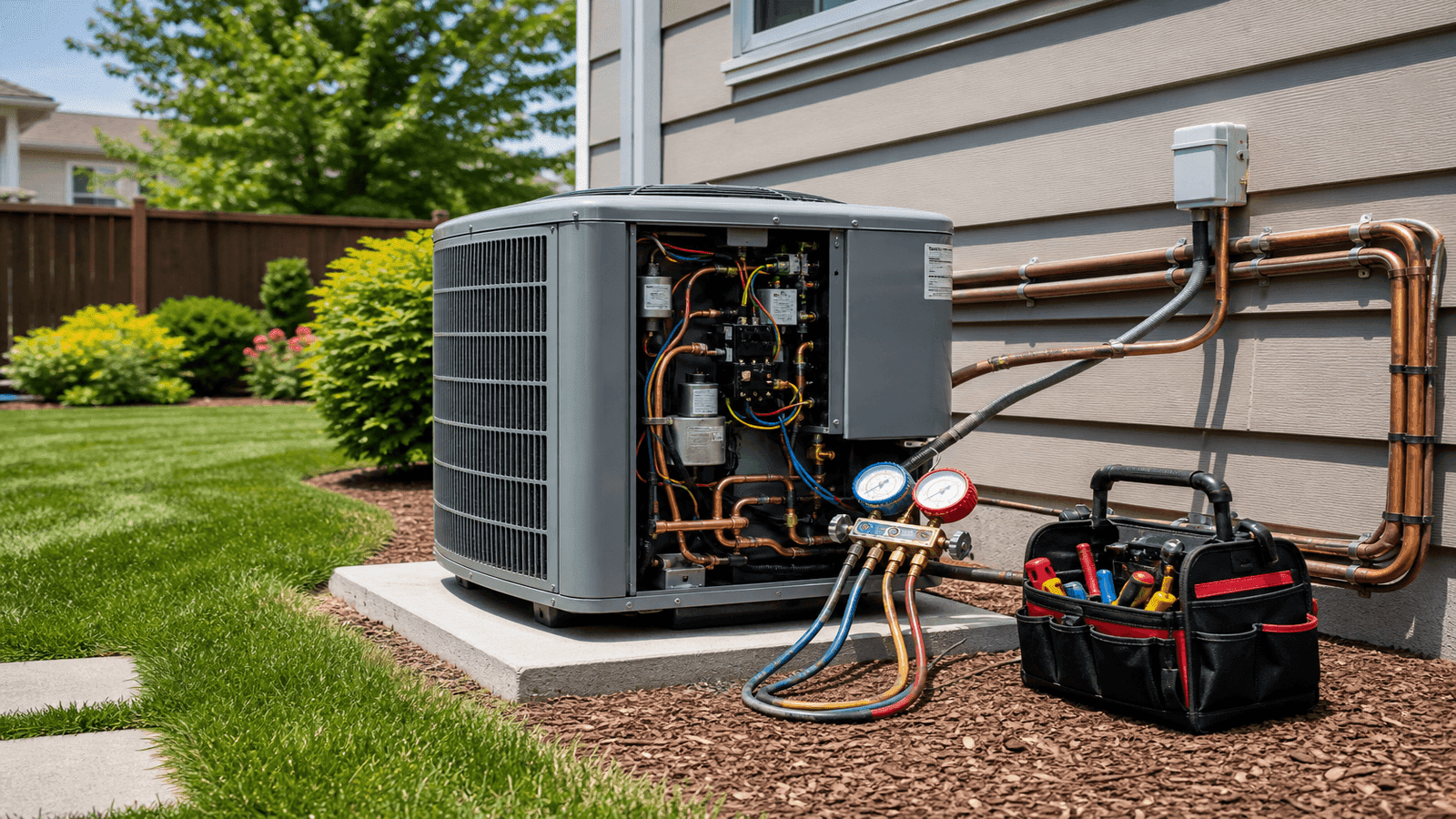
Photo: Residential HVAC outdoor unit in a backyard setting showing copper refrigerant lines connecting to the home with a service panel open
NearbyHunt Network Insight
Data from HVAC professionals in the NearbyHunt network shows consistent patterns for refrigerant-related service requests across the United States:
| Refrigerant Service Type | % of AC Requests | Average Total Cost |
| Low refrigerant / recharge | 24% | $300-$600 |
| Leak detection and repair | 18% | $400-$900 |
| Frozen evaporator coil (often low refrigerant) | 14% | $200-$500 |
| R-22 system consultation | 8% | $150-$300 |
| Compressor failure (often from low refrigerant) | 6% | $1,500-$3,000 |
Refrigerant-related issues spike 340% between May and August compared to the rest of the year. Homeowners who schedule pre-season maintenance in April or May catch 82% of slow leaks before they cause comfort problems during peak cooling season.
When to Call a Professional
Call an HVAC technician if you notice any of these situations:
- Supply air temperature is less than 10 degrees cooler than room temperature
- Ice is visible on the indoor coil, refrigerant lines, or outdoor unit
- You hear hissing or bubbling near refrigerant components
- The system runs constantly without reaching the set temperature
- Your electric bill increases 20% or more compared to the same period last year
- The system short cycles (turns on and off every 2-5 minutes)
Do not wait for multiple symptoms. A single confirmed symptom justifies a professional evaluation. Early detection typically costs $150-$300 for diagnosis, while delayed service leads to compressor damage costing 5-10 times that amount.
Find HVAC Professionals on NearbyHunt
When your AC is not cooling properly, NearbyHunt connects you with EPA 608-certified HVAC technicians who specialize in refrigerant leak detection and system recharging. Get multiple quotes, compare verified reviews, and book service through one platform.
Sources and References
[1] U.S. Department of Energy. "Energy Saver: Heating and Cooling."
[2] U.S. Environmental Protection Agency. "Refrigerant Management: Residential Systems."
[3] U.S. Environmental Protection Agency. "Section 608 Technician Certification Requirements."
[4] Forbes Home. "How Much Does an AC Recharge Cost?"
[5] Lennox Industries. "Everything You Need to Know About the 2025 New Refrigerant Transition."
[6] Refrigerants Center. "R410A Operating Pressures: Charts and Best Practices."
[7] Ferguson. "HVAC Superheat and Subcooling: Pro Diagnostic Guide."
[8] ENERGY STAR. "Heat and Cool Efficiently."
Disclaimer: Refrigerant handling is regulated by federal law under Section 608 of the Clean Air Act. Only EPA 608-certified technicians may purchase, handle, recover, or dispose of refrigerants. Violations carry penalties up to $44,539 per day. The costs provided in this article are national averages from 2025-2026 data and may vary based on your location, equipment type, and refrigerant availability. This article is intended to help homeowners identify symptoms and understand the professional diagnostic process. It does not provide instructions for handling refrigerants. Always hire a licensed, insured HVAC technician for refrigerant work. R-454B is classified as mildly flammable (A2L) and requires certified handling. This article is for informational purposes only and does not constitute professional HVAC advice for your specific situation.

Daniel is an EPA-certified HVAC technician & Energy Efficiency Consultant with over 14 years of experience in maintaining and installing heating and cooling systems throughout the Midwest. Passionate about sustainability, Dan specialises in energy-efficient retrofits and intelligent climate control systems. He writes for NearbyHunt to help homeowners extend the lifespan of their HVAC units while lowering utility bills.

Christine is an EPA-certified HVAC professional with 17 years of experience in heating, cooling, and indoor air quality systems. She has managed large-scale residential installations and worked as a technical trainer for new HVAC apprentices. Chris’s reviews focus on accuracy, safety, and performance standards in modern HVAC practices.