- A standard HVAC tune-up costs $75 to $200 per visit in 2026, with the national average at $120 to $150 for a single-system home [1].
- Annual maintenance service plans cost $150 to $500 per year and typically include two seasonal visits, priority scheduling, and repair discounts [3].
- Service plans save 15 to 25% compared to booking individual visits, plus they reduce emergency repair costs by catching problems early [3].
- The DOE reports that neglected systems lose up to 5% efficiency per year, meaning a skipped tune-up costs more in energy waste than the tune-up itself [2].
- ASHRAE Standard 180 establishes minimum inspection frequencies and task requirements for HVAC maintenance, and residential best practices follow similar preventive schedules [4].
- Homeowners who maintain their systems spend an average of $400 to $600 per year on total HVAC costs, while those who skip maintenance average $1,200 to $2,500 in reactive repairs [5].
- Regular maintenance extends equipment lifespan by 5 to 7 years, protecting a $5,000 to $15,000 investment [5].
The average HVAC maintenance visit costs $75 to $200 for a standard tune-up in 2026, while annual service plans run $150 to $500, depending on coverage level [1]. Where the math gets interesting is what happens when you skip maintenance. The U.S. Department of Energy estimates that a neglected HVAC system loses up to 5% of its rated efficiency for every year without professional service [2].
After four or five years of skipped tune-ups, a system rated at 18 SEER2 performs closer to 14 SEER2, burning hundreds of extra dollars in energy costs annually while accelerating wear on the compressor, blower motor, and electrical components.
Daniel Torres, a Certified HVAC Technician and Energy Efficiency Consultant with EPA 608, NATE, and HVAC Excellence certifications and 14 years of field experience in Minneapolis, puts it bluntly: "I have never once performed a maintenance visit where I did not find at least one issue that would have become a repair bill within six months. A $150 tune-up catching a failing capacitor saves the homeowner $400 to $800 in emergency repairs, plus the lost efficiency from running a system out of specification."
For a broader look at HVAC system costs and types, see the NearbyHunt HVAC Costs guide.

Get quotes from top-rated pros.
The homeowners who call me for emergency repairs in July and January are almost always the ones who skipped their spring and fall tune-ups. Reactive HVAC spending is three to five times more expensive than preventive spending. The system does not care about your budget. It degrades on a predictable schedule, and maintenance is the only thing that resets the clock.
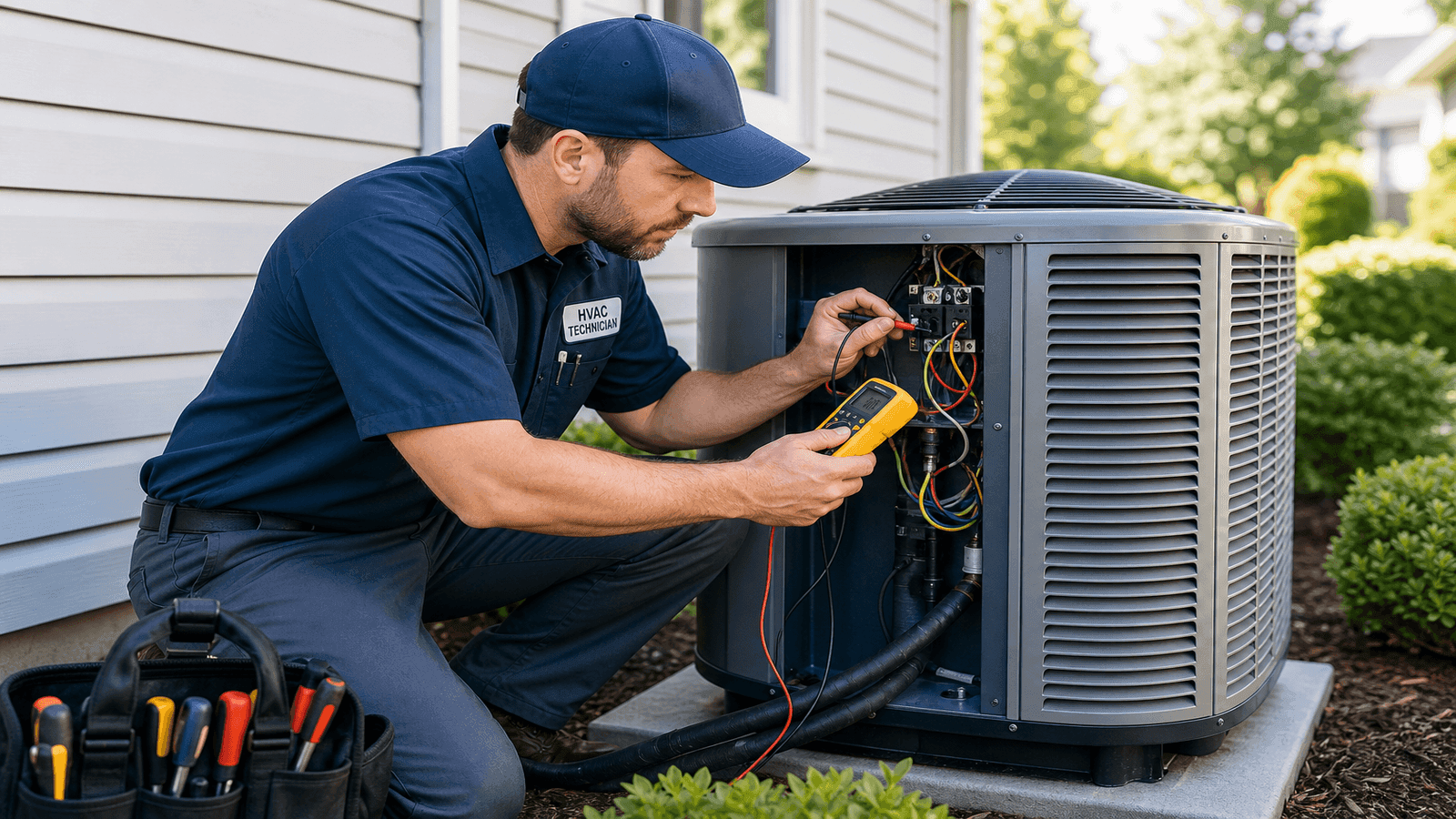
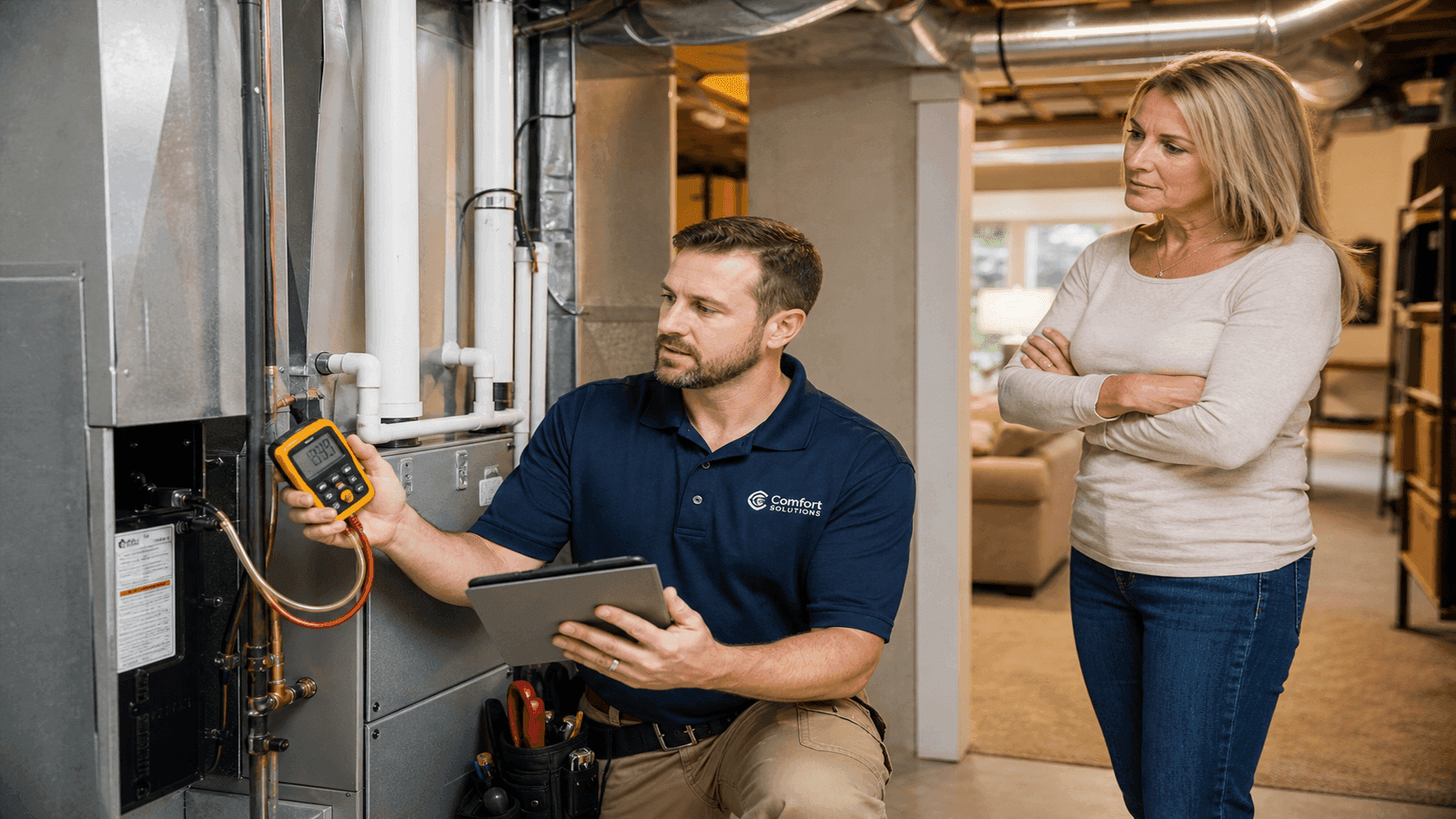
Photo: Overview of HVAC maintenance costs showing a technician performing a seasonal tune-up on a residential air conditioning unit
What a Tune-Up Costs
HVAC tune-up pricing breaks into three tiers depending on the scope of work, and understanding those tiers prevents overpaying for services you do not need or underpaying for an inspection that skips critical checks.
Basic Tune-Up: $75 to $150
A basic tune-up covers the essential preventive tasks that keep a system running safely and within manufacturer specifications. This tier takes 45 to 60 minutes and includes filter inspection or replacement, thermostat calibration, condensate drain clearing, visual inspection of electrical connections, and a basic operational test. Most independent HVAC contractors offer this level as their standard seasonal visit.
Standard Service: $150 to $250
Standard service adds refrigerant pressure measurement, evaporator and condenser coil inspection, blower motor amp draw testing, and a more thorough electrical component evaluation including capacitor testing. This tier runs 60 to 90 minutes and is what most manufacturers require to maintain warranty coverage [1]. If a technician spends less than 45 minutes on a "complete tune-up," they are cutting corners.
Comprehensive Diagnostic: $250 to $450
A comprehensive diagnostic includes everything in the standard tier plus duct leakage testing, airflow measurement (CFM per ton), combustion analysis for gas furnaces, and a written report with efficiency recommendations. This level is most valuable for systems older than 8 years or homes with comfort complaints that basic maintenance has not resolved.
| Service Level | Price Range | Duration | Best For |
| Basic tune-up | $75-$150 | 45-60 min | Annual preventive care, newer systems |
| Standard service | $150-$250 | 60-90 min | Warranty compliance, most homeowners |
| Comprehensive diagnostic | $250-$450 | 90-120 min | Older systems, comfort issues, pre-purchase |
What Affects the Price
Geography is the biggest variable. HVAC maintenance in Minneapolis runs 15 to 25% higher than in Atlanta or Dallas due to labor rates and heating season complexity. System type matters too. A standard split-system AC tune-up sits at the lower end, while a dual-fuel heat pump system with a gas furnace backup requires more inspection points and takes longer, pushing costs toward the higher end. Multi-system homes (two or more units) typically receive a per-unit discount of 10 to 20% when serviced on the same visit.
I tell homeowners to be suspicious of any tune-up advertised below $49. At that price, the company is using the visit as a sales call, not a maintenance appointment. A legitimate 15-point inspection with refrigerant pressure checks and amp draw testing takes a trained technician 60 minutes minimum. That cannot be done profitably at $49 without upselling unnecessary repairs or parts.
What is Included in a Professional Tune-Up
A professional HVAC tune-up follows a structured checklist that covers four categories: pre-service inspection, refrigerant and coil work, electrical and mechanical testing, and final system verification. Understanding what should happen during each phase helps you evaluate whether your contractor is delivering a thorough service.
Pre-Service Inspection
The technician begins with a visual assessment of both indoor and outdoor units: air filter condition, condensate drain line for clogs, thermostat calibration, and visible signs of wear or corrosion. The outdoor unit gets inspected for debris accumulation, vegetation encroachment (24 inches of clearance minimum), and refrigerant line insulation.
Get quotes from top-rated pros.
Refrigerant and Coil Service
This phase legally requires an EPA 608-certified technician. It includes measuring refrigerant pressures (suction and discharge) and calculating superheat and subcool values to verify proper charge. The condenser coil is cleaned if dirty, and the evaporator coil is inspected for buildup. A system running with refrigerant charge 10% above or below specification loses 5 to 20% of its rated efficiency [2].
Electrical and Mechanical Testing
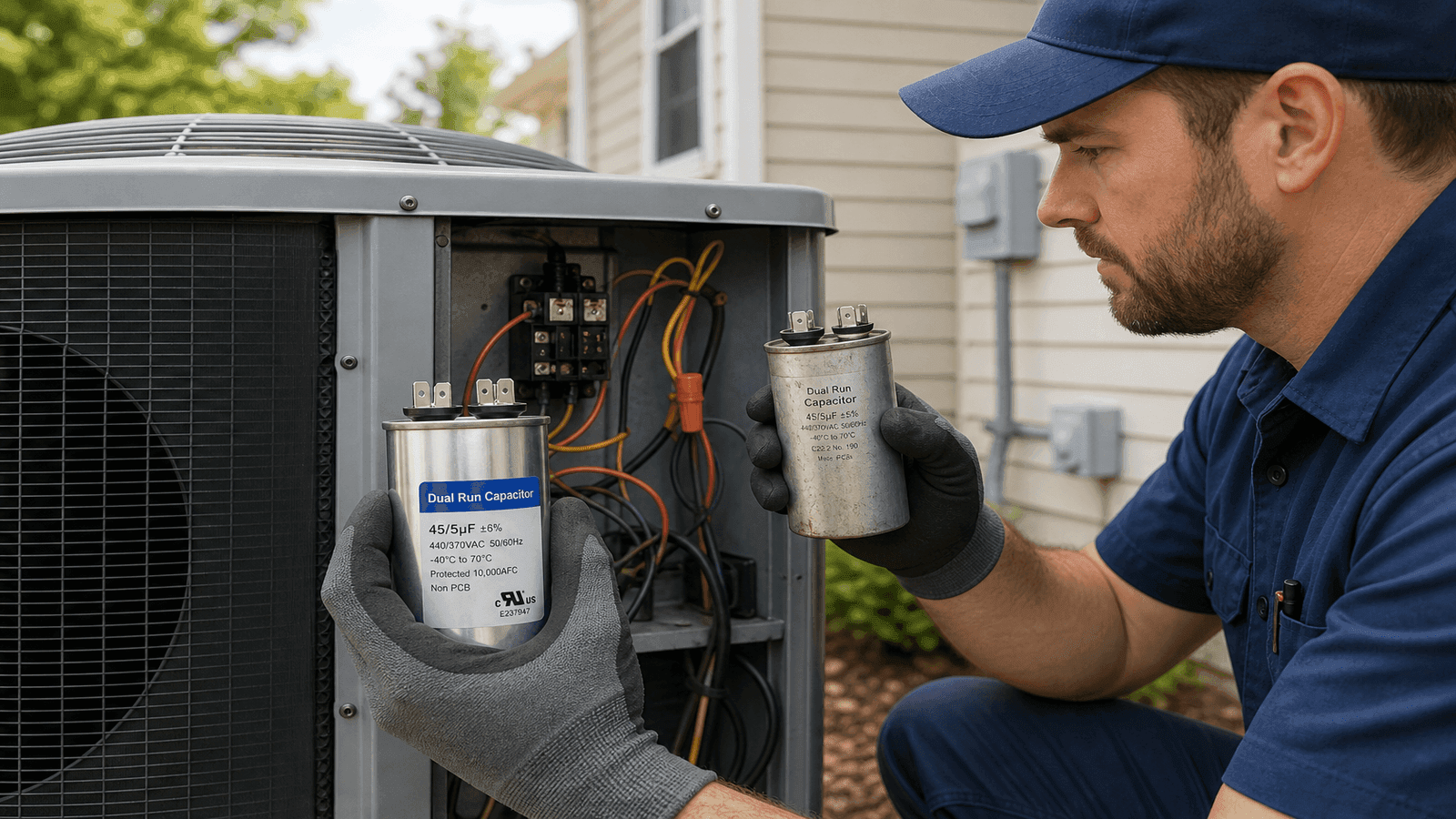
The technician tests run and start capacitors, measures motor amp draw against nameplate ratings, inspects contactor points for pitting, checks wiring connections for tightness and heat damage, and tests safety controls including high-pressure switches and flame sensors (for furnaces). This phase catches the failing components that cause mid-season breakdowns.
Final System Verification
The technician runs the system through a complete heating or cooling cycle, measuring supply and return air temperature differential (typically 15 to 22 degrees for cooling). They verify proper airflow, check that the system cycles correctly, and provide a written summary of findings and recommended repairs before leaving.
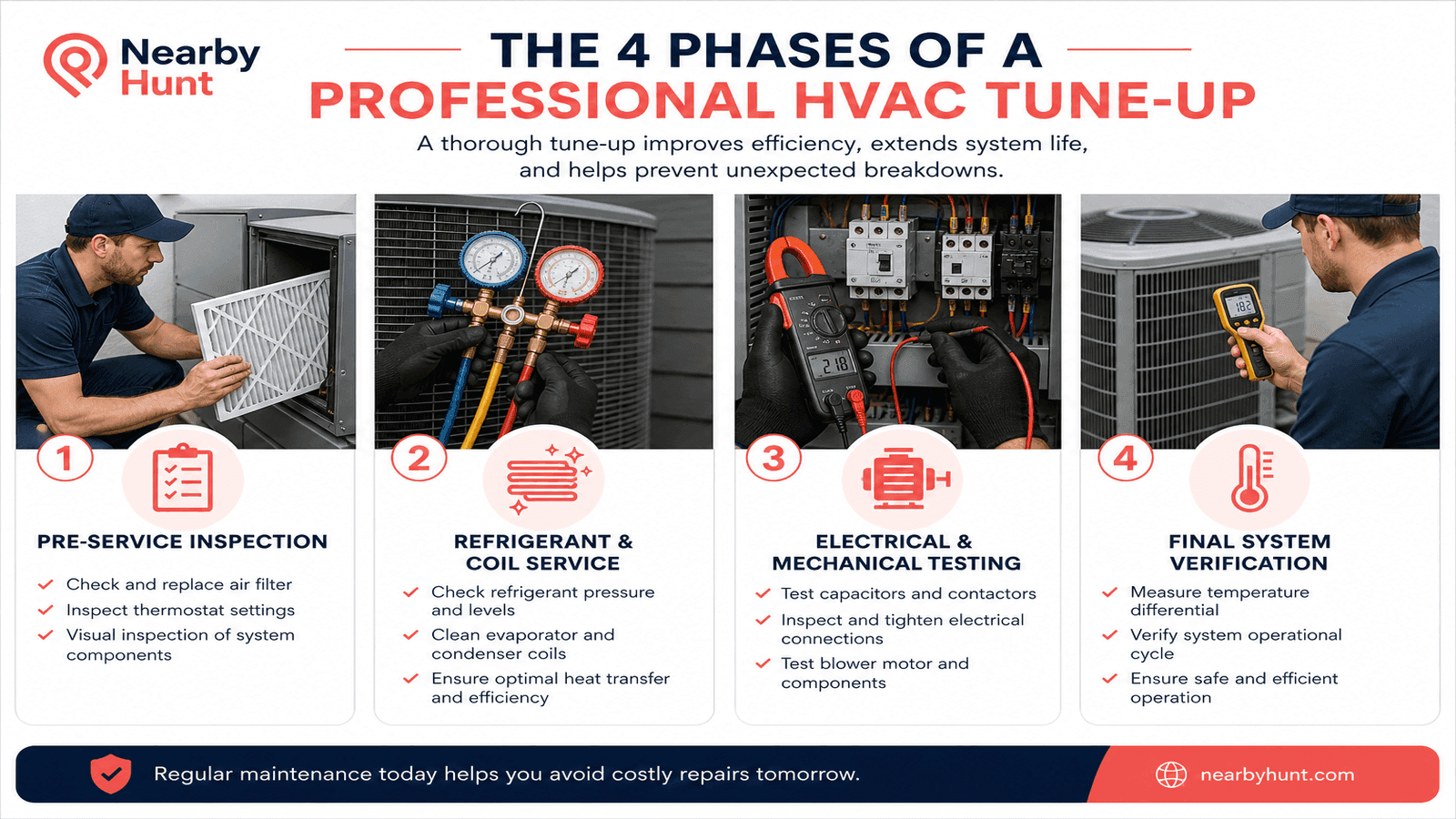
Photo: Detailed HVAC maintenance checklist showing the four phases of a professional tune-up inspection
Service Plans vs. Individual Visits
The decision between buying an annual service plan and booking individual tune-ups comes down to simple math and risk tolerance. Both approaches keep your system maintained, but the cost structure and added benefits differ significantly.
Individual Visit Pricing
Booking tune-ups separately means paying $75 to $250 per visit, typically scheduling one in spring (cooling prep) and one in fall (heating prep). Two standard visits per year cost $300 to $500 total at full price. Emergency service calls outside of a plan run $100 to $250 for the diagnostic fee alone, before any repair costs.
Annual Service Plan Pricing
Service plans from HVAC contractors typically cost $150 to $500 per year and bundle two seasonal tune-ups with additional benefits [3]. The most common plan structures are:
| Plan Tier | Annual Cost | Includes |
| Basic | $150-$250 | Two seasonal tune-ups, filter included |
| Standard | $250-$350 | Two tune-ups, priority scheduling, 10-15% repair discount |
| Premium | $350-$500 | Two tune-ups, priority scheduling, 15-20% repair discount, no diagnostic fee, extended parts coverage |
The Real Savings
The tune-up visits alone save 15 to 25% compared to individual booking. But the hidden value is in the repair discounts and waived diagnostic fees. A single repair visit under a standard plan saves $150 to $300 in diagnostic and labor markups. Over a five-year period, a homeowner averaging one repair per year saves $750 to $1,500 in repair costs on top of the tune-up savings.
When Individual Visits Make Sense
If your system is under five years old, covered by a manufacturer warranty, and you have had zero repair issues, individual visits may be more cost-effective. New systems are less likely to need repairs, and the manufacturer warranty covers parts regardless. Once a system passes the five-year mark or the warranty expires, a service plan becomes the better financial bet.
NearbyHunt Network Insight
HVAC contractors in the NearbyHunt network report that homeowners on annual service plans experience 40 to 60% fewer emergency repair calls compared to non-plan customers. Tune-up visits catch failing capacitors, worn contactors, and refrigerant leaks before they cause complete system failures. Plan customers also receive faster response times during peak summer and winter demand because priority scheduling moves them ahead of the general queue.
How Often Should You Schedule Maintenance
Maintenance frequency depends on system type, age, and usage patterns. The baseline recommendation from equipment manufacturers and industry organizations is straightforward, but several factors push the schedule in one direction or the other.
Get quotes from top-rated pros.
Standard Frequency
Most HVAC manufacturers and the ENERGY STAR program recommend professional maintenance at least once per year [6]. For homes with a central AC or furnace as separate systems, that means one cooling tune-up in spring and one heating tune-up in fall. Heat pump owners need both visits because the same equipment handles heating and cooling year-round.
ASHRAE Guidelines
ASHRAE Standard 180 establishes minimum inspection and maintenance frequencies for commercial HVAC systems [4]. While the standard applies to commercial buildings, its preventive framework informs residential best practices: quarterly filter inspections, annual equipment inspections, and documented maintenance records. Residential professionals apply these principles at homeowner scale with filter changes every 1 to 3 months, professional tune-ups twice per year, and a maintenance log tracking what was done at each visit.
Factors That Increase Frequency
Several conditions warrant more frequent maintenance:
- Older systems (10+ years): Components wear faster and tolerances drift. Semi-annual professional visits are the minimum.
- High-use climates: Homes in Phoenix, Houston, Miami, and similar markets put 50% more operating hours on equipment than moderate climates.
- Pets: Pet hair and dander clog filters 30 to 50% faster. Homes with multiple pets should check filters monthly.
- Dual-fuel systems: Heat pump plus gas furnace setups have more components and switchover points that need verification.
DIY Between Professional Visits
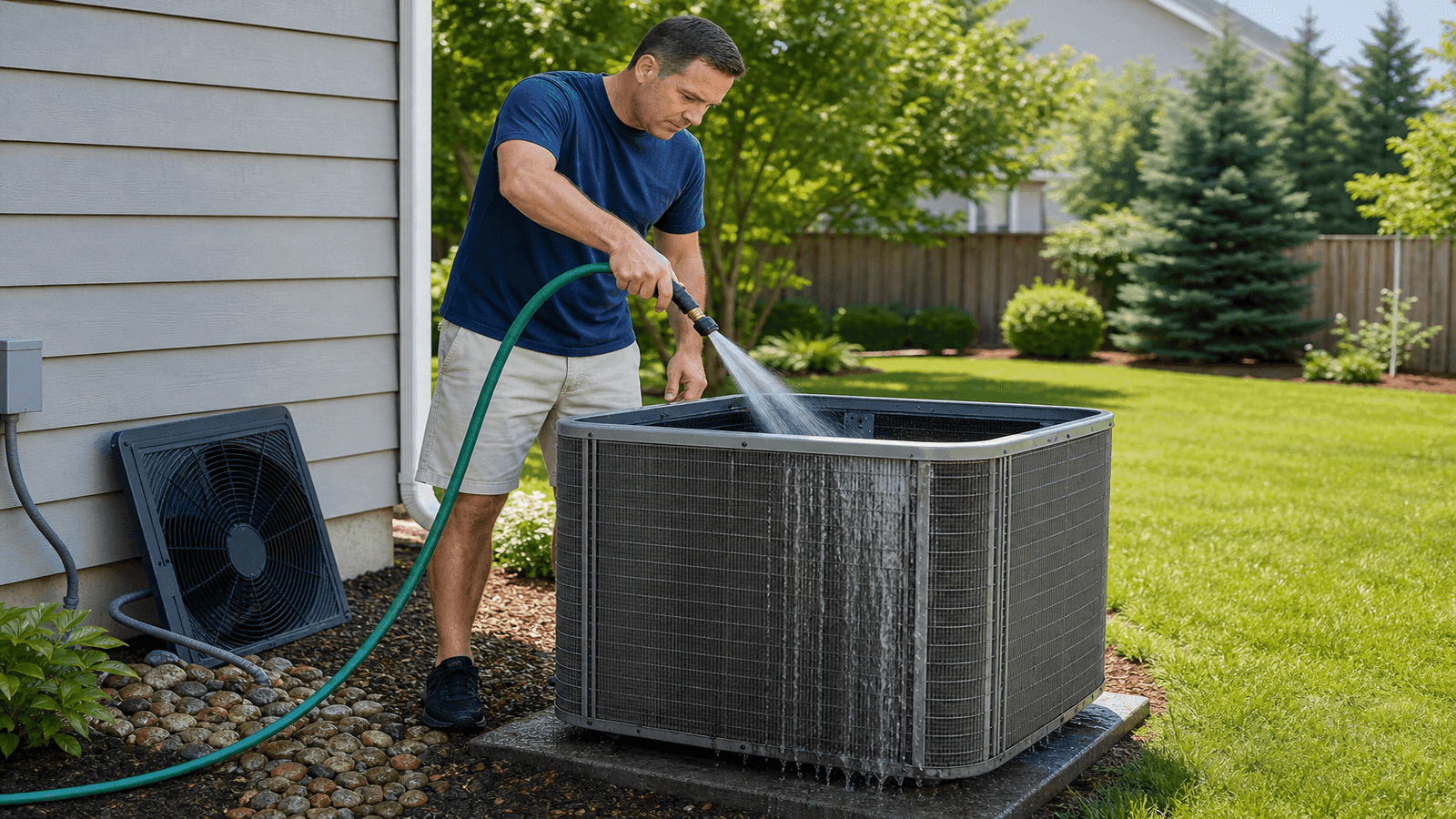
Homeowners can handle three tasks between visits: replacing the air filter every 1 to 3 months (MERV 8 to 13 for most systems), keeping the outdoor unit clear of debris and vegetation, and flushing the condensate drain line with white vinegar monthly during cooling season.
I maintain a database of every system I service. The data from 1,200 residential units in the Minneapolis-St. Paul area over the past eight years shows a clear pattern: systems receiving two professional visits per year have an average repair cost of $180 annually. Systems receiving one visit average $320 in annual repairs. Systems with no professional maintenance average $780, and 23% of those needed full system replacement within 10 years.
The ROI of Preventive Maintenance
Homeowners often view maintenance as an expense. The data shows it is an investment with a measurable return that compounds over the life of the equipment.
Energy Savings
The DOE estimates that proper HVAC maintenance reduces energy consumption by 15 to 20% compared to neglected systems [2]. For a household spending $200 per month on heating and cooling (the national average for a 2,000-square-foot home), that translates to $360 to $480 in annual energy savings. Over 15 years, cumulative energy savings reach $5,400 to $7,200.
Avoided Repair Costs
The EPA estimates a 4:1 return on preventive maintenance investment [7]. A homeowner spending $300 per year on a service plan avoids an average of $1,200 in reactive repair costs annually, plus the convenience costs of emergency breakdowns: missed work, hotel stays during extreme weather, and temporary equipment rental.
Extended Equipment Lifespan
Well-maintained HVAC systems last 15 to 20 years. Neglected systems fail in 10 to 12 years [5]. On a $10,000 system, that difference represents $3,300 to $5,000 in additional value from the same equipment purchase.
Total ROI Calculation
Here is the 15-year cost comparison for a $10,000 HVAC system in a moderate climate:
| Category | With Maintenance | Without Maintenance |
| Annual maintenance cost | $300/year ($4,500 total) | $0 |
| Annual energy cost | $2,000 ($30,000 total) | $2,400 ($36,000 total) |
| Repair costs over 15 years | $2,700 | $8,500 |
| Replacement timing | Year 17-20 | Year 10-12 |
| Early replacement cost | $0 | $12,000 (new system at year 11) |
| Total 15-year cost | $37,200 | $56,500 |
| Net savings from maintenance | $19,300 | -- |
The $4,500 invested in maintenance over 15 years returns $19,300 in avoided costs. That is a 4.3x return on investment.
Get quotes from top-rated pros.
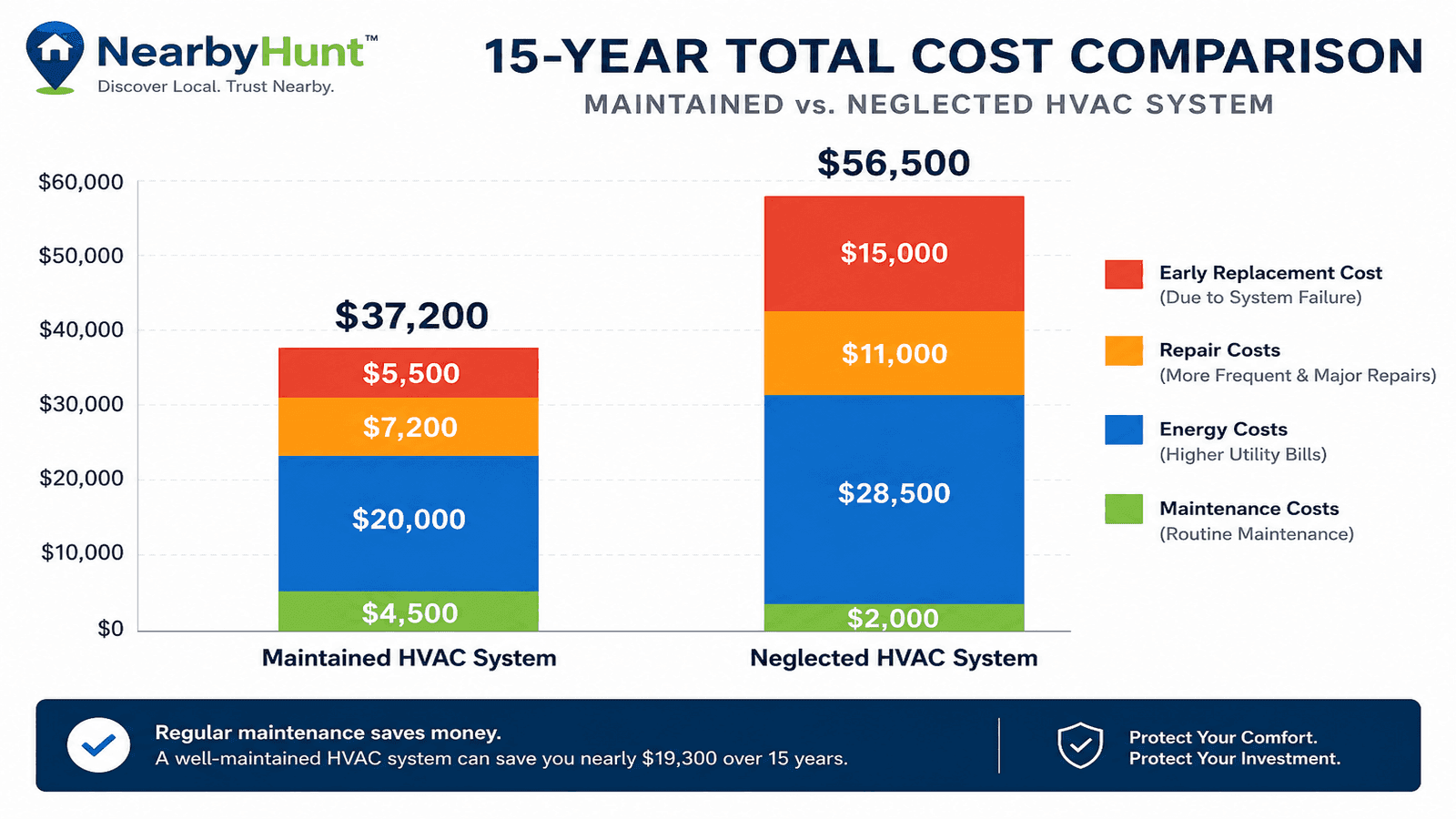
Photo: Chart showing the 15-year cost comparison between maintained and neglected HVAC systems with energy, repair, and replacement costs
Case Study: The Kowalski Family, Milwaukee, WI
Jennifer and Mark Kowalski moved into a 1,800-square-foot Milwaukee bungalow in 2018 with a 14 SEER split system installed in 2013. They skipped professional maintenance for four years. By summer 2022, the system was short-cycling, the upstairs ran 6 degrees warmer than the thermostat setting, and July electric bills hit $310.
An emergency repair call revealed a burned contactor, low refrigerant from a slow leak at a flare fitting, and a condenser coil caked with cottonwood debris. The repair bill was $1,340. The technician noted that every issue would have been caught during a standard tune-up.
The Kowalskis signed up for a $280 annual service plan that fall. Over the next three years (2023 through 2025), their maintenance visits caught and addressed a failing run capacitor ($85 repair with plan discount versus $220 at emergency rates), a cracked condensate drain pan ($140 versus $350), and a blower motor approaching end-of-life (replaced proactively for $380 versus an estimated $650 to $900 for emergency weekend service).
Total maintenance spending (2023-2025): $840 in plan costs plus $605 in discounted repairs = $1,445. Without the plan, the same repairs at emergency pricing would have cost $2,560 to $2,810. Net savings over three years: $1,115 to $1,365. Their July 2025 electric bill dropped to $215, a 31% reduction from the pre-maintenance peak.
Mark noted: "We used to hold our breath every time the temperature hit 90 degrees. Now we know someone already checked the system in April and it is ready."
How to Choose a Maintenance Plan
Not all service plans deliver equal value. The range of pricing and included services across HVAC contractors is wide, and some plans are structured primarily as customer retention tools with minimal actual benefit. Here is what to evaluate.
Must-Have Inclusions
Any plan worth paying for should include two seasonal visits per year (spring and fall), a written report after each visit with findings and recommendations, refrigerant pressure checks at each visit, capacitor and electrical component testing, and a repair discount of at least 10%. If a plan omits refrigerant checks or electrical testing, it is a filter-change service marketed as a tune-up.
Red Flags
Watch for plans that lock you into multi-year contracts with cancellation penalties, require you to purchase replacement equipment exclusively through the plan provider, or include vague language like "inspection" without specifying what is inspected. Also be cautious of plans priced below $120 per year. At that price, the company is likely subsidizing the plan through aggressive repair upselling during visits.
Getting Quotes
Request maintenance plan quotes from at least three licensed HVAC contractors in your area. Ask each contractor for their specific checklist, repair discount percentage, and whether they waive diagnostic fees for plan members. A $350 plan that includes comprehensive diagnostics and 20% repair discounts delivers better value than a $200 plan that covers only basic filter changes and visual inspection.
Seasonal Maintenance Timing
When you schedule maintenance matters almost as much as whether you schedule it. Timing affects both the quality of service you receive and the price you pay.
Spring: Cooling Prep (March through May)
Spring tune-ups prepare the cooling system for summer demand, focusing on refrigerant charge, condenser coil cleanliness, condensate drain function, and thermostat cooling mode operation. Scheduling in March or early April avoids the rush that begins in May.
Fall: Heating Prep (September through November)
Fall visits prepare the heating system. For furnaces, this includes combustion analysis, heat exchanger inspection, burner cleaning, and safety control testing. For heat pumps, the technician verifies defrost cycle operation and reversing valve function. Schedule in September or early October before the first cold snap triggers backlogs.
Off-Season Pricing Advantage
Many HVAC contractors offer 10 to 20% discounts for maintenance scheduled during their slow periods (late winter for cooling tune-ups, late summer for heating). Avoid scheduling routine tune-ups in June through August (cooling) or December through February (heating). Those are peak emergency periods with longer wait times, reduced availability, and no pricing flexibility.
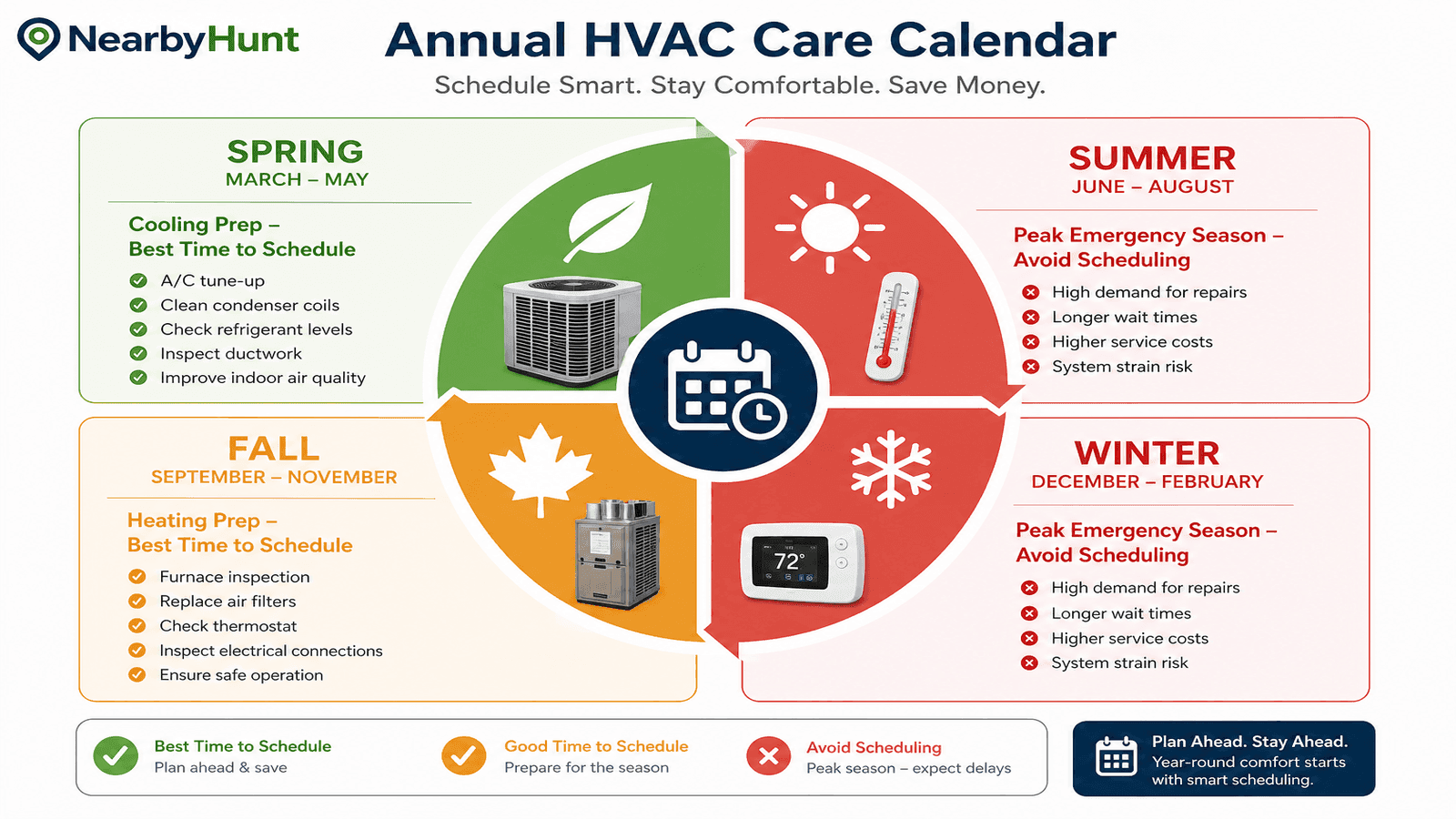
Photo: Seasonal HVAC maintenance calendar showing optimal scheduling windows for spring cooling and fall heating tune-ups
Disclaimer: This article is intended for general informational purposes only and does not constitute professional HVAC, financial, or tax advice. Maintenance costs and savings estimates are based on national averages and vary by region, system type, home size, and local labor rates. Always obtain quotes from licensed HVAC contractors in your area for accurate pricing. NearbyHunt does not assume liability for outcomes resulting from information presented in this guide.
Sources & References
[1] Forbes Home. "How Much Does HVAC Maintenance Cost? (2026)."
[2] U.S. Department of Energy. "Heating and Cooling."
[3] Today's Homeowner. "How Much Does HVAC Maintenance Cost? (2026)."
[4] ASHRAE. "Standards 180 and 211."
[5] WorkTrek. "HVAC Maintenance Statistics: What the Numbers Reveal."
[6] ENERGY STAR. "Maintenance Checklist."
[7] U.S. Environmental Protection Agency. "Benefits of Preventive Maintenance."
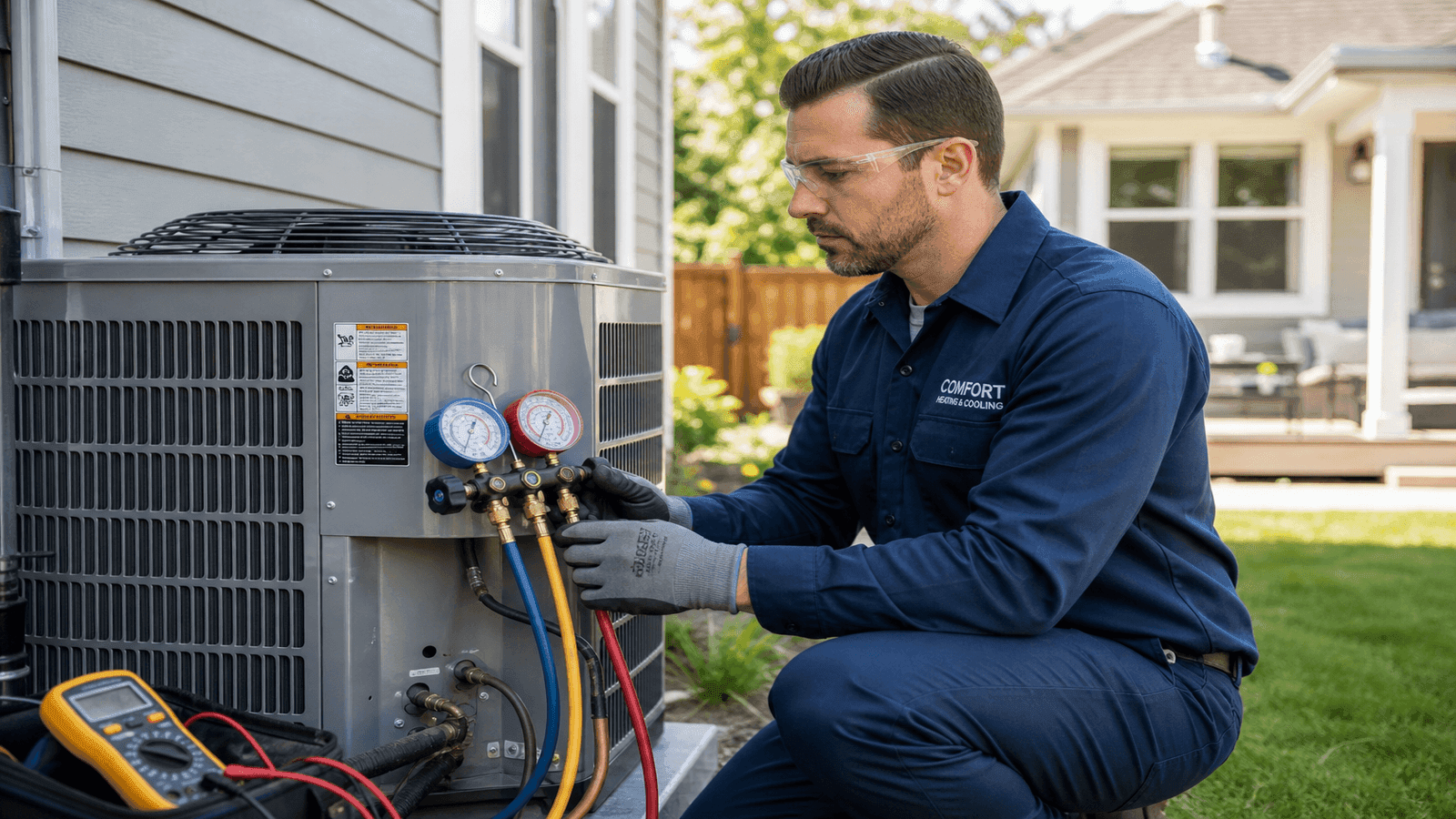

Daniel is an EPA-certified HVAC technician & Energy Efficiency Consultant with over 14 years of experience in maintaining and installing heating and cooling systems throughout the Midwest. Passionate about sustainability, Dan specialises in energy-efficient retrofits and intelligent climate control systems. He writes for NearbyHunt to help homeowners extend the lifespan of their HVAC units while lowering utility bills.

Christine is an EPA-certified HVAC professional with 17 years of experience in heating, cooling, and indoor air quality systems. She has managed large-scale residential installations and worked as a technical trainer for new HVAC apprentices. Chris’s reviews focus on accuracy, safety, and performance standards in modern HVAC practices.