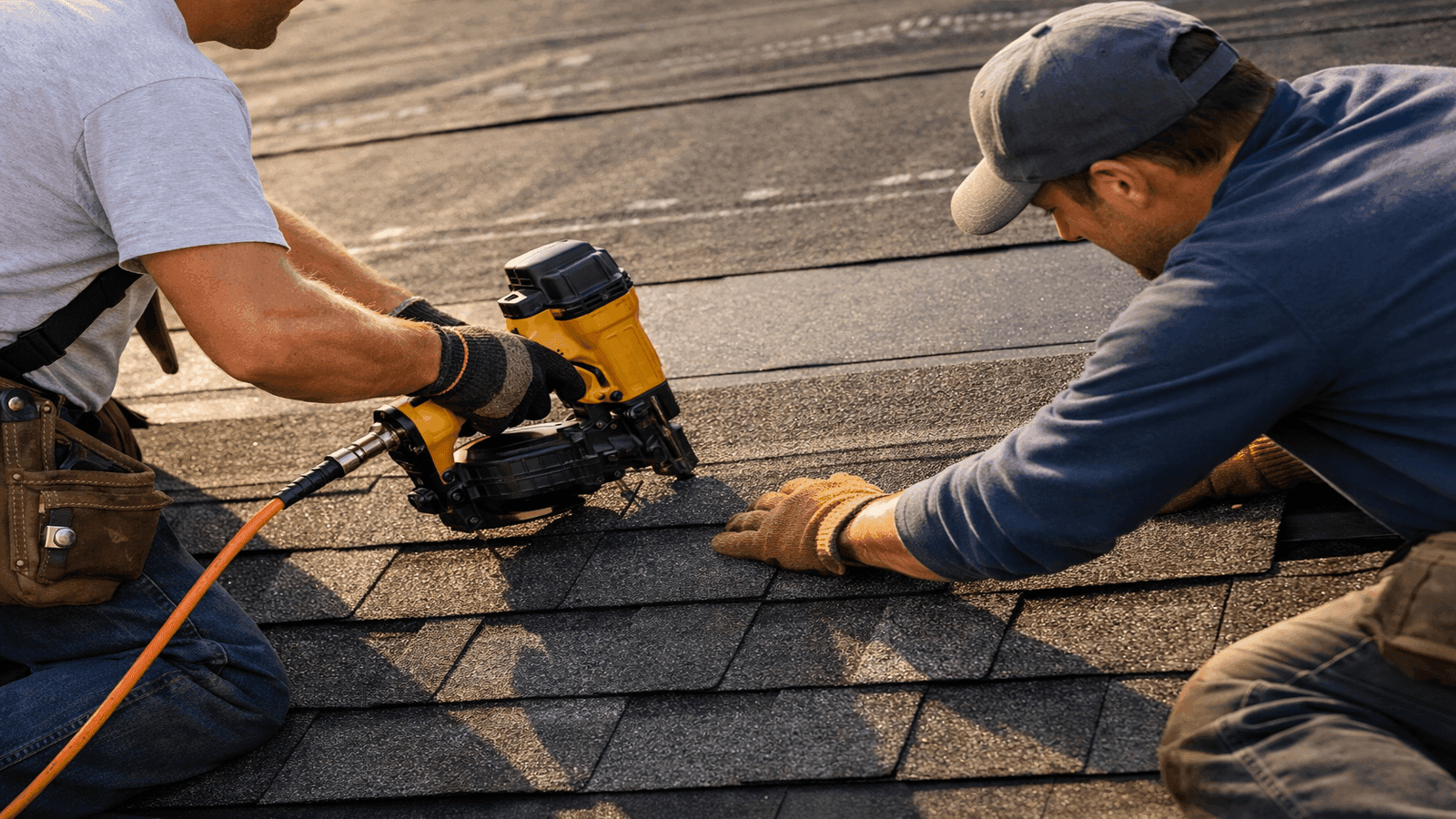
- Roof pitch is expressed as rise over run (e.g., 6:12 means 6 inches of rise for every 12 inches of horizontal run), and it controls drainage speed, material eligibility, and long-term performance.
- Slopes below 2:12 require flat-roof membranes (TPO, EPDM, or built-up roofing); installing asphalt shingles on anything less than 2:12 violates IRC building code and voids most manufacturer warranties [1].
- Steep-slope roofs (9:12 and above) add 25-50% to labor costs because crews must use safety harnesses, jacks, and slower working methods.
- The optimal roof pitch for residential solar panels is 15 to 40 degrees, which corresponds to approximately a 3:12 to 9:12 ratio, capturing near-maximum annual energy production [2].
- Low-slope roofs in cold climates are significantly more prone to ice dams because meltwater moves slowly toward gutters and refreezes along eaves before it can drain.
- The licensed roofers in our NearbyHunt network report that roughly 30% of homeowners who request a re-roofing estimate are surprised to learn their roof pitch disqualifies their first material choice, most often luxury shingles or clay tile.
Roof pitch is one of those technical terms that gets thrown around in contractor estimates and building inspections but rarely gets explained in plain language. If a roofer tells you that your home has a 6:12 pitch, what does that actually mean? How does it affect what materials you can use, how your roof drains, whether solar panels will work well, and how much the next re-roof will cost? This article breaks all of it down in detail. James Carver has completed 1,800-plus roofing projects across the U.S. South and Midwest in a 20-year career, and pitch is one of the first things he evaluates on every job. This guide covers how to measure pitch, how to interpret what you find, and every downstream consequence pitch has on your roofing decisions. For context on how pitch fits into the full roofing system, start with our complete overview: All About Roofing.

Get quotes from top-rated pros.
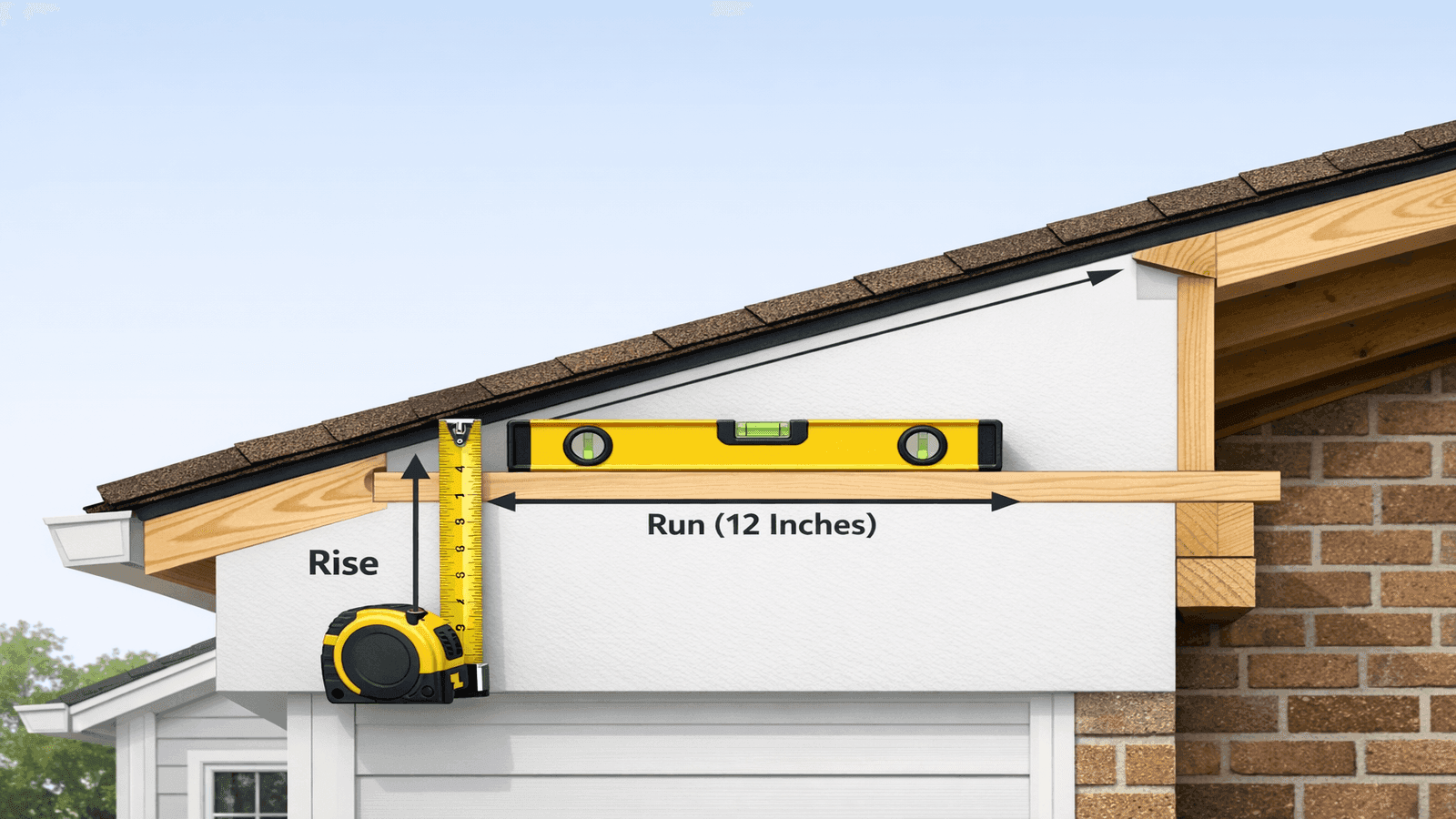
Photo: Diagram showing roof pitch measurement with a level and tape measure, illustrating rise over run ratio on a residential roof cross-section
What Is Roof Pitch and Why Does It Matter?
Roof pitch is a measure of how steeply a roof slopes, expressed as the ratio of vertical rise to horizontal run. The standard format in North American residential construction is X:12, where X is the number of inches the roof rises vertically for every 12 inches of horizontal distance measured from the center ridge to the eave.
A 4:12 pitch, for example, rises 4 inches for every 12 horizontal inches. A 12:12 pitch rises 12 inches for every 12 inches, which is a 45-degree angle. A 2:12 pitch is barely sloped, barely visible from the street on a one-story home. The number on the left side of the ratio is the only variable; the denominator is always 12 in the U.S. system.
The first thing I do when I arrive at any re-roof estimate is step back and eyeball the pitch from the street. Not to measure it exactly, just to calibrate my expectations. Pitch tells me immediately what materials are on the table, how many safety precautions the crew will need, and roughly how the labor quote will compare to the material quote. Everything flows from that single number.
Pitch matters because gravity is the primary mechanism by which a roof drains. A steeper pitch moves water faster, gives it less time to find gaps or seams, and puts less stress on the waterproofing layers underneath. A shallower pitch slows that water movement and demands more from the membrane or underlayment to compensate.
The International Residential Code (IRC) and the International Building Code (IBC) both prescribe minimum pitch requirements by material type because material manufacturers design their products around specific drainage assumptions [1]. Installing the wrong material on the wrong pitch is a code violation, a warranty void, and a leak waiting to happen.
Roof Pitch Categories: From Flat to Steep
The roofing industry uses four broad categories to classify pitch. Each category carries a different set of material options, drainage characteristics, and installation requirements.
Flat and Minimally Sloped Roofs (Less Than 2:12)
A "flat" roof is never truly flat; building code requires a minimum slope of 1/4:12 to ensure water drains toward scuppers or internal drains rather than pooling indefinitely [1]. Anything below 2:12 is treated as a low-slope or flat-roof system from a material standpoint.
These roofs require waterproof membrane systems because shingles and tiles rely on gravity-assisted water shedding that does not work at such shallow angles. Common materials include TPO (thermoplastic polyolefin), EPDM (ethylene propylene diene monomer rubber), modified bitumen, and built-up roofing (BUR) with multiple gravel-embedded plies.
Flat and near-flat roofs are common in the Southwest, on mid-century modern homes, and on commercial construction. They require more frequent inspection because any debris, standing water, or small breach in the membrane becomes a much more serious problem without slope helping to shed it quickly.
Low-Slope Roofs (2:12 to 4:12)
Low-slope roofs are common on ranch-style homes, additions, and porches. Asphalt shingles are technically permitted starting at 2:12, but IRC code requires double-layer underlayment from 2:12 to 4:12 because the slower water movement demands extra protection [1].
At this pitch range, homeowners must use shingles rated for low-slope application or add an ice-and-water shield across the full roof surface rather than just at the eaves and valleys. Metal roofing panels with lapped, sealant-applied seams are also viable starting at 1/2:12, making standing-seam metal a strong choice for this category.
Conventional Slope Roofs (4:12 to 9:12)
The 4:12 to 9:12 range is the most common pitch category for residential construction in North America. At this range, all standard roofing materials become available: three-tab and architectural asphalt shingles, exposed-fastener and standing-seam metal panels, concrete tile, and most metal shingle systems.
The upper end of this range (around 6:12 to 8:12) is often considered ideal for performance. Water moves briskly, snow sheds well in most conditions, and installation is still manageable with standard safety precautions. The overwhelming majority of new suburban homes built in the last 40 years fall into this category.
Steep-Slope Roofs (9:12 and Above)
Steep roofs are visually dramatic and extremely common in Victorian, Tudor, and steep cottage architectural styles. Natural slate and clay tile reach their highest performance levels here, partly because the steep angle prevents moss and algae colonization and partly because these heavy materials need strong positive drainage to perform as intended.
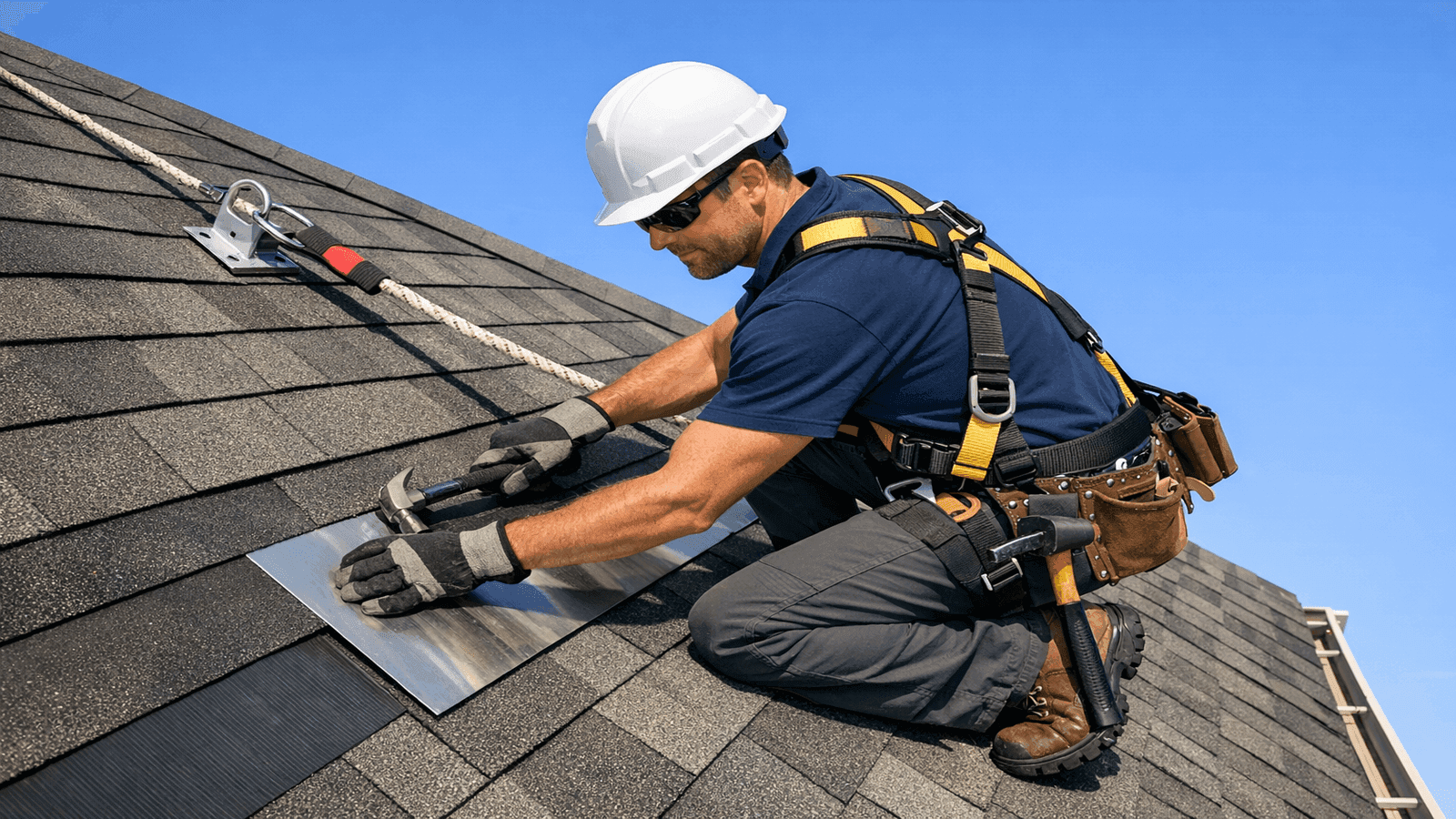
The tradeoff is cost: steep slopes require safety equipment (jacks, harnesses, brackets), slow the pace of work significantly, and increase material waste because cutting becomes more complex. The added labor alone typically adds 25-50% to a re-roofing estimate compared to a conventional-slope home of the same square footage.
Get quotes from top-rated pros.
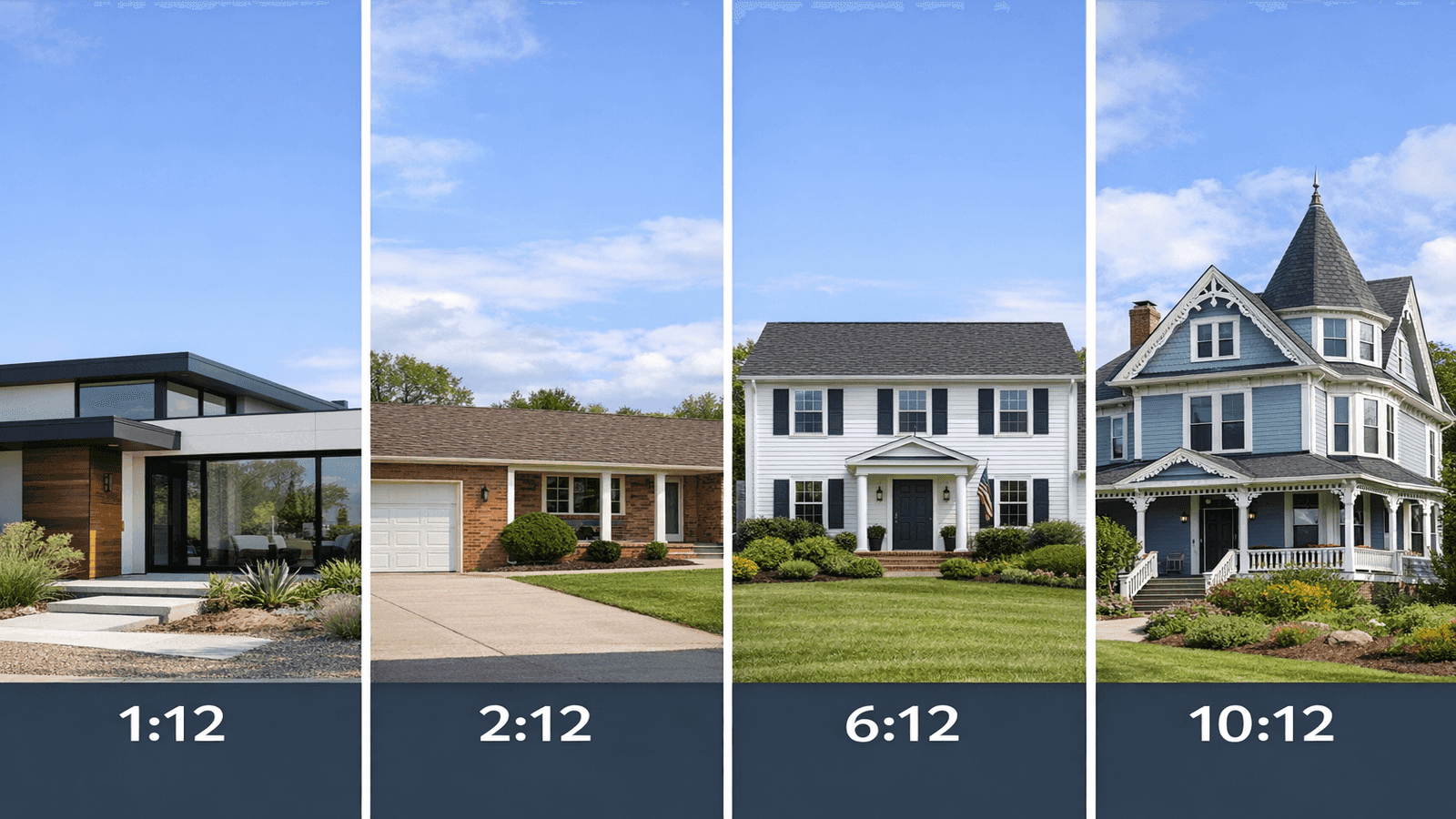
Photo: Side-by-side comparison of four roof pitch categories from flat to steep, showing typical home styles associated with each pitch range
How to Measure Roof Pitch: Three Methods
You do not need to climb on the roof to measure pitch in most cases. Here are three reliable methods.
Method 1: Measuring From the Attic (Safest)
This is the method most professionals recommend for homeowners because it requires no ladder work on the exterior roof surface.
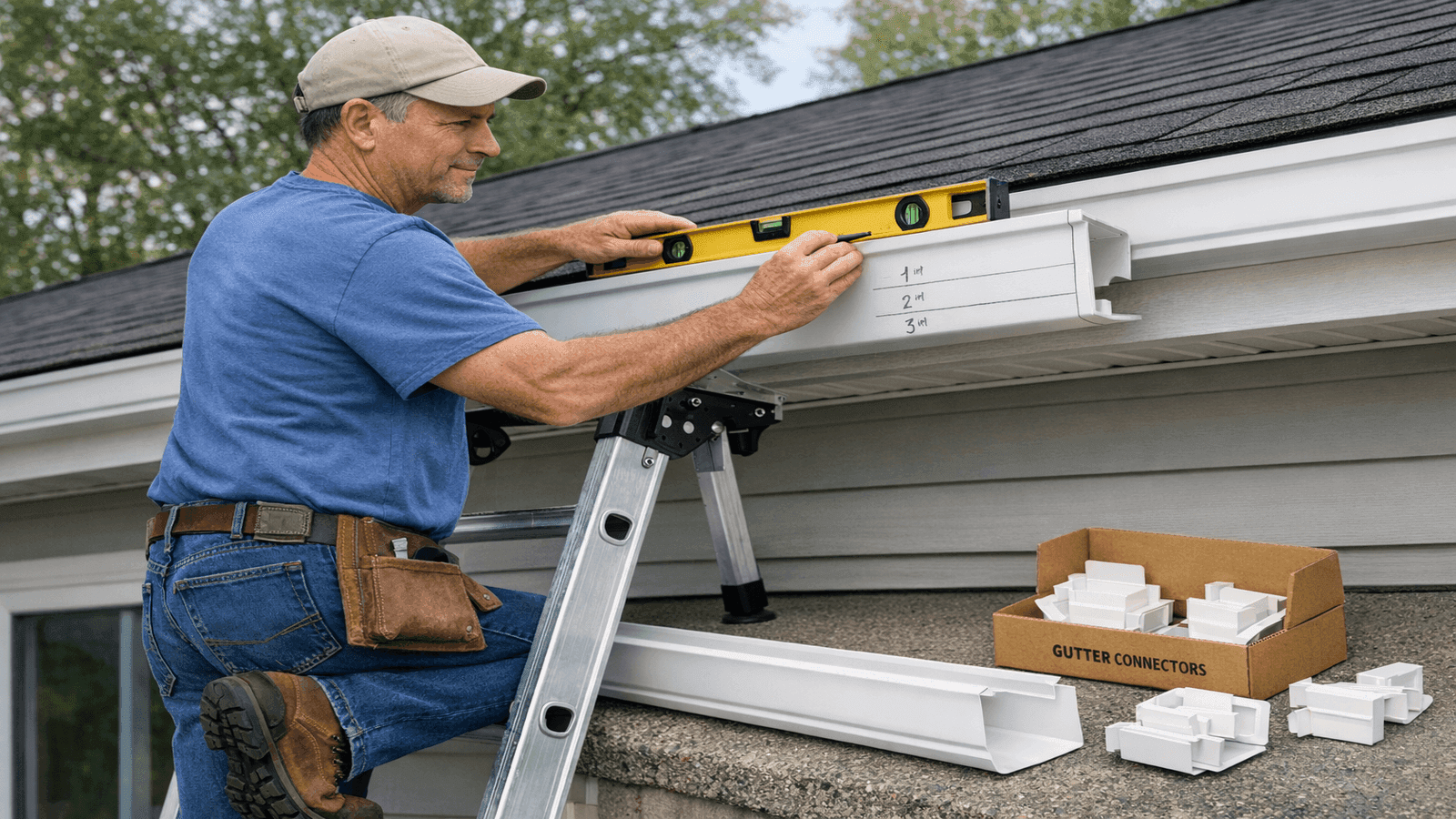
- Bring a standard carpenter's level (at least 12 inches long) into the attic.
- Hold the level horizontally against the underside of a rafter.
- Starting 12 inches from where the level touches the rafter, measure straight down to the rafter surface.
- That vertical measurement in inches is your rise. The pitch is that number over 12.
If the vertical measurement is 6 inches, your pitch is 6:12. If it's 4 inches, your pitch is 4:12. This method works on any rafter that's accessible and gives an accurate result without any roof access.
Method 2: Level and Tape Measure From the Exterior
If you can safely access the roof surface from a ladder at the eave:
- Rest a 12-inch level flat on the roof surface.
- Hold one end of the level at the roof and lift the other end until the bubble reads level.
- Measure the vertical distance from the roof surface up to the lifted end of the level.
- That measurement is your rise per 12 inches of run.
Method 3: Smartphone Pitch Gauge App
Multiple free apps (Pitch Gauge, Roofr Measure, even the built-in iPhone Measure app) can calculate pitch using the device's accelerometer. Place the phone flat on the roof surface (or on a straight board held against the roof), and the app reads the angle in both degrees and X:12 ratio.
This method is useful for quick verification but can be slightly less accurate on rough-textured surfaces like asphalt shingles where the phone isn't lying perfectly flat. It works well on smooth metal or tile surfaces.
I've used every method over the years, but the attic measurement is the one I trust the most. It reads the actual structural angle of the rafter without interference from accumulated roofing layers, high-profile shingles, or a wavy deck. On any older home where multiple layers of shingles have been installed, the exterior measurement can read higher than the actual structural pitch by half a pitch unit or more.
Pitch Reference Table: Materials, Degrees, and Suitability
The table below shows the pitch spectrum, corresponding degree angles, compatible materials, and the key tradeoffs at each range.
| Pitch Ratio | Degrees | Primary Materials | Key Strengths | Key Limitations |
| 1/4:12 | 1.2° | TPO, EPDM, built-up roofing (BUR) | Usable on nearly flat surfaces | Requires precise drainage design, no shingles |
| 1/2:12 to 2:12 | 2.4–9.5° | Modified bitumen, metal panels (seamed) | Low visual profile, works with modern architecture | Membrane maintenance required every 10–20 years |
| 2:12 to 4:12 | 9.5–18.4° | Asphalt shingles (double underlayment), standing seam metal, TPO | Full range of asphalt options begins | Double underlayment required; ice dam risk in cold climates |
| 4:12 to 6:12 | 18.4–26.6° | Asphalt shingles, metal, concrete tile, metal shingles | Single underlayment, broad material choice | Standard range; no special code treatment |
| 6:12 to 9:12 | 26.6–36.9° | Asphalt shingles, metal, clay tile, concrete tile, wood shake | Excellent drainage, clay and tile perform well | Labor costs start rising above 7:12 |
| 9:12 to 12:12 | 36.9–45° | Natural slate, clay tile, wood shake, metal | Best material performance, excellent snow shedding | 25–50% labor premium, safety equipment required |
| 12:12 and above | 45°+ | Slate, clay tile, cedar shake, specialty metal | Maximum shedding, architectural drama | Significant labor premium, limited crew availability |
Pitch and Drainage: The Physics Behind It
The relationship between pitch and drainage is straightforward: steeper angles produce faster water velocity, which reduces the time water spends on the roof surface and decreases the chance it finds a breach.
Roofing industry data shows that a 12:12 pitch sheds water roughly four times faster than a 3:12 pitch under the same rainfall intensity [1]. This speed difference has real consequences for underlayment selection, seam design, and flashing depth. On a 4:12 roof, flashing at a chimney needs to extend further under the shingles than on a steep-slope roof because slower water travels farther upslope along the chimney base before gravity redirects it.
For homeowners in high-rainfall regions (Pacific Northwest, Southeast coastal areas, Appalachian foothills), the drainage advantage of a 6:12 or steeper pitch is measurable in longer material life and fewer leak events over time. For homeowners in the arid Southwest, a 2:12 or 3:12 roof drains the modest annual rainfall perfectly well and is architecturally appropriate.
Pitch and Snow Loads: Cold Climate Considerations
In cold climates, pitch affects two distinct problems: snow accumulation and ice dam formation.
Snow accumulation depends on both pitch and surface texture. A steep, smooth metal roof at 9:12 or higher sheds snow quickly, often within hours of a storm ending. An architectural asphalt roof at 4:12 may hold snow for days, adding structural load. Most residential structures are engineered for their local climate's ground snow load, but roofs accumulate snow at rates above the ground level, particularly when drifting occurs near parapets, dormers, or valleys.
Ice dams are the more common and more damaging cold-climate pitch problem. They form when heat escaping through the roof deck melts snow near the ridge, and that meltwater runs down toward the cold eave and refreezes before it can drain into the gutter. Research from building science experts indicates that roofs with slopes less than 4:12 are significantly more susceptible to ice dams because meltwater moves slowly toward gutters and has more opportunity to refreeze along the way [1].
Ice dam protection requires a full ice-and-water shield application from the eave up through at least 24 inches past the interior wall line. On low-slope roofs in climates with sustained below-freezing temperatures (New England, Upper Midwest, Mountain West), this protection should cover the entire roof surface.
Get quotes from top-rated pros.
I've seen ice dam damage on steep roofs too, but it's almost always traceable to inadequate attic insulation, not pitch. The attic heat escaping through a poorly insulated deck causes the melt cycle regardless of slope. Pitch buys you time, but it's not a substitute for proper air sealing and R-value in the attic.
Pitch and Solar Panels: Finding the Optimal Angle
Homeowners considering rooftop solar need to understand how pitch interacts with solar production. Solar panels generate maximum electricity when their surface is perpendicular to the sun's rays. At U.S. latitudes (roughly 25 to 50 degrees north), this optimal angle is typically between 15 and 40 degrees, which corresponds to approximately a 3:12 to 9:12 roof pitch [2].
The good news is that production within this range is nearly flat. A south-facing 4:12 roof in San Diego loses only about 2% of its annual production potential compared to the theoretically ideal angle for that latitude [2]. The difference between a 5:12 and a 7:12 roof in most U.S. markets is measured in single-digit percentage points of annual output, not a significant enough gap to change the economics of a solar installation.
Flat roofs actually allow solar installers the most flexibility because racking systems can tilt panels to any desired angle regardless of the underlying roof. The tradeoff is that ballasted racking on a flat roof adds weight, and the panels need to be spaced further apart to prevent self-shading.
Consider the case of homeowner Marcus T. from Plano, Texas. Marcus was set on installing a 10-panel solar array on his southwest-facing garage roof, which measured a 4:12 pitch. His solar installer confirmed the pitch was well within the optimal 3:12 to 9:12 range and that the southwest orientation would capture 90-plus percent of optimal annual production. The pitch was not a barrier at all. His bigger question became which roofing material to use beneath the array, and he chose standing-seam metal because the mounting clamps attach to the seams without penetrating the metal surface, preserving the waterproofing.
How Pitch Affects Re-Roofing Cost
Pitch is one of the top three factors in any roofing cost estimate, alongside square footage and material choice. Contractors calculate roofing area in "squares" (one square equals 100 square feet of actual roof surface), and pitch increases both the number of squares on a given footprint and the difficulty of installing each one.
A home with a 1,500-square-foot footprint and a 4:12 pitch has roughly 1,650 square feet of actual roof surface (a pitch factor of about 1.10). The same footprint at an 8:12 pitch has roughly 1,900 square feet of surface (a pitch factor of about 1.28). At a 12:12 pitch, the surface area reaches about 2,120 square feet (a pitch factor of about 1.41). Every square added means more materials, more labor, and more waste.
Beyond the square count, steep slopes require specialized equipment: roof jacks (brackets that create temporary platforms), safety harnesses, and slower, more deliberate installation. The labor rate per square on a 10:12 or steeper roof is typically 25-50% higher than on a 4:12 to 6:12 roof, and some contractors decline very steep work entirely. Material waste also increases because more cuts are required to fit steep-slope geometry.
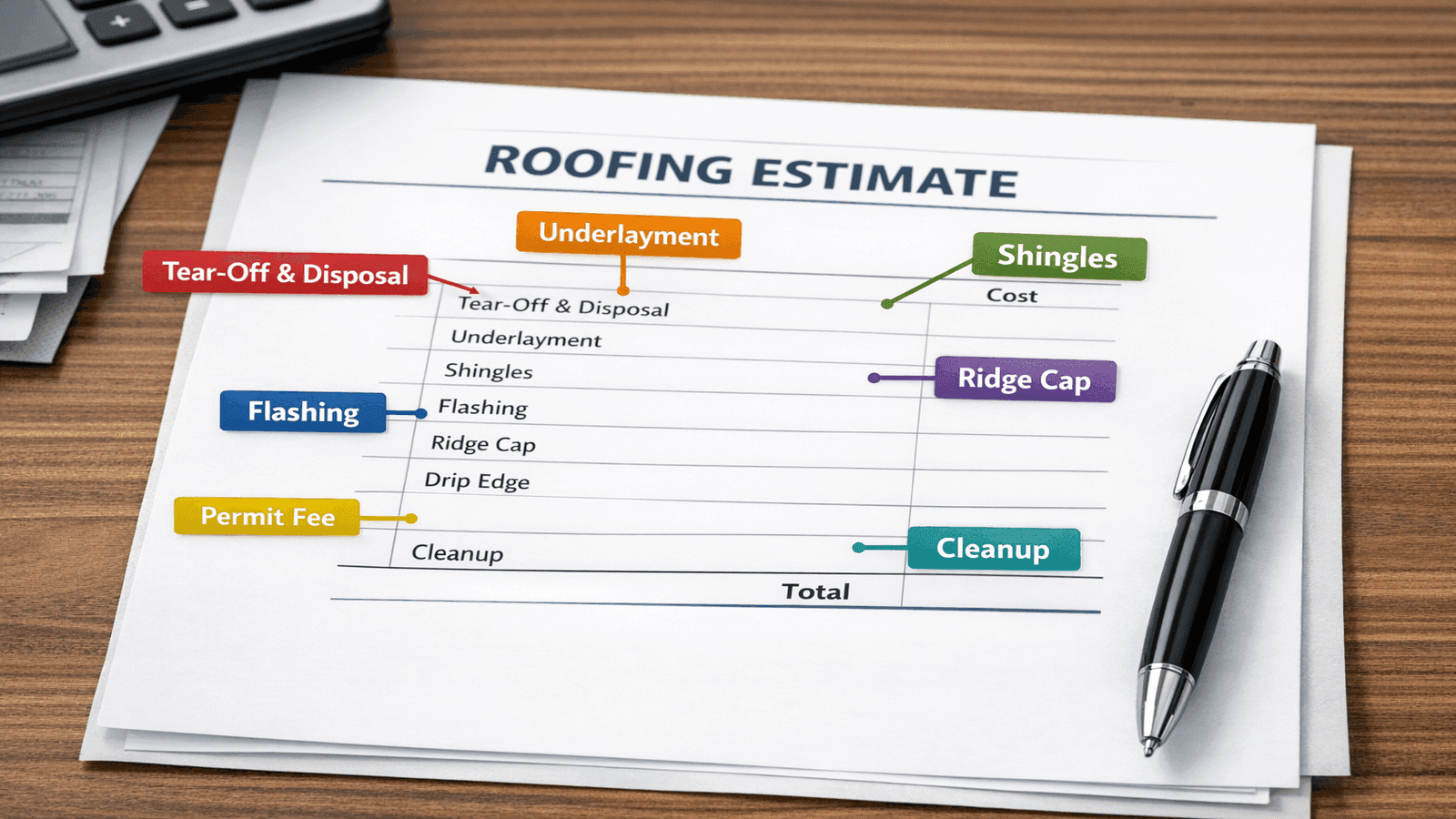
For a homeowner getting estimates, ask each contractor to break out the "pitch factor" or "steep slope surcharge" as a line item. This makes it easy to compare quotes on an apples-to-apples basis.
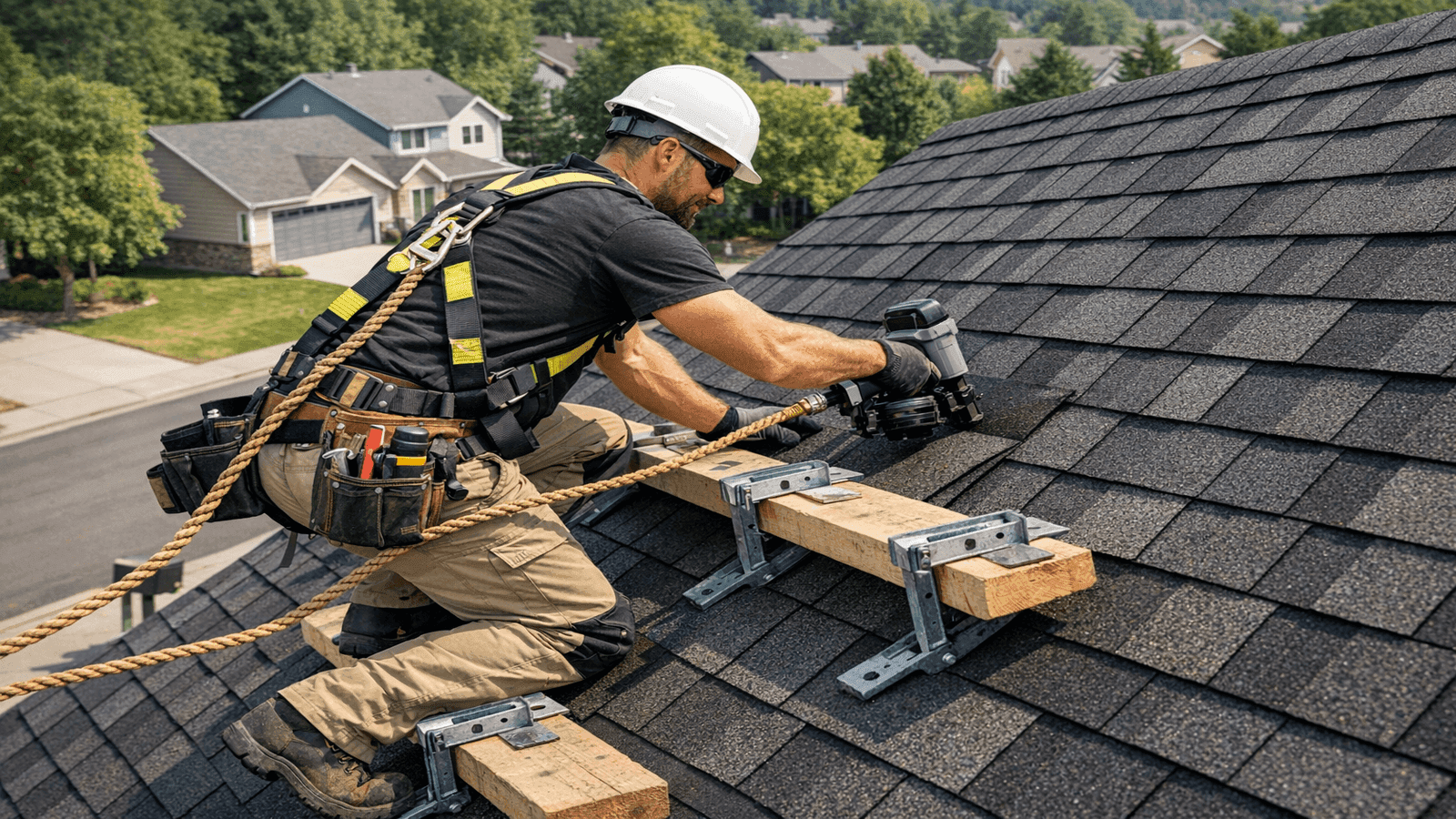
Photo: Roofing contractor working on a steep-slope roof with safety equipment showing a pitch above 9:12 with visible roof jacks and harness system
Pitch and Material Compatibility: What the Building Code Requires
The IRC and IBC set legally binding minimum pitch requirements for each material type. Installing below the minimum is a code violation and voids virtually every manufacturer's product warranty [1]. Here is a summary of the key minimums:
- Built-up roofing (BUR), TPO, EPDM, modified bitumen, liquid-applied membranes: minimum 1/4:12
- Metal panels with seamed, sealant-lapped joints: minimum 1/2:12
- Mineral-surfaced roll roofing: minimum 1:12
- Asphalt shingles and photovoltaic shingles: minimum 2:12 (double underlayment required from 2:12 to 4:12)
- Clay and concrete tile: minimum 2.5:12
- Metal panels with nonsoldered seams, no sealant: minimum 3:12
- Metal shingles and wood shingles: minimum 3:12
- Slate and wood shakes: minimum 4:12
Clay and concrete tile installed between 2.5:12 and 4:12 generally require an additional waterproof underlayment (often a modified bitumen sheet) beneath the tiles. From 6:12 and above, clay tile performs at its best: the steep angle prevents water infiltration even around the overlapping tile joints and inhibits moss and algae growth.
Natural slate is the most demanding from a pitch standpoint. Most slate manufacturers specify 4:12 as the minimum, but many installers prefer 6:12 or steeper because the weight of slate means any water that works between the laps exerts more pressure at low angles.
For a full material comparison including lifespan, cost, and climate suitability, see Types of Roofing Materials.
Regional Pitch Trends Across the United States
Roof pitch is not random: it tracks climate, architectural traditions, and regional building codes that evolved over generations.
Southwest (Arizona, Nevada, New Mexico, Southern California): Low-slope and flat roofs (1/4:12 to 3:12) are extremely common, particularly in Spanish Mission, Pueblo, and contemporary desert architectural styles. Low annual rainfall means minimal drainage pressure, and flat roofs integrate well with rooftop HVAC units and solar arrays.
Southeast and Gulf Coast (Florida, Louisiana, Alabama): Conventional slopes (4:12 to 6:12) dominate. High humidity and hurricane-force wind uplift requirements push builders toward pitches that provide good drainage without creating excessive wind sail area at the eave. Florida Building Code requires wind uplift testing that specific low-slope systems must meet.
Northeast and New England: Steeper pitches (6:12 to 12:12) are traditional, driven by snow loads, historic architectural styles, and the need to shed both rain and ice effectively. Salt Box, Cape Cod, and Colonial styles in this region commonly feature pitches in the 8:12 to 12:12 range.
Pacific Northwest (Washington, Oregon): Conventional to steep slopes (5:12 to 10:12) handle heavy annual rainfall. The region's architectural preference for craftsman and Tudor-influenced styles also favors steeper rooflines, and many homes use cedar shake or metal that performs well in wet climates at these angles.
Mountain West (Colorado, Utah, Montana, Idaho): Steeper slopes (7:12 to 12:12 and beyond) are common in higher elevations because snow loads are substantial and snow shedding is a structural necessity. Chalet and A-frame styles in ski country may push to 12:12 or greater.
For a broader look at roofing problems that vary by region, including issues specific to these climates, see Common Roofing Problems. For eco-friendly material options that interact with pitch differently, see Green Roofing Options.
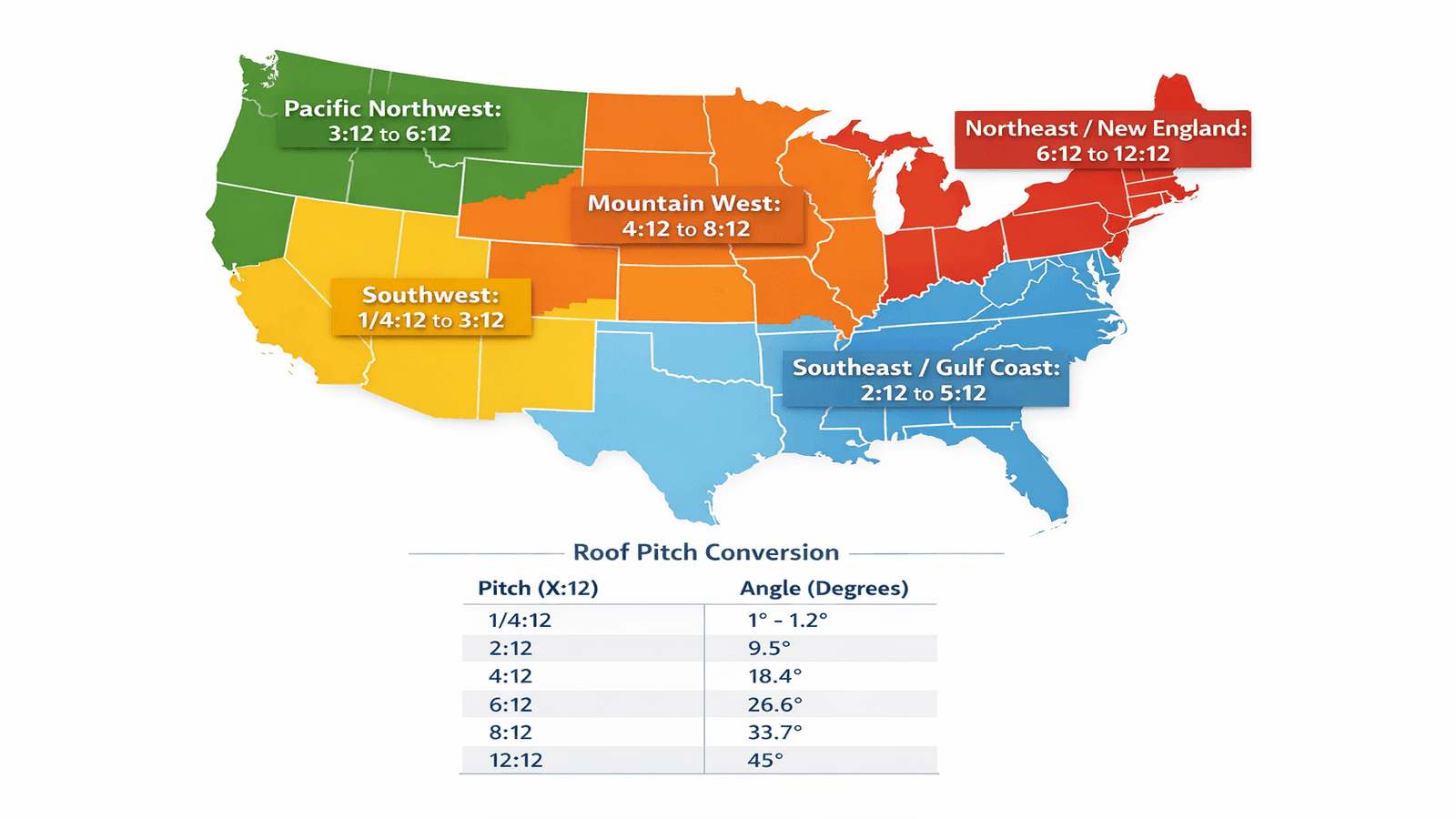
Photo: Comparison infographic showing regional roof pitch trends across the United States with a map and typical pitch ranges by climate zone
How Pitch Connects to Other Roof System Components
Pitch does not operate in isolation. It affects nearly every component in the roofing system, and understanding these connections helps homeowners make better decisions during inspections and re-roofing projects.
Underlayment: Synthetic underlayments are engineered for specific pitch ranges. Products rated for low-slope use have higher water resistance and different overlap requirements than steep-slope versions. Using a standard felt underlayment on a 2:12 or 3:12 roof is a common shortcut that creates moisture problems within a few years.
Flashing depth: At lower pitches, flashing must extend farther under the primary roofing material because water moves slowly and has more time to work upward by capillary action. The IRC specifies minimum flashing dimensions that increase as pitch decreases.
Gutter sizing: Low-slope roofs drain water more slowly, which actually smooths out peak flow rates into gutters compared to steep slopes. However, steep-slope roofs shed water so quickly during heavy rain that undersized gutters overflow. The peak flow rate from a 12:12 roof during a 2-inch-per-hour rain event can be double what the same footprint produces on a 4:12 roof.
Attic ventilation: Steep roofs naturally create a larger attic cavity, which can improve natural convection airflow through ridge and soffit vents. Very steep roofs may benefit from additional ridge vent length to balance the increased attic volume. For a complete look at all these components and how they interact, see Roof Components Explained.
Conclusion
Roof pitch is not just an architectural choice. It's a structural and functional specification that drives every other decision you make about your roof: which materials are code-compliant, how well water and snow drain, whether solar panels will perform optimally, and what re-roofing labor will cost. A 6:12 pitch is generally the sweet spot for most U.S. climates because it balances drainage performance, material flexibility, labor cost, and solar compatibility. But the right pitch for your home depends on your climate, your architectural style, and your long-term goals.
If you are planning a re-roof and need to know whether your current pitch is limiting your material options, the easiest first step is a professional inspection. A licensed roofer can measure your pitch, identify whether your current material installation is code-compliant, and walk you through every material option available to you at your specific angle.
Disclaimer: This article is intended for general informational purposes only and does not constitute professional roofing, engineering, or legal advice. Roofing requirements vary by jurisdiction, and local building codes may impose standards beyond those described here. Always consult a licensed roofing contractor and your local building department before making decisions about your roof. NearbyHunt.com does not endorse any specific contractor, product, or manufacturer.
Sources & References
[1] Minimum Roof Slopes Required by Roofing Material - Building Code Trainer
[2] How Roof Pitch and Orientation Affect Your Solar Production - Infinity Solar USA
[3] Roof Slope Guidelines - Professional Roofing (NRCA)
[4] Measuring Roof Slope and Pitch - InterNACHI
[5] IBC 2018 Chapter 15: Roof Assemblies and Rooftop Structures - ICC
[6] Ice Dam Prevention for Steep-Slope Roof Systems - Technical Assurance

James is a licensed roofing contractor with 20 years of experience in roof installation, inspection, and repair across the U.S. South and Midwest. He specialises in asphalt shingles, metal roofing, and storm damage restoration. On NearbyHunt, James offers practical advice on roof maintenance, insurance claims, and selecting the right materials for long-lasting protection.

Jacob is a licensed roofing contractor with over 18 years of experience in roof inspection, installation, and restoration. Based in Texas, he has led hundreds of successful roofing projects across residential and commercial properties. Jacob is also a certified storm damage specialist, ensuring that all NearbyHunt roofing content meets industry best practices and safety standards.