- Approximately 20,000 people are injured annually in ladder-related incidents during gutter cleaning -- ladder safety is not optional and cannot be rushed [1]
- Clean gutters at least twice yearly (spring after pollen season, fall after leaf drop) and after every major storm to prevent water intrusion
- Clogged gutters cause $1,000-$4,500 in avoidable damage annually including fascia rot, foundation erosion, and basement flooding
- The 4:1 ladder angle rule (one foot out for every four feet of height) significantly reduces fall risk compared to steep ladder placement
- James Carver has responded to dozens of gutter-related roof damage calls across the U.S. South and Midwest -- 90% involved gutters that had not been cleaned in two or more years
Most homeowners think about gutters only when they notice water spilling over the edge during a rainstorm. By that point, the damage has often already started. Gutters are the first line of defense for your roof, fascia, soffits, and foundation. When they fail, water finds every vulnerable entry point into your home's structure. A single season of neglected gutters can result in thousands of dollars in damage that would have cost nothing to prevent.
The challenge is that gutter cleaning carries real physical risk. The Consumer Product Safety Commission estimates that approximately 20,000 ladder-related injuries occur annually during home maintenance tasks including gutter cleaning [1]. Most of those injuries happen not because the work is difficult, but because homeowners skip safety setup steps in the interest of getting the job done faster. This guide covers the entire process from safety equipment through ground-level alternatives, with the same approach used across the 1,800-plus residential roofing projects James Carver has completed across the U.S. South and Midwest. For a broader look at roof maintenance and what keeps a roof system healthy long-term, see the complete guide on roofing DIY and maintenance.

Get quotes from top-rated pros.
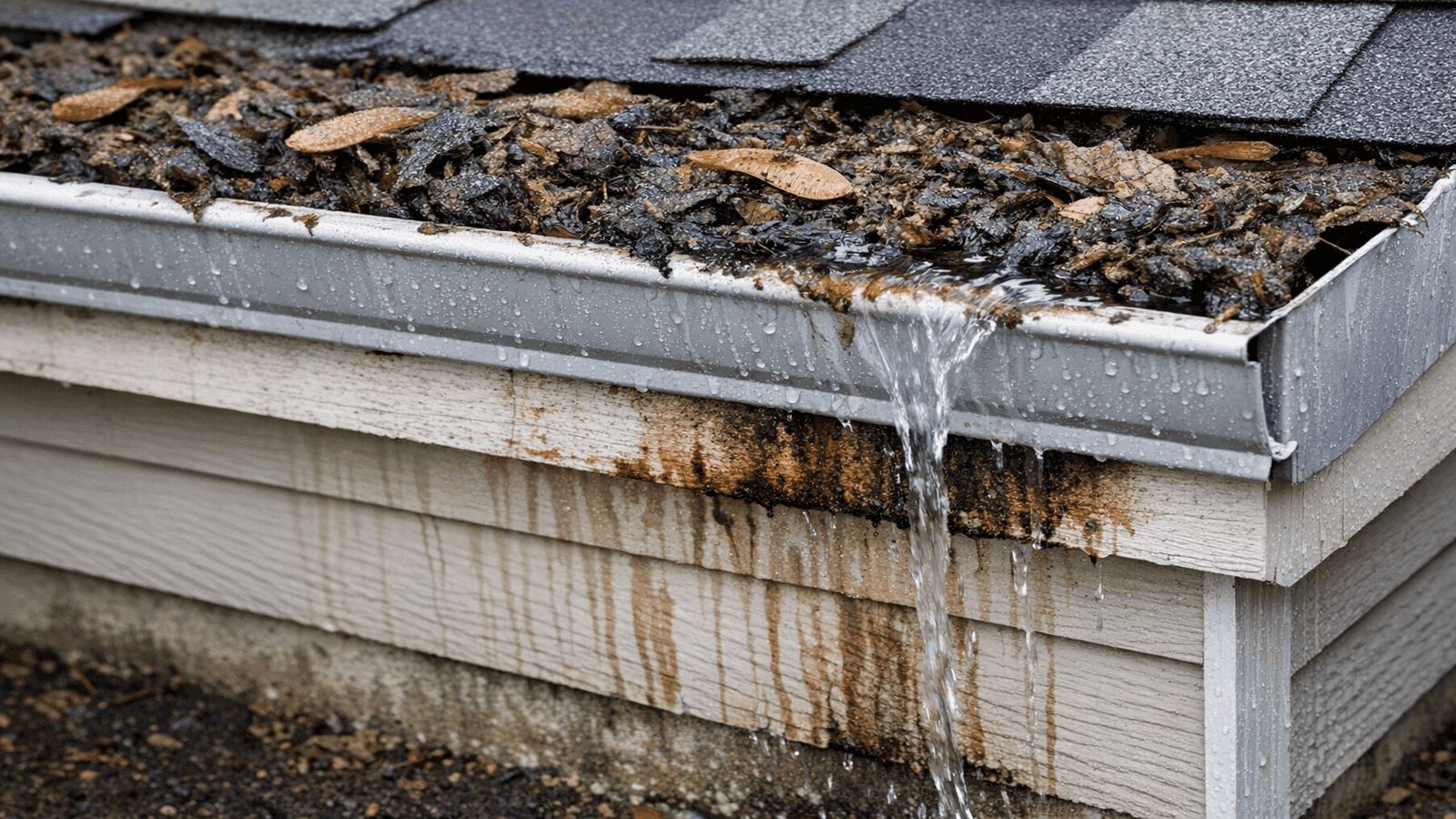
Photo: Clogged residential gutter overflowing with wet leaves and debris, showing water damage streaks on the fascia board and foundation staining below
Why Gutter Cleaning Is Non-Negotiable
Gutters do one job: channel water from your roof surface away from your home's structure. When they clog, that water has nowhere to go except over the edge and directly against the fascia boards, down the exterior wall, and into the soil immediately adjacent to your foundation.
What happens when gutters fail:
- Water backs up under shingles at the eaves, accelerating shingle deterioration and creating conditions for ice dams in winter climates
- Fascia boards absorb standing water and begin to rot, eventually requiring full replacement
- Saturated soil at the foundation line causes uneven pressure against basement walls and crawl space framing
- Basement flooding and foundation cracks follow after seasons of repeated overflow
The cost of deferred maintenance adds up quickly. Fascia board replacement runs $400-$1,200 depending on linear footage and material. Foundation crack repair starts at $4,000 and can reach $10,000 or more for structural issues. These are costs that routine gutter cleaning -- priced at $100-$250 professionally or essentially $0 DIY -- would have prevented entirely [3].
How often should you clean your gutters?
How often should you clean your gutters?
| Cleaning Frequency | Situation | Annual Maintenance Cost | Cost If Neglected |
| Twice yearly | Standard suburban lot, some trees | $100-$250 professional | $400-$1,200 fascia/soffit |
| 3-4 times yearly | Overhanging trees, heavy leaf drop | $200-$500 professional | $1,000-$4,500 water damage |
| After every major storm | Storm-prone region, wooded lot | Variable | $4,000-$10,000 foundation repair |
| Once yearly | Minimal trees, gutter guards installed | $50-$150 professional | $400-$800 partial fascia |
Spring cleaning targets pollen, seed pods, and the debris that accumulated over winter. Fall cleaning after the bulk of leaf drop is the most critical session of the year. In regions with heavy spring allergies or dense pine tree coverage, a third cleaning in early summer often makes sense.
Safety Equipment and Setup (Never Skip This)
Every gutter cleaning injury follows the same pattern: a homeowner skips one safety step to save five minutes and pays for it with a fall from height. The equipment listed below is not optional. Each item addresses a specific failure mode that has sent people to the emergency room.
Ladder selection:
For a single-story home (8-10 feet to the gutter line), a 16-foot extension ladder provides adequate reach with safe working room. For two-story homes (17-20 feet to the gutter line), you need at least a 24-foot extension ladder. Never use a step ladder for two-story gutter work -- step ladders lack the stability and reach required. Your ladder must be rated for your weight plus your gear. Most household ladders carry a 225 or 250-pound rating, and adding tools, a debris bucket, and water-soaked protective gear can push you past that limit [2].
Critical safety equipment:
- Ladder stabilizer (standoff): Attaches to the top of the extension ladder and creates a wide, stable contact point against the wall above the gutter line. This keeps the ladder from resting directly on the gutter (which can bend or detach aluminum gutters) and provides lateral stability. Cost: $30-$70. This single piece of equipment prevents more gutter-related ladder incidents than any other item on this list.
- Non-slip work boots: Wet conditions are constant during gutter work. Standard sneakers on wet ladder rungs are a documented injury pattern. Work boots with rubber lug soles provide the grip required.
- Safety glasses: Gutters accumulate wasps, hornets, spiders, and other insects that nest in debris through the season. Disturbing that debris without eye protection has sent multiple homeowners to urgent care. Glasses also protect against debris blowback when flushing with a pressurized hose.
- Work gloves: Heavy rubber or leather work gloves prevent cuts from metal gutter edges and reduce direct exposure to decomposed organic material, which carries bacteria and mold spores.
- Roof harness: Required any time your work takes you onto the roof surface rather than remaining on the ladder. A basic fall arrest harness costs $50-$150 and anchors to the roof ridge with a rated anchor point.
The 4:1 ladder angle rule:
For every four feet of height, the ladder base should be placed one foot away from the wall. At a 16-foot working height, the base belongs four feet from the house. This angle creates a stable load path through the ladder rails and prevents both forward tip-over (base too close) and backward rearward fall (base too far). Marking the correct base position before climbing eliminates the temptation to adjust position while on the ladder.
Always maintain three points of contact -- two feet and one hand, or two hands and one foot -- while on the ladder. Never lean past the ladder's side rails to extend your reach. Move the ladder instead.
The injury I see most often in my work is not a dramatic fall from the top of a ladder. It is an overreach at the middle rung -- a homeowner who has been on the ladder for 20 minutes, feels comfortable, decides to reach just a little farther to avoid moving the ladder again, and loses their center of gravity. That shift happens in less than a second. Moving the ladder takes 90 seconds. The math is not complicated.
A NearbyHunt network survey of licensed roofers in our contractor database found that 85% of roofers identified homeowner ladder setup errors as the single most common danger in DIY gutter work -- more common than tool misuse, debris handling problems, or working in adverse weather conditions.
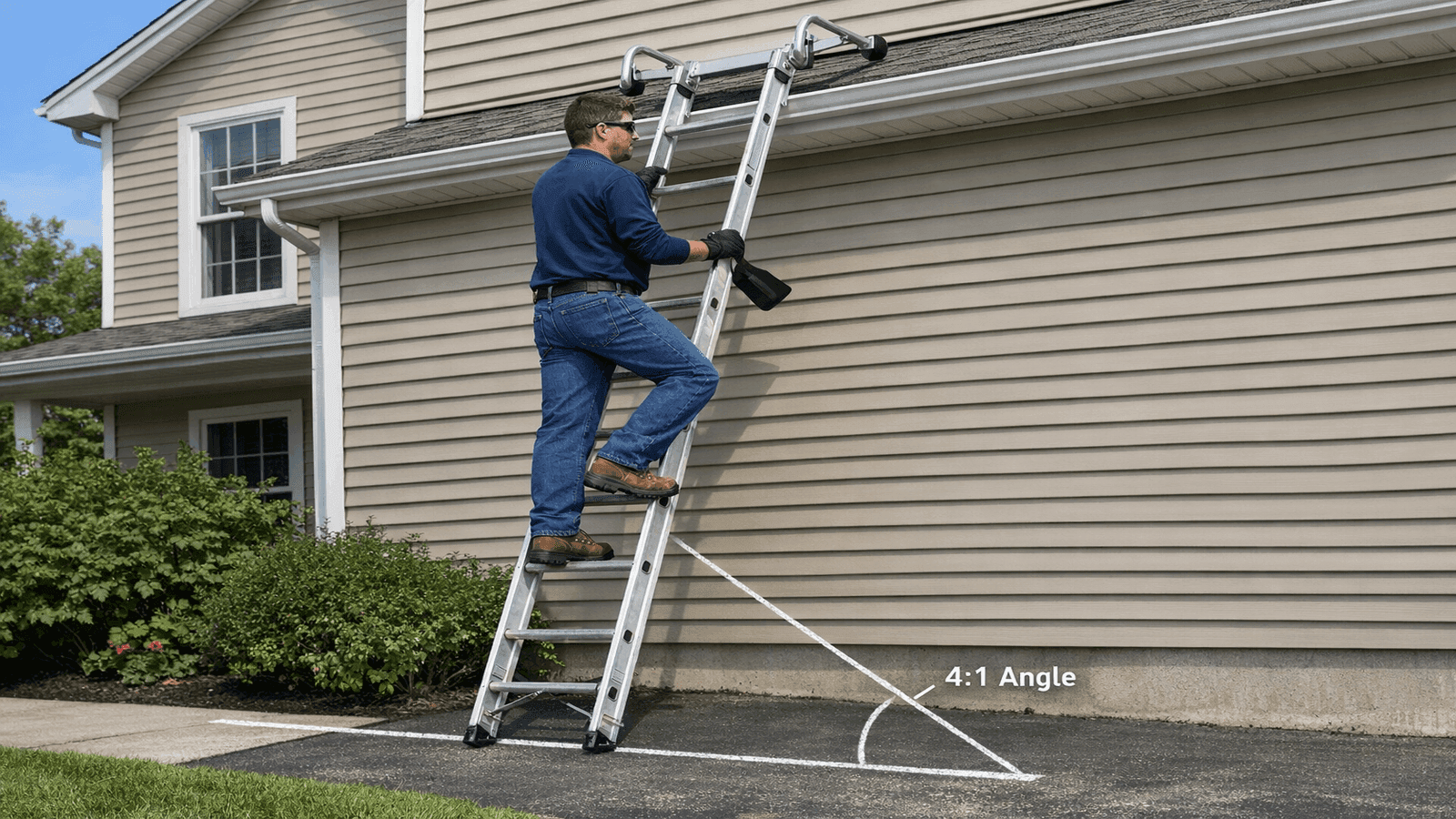
Photo: Extension ladder with standoff stabilizer properly set up against two-story home at the 4:1 angle for safe gutter cleaning, person demonstrating three-point contact
Tools for Gutter Cleaning
The right tools make the difference between a two-hour project and a four-hour project. They also affect the quality of the cleaning -- a garden hose alone leaves debris packed into corners that a scoop removes in seconds.
Essential tools:
- Gutter scoop or trowel: Plastic preferred over metal. Metal scoops scratch and gouge aluminum gutters, creating raw edges that rust and eventually leak. Plastic scoops conform to the gutter profile and remove packed wet debris cleanly. Cost: $5-$15.
- Garden hose with pistol-grip nozzle: The pressurized rinse after scooping flushes fine particles and confirms the downspout is clear. A gutter cleaning wand attachment extends the hose reach to the center of wide gutters without requiring constant ladder repositioning.
- 5-gallon bucket with ladder hook: Hang the bucket from a ladder rung to collect debris as you scoop. Dropping debris onto landscaping below damages plants and creates a separate cleanup job.
Get quotes from top-rated pros.
Optional tools for faster or ground-level cleaning
| Tool | Best For | Cost | DIY or Rent? |
| Gutter scoop (plastic) | All debris types, precise cleaning | $5-$15 | Buy |
| Pistol-grip hose nozzle | Flushing after scooping | $10-$25 | Buy |
| Leaf blower with gutter attachment | Dry leaf debris only | $30-$60 attachment | Buy if you own blower |
| Wet/dry shop vac with gutter attachment | Wet compacted debris | $40-$80 attachment | Rent for one-time use |
| Pressure washer gutter wand | Heavy buildup, second-story reach | $20-$50 attachment | Rent |
| Telescoping gutter wand | Ground-level rinsing supplement | $20-$40 | Buy |
Step-by-Step Gutter Cleaning Process
Work from a prepared position, not a rushed one. Every step below exists for a reason.
Step 1: Set up the ladder.
Position the ladder at the downspout end of the first gutter run. Verify the 4:1 angle, attach the stabilizer above the gutter line, and confirm all four feet are on firm, level ground. If the ground is soft, use a wide board under the feet to distribute the load.
Step 2: Start at the downspout end and work away from it.
Scooping debris toward the downspout packs material directly into the drain opening. Work in the opposite direction -- pushing debris toward the open end of the gutter run where you can collect it into your bucket.
Step 3: Scoop out bulk debris.
Use your plastic scoop to remove packed leaves, seed pods, and compacted material. Transfer debris directly into the hanging bucket rather than dropping it. Wet gutter debris is heavy -- a full bucket of packed leaves can weigh 15-20 pounds.
Step 4: Move the ladder in sections.
Clean a 4-5 foot section, descend, reposition the ladder, climb again. Do not overreach. This is the step homeowners consistently abbreviate, and it is the step where injuries happen.
Step 5: Flush with the hose from the far end toward the downspout.
After all bulk debris is removed, flush the gutter with a garden hose starting from the end farthest from the downspout. Watch the water flow toward the downspout and listen for free drainage. Standing water in any section indicates either a low spot or improper slope.
Step 6: Check downspout flow.
Run the hose at full pressure into the downspout from the top. If water backs up immediately, the downspout is blocked. Clear the blockage before moving to the next run.
Step 7: Inspect gutters while cleaning.
Cleaning is the best opportunity to identify damage. Look for sags, holes, separated joints, and loose hanger spikes. Note any damage for repair during the same session or to schedule with a contractor.
Step 8: Inspect visible shingles from ladder position.
From a safely positioned ladder, you have a direct view of the lower shingle courses. Look for curling, cracked tabs, missing granules, and any areas where shingles have lifted. Document with a phone photo rather than climbing onto the roof surface to investigate. For a full inspection protocol covering the entire roof system, see the roof inspection checklist.
While you are cleaning, check the gutter slope. Gutters are supposed to run at a slight downward pitch toward the downspout -- roughly a quarter inch of drop for every 10 feet of run. If you see standing water or watermarks showing where water sits between cleanings, the gutter has either settled or was installed incorrectly. That causes corrosion at the water line and eventually a leak at the gutter seam. It is an easy fix -- resetting the hanger positions takes 30 minutes -- but only if you catch it early.
Cleaning from the Ground (No-Ladder Methods)
Not every homeowner is comfortable on a ladder, and not every situation requires one. Ground-level gutter cleaning methods have real utility, especially for single-story homes and routine maintenance between full seasonal cleanings.
Leaf blower with gutter kit attachment:
A curved or U-shaped plastic attachment connects to the blower nozzle and arcs up over the gutter edge. Effective for dry, loose leaves and light debris. Limitations: it blows debris out of the gutter but does not control where it lands (frequently back onto the roof surface or against the house siding), and it cannot remove compacted wet debris or clear downspout blockages.
Wet/dry shop vac with gutter extension:
A vacuum extension kit with a curved wand reaches into the gutter and pulls debris into the vacuum canister. Works for both wet and dry material. Requires more frequent repositioning than ladder-based cleaning but is effective for homeowners who cannot safely use a ladder.
Pressure washer with gutter wand attachment:
A telescoping wand with a U-shaped nozzle directs high-pressure water into the gutter channel. Effective at breaking up compacted debris and flushing it toward the downspout. Significant blowback is the main downside -- debris and water spray onto the house face and roof surface. Not recommended for gutters with aging sealant at joints, which the pressure can dislodge.
Telescoping garden hose wand:
A simple curved wand extends the garden hose up and over the gutter edge for low-pressure rinsing. Best used as a follow-up rinse after other ground-level cleaning methods, not as the primary debris removal tool.
Ground-level tools are a reasonable choice for a single-story home after a light leaf fall, when the gutters are mostly clear and you are just doing maintenance flushing. They are not a substitute for a full cleaning when a gutter has been neglected for a season or more. For anything above single-story, or any gutter with visible debris buildup, you need ladder access or a professional. There is no reliable way to confirm the downspout is fully clear from the ground.
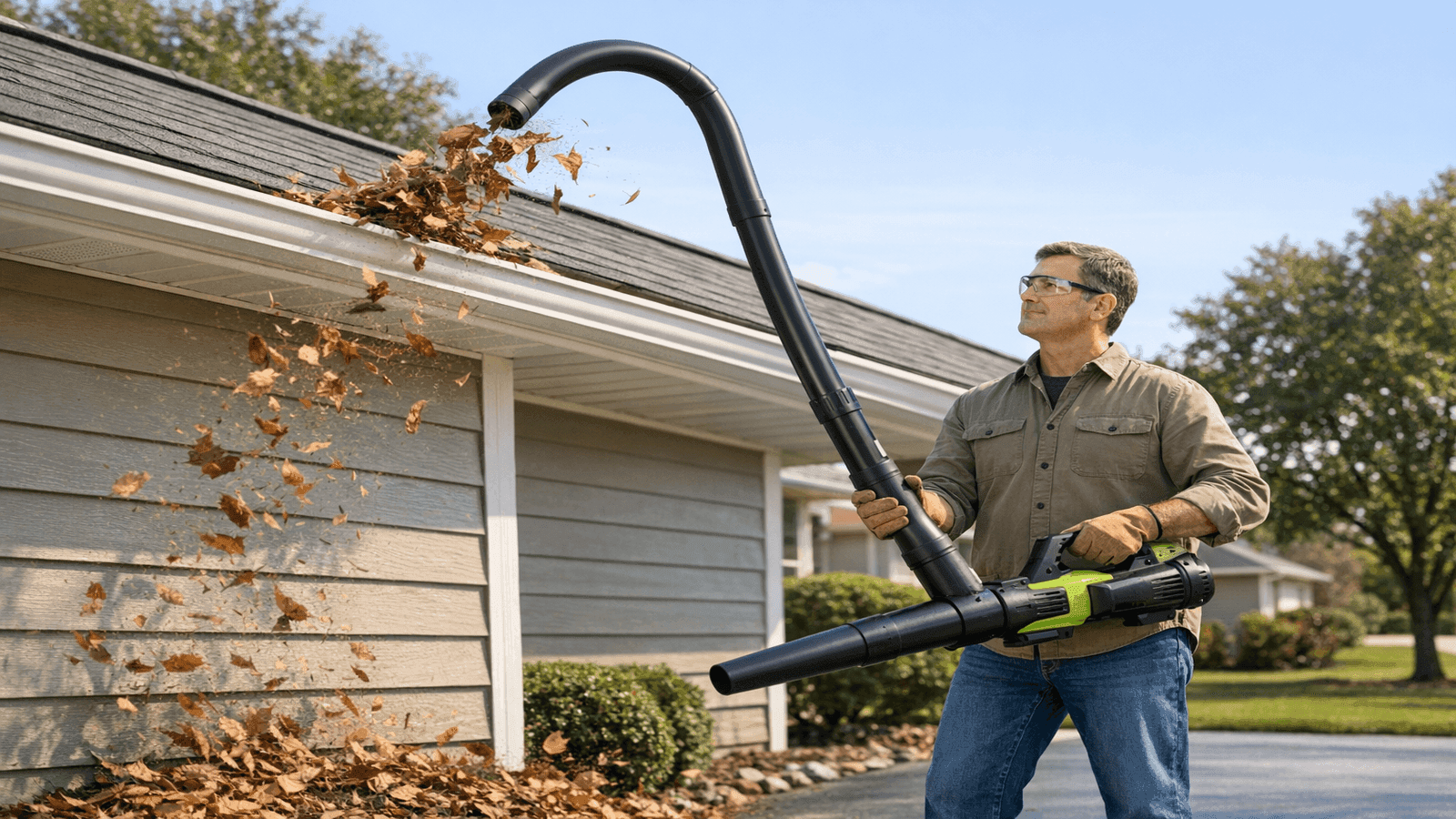
Photo: Homeowner using cordless leaf blower with curved gutter extension attachment from ground level to blow leaves out of single-story home gutters
Cleaning Downspouts and Checking Drainage
A clean gutter with a blocked downspout is still a failed drainage system. Downspout blockages are common, especially at the bottom elbow where debris accumulates, and they are the most frequent cause of gutter overflow on otherwise maintained systems.
How to tell a downspout is blocked:
Water backs up at the gutter-to-downspout junction and overflows before reaching the downspout opening. You can also tap the downspout with a knuckle and listen for a hollow sound (clear) versus a dull thud (blocked).
Clearing a blocked downspout:
- Insert a garden hose into the bottom of the downspout and turn it on full pressure. The upward water pressure often dislodges debris packed in the lower elbow.
- If that fails, insert a plumber's snake from the top of the downspout and work it through the blockage.
- For downspouts with a removable bottom elbow section, disconnecting the elbow and clearing it manually is often the fastest solution.
Underground drain connections:
Some homes connect downspouts to underground drain lines that carry water to the street curb or a dry well. If flushing the downspout clears the above-ground section but water still backs up at the ground connection, the underground line may be blocked by root intrusion or collapsed pipe. This requires a drain specialist, not a gutter cleaner.
| Downspout Issue | DIY Solution | Estimated Cost | When to Call a Pro |
| Leaf or debris blockage | Hose from bottom or snake from top | $0 with existing tools | Not needed |
| Dislodged elbow section | Reconnect with sheet metal screws | $5-$10 | If elbow is corroded |
| Underground drain blocked | Flush with hose first | $0 | Root intrusion, collapsed pipe |
| Missing or damaged extender | Install downspout extender | $10-$25 | Not needed |
| Foundation drainage failure | Install buried drain extension | $200-$600 DIY | Complex grading required |
Installing downspout extenders:
Extenders direct water from the downspout discharge point at least four feet away from the foundation. Flexible extenders ($10-$20) connect to the existing downspout and lie flat on the ground, rolling out when it rains and retracting when dry. Rigid buried extensions ($150-$400 installed) route water further away underground. Any lot where the grade slopes toward the foundation requires at minimum a four-foot surface extender [4].
Get quotes from top-rated pros.
Inspecting Gutters While You Clean
Cleaning season is inspection season. Running your hands along the gutter interior and examining every joint and seam while debris is removed takes five extra minutes per run and can catch problems that would otherwise go unnoticed until they cause water damage inside the home.
What to look for:
- Rust spots: Surface rust on steel gutters is treatable with rust-converter primer ($12-$18) and gutter paint. Through-rust that perforates the metal requires section replacement.
- Holes and cracks: Small holes up to a half-inch diameter can be patched with roofing cement and a fiberglass mesh patch. Larger damage requires section replacement.
- Separated seams: The joint where two gutter sections overlap is sealed with gutter sealant. Sealant dries out and cracks after 5-10 years. Clean the joint, allow it to dry fully, and apply fresh sealant from inside the gutter ($8-$15 per tube).
- Improper slope: Standing water at any point between hangers indicates a low spot. Resetting the adjacent hanger corrects the pitch.
- Loose hanger spikes or screws: Gutters attach to the fascia via hangers spaced every 24-36 inches. Spikes back out over time. Replace them with 3-inch gutter screws, which hold significantly better and reinstall in the same holes.
When to replace rather than repair:
Gutters over 20 years old with widespread rust, multiple separated seams, or significant sag across multiple sections are past their effective service life. Replacement costs $6-$12 per linear foot installed for standard aluminum K-style gutters, with seamless gutters at the higher end of that range. The investment eliminates recurring repair costs and fully restores drainage performance [5].
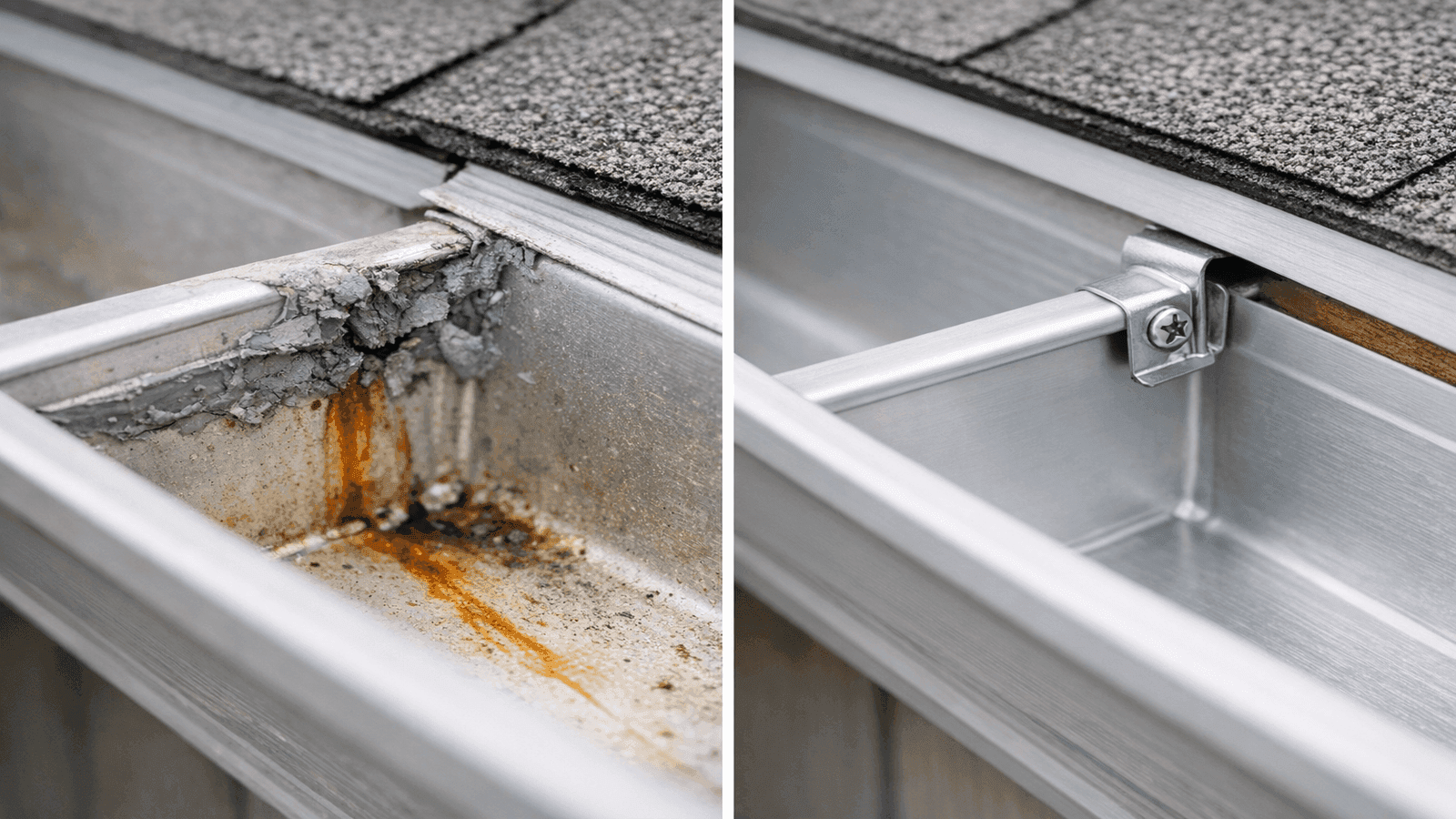
Photo: Close-up comparison of damaged gutter section showing separated seam with failed sealant and rust stain versus adjacent properly secured gutter with new hanger in good condition
Gutter Guards: Worth It or a Marketing Gimmick?
The gutter guard industry markets aggressively, and the claims made by some companies significantly overstate what guards can actually prevent. Understanding the honest performance picture helps homeowners make a decision based on their specific situation rather than the sales pitch.
Types of gutter guards:
- Micro-mesh: A fine stainless steel mesh sits over the gutter opening, blocking debris while allowing water through. Best performance of all guard types; reduces cleaning frequency to approximately once per year. Cost: $4-$10 per linear foot installed.
- Reverse curve (surface tension): Water follows the curve into the gutter while debris falls off the edge. Effective for large debris but allows seeds, pine needles, and small particles to pass through. Cost: $3-$6 per linear foot.
- Foam inserts: Porous foam fills the gutter interior. Seeds germinate in the foam and become extremely difficult to remove. Not recommended.
- Screen guards: Flat screens sit over the gutter opening. Effective for large leaves, ineffective for anything smaller. Require their own periodic cleaning.
The honest ROI calculation:
If you currently pay $200 per year for professional gutter cleaning and micro-mesh guards cost $1,500 installed on a standard home, the payback period is 7.5 years assuming you still pay $50 annually for one maintenance cleaning. That is a reasonable investment for a homeowner planning to stay in the home long-term with mature trees that are not going anywhere.
Micro-mesh guards from established manufacturers work. I have installed them on my own customers' homes and the reduction in cleaning frequency is real. What does not work is the $99 foam insert kit from the hardware store, or any guard that requires sliding under the first shingle course -- that design traps moisture and causes premature shingle failure at the eaves. If you are going to install guards, spend the money on quality micro-mesh installed by a contractor who will warranty the work.
No guard eliminates the need for annual inspection. Gutters still need to be checked for sags, joint separation, and debris accumulation that bypasses even the best guards -- particularly in heavy-seed or pine-needle environments.
Real-World Case Study
Patricia W. in Charlotte, NC contacted James Carver after noticing that her soffit panels had begun to sag and discolor along the back of her home. A visual inspection from the yard showed nothing obviously wrong with the gutters themselves. When James inspected the fascia boards behind those gutters, he found the problem immediately.
The gutters had not been cleaned in approximately four years. Packed debris had held standing water against the fascia boards through multiple full seasons, and the rot had spread laterally from the fascia into the soffit framing. By the time Patricia noticed cosmetic changes to the soffit panels from the ground, the structural framing behind them had already deteriorated significantly.
The total cost of repair: $2,200 for full fascia and soffit replacement along the affected 40-foot rear elevation. A gutter cleaning every six months -- at roughly $100-$150 professionally -- would have cost $800-$1,200 over those four years and prevented the entire repair.
"That is the conversation I have with homeowners every year," says James. "The gutters looked fine from the ground. No visible overflow, no obvious clogging. But the weight of compacted debris was holding moisture against the fascia all winter, every winter, for four years. By the time the soffit showed it, the damage was already done."
Conclusion
Gutter cleaning is one of the highest-return maintenance tasks a homeowner can perform. The time investment is two to four hours twice a year. The cost is $0 in tools you already own or $150-$250 paid to a professional. The alternative -- fascia rot, foundation erosion, or basement water intrusion -- starts at $400 and climbs into the thousands.
Safety setup takes more time than the cleaning itself, and that time is non-negotiable. The 4:1 ladder angle, a stabilizer, gloves, and safety glasses are the difference between a productive afternoon and an emergency room visit. If ladder work is not something you can do safely and confidently, professional gutter cleaning at $100-$250 per visit is one of the best values in home maintenance.
For gutter problems that reveal larger roofing issues -- damaged shingles at the eave line, fascia rot, or separated flashing at the drip edge -- connect with a licensed contractor through Find Licensed Roofers Near You to get a proper inspection before small damage becomes a structural problem.
- Disclaimer: The information in this guide is provided for educational purposes and general homeowner awareness. Gutter cleaning involves working at height, which carries inherent fall risk. Homeowners should assess their own physical capabilities and comfort level with ladder work before attempting DIY gutter cleaning. For two-story homes, complex rooflines, or any situation where ladder safety cannot be fully ensured, professional service is strongly recommended. Cost estimates reflect national averages as of early 2026 and will vary by region, home size, and contractor.*
Sources & References
- Consumer Product Safety Commission -- Ladder Safety Statistics
- American Ladder Institute -- Safe Ladder Use Guidelines
- This Old House -- How to Clean Gutters
- Bob Vila -- Downspout Extension and Drainage Guide
- Family Handyman -- Gutter Repair and Replacement Guide
- Centers for Disease Control and Prevention -- Fall Prevention at Home
- National Safety Council -- Ladder Safety Resources
- House Logic -- Gutter Guard Types and Performance Comparison


James is a licensed roofing contractor with 20 years of experience in roof installation, inspection, and repair across the U.S. South and Midwest. He specialises in asphalt shingles, metal roofing, and storm damage restoration. On NearbyHunt, James offers practical advice on roof maintenance, insurance claims, and selecting the right materials for long-lasting protection.

Jacob is a licensed roofing contractor with over 18 years of experience in roof inspection, installation, and restoration. Based in Texas, he has led hundreds of successful roofing projects across residential and commercial properties. Jacob is also a certified storm damage specialist, ensuring that all NearbyHunt roofing content meets industry best practices and safety standards.