- The roof almost always comes first because it is the primary barrier against water intrusion; replacing siding on a leaking home means the new siding will absorb water damage from above.
- Roof replacement averages $9,500 to $14,000 for a standard asphalt shingle system on a 2,000-square-foot home, with metal and tile running significantly higher [1].
- Siding replacement ranges from $5,000 to $18,000+ depending on material, with vinyl at the low end and fiber cement or wood at the top [2].
- Insurance carriers increase premiums by 25-50% on roofs over 20 years old, and many switch from replacement-cost to actual-cash-value coverage after the 20-year mark.
- Bundling roof and siding replacement saves 10-20% in combined labor costs when both projects are awarded to the same contractor or scheduled within the same week.
- A new roof recovers approximately 60-70% of its cost at resale, while new siding returns roughly 82% according to the National Association of Realtors Remodeling Impact Report.
Standing in your driveway and staring at a house that needs both a new roof and new siding is one of the most frustrating positions a homeowner can be in. The budget rarely covers both at once, and the wrong choice can cost you thousands in follow-on damage. This guide to all about roofing is the foundation for understanding your roof as a system. Below, James Carver, who has overseen 1,800-plus roofing projects across the U.S. South and Midwest, walks you through a clear decision framework, current cost data, and the conditions that flip the typical priority order.

Get quotes from top-rated pros.
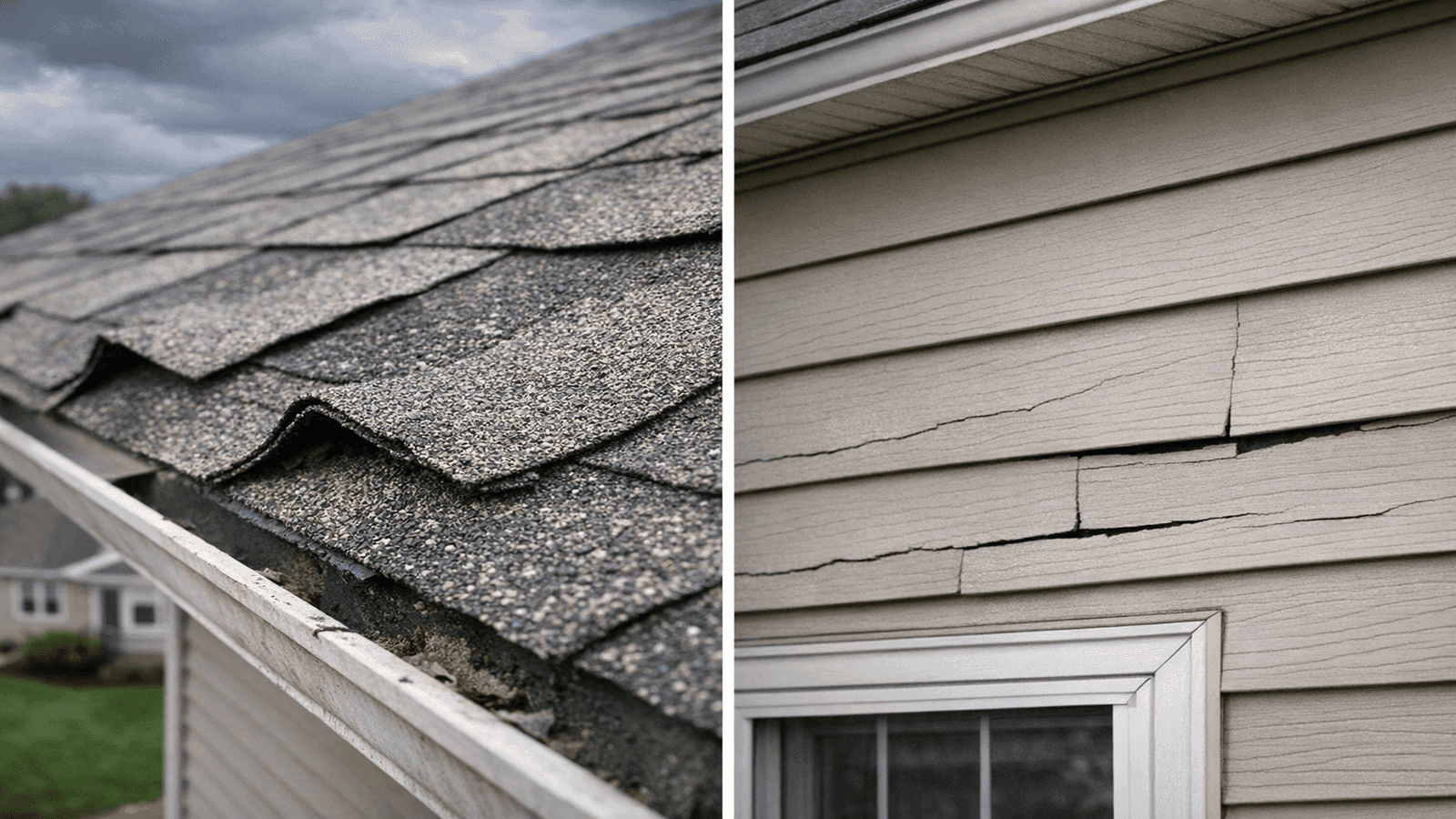
Photo: Side-by-side aerial view of a residential home showing damaged asphalt shingles on the roof and faded cracked vinyl siding on the exterior walls, illustrating the roof vs siding replacement decision
Why This Decision Matters More Than Most Homeowners Realize
Choosing between roof and siding is not simply a cosmetic or budget question. It is a structural sequencing question. Every element of your home's exterior depends on a water-resistant layer above it. Siding is designed to shed rain that runs down the walls, but it is not designed to handle water that enters from above through a compromised roof deck, damaged flashing, or missing shingles.
When water enters through the roof, it travels down through insulation, framing, wall cavities, and eventually reaches the wall sheathing behind the siding. New fiber cement or vinyl panels installed over a wall cavity that is already absorbing roof-sourced water will begin to show rot, mold, and panel separation within two to three years. The money spent on new siding becomes a loss.
The reverse problem is far less severe. Installing a new roof over existing siding that needs replacing is workable. Roofers typically protect the siding with plywood shields during tear-off, and the debris from a roof job is manageable. Some scuffing and minor damage can occur, but it does not compromise the structural function of the siding the way water intrusion from above does.
In over twenty years of doing this work, I have seen homeowners waste twenty thousand dollars on beautiful new siding only to watch it fail within three years because they skipped the roof. Water does not care how nice your panels look. It follows gravity, and gravity starts at the roof.
This sequencing logic is the default recommendation. But there are specific conditions under which siding takes priority, and there are situations where doing both at the same time is the financially optimal move. Understanding those conditions is what this guide is built around.
When to Prioritize the Roof
Active Leaks, Staining, or Sagging
Any visible interior sign of water intrusion is an automatic roof-first situation. Brown ceiling stains, soft spots on the attic floor, daylight visible through the roof deck, and sagging in the ceiling plane all indicate that water is already inside the structure. Delaying roof replacement in these conditions accelerates rot in the structural decking, the rafters, and the top plates of the wall framing.
The cost of ignoring an active leak compounds quickly. A roof deck replacement adds $1,000 to $3,000 to the base replacement cost. If rafters are compromised, structural repairs can push the total project $5,000 to $10,000 higher than a straightforward tear-off-and-replace.
Roofs Over 20 Years Old
Asphalt shingles have a rated lifespan of 15 to 30 years, but the realistic functional lifespan in hot climates like Florida, Texas, and Georgia is often closer to 15 to 18 years. A roof approaching or past the 20-year mark is statistically in its failure window regardless of how good it looks from the curb. The granules that protect the asphalt layer have shed, the mat underneath is brittle, and the sealing strips on the shingles are no longer reliably bonding. For a deeper look at how roofing materials age, see the guide on how long do roofs last.
Insurance carriers are also increasingly aggressive about roofs in this age range. Once a roof passes 20 years, nearly 70% of carriers switch from replacement-cost-value (RCV) coverage to actual-cash-value (ACV) coverage, which factors in depreciation. That means a roof that costs $12,000 to replace might yield only $4,000 to $6,000 from an ACV claim after depreciation. A new roof restores full RCV coverage and typically reduces the annual premium by 5 to 35%, according to insurance industry data for 2026 [1].
Missing Shingles, Storm Damage, or Wind Uplift
Storm damage has an urgency that siding damage rarely matches. A missing shingle or a section of lifted flashing creates an immediate water entry point. A single rain event can soak the decking and insulation beneath, turning a $600 repair into a $4,000 deck replacement if ignored for even a few weeks.
Wind-damaged siding is unsightly and can allow air infiltration, but it rarely creates the same acute water-entry risk as a compromised roof plane. The exception is if siding panels have been completely blown off and the house wrap or structural sheathing is exposed directly to rain. In that case, temporary weatherproofing and then a fast siding repair are warranted.
Selling the Home Within 12 to 24 Months
Buyers and their inspectors flag old or damaged roofs as the single biggest negotiating lever in a real estate transaction. A buyer who sees a 22-year-old asphalt roof will either walk away or submit an offer $10,000 to $20,000 below asking price to account for the anticipated replacement. A new roof eliminates that deduction and signals that the home has been well maintained.
The data supports the investment: roof replacement recaptures approximately 60 to 70% of its cost at resale, and homes with new roofs sell faster and closer to the asking price than comparable homes with aging roofs [2]. Siding replacement recovers around 82% of its cost, which is a strong return, but a buyer who identifies a bad roof will not care how good the siding looks.
When I am doing a pre-listing assessment, the roof is always the first thing I check. I have seen deals fall apart at inspection over a 19-year-old roof that looked fine from the street. Buyers today have educated inspectors and they know what they are looking for.
Common Roofing Problems Already Present
If you are seeing granule accumulation in gutters, cracked or curling shingle edges, or daylight in the attic, these are the warning signs of a roof entering its final stage of functional life. The guide on common roofing problems covers these indicators in depth. When three or more of these signs are present simultaneously, the roof has exceeded its maintenance window and replacement is the correct course.
Get quotes from top-rated pros.
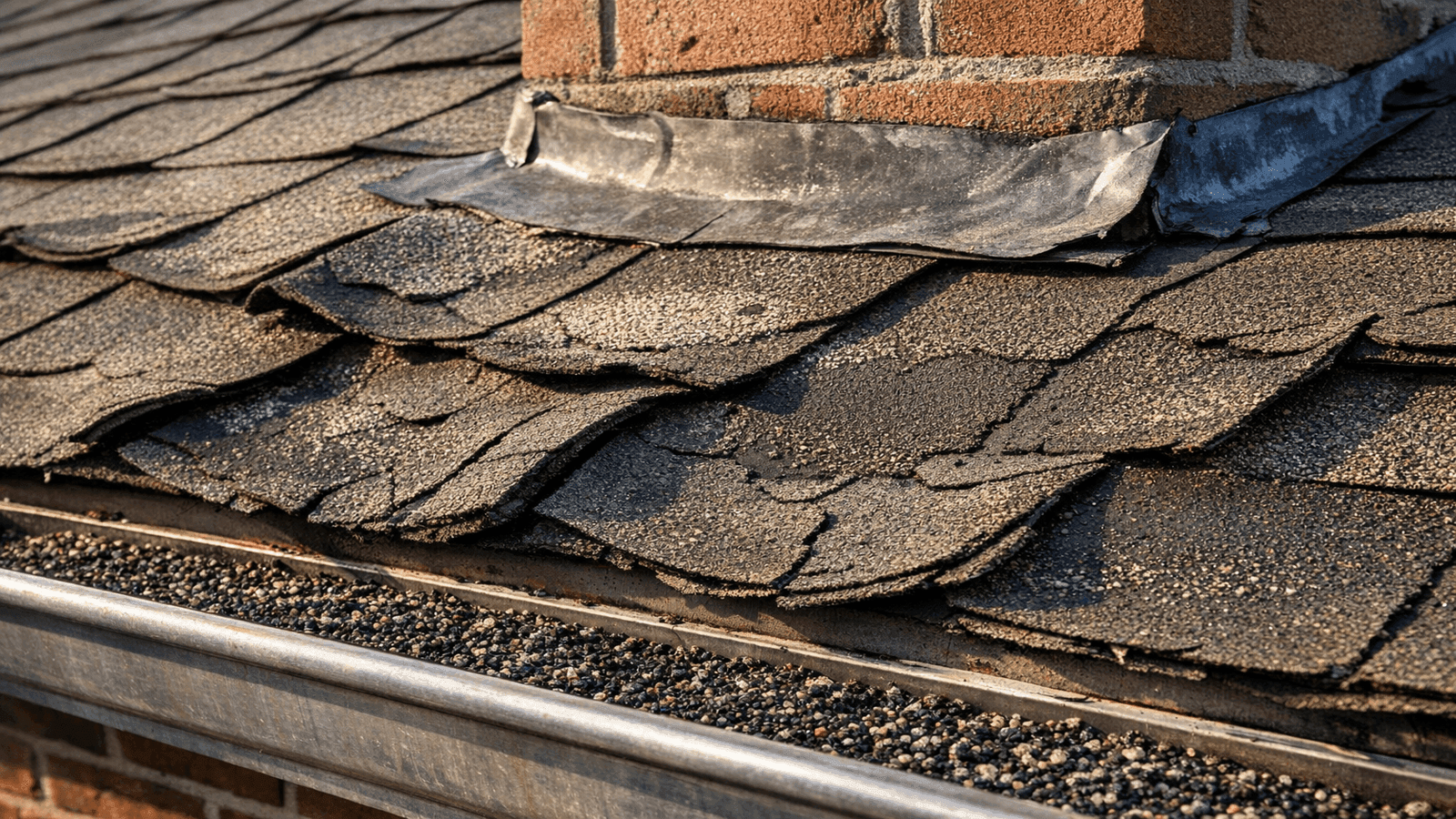
Photo: Close-up photograph of a residential roof showing curling asphalt shingles, granule loss in gutters, and lifted flashing at the chimney, indicating a roof past its functional lifespan
When Siding Takes Priority
There are genuine situations where siding damage becomes the more urgent structural issue. These are less common than roof failures, but they are real and they carry serious consequences if ignored.
Rot or Mold Has Penetrated the Sheathing
Wood rot in siding does not stay in the siding. It migrates inward to the wall sheathing (typically OSB or plywood), and from there to the structural framing. Once rot reaches framing members, you are dealing with a structural repair, not just a cosmetic replacement. Pest inspectors often discover termite infestations that began because rotting siding gave termites a moisture-softened entry point into the wall cavity.
If a probe or screwdriver pushed against the base of the siding panels sinks in, the rot has reached the sheathing. At that point, the siding must come off immediately regardless of the roof's condition, because the structural integrity of the wall is at stake. Waiting to fix the roof first would allow the rot to continue advancing during the delay.
Energy Efficiency Is Severely Compromised
Gaps, cracked panels, and missing siding sections allow heated or cooled air to escape continuously. In climates with extreme summer heat (Dallas-Fort Worth, Phoenix, Florida) or cold winters (Baltimore, upper Midwest), the energy loss from failed siding can add $50 to $200 per month to utility bills depending on the home's size and the severity of the gaps. When the roof is in serviceable condition but the siding is creating measurable energy loss, the siding project has a faster financial payback period.
Pest Entry Points
Woodpeckers, carpenter ants, and rodents exploit gaps and soft spots in siding to enter wall cavities. Once inside, these pests can cause damage that costs far more to remediate than new siding would have. If a pest inspector identifies active infestation entry points in the siding, that project moves ahead of cosmetic or aging-related concerns.
I have done jobs where the homeowner was sure the roof needed replacing first, but when we pulled the siding we found the sheathing was so far gone that there was literally nothing solid left to attach new siding to. The structural condition of what is behind the panels matters more than what you can see from the street.
Cost Comparison: Roof vs. Siding Replacement in 2026
Understanding the cost profiles of both projects helps you plan sequencing and financing. The table below reflects national averages for a 2,000-square-foot single-family home in 2026:
| Project | Low End | Average | High End | Most Common Material |
| Roof Replacement | $7,500 | $10,000–$12,000 | $46,000+ | Asphalt shingles |
| Vinyl Siding | $5,000 | $8,400–$12,000 | $25,200 | Standard vinyl |
| Fiber Cement Siding | $7,500 | $14,674 | $21,000+ | HardiePlank |
| Wood Siding | $6,000 | $11,000 | $20,000+ | Cedar or pine |
| Metal Roofing | $15,000 | $25,000 | $46,000+ | Steel standing seam |
| Slate/Tile Roofing | $25,000 | $40,000 | $80,000+ | Natural slate/clay |
Asphalt shingle roof replacement remains the most common project, averaging $9,500 to $14,000 for a standard 2,000-square-foot home, with the bulk of the cost in labor (50-60% of total) [1]. Vinyl siding is the most affordable siding replacement, averaging $4 to $12 per square foot installed, or $8,400 to $25,200 for an average home [2]. Fiber cement siding sits in the middle of the market at $5 to $14 per square foot, with national project averages around $14,674.
The cost gap between roofing and siding narrows considerably once you move into premium materials. A natural slate or standing-seam metal roof can cost two to four times as much as a fiber cement siding replacement, which shifts the financial calculus significantly for homeowners whose siding is also a premium material.
How to Do Both: Bundling Contractors and Timing
If your budget supports tackling both projects, or if you are buying a home with both needs, bundling the work with a single contractor is almost always the smarter approach.
Labor Savings from Bundling
When one crew handles both the roof and the siding, the mobilization costs (truck time, equipment setup, staging materials) are shared across both projects. Many experienced exterior contractors in the NearbyHunt network offer 10 to 20% discounts on the second project when both are awarded together, because the overhead burden per project drops significantly. The licensed contractors in our NearbyHunt network report that approximately 65% of homeowners who bundle roof and siding projects save between $1,500 and $4,000 compared to hiring separate contractors on separate timelines.
Correct Sequencing When Doing Both
Always complete the roof first, then the siding, even when bundling. This matters for several practical reasons. Roof tear-off generates debris, including nails, granules, and broken shingle pieces, that fall onto the siding and ground below. New siding installed before the roof replacement will absorb impact damage and require cleaning or spot repairs. New siding installed after the roof is already in place arrives in perfect condition and benefits from the new, water-tight overhead protection from day one.
The one exception is when siding rot has compromised the wall framing adjacent to the roof edge. In those situations, the wall framing must be stabilized before roofing work begins, because the structural connection between the roof system and the wall depends on sound top plates and rafter tails.
Get quotes from top-rated pros.
Financing Options
Most exterior contractors offer financing through third-party lenders, and many states have energy-efficiency improvement programs that provide low-interest loans for projects that improve the building envelope. For homeowners replacing both roof and siding in a single year, the total project cost often qualifies for a larger financing package at a lower rate than two separate smaller loans would.
Home equity lines of credit (HELOCs) remain a popular option for projects in the $20,000 to $40,000 range. For homeowners with limited equity, personal improvement loans with 12 to 60-month terms are available through most major lenders at rates that are often lower than financing offered directly through contractors.
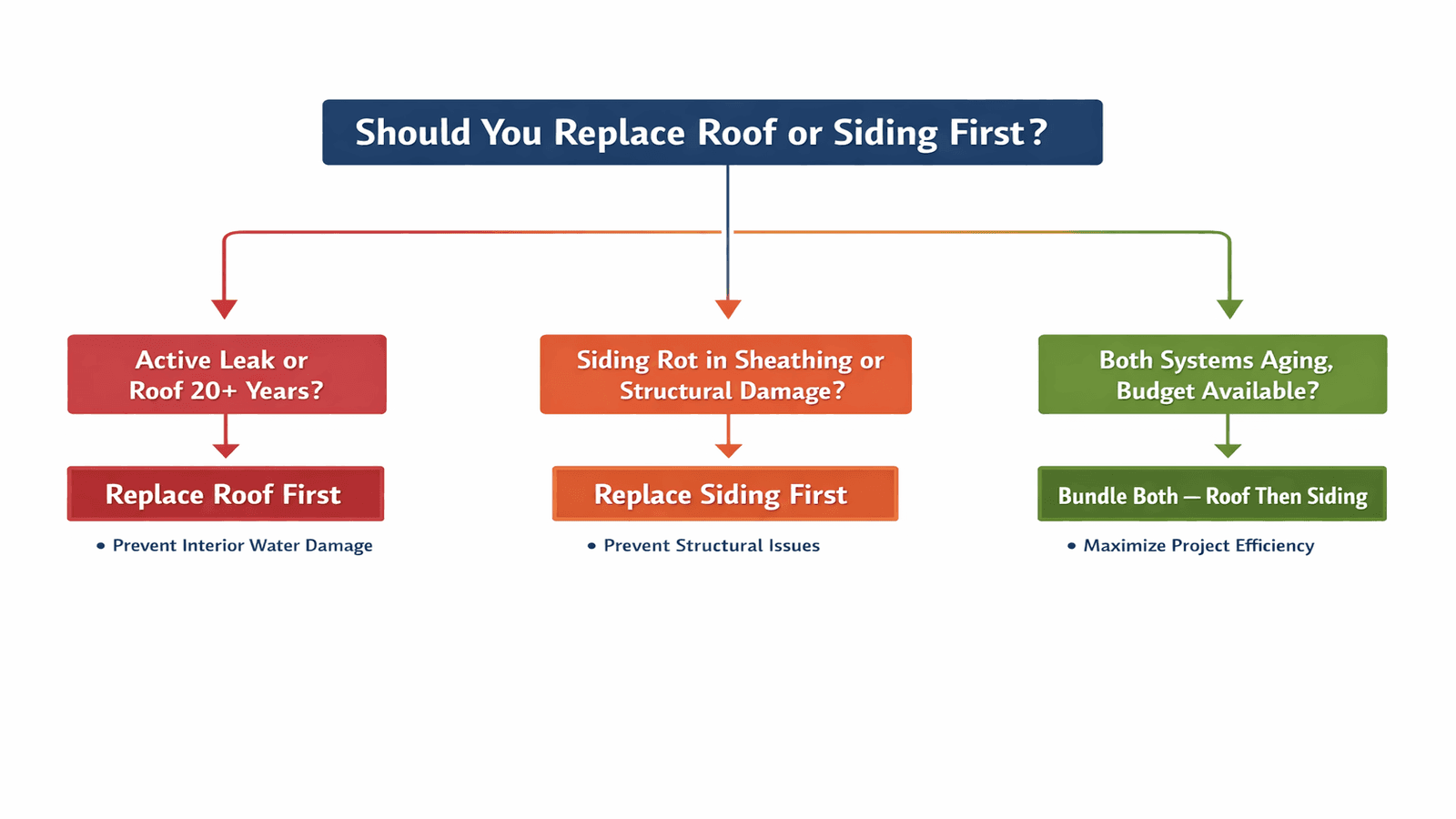
Photo: Infographic showing a decision flowchart for roof vs siding replacement priority, with branches for active leaks, age over 20 years, structural rot, and budget constraints leading to recommended action steps
DIY vs. Professional for Each Project
Roofing: Almost Never DIY
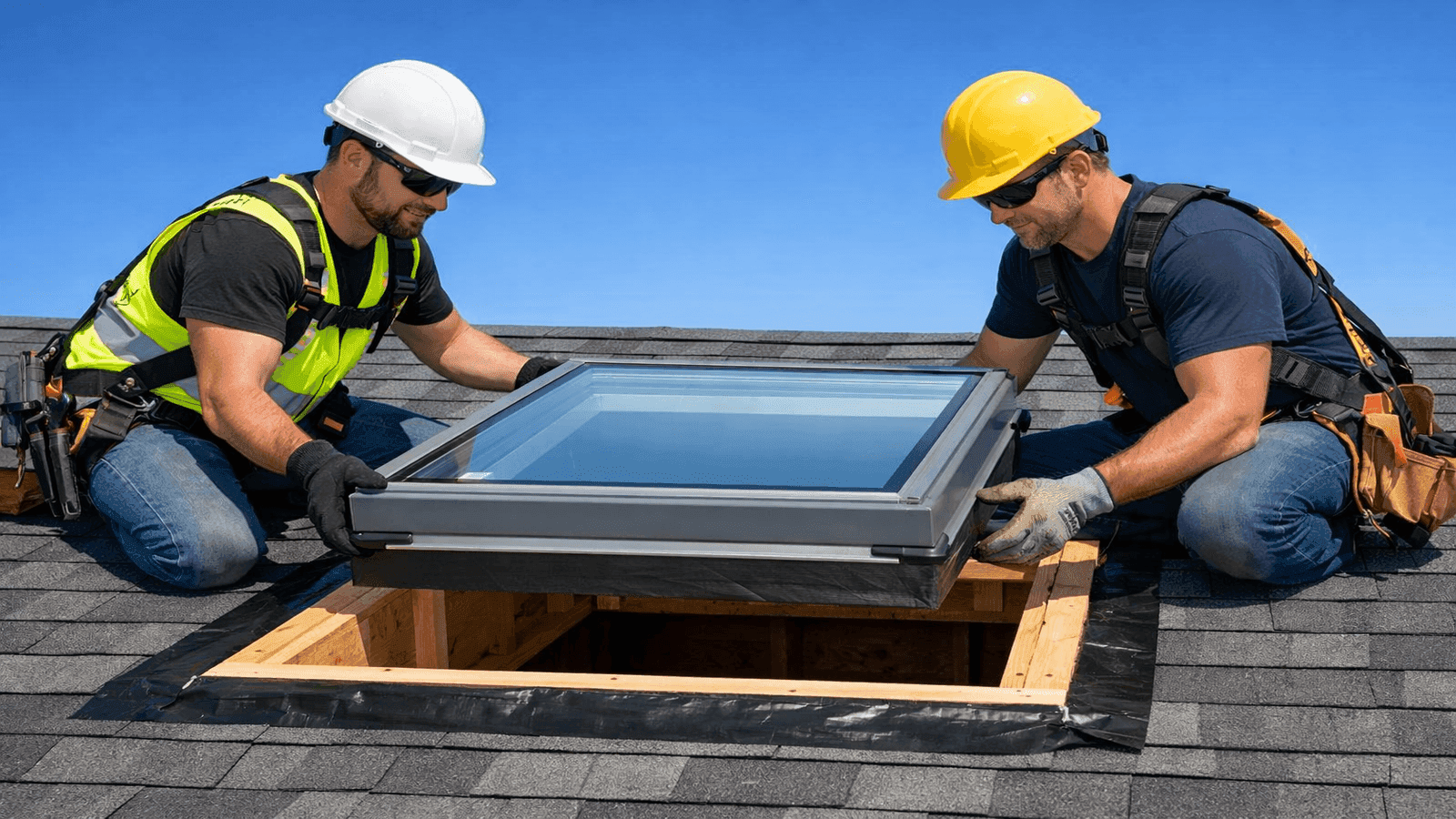
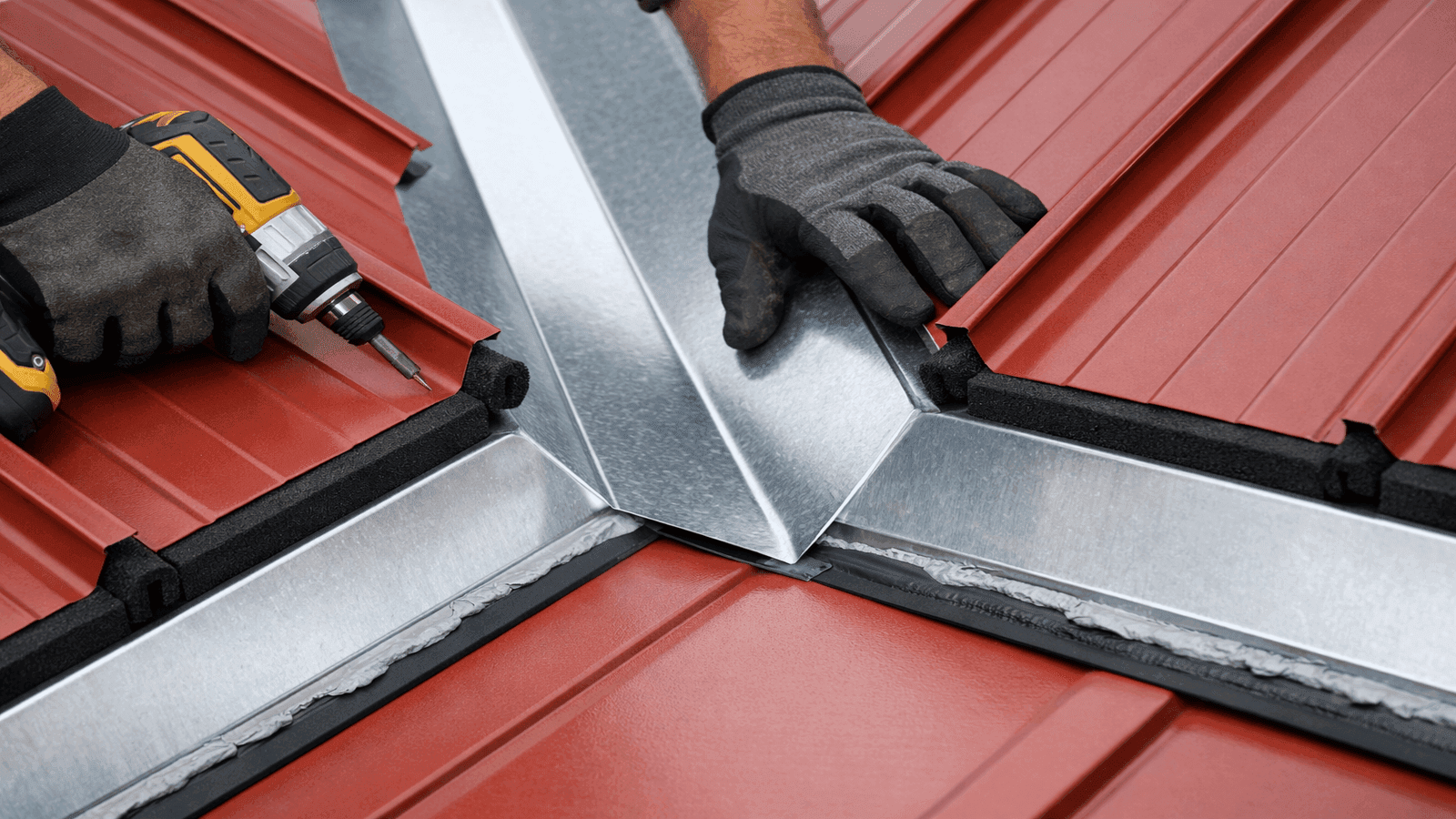
Roof replacement is among the most physically demanding and technically precise home improvement projects that exist. A single improperly seated piece of flashing at a chimney, skylight, or roof valley will allow water to enter the structure for years before the damage becomes visible. By the time interior damage is apparent, the remediation cost far exceeds what a professional installation would have cost.
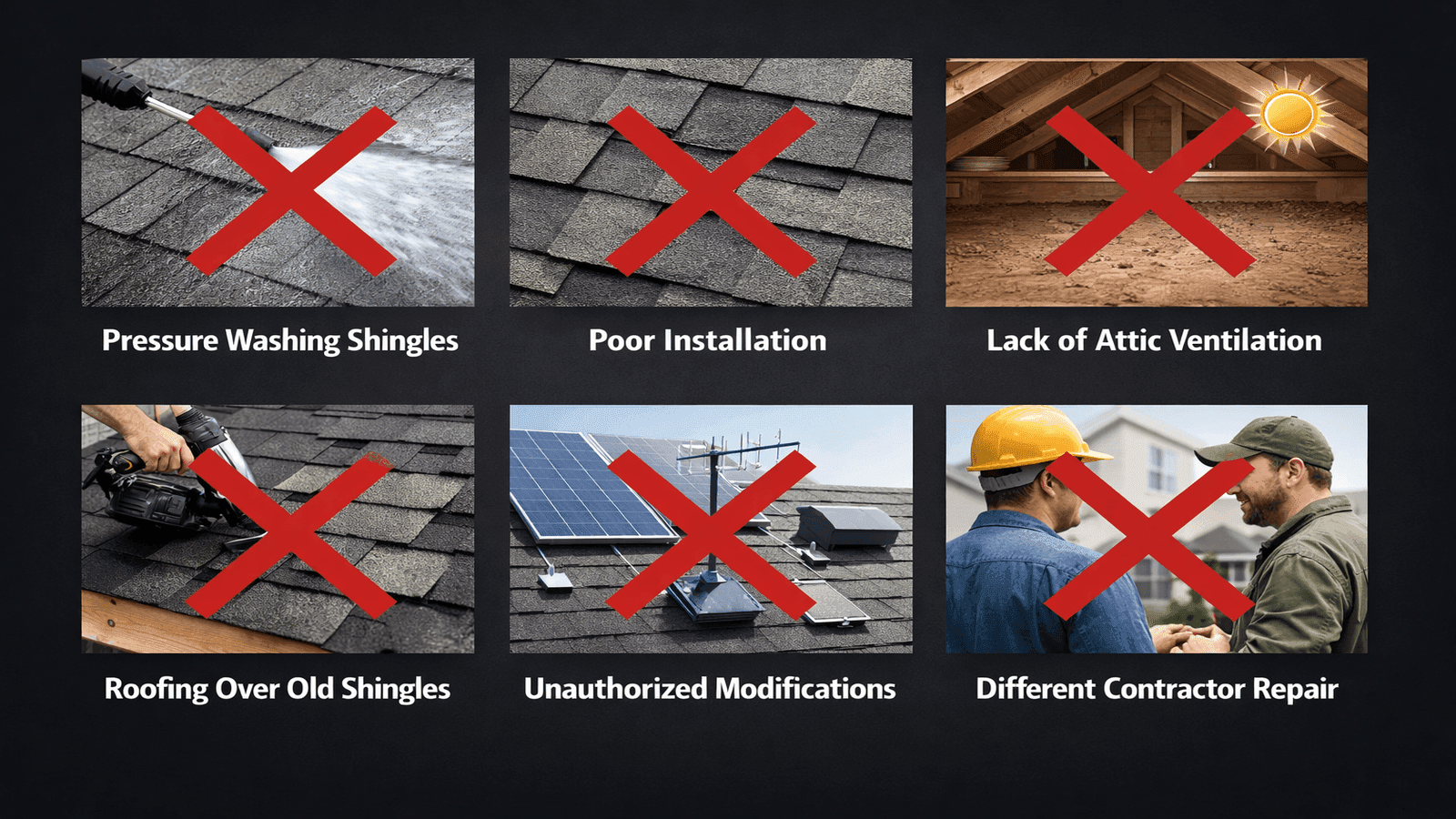
In Florida, Texas, and Georgia (the three states where James Carver has concentrated his 1,800-plus projects), permits are required for roof replacement in virtually every jurisdiction. Unpermitted roof replacements can void homeowners insurance claims and create title issues when the home is sold. Most DIY roofing attempts also void manufacturer shingle warranties, which typically require installation by a licensed contractor.
The physical risk is also significant. Roof replacement involves working on steep slopes with heavy bundles of shingles, at heights of 12 to 30 feet, with the constant hazard of falls. The roofing industry has one of the highest fall-fatality rates of any construction trade.
Siding: Limited DIY Options
Vinyl siding installation is within reach for experienced DIYers on simple, flat wall sections with no complex trim, corners, or around openings. The material snaps together and does not require specialized tools beyond a utility knife, a snap lock punch, and a zip tool for removal. However, the savings are usually less than homeowners expect, because labor for vinyl siding is typically $2 to $5 per square foot, and the time investment for an inexperienced installer on a full house is substantial.
Fiber cement siding is generally not a DIY project. It is heavy, requires carbide-tipped blades, generates silica dust during cutting (requiring respiratory protection), and must be installed with specific nailing patterns to maintain manufacturer warranties and fire ratings. Incorrect installation of fiber cement also allows moisture intrusion at cut edges, which defeats the primary reason most homeowners choose the material over vinyl.
For details on the full range of materials and their installation considerations, the guide on types of roofing materials and its companion siding content explain what drives material selection decisions.
Impact on Home Insurance
The insurance implications of roof age are more significant than most homeowners realize until they receive a renewal notice or file a claim. Roofs over 15 years old trigger surcharges of 10 to 20% in most standard policies. At 20 years, nearly 70% of carriers switch from replacement-cost-value to actual-cash-value coverage, meaning the insurer will depreciate the roof's value when calculating a claim payout [1].
For a concrete example: a 21-year-old roof that costs $11,000 to replace might be valued at only $4,400 under ACV coverage after applying a 60% depreciation factor. The homeowner would be responsible for the remaining $6,600 out of pocket on top of the deductible. A new roof restores full RCV coverage and can lower the annual premium by 5 to 35%, partially offsetting the replacement cost over time.
Siding condition matters to insurance, but it is a secondary factor in most standard policies. Some carriers have begun flagging severely deteriorated siding as a habitability concern, but this is not yet as systematically enforced as roof age policies.
The Decision Framework: A Step-by-Step Guide
Use this framework when you are not sure which project to tackle first:
Step 1: Check for active water intrusion. Look for ceiling stains, sagging drywall, soft spots in the attic floor, or musty odors in the upper level. If any of these are present, the roof comes first. No other consideration overrides active water entry.
Step 2: Determine roof age. If the roof is 18 years or older, prioritize it regardless of siding condition. The probability of failure and the insurance implications make it the higher-risk asset to leave unaddressed.
Step 3: Assess siding for structural rot. Use a screwdriver or probe to test the bottom two feet of siding panels and any areas around windows and doors. If the tool sinks in without resistance, the sheathing has rot and siding takes priority over cosmetic considerations.
Step 4: Evaluate urgency vs. timeline. If neither system shows immediate structural risk, assess your 12 to 24-month plans. Selling the home? New roof first. Staying long-term and the siding is creating measurable energy loss? Siding may offer a faster payback.
Step 5: Get quotes for both and ask about bundling discounts. Even if you can only afford one project now, get bids for both. Many contractors will hold a bundling price for 90 days if you commit to both projects, allowing you to do the roof now and the siding later at the discounted rate.
Step 6: Review your insurance policy. Call your agent and ask specifically whether your current roof age affects your coverage type (RCV vs. ACV) and whether a new roof would change your premium. That single phone call has changed many homeowners' priority decisions.
A Real Homeowner Case Study: Marcus's Decision in Dallas
Marcus, a homeowner in the Dallas suburb of Garland, Texas, called James Carver in spring 2024 with a problem many homeowners face: his 17-year-old asphalt shingle roof was showing granule loss and two sections of curling shingles near the ridge, and his 12-year-old vinyl siding had three sections that had buckled and faded badly from UV exposure.
His budget was $18,000. A full roof replacement came in at $13,200. New vinyl siding on the front and two side elevations was quoted at $9,800. He could not comfortably do both.
Kevin walked him through the framework above. The roof was in its statistical failure window at 17 years in a Dallas climate that cycles between extreme summer heat and hail storms. His insurance policy had already shifted to ACV coverage at the 15-year mark. The siding was cosmetically poor but structurally sound; a probe test found no rot, and the energy bills had not increased noticeably.
Marcus replaced the roof for $13,200. His insurance agent confirmed the new roof qualified for a $340 annual premium reduction, and the carrier restored full RCV coverage. He set aside the remaining $4,800 and planned to tackle the siding the following spring. When he got new siding quotes 11 months later, he negotiated a bundling discussion with the same contractor, who offered $700 off the second project because of the prior relationship. Total outlay over 14 months: $22,300 for both projects, compared to the $23,000 combined quote he had received for both at once. The strategic sequencing saved him money and protected the home correctly.
Eco-Friendly Considerations and Long-Term Planning
For homeowners thinking about long-term environmental impact, the choice of materials in both projects has meaningful implications. Metal roofing, for example, is often made from 25 to 95% recycled content and is fully recyclable at the end of its 40 to 70-year lifespan, reducing landfill load compared to asphalt shingles, which currently account for approximately 11 million tons of landfill waste annually in the United States. For a deeper look at sustainable options, the guide on green roofing options covers materials and systems that reduce environmental impact without sacrificing durability.
On the siding side, fiber cement manufactured without asbestos (all modern fiber cement is asbestos-free) has a lower lifecycle environmental cost than vinyl, which is a petroleum product that off-gasses during production and does not biodegrade. Engineered wood siding from sustainably certified forests occupies a middle ground: lower embodied carbon than fiber cement, but requiring more maintenance and more vulnerable to moisture.

Photo: Comparison photograph showing a home exterior before renovation with aging asphalt shingles and faded siding next to the same home after roof and siding replacement with new architectural shingles and fiber cement siding
Conclusion
The decision between replacing your roof or your siding first has a clear default answer in most situations: the roof comes first. It is the top of the water-shedding chain, and new siding installed below a failing roof is money poorly spent. But the nuances matter. Structural rot in siding, pest infestations, and severe energy loss can all push siding to the front of the line. The cost comparison, the insurance implications, the resale impact, and the opportunity to bundle both projects for savings all factor into a complete decision.
Use the six-step framework in this guide as your starting point, get professional inspections for both systems, and then request quotes that include bundling scenarios. The best outcome for most homeowners is a well-sequenced plan that protects the home structurally first and maximizes the financial return on both investments.
Disclaimer: The cost figures, insurance statistics, and return-on-investment percentages cited in this article reflect national averages and industry survey data as of early 2026. Actual costs vary significantly by geographic region, home size, material selection, labor market conditions, and contractor availability. This article is intended for general educational purposes and does not constitute professional financial, insurance, or contracting advice. Always consult a licensed contractor and your insurance agent before making decisions about your specific home.
Sources & References
[1] Ridgeline Roofing. "Roof Replacement Costs in 2026: Average Prices, Materials & Cost Factors." https://ridgeline-roofing.com/news/roof-replacement-costs-in-2026-what-homeowners-should-expect/
[2] NerdWallet. "Roof Replacement Cost in 2026." https://www.nerdwallet.com/home-ownership/home-improvement/learn/roof-replacement-cost
[3] This Old House. "Siding Replacement Cost (2026 Pricing)." https://www.thisoldhouse.com/siding/siding-replacement-cost
[4] National Association of Realtors. "Remodeling Impact Report: Vinyl Siding ROI." https://www.nerdwallet.com/home-ownership/home-improvement/learn/cost-to-replace-vinyl-siding
[5] Openly Insurance. "Does Roof Age Affect Home Insurance Rate." https://openly.com/the-open-door/articles/does-roof-age-affect-home-insurance-rate
[6] Campo Roof. "Roofing Costs in 2026: What Homeowners Should Expect." https://www.camporoof.com/roofing-costs-in-2026-what-homeowners-should-expect/
[7] Idaho Roofing Contractors. "Roofing for Resale Value: Why a New Roof Pays Off When Selling Your Home in 2026." https://www.idahoroofingcontractors.com/roofing-for-resale-value-why-a-new-roof-pays-off-when-selling-your-home-in-2026/

James is a licensed roofing contractor with 20 years of experience in roof installation, inspection, and repair across the U.S. South and Midwest. He specialises in asphalt shingles, metal roofing, and storm damage restoration. On NearbyHunt, James offers practical advice on roof maintenance, insurance claims, and selecting the right materials for long-lasting protection.

Jacob is a licensed roofing contractor with over 18 years of experience in roof inspection, installation, and restoration. Based in Texas, he has led hundreds of successful roofing projects across residential and commercial properties. Jacob is also a certified storm damage specialist, ensuring that all NearbyHunt roofing content meets industry best practices and safety standards.