- Understanding roofing terminology before getting quotes puts you in a stronger position to compare bids accurately and catch inflated line items.
- A roofing square equals 100 square feet, so a 2,000 sq ft roof is 20 squares: knowing this one term alone prevents overcharging on materials.
- Over 60% of roofing disputes involve homeowners who didn't understand what was included in their contract, according to licensed roofers in the NearbyHunt network.
- Flashing failures account for roughly 95% of all roof leaks, making the flashing terms in this glossary among the most practically useful to know [1].
- Red-flag contractor language includes vague terms like "standard materials," "industry-standard install," and "code minimum" without further specification in writing.
- Knowing the difference between a manufacturer warranty and a workmanship warranty is essential: one covers material defects, the other covers installation errors, and they protect you in very different ways.
When a roofing contractor hands you a proposal, the document can feel like it's written in a foreign language. Terms like "mechanically fastened underlayment," "counterflashing," "step flashing," and "Class 4 impact resistance" appear without explanation, and most homeowners sign anyway. Our guide to All About Roofing covers the full scope of roofing systems and costs, but this glossary focuses on one specific goal: making sure you understand every word on that contract before you hand over a check.
James Carver has completed more than 1,800-plus roofing projects across the U.S. South and Midwest in his 20-year career as a licensed home improvement contractor. He has seen homeowners pay for services they did not receive simply because they didn't know what those services meant. This glossary covers 50-plus professional roofing terms organized by category, with plain-language definitions and practical context for each.

Get quotes from top-rated pros.

Photo: Roofing contractor reviewing a proposal with a homeowner at a kitchen table, pointing at contract line items
Quick Reference: Most Critical Roofing Terms by Category
Before diving into the full glossary, this table summarizes the terms homeowners encounter most often on bids and inspection reports, organized by how frequently they appear and how often misunderstandings cost money.
| Category | Term | Why It Matters | Risk if Misunderstood |
| Measurement | Roofing Square | All pricing is per-square (100 sq ft) | Overpaying if square count is inflated |
| Materials | Architectural vs. Three-Tab | Warranty length and wind rating differ significantly | Paying for architectural, receiving three-tab |
| Waterproofing | Step Flashing | Correct wall-junction waterproofing method | Leak within 3-5 years from continuous flashing |
| Waterproofing | Ice & Water Shield | Self-sealing membrane required at eaves and valleys | Ice dam leaks on any roof in cold climates |
| Scope | Tear-Off vs. Overlay | Tear-off required in most cases; overlay hides damage | Shorter roof life, hidden deck rot |
| Warranty | Manufacturer vs. Workmanship | Two separate protections; both needed | Installation errors uncovered by either |
| Cost | Decking Replacement | Priced per OSB sheet, not as a flat fee | Open-ended cost overruns post tear-off |
| Insurance | ACV vs. RCV | Determines how much insurer pays after a claim | Underinsured; large out-of-pocket balance |
| Red Flag | AOB (Assignment of Benefits) | Transfers your insurance rights to contractor | Loss of claim control; potential fraud exposure |
| Red Flag | "Code Minimum" | Floor standard, not quality standard | Below-best-practice installation accepted as normal |
Structural Roofing Terms
Understanding the structural components of your roof helps you make sense of inspection reports, contractor bids, and insurance adjustments. These are the foundational terms that describe the physical framework your roofing materials rest on.
Roof Deck (also: Roof Sheathing): The flat structural surface, typically oriented strand board (OSB) or plywood, that is nailed directly to the roof rafters. All other roofing layers are installed on top of the deck. When contractors note "deck replacement needed," they mean this layer has rotted or delaminated and must be replaced before new shingles go down, which adds material and labor cost.
Rafters: The angled structural beams that run from the ridge down to the exterior walls, forming the sloped shape of the roof. Rafters are part of your home's framing and are distinct from the roofing system itself. If rafters are damaged by moisture or wood-boring insects, the repair cost escalates significantly beyond standard roofing work.
Ridge: The horizontal peak at the very top of a pitched roof, formed where two sloping roof planes meet. The ridge is the highest point of the roof and one of the most critical ventilation and weatherproofing zones. Ridge caps and ridge vents are installed here.
Hip: A type of roof design where all four sides slope downward toward the walls. A hip roof has no vertical gable ends, which generally makes it more wind-resistant than a gable roof. Hip-to-ridge intersections require careful flashing and are common areas for leaks if not installed correctly.
Gable: The triangular vertical section of wall at the end of a ridged roof, between the two sloping roof planes. Gable roofs are among the most common residential designs in the United States. The edge of the roof along a gable is called the rake.
Eave: The lower horizontal edge of the roof that overhangs the exterior wall. Eaves are where ice dams form during winter and where drip edge flashing is installed to direct water into gutters. Adequate eave overhang (typically 12-18 inches) protects siding and the foundation from runoff.
Rake: The sloped edges of a gable roof that run from the eave to the ridge at the end walls of the home. Rake edges require their own flashing or trim detail to prevent wind-driven rain infiltration. Rake boards are the visible trim pieces covering this edge from the exterior.
Valley: The internal angle formed where two sloping roof planes meet and water flows downward. Valleys concentrate water flow and are among the most leak-prone areas of any roof. Open valleys (exposed metal) and closed valleys (shingles woven across) handle water management differently and have different maintenance needs.
Pitch (also: Slope): The measurement of a roof's steepness, expressed as a ratio of rise over run. A 6:12 pitch means the roof rises 6 inches for every 12 inches of horizontal run. Pitch affects material options, walkability for crews, and how aggressively water runs off. Roofs below a 2:12 pitch require flat-roof membrane systems rather than shingles.
Square (Unit of Measurement): One of the most important terms in any roofing bid. One roofing square equals 100 square feet of roof area. Contractors price materials and labor by the square. A 2,200 square foot footprint may translate to 25-30 squares of actual roof surface depending on pitch and complexity.
Decking Replacement: A line item that appears when the existing roof deck is damaged and must be replaced before new material goes down. Honest contractors price this per sheet of OSB (typically $80-$150 per sheet installed). Vague bids that say "deck replacement if needed" without a per-sheet rate are a negotiation risk.
When I inspect a roof before bidding, I look at the deck condition first. Soft spots when you walk the roof, dark staining on the underside in the attic, and edges that have delaminated are all signs you'll need deck replacement. That work adds real cost, and any contractor who doesn't mention the possibility before signing is either not inspecting carefully or planning to surprise you with a change order.
Roofing Materials Terms
These terms appear directly on material spec sheets and contractor bids. Knowing what each material is (and what class or grade applies) allows you to verify that the materials installed match what you paid for.
Asphalt Shingle: The most widely installed residential roofing material in North America, covering approximately 75% of U.S. homes [2]. An asphalt shingle consists of a fiberglass mat coated in asphalt and topped with mineral granules that provide UV protection, fire resistance, and color. They come in three-tab (flat, single layer) and architectural (dimensional, laminated) styles.
Architectural Shingle (also: Dimensional or Laminated Shingle): A premium asphalt shingle made from two layers of material bonded together, giving it a textured, dimensional appearance similar to wood shake or slate. Architectural shingles typically carry 30-50 year manufacturer warranties and provide better wind resistance than three-tab shingles. They are the current standard for residential new construction and replacement.
Three-Tab Shingle: The original flat asphalt shingle style, distinguished by evenly spaced cutouts (tabs) along the bottom edge that create a uniform, single-layer look. Three-tab shingles are thinner and less expensive than architectural shingles but typically carry shorter warranties (20-25 years) and lower wind-resistance ratings. They are less common on new installations today but still appear on older homes.
Designer Shingle (also: Premium or Luxury Shingle): The highest tier of asphalt shingle, designed to mimic the appearance of slate or cedar shake more convincingly than standard architectural shingles. Designer shingles are heavier, carry Class 4 impact resistance in many cases, and often come with lifetime manufacturer warranties. They cost significantly more than standard architectural products.
Metal Roofing: A broad category covering panels or shingles made from steel, aluminum, copper, or zinc. Metal roofs are known for long lifespans (40-70 years), high wind resistance, and energy efficiency due to their reflective properties. The two main types are standing seam (exposed fastener vs. concealed fastener) and metal shingle.
Standing Seam Metal Roof: A premium metal roofing system where vertical panels interlock at raised seams and fasteners are completely hidden. This concealed fastener design eliminates exposed screw penetrations (a common leak point in exposed-fastener systems) and allows for thermal expansion and contraction. Standing seam systems are the most durable and highest-cost metal roofing option.
TPO (Thermoplastic Polyolefin): A single-ply white or light-colored membrane roofing material widely used on low-slope and flat commercial roofs. TPO reflects UV radiation and reduces cooling costs. It is installed by heat-welding seams together, creating a watertight bond. TPO is increasingly used on residential flat sections and additions.
EPDM (Ethylene Propylene Diene Monomer): A synthetic rubber membrane used primarily on flat or low-slope roofs. EPDM is typically black (which absorbs heat), flexible even in cold temperatures, and known for its long track record in commercial flat roofing. Seams are bonded with adhesive or tape rather than heat welding.
Modified Bitumen: A roofing membrane made from asphalt reinforced with polymerized rubber or plastic modifiers, used on low-slope residential and commercial roofs. It is typically installed in multiple layers and can be applied via torch, cold adhesive, or self-adhering peel-and-stick methods. Modified bitumen is more durable and flexible than traditional built-up roofing (BUR).
Class 4 Impact Resistance: The highest rating in the UL 2218 hail impact test, indicating that the shingle (or metal panel) withstood a 2-inch steel ball drop without cracking. Many insurance companies offer premium discounts of 10-30% for homes with Class 4 rated roofs. In hail-prone states like Texas and Colorado, this rating is highly recommended.
Granules: The small mineral pieces (crushed stone, slate, quartz, or ceramic-coated) embedded in the surface of asphalt shingles. Granules protect the asphalt from UV degradation and give shingles their color. Excessive granule loss in gutters or on the ground is a reliable sign that shingles are approaching end of life.
For a full breakdown of material types, lifespans, and cost comparisons, see:Types of Roofing Materials.
Get quotes from top-rated pros.
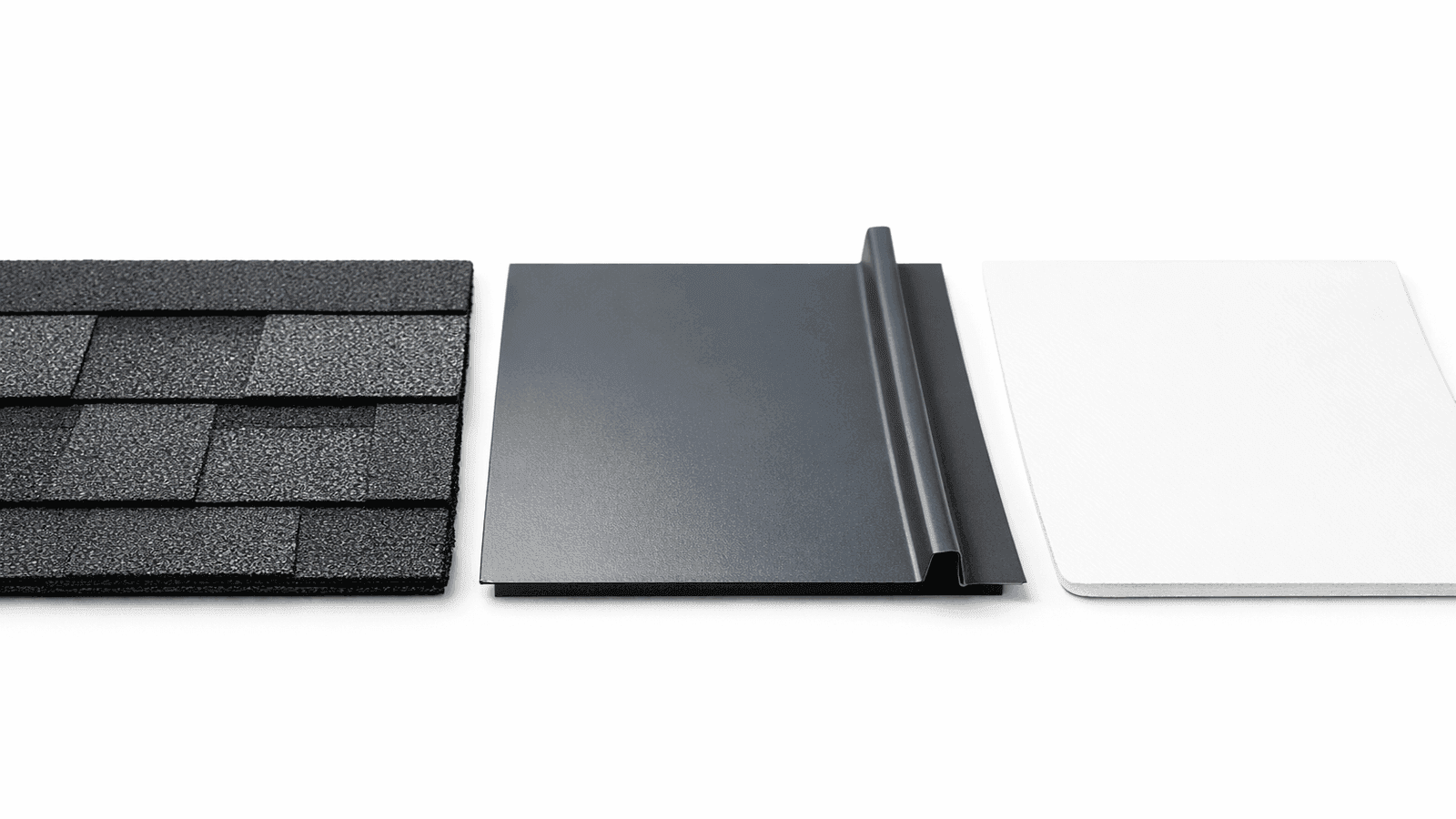
Photo: Close-up comparison of three roofing materials side by side: architectural asphalt shingle, standing seam metal panel, and TPO membrane
Waterproofing and Flashing Terms
Flashing failures cause roughly 95% of all roof leaks [1]. This is the category of roofing work that is most commonly done poorly, most frequently skipped on budget bids, and most important for long-term roof performance. These terms deserve careful attention in any contract.
Flashing: Thin pieces of corrosion-resistant metal (typically galvanized steel, aluminum, or copper) installed at joints, edges, and penetrations to direct water away from vulnerable areas. Flashing is the primary water-management layer at every roof transition. Improper flashing installation is the leading cause of roof leaks in residential construction.
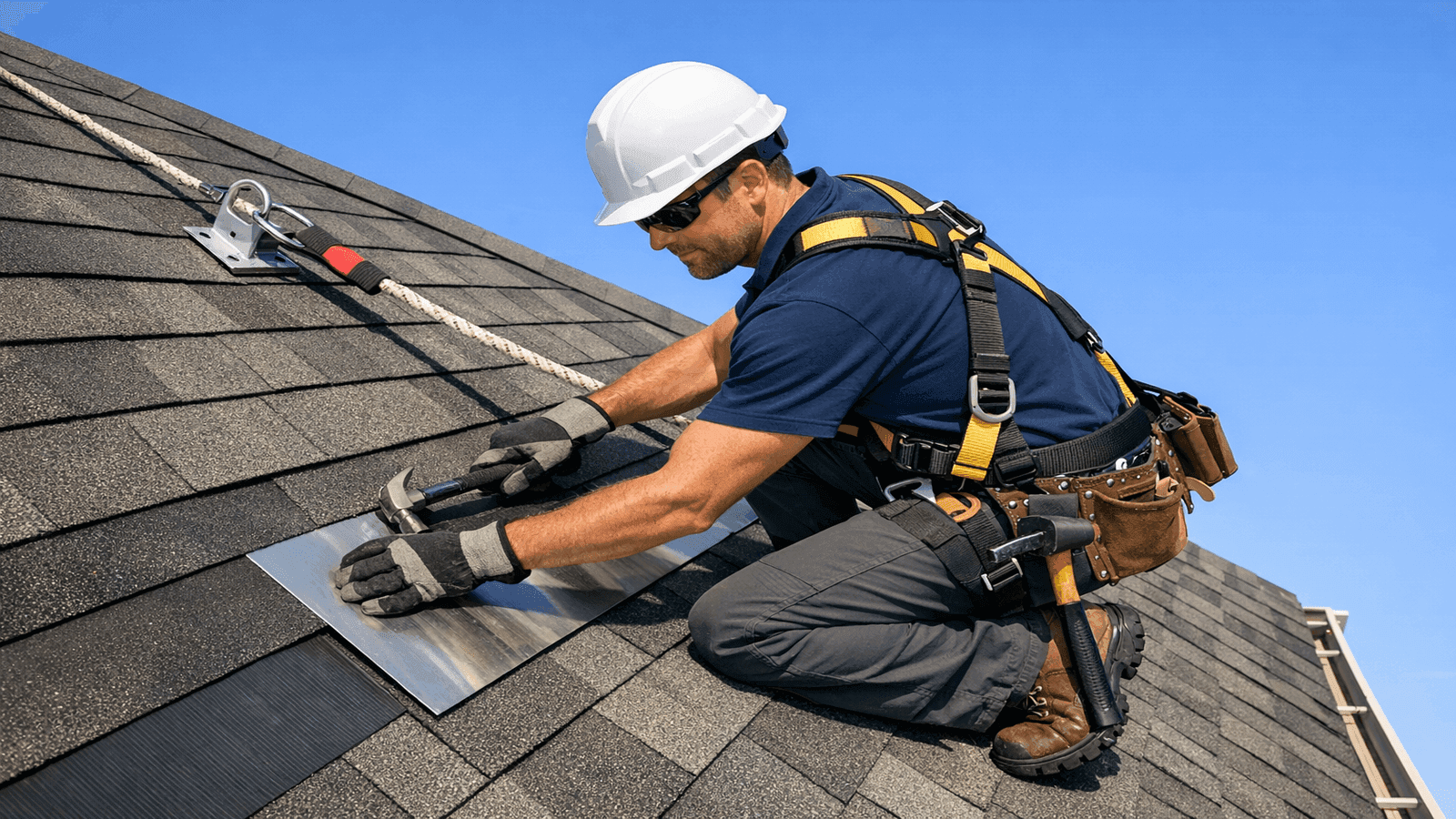
Step Flashing: Individual L-shaped pieces of metal installed course-by-course along the junction where a sloped roof meets a vertical wall (such as a side wall, dormer, or addition). Each piece of step flashing overlaps the one below and is woven between shingle courses. It creates a staircase-like waterproofing detail that is far more effective than a single continuous piece of metal bent over the joint.
Counterflashing: A second layer of flashing installed over step flashing or base flashing and embedded into a wall or chimney mortar joint. Counterflashing covers the top edge of the step flashing to prevent water from getting behind it. On chimneys, step flashing on the sides combined with counterflashing above is the correct two-piece system.
Chimney Flashing: The complete flashing assembly where a chimney penetrates the roof, consisting of base flashing (front apron), step flashing (sides), saddle or cricket flashing (back), and counterflashing. A properly flashed chimney uses multiple pieces working together. Single-piece or caulk-only chimney "flashing" is a known failure point.
Valley Flashing: Metal flashing installed in roof valleys before shingles are laid. Open valleys use exposed metal (typically W-metal or W-valley flashing) as the finished water channel. Closed-cut and woven valleys cover the metal with shingles but still rely on underlying metal flashing for waterproofing. Valley flashing is a critical item to verify in any roofing contract.
Drip Edge: An L-shaped metal flashing installed along the eave (bottom) and rake (side) edges of the roof. Drip edge serves two functions: it directs runoff into the gutter rather than behind it, and it prevents wind from lifting shingles at the edge. Most building codes require drip edge installation. It should be installed under the underlayment on rakes and over the underlayment at eaves.
Ice and Water Shield (also: Ice and Water Barrier): A self-adhering rubberized waterproofing membrane installed directly on the deck at eaves, valleys, and other vulnerable areas before underlayment. It seals around nails, preventing water infiltration even if shingles are lifted by ice dams or wind. Most codes require it at the first two to three feet of eave in cold climates.
Underlayment: A water-resistant (but not fully waterproof) layer installed over the roof deck and under the finished roofing material. Felt underlayment (#15 or #30 felt) is the traditional option; synthetic underlayment is lighter, stronger, and more tear-resistant. Underlayment provides a secondary moisture barrier if water gets under the shingles.
Pipe Boot (also: Pipe Flashing or Pipe Collar): A pre-formed rubber or metal sleeve that seals around vent pipes where they penetrate the roof. Rubber pipe boots crack and shrink over time as the rubber degrades from UV exposure and thermal cycling. A cracked pipe boot is one of the most common and most overlooked sources of attic leaks.
Cricket (also: Saddle): A small peaked structure, shaped like a tent, built behind a chimney or other wide roof penetration to divert water around it. Without a cricket, water ponds behind a chimney and accelerates rot and leakage. Building codes typically require a cricket for any chimney wider than 30 inches measured perpendicular to the roof slope.
Sealant (also: Caulk or Mastic): Flexible elastomeric compounds used to seal small gaps at flashings and penetrations. Sealant is a supplement to proper flashing, not a replacement for it. Bids that rely on caulk and sealant as the primary waterproofing method at chimneys or wall junctions are a red flag.
The most common callback I see in this business is a leak around the chimney or where a roof meets an addition wall. Almost every time, I find either missing step flashing, a single bent piece of aluminum used instead of counterflashing, or a joint that was just caulked. Proper flashing is labor-intensive and requires skill. When a bid is dramatically lower than others, look at the flashing spec first.
Ventilation Terms
Attic ventilation directly affects roof system longevity. Inadequate ventilation causes heat and moisture buildup that degrades shingles from the underside, warps decking, and voids manufacturer warranties. These terms appear on bids and inspection reports but are rarely explained to homeowners.
Ridge Vent: A continuous ventilation strip installed along the entire length of the roof ridge, allowing hot air to exhaust from the attic. Ridge vents work by convection: hot air rises to the peak and exits while cooler air enters at the soffits below. A properly installed ridge vent combined with adequate soffit venting is the most effective passive ventilation system for residential roofs.
Soffit Vent: Ventilation openings installed in the soffit (the underside of the eave overhang) that allow outside air to enter the attic. Soffit vents are the intake half of the ventilation system; ridge or gable vents are the exhaust half. Without adequate soffit ventilation, a ridge vent cannot function correctly because there is no airflow pathway.
Gable Vent: Louvered openings installed in the triangular gable ends of a home to allow cross-ventilation through the attic. Gable vents can work as a standalone ventilation system but are less effective than a balanced ridge/soffit system. When combined with ridge vents, gable vents can actually disrupt airflow patterns and reduce system efficiency.
Attic Fan (Power Ventilator): A mechanically powered fan installed in the roof or gable that actively exhausts hot air from the attic. Attic fans can be effective but add electrical cost and require maintenance. If a home's passive ventilation (ridge and soffit vents) is properly sized and unobstructed, attic fans are generally unnecessary.
Net Free Area (NFA): The actual open area of a vent product measured in square inches, after accounting for mesh, louvers, or baffles that restrict airflow. NFA is used to calculate whether a home has sufficient ventilation capacity. The standard requirement is 1 square foot of NFA per 150 square feet of attic floor area (or 1:300 with both intake and exhaust balanced).
Baffles (also: Rafter Vents): Cardboard or plastic channels installed between rafters in the attic to maintain an air pathway from soffit vents to the open attic space. Baffles prevent insulation from blocking soffit vent openings. They are required whenever blown-in or batt insulation is installed in an attic that relies on soffit venting.
Cost and Contractor Terms
These terms appear in proposals, contracts, and insurance estimates. Knowing them protects you during the bidding process and during any insurance claim.
Material Takeoff: The process of calculating the exact quantity of materials needed for a roofing project based on roof measurements. A proper material takeoff includes waste factors (typically 10-15% for standard roofs, up to 20% for complex roofs with multiple hips, valleys, and dormers). Contractors who cannot provide a written material takeoff on request may be estimating informally.
Labor Rate per Square: The cost to install one square (100 sq ft) of roofing material, separate from material cost. Labor rates vary significantly by region and material type. In the Dallas-Fort Worth area, labor for asphalt shingle installation typically runs $80-$150 per square; in higher cost-of-living markets, rates can reach $200 or more per square.
Tear-Off: The removal of the existing roofing material before new material is installed. A tear-off exposes the deck for inspection and is required when there are already two layers of shingles (most building codes prohibit a third layer) or when deck damage is suspected. Contracts should state clearly whether tear-off is included and at what cost.
Overlay (also: Re-Roof or Cap-Over): Installing a new layer of shingles directly over the existing layer without tear-off. Most codes allow one overlay. Overlaying can mask deck damage, adds weight to the structure, and reduces the lifespan of the new shingles (because the old layer underneath causes uneven installation). Overlays cost less upfront but are generally not recommended by quality contractors.
Manufacturer Warranty: A warranty provided by the shingle or roofing material manufacturer covering defects in the product itself. Manufacturer warranties range from 25 years to "lifetime" (which typically means the lifetime of the original owner, not the house). These warranties often require the roofing system to be installed exactly to manufacturer specifications, using other components from the same product line.
Workmanship Warranty: A warranty provided by the roofing contractor covering errors made during installation. Workmanship warranties are separate from and in addition to manufacturer warranties. A reputable contractor typically offers a 5-10 year workmanship warranty. Warranties shorter than 2 years should be treated skeptically.
Actual Cash Value (ACV): An insurance settlement method that pays the depreciated value of the damaged roof at the time of the claim, not the cost to replace it new. For a 15-year-old roof, ACV may cover only 30-40% of replacement cost, leaving the homeowner responsible for the remainder.
Replacement Cost Value (RCV): An insurance settlement method that covers the full cost to replace the damaged roof with new materials and labor, regardless of the roof's age. RCV policies are more expensive but provide significantly better protection. After an RCV claim, insurance companies typically release an initial ACV payment, then release the "recoverable depreciation" once the work is completed.
Supplement: In insurance claim contexts, a supplement is an additional claim filed after the initial insurance estimate to cover costs that were missed, underpaid, or discovered during construction (such as damaged decking found during tear-off). Legitimate contractors file supplements routinely on insurance jobs; contractors who discourage you from asking about supplements may be leaving money on the table.
Change Order: A written amendment to the original contract that documents a change in scope, materials, or price. Any deviation from the original contract should be documented in a signed change order before work proceeds. Verbal agreements about changes are extremely difficult to enforce.
Permit: A government-issued authorization required for most roofing projects that involve structural work or a full replacement. Permits ensure the work is inspected and meets local building codes. Contractors who offer to skip the permit to save money are exposing you to liability: if unpermitted work is discovered during a home sale or insurance claim, it can cause significant problems.
Lien Waiver: A document signed by the contractor (and subcontractors) confirming that they have been paid and waiving their right to file a mechanic's lien against your property. Always request a lien waiver upon final payment. Without one, a subcontractor your contractor failed to pay could potentially place a lien on your home.
For more detail on evaluating roofing proposals and what a complete roofing system includes, see: Roof Components Explained.

Photo: Infographic showing a roofing proposal document with labeled line items including tear-off, underlayment, flashing, shingles, and ventilation with cost ranges
Case Study: How Marcus Saved $3,200 by Knowing Roofing Terms
Marcus, a homeowner in Plano, Texas, received three bids for a full roof replacement on his 2,400 sq ft colonial after a hail storm. Two bids came in around $14,000-$15,000 and the third came in at $9,800. The low bid seemed like the obvious winner until Marcus read through the contract carefully, armed with a basic understanding of roofing terminology.
The $9,800 contract specified "overlay" rather than "tear-off," used three-tab shingles rather than architectural shingles, included no mention of ice and water shield, and listed "valley flashing as applicable" without specifying open or closed valley construction. When Marcus asked the contractor to explain each of those terms, the contractor became evasive and said "that's just standard industry practice."
Marcus declined that bid and hired one of the contractors who had provided the $14,500 proposal. That contractor's contract spelled out a complete tear-off, 30-year architectural shingles with a manufacturer warranty, full ice and water shield at all eaves and valleys, W-valley open flashing with copper valley metal, and a 7-year workmanship warranty.
The licensed roofers in our NearbyHunt network report that over 60% of homeowners who initially chose the lowest bid on a roofing project later discovered that key components (typically ice and water shield, step flashing, or proper ventilation) had been omitted or substituted with cheaper alternatives. Understanding the terms in the contract before signing is the single most effective protection against this outcome.
Contractor Red Flag Terms: What to Watch For
Certain words and phrases in a roofing proposal or sales conversation should trigger immediate follow-up questions. These terms are either intentionally vague, misused to justify poor work, or signal that the contractor is not operating transparently.
"Standard Materials": When a bid lists only "standard asphalt shingles" without specifying the manufacturer, product line, weight, or warranty class, the contractor can substitute any shingle they choose. Always require the exact product name, model, and manufacturer to be listed in writing.
"Code Minimum": Building codes establish the floor for acceptable construction, not a quality standard. "Code minimum" ventilation, flashing, or deck fastening is not the same as best practice. Quality contractors install to a higher standard than code minimum; using this term as a selling point is a red flag.
"We'll invoice you for any extra decking": Without a per-sheet price in the contract for additional decking, this line item becomes open-ended. Any deck replacement that is not priced per sheet (or capped) creates risk for cost overruns after the tear-off exposes the deck.
"We can handle the insurance claim for you": While contractors can assist with supplemental claims, be very cautious of any contractor who asks you to sign an Assignment of Benefits (AOB) agreement. An AOB transfers your rights under the insurance policy to the contractor, which removes your control over the claim and the settlement.
"No permit needed for this job": Any full roof replacement or significant structural roofing work requires a permit in virtually every U.S. jurisdiction. A contractor who tells you a permit is not needed (to avoid the inspection or because they are unlicensed) is creating liability for you as the homeowner.
"Cash only discount": Cash-only requests mean no paper trail, no consumer protection, and no recourse if the work is substandard or the contractor disappears. Legitimate contractors accept checks or credit cards and provide receipts.
"Lifetime warranty": Unless you have the warranty document in hand and have read the exclusions, a verbal "lifetime warranty" is meaningless. Most lifetime shingle warranties are prorated, non-transferable, and void if installation does not meet manufacturer specifications, which means they rarely cover what homeowners expect.
For context on the types of roofing issues that stem from poor installation and missed components, see: Common Roofing Problems.
According to consumer roofing guides, understanding which terms carry the highest financial risk is the fastest way to evaluate any proposal [6].
Get quotes from top-rated pros.
In 20 years and more than 1,800-plus projects across the U.S. South and Midwest, I've seen every version of the low-bid problem. The homeowner signs a vague contract, the contractor strips the job of anything that can't be seen from the ground, and the roof leaks in 3 years. The vocabulary in a roofing contract is not accidental. Contractors who use vague language are either sloppy or strategic about it. Either way, you're the one at risk.
Additional Roofing Terms Reference
The following terms appear frequently in roofing conversations, inspection reports, and insurance documents.
Fascia: The vertical board running along the lower edge of the roof, to which gutters are typically attached. Fascia boards can rot when gutters overflow or when drip edge is improperly installed, allowing water to run behind the gutter.
Soffit: The finished underside of the eave overhang, between the fascia and the exterior wall. In addition to its aesthetic function, the soffit houses intake ventilation (soffit vents) for the attic. Rotted or blocked soffits disrupt attic ventilation.
Dormer: A structural projection from the main roof slope containing a window. Dormers create multiple roof-wall junctions that require careful step flashing on all sides. They are one of the more complex areas of a residential roof to properly waterproof.
Skylight: A glazed opening in the roof that admits natural light. Skylights require a complete curb-and-flashing assembly and are among the most common sources of roof leaks when the surrounding flashing fails or when the curb is not properly waterproofed.
Curb: A raised perimeter frame, typically 8 inches or higher, on which a skylight or rooftop mechanical unit is mounted. The curb elevates the unit above the roof surface to prevent water infiltration. Curb height and flashing detail are critical to preventing leaks.
Penetration: Any element that passes through the roof assembly, including plumbing vents, electrical conduit, HVAC equipment, and skylights. Every penetration is a potential leak point and requires a proper flashing or boot assembly.
Felt (15-lb or 30-lb): Traditional asphalt-saturated paper underlayment used beneath shingles. 30-lb felt is heavier and provides better water resistance than 15-lb. Synthetic underlayment has largely replaced felt on new installations because it is lighter, more tear-resistant, and does not absorb water.
Synthetic Underlayment: A woven or spunbond polypropylene underlayment that is lighter, stronger, and more UV-stable than traditional felt paper. Synthetic underlayment can typically be left exposed for 30-180 days without degrading, which is useful during phased construction.
Hip and Ridge Cap Shingles: Pre-formed or cut shingle pieces installed along hip edges and the ridge line to cap the intersection of roof planes. Hip and ridge caps must be specifically designed for that application (not cut from field shingles) to maintain the manufacturer warranty on the overall system.
Starter Strip: A course of shingles (or purpose-built starter material) installed at the eave and rake edges of the roof before the first full shingle course. The starter strip seals the joints between field shingles at the most wind-vulnerable part of the roof and is required for warranty compliance on most architectural shingle systems.
Drip Edge: An L-shaped metal flashing installed along eave and rake edges. On eaves, it is installed under the ice and water shield. On rakes, it is installed over the underlayment. This distinction matters for correct water management and is frequently reversed by inexperienced crews.
Coverage: The area of shingle that remains exposed after installation, overlapped by the course above. Standard architectural shingles typically have 5.625 inches of exposure. Increasing exposure (to stretch material across more area) reduces weather resistance and may void the manufacturer warranty.
Self-Sealing Strip: An adhesive strip on the back of asphalt shingles that bonds to the course below after installation, activated by heat from the sun. This strip is essential for wind resistance. In cold climates, hand-sealing may be required if shingles are installed in cold weather when the strip will not activate on its own.
Heat Welding: A method of joining single-ply membrane sections (TPO, PVC) by melting the edges together with hot air, creating a monolithic seam. Heat-welded seams are considered superior to adhesive-bonded seams because they become part of the membrane itself rather than a separate bond.
R-Value: A measure of thermal resistance. While R-value is primarily an insulation term, it appears in roofing contexts when discussing insulated roof deck systems, particularly on low-slope commercial roofs. Higher R-values indicate better thermal performance and lower energy costs.
Slope Calculation: The process of measuring roof area based on actual slope, not just horizontal footprint. A steeply pitched roof has significantly more actual surface area than its footprint suggests. A 12:12 pitch roof has approximately 41% more surface area than a flat projection of the same footprint, which is why slope-adjusted pricing matters.
For a perspective on how roofing materials perform over time, see: How Long Do Roofs Last.

Photo: Detailed labeled diagram of a residential roof cross-section showing all layers from deck to shingles, with flashing details at valley, eave, and chimney
Roofing Term Quick Lookup by Project Phase
Use this quick reference to identify which terms matter most at each stage of your roofing project:
| Project Phase | Key Terms to Know | Why It Matters |
| Getting Estimates | square (100 sq ft), pitch, tear-off, overlay/cap-over, decking inspection | Understand exactly what you are paying for |
| Reviewing Contract | warranty (workmanship vs. manufacturer), permit, lien waiver, change order | Protect yourself legally and financially |
| During Installation | drip edge, starter strip, underlayment, ice and water shield, step flashing | Verify correct installation sequence |
| Inspection and Completion | valley, ridge cap, pipe boot, counterflashing, final inspection | Confirm all flashings sealed before payment |
| Long-Term Maintenance | granule loss, algae/moss, flashing failure, soffit/fascia, gutter slope | Know when to call a roofer early |
Disclaimer: The information in this article is intended for general educational purposes only. Roofing requirements, building codes, and contractor licensing standards vary by state, county, and municipality. Always verify that any contractor you hire is licensed, bonded, and insured in your state. For projects requiring permits, confirm requirements with your local building department before work begins. NearbyHunt does not provide legal, insurance, or structural engineering advice.
Conclusion
Understanding roofing terminology before you sign a contract is one of the most practical things you can do as a homeowner. It takes 15 minutes to review, and it can prevent thousands of dollars in disputes, omitted work, and substandard installations. The terms covered in this glossary, from the roofing square to step flashing to the assignment of benefits, appear in virtually every residential roofing proposal. Bookmark this page before your next contractor meeting, review the contract line by line, and ask for written clarification on any term you do not recognize. A contractor who cannot or will not explain their own proposal in plain language is telling you something important.
Sources & References
[1] National Roofing Contractors Association (NRCA) — Roofing Installation Best Practices and Leak Statistics: https://www.nrca.net/roofing-knowledge/technical-manual
[2] Asphalt Roofing Manufacturers Association (ARMA) — Residential Roofing Market Data: https://www.asphaltroofing.org/resources/statistics
[3] Insurance Institute for Business and Home Safety (IBHS) — Class 4 Impact Resistance Research: https://ibhs.org/hail/rating-the-resistance-of-residential-roofs-to-hail-impact/
[4] International Residential Code (IRC) — Section R905: Requirements for Roof Coverings: https://codes.iccsafe.org/content/IRC2021P2/chapter-9-roof-assemblies
[5] UL Standards — UL 2218 Impact Resistance of Prepared Roof Covering Materials: https://www.ul.com/resources/ul-2218-impact-resistance-roofing
[6] Forbes Home: Roofing Terms Glossary: https://www.forbes.com/home-improvement/roofing/roofing-terms/

James is a licensed roofing contractor with 20 years of experience in roof installation, inspection, and repair across the U.S. South and Midwest. He specialises in asphalt shingles, metal roofing, and storm damage restoration. On NearbyHunt, James offers practical advice on roof maintenance, insurance claims, and selecting the right materials for long-lasting protection.

Jacob is a licensed roofing contractor with over 18 years of experience in roof inspection, installation, and restoration. Based in Texas, he has led hundreds of successful roofing projects across residential and commercial properties. Jacob is also a certified storm damage specialist, ensuring that all NearbyHunt roofing content meets industry best practices and safety standards.