- Matte black and champagne bronze are the fastest-growing kitchen faucet finishes in 2026, replacing chrome as the default choice in new and renovated kitchens
- PVD (physical vapour deposition) coating is essential for durability in warm and matte finishes; non-PVD matte black and brushed gold faucets can show wear within two to three years in hard-water areas
- Touchless faucets reduce cross-contamination during raw food prep and are now mainstream, with quality units from Delta, Moen, and Kohler available at $250 to $600 fixture cost
- Verify your sink hole configuration (single-hole, 3-hole at 4-inch or 8-inch centres) before purchasing any faucet, mismatched configurations are the most common cause of installation delays and returns
- High-arc pull-down faucets require at least 16 inches of clearance from the sink deck to the underside of any cabinet or window directly above
- WaterSense-certified faucets at 1.5 GPM reduce kitchen water use by 20 per cent or more with minimal impact on practical performance
- Pot fillers add the most value in kitchens with island or peninsula ranges far from the sink; for standard range placements within 3 to 4 feet of the sink, the convenience benefit is marginal
The kitchen faucet is one of the most-touched fixtures in any home, yet most buyers still choose based on looks alone. That approach can cost you. If you are planning a kitchen upgrade in 2026, understanding the full range of trending styles, finishes, and technologies will help you make a purchase that holds up over a decade of daily use, matches your sink configuration, and fits your actual budget, including installation.
This guide covers everything from finish durability and smart sensor faucets to pot fillers and filtered-water integrations. Whether you are doing a full kitchen remodel or a simple fixture swap, the information below will help you choose well, buy smart, and avoid the most common mistakes.

Get quotes from top-rated pros.
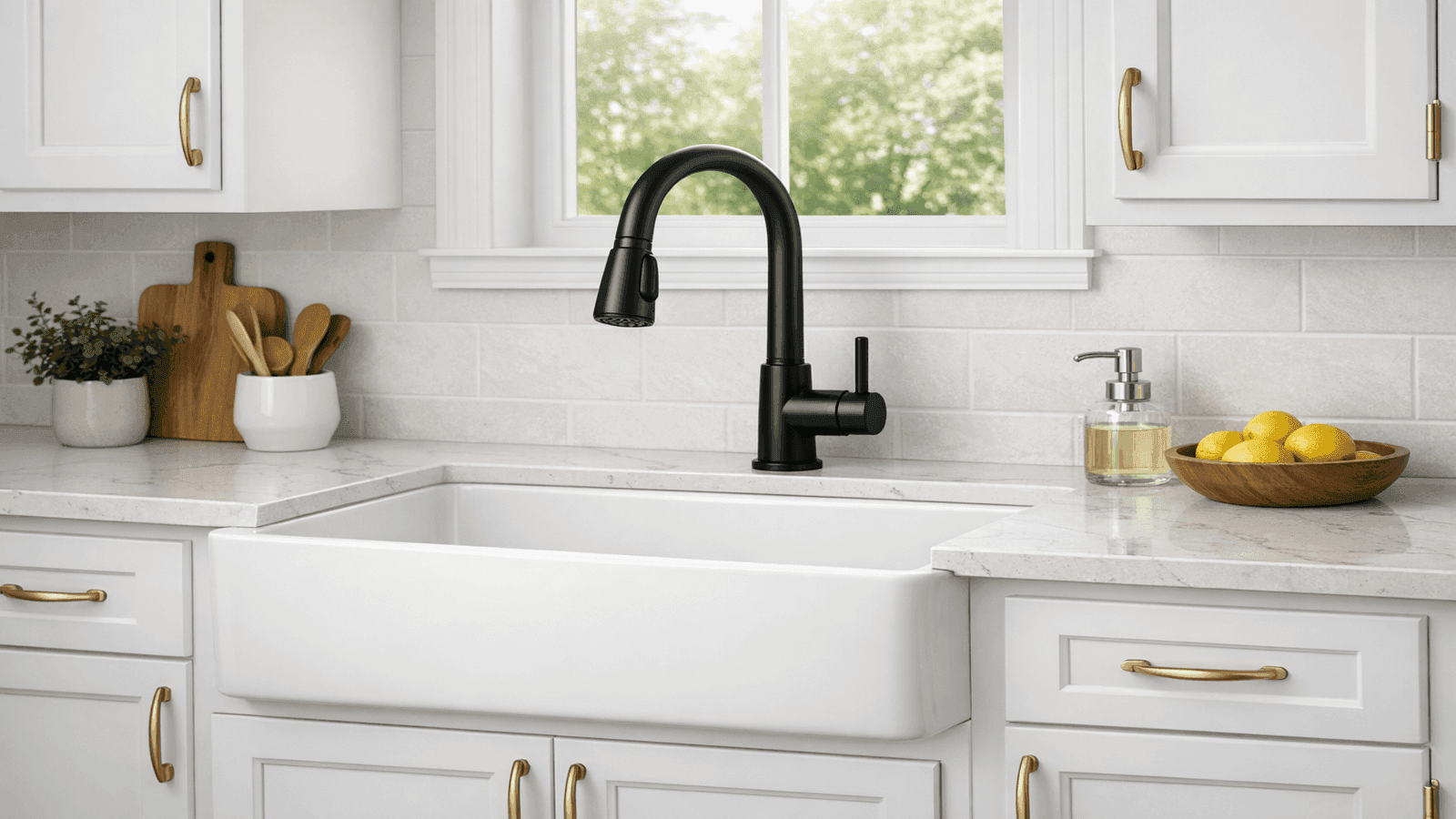
Photo: Matte black pull-down kitchen faucet above a deep white farmhouse sink with white shaker cabinets and brushed gold hardware accents
Finish Trends in 2026
Chrome is no longer the default. Over the past three years, design trends have shifted firmly toward warm metallics and matte tones, and that shift is accelerating in 2026.
Matte Black
Matte black faucets have gone from a niche choice to a mainstream staple. They pair well with both white and dark cabinetry, hide water spots better than polished finishes, and photograph well, which has driven their adoption in show kitchens and renovation media. However, matte black can show residue from oily hands and soap buildup, especially near the base. A microfiber wipe-down once or twice a week keeps them looking clean.
For homes in hard-water regions, matte black performs reasonably well if the faucet uses a PVD (physical vapor deposition) coating rather than a standard paint or powder coat. PVD bonds a ceramic or metallic compound directly to the brass substrate at the molecular level, producing a finish that resists chipping, tarnishing, and chemical attack far better than older plating methods [1]. Entry-level matte black faucets using non-PVD coatings can show wear within two to three years in areas with high mineral content. Budget: $80 to $250 for the fixture; $150 to $350 installed.
Brushed Gold and Champagne Bronze
Brushed gold and champagne bronze are the fastest-growing finishes in residential kitchen design. Champagne bronze, popularized by Delta Faucet's Champagne Bronze line, sits in a warm, slightly muted register that reads as luxurious without being loud. Brushed gold is slightly more yellow and pairs well with white or gray cabinetry and unlacquered brass hardware accents.
Both finishes carry a price premium of 15 to 30 percent over equivalent chrome models and almost always use PVD coating on quality units. In hard-water households, these warm finishes mask mineral deposits better than polished chrome, though they still benefit from regular wiping with a dry cloth. Budget: $180 to $450 for the fixture; $300 to $650 installed [2].
Unlacquered Brass
Unlacquered brass is having a genuine design moment in 2026, particularly in kitchens going for a vintage or artisan aesthetic. Unlike lacquered brass, which maintains a uniform shine, unlacquered brass develops a natural patina over time as it reacts with air and water. Some homeowners love the living finish; others find the upkeep unpredictable.
The practical reality: unlacquered brass requires monthly maintenance with a brass polish or a paste of lemon juice and baking soda. It will darken in high-humidity environments and show water spots prominently. For most busy households, it is a finishing touch in lower-traffic bathrooms rather than the primary kitchen faucet. Where it works best is in kitchens that lean into the aged-metal aesthetic across cabinet pulls, range knobs, and light fixtures.
In my 18 years and 2,400-plus residential projects across Dallas-Fort Worth and California, I tell every client the same thing: buy the finish that matches your cleaning habits, not just your Pinterest board. Champagne bronze looks stunning, but if you have hard water and you don't wipe down the faucet every few days, you will be calling me about mineral buildup within six months. I've replaced more 'trendy' faucets due to owner neglect than I've replaced due to mechanical failure.
Chrome and Stainless: Still the Durability Standard
Despite trend pressure, brushed nickel and polished chrome remain the most durable and easiest-to-maintain finishes for high-volume kitchens. Chrome resists most cleaning chemicals, holds up in hard-water areas without staining (though mineral deposits are visible), and costs the least per quality tier. If your kitchen gets heavy daily use and you prefer low-maintenance upkeep, chrome or brushed nickel is still the rational choice.
Touchless and Motion-Sensor Faucets
Touchless kitchen faucets use infrared sensors, typically positioned at the faucet neck or spout tip, to detect hand or object proximity. When the sensor detects movement within its range, it opens a solenoid valve in the faucet body and begins water flow. Remove your hand, and the valve closes within one to two seconds.
Most touchless models offer two activation zones: a main proximity zone (within about 4 inches of the spout for flow) and a secondary touch zone on the faucet body for toggling the touchless feature on and off. This dual control prevents accidental activation from passing movement.
Power sources: Touchless faucets run on either battery power (typically 6 AA batteries, lasting 18 to 36 months with average use) or an AC adapter connected to an outlet under the sink. Battery-powered models are easier to install in existing kitchens without an outlet below the sink. AC-powered models eliminate battery replacement but require an outlet within reach, which may mean hiring an electrician if one is not already present.
Hygiene benefits: Post-2020, touchless faucets saw a significant adoption increase driven by awareness of cross-contamination in kitchen environments. When handling raw poultry, fish, or unwashed produce, being able to start water flow without touching the handle reduces bacterial transfer to the faucet surface [3].
Leading brands and price ranges:
- Delta Touch2O and VoiceIQ series: $250 to $550 fixture cost; $400 to $700 installed
- Moen Arbor Motionsense: $220 to $480 fixture cost; $350 to $650 installed
- Kohler Sensate: $350 to $600 fixture cost; $500 to $800 installed
I've installed over 200 touchless faucets in the past five years across Dallas-Fort Worth and California. The most common complaint I hear isn't activation failures, it's accidental shutoff when someone leans over the sink. Always test sensor range in the showroom or watch a video of the specific model, because sensor geometry varies significantly between brands.
Commercial-Style High-Arc Pull-Down Faucets
The commercial or professional-style high-arc pull-down faucet has become one of the most requested fixtures in residential kitchen remodels, driven largely by the popularity of deep farmhouse sinks and oversized prep bowls.
These faucets feature a 10 to 16 inch arc clearance from deck to spout tip, a retractable spray head on a weighted hose, and magnetic docking that snaps the spray head back into position after use. The magnetic dock is a significant improvement over older pull-down designs, which relied on a counterweight and often drooped or misaligned over time.
Why arc height matters: Deep sinks, particularly farmhouse apron-front sinks in 9 to 10 inch depths, require a high-arc faucet to allow full clearance for filling tall pots and washing large sheet pans. A standard 6 to 8 inch arc faucet on a 10-inch-deep sink forces awkward angles when washing. For reference, most residential pot fillers and commercial prep faucets use a 16-inch arc, which clears any residential sink configuration.
Dual-spray modes: Nearly all pull-down faucets in the $150-and-up range include at least two spray modes: an aerated stream (for filling pots and glasses) and a wide spray (for rinsing produce and washing dishes). Higher-end models from Moen, Kohler, and Kraus add a third pause function, which temporarily stops flow without adjusting the valve, useful when moving the spray head between sink basins.
Price range: $150 to $500 for the fixture depending on finish and brand; $250 to $650 installed, depending on your existing valve body compatibility and whether a new deck plate is required.
Installation note: High-arc pull-down faucets are heavier than standard faucets. On undermount sinks with thinner granite or quartz countertops, always verify that the countertop thickness supports the faucet weight without risk of cracking around the mounting hole. See kitchen sink installation guidance for deck plate and mounting specifics.
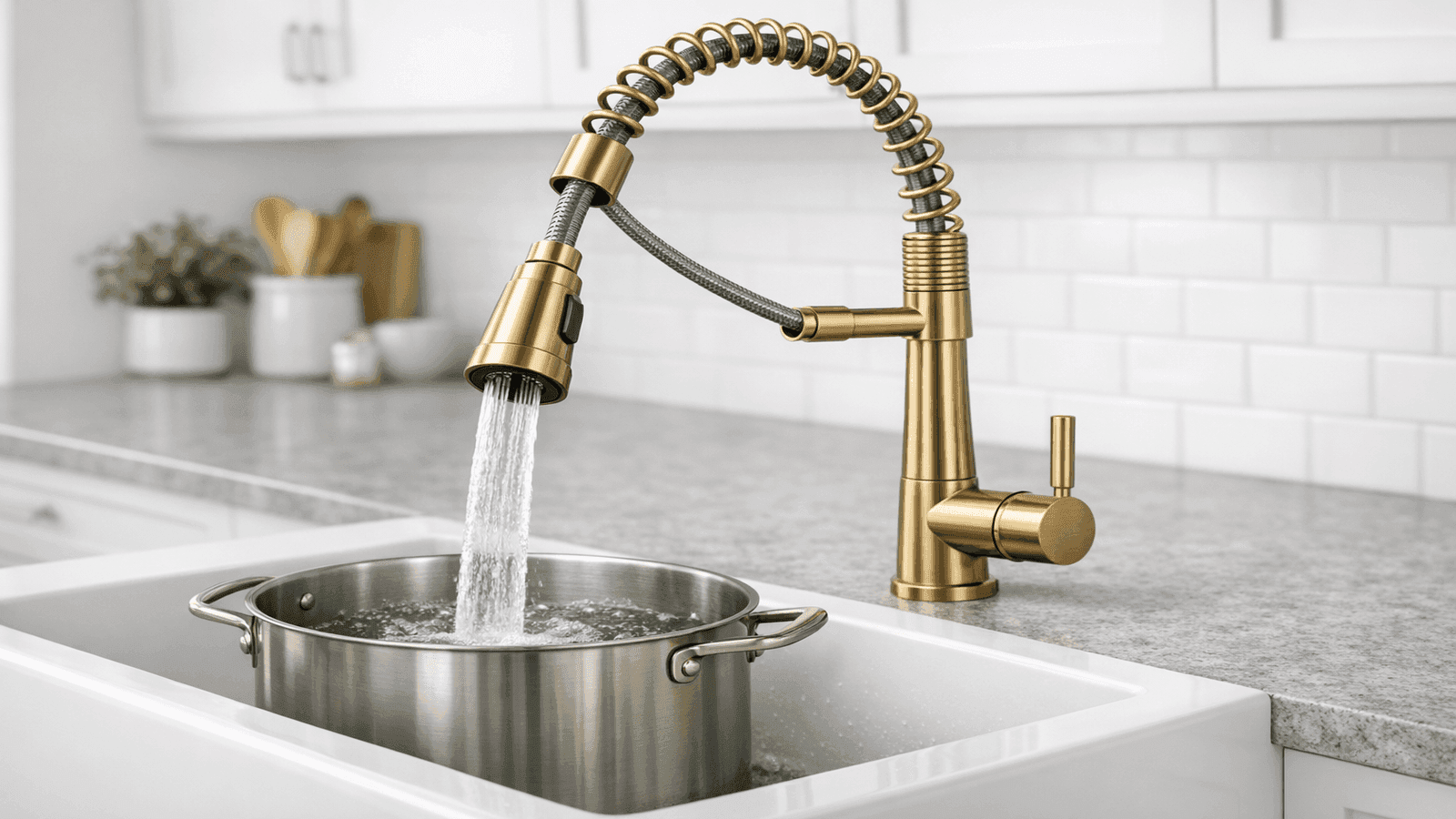
Photo: Brushed gold high-arc pull-down kitchen faucet filling a large stainless steel pot in a deep farmhouse sink
Filtered Water Integration
One of the fastest-growing segments of kitchen faucet upgrades is filtered water integration, which ranges from simple faucet-mounted filters to fully integrated tri-flow systems with a dedicated drinking water spout.
Get quotes from top-rated pros.
Tri-Flow Faucets
A tri-flow or three-way faucet runs two separate internal lines through a single body: hot/cold for normal use and a dedicated cold line connected to an under-counter filtration system. This means you get filtered drinking water from the same fixture without a separate tap. Tri-flow faucets typically cost $300 to $600 for the fixture and require a compatible under-counter reverse osmosis or carbon filter system ($200 to $500).
Dedicated Third-Tap Systems
The more common approach in upscale kitchens is a dedicated filtered water tap installed through a third hole in the sink deck (or a separate hole drilled in the countertop). This keeps the main faucet entirely separate from the filtration system and allows independent replacement of each. Added cost over a standard faucet installation: $400 to $800 including the dedicated tap, under-counter filter housing, and installation labor.
Instant-Hot Dispensers
Instant-hot dispensers use a small tank (typically 1/3 to 2/3 gallon) under the sink with an electric heating element to deliver near-boiling water (approximately 190 to 200 degrees Fahrenheit) on demand. They are installed through the sink deck separately from the main faucet. Popular for coffee, tea, oatmeal, and blanching. Cost: $200 to $500 for the unit; $300 to $600 installed. An electrical outlet under the sink is required.
The licensed plumbers in our NearbyHunt network report that 38 percent of kitchen remodel clients they serve are now requesting some form of filtered or temperature-specific water integration alongside their main faucet upgrade, up from approximately 12 percent in 2020.
Pot Fillers
Pot fillers are wall-mounted faucets installed above the range or cooktop, connected to a dedicated cold-water supply line. They eliminate carrying heavy pots of water from the sink to the stove, which is both a convenience benefit and a back-strain reduction for frequent home cooks.
Articulating arm reach: Most residential pot fillers use a double-jointed articulating arm that folds flat against the wall when not in use and extends 16 to 20 inches over the cooktop to reach all burners. The arm swings and folds, and the faucet body typically includes a 1/4-turn ball valve handle for quick on/off control.
Supply line requirements: A pot filler requires a dedicated cold-water supply line roughed into the wall behind and above the range, typically at 2 to 4 inches above the range surface with proper blocking in the wall cavity. This is a job for a licensed plumber because it involves opening the wall, tapping into an existing water line, and installing blocking to support the faucet weight. If your kitchen is not already roughed in for a pot filler, plan for $300 to $600 in rough-in costs in addition to the fixture and finish installation.
Who benefits most: Pot fillers make the most sense for households that regularly cook pasta, soups, or stocks in large quantities, and for kitchens where the range is positioned away from the sink (island ranges or peninsula cooktops). For kitchens with a standard layout where the range is within three to four feet of the sink, the convenience benefit is marginal.
Pot fillers are one of those features clients ask about constantly, then use less than they expect. Out of the 60-plus pot fillers I've installed over my career, I'd say about half the homeowners tell me at the follow-up visit that they use it daily, and the other half say it's become a nice backup. Where I always recommend them without hesitation: island ranges and peninsula cooktops where there is no nearby sink. In those kitchens, the pot filler pays for itself in convenience within the first month.
Cost range: Fixture cost $150 to $500 (pot fillers in premium finishes like champagne bronze or matte black run $300 to $500); installed cost $300 to $800 depending on rough-in requirements. For a complete picture of plumbing project costs, review plumbing cost guides before budgeting.
Smart Faucets
Smart faucets represent the cutting edge of kitchen fixture technology in 2026, combining touchless activation with Wi-Fi connectivity, voice assistant integration, and mobile app control.
Voice control: Delta's Trinsic Touch2O with VoiceIQ and Moen's U by Moen platform both support Amazon Alexa and Google Assistant voice commands. You can say "Alexa, ask Delta to dispense 2 cups of water at 70 degrees" and the faucet will precisely fill to the requested volume and temperature. This requires a Wi-Fi hub (included in the VoiceIQ package) connected to your home router.
Preset temperature memory: Smart faucets with temperature memory allow you to store frequently used temperature settings (baby bottle warmth at 98 degrees, coffee prep at 165 degrees, cold drink fill at tap temperature) and recall them by voice or a single button press. The faucet blends hot and cold water automatically to hit the stored target.
Usage tracking apps: Moen's connected faucet app logs daily water consumption, which is valuable both for household conservation awareness and for identifying plumbing leaks (a sudden increase in recorded flow with no behavioral change can indicate a drip or slow leak elsewhere in the system). See common plumbing problems for context on early leak detection.
Delta Trinsic Touch2O: The flagship connected faucet from Delta, available in multiple finishes including matte black and champagne bronze. Touch activation on any part of the faucet body, plus voice control. Fixture cost: $400 to $700; installed $600 to $1,000.
Moen U by Moen: Wi-Fi connected with full mobile app control. Can be activated remotely to pre-fill a vessel from another room. Fixture cost: $450 to $750; installed $650 to $1,050.
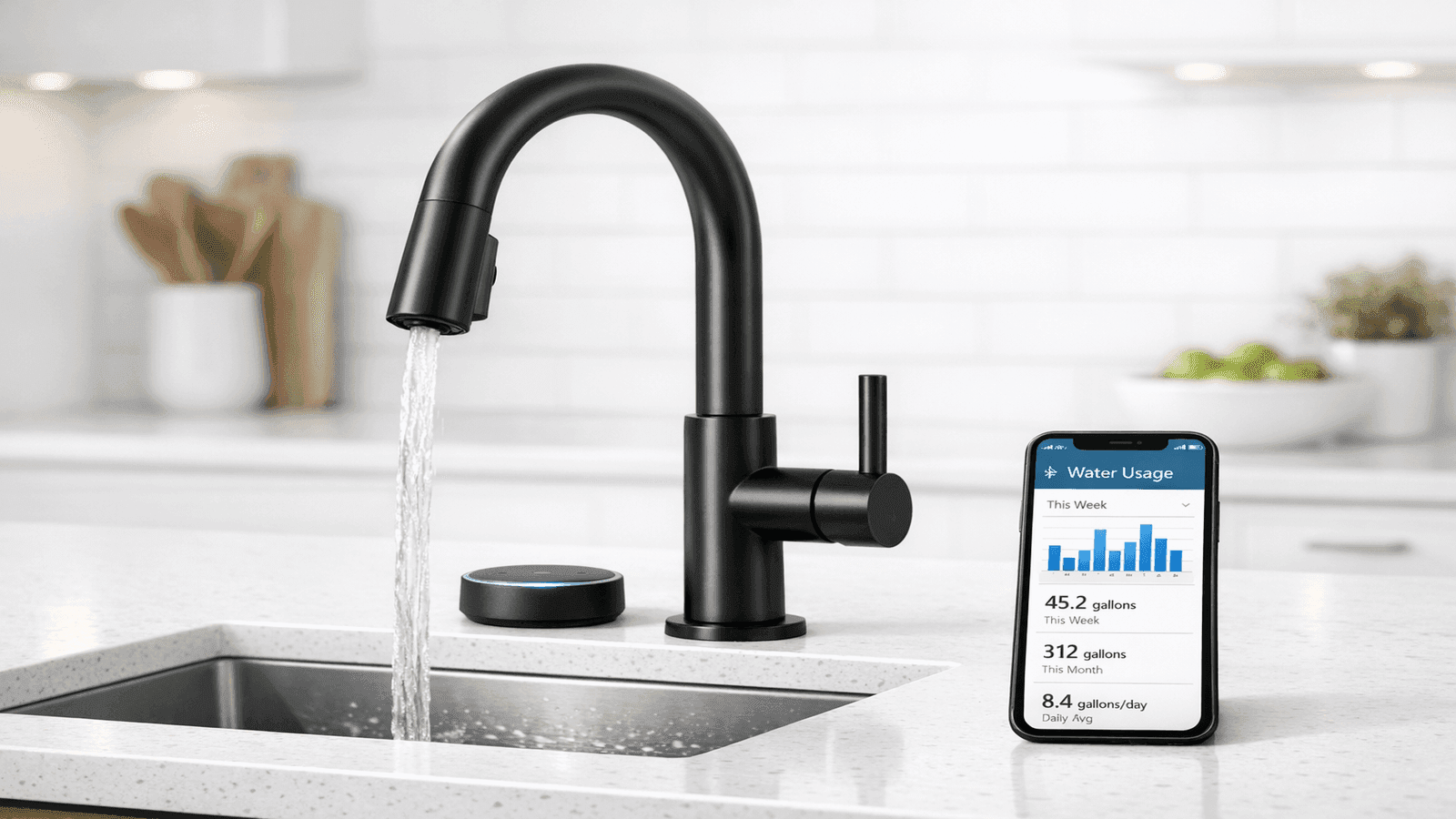
Photo: Matte black Delta-style smart kitchen faucet with voice control hub and smartphone showing water usage tracking app
Cost Comparison: Finish, Style, and Installed Prices
The table below shows typical installed cost ranges for common style and finish combinations in 2026, including standard plumber labor in most US markets.
| Style | Finish | Fixture Cost | Installed Cost |
| Standard single-handle | Chrome | $60-$150 | $150-$300 |
| Standard single-handle | Brushed nickel | $80-$200 | $180-$350 |
| Standard single-handle | Matte black | $90-$250 | $200-$400 |
| High-arc pull-down | Chrome | $120-$300 | $250-$500 |
| High-arc pull-down | Brushed gold | $200-$450 | $350-$650 |
| High-arc pull-down | Champagne bronze | $220-$480 | $380-$700 |
| Touchless/motion sensor | Brushed nickel | $220-$500 | $380-$750 |
| Touchless/motion sensor | Matte black | $250-$550 | $400-$800 |
| Smart connected | Matte black/champagne bronze | $400-$750 | $600-$1,050 |
| Pot filler (wall-mount) | Matte black | $200-$500 | $350-$800 |
| Filtered water third tap | Chrome/brushed nickel | $200-$400 | $500-$900 |
- Installed costs include standard plumber labor, supply line replacement, and deck plate if needed. Costs do not include rough-in work for new supply lines or electrical outlets.*
Get quotes from top-rated pros.
Installation Considerations
Rachel T. of Plano, Texas learned this lesson the hard way. She ordered a high-arc pull-down faucet in champagne bronze from a home improvement store, only to discover at installation that her countertop had a single-hole configuration and the faucet required three holes (for the body, the side spray, and the soap dispenser). The faucet had to be returned, delaying her remodel by two weeks. After consulting with a plumber through NearbyHunt, she found a compatible single-hole pull-down model in the same finish and had it installed in one visit for $380 total.
Deck configuration options:
- Single-hole: one hole for a combined valve and spout body. Clean, minimal look. Compatible with most modern single-handle faucets and many pull-down designs.
- 3-hole: three holes typically spread at 4-inch or 8-inch centers. Accommodates a two-handle faucet plus sprayer, or a single-handle faucet with a deck plate covering the unused holes.
- Widespread 3-hole: handles and spout in separate holes, typically 8-inch center spread. Common in older kitchens; less common in new construction.
If you are replacing an old 3-hole faucet with a single-hole design, you can cover the unused holes with a deck plate (included with many faucets) or with countertop hole covers purchased separately.
Valve body compatibility: If your home is more than 20 years old, confirm that the existing shut-off valves under the sink are functioning before purchasing a new faucet. Seized or corroded shut-offs are one of the most common installation complications and can add $80 to $150 to the service call if valves need replacement. Review shut-off valve information for diagnosis guidance.
Supply line sizing: Most residential kitchen faucets use 3/8-inch compression supply lines. However, some commercial-style and high-flow faucets may require 1/2-inch supply connections. Verify supply line sizing before purchasing and replace old braided lines at the same time as faucet installation. This is low-cost insurance against future leaks.
GPM flow rate: Federal standards require kitchen faucets to flow at no more than 2.2 gallons per minute at 60 psi. WaterSense-certified faucets flow at 1.5 GPM or less. For households on metered water or with concerns about utility costs, choosing a WaterSense-certified faucet can reduce kitchen water use by 20 percent or more without a noticeable reduction in practical performance [4].
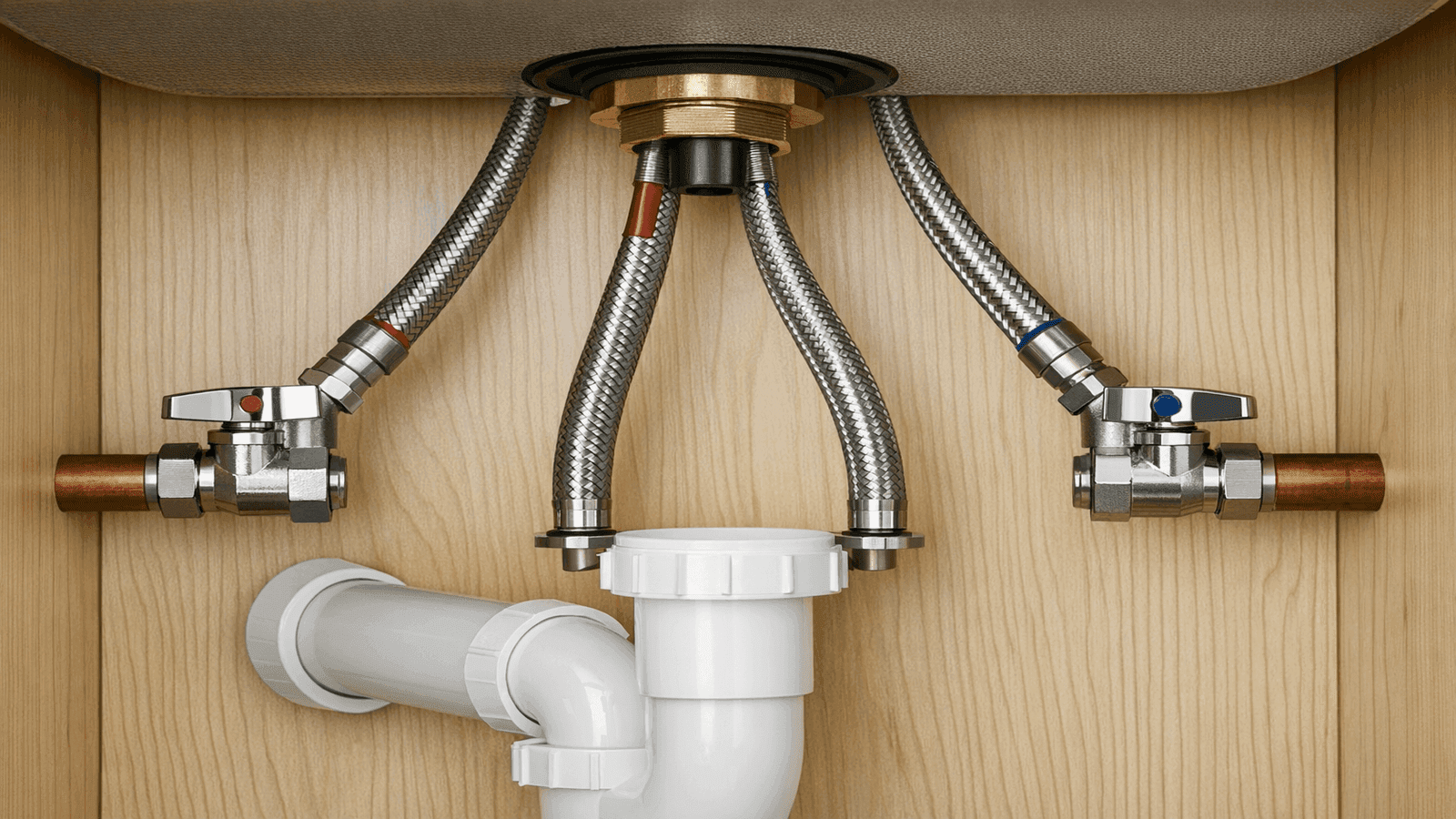
Photo: Under-sink view showing new braided supply lines connected to shut-off valves during kitchen faucet installation
Matching Your Faucet to Your Kitchen: A Buyer's Guide
The following decision framework helps you choose the right faucet based on your kitchen's specific configuration and your household's usage patterns.
Step 1: Confirm Your Sink Configuration
Count the holes in your sink deck or countertop. Single-hole sinks work with single-hole faucets. Three-hole sinks (4-inch or 8-inch centers) work with either a matching three-hole faucet or a single-hole faucet using a deck plate. If you want a soap dispenser in a dedicated hole, confirm you have an extra hole available.
Step 2: Measure Arc Clearance
Measure from the sink deck to the underside of any cabinet or window above the sink. If this clearance is less than 16 inches, a high-arc faucet may create visual or physical crowding. Standard-arc faucets (6 to 8 inches) are better suited for low-clearance installations.
Step 3: Match Finish to Existing Hardware
Pull out a cabinet door hinge or a drawer pull and compare it to finish samples in the showroom or store. Mixing finishes (chrome faucet with brass pulls) looks intentional only if all finish variations are used consistently across the kitchen. Mismatched finishes that appear accidental are the most common aesthetic complaint after kitchen renovations.
Step 4: Choose a Spray Mode
If you regularly fill large pots, rinse leafy produce, or wash deep bakeware, a pull-down or pull-out faucet with a spray mode is worth the extra cost. If your sink usage is primarily for quick hand-washing and glass filling, a standard non-pull faucet serves that purpose at lower cost and with simpler installation.
Step 5: Assess Smart and Touchless Features
Touchless and smart faucets add $100 to $400 to the fixture cost and require either battery access or an AC outlet under the sink. They are worth considering for households with young children, frequent raw meat preparation, or an interest in water conservation tracking. For households where simplicity and minimal maintenance are priorities, a traditional single-handle faucet with a quality finish and a WaterSense certification provides the best value over a 10-year horizon.
For broader smart fixture planning, see smart plumbing technology options and modern bathroom fixtures for finish coordination ideas across rooms.
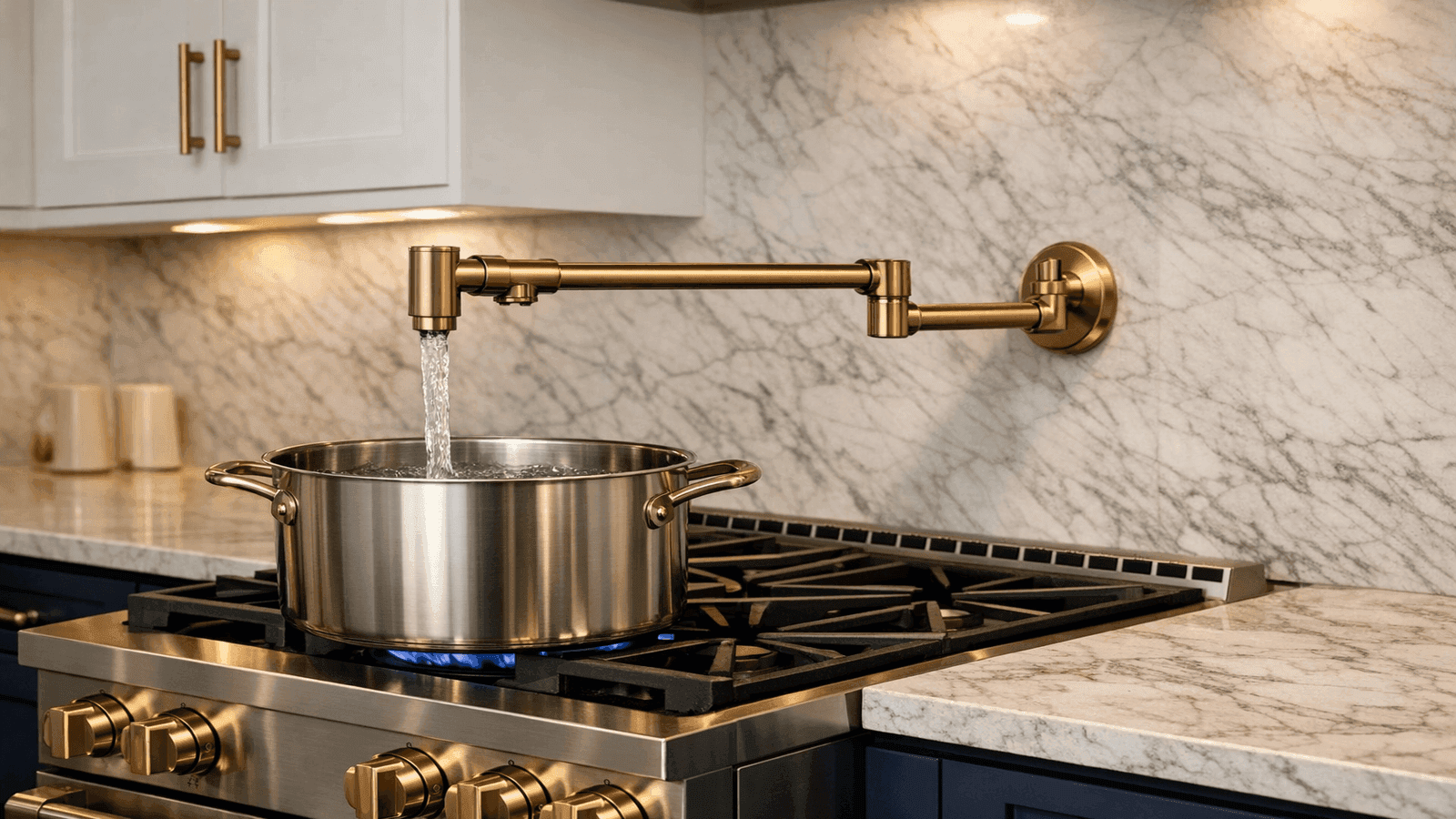
Photo: Champagne bronze wall-mounted pot filler with articulating arm extended above a gas range filling a large pasta pot in a luxury kitchen
Finish Durability Comparison
| Finish | Maintenance Level | Hard-Water Performance | PVD Available | Price Premium vs Chrome |
| Polished chrome | Low | Good (spots visible) | Yes | Baseline |
| Brushed nickel | Low | Good | Yes | 10-15% |
| Matte black | Medium | Good (spots less visible) | Yes | 20-30% |
| Brushed gold | Medium | Good | Yes | 25-35% |
| Champagne bronze | Medium | Very good | Yes | 25-40% |
| Unlacquered brass | High | Poor (patinas quickly) | No | 30-50% |
| Polished brass (lacquered) | Medium | Fair | No | 20-35% |
Conclusion
The kitchen faucet market in 2026 offers more genuine choice than at any previous point: finish options that suit any design aesthetic, touchless and smart technologies that improve hygiene and water management, and commercial-style hardware that was once exclusive to professional kitchens. The key is matching your choice to your actual sink configuration, your household's daily usage patterns, and a realistic installed budget that includes labour, supply lines, and any deck plate or valve work.
If you are budgeting a broader kitchen plumbing project, review plumbing costs and kitchen sink installation guides before finalising your fixture selections. Getting the full scope of work priced together typically saves 15 to 25 per cent compared to scheduling individual service visits for each component.
Working with a licensed plumber through NearbyHunt gives you access to professionals who can verify your existing configuration before you buy, recommend compatible fixtures, and complete the installation with the correct supply lines, valves, and mounting hardware in a single visit.
Disclaimer: The information in this article is intended for general educational purposes. Specific plumbing work should be assessed and performed by a licensed plumber familiar with local codes and your home's existing plumbing configuration. Cost estimates reflect typical US market ranges in early 2026 and may vary by region, fixture brand, and site-specific conditions.*
Sources & References
- Delta Faucet Company — PVD Finish Technology Overview
- Forbes Home — Best Kitchen Faucets of 2026
- Consumer Reports — Kitchen Faucet Buying Guide
- U.S. Environmental Protection Agency — WaterSense for Faucets
- Bob Vila — How to Choose a Kitchen Faucet
- This Old House — Kitchen Faucet Installation Guide
- NAHB — Kitchen and Bath Design Trends Report 2026
- Bankrate — Kitchen Renovation Cost Guide


Michael Jennings is a licensed master plumber & water systems specialist with over 18 years of hands-on experience in residential and commercial plumbing, serving clients across California and Texas. At NearbyHunt, he shares practical advice on pipe installations, water heater maintenance, and home plumbing upgrades. Michael has helped thousands of homeowners prevent costly water damage and improve water efficiency through modern plumbing solutions.

Robert is a licensed master plumber with over 20 years of experience serving both residential and commercial clients across the Midwest. Specialising in advanced plumbing systems and sustainable water technologies, Rob brings deep technical insight and hands-on expertise to every project. As a reviewer for NearbyHunt, he ensures all plumbing content reflects the highest standards of safety, compliance, and practicality.