- Most HVAC repairs cost $150 to $900, with the national average sitting around $450 for a single visit and fix [1].
- Service call fees run $75 to $200 before any parts or labor, and emergency after-hours calls typically double that range [2].
- Capacitor replacement is the most common repair at $150 to $400 total, while compressor replacement is the most expensive at $1,500 to $3,500 [3].
- The 50% rule still holds in 2026: if the repair costs more than half the price of a new system, replacement is the stronger financial move [4].
- R-410A refrigerant prices have climbed 40 to 60 percent since the January 2025 production phase-down, making leak repairs on older systems increasingly expensive [5].
When your HVAC system breaks down mid-July or stops heating in January, the first question is always the same: how much is this going to cost? The honest answer depends on what failed, how old the system is, and whether the repair makes financial sense compared to replacement.
HVAC repair costs in 2026 range from $75 for a simple drain line flush to $3,500 or more for a compressor swap. That spread exists because an HVAC system has dozens of components with different failure rates, part costs, and labor requirements. A capacitor that costs $15 at the supply house still carries $150 to $400 in total cost once you factor in the service call, diagnosis time, and installation. A compressor that costs $800 wholesale requires 3 to 5 hours of skilled labor, refrigerant recovery, and system testing.
Daniel Torres, a Certified HVAC Technician and Energy Efficiency Consultant with 14 years of field experience in Minneapolis, MN (EPA 608 Universal, NATE Certified, HVAC Excellence), contributed the expert analysis and cost breakdowns throughout this article. His pricing data is drawn from over 2,400 residential service calls he has completed across the upper Midwest. For full system replacement pricing and installation guidance, see our HVAC costs guide.

Get quotes from top-rated pros.
The repair that catches homeowners off guard most often is refrigerant. They expect a $200 recharge, but when I explain that R-410A has gone from $40 per pound to $75 to $90 per pound since the 2025 phase-down, and their 3-ton system needs 4 to 6 pounds, the math changes fast. That is before we even find and fix the leak that caused the loss. I always run through the full cost picture before touching the gauges.
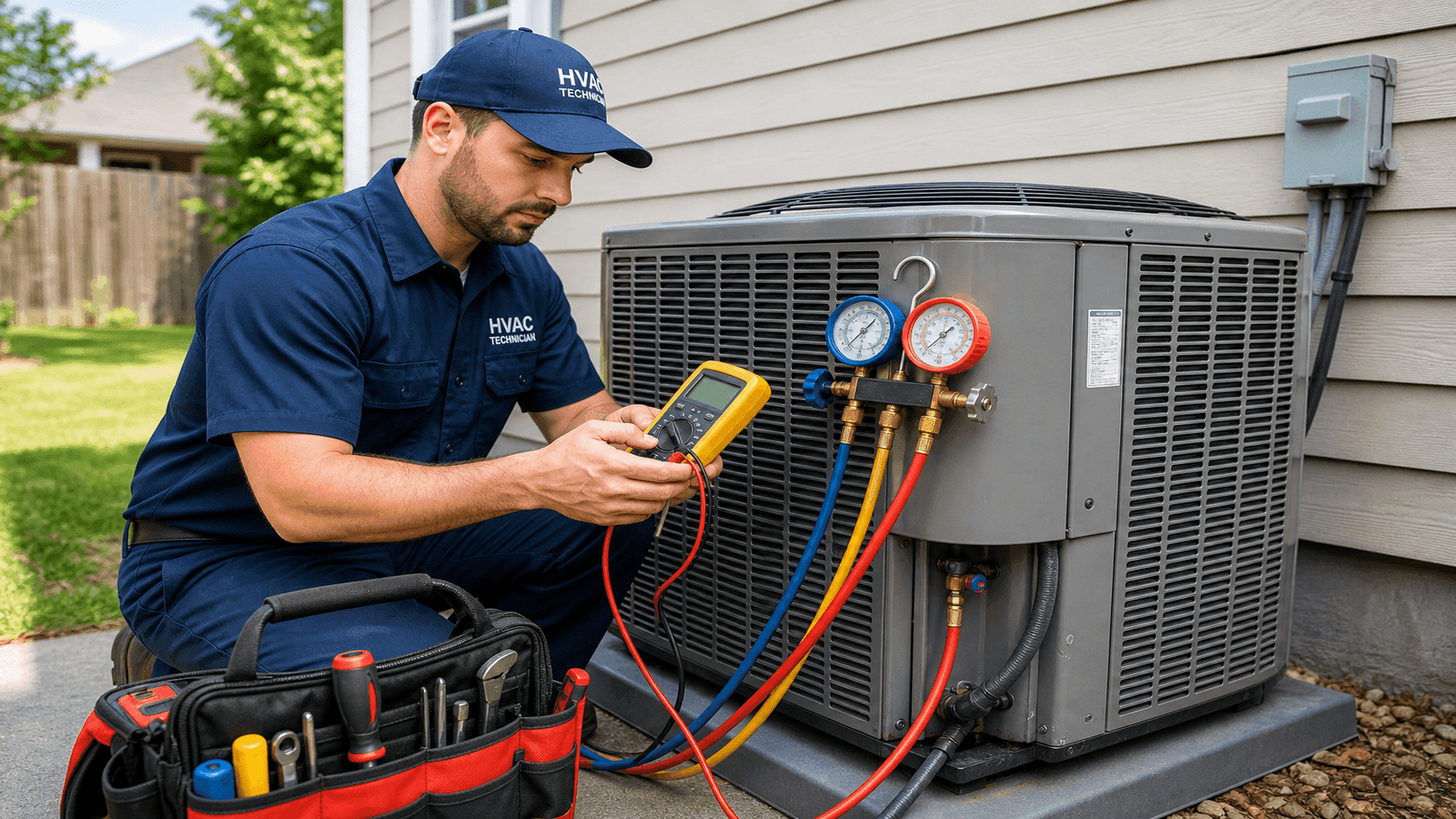
Photo: Technician diagnosing an HVAC system with multimeter and gauges at a residential outdoor unit
Average HVAC Repair Costs in 2026
The table below reflects 2026 national averages based on contractor pricing data, NearbyHunt network quotes, and industry cost surveys. Lower-end figures apply to straightforward fixes on accessible equipment. Higher-end figures account for hard-to-reach installations, older systems requiring discontinued parts, or premium-brand components.
| Repair Type | Average Cost (Parts + Labor) | Typical Time |
| Capacitor replacement | $150 to $400 | 30 to 60 min |
| Contactor replacement | $200 to $450 | 45 to 90 min |
| Refrigerant recharge (R-410A) | $250 to $700 | 30 to 60 min |
| Refrigerant leak repair + recharge | $500 to $1,500 | 2 to 4 hours |
| Blower motor replacement | $400 to $1,000 | 1 to 3 hours |
| Condenser fan motor | $300 to $700 | 1 to 2 hours |
| Evaporator coil replacement | $1,000 to $3,500 | 3 to 6 hours |
| Condenser coil replacement | $1,500 to $3,000 | 3 to 5 hours |
| Compressor replacement | $1,500 to $3,500 | 3 to 5 hours |
| Circuit board replacement | $400 to $900 | 1 to 2 hours |
| Thermostat replacement | $150 to $400 | 30 to 60 min |
| Drain line cleaning or repair | $75 to $250 | 20 to 45 min |
| Igniter replacement (furnace) | $150 to $400 | 30 to 60 min |
| Flame sensor cleaning/replacement | $100 to $300 | 20 to 45 min |
| Expansion valve replacement | $350 to $800 | 2 to 3 hours |
Most homeowners pay between $250 and $650 for a single repair visit. The NearbyHunt network average across all HVAC repair categories in Q1 2026 was $467, a 6 percent increase over the same period in 2025 driven primarily by refrigerant and component cost inflation [1].
Service Call Fees and Hourly Rates
Before any repair work begins, most HVAC companies charge a service call fee, also called a diagnostic fee or trip charge. This covers travel time, initial inspection, and the diagnosis itself.
Service Call Fee Breakdown
| Fee Type | Typical Range |
| Standard service call (weekday) | $75 to $150 |
| After-hours or weekend call | $125 to $250 |
| Emergency same-day service | $150 to $300 |
| Holiday call | $200 to $400 |
Hourly labor rates for licensed HVAC technicians run $85 to $150 per hour for residential work in 2026 [2]. Commercial rates are higher, typically $110 to $190 per hour. Many companies roll the service call fee into the total repair bill if you authorize the work, so the diagnostic fee effectively becomes a deposit toward the repair.
Flat-rate pricing has become more common in residential HVAC. Rather than charging hourly, the technician quotes a fixed price for the repair after diagnosis. This gives homeowners more cost certainty. In Daniel's experience, about 65 percent of residential HVAC companies in the Minneapolis metro now use flat-rate books rather than time-and-materials billing.
Get quotes from top-rated pros.
I tell every homeowner to ask one question before authorizing work: "Does the service call fee apply toward the repair if I say yes?" Most reputable companies will credit the diagnostic fee. If a company charges $150 for the diagnostic and then quotes $400 for the capacitor on top of that, you are paying $550 total. Another company might charge $100 for the diagnostic but credit it toward a $350 total repair. Same work, $200 difference.
Common HVAC Repairs: Costs and Details
Capacitor Replacement ($150 to $400)
The capacitor is the single most common HVAC repair. This small cylindrical component stores and delivers the electrical charge needed to start the compressor and fan motors. When a capacitor fails, the system either will not start at all or cycles on and off rapidly.
Why it fails: Heat exposure is the primary killer. Capacitors degrade faster in hot climates and in systems that run frequently. A capacitor rated for 10 to 15 years of service in Minnesota may last only 6 to 8 years in Phoenix or Houston [3].
Parts cost: The capacitor itself costs $8 to $45 depending on type (single run vs. dual run) and voltage rating. The labor and diagnostic time account for most of the bill.
Warning signs: Humming from the outdoor unit without the fan spinning, the system struggling to start, or intermittent shutdowns on hot days.
A failed capacitor that goes unaddressed forces the compressor to work harder on startup, which can burn out the compressor motor. A $200 capacitor repair that gets ignored for a season can turn into a $2,500 compressor replacement.
Refrigerant Recharge and Leak Repair ($250 to $1,500)
Refrigerant issues are the second most common HVAC service call and the one where costs have shifted the most in 2026. The January 2025 phase-down of R-410A production under the AIM Act has pushed wholesale prices from $25 to $40 per pound up to $50 to $90 per pound in many markets [5].
Simple recharge (no leak found): $250 to $700 for 2 to 6 pounds of R-410A. However, a properly sealed system should not lose refrigerant. If a technician says you need a recharge, insist on a leak search first.
Leak repair plus recharge: $500 to $1,500 depending on leak location. Evaporator coil leaks and line set leaks are more expensive to access and repair than valve or fitting leaks.
R-454B considerations: Systems manufactured after January 2025 use R-454B (Solstice N15) or similar A2L refrigerants. These currently run $30 to $80 per pound and require technicians with updated safety training due to the mild flammability classification [5].
Real-World Example (Nguyen Household, Minneapolis, MN): The Nguyen family called Daniel in August 2025 when their 9-year-old Carrier system stopped cooling. Diagnosis revealed a pinhole leak at a factory braze joint on the evaporator coil. The coil was under the manufacturer's 10-year parts warranty, but labor, refrigerant recovery, evacuation, and recharge totaled $1,150. Without the parts warranty, the total would have been $2,800. Daniel's recommendation: repair was justified because the system had 6 to 8 years of expected life remaining and the warranty covered the most expensive component.
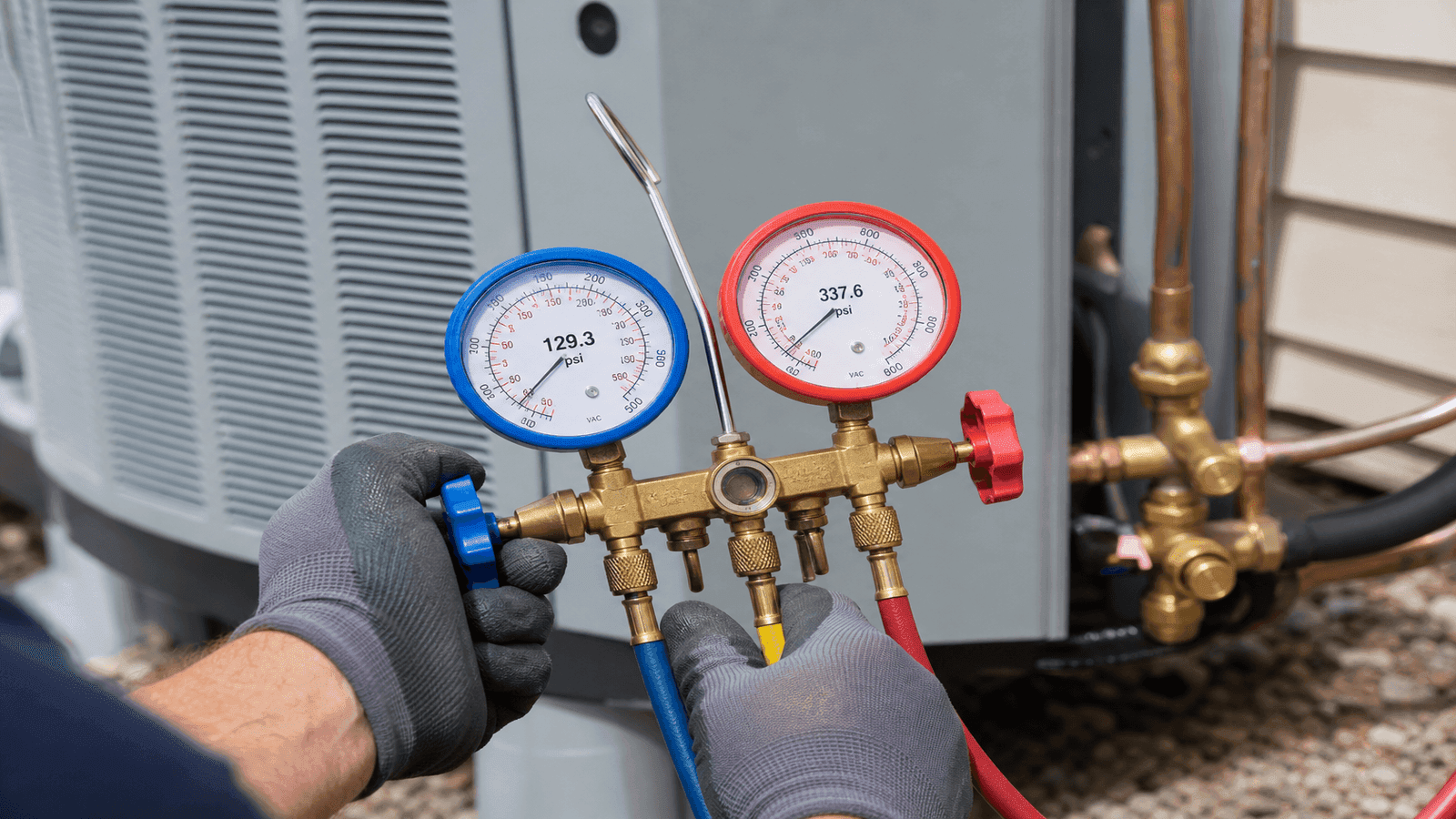
Photo: Close-up of HVAC technician checking refrigerant pressure gauges on a residential air conditioning unit
Blower Motor Replacement ($400 to $1,000)
The blower motor pushes conditioned air through the ductwork. When it fails, you get no airflow even though the outdoor unit may still be running.
Variable-speed vs. single-speed: Variable-speed ECM motors cost $350 to $700 for the part alone, compared to $100 to $250 for a standard PSC motor. The labor is similar for both types (1 to 3 hours), but the part cost difference pushes the total bill significantly higher for variable-speed systems [3].
Warning signs: Weak airflow from vents, squealing or grinding sounds from the air handler, or the system blowing room-temperature air.
Lifespan: A well-maintained blower motor typically lasts 10 to 20 years. Dirty filters are the leading cause of premature blower motor failure because they force the motor to work harder and run hotter.
Compressor Replacement ($1,500 to $3,500)
The compressor is the heart of the system and the most expensive component to replace. It pressurizes refrigerant and circulates it between the indoor and outdoor coils.
When compressor replacement makes sense: Only on systems under 8 to 10 years old with a valid parts warranty. A compressor replacement on a 14-year-old system is rarely a good investment because other major components (coils, motors, circuit boards) are approaching the end of their service life too [4].
Parts warranty matters: Most manufacturers offer 5 to 10 year compressor warranties. If the compressor fails within the warranty window, the homeowner pays only for labor, refrigerant, and miscellaneous parts, typically $800 to $1,200. Without warranty coverage, the total reaches $2,500 to $3,500.
Compressor failure causes: Low refrigerant (from unaddressed leaks), electrical problems, acid buildup from moisture contamination, and overheating from dirty condenser coils. Four out of five compressor failures Daniel has seen in his career trace back to a smaller problem that went unfixed.
Evaporator and Condenser Coil Replacement ($1,000 to $3,500)
Coil replacements sit in the mid-to-high repair cost range and often trigger the repair-vs-replace conversation.
Evaporator coil (indoor): $1,000 to $3,500 installed. The coil itself costs $600 to $2,000, and labor runs $400 to $1,500 because accessing the coil inside the air handler or furnace cabinet can be time-consuming [6].
Condenser coil (outdoor): $1,500 to $3,000 installed. Slightly easier to access than evaporator coils, but the parts tend to be more expensive.
Common failure mode: Formicary corrosion (tiny pinhole leaks caused by acids from household chemicals) is the leading cause of evaporator coil failure in systems under 10 years old. The leaks are often too small to see but large enough to lose refrigerant over weeks or months.
Repair vs. Replace: The Decision Framework
The most consequential HVAC decision a homeowner faces is not which repair to approve, but whether repairing the system is still the right financial strategy. Two widely used rules help frame the decision.
The 50% Rule: If the repair costs 50 percent or more of the price of a new system, replace rather than repair. For context, a new mid-efficiency system installed averages $7,000 to $14,000 in 2026, so the 50% threshold falls between $3,500 and $7,000 depending on system type [4].
The $5,000 Rule: Multiply the system's age (in years) by the repair cost. If the result exceeds $5,000, replacement is typically the better investment.
| System Age | Repair Cost | Age x Cost | Recommendation |
| 5 years | $800 | $4,000 | Repair |
| 8 years | $600 | $4,800 | Repair (borderline) |
| 10 years | $700 | $7,000 | Replace |
| 12 years | $500 | $6,000 | Replace |
| 15 years | $400 | $6,000 | Replace |
| 6 years | $1,200 | $7,200 | Replace (major component) |
Additional factors that tilt toward replacement:
- The system uses R-22 refrigerant (discontinued, $100 to $200+ per pound)
- Energy bills have increased 20 percent or more over the past 3 years with no rate change
- The system has needed 2 or more repairs in the past 12 months
- Federal or state rebates are available (IRA heat pump rebates of up to $8,000 for qualifying households remain active through 2032) [7]
Additional factors that tilt toward repair:
- System is under 8 years old with a valid warranty
- The repair is under $500 and the system has been well-maintained
- No other components show signs of wear
- Replacement would require ductwork modifications that inflate the total cost
Get quotes from top-rated pros.
The $5,000 rule is a solid starting point, but I also look at repair frequency. A 10-year-old system that has never needed a repair and now needs a $600 blower motor is a clear repair candidate. A 10-year-old system that needed a capacitor last year, a contactor this spring, and now the blower motor is going? That system is telling you it is entering the cascade failure stage. Every component has roughly the same accumulated wear, and once one major part goes, the others tend to follow within 12 to 24 months.
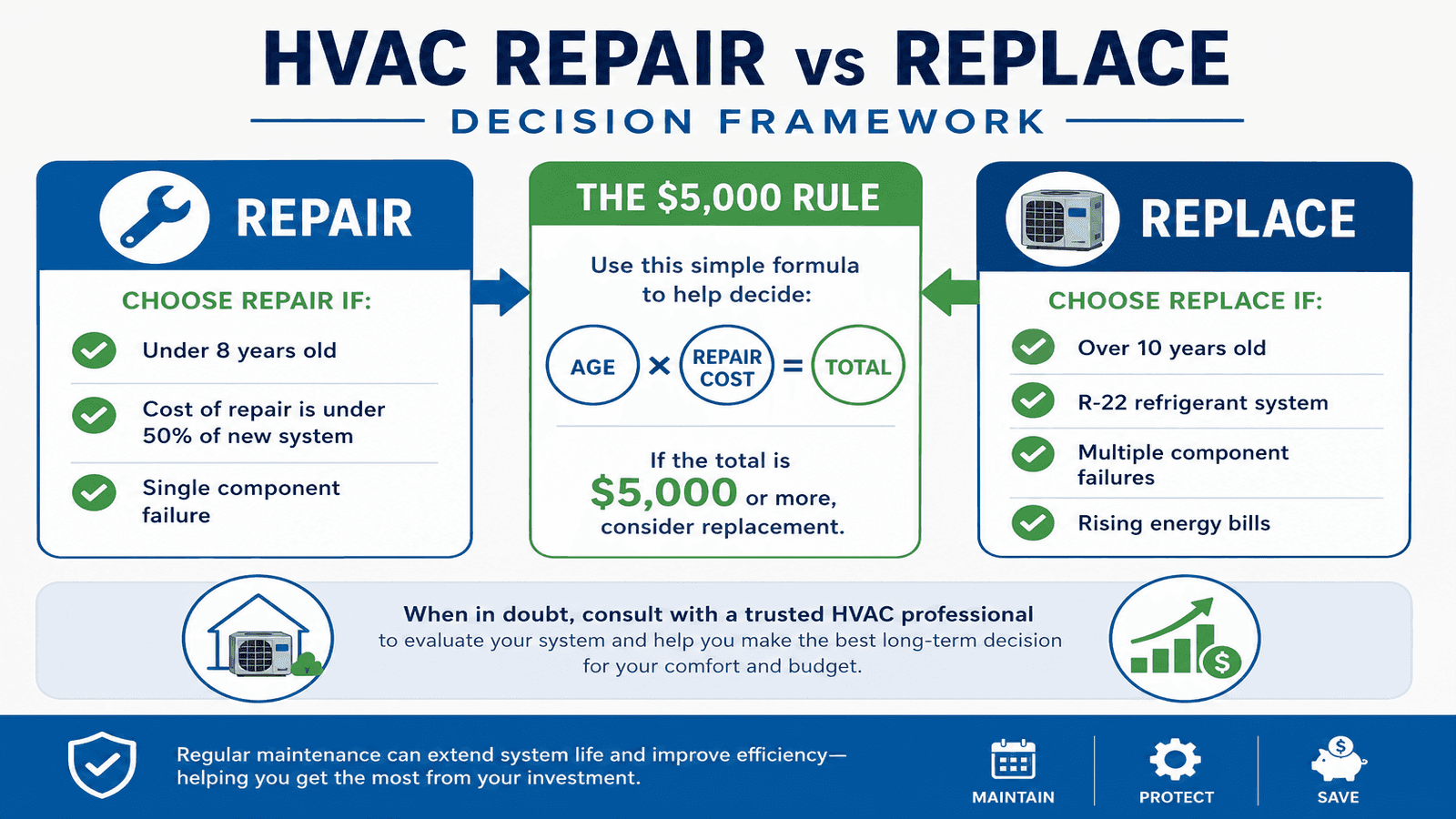
Photo: Comparison infographic showing the HVAC repair vs replace decision framework with the 50% rule and $5,000 rule
Seasonal Pricing and Emergency Premiums
HVAC repair costs are not static throughout the year. Demand cycles create predictable pricing patterns that homeowners can use to their advantage.
Peak season surcharges: June through August (cooling) and December through February (heating) are the busiest periods for HVAC repair. Many companies add 10 to 25 percent during peak demand simply because technician availability is limited and overtime labor is more expensive.
Off-season savings: March through May and September through November are the best windows for non-emergency repairs. Technicians have more availability, and some companies run shoulder-season specials or maintenance promotions.
Emergency and after-hours costs: A repair that costs $400 during a Tuesday morning appointment may run $600 to $800 on a Saturday evening or holiday. Emergency fees of $100 to $200 on top of the standard service call are common.
Scheduling tip from the NearbyHunt network: Contractors in the NearbyHunt network report that homeowners who schedule maintenance in April or October catch 80 percent of potential failures before they become emergency calls. A $150 to $250 maintenance visit that identifies a weak capacitor or low refrigerant charge prevents a $400 to $1,000 emergency repair in the middle of summer.
How to Save on HVAC Repairs
Not every cost-saving strategy works, but these consistently deliver real savings based on data from NearbyHunt network contractors and Daniel's field experience.
1. Get multiple quotes. Three quotes is the standard recommendation. The spread between the lowest and highest quote for the same repair averages 30 to 50 percent in most markets. Be cautious of quotes that are dramatically lower than the others, as that may signal corners being cut on parts quality or warranty coverage.
2. Ask about warranty coverage. Parts warranties of 5 to 10 years are standard from major manufacturers. If the failed component is under warranty, you pay only for labor and refrigerant. Many homeowners do not realize they have active warranty coverage until they ask.
3. Invest in annual maintenance. A maintenance plan costing $150 to $400 per year catches small problems before they become expensive repairs. According to ASHRAE data, well-maintained systems experience up to 95 percent fewer major breakdowns [8]. Daniel's maintenance customers average 72 percent lower annual repair costs compared to his repair-only customers.
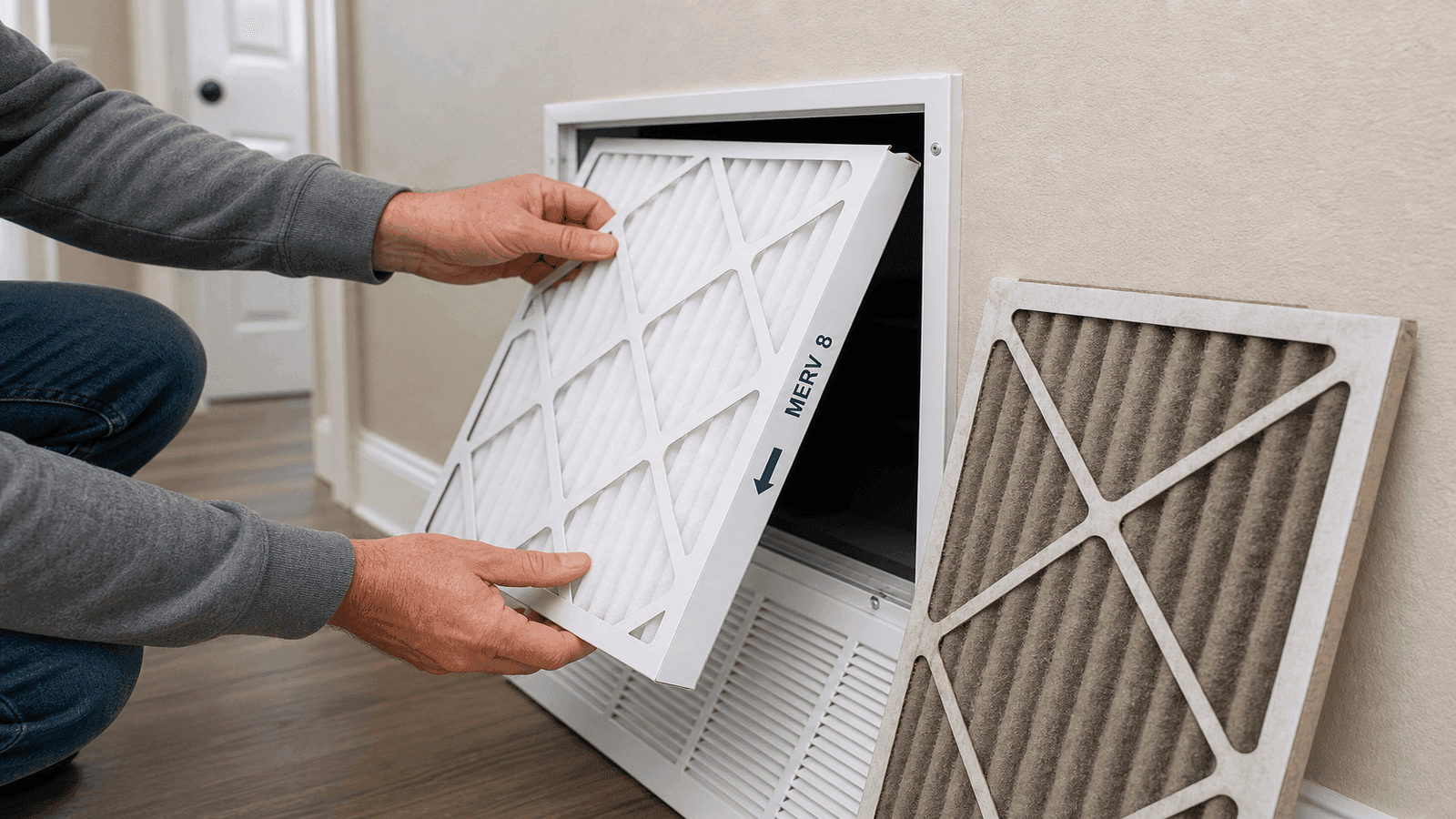
4. Replace the filter regularly. A clogged filter reduces airflow, forces the blower motor to overwork, and can cause the evaporator coil to freeze. Filter replacement costs $5 to $30 every 1 to 3 months and prevents hundreds of dollars in avoidable repairs.
5. Keep the outdoor unit clear. Maintain 2 feet of clearance around the condenser. Debris, vegetation, and pet hair on the condenser coils reduce efficiency and contribute to overheating, which shortens compressor and fan motor life.
6. Consider a home warranty. Home warranty plans ($400 to $700 per year) cover HVAC repairs with a service call fee of $75 to $125 per visit. They make financial sense for homeowners with older systems (8+ years) that are past the manufacturer warranty period but not yet ready for replacement.
When to Call a Professional vs. DIY
Some HVAC tasks are safe for homeowners. Others require a licensed technician for safety, legal, and warranty reasons.
Safe for homeowners:
- Replacing air filters
- Cleaning debris from the outdoor condenser unit
- Checking and resetting the circuit breaker
- Clearing the condensate drain line with a wet/dry vacuum
- Programming or replacing the thermostat (low-voltage models)
Requires a licensed technician:
- Any work involving refrigerant (EPA 608 certification required by federal law)
- Electrical component replacement (capacitors, contactors, circuit boards)
- Blower motor or compressor replacement
- Gas furnace repairs (gas valve, heat exchanger, igniter)
- Any repair where the manufacturer warranty requires professional installation
Attempting a refrigerant-related repair without EPA 608 certification is a federal violation carrying fines of up to $44,539 per day per violation under the Clean Air Act, as enforced by the EPA [9].
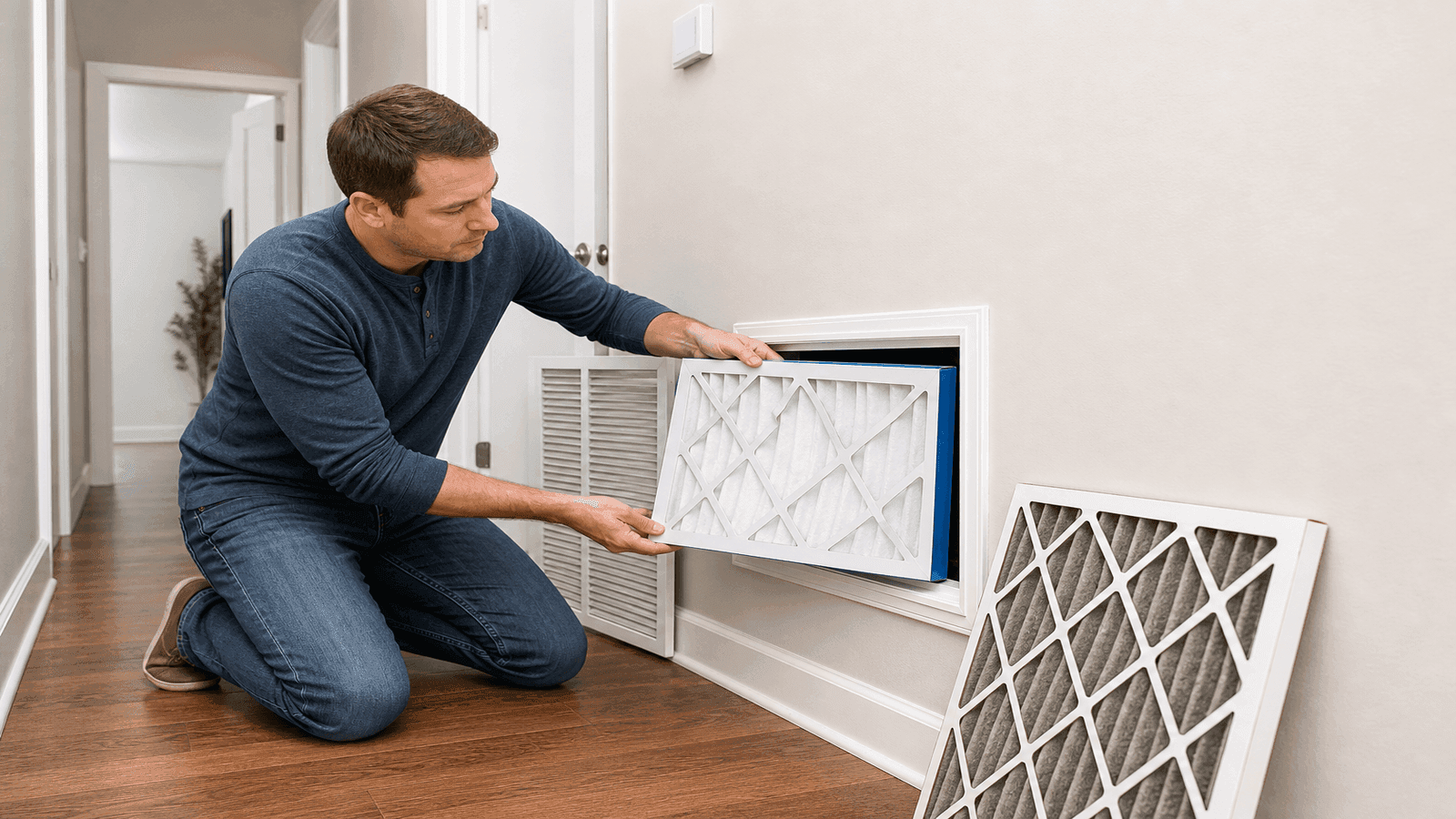
Photo: Homeowner changing an HVAC air filter in the return vent of a residential hallway
Finding a Qualified HVAC Repair Technician
The quality of the technician directly affects the quality and longevity of the repair. Here is what to verify before hiring.
Certifications to look for:
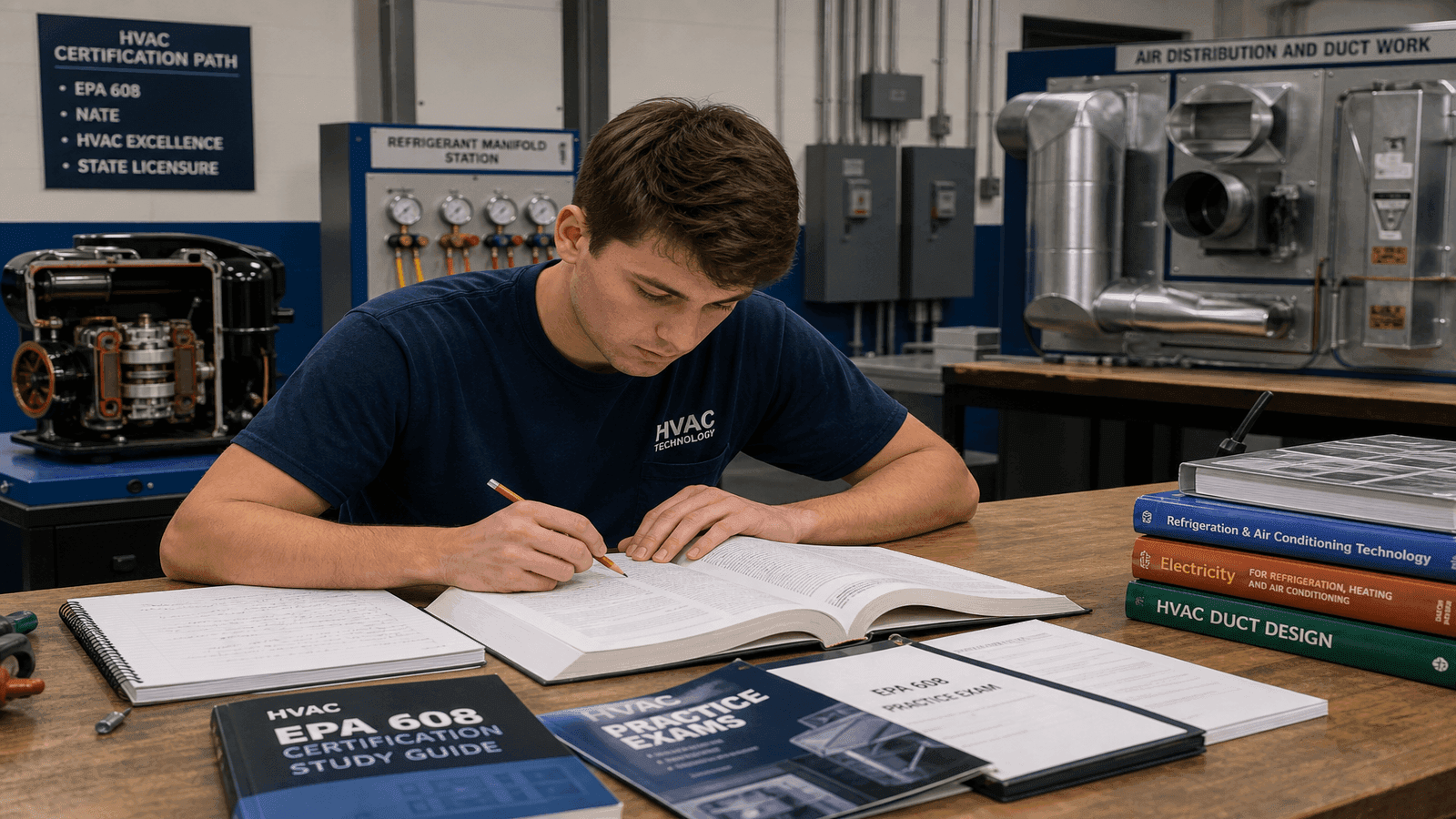
- EPA 608 Universal: Required by federal law for any technician handling refrigerants
- NATE Certification: The industry's most recognized competency credential, covering installation, service, and specialty areas
- State or local licensing: Requirements vary by state. Most states require HVAC contractors to hold a mechanical or specialty contractor license
Questions to ask before hiring:
- Is the diagnostic fee credited toward the repair?
- What is the warranty on parts and labor for this repair?
- Are you using OEM (original equipment manufacturer) or aftermarket parts?
- Can you provide a written estimate before starting work?
Licensed, insured HVAC technicians in your area are available through the NearbyHunt contractor network. Contractors in the network are verified for licensing, insurance, and customer satisfaction ratings.
Sources
- Forbes Home. "How Much Does HVAC Repair Cost? (2026)." https://www.forbes.com/home-improvement/hvac/hvac-repair-cost/
- FieldEdge. "HVAC Technician Hourly Rates: 2026 U.S. State Guide." https://fieldedge.com/blog/hvac-technician-hourly-rates/
- This Old House. "How Much Does AC Capacitor Replacement Cost? (2026 Prices)." https://www.thisoldhouse.com/heating-cooling/ac-capacitor-cost
- ENERGY STAR. "When Is It Time to Replace?" https://www.energystar.gov/saveathome/heating-cooling/replace
- HVAC Calculator Hub. "R-454B vs. R-410A: What the 2025 Phase-Out Means for Your Repair Bill." https://hvaccalculatorhub.com/blog/r454b-vs-r410a-refrigerant-phase-out
- Bob Vila. "How Much Does Evaporator Coil Replacement Cost? (2026)." https://www.bobvila.com/articles/evaporator-coil-replacement-cost/
- Bryant. "HVAC Replacement Guide 2026: Costs, Signs, and Benefits." https://www.bryant.com/en/us/products/hvac-replacement/
- ASHRAE. "HVAC Maintenance Best Practices." https://www.ashrae.org
- EPA. "Section 608 of the Clean Air Act: Stationary Refrigeration and Air Conditioning." https://www.epa.gov/section608
- Disclaimer: The costs and prices listed in this article are national averages based on 2026 data from industry sources, NearbyHunt network contractor quotes, and the author's professional experience. Actual costs vary by location, system type, brand, and contractor. Always obtain multiple written estimates from licensed, insured HVAC professionals before authorizing repairs. This article is for informational purposes only and does not constitute professional HVAC advice for your specific situation.*

Daniel is an EPA-certified HVAC technician & Energy Efficiency Consultant with over 14 years of experience in maintaining and installing heating and cooling systems throughout the Midwest. Passionate about sustainability, Dan specialises in energy-efficient retrofits and intelligent climate control systems. He writes for NearbyHunt to help homeowners extend the lifespan of their HVAC units while lowering utility bills.

Christine is an EPA-certified HVAC professional with 17 years of experience in heating, cooling, and indoor air quality systems. She has managed large-scale residential installations and worked as a technical trainer for new HVAC apprentices. Chris’s reviews focus on accuracy, safety, and performance standards in modern HVAC practices.