- Smart thermostats cost $50 to $350 for the unit alone, with professional installation adding $100 to $350 depending on wiring complexity. Total installed cost for most homeowners falls between $150 and $500. [1]
- The U.S. Department of Energy estimates smart thermostats save 10% on heating and up to 15% on cooling bills annually, translating to $100 to $200 per year for the average U.S. household spending roughly $1,000 to $1,400 on heating and cooling. [2]
- ENERGY STAR certified models deliver a minimum average of 8% savings on heating and cooling, or approximately $50 per year, with actual results varying based on climate, occupancy patterns, and HVAC system type. [3]
- The C-wire (common wire) is the most common installation obstacle. Homes without a C-wire need an adapter ($25 to $50) or professional wiring ($120 to $200), which can double DIY installation costs. [4]
- Payback period for most smart thermostats is 1 to 3 years, making them one of the fastest-returning home energy upgrades available. A $200 thermostat saving $120 per year pays for itself in under two years.
- NearbyHunt network data shows that 62% of smart thermostat installations involve homes upgrading from a basic manual or non-programmable unit, where savings potential is highest because there is no existing scheduling capability.

Get quotes from top-rated pros.
Heating and cooling accounts for roughly 48% of energy use in a typical U.S. home, making it the single largest utility expense. [2] A smart thermostat is one of the most cost-effective ways to reduce that number without replacing equipment or changing your comfort level.
Daniel Torres, a Certified HVAC Technician and Energy Efficiency Consultant with EPA 608 Universal, NATE, and HVAC Excellence certifications and 14+ years of field experience in Minneapolis, MN, has installed hundreds of smart thermostats across every major brand. "The technology has matured significantly since the first Nest hit the market. Today's models work with virtually every residential HVAC system, and the energy savings are real and measurable. I track before-and-after utility data on my installations, and most homeowners see 8 to 15% reductions in their heating and cooling costs within the first full season."
The real question is which model fits your system, whether you can install it yourself, and how long until the savings cover your investment. This guide breaks down unit costs by brand, installation expenses, the C-wire issue that catches many homeowners off guard, and ROI calculations based on 2026 pricing.
For a broader look at HVAC-related costs and budgeting, see the HVAC Costs pillar page for equipment, repairs, and maintenance pricing across all major system types.
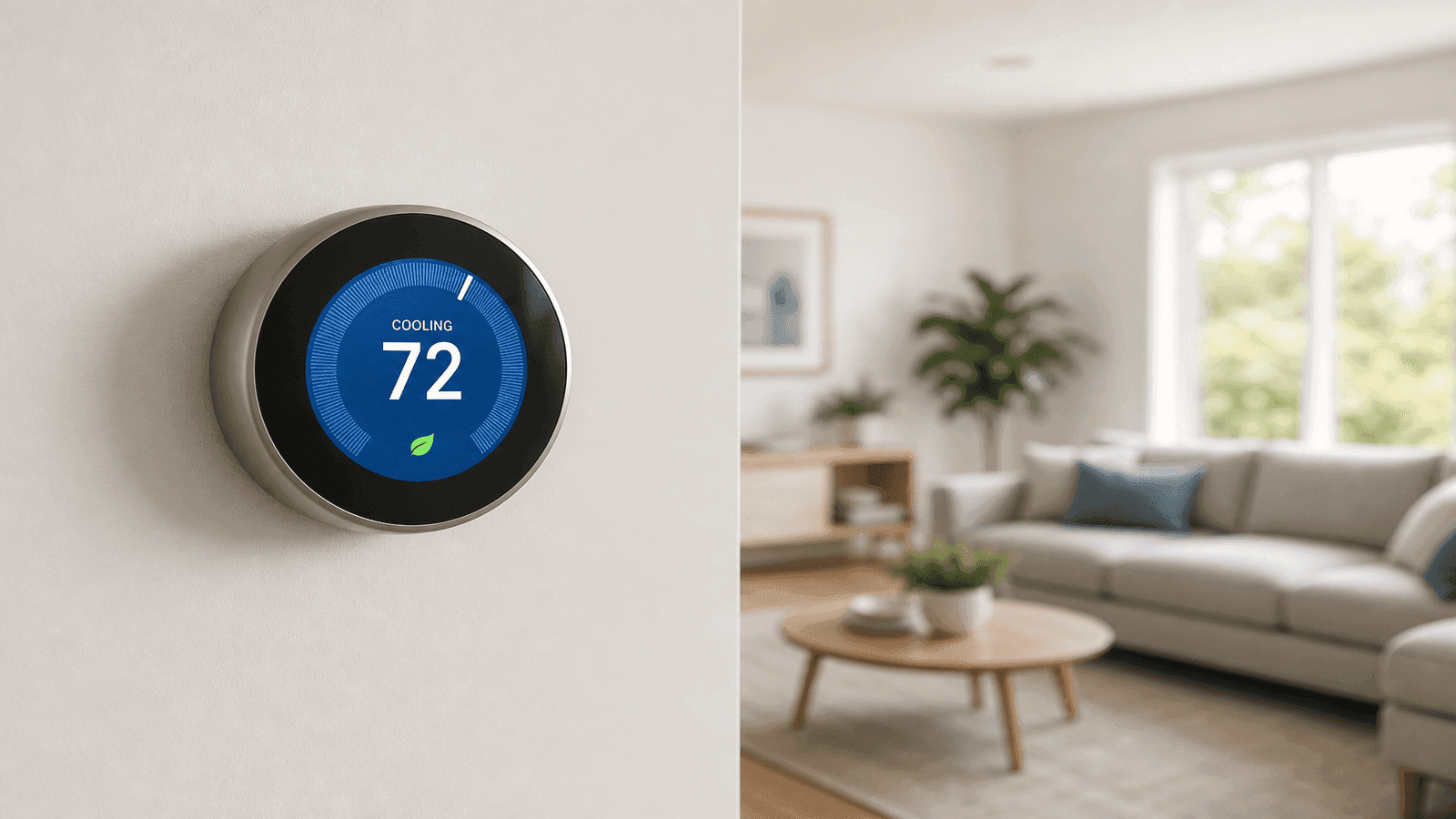
Photo: Smart thermostat mounted on a living room wall displaying temperature and energy usage data with a modern home interior in the background
Smart Thermostat Prices by Brand (2026)
Prices vary significantly across brands and product lines. The table below covers the most popular models available in the U.S. market as of 2026.
Premium Smart Thermostats ($200 to $350)
| Brand/Model | MSRP | Key Features | ENERGY STAR |
| Google Nest Learning Thermostat (4th Gen) | $280 | Learning algorithm, home/away sensing, temperature history, matter support | Yes |
| Ecobee Smart Thermostat Premium | $250 | Built-in air quality monitor, room sensor included, Siri/Alexa/Google | Yes |
| Honeywell Home T10 Pro | $230 | RedLINK room sensors, touchscreen, humidity control | Yes |
Mid-Range Smart Thermostats ($100 to $200)
| Brand/Model | MSRP | Key Features | ENERGY STAR |
| Ecobee Smart Thermostat Enhanced | $190 | Room sensor compatible, no air quality monitor, same app/learning | Yes |
| Google Nest Thermostat | $130 | Simplified design, app-based scheduling, savings finder | Yes |
| Honeywell Home T9 | $180 | Smart room sensors, C-wire adapter included, geofencing | Yes |
| Emerson Sensi Touch 2 | $170 | Touchscreen, wide HVAC compatibility, no C-wire required | Yes |
Budget Smart Thermostats (Under $100)
| Brand/Model | MSRP | Key Features | ENERGY STAR |
| Amazon Smart Thermostat | $80 | Alexa built-in, Hunches learning, basic scheduling | Yes |
| Emerson Sensi Smart (ST55) | $90 | Wi-Fi, app control, works without C-wire, easy DIY | Yes |
| Honeywell Home X2S | $55 | Wi-Fi, simple app, basic scheduling, compact design | Yes |
What drives the price difference? Premium models add room sensors (which balance temperatures across your home), learning algorithms that build schedules automatically, air quality monitoring, and broader smart home integration. Budget models handle basic scheduling and remote control effectively but lack multi-room sensing and adaptive learning.
For a single-zone system in a home under 1,800 square feet, the $80 to $130 range gets you 90% of the energy savings a $280 model delivers. The premium models earn their price in larger homes with hot and cold spots, where room sensors make a measurable difference.
Get quotes from top-rated pros.
Installation Costs: DIY vs. Professional
The thermostat unit is only part of the total cost. Installation ranges from free (if you do it yourself and have compatible wiring) to $350 or more for professional work on complex systems.
DIY Installation
Most smart thermostats are designed for homeowner installation. The process takes 20 to 45 minutes with basic tools.
| Cost Component | Typical Cost |
| Thermostat unit | $55 - $280 |
| C-wire adapter (if needed) | $25 - $50 |
| Wire labels (included with most units) | $0 |
| Basic tools (screwdriver, level) | $0 (already owned) |
| Total DIY Cost | $55 - $330 |
When DIY works: Your existing thermostat has at least 4 labeled wires (R, W, Y, G), the new thermostat passes the manufacturer's online compatibility checker, and you are comfortable working with low-voltage wiring.
Professional Installation
| Cost Component | Typical Cost |
| Thermostat unit (contractor-supplied) | $80 - $300 |
| Labor (HVAC technician, 1-2 hours) | $100 - $250 |
| C-wire installation (if needed) | $120 - $200 additional |
| Multi-zone setup (if applicable) | $50 - $150 additional |
| Total Professional Cost | $200 - $500 |
When to hire a pro:
- Your system is multi-stage, heat pump, or dual fuel
- There is no C-wire and you prefer a permanent wiring solution over an adapter
- The existing wiring is old, unlabeled, or does not match standard color codes
- You have a high-voltage (120V/240V) thermostat (baseboard or wall heater systems)
- The manufacturer's compatibility check shows warnings or unsupported configurations
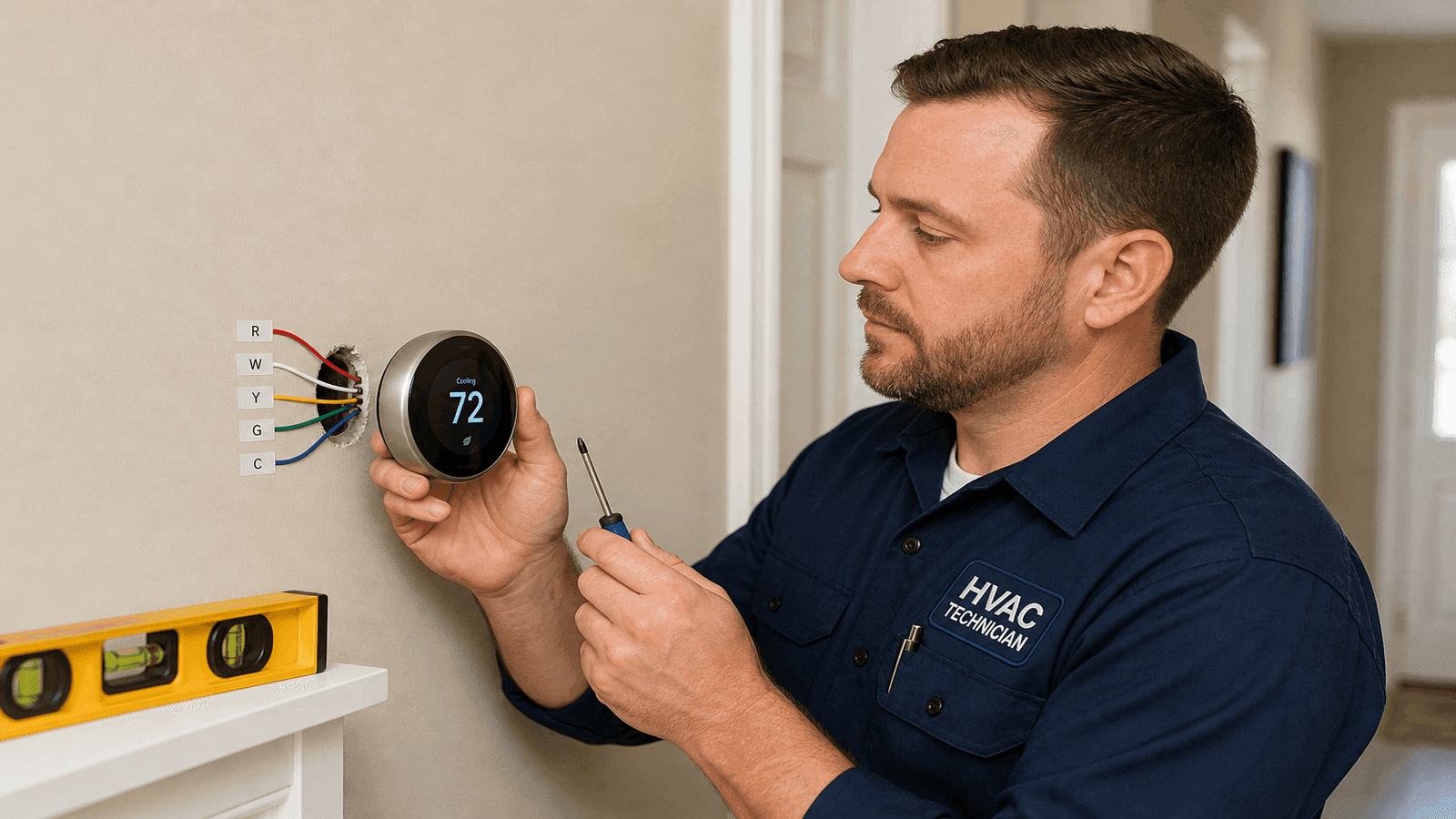
Photo: HVAC technician installing a smart thermostat on a wall with labeled low-voltage wires visible and the old thermostat baseplate removed
The C-Wire Problem (and How to Solve It)
The C-wire (common wire) provides continuous 24-volt power from your HVAC transformer to the thermostat. Older homes built before 2000 often have only 4 wires running to the thermostat (R, W, Y, G), with no C-wire. Most smart thermostats need that fifth wire to power their Wi-Fi radios, displays, and processors without draining the HVAC control board.
How to Check for a C-Wire
- Turn off your HVAC system at the breaker
- Remove your existing thermostat cover
- Look at the wire terminals on the base plate
- If a wire is connected to the "C" terminal, you have a C-wire
- If the "C" terminal is empty, check behind the wall plate for a tucked-away blue or brown wire that was never connected
Solutions When You Have No C-Wire
| Solution | Cost | Difficulty | Reliability |
| C-wire adapter kit (Honeywell, ecobee) | $25 - $50 | DIY (30 min) | Good for most systems |
| Power extender kit (included with some models) | $0 (included) | DIY (15 min) | Good |
| Run new thermostat wire (18/5 or 18/8) | $120 - $200 (pro install) | Professional | Best long-term solution |
| Use a model that works without C-wire (Sensi, some Honeywell) | $0 extra | N/A | Varies by system |
| Battery-powered smart thermostat | $80 - $200 | DIY | Limited features |
Which brands handle the C-wire issue best?
- Ecobee includes a Power Extender Kit with every thermostat, solving the C-wire problem at no extra cost
- Honeywell T9 includes a C-wire adapter in the box
- Emerson Sensi models work without a C-wire on most systems, drawing power through the existing wires
- Google Nest uses internal battery charging through the HVAC wires, but some systems (especially heat-only or millivolt systems) may not provide enough power, causing connectivity drops
- Amazon Smart Thermostat requires a C-wire with no adapter included
Get quotes from top-rated pros.
The number one callback I get on smart thermostat installations is a Nest dropping offline on a system without a C-wire. It works fine for a few weeks, then the battery cannot keep up. I always recommend either an ecobee with the included extender or running a proper C-wire. The $120 to $200 for new wire saves you multiple service calls down the road.
Total Cost Comparison by Scenario
Real-world costs depend on your starting point. Here are five common scenarios with full cost breakdowns.
| Scenario | Thermostat | Installation | C-Wire Fix | Total Cost |
| DIY, existing C-wire, budget model | Amazon Smart ($80) | $0 (DIY) | $0 | $80 |
| DIY, existing C-wire, mid-range model | Nest Thermostat ($130) | $0 (DIY) | $0 | $130 |
| DIY, no C-wire, ecobee (includes extender) | Ecobee Enhanced ($190) | $0 (DIY) | $0 (included) | $190 |
| Pro install, no C-wire, premium model | Nest Learning ($280) | $150 (labor) | $150 (new wire) | $580 |
| Pro install, multi-stage system, premium | Ecobee Premium ($250) | $200 (labor) | $0 (extender) | $450 |
Most homeowners land between $130 and $300 for a complete installation with a mid-range thermostat. The $500+ range typically involves professional C-wire installation combined with a premium thermostat on a complex HVAC system.
Energy Savings and ROI
The financial case for smart thermostats is well-documented, but actual savings depend on several factors specific to your home.
What the Data Shows
| Source | Reported Savings | Notes |
| U.S. Department of Energy | 10% heating, 15% cooling | Based on programmed setback schedules [2] |
| ENERGY STAR (certified models) | 8% average ($50/year) | Conservative estimate across all climates [3] |
| Nest independent studies | 10-12% heating, 15% cooling | Based on actual Nest customer utility data [5] |
| Ecobee customer data | Up to 26% on cooling | Best-case results in hot climates [6] |
ROI Calculation: Three Scenarios
Scenario 1: Budget install, moderate climate
- Total cost: $130 (Nest Thermostat, DIY)
- Annual savings: $80 (8% of $1,000 annual HVAC cost)
- Payback period: 1.6 years
- 5-year net savings: $270
Scenario 2: Mid-range install, cold climate
- Total cost: $250 (Ecobee Premium, DIY with included extender)
- Annual savings: $165 (12% of $1,375 annual HVAC cost)
- Payback period: 1.5 years
- 5-year net savings: $575
Scenario 3: Premium pro install, hot climate
- Total cost: $450 (Ecobee Premium, professional install)
- Annual savings: $195 (15% of $1,300 annual cooling-heavy HVAC cost)
- Payback period: 2.3 years
- 5-year net savings: $525
What Affects Your Savings
Savings run higher when upgrading from a manual thermostat, living in extreme climates, having irregular schedules, or having poor insulation. Savings run lower if you already use a well-programmed thermostat, live in a mild climate, have consistent occupancy, or frequently override scheduled setbacks.
Case Study: The Garcias' First-Year Savings in Phoenix
Carlos and Maria Garcia in Phoenix, Arizona, replaced two manual thermostats with Ecobee Smart Thermostat Premium units in a 2,400-square-foot home with a two-zone HVAC system. Total project cost: $500 for two units (purchased during a holiday sale at $199 each) plus $300 for professional installation on the dual-zone system. Grand total: $800.
Their HVAC system runs heavily from May through October in the Phoenix heat. Before the upgrade, they set both thermostats to 76 degrees around the clock because adjusting them manually throughout the day was impractical. With the ecobee's occupancy sensing and scheduling, the system now sets back to 82 degrees when the house is empty during work hours and pre-cools to 76 degrees before they arrive home.
After one full year of utility data comparison, their cooling bills dropped from an average of $285/month during summer to $215/month, a $70/month reduction during the six hottest months. Annual HVAC savings totaled $480. At that rate, the $800 investment pays back in 20 months.
"We assumed our bills were just what they were in Phoenix," Carlos said. "We did not realize how much energy we wasted cooling an empty house eight hours a day."
NearbyHunt Network Insight: Across the NearbyHunt provider network, HVAC technicians report that homeowners upgrading from manual thermostats in cooling-dominated climates (Arizona, Texas, Florida) see the highest savings percentages, averaging 12 to 18% reductions in annual HVAC costs. Homes upgrading from existing programmable thermostats see smaller but consistent gains of 5 to 10%, primarily from occupancy sensing and adaptive learning features.
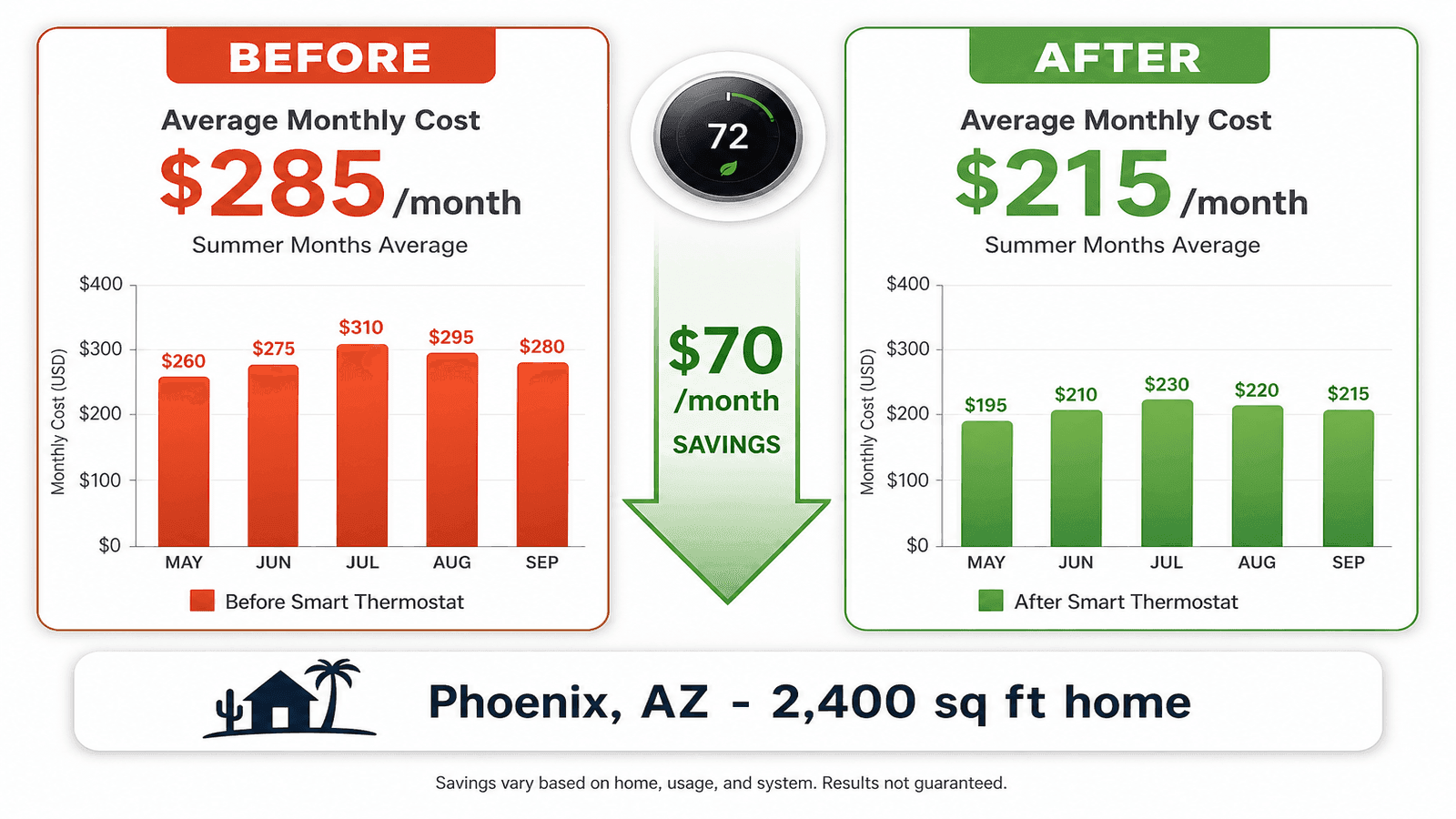
Photo: Split screen showing a utility bill comparison before and after smart thermostat installation with monthly energy cost charts for a Phoenix Arizona home
Smart Thermostat Features Worth Paying For
Not every feature justifies the price premium. Here is what actually moves the needle on energy savings versus what is primarily a convenience upgrade.
Get quotes from top-rated pros.
High-Impact Features (Save Money)
Occupancy sensing and geofencing. The thermostat detects when you leave and adjusts temperature automatically. This single feature accounts for the majority of savings in homes with variable schedules. Available on Nest, Ecobee, and Honeywell T9/T10.
Room sensors. Wireless sensors placed in different rooms balance temperatures based on where you spend time, not just where the thermostat is mounted. Ecobee includes one sensor; Nest and Honeywell sell them separately ($35 to $40 each).
Adaptive scheduling. The thermostat builds a temperature schedule based on your patterns over time. Nest and Ecobee both offer this, though Nest's algorithm is more aggressive in its setback recommendations.
Energy reports. Monthly reports showing when and how your system runs help identify waste patterns. All major brands offer this through their apps.
Convenience Features (Nice to Have)
- Voice control (Alexa, Google, Siri)
- Touchscreen display
- Air quality monitoring (Ecobee Premium only)
- Smart home integration (HomeKit, Matter, SmartThings)
- Filter change reminders
- Humidity control display
These features do not directly reduce energy costs, but they improve the ownership experience and may help you engage more actively with your home's energy use.
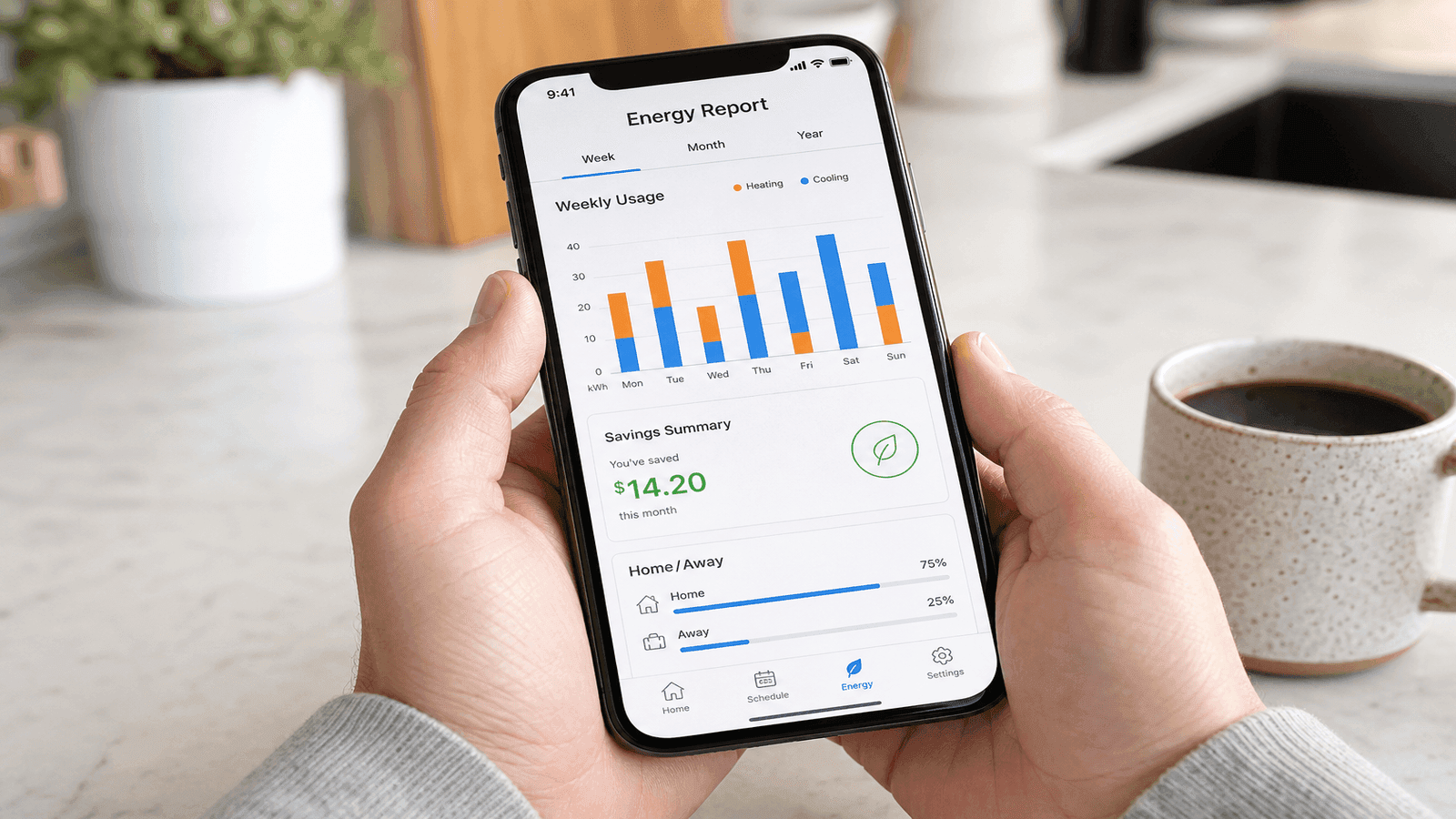
Photo: Homeowner using a smartphone app to view smart thermostat energy reports showing daily heating and cooling usage patterns and monthly savings data
Utility Rebates and Incentives
Many electric and gas utilities offer rebates for ENERGY STAR certified smart thermostats, reducing your out-of-pocket cost significantly.
Common Rebate Amounts
| Rebate Type | Typical Value |
| Electric utility rebate | $25 - $100 |
| Gas utility rebate | $25 - $75 |
| Manufacturer instant rebate (seasonal) | $20 - $50 |
| Utility marketplace discount (direct purchase) | $50 - $125 off MSRP |
How to Find Rebates
- Visit the ENERGY STAR rebate finder at energystar.gov/rebate-finder [3]
- Check your electric utility's website for a "marketplace" or "energy savings" section
- Look for seasonal promotions (Earth Day, Black Friday, and back-to-school sales frequently include thermostat discounts)
Multiple utility providers offer $50 to $125 instant discounts on Sensi and Ecobee models through their online marketplaces, bringing a $200 model down to $75 to $150 before energy savings begin. [7]
Brand Comparison: Strengths and Weaknesses
| Factor | Google Nest | Ecobee | Honeywell Home | Emerson Sensi | Amazon |
| Best model | Learning ($280) | Premium ($250) | T9 ($180) | Touch 2 ($170) | Smart ($80) |
| Learning algorithm | Excellent | Good | Basic | None | Basic (Hunches) |
| Room sensors | Sold separately ($35) | 1 included ($40 more) | Sold separately ($40) | Not available | Not available |
| C-wire solution | Internal battery (unreliable on some systems) | Power Extender Kit included | C-wire adapter included (T9) | Works without C-wire | Requires C-wire |
| HVAC compatibility | Most systems | Most systems | Widest compatibility | Very wide compatibility | Basic systems |
| Best for | Tech-forward homes, Google ecosystem | Balanced features, Apple/Alexa homes | Complex HVAC systems | Budget-conscious, older homes | Alexa-only smart homes |
| Weakness | C-wire issues, Google ecosystem lock-in | Premium price for top model | Less intuitive app | No learning algorithm | Limited features |
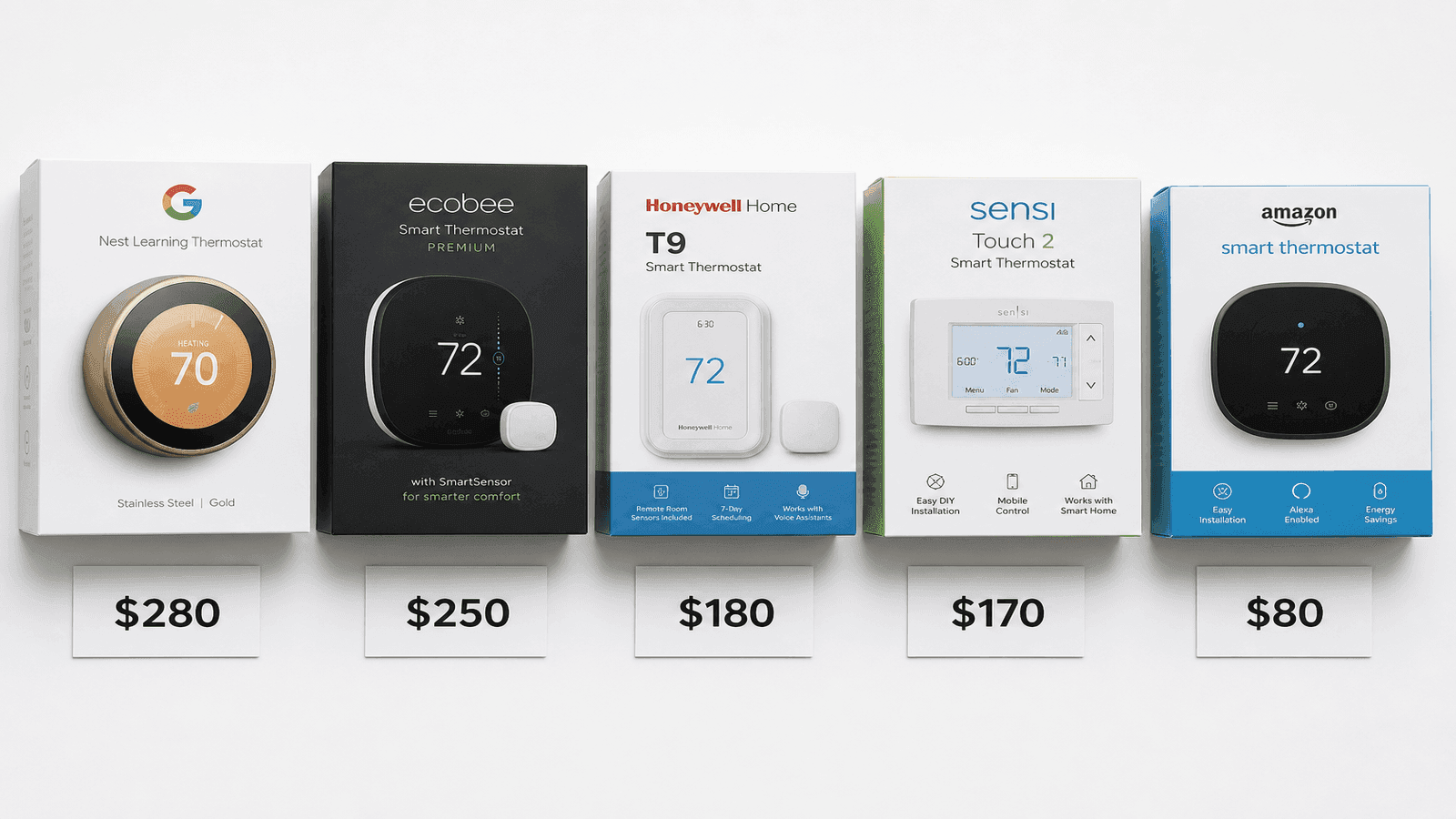
Photo: Overhead flat lay of five popular smart thermostat boxes from Nest Ecobee Honeywell Sensi and Amazon arranged on a white surface with price tags visible
Make the Upgrade
A smart thermostat is one of the few home improvements that pays for itself within one to three years and continues generating savings for its entire 8 to 12 year lifespan. Whether you choose a $80 budget model or a $280 premium unit, the energy savings are real and documented by the Department of Energy, ENERGY STAR, and independent customer data.
If your home still runs on a manual thermostat or a basic programmable model from the 2000s, the upgrade delivers the strongest return. If you are unsure about your wiring, HVAC system compatibility, or whether a C-wire solution is needed, find a certified HVAC technician near you on NearbyHunt to handle the installation and ensure everything is configured for maximum efficiency.
Disclaimer: This article provides general pricing guidance and energy savings estimates for residential smart thermostats in the United States. Actual costs vary by region, retailer, and installer. Energy savings depend on climate, home insulation, HVAC system type, occupancy patterns, and thermostat settings. NearbyHunt connects homeowners with local service providers but does not sell thermostats or perform installations directly. All pricing reflects 2026 market data and may change.
Sources
[1] Forbes Home. "How Much Does Smart Thermostat Installation Cost?"
[2] U.S. Department of Energy. "Programmable Thermostats."
[3] ENERGY STAR. "Smart Thermostats FAQs."
[4] This Old House. "How Much Does C-Wire Installation Cost?"
[5] Nest. "Energy Savings from the Nest Learning Thermostat."
[6] Ecobee. "Smart Thermostats and Smart Home Devices."
[7] ENERGY STAR. "Rebate Finder."
[8] Bob Vila. "How Much Does Smart Thermostat Installation Cost?"

Daniel is an EPA-certified HVAC technician & Energy Efficiency Consultant with over 14 years of experience in maintaining and installing heating and cooling systems throughout the Midwest. Passionate about sustainability, Dan specialises in energy-efficient retrofits and intelligent climate control systems. He writes for NearbyHunt to help homeowners extend the lifespan of their HVAC units while lowering utility bills.

Christine is an EPA-certified HVAC professional with 17 years of experience in heating, cooling, and indoor air quality systems. She has managed large-scale residential installations and worked as a technical trainer for new HVAC apprentices. Chris’s reviews focus on accuracy, safety, and performance standards in modern HVAC practices.