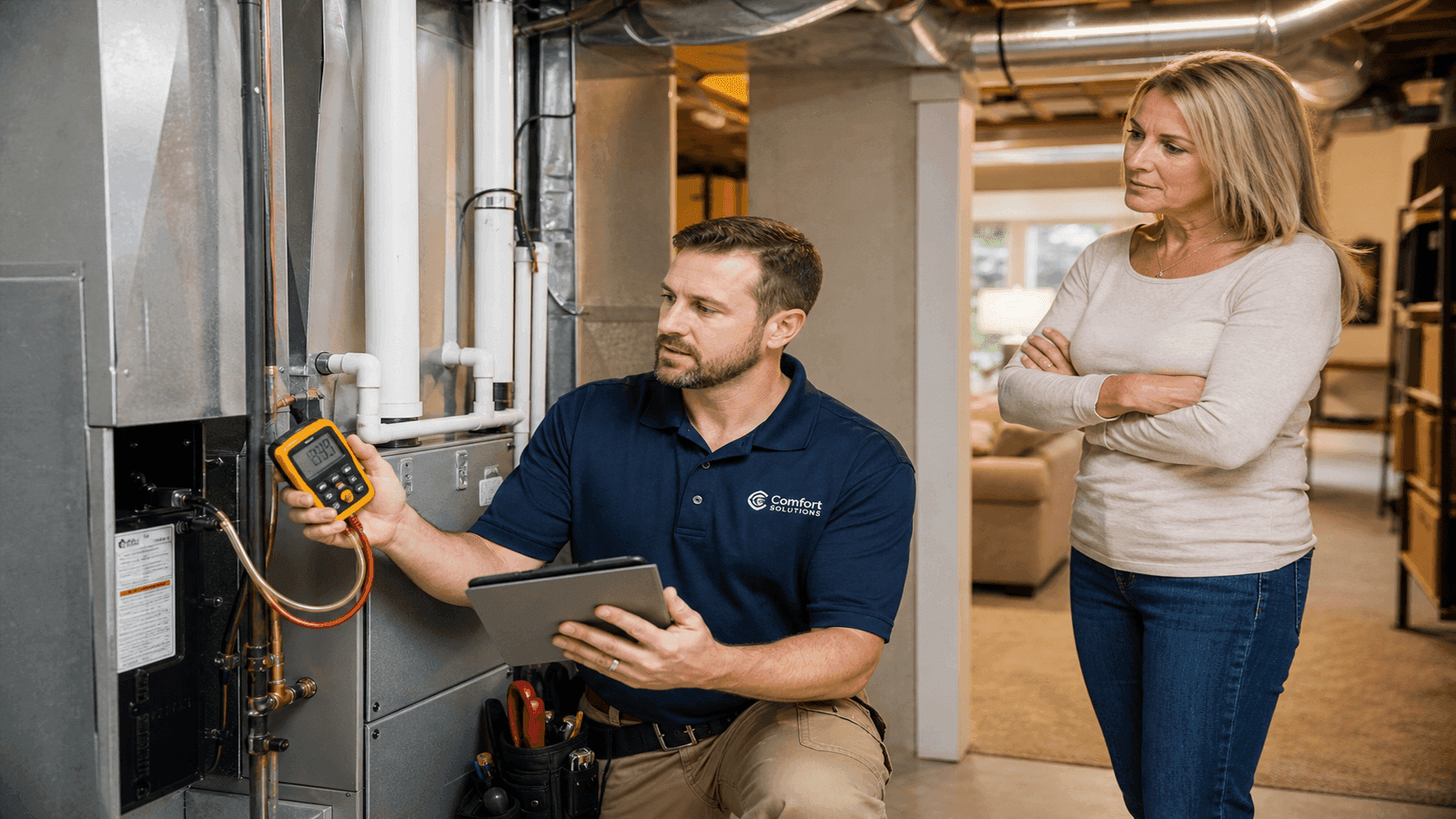
- Resetting your AC unit takes less than 10 minutes and resolves roughly 30% of "AC not working" calls before a technician is needed, saving $150 to $450 in service fees [1].
- The universal reset method works on all system types: turn off the thermostat, flip the breaker off, wait 60 seconds, restore power, then restart the thermostat 5 minutes later [2].
- A dirty air filter is the number one trigger for AC shutdowns that require a reset. The Department of Energy confirms that clogged filters reduce system efficiency by up to 15% [3].
- Not every AC has a physical reset button. Central units sometimes have one on the outdoor condenser near the refrigerant lines. Window units typically have one on the control panel or built into the GFCI plug [4].
- Repeated resets signal a deeper problem. If your system trips again within 24 hours, stop resetting and call a licensed HVAC technician to prevent compressor damage or electrical hazards [5].
- 90% of major AC breakdowns could have been prevented with seasonal maintenance checks, according to HVAC industry data [6].
Your AC stopped blowing cold air, the thermostat screen went blank, or the outdoor unit just will not kick on. Before you schedule a service call that averages $150 to $450, a simple reset may be all your system needs [1].
Power surges, brief outages, tripped breakers, and even a thermostat glitch can shut down an otherwise healthy AC system. The fix is straightforward: cut power, let the system discharge, and restart in the correct sequence. The whole process takes under 10 minutes regardless of system type.
This guide walks through the reset procedure for central air conditioners, window units, ductless mini splits, and heat pumps. It also covers when a reset will not solve the problem and a licensed technician is the right next step.
This guide is part of the HVAC How To & DIY series covering the most common heating and cooling tasks homeowners can handle safely.
HVAC technicians in the NearbyHunt network report that roughly one in three "AC not working" service calls they respond to are resolved by a reset or a filter change, with no parts replacement needed.

Get quotes from top-rated pros.
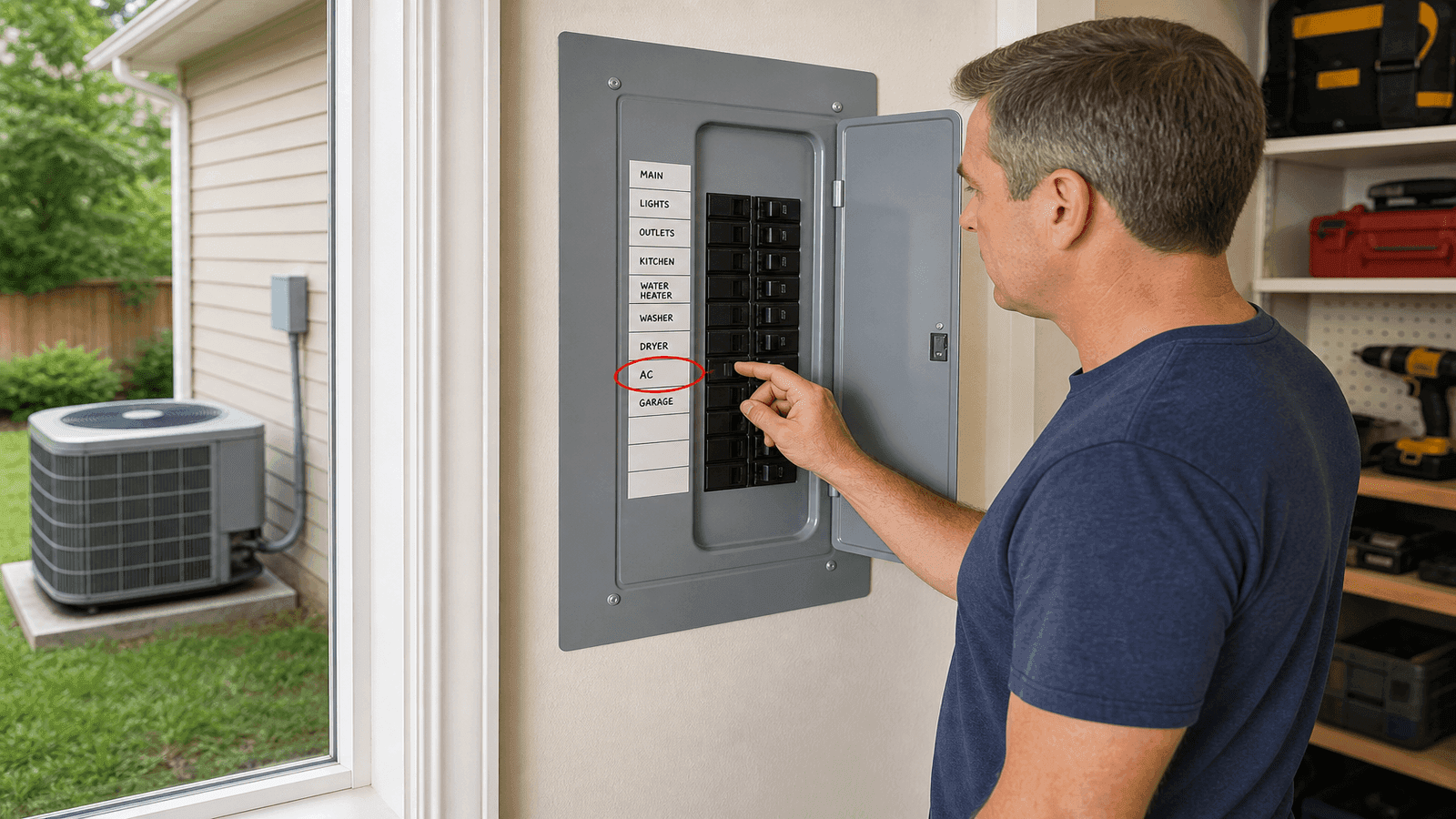
Photo: Homeowner standing at an electrical breaker panel preparing to reset a tripped AC breaker with outdoor condenser unit visible through nearby window
When Your AC Needs a Reset
Not every AC problem calls for a reset. Knowing which symptoms respond to a power cycle and which ones require professional diagnosis saves time and prevents further damage.
| Symptom | Reset Likely to Fix? | Why |
| AC stopped after a power outage or surge | Yes | Internal safety circuits locked out during voltage spike [2] |
| Thermostat is blank or unresponsive | Yes | Control board needs a fresh power cycle to reinitialize |
| Outdoor unit hums but fan does not spin | Maybe | Could be a tripped safety or a failed capacitor |
| AC blows warm air only | Maybe | Could be a frozen coil from restricted airflow or low refrigerant |
| Breaker trips repeatedly after reset | No | Electrical fault, compressor short, or wiring issue requiring a technician [5] |
| Burning smell from indoor or outdoor unit | No | Shut off power immediately and call a licensed HVAC technician |
| Water pooling around indoor unit | No | Clogged condensate drain, not a power issue |
If the breaker trips more than once in the same day, do not keep resetting it. A breaker is a safety device. Repeated tripping usually points to a compressor drawing excessive amps, a shorted wire, or a failing capacitor. Continuing to force the system on can turn a $200 capacitor replacement into a $2,500 compressor replacement.
Before You Start: Safety Checklist
Every reset procedure involves your home's electrical panel. Follow these precautions before touching anything.
- Wear rubber-soled shoes when working near the breaker panel
- Keep hands dry and stand on a dry surface
- Never remove the access panel on the outdoor condenser unit unless you are a licensed technician
- Turn off the thermostat first before cutting power at the breaker
- Wait the full recommended time before restoring power to allow capacitors to discharge completely
High-voltage capacitors inside AC units store enough energy to cause serious injury even after the breaker is off. The wait time between power off and power on is not optional.
Universal Reset Method (All AC Types)
This five-step procedure works for central air conditioners, heat pumps, packaged units, and most split systems. It takes about 10 minutes total.
Step 1: Turn Off the Thermostat
Set your thermostat to the OFF position. Do not just raise the temperature set point. The thermostat must stop sending a call signal to the system before you cut power.
Step 2: Switch Off the Circuit Breaker
Go to your home's electrical panel and find the breaker labeled for your AC or HVAC system. Most homes have a dedicated 20-amp or 30-amp double-pole breaker for the condensing unit and a separate breaker for the air handler or furnace.
Flip both breakers to the OFF position.
Step 3: Wait 60 Seconds Minimum
This waiting period allows internal capacitors to discharge and the control board to fully power down. For systems that tripped due to a power surge, waiting a full 5 minutes gives the compressor's internal overload protector time to cool and reset [2].
Step 4: Restore Power at the Breaker
Flip the breaker(s) back to the ON position. You should hear a faint click from the contactor in the outdoor unit as it re-energizes.
Step 5: Turn the Thermostat Back On
Wait at least 5 minutes after restoring the breaker before switching the thermostat back to COOL mode. Set the temperature 3 to 5 degrees below the current room temperature to trigger an immediate cooling cycle.
The compressor has a built-in time delay of approximately 3 minutes to prevent short cycling. If the system does not start right away, give it up to 10 minutes before attempting another reset [2].
Get quotes from top-rated pros.
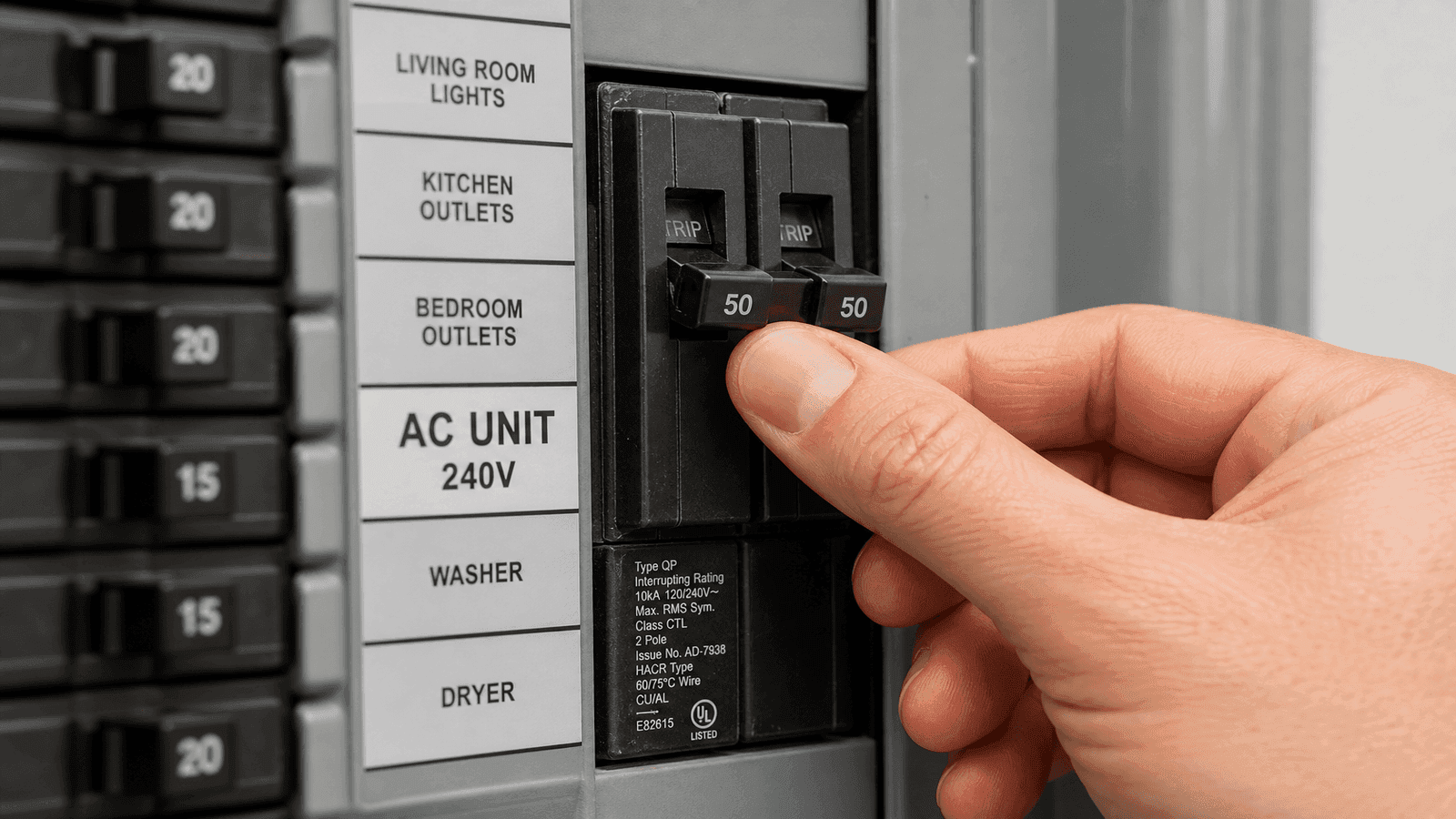
Photo: Close-up of a residential electrical breaker panel with a hand flipping the AC breaker switch to the off position with labels clearly visible
I always tell homeowners to wait a full 5 minutes, not just 60 seconds. The 60-second minimum resets the control board, but the compressor's internal thermal overload can take several minutes to cool down. Rushing the restart is the number one reason people think the reset did not work.
Reset by AC System Type
While the universal method covers most situations, each system type has specific reset procedures and button locations worth knowing.
Central Air Conditioner
Central AC systems are the most common type in U.S. homes and the most likely to need a reset after a storm or power event.
Reset button location: Some central AC outdoor units have a small red or yellow reset button near the bottom of the unit, close to the refrigerant lines. Not all models include one [4].
If your unit has a reset button:
- Turn off the thermostat
- Locate the reset button on the outdoor condenser unit
- Press and hold the button for 3 to 5 seconds until you hear a click
- Wait 5 minutes
- Turn the thermostat to COOL and set it below room temperature
If your unit does not have a reset button:
Follow the universal breaker reset method described above. Most central AC units manufactured after 2010 rely on the breaker panel for resets rather than a dedicated button.
Window Air Conditioner
Window units are self-contained and simpler to reset than central systems.
Reset button location: Check the control panel on the front of the unit. Many window ACs also have a reset button built into the GFCI plug at the end of the power cord [4].
Steps:
- Press the power button to turn the unit off
- Unplug the unit from the wall outlet
- Wait 60 seconds
- If the power cord has a GFCI plug with a TEST and RESET button, press RESET
- Plug the unit back in
- Press the power button and set your desired temperature
Window AC tip: If the GFCI plug trips repeatedly, try plugging the unit into a different outlet on a separate circuit. Window ACs draw 5 to 15 amps, and sharing a circuit with other appliances is a common trip cause.
Ductless Mini Split
Mini splits have separate indoor and outdoor components connected by refrigerant lines and communication wiring. A reset must address both units in the correct order.
Steps:
- Turn off the unit using the remote control or wall controller
- Locate the dedicated mini split breaker in your electrical panel and switch it off
- Wait 60 seconds for the indoor unit and outdoor unit to fully power down
- Switch the breaker back on, restoring power to the outdoor unit first
- Wait 5 minutes for the communication link between indoor and outdoor units to reinitialize
- Turn the system on using the remote control
Mini split tip: If error codes appear on the indoor unit display after the reset, write down the code before cycling power again. The code identifies the specific fault and disappears after a second reset, making diagnosis harder for a technician if the problem persists.
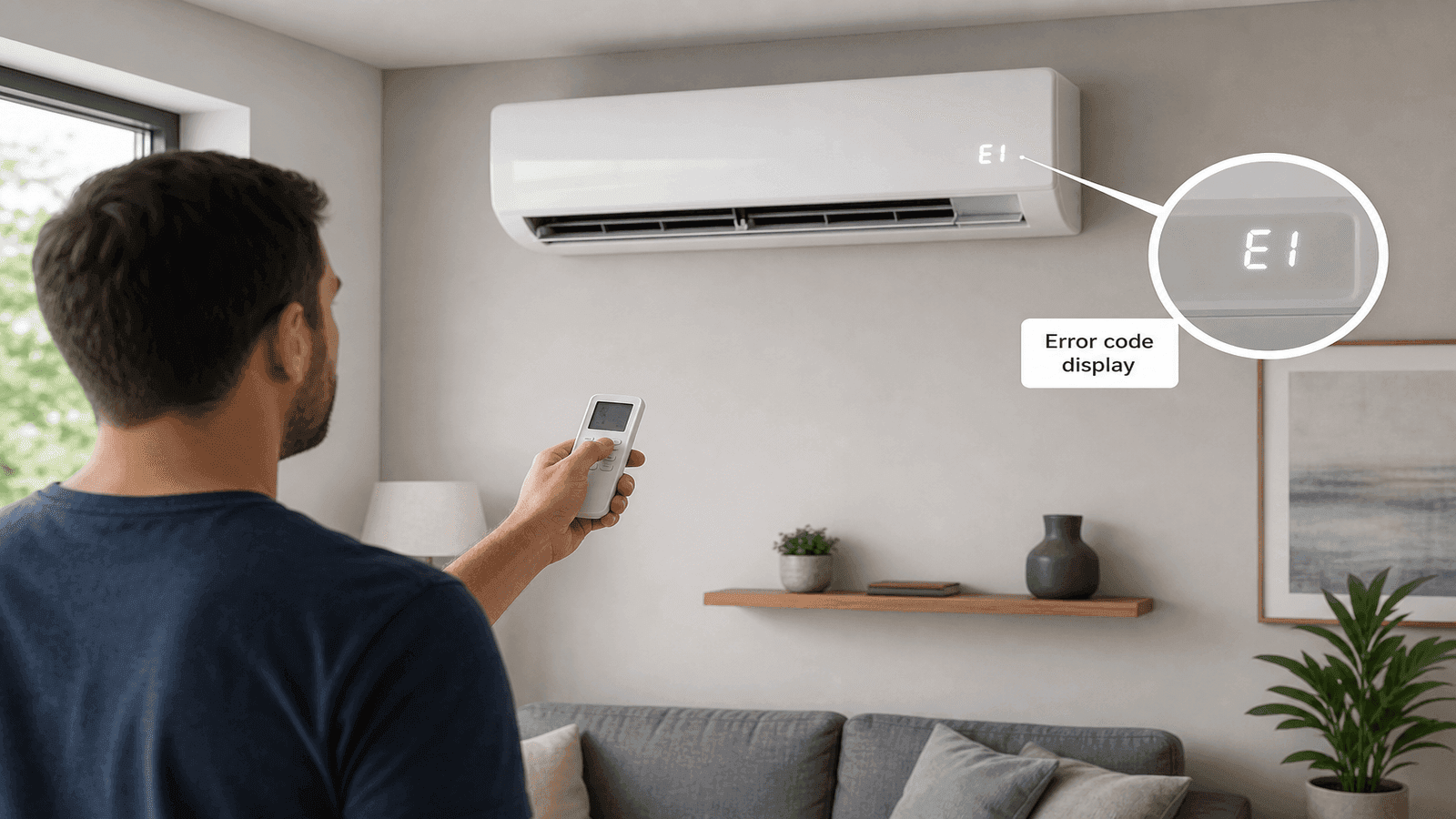
Photo: Ductless mini split indoor wall unit displaying an error code on its LED panel with a homeowner pointing a remote control at the unit
Heat Pump
Heat pumps function as both heating and cooling systems. The reset procedure is nearly identical to a central AC reset, but heat pumps have an additional consideration: the reversing valve.
Steps:
- Turn the thermostat to OFF
- Switch off the heat pump breaker and the air handler breaker at the electrical panel
- Wait 60 seconds to 5 minutes
- Restore power to the air handler breaker first, then the heat pump breaker
- Wait 5 minutes, then set the thermostat to the desired mode (COOL or HEAT)
Heat pump tip: If the heat pump runs but only blows air at room temperature after a reset, the reversing valve may be stuck. This is not a DIY fix and requires a licensed technician.
Thermostat Reset Procedures
Sometimes the AC itself is fine but the thermostat lost its programming or stopped communicating with the system. A thermostat-specific reset can fix blank screens, incorrect readings, and communication errors.
Programmable Thermostat
- Remove the thermostat from its wall plate
- Remove the batteries
- Wait 30 seconds
- Reinsert fresh batteries
- Reattach to the wall plate
- Reprogram your schedule and temperature settings
Smart Thermostat (Wi-Fi Connected)
- Navigate to the thermostat's settings menu
- Select "Reset" or "Restart"
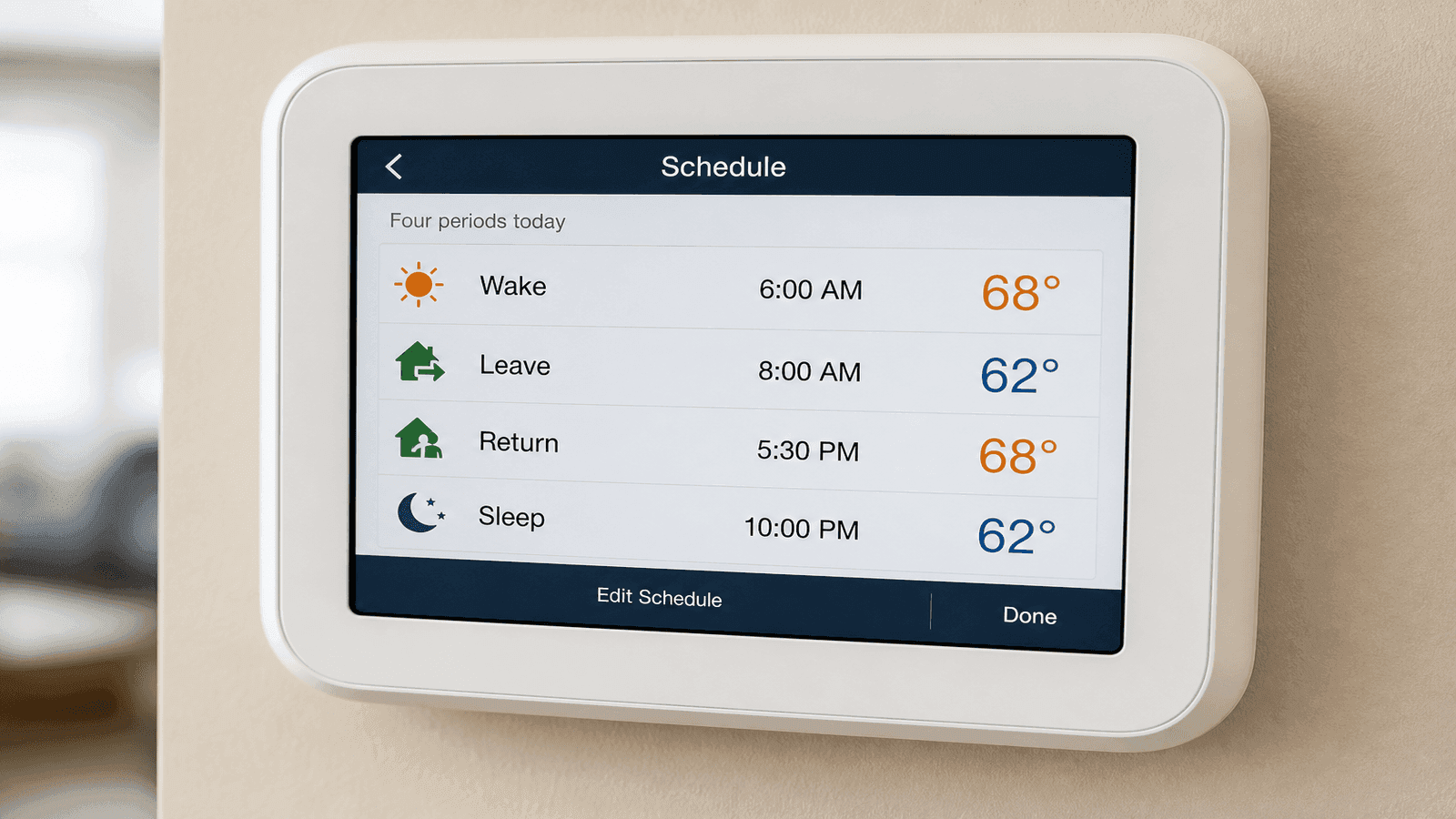
- Choose "Schedule Reset" to keep Wi-Fi settings, or "Factory Reset" to start fresh
- Wait for the reboot cycle to complete (typically 2 to 5 minutes)
- Verify the thermostat reconnects to Wi-Fi and communicates with your HVAC system
Non-Programmable Thermostat
- Turn the thermostat to OFF
- Flip the AC breaker off at the electrical panel
- Wait 30 seconds
- Flip the breaker back on
- Turn the thermostat to COOL and adjust the set point
Get quotes from top-rated pros.
Dead thermostat batteries cause more confusion than almost any other HVAC issue. Homeowners assume the whole system has failed when the fix is a $3 pair of AA batteries. I recommend writing the battery change date on a small label inside the thermostat cover and replacing them every 12 months.
Troubleshooting After a Reset
You performed the reset correctly, but the AC still is not working. Here is a systematic checklist to narrow down the problem before calling for service.
Check the Air Filter
A clogged filter restricts airflow, causes the evaporator coil to freeze, and can trip the system's safety switches. The Department of Energy reports that dirty filters reduce AC efficiency by up to 15% [3]. Pull the filter out and hold it up to a light source. If you cannot see light through it, replace it.
Inspect the Outdoor Unit
Walk outside and check the condenser unit:
- Is the fan spinning? If the compressor hums but the fan is still, the fan motor or capacitor may have failed.
- Is the unit clogged with debris? Leaves, grass clippings, and cottonwood seeds blocking the fins reduce heat exchange and can cause overheating.
- Is ice on the refrigerant lines? Ice indicates low refrigerant or severe airflow restriction. Turn the system off and let it thaw completely before running it again.
Verify the Condensate Drain
Indoor AC units produce condensation that drains through a PVC pipe. If that drain clogs, many systems have a safety float switch that shuts the unit off to prevent water damage. Clear the drain line and the system should restart normally.
Check for Tripped Safety Switches
Many AC systems have a secondary disconnect box mounted on the exterior wall near the outdoor unit. This box contains a pull-out fuse block or breaker. Confirm it is fully seated and the fuses are intact.
| Problem After Reset | Likely Cause | DIY or Pro? |
| System runs for a few minutes then shuts off | Frozen coil or overheating compressor | Check filter (DIY), then call pro if it persists |
| Fan runs but no cold air | Low refrigerant or failed compressor | Call a licensed technician |
| Breaker trips again immediately | Electrical short or grounded compressor | Call a licensed technician immediately |
| Strange clicking or buzzing from outdoor unit | Failing contactor or capacitor | Pro recommended (capacitors store dangerous voltage) |
| Indoor unit leaks water after reset | Clogged condensate drain or frozen coil thawing | Clear drain (DIY), check filter |
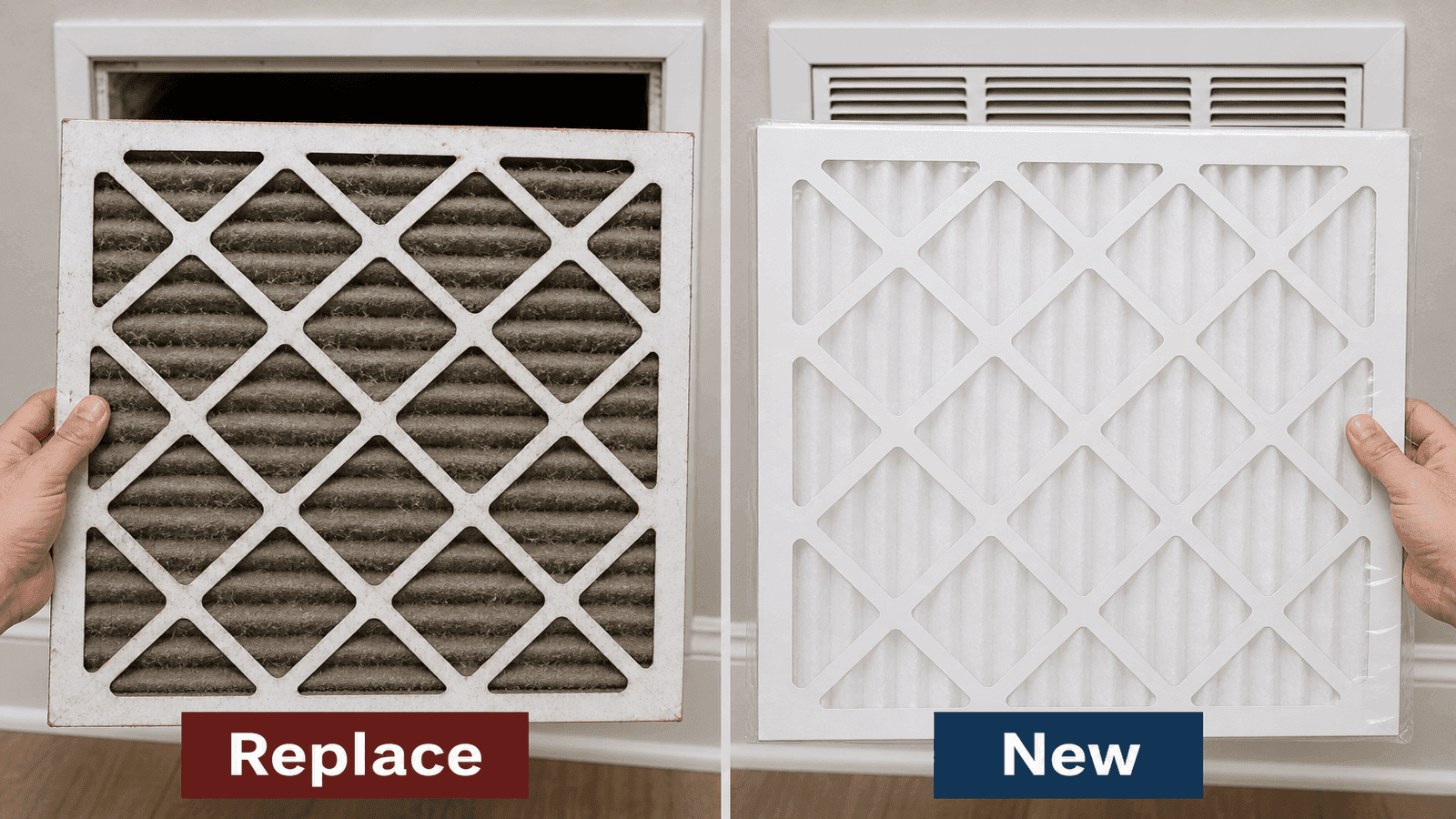
Photo: Close-up of a dirty clogged AC air filter being removed from a return vent compared to a clean new replacement filter side by side
Case Study: The Hendersons' Repeated AC Shutdowns
Mark and Lisa Henderson in Plano, Texas called for emergency HVAC service in July 2025 after their central AC shut down three times in one week. Each time, Mark reset the breaker and the system ran for 8 to 12 hours before tripping again.
The technician found two problems working together. First, the air filter had not been changed in over six months and was almost completely blocked. Second, the restricted airflow caused the evaporator coil to freeze repeatedly. Each time the ice built up, the compressor overheated and tripped the thermal overload.
The fix took 20 minutes: a new filter ($12) and a full defrost cycle. The technician also cleaned the evaporator coil and checked the refrigerant charge, which was within normal range. Total cost: $189 for the service call and filter, compared to the $2,200 compressor replacement that could have resulted from continued forced resets.
The Hendersons now change their filter on the first day of every month during cooling season and have not had a single shutdown since.
Prevent Future AC Shutdowns
Regular maintenance reduces the likelihood of needing emergency resets. These tasks take minimal time and cost very little compared to a service call.
Monthly during cooling season:
- Replace or clean the air filter (the single most impactful task according to DOE data [3])
- Clear debris from around the outdoor condenser unit, maintaining at least 2 feet of clearance on all sides
Twice per year (spring and fall):
- Gently rinse the outdoor condenser coils with a garden hose (no pressure washer)
- Pour a cup of white vinegar or bleach solution down the condensate drain to prevent clogs
- Check thermostat batteries and replace annually
Annually (professional service recommended):
- Full system inspection including refrigerant charge, electrical connections, and capacitor health
- Evaporator and condenser coil cleaning
- Duct inspection for leaks (homes with leaky ducts can lose up to 20% of cooled air) [3]
Annual preventive maintenance costs $150 to $300 on average and prevents up to 95% of major breakdowns according to ASHRAE guidelines [5]. HVAC systems that receive regular professional maintenance last 40% longer than systems that receive none [6].
When to Stop Resetting and Call a Pro
A reset is a first-response tool, not a long-term solution. Contact a licensed HVAC technician if any of the following apply:
- The breaker trips again within 24 hours of resetting
- You smell burning, melting plastic, or electrical odor from the unit
- The outdoor unit makes grinding, screeching, or loud banging sounds
- Ice forms on the refrigerant lines or outdoor unit repeatedly
- Your energy bills spike suddenly without a change in usage
- The system is more than 15 years old and resets are becoming frequent
The average HVAC service call costs $150 to $450 depending on your location and the complexity of the repair [1]. Emergency and after-hours calls typically run $280 to $600. Scheduling a standard appointment rather than an emergency visit saves significant money when the situation is not urgent.
Need a licensed HVAC technician in your area? Find trusted HVAC pros on NearbyHunt to get quotes from verified professionals near you.
Disclaimer: This article provides general educational guidance on resetting AC units. HVAC systems involve high-voltage electricity and pressurized refrigerant. Always consult a licensed HVAC technician for diagnosis and repair beyond basic resets and filter changes. Costs mentioned are national averages as of 2026 and may vary by location. Local building codes and manufacturer warranty terms may affect which tasks homeowners can legally perform.
Sources & References
[1] American Standard Air. "Average HVAC Repair Cost."
[2] One Hour Heating & Air. "How to Reset Your AC Unit."
[3] U.S. Department of Energy. "Air Conditioner Maintenance."
[4] Heating News Journal. "Locating Reset Buttons on AC Units."
[5] Trane. "Top 5 Causes of Frozen AC Coils."
[6] Warner Service. "AC Stats & Savings."
[7] EPA. "Section 608 of the Clean Air Act."

Daniel is an EPA-certified HVAC technician & Energy Efficiency Consultant with over 14 years of experience in maintaining and installing heating and cooling systems throughout the Midwest. Passionate about sustainability, Dan specialises in energy-efficient retrofits and intelligent climate control systems. He writes for NearbyHunt to help homeowners extend the lifespan of their HVAC units while lowering utility bills.

Christine is an EPA-certified HVAC professional with 17 years of experience in heating, cooling, and indoor air quality systems. She has managed large-scale residential installations and worked as a technical trainer for new HVAC apprentices. Chris’s reviews focus on accuracy, safety, and performance standards in modern HVAC practices.