- Full duct replacement costs $1,400 to $12,000 depending on home size, material, and accessibility, with most homeowners paying $4,000 to $8,000 for a standard 2,000 sq ft home [1].
- Leaky ducts waste 20-30% of conditioned air according to the U.S. Department of Energy, costing the average household $300 to $700 per year in lost energy [2].
- Duct sealing costs $500 to $1,500 and may be sufficient if your system is under 15 years old with only minor leaks at joints and connections [3].
- Sheet metal ducts last 25-30+ years and deliver the best long-term value, while flex duct is cheapest upfront but prone to sagging, kinking, and a shorter 10-20 year lifespan [4].
- ENERGY STAR requires duct leakage at or below 4 CFM25 per 100 sq ft of conditioned floor area for certified new homes, a threshold most older systems fail by a wide margin [5].
Most homeowners never think about their ductwork until something goes wrong. Uneven room temperatures, dust blowing from vents, higher energy bills, or an HVAC system that runs constantly but never fully heats or cools the house. By the time those symptoms show up, the duct system has usually been losing conditioned air for years.
Daniel Torres, a Certified HVAC Technician and Energy Efficiency Consultant with EPA 608 Universal, NATE, and HVAC Excellence certifications and 14+ years of field experience in Minneapolis, MN, provided the technical insights and project data throughout this article. His pricing observations come from hundreds of duct inspections and replacements across the upper Midwest, where extreme temperature swings put ductwork under constant thermal stress.
"I test duct leakage on almost every service call now, and the numbers consistently surprise homeowners. In 2025, I tested 83 systems during routine maintenance visits. The average total duct leakage was 22%, and 61 of those 83 homes exceeded the ENERGY STAR threshold. Most of those homeowners had no idea they were heating and cooling their attic or crawl space."
Below, you will find every cost factor in a duct replacement project: materials, labor, home size, accessibility, and the critical decision between sealing what you have and starting fresh. The pricing data is compiled from NearbyHunt network contractor quotes, manufacturer pricing guides, and DOE/ENERGY STAR technical publications.
For a full breakdown of HVAC system costs, see our HVAC Costs Guide.

Get quotes from top-rated pros.
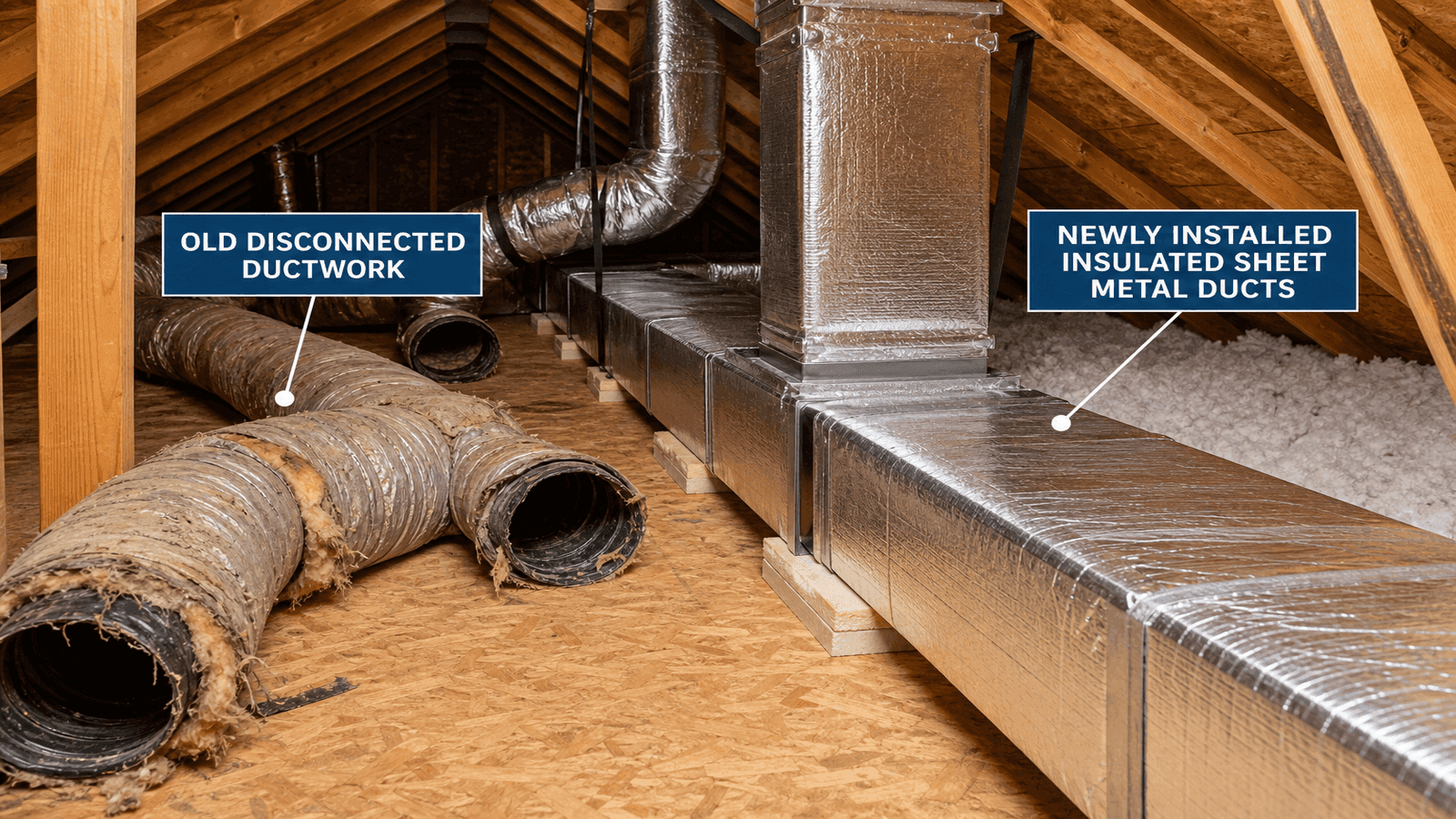
Photo: Cutaway view of a residential attic showing old disconnected ductwork next to newly installed insulated sheet metal ducts
Average Duct Replacement Cost
The national average for a complete residential duct replacement ranges from $1,400 to $12,000, with the wide range driven primarily by home size, duct material, and how accessible the existing ducts are [1]. For a typical single-story 2,000 sq ft home with ducts in an accessible attic, expect to pay $4,000 to $8,000 installed.
Cost by Home Size (2026 Averages)
| Home Size | Linear Feet of Duct | Average Replacement Cost |
| 1,000 sq ft | 50-80 ft | $1,400 to $3,500 |
| 1,500 sq ft | 80-120 ft | $2,500 to $5,500 |
| 2,000 sq ft | 120-160 ft | $4,000 to $8,000 |
| 2,500 sq ft | 150-200 ft | $5,500 to $10,000 |
| 3,000+ sq ft | 200-300 ft | $7,000 to $12,000 |
What is included in the cost: Removal and disposal of old ductwork ($500 to $1,200), new duct materials, insulation, hangers, registers, sealing at all connections, and a post-installation leakage test. Permits add $300 to $800 depending on your municipality.
Cost per linear foot: $25 to $55 per linear foot is the standard industry range, with the variation driven almost entirely by material choice and accessibility [1].
NearbyHunt network data from Q1 2026 shows the national median for a full duct replacement in a 2,000 sq ft home landed at $5,800, with the lowest 10% of quotes at $3,200 and the highest 10% at $9,400. Quotes in the Northeast and West Coast averaged 18-25% higher than the Midwest and Southeast.
Cost by Duct Material
The material you choose affects not just upfront price but long-term durability, airflow efficiency, and maintenance requirements. Here is how the three main residential duct materials compare.
Duct Material Comparison (2026 Pricing)
| Material | Cost Per Linear Foot | Lifespan | Best For |
| Galvanized Sheet Metal | $7 to $13 | 25-30+ years | Whole-house systems, long-term value |
| Flexible (Flex) Duct | $2 to $7 | 10-20 years | Short runs, tight spaces, budget projects |
| Fiberboard | $2 to $6 | 10-15 years | Noise reduction, budget-conscious installs |
Sheet Metal Ducts
Galvanized steel or aluminum sheet metal is the industry standard for a reason. The smooth interior surface creates minimal friction loss, meaning your HVAC system moves air efficiently without working harder than necessary. Sheet metal resists mold, holds up in extreme temperatures, and can be professionally cleaned if needed [4].
The downside is cost. Sheet metal requires skilled fabrication, heavier support hardware, and more labor hours to install. For a 2,000 sq ft home, sheet metal ductwork typically runs $3,500 to $7,000 for materials and installation.
Flexible Duct
Flex duct is a wire coil wrapped in plastic and insulation. It is the cheapest option and the fastest to install, making it popular with builders working on tight budgets. A full flex duct system for a 2,000 sq ft home costs $1,500 to $4,000 installed.
The tradeoff is performance. Flex duct kinks easily, sags over time if not properly supported, and the corrugated interior creates more airflow resistance than smooth sheet metal. Improperly installed flex duct is the single most common cause of duct system inefficiency that Daniel Torres encounters in his Minneapolis service area.
"About 70% of the flex duct installations I inspect have at least one run that is kinked, sagging, or stretched too tight across a truss. Each of those problems restricts airflow and creates a spot where conditioned air leaks into the attic. Flex duct can work fine on short, straight runs of 10 feet or less. Anything longer or with bends should be rigid metal."
Fiberboard Duct
Fiberboard ducts are made from compressed fiberglass with a foil exterior. They offer built-in insulation and excellent noise dampening, which can matter in homes where duct noise travels into living spaces. Cost falls between flex and sheet metal at $2 to $6 per linear foot [4].
The major drawback is durability. Fiberboard is susceptible to moisture damage and mold growth, particularly in humid climates. The rough interior surface traps dust and debris over time, and fiberboard ducts cannot be effectively cleaned the way metal ducts can. Most HVAC professionals recommend against fiberboard in crawl spaces or any area prone to moisture.
Get quotes from top-rated pros.
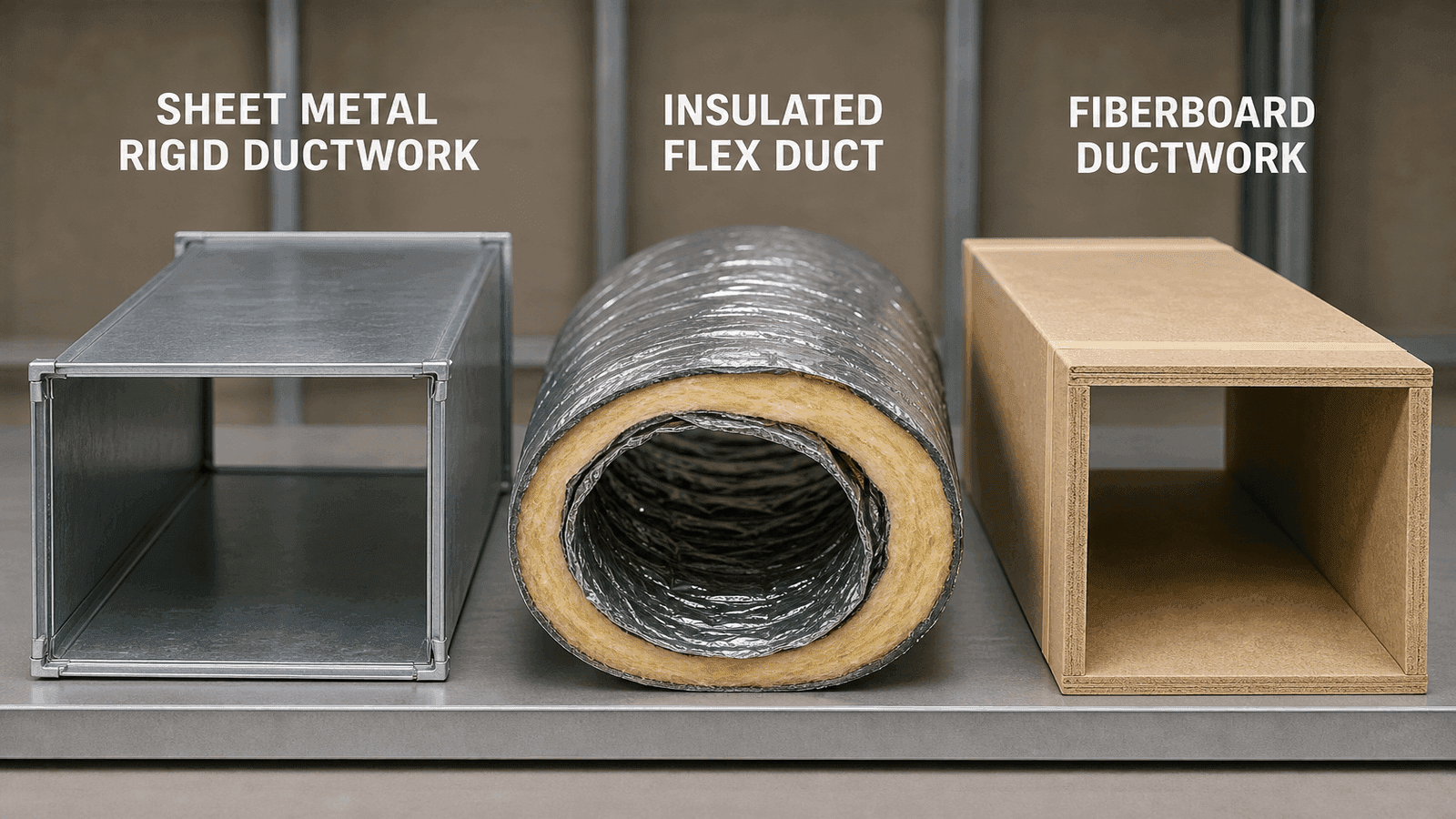
Photo: Side-by-side comparison of sheet metal rigid ductwork, insulated flex duct, and fiberboard ductwork sections
Duct Sealing vs. Replacing
Not every duct problem requires a full replacement. In many cases, professional sealing can restore a significant portion of your system's efficiency at a fraction of the cost. The right choice depends on the age of your ducts, the severity of the leaks, and whether the duct system was properly sized and designed in the first place.
Sealing vs. Replacing Decision Guide
| Factor | Seal | Replace |
| Duct age | Under 15 years | Over 20 years |
| Leakage level | Under 20% total | Over 25% total |
| Physical condition | Intact with joint leaks | Crushed, disconnected, corroded |
| Design/sizing | Correctly sized | Undersized or poorly routed |
| Mold present | No | Yes |
| Asbestos present | N/A (do not disturb) | Professional abatement + replace |
| Cost | $500 to $1,500 | $1,400 to $12,000 |
When Sealing Makes Sense
Professional duct sealing involves either manual application of mastic sealant and metal tape at every joint and connection, or aerosol-based sealing (Aeroseal) that pressurizes the system and sprays sealant particles that collect at leak points. Manual sealing costs $500 to $1,500 for a typical home. Aeroseal treatment runs $1,000 to $2,500 but can seal leaks inside walls and other areas that manual methods cannot reach [3].
Sealing is the right move when your ducts are structurally sound, properly sized, and less than 15-20 years old. If leakage testing shows total losses under 20% and the duct runs are intact with no crushed sections, sagging, or disconnected joints, sealing delivers strong ROI. Most homeowners recoup the cost in energy savings within 2-4 years [3].
When Replacement is Necessary
Replacement makes sense when ducts are over 20 years old, show visible deterioration (rust, holes, collapsed sections, pest damage), contain mold, or were incorrectly sized for the HVAC system. Undersized ducts restrict airflow regardless of how well they are sealed, forcing the system to work harder and shortening equipment life.
"I had a homeowner in Minnetonka, MN spend $1,200 on professional duct sealing in early 2025. The leakage dropped from 28% to 18%, which helped, but her rooms were still uneven because the original builder used 6-inch flex runs where 8-inch rigid was needed. We ended up replacing the entire system for $6,400 three months later. If we had done a full assessment first instead of just a leakage test, we would have caught the sizing issue and gone straight to replacement."
Energy Loss from Leaky Ducts
The U.S. Department of Energy reports that the typical residential forced-air duct system loses 20-30% of conditioned air through leaks, holes, and poorly connected joints [2]. That is not a minor inefficiency. For a household spending $2,000 per year on heating and cooling, duct losses account for $400 to $600 in wasted energy annually.
The problem is worse when ducts run through unconditioned spaces like attics, crawl spaces, and unfinished basements. In those locations, leaking ducts are not just losing air. They are dumping heated or cooled air directly into spaces where it provides zero benefit, while pulling in unconditioned (and often dirty) air from those same spaces.
ENERGY STAR duct leakage standards for certified new homes require total duct leakage to outdoor at or below 4 CFM25 per 100 sq ft of conditioned floor area, or 40 CFM25 total, whichever is greater [5]. Most existing homes built before 2010 fail this standard by a wide margin. In Daniel Torres's 2025 field testing of 83 systems, the average leakage rate was 22%, and 73% of homes exceeded the ENERGY STAR threshold.
Annual Energy Cost of Duct Leakage:
Annual Energy Cost of Duct Leakage
| Leakage Rate | Annual Cooling/Heating Bill | Estimated Waste | 10-Year Waste |
| 10% (well-sealed) | $2,000 | $200 | $2,000 |
| 20% (average home) | $2,000 | $400 | $4,000 |
| 30% (poorly sealed) | $2,000 | $600 | $6,000 |
| 40%+ (severe) | $2,000 | $800+ | $8,000+ |
At a 25% leakage rate, a 3-ton HVAC system effectively loses three-quarters of a ton of capacity to duct losses. That means a system designed to cool 2,000 sq ft is only delivering enough conditioned air for roughly 1,500 sq ft, forcing longer run times, higher utility bills, and accelerated wear on the equipment [2].
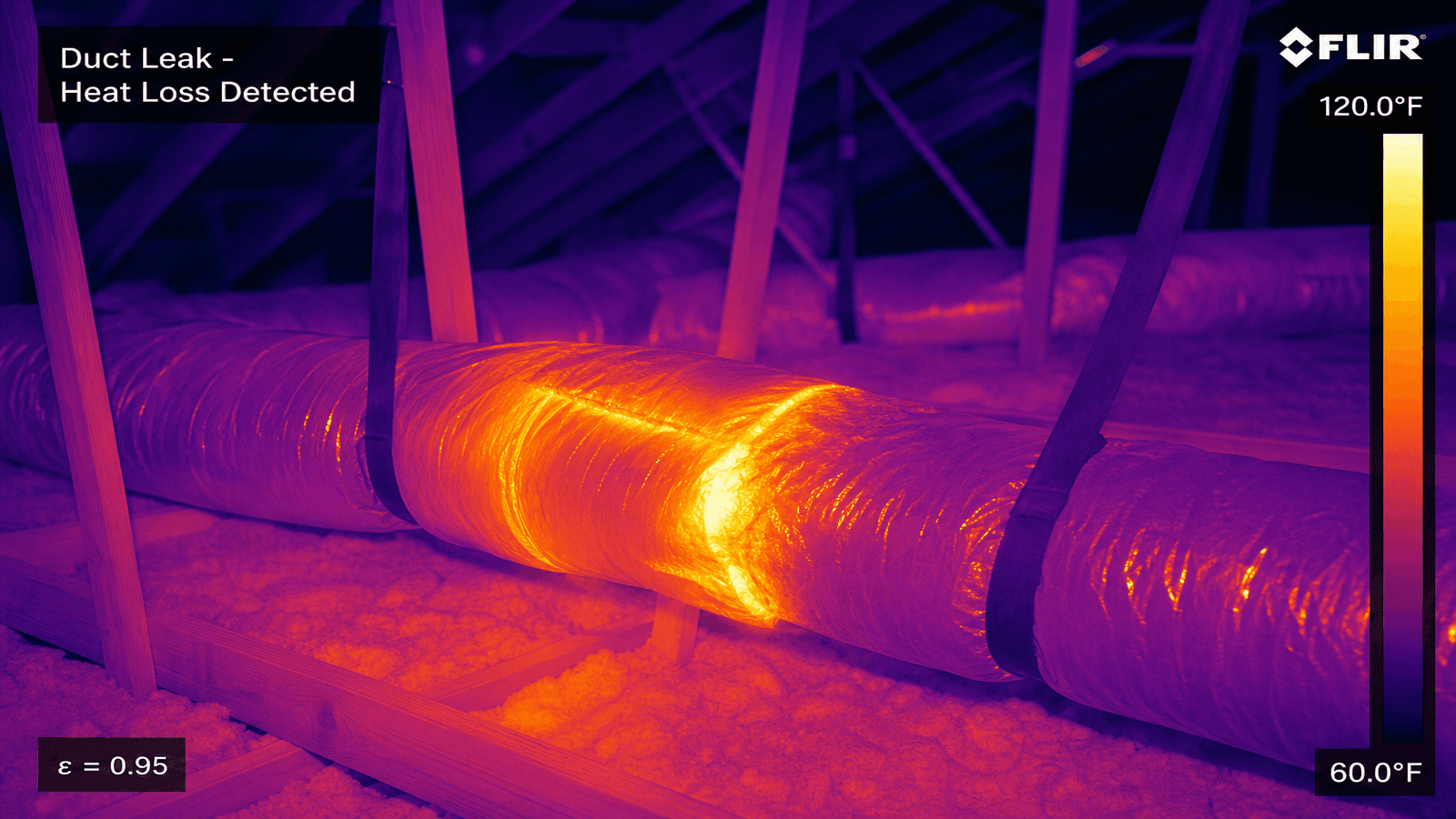
Photo: Thermal imaging photo showing heat escaping from leaky ductwork in an unconditioned attic space
Cost Factors That Affect Your Quote
Beyond material choice, several project-specific factors can push your duct replacement cost higher or lower.
Get quotes from top-rated pros.
Home Layout and Accessibility
Ducts in an open, accessible attic with standard spacing are the easiest and cheapest to replace. Ducts buried inside walls, running through finished ceilings, or located in tight crawl spaces with limited clearance add significant labor time. Expect to pay 30-50% more for ducts in hard-to-reach locations compared to an open attic installation.
Number of Duct Runs and Vents
A simple ranch-style home with 8-10 supply vents and a single return costs far less to re-duct than a two-story colonial with 15-20 supply registers, multiple returns, and runs that span both floors. Each additional duct run adds $250 to $500 in materials and labor.
Insulation Requirements
All ducts running through unconditioned spaces need insulation to prevent energy loss and condensation. Standard R-6 insulation wrapping adds $1 to $3 per linear foot. In extreme climates, R-8 insulation may be required by code, adding slightly more. Insulated flex duct comes with built-in insulation, which is one reason it is popular despite its performance limitations.
Old Duct Removal and Disposal
Removing existing ductwork is labor-intensive, particularly in tight spaces. Disposal of old duct material costs $500 to $1,200 depending on volume and local disposal fees. If the existing ducts contain asbestos-wrapped insulation (common in homes built before 1980), professional abatement is required and can add $2,000 to $5,000 to the project.
Permits and Inspections
Most jurisdictions require a mechanical permit for duct replacement work, costing $300 to $800. Some municipalities also require a post-installation inspection to verify proper sealing and insulation. While permits add cost, they also ensure the work meets building code and can be important for insurance claims and home resale.
Case Study: The Kowalski Home, Edina, MN
Mark and Sarah Kowalski purchased a 1987-built, 2,400 sq ft two-story home in Edina, MN in the summer of 2024. Their first winter revealed a 12-degree temperature difference between the main floor and the upstairs bedrooms. The second-floor rooms never reached the thermostat set point, and the furnace ran almost continuously during cold snaps.
Daniel Torres inspected the system in March 2025. His findings:
- Duct material: Original fiberboard trunk lines with flex duct branch runs
- Total duct leakage: 31% (nearly double the ENERGY STAR threshold)
- Three disconnected flex runs in the attic where tape connections had failed
- Undersized returns: Only one 14x20 return for the entire second floor
- Fiberboard deterioration: Visible moisture damage and delamination on two trunk sections
The Kowalskis received three quotes for full duct replacement: $7,200, $8,100, and $9,800. They chose the middle quote from a NearbyHunt network contractor who specified galvanized sheet metal trunk lines, properly supported R-8 insulated flex runs (all under 8 feet with no bends greater than 45 degrees), and a second return added on the upper floor.
Results after one full heating season (2025-2026):
- Room-to-room temperature difference dropped from 12 degrees to 2 degrees
- Post-installation leakage test: 6% (well within ENERGY STAR standards)
- Monthly heating bill during December-February averaged $168, down from $247 the prior winter
- Annual energy savings: approximately $540
- Projected payback period for the $8,100 investment: 15 years on energy savings alone (though comfort improvement and equipment longevity provide additional value)
"The Kowalski project is a textbook example of why I always start with a leakage test and a visual inspection before recommending anything. Sealing would have been a waste of money here. The fiberboard was deteriorating, the flex connections were failing, and the returns were undersized. Full replacement was the only option that would actually solve the problem."
How to Save on Duct Replacement
Duct replacement is not a small expense, but several strategies can reduce the total cost without compromising quality.
Get multiple quotes. Three quotes minimum. NearbyHunt network contractors in your area can provide itemized estimates that break down materials, labor, permits, and disposal separately. Line-item quotes make it easy to compare what you are actually getting.
Time the project with other HVAC work. If you are replacing your furnace or AC system, adding duct replacement to the same project often saves $500 to $1,500 in labor because the contractor is already on site and may need to disconnect ducts anyway. Bundled projects also mean a single permit fee instead of two.
Consider partial replacement. If only some duct runs are damaged or undersized, you may not need a full system replacement. Replacing the worst sections (typically attic runs or crawl space ducts) while sealing the intact portions can cut costs by 40-60%.
Check for utility rebates. Some utility companies offer rebates for duct sealing or replacement that achieves verified leakage reduction below a specific threshold. These rebates typically range from $200 to $500 and require a post-installation blower door or duct blaster test.
Avoid the cheapest quote. A low bid that skips proper sealing, uses minimal insulation, or does not include a post-installation leakage test will cost more in energy waste over the next decade than the money saved upfront.
Signs Your Ducts Need Replacement
Not sure whether your ductwork needs attention? These symptoms indicate potential duct problems worth investigating.
- Rooms that are always too hot or too cold despite the HVAC system running normally
- Visible dust blowing from supply registers when the system kicks on
- Utility bills increasing year over year without changes in usage patterns
- The HVAC system runs constantly without reaching the set temperature
- Tangled, kinked, or sagging flex duct visible in the attic or crawl space
- Musty or stale odors coming from supply vents (possible mold in fiberboard or insulation)
- Ductwork over 20 years old, particularly fiberboard or early-generation flex duct
- Rattling, whistling, or popping sounds from ducts during system operation
- Excessive dust accumulation throughout the home despite regular cleaning
If you notice three or more of these signs, schedule a professional duct inspection with a leakage test. Most HVAC contractors charge $200 to $400 for a comprehensive duct assessment that includes a visual inspection and a duct blaster test to measure total leakage.
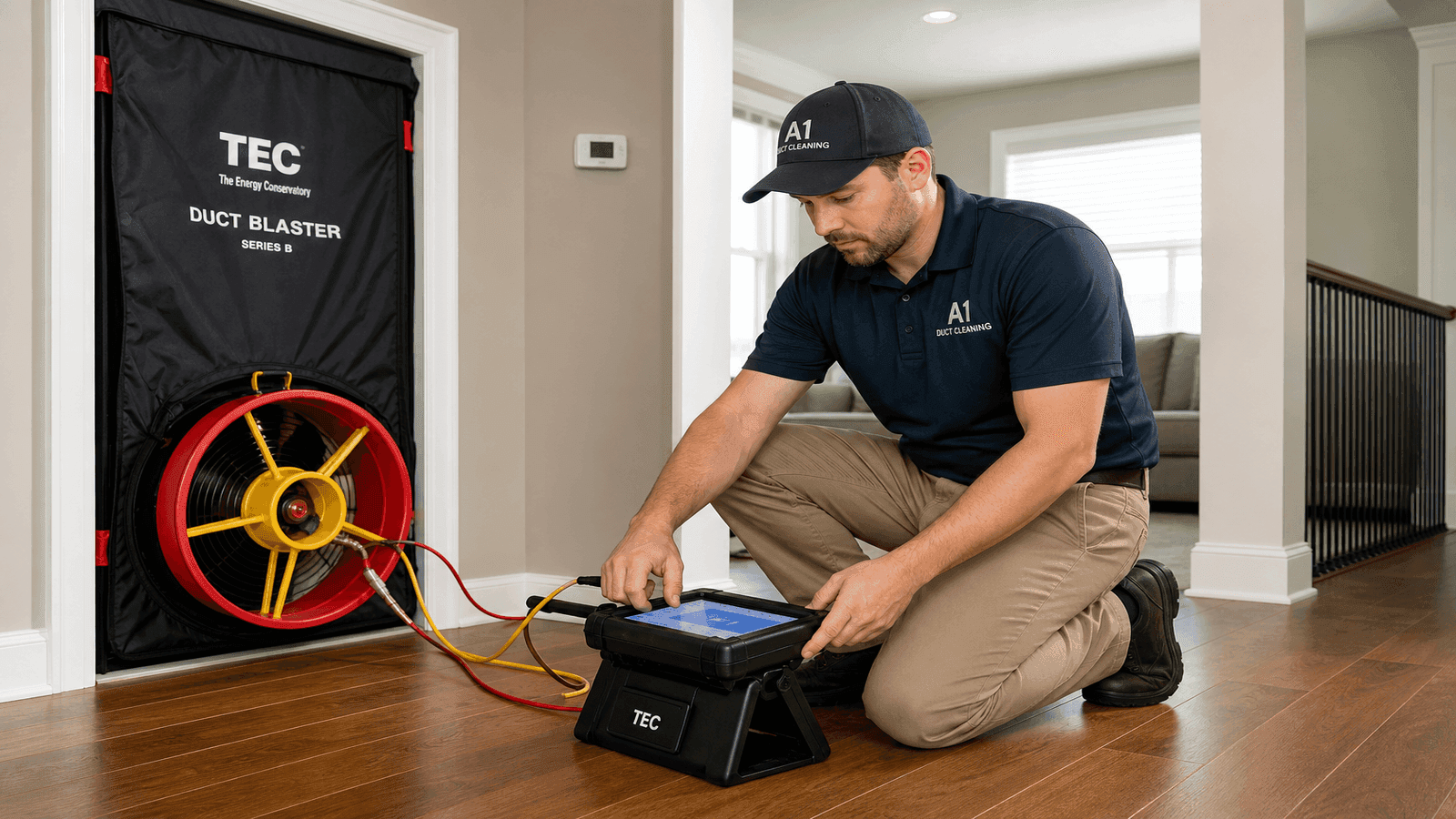
Photo: HVAC technician using a duct blaster testing device to measure duct leakage in a residential home
Sources
- Forbes Home. "How Much Does Ductwork Installation Cost?" (2026). https://www.forbes.com/home-improvement/hvac/ductwork-installation-cost/
- U.S. Department of Energy / ENERGY STAR. "Duct Sealing." https://www.energystar.gov/saveathome/heating-cooling/duct-sealing
- Advanced Professional Home Services. "Duct Sealing vs Duct Replacement." https://advancedphvac.com/duct-sealing-vs-duct-replacement-which-is-right/
- JADE Learning. "Duct Material Comparison for Residential Installations." https://www.jadelearning.com/blog/duct-material-comparison-for-residential-installations/
- ENERGY STAR. "Duct Leakage to Outdoors Test Exemptions Guide, Version 6." https://www.energystar.gov/sites/default/files/2025-01/Duct%20Leakage%20Exemptions%20Guide%20v6%202024-12-02.pdf
- This Old House. "How Much Does Air Duct Replacement Cost?" (2026). https://www.thisoldhouse.com/heating-cooling/air-ducts-replacement-cost
- Fixr. "How Much Does It Cost to Install Ductwork?" https://www.fixr.com/costs/ductwork
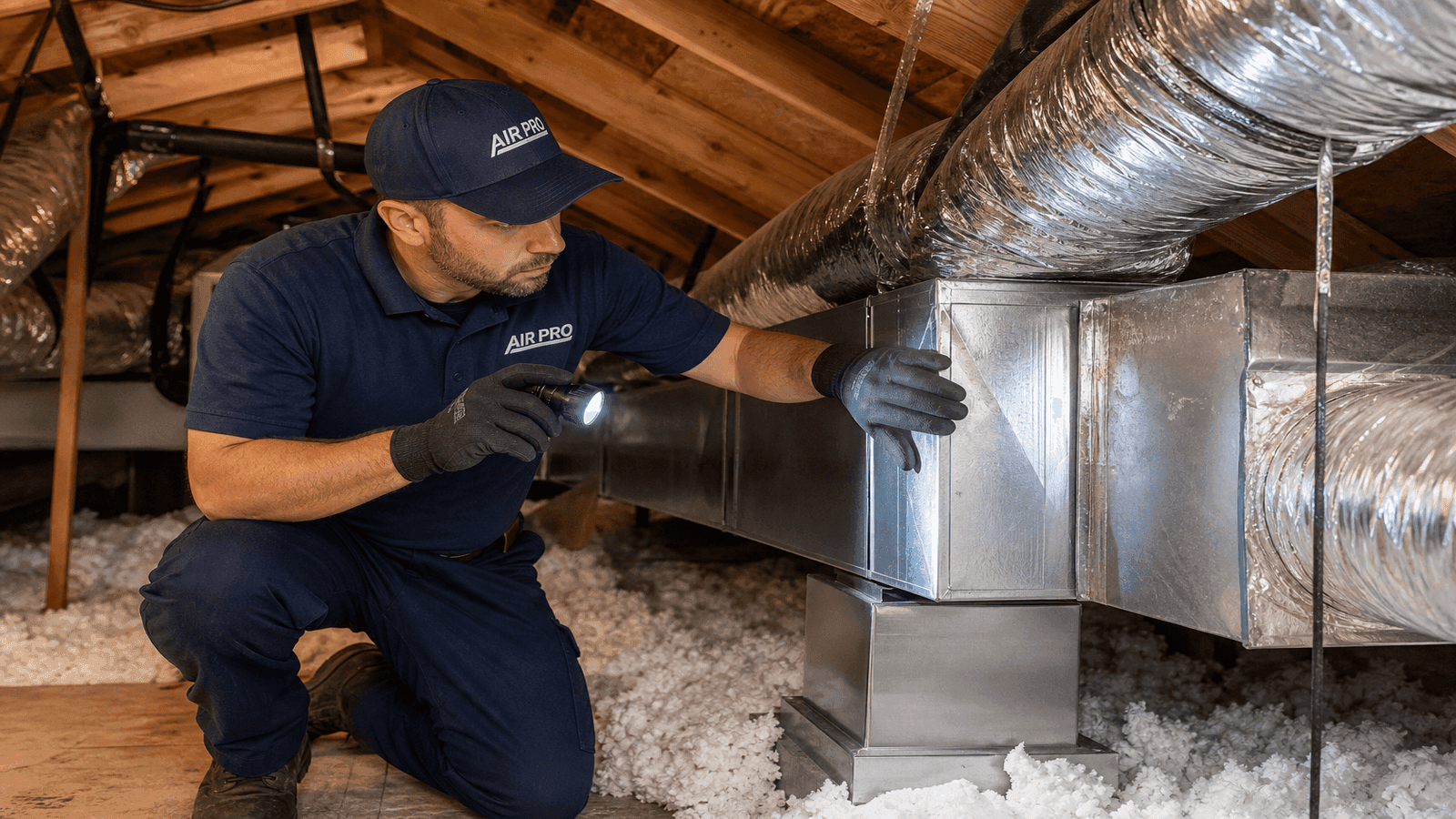

Daniel is an EPA-certified HVAC technician & Energy Efficiency Consultant with over 14 years of experience in maintaining and installing heating and cooling systems throughout the Midwest. Passionate about sustainability, Dan specialises in energy-efficient retrofits and intelligent climate control systems. He writes for NearbyHunt to help homeowners extend the lifespan of their HVAC units while lowering utility bills.

Christine is an EPA-certified HVAC professional with 17 years of experience in heating, cooling, and indoor air quality systems. She has managed large-scale residential installations and worked as a technical trainer for new HVAC apprentices. Chris’s reviews focus on accuracy, safety, and performance standards in modern HVAC practices.