- Air-source heat pumps cost $8,000 to $18,000 installed in 2026, with the national average at $12,500 for a standard model and $15,400 for cold-climate units [1].
- Geothermal (ground-source) systems cost $15,000 to $40,000 but qualify for a 30% federal tax credit through 2032, reducing net cost to $10,500 to $28,000 [3].
- The federal 25C tax credit expired December 31, 2025. State HOMES/HEAR rebates (up to $8,000) and utility rebates ($200 to $2,000) are the remaining air-source incentives [2].
- Cold-climate heat pumps add $2,000 to $4,000 over standard models but maintain full heating capacity down to -15 degrees F or lower [4].
- Ductless mini-split heat pumps cost $3,000 to $8,000 per zone, making them the most affordable entry point for homes without existing ductwork [5].
- Dual-fuel systems (heat pump plus gas furnace) cost $10,000 to $20,000 and offer the lowest combined operating costs in regions with very cold winters and cheap natural gas [6].
- Operating savings of $500 to $1,200 per year over gas furnace and AC combinations make heat pumps a 7- to 12-year payback in most U.S. climates, even without federal credits [1].
Installing a heat pump is one of the fastest-growing home improvement decisions in the United States, with the Department of Energy reporting that heat pumps outsold gas furnaces nationally for the third consecutive year in 2025 [1].
Daniel Torres, a Certified HVAC Technician and Energy Efficiency Consultant with EPA 608 Universal, NATE, and HVAC Excellence certifications and 14+ years of field experience in Minneapolis, MN, provided the cost data and expert commentary throughout this guide. His pricing observations draw on hundreds of installations across the upper Midwest, where cold-climate heat pumps face the toughest real-world test.
The cost picture shifted in 2026. The federal Section 25C tax credit (up to $2,000/year for air-source heat pumps) expired December 31, 2025 [2]. However, state HOMES and HEAR Act rebates remain active (up to $8,000 for qualifying households), and the 30% federal geothermal credit continues through 2032 [3]. Heat pumps still pencil out for most homeowners when you factor in operating savings, remaining rebates, and rising natural gas costs.
For a broader view of all HVAC system types and pricing, visit the NearbyHunt HVAC Costs guide.

Get quotes from top-rated pros.
I installed my first cold-climate heat pump in 2019 when most Minneapolis contractors said heat pumps couldn't handle our winters. About 400 installations later, I've tracked every job's cost breakdown. The biggest surprise for homeowners is how much the total varies based on factors beyond the equipment itself. Ductwork, electrical panel upgrades, and refrigerant line sets can swing the final price by $3,000 to $6,000.
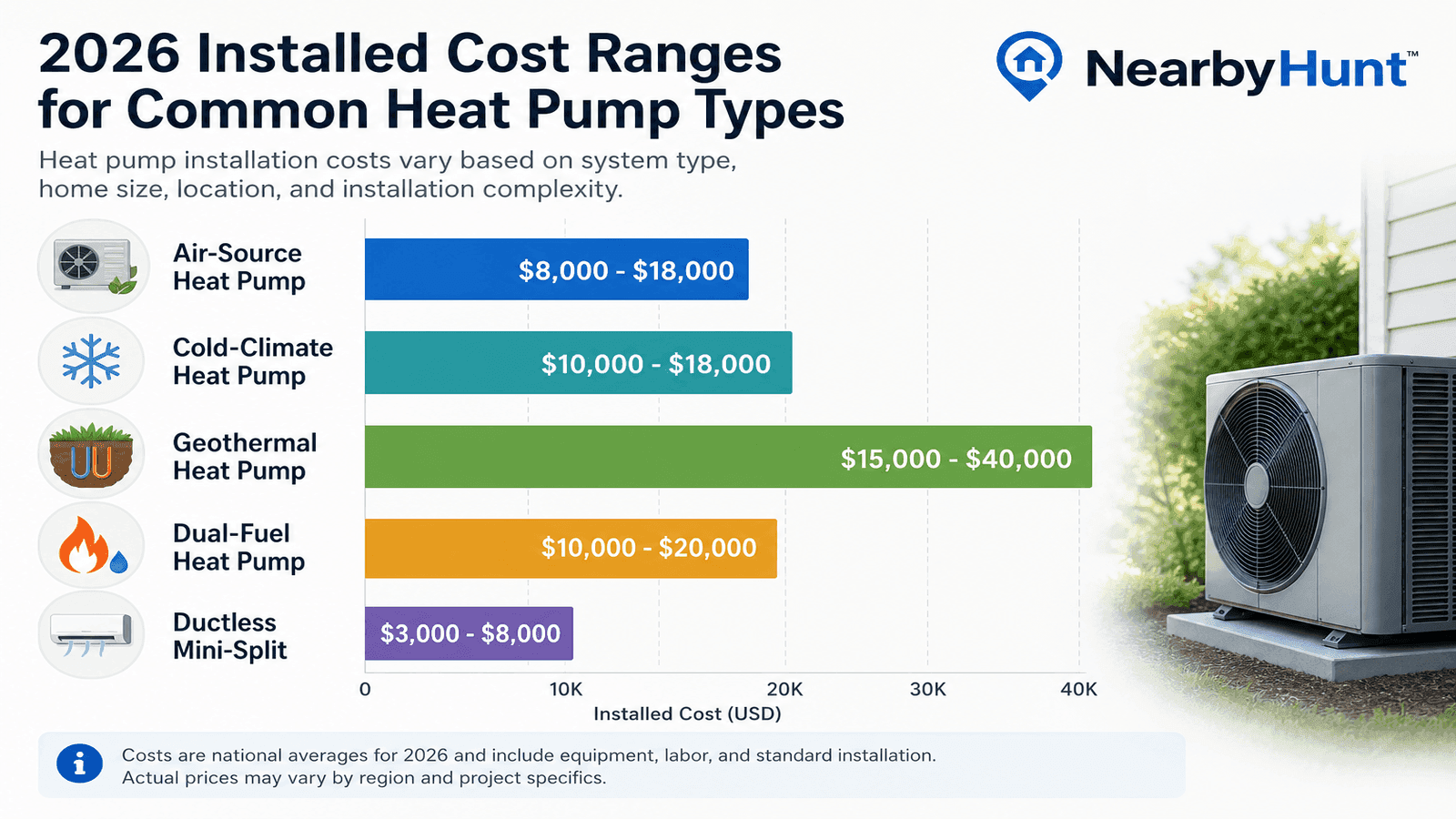
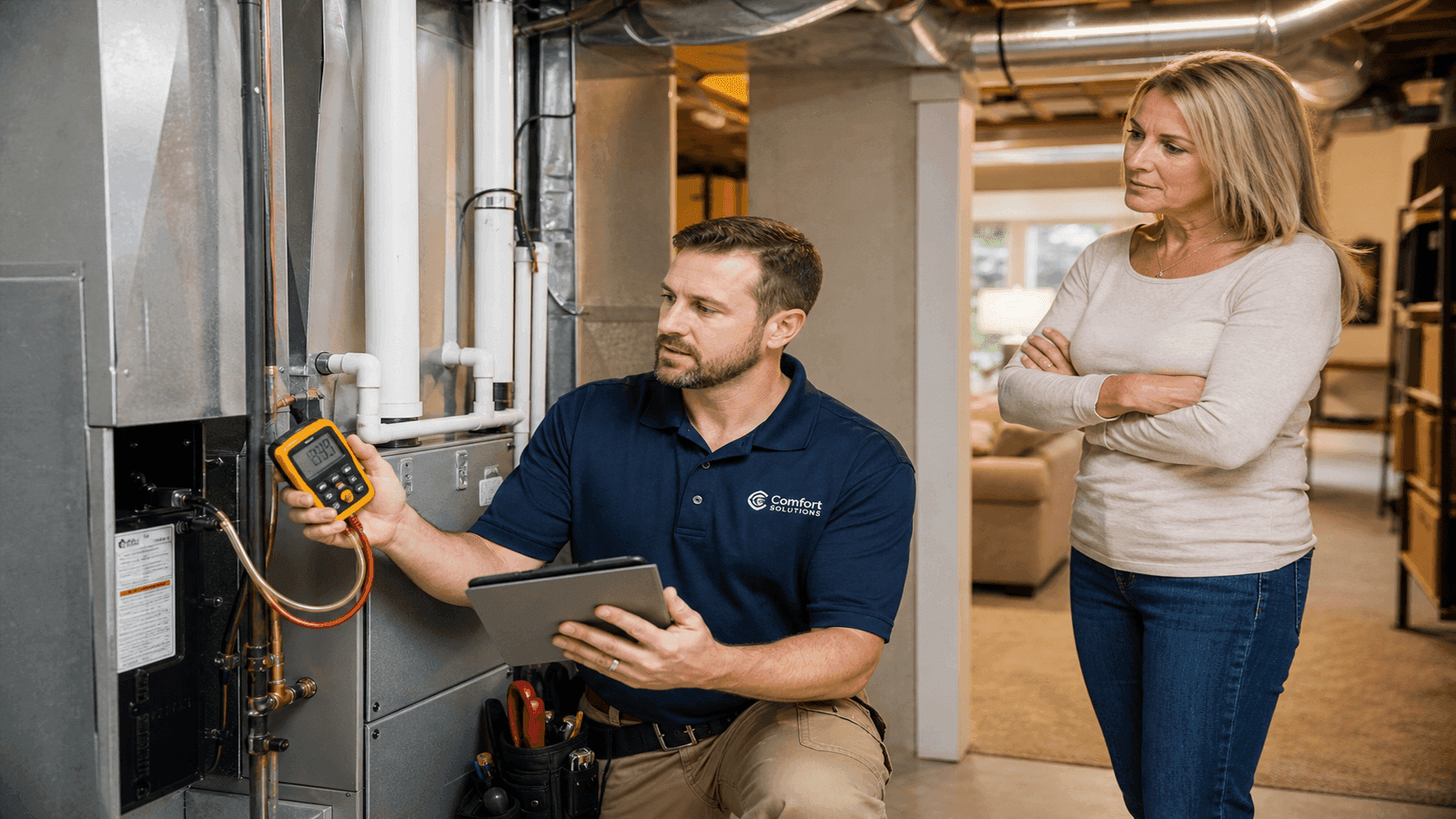
Photo: Overview of heat pump installation costs in 2026 showing average price ranges by system type
Heat Pump Cost by Type
Every heat pump moves thermal energy rather than generating it, which is why they deliver 2 to 5 times more heating energy than the electricity they consume. But the cost differences between types are significant, driven by equipment complexity, installation requirements, and performance capabilities.
Air-Source Heat Pump Cost
Air-source heat pumps are the most common residential option, accounting for roughly 85% of all heat pump installations nationally [1]. They extract heat from outdoor air (even in cold weather) and transfer it indoors during winter, then reverse the process for cooling in summer.
Cost by Tonnage (2026 Averages)
| System Size | Home Size (Approx.) | Average Installed Cost |
| 1.5 Ton | 600 to 1,000 sq ft | $6,500 to $9,500 |
| 2 Ton | 1,000 to 1,400 sq ft | $7,500 to $11,000 |
| 2.5 Ton | 1,400 to 1,700 sq ft | $8,500 to $13,000 |
| 3 Ton | 1,700 to 2,100 sq ft | $9,500 to $15,000 |
| 4 Ton | 2,100 to 2,700 sq ft | $11,000 to $17,000 |
| 5 Ton | 2,700 to 3,500 sq ft | $13,000 to $18,000 |
Equipment accounts for approximately 55-60% of the total installed cost. Labor, materials (refrigerant lines, electrical wiring, thermostat, pad, and disconnect), and permits make up the remaining 40-45% [5].
Cost by Efficiency Tier
| Efficiency Level | SEER2 Range | HSPF2 Range | Price Premium Over Baseline |
| Standard | 14.3 to 15.5 | 7.5 to 8.0 | Baseline |
| High efficiency | 15.5 to 18.0 | 8.0 to 9.5 | $1,500 to $3,000 more |
| Premium (variable-speed) | 18.0 to 22.0 | 9.5 to 13.0 | $3,000 to $6,000 more |
Variable-speed inverter models cost more upfront but save 20-40% on annual energy costs compared to single-stage units because they run at partial capacity 80-90% of the time [7]. In a home spending $2,000 per year on heating and cooling, that translates to $400 to $800 in annual savings.
Cold-Climate Heat Pump Cost
Cold-climate heat pumps (ccASHP) are engineered to maintain rated heating capacity at temperatures down to -15 degrees F, and many models operate effectively at -22 degrees F [4]. Standard air-source heat pumps lose significant capacity below 20 degrees F and rely heavily on auxiliary electric resistance heat, which is expensive to run.
Cold-Climate Models and Pricing (2026):
Cold-Climate Models and Pricing (2026)
| Brand/Model | SEER2 | HSPF2 | Rated Low Temp | Installed Cost (3 Ton) |
| Mitsubishi Hyper-Heat | 18.0 | 11.0 | -13 F | $14,000 to $18,000 |
| Bosch IDS 2.0 | 19.0 | 11.5 | -13 F | $13,000 to $17,000 |
| Daikin Fit | 16.5 | 9.5 | -13 F | $11,500 to $15,000 |
| Carrier Greenspeed | 20.0 | 12.0 | -15 F | $14,500 to $18,500 |
The premium over a standard air-source unit is $2,000 to $4,000, but in heating-dominated climates like Minnesota, Wisconsin, or Maine, the reduced reliance on backup electric heat pays back that premium within 2 to 4 winters [4].
In my Minneapolis-area installations, cold-climate heat pumps consistently outperform what the specs promise. I tracked a Bosch IDS 2.0 through the 2025-2026 winter in Maple Grove, MN, where we hit -19 degrees for three consecutive nights. The system maintained 68 degrees indoors without the backup heat strips ever kicking on. The homeowner's January electric bill was $165. Their old 80% AFUE gas furnace plus AC combo was costing $280 per month in winter gas alone.
Get quotes from top-rated pros.
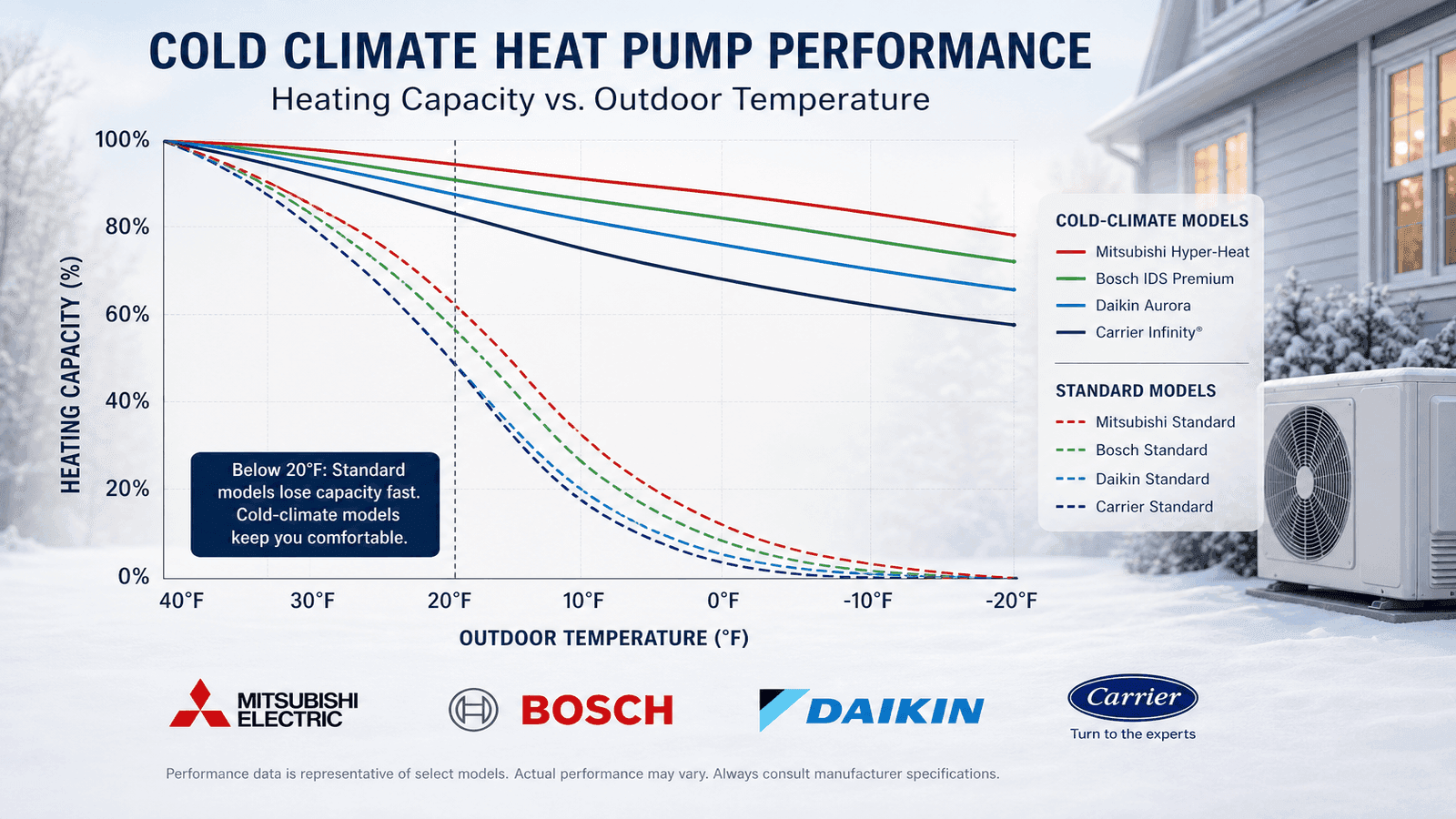
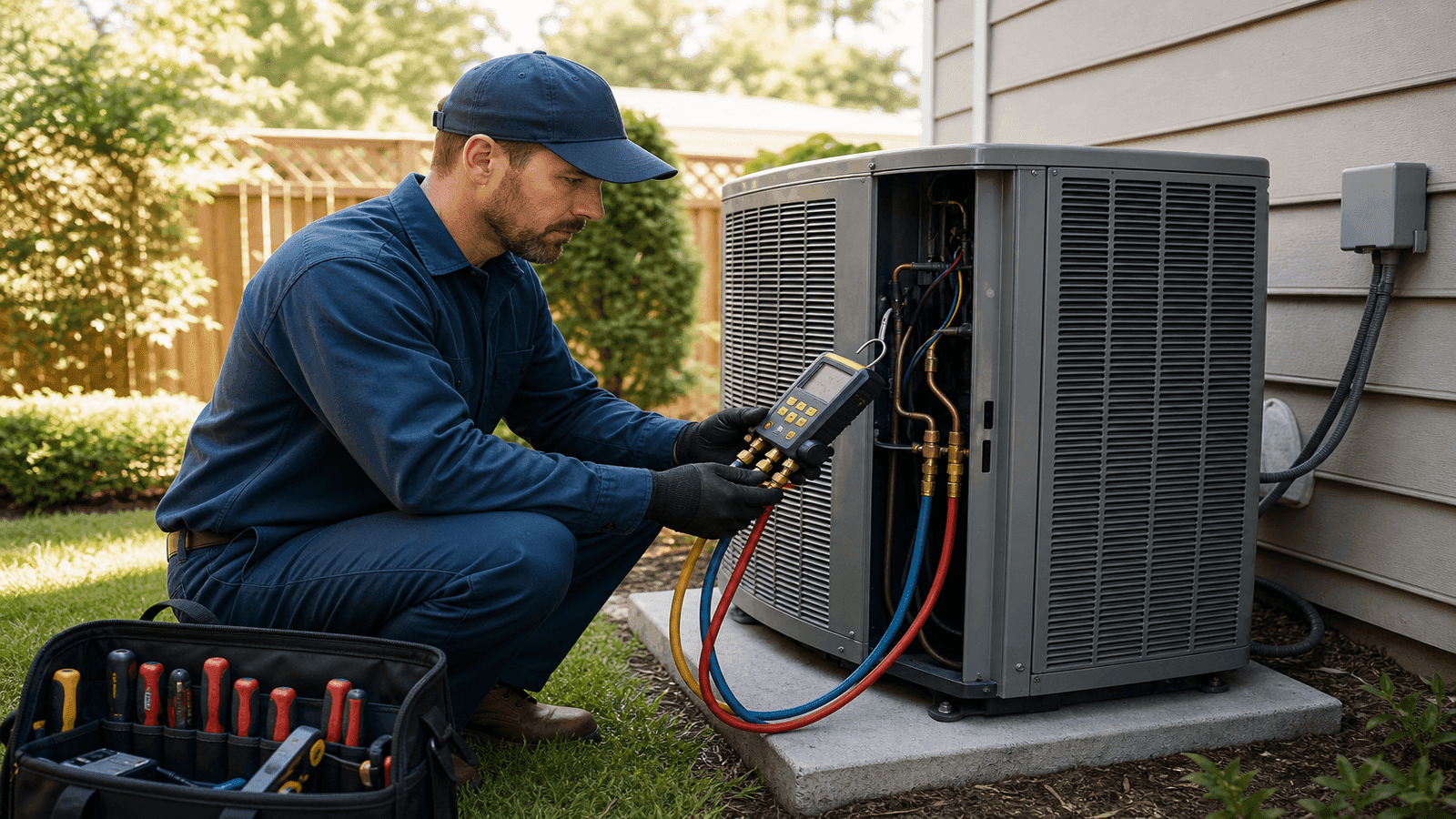
Photo: Comparison of cold-climate heat pump brands showing capacity retention at low temperatures
Geothermal (Ground-Source) Heat Pump Cost
Geothermal heat pumps extract heat from underground, where temperatures remain a constant 50-55 degrees F year-round regardless of outdoor conditions. They achieve COP (coefficient of performance) values of 3.5 to 5.0, meaning they produce 3.5 to 5 units of heating energy for every unit of electricity consumed [8].
Geothermal Cost Breakdown
| Component | Cost Range |
| Ground loop installation (horizontal) | $5,000 to $15,000 |
| Ground loop installation (vertical) | $10,000 to $25,000 |
| Indoor heat pump unit | $3,000 to $7,000 |
| Ductwork modifications | $1,000 to $3,000 |
| Desuperheater (water heating) | $500 to $1,500 |
| Permits and engineering | $500 to $2,000 |
| Total installed | $15,000 to $40,000 |
Horizontal loops require 400 to 600 linear feet of trenching per ton (best for larger lots). Vertical loops drill 150 to 300 feet deep per ton and cost more but need less surface area [8].
The 30% Federal Tax Credit: Geothermal qualifies for a 30% credit under Section 25D through 2032, applying to the full installed cost [3]. A $30,000 installation nets $9,000 back, reducing effective cost to $21,000. This is a dollar-for-dollar tax credit, not a deduction.
Case Study
The Hendersons replaced a 22-year-old propane system with a 4-ton vertical-loop geothermal unit. Installed cost: $32,000. After the 30% federal credit ($9,600) and Ohio utility rebate ($1,500), net cost was $20,900. Annual heating/cooling dropped from $4,200 to $1,100, saving $3,100 per year with a 6.7-year payback.
Dual-Fuel Heat Pump Cost
Dual-fuel pairs a heat pump with a gas furnace. The heat pump runs down to a set outdoor temperature (25-35 degrees F), then the furnace takes over [6].
| Configuration | Average Installed Cost |
| Standard HP + 80% AFUE furnace | $10,000 to $15,000 |
| High-efficiency HP + 96% AFUE furnace | $14,000 to $20,000 |
| Cold-climate HP + 96% AFUE furnace | $16,000 to $22,000 |
Dual-fuel makes sense where gas costs less than $1.20/therm and temperatures regularly drop below 10 degrees F. As cold-climate heat pump technology improves, many homeowners in zones 5 and 6 find a ccASHP alone performs well enough to skip the gas furnace entirely [6].
Ductless Mini-Split Heat Pump Cost
Ductless mini-splits mount indoor units on walls, connected to an outdoor compressor through a 3-inch wall penetration [5]. No ductwork means no duct losses and no major construction.
| Setup | Average Installed Cost |
| Single zone (1 indoor unit) | $3,000 to $8,000 |
| Dual zone (2 indoor units) | $5,000 to $11,000 |
| Tri zone (3 indoor units) | $7,500 to $14,000 |
| Quad zone (4 indoor units) | $10,000 to $17,000 |
Each additional zone adds $1,500 to $3,500. Best for older homes without ductwork, additions, garages, and sunrooms. HVAC professionals in the NearbyHunt network report mini-split installations are up roughly 35% year-over-year.
What Drives Heat Pump Installation Cost
The equipment price is only part of the story. Installation variables routinely add $2,000 to $8,000 to the final bill, and understanding these factors helps you evaluate quotes accurately.
Get quotes from top-rated pros.
Equipment and Brand
Premium brands (Carrier, Trane, Lennox, Mitsubishi) typically cost 15-25% more than value brands (Goodman, Amana, Rheem) for comparable specifications [5]. The price premium buys longer warranty coverage and wider dealer networks. However, installation quality matters more than brand name. A properly installed Goodman unit will outperform a poorly installed Carrier unit every time.
For a 3-ton air-source heat pump installed, expect to pay $8,500 to $12,500 for value brands (Goodman, Rheem), $10,500 to $16,000 for mid-tier (Trane, Carrier, York), and $11,500 to $18,000 for premium brands (Lennox, Mitsubishi, Daikin).
Other Cost Factors
- Electrical panel upgrade: Homes with 100-amp panels (pre-1990) may need a 200-amp upgrade at $1,500 to $3,500 [9]. Homes already at 200 amps just need a new circuit ($200 to $500).
- Ductwork modifications: Heat pumps deliver lower supply temperatures (90-110 degrees F vs. 130-160 degrees F for furnaces), so ducts may need resizing or sealing. Budget $500 to $3,000 for modifications or $2,000 to $5,000 for full replacement [7].
- Refrigerant line sets: Older lines may not work with R-454B. New line sets run $500 to $1,500 [10].
- Labor rates: The same job costs 20-35% more in the Northeast and West Coast than in the Southeast or Midwest [5].
- Permits: Mechanical permits cost $100 to $500. A reputable contractor includes permits in their quote.
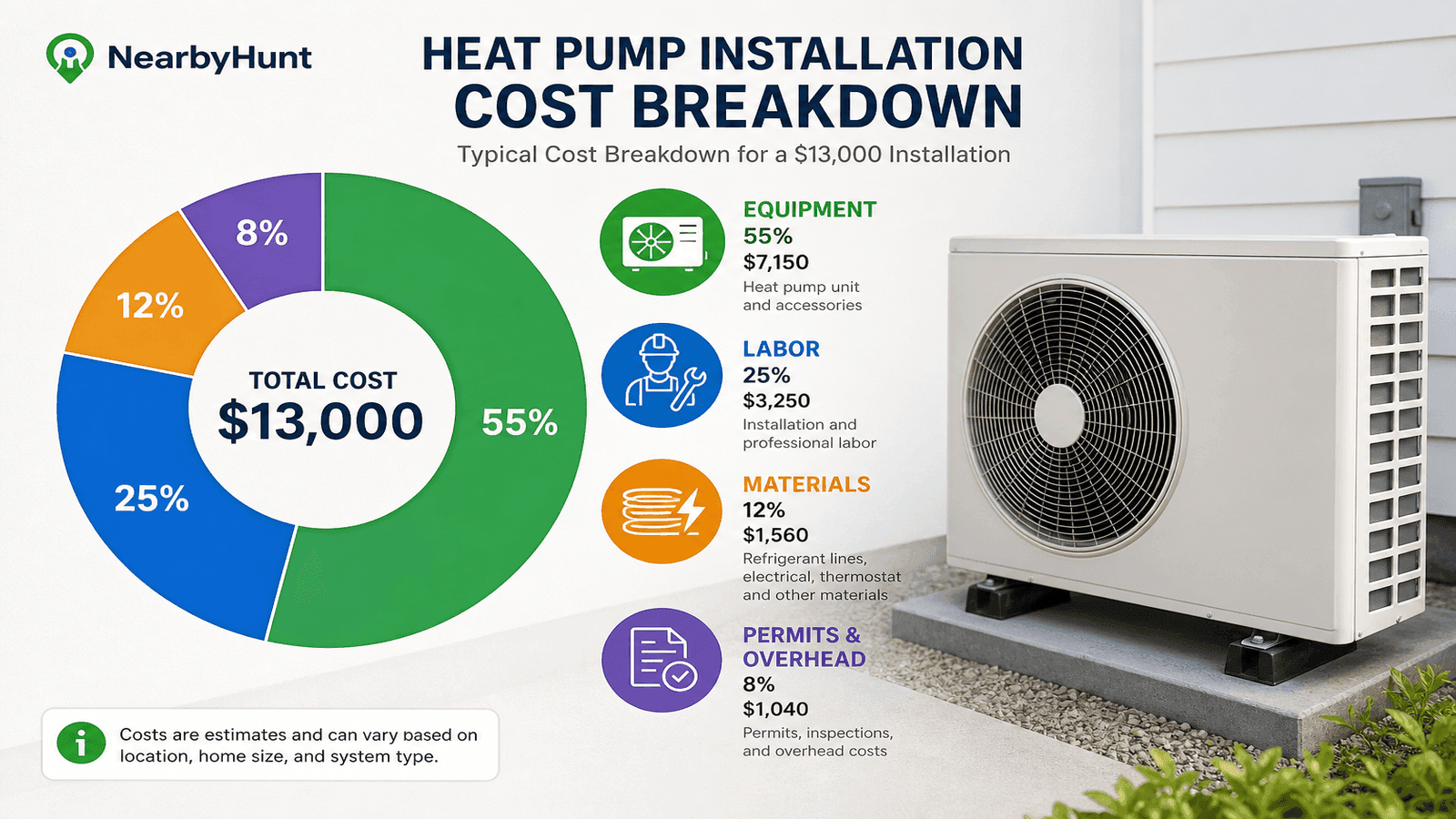
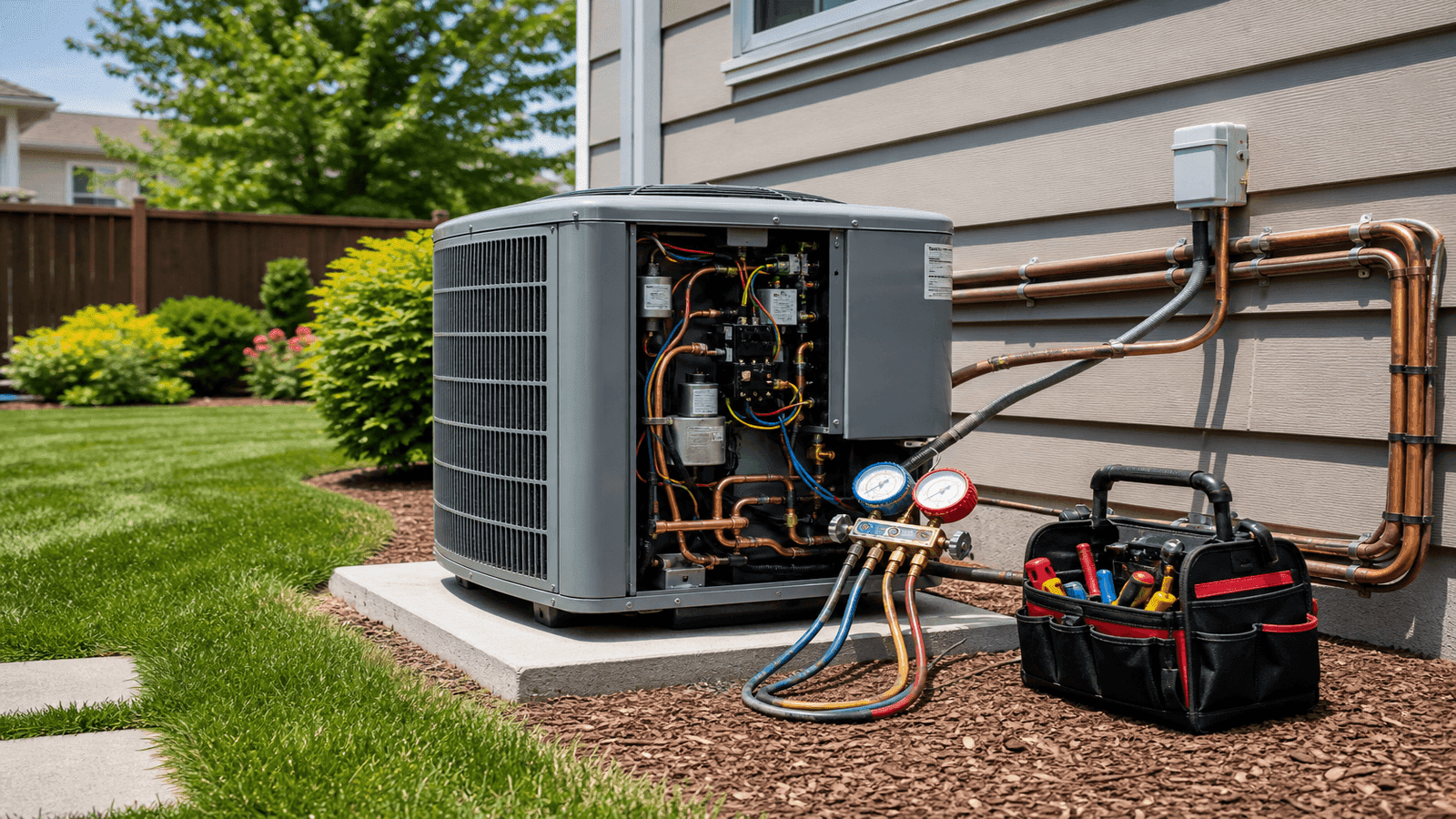
Photo: Breakdown of heat pump installation cost components showing equipment, labor, materials, and permits
Rebates and Incentives in 2026
The incentive picture changed dramatically when the federal Section 25C tax credit expired on December 31, 2025 [2]. Here is what remains available.
Federal Incentives
Section 25C (Air-Source Heat Pumps): EXPIRED. The credit that provided up to $2,000 per year for qualifying air-source heat pump installations ended December 31, 2025. It does not apply to systems installed in 2026 or later.
Section 25D (Geothermal Heat Pumps): ACTIVE through 2032. A 30% tax credit on the full installed cost of geothermal systems, including ground loops, equipment, and labor [3]. No annual cap. A $35,000 geothermal installation generates a $10,500 tax credit. The credit steps down to 26% in 2033 and 22% in 2034.
State HOMES and HEAR Act Rebates
The IRA allocated $8.8 billion for home electrification rebates through HOMES and HEAR programs [11]. These are point-of-sale rebates applied at purchase.
| Household Income Level | Maximum Heat Pump Rebate |
| Below 80% area median income (AMI) | Up to $8,000 |
| 80-150% AMI | Up to $4,000 |
| Above 150% AMI | Not eligible for HEAR rebates |
About 35 states have active programs as of early 2026, though several have exhausted initial allocations [11]. Check the DSIRE database (dsireusa.org) for current availability in your state.
Utility Rebates
Local utilities offer $200 to $2,000 in additional rebates that stack on top of state and federal incentives [5]. Electric co-ops commonly offer $500 to $1,500 for geothermal, and municipal utilities offer $300 to $800 for ENERGY STAR certified heat pumps.
The 25C credit going away hurt. But I am selling more heat pumps than ever because the operating savings justify the investment. Replacing an 80% AFUE gas furnace and 14 SEER AC with a modern heat pump saves $800 to $1,200 per year. That is a 10- to 12-year payback without any credits. Add a HOMES rebate and payback drops to 4 to 6 years.
Operating Costs and Payback
Heat pumps move heat rather than generate it, delivering 2.5 to 4 units of heating energy for every unit of electricity consumed (COP of 2.5 to 4.0) [1]. A gas furnace maxes out at 0.96 effective COP.
Annual Operating Cost Comparison
| System Type | Annual Heating Cost | Annual Cooling Cost | Total Annual |
| Gas furnace (80% AFUE) + AC (14 SEER2) | $1,400 to $2,200 | $500 to $900 | $1,900 to $3,100 |
| Gas furnace (96% AFUE) + AC (18 SEER2) | $1,000 to $1,600 | $350 to $600 | $1,350 to $2,200 |
| Air-source HP (standard) | $800 to $1,400 | $350 to $650 | $1,150 to $2,050 |
| Air-source HP (variable-speed) | $600 to $1,100 | $250 to $500 | $850 to $1,600 |
| Geothermal HP | $400 to $800 | $200 to $400 | $600 to $1,200 |
Estimates assume national average rates of $0.16/kWh electricity and $1.30/therm natural gas (EIA, Q1 2026) [12]. In the Pacific Northwest ($0.11/kWh), heat pumps have an even larger advantage. Where natural gas is very cheap ($0.70/therm), the gap narrows.
Get quotes from top-rated pros.
Payback Period by Scenario
- Replacing gas furnace + AC with air-source HP: $12,500 upfront ($8,500 after HOMES rebate). Saves $750-$1,200/year. Payback: 7-11 years without rebate, 5-8 years with.
- Replacing propane with geothermal: $30,000 upfront ($21,000 after 30% credit). Saves $2,800-$3,500/year. Payback: 6-7.5 years.
- Adding ductless mini-split (no existing AC): $5,500 single zone. Saves $700-$1,300/year vs. window units + baseboard. Payback: 4-7 years.
NearbyHunt Network Insight
HVAC contractors in the NearbyHunt network report that heat pump installations now represent approximately 40% of all replacement jobs across their service areas, up from under 20% three years ago. The fastest adoption is in climate zones 3 through 5 (Mid-Atlantic, Midwest, and Pacific Northwest), where heating loads are significant but winters are moderate enough for standard air-source models to handle the full season without backup heat.
How to Get the Best Price
Getting a fair price on a heat pump requires more than collecting three quotes. The difference between the lowest and highest quote for the same home often exceeds $5,000, and the cheapest bid is not always the best value.
Get a Manual J Load Calculation
Any contractor who sizes your system based on "one ton per 500 square feet" is guessing. A Manual J calculation determines the exact heating and cooling load based on your home's insulation, windows, air sealing, and climate data [7]. Oversized heat pumps short-cycle and fail to dehumidify. Undersized units run constantly and cannot keep up on the coldest days. A Manual J takes 30 to 60 minutes and should be included in any professional quote.
Compare Quotes Line by Line
Request that each quote specifies: exact model numbers, SEER2/HSPF2 ratings, Manual J confirmation, ductwork and electrical scope, thermostat model, permit fees, and labor warranty terms (separate from manufacturer warranty). The cheapest quote often omits items that show up as change orders during installation.
Time Your Purchase
Spring (March through May) and fall (September through November) offer the best pricing because HVAC contractors have lighter schedules and manufacturers run seasonal promotions [5]. Avoid emergency replacements in July or January when demand peaks.
Check Contractor Credentials
At minimum, verify a state HVAC license, EPA Section 608 certification, manufacturer certification for the brand being installed, adequate liability insurance, and positive reviews on established platforms including the NearbyHunt network.
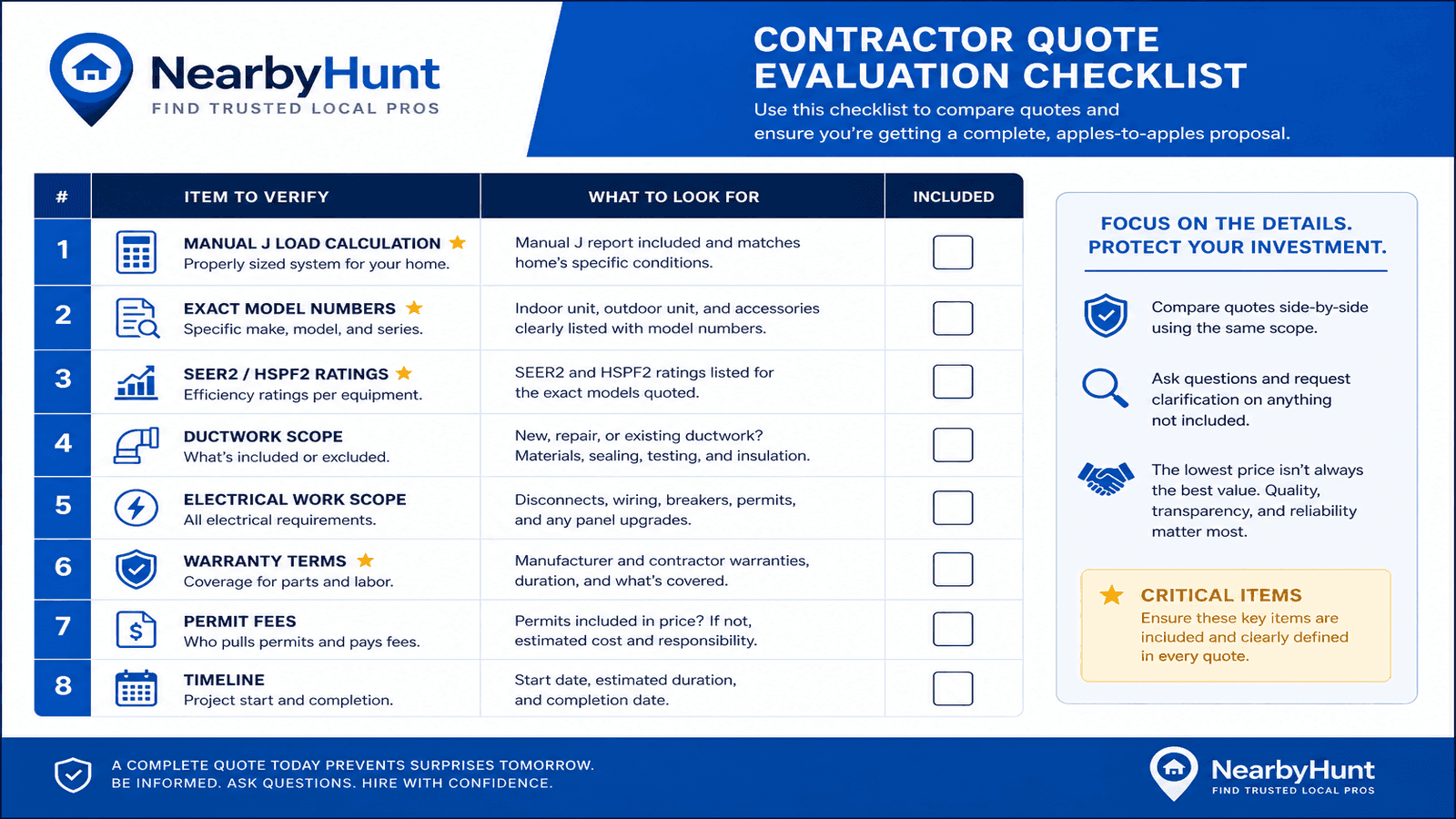
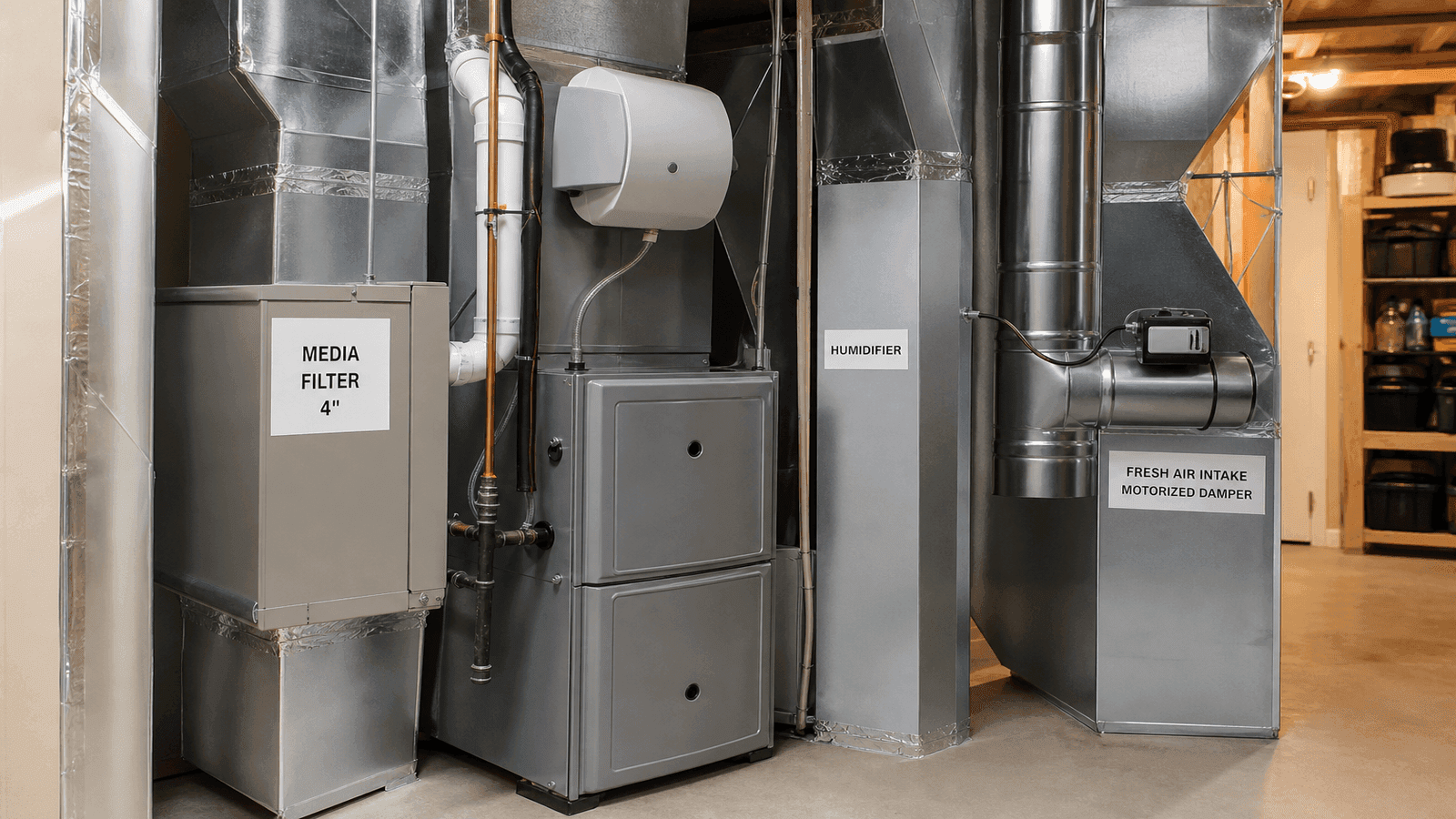
Photo: Checklist for evaluating heat pump contractor quotes with key items to compare
R-454B Refrigerant in 2026
All heat pumps manufactured after January 1, 2026, use R-454B refrigerant, replacing R-410A per EPA AIM Act regulations [10]. R-454B has 78% lower global warming potential than R-410A. For buyers, the practical change is minimal: equipment looks the same, installs the same way, and performs comparably. New units include built-in leak detection sensors because R-454B is classified as mildly flammable (A2L). The transition has added $200 to $500 to new system prices [10]. Existing R-410A systems do not need replacement, though R-410A service charges have risen to $200 to $600 as production ramps down.
Replace vs. Repair
Replace when the system is over 12 years old and needs a repair exceeding $1,500, uses R-22 refrigerant, or energy bills have climbed 20%+ without rate changes. Repair when the system is under 8 years old and the fix costs under $1,000, or the issue is a single component failure (capacitor, contactor, fan motor) still under warranty.
The 50% Rule: If one repair costs more than 50% of a new system's price and the unit is past its midlife point (8+ years), replacement is usually the better financial choice [7].
Disclaimer: Pricing reflects national averages from manufacturer data, NearbyHunt network contractor quotes, and federal agency sources (DOE, EPA, EIA) as of May 2026. Costs vary by region and project. Obtain multiple written quotes from licensed contractors. Tax information is general guidance; consult a tax professional for your situation.
Find a heat pump installer near you. Connect with licensed, reviewed HVAC professionals in the NearbyHunt network who specialize in heat pump installations, including cold-climate and geothermal systems.
Sources
[1] U.S. Department of Energy. "Heat Pump Systems." Energy.gov.
[2] U.S. Congress. "One Big Beautiful Bill Act." Section 25C modifications, effective January 1, 2026.
[3] Internal Revenue Service. "Residential Clean Energy Credit (Section 25D)." IRS.gov.
[4] Northeast Energy Efficiency Partnerships. "Cold Climate Air Source Heat Pump Specification." NEEP.
[5] ENERGY STAR. "Heat Pumps." EnergyStar.gov.
[6] American Council for an Energy-Efficient Economy. "Dual-Fuel Heat Pump Systems." ACEEE.
[7] Air Conditioning Contractors of America. "Manual J Residential Load Calculation." ACCA.
[8] International Ground Source Heat Pump Association. "Residential Geothermal Systems." IGSHPA.
[9] National Electrical Code (NEC) 2023. Article 440: Air-Conditioning and Refrigerating Equipment.
[10] U.S. Environmental Protection Agency. "AIM Act: Phasedown of Hydrofluorocarbons." EPA.gov.
[11] U.S. Department of Energy. "Home Energy Rebates." Energy.gov.
[12] U.S. Energy Information Administration. "Electric Power Monthly" and "Natural Gas Monthly." EIA.gov.

Daniel is an EPA-certified HVAC technician & Energy Efficiency Consultant with over 14 years of experience in maintaining and installing heating and cooling systems throughout the Midwest. Passionate about sustainability, Dan specialises in energy-efficient retrofits and intelligent climate control systems. He writes for NearbyHunt to help homeowners extend the lifespan of their HVAC units while lowering utility bills.

Christine is an EPA-certified HVAC professional with 17 years of experience in heating, cooling, and indoor air quality systems. She has managed large-scale residential installations and worked as a technical trainer for new HVAC apprentices. Chris’s reviews focus on accuracy, safety, and performance standards in modern HVAC practices.