- The average furnace replacement costs $3,200-$7,800 installed, with a national average of $5,200 in 2026; gas furnaces run $3,800-$10,000, electric furnaces $2,000-$5,500, and oil furnaces $4,500-$10,500 depending on efficiency rating and installation complexity [1].
- Gas furnaces remain the most popular choice for cold-climate homeowners, but high-efficiency models (96%+ AFUE) carry a $2,000-$4,000 premium over standard 80% AFUE units that takes 5-8 years to recoup in fuel savings [2].
- Electric furnaces cost 30-50% less to install than gas but run 2-4 times more per heating season to operate, making them best suited for mild climates or homes without existing gas lines [3].
- The federal Section 25C tax credit (30%, up to $600) expired December 31, 2025 for furnace installations, but state-level rebates and utility incentive programs remain active in most states through HEEHRA and local programs [4].
- Daniel Torres has replaced more than 800 furnaces across Minnesota and the upper Midwest over 14 years. His most consistent finding: homeowners who right-size their replacement using a Manual J calculation spend 15-25% less on annual heating costs than those who simply match the old unit's BTU rating.
Replacing a furnace is one of the largest single investments in your home's comfort system. When it fails at year 18 or 20, the replacement decision involves fuel type, efficiency rating, sizing, brand selection, and contractor choice. Each variable shifts the final installed price by thousands of dollars.
Daniel Torres, a Certified HVAC Technician holding EPA 608 Universal, NATE, and HVAC Excellence certifications with 14 years of field experience in Minneapolis, developed this pricing guide from project data across hundreds of residential replacements. His records show the gap between the lowest and highest quote on the same job routinely exceeds $3,500.
This guide covers 2026 pricing for gas, electric, and oil furnaces by efficiency tier, home size, and brand. For a broader look at all HVAC system costs, see our complete guide to HVAC costs.

Get quotes from top-rated pros.
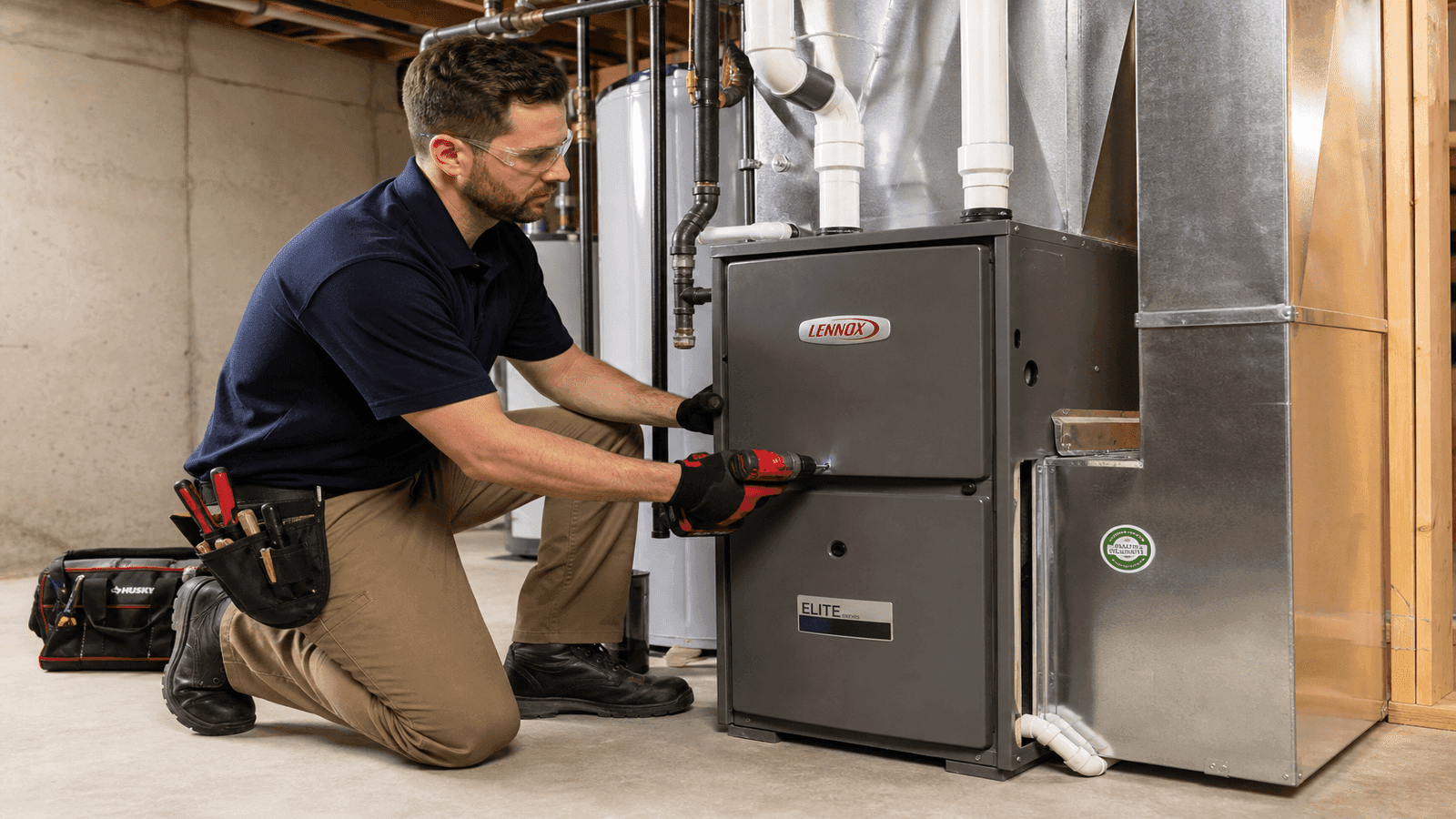
Photo: HVAC technician installing a new high-efficiency gas furnace in a residential basement utility room with ductwork connections visible
Cost by Fuel Type
The fuel source powering your furnace is the single largest factor in both equipment cost and long-term operating expense. Each fuel type comes with distinct installation requirements that affect labor pricing.
Gas furnaces cost $3,800-$10,000 installed and heat approximately 47% of U.S. homes according to the Energy Information Administration. Standard efficiency models (80% AFUE) use a conventional metal flue that vents through the roof. High-efficiency models (90-98% AFUE) use sealed combustion with PVC exhaust venting through a sidewall, eliminating the need for a traditional chimney. Upgrading from standard to high-efficiency often requires new PVC venting ($850-$1,850) and condensate drain installation ($200-$400) [1][2].
Electric furnaces cost $2,000-$5,500 installed and are the cheapest option upfront. They heat air using electric resistance elements rather than combustion, meaning no gas lines, no flue, no carbon monoxide risk, and no combustion air requirements. Installation is simpler and faster. However, electric furnaces operate at or near 100% efficiency only in converting electricity to heat. The problem is the cost of that electricity: at the national average rate of $0.17/kWh, an electric furnace costs $1,800-$3,200 per heating season in a northern climate, compared to $800-$1,400 for a gas furnace burning natural gas at $1.20/therm [3].
Oil furnaces cost $4,500-$10,500 installed and are most common in the Northeast, where an estimated 4.6 million households still rely on heating oil. Oil furnace installation is the most complex of the three types: it requires a fuel storage tank (275-330 gallon indoor or underground), an oil supply line, a barometric damper, and specialized burner tuning. If your existing oil tank needs replacement, add $1,800-$3,500 to the project. Annual fuel costs run $1,500-$3,000 depending on oil prices and home size [5].
I've replaced gas, electric, and oil furnaces in every type of home across Minneapolis. The biggest mistake I see is homeowners switching fuel types without fully accounting for the conversion costs. Going from oil to gas sounds great until you add the gas line extension ($1,500-$3,000), the old tank removal ($500-$1,500), and the permits. Sometimes it still makes sense, but the numbers need to work on a 10-year basis, not just year one.
| Fuel Type | Installed Cost | Equipment Only | Annual Fuel Cost (2,000 sq ft) | Avg. Lifespan |
| Gas (80% AFUE) | $3,800-$6,500 | $1,500-$3,500 | $800-$1,400 | 15-20 years |
| Gas (96%+ AFUE) | $5,500-$10,000 | $2,800-$6,200 | $600-$1,100 | 18-25 years |
| Electric | $2,000-$5,500 | $800-$2,500 | $1,800-$3,200 | 20-30 years |
| Oil (83-87% AFUE) | $4,500-$10,500 | $2,500-$6,000 | $1,500-$3,000 | 15-25 years |
Total Cost by Home Size
Furnace sizing is measured in BTUs (British Thermal Units) per hour. A furnace that is too small will run constantly without reaching the set temperature. A furnace that is too large will short-cycle, turning on and off frequently, which wastes fuel, wears components faster, and creates uncomfortable temperature swings.
The correct approach is a Manual J load calculation, which factors in square footage, climate zone, insulation quality, window area, ceiling height, and air infiltration rate. A rough guideline is 30-60 BTUs per square foot depending on climate: homes in ASHRAE Climate Zone 6-7 (Minneapolis, Chicago, Denver) need 45-60 BTUs/sq ft, while homes in Zone 3-4 (Atlanta, Dallas, Charlotte) need 30-40 BTUs/sq ft [6].
HVAC contractors in the NearbyHunt network report that 70% of furnaces they replace in existing homes are oversized by 20-40%. The previous installer or homeowner selected a larger unit "just to be safe," resulting in years of higher fuel bills and premature heat exchanger wear. A properly sized replacement almost always costs less and performs better.
| Home Size | BTU Range (Cold Climate) | BTU Range (Mild Climate) | Gas Installed | Electric Installed | Oil Installed |
| 1,000 sq ft | 45,000-60,000 | 30,000-40,000 | $3,200-$5,800 | $1,800-$3,800 | $3,800-$6,500 |
| 1,500 sq ft | 67,000-90,000 | 45,000-60,000 | $3,800-$6,800 | $2,000-$4,200 | $4,200-$7,800 |
| 2,000 sq ft | 90,000-120,000 | 60,000-80,000 | $4,500-$8,000 | $2,200-$4,800 | $4,800-$9,000 |
| 2,500 sq ft | 112,000-150,000 | 75,000-100,000 | $5,200-$9,500 | $2,500-$5,200 | $5,500-$10,000 |
| 3,000 sq ft | 135,000-180,000 | 90,000-120,000 | $6,000-$11,000 | $3,000-$5,500 | $6,200-$10,500 |
Last winter I replaced a furnace for a family in Bloomington, Minnesota. Their old unit was a 120,000 BTU model in a 1,600 square foot rambler. When I ran the Manual J, the house only needed 72,000 BTUs. We installed a 80,000 BTU two-stage unit, and their gas bill dropped 28% that first winter. The equipment cost $1,200 less than replacing with the same oversized capacity.
Gas Furnace Efficiency Tiers
Gas furnace efficiency is measured by AFUE (Annual Fuel Utilization Efficiency), which tells you what percentage of the fuel consumed is converted to usable heat. An 80% AFUE furnace sends 20 cents of every dollar up the flue as waste heat. A 96% AFUE furnace wastes only 4 cents [2].
Standard efficiency (80% AFUE) furnaces are the baseline. They use a single-stage burner that runs at full capacity whenever the thermostat calls for heat. Venting goes through a metal flue pipe and chimney. Equipment cost runs $1,500-$3,500. These units are still manufactured and sold in large volumes because they cost less upfront and work with existing chimney venting in older homes.
Mid-efficiency (90-95% AFUE) furnaces represent the sweet spot for many homeowners. They use a secondary heat exchanger to capture more heat from exhaust gases, and the resulting condensate (slightly acidic water) drains through a condensate line. Venting switches from metal flue to PVC pipe through a sidewall, which can actually simplify installation in homes without a chimney. Equipment cost is $2,200-$4,800 [2].
High-efficiency (96-98.7% AFUE) furnaces extract nearly all available heat from combustion gases. Most feature two-stage or modulating burners and variable-speed blower motors that adjust output to match heating demand. A modulating furnace can operate at 40-100% capacity rather than the on/off cycling of a single-stage unit. Equipment cost is $2,800-$6,200. Lennox's SL297NV model achieves the industry-leading 98.7% AFUE rating [2][7].
The payback period depends on local gas prices and climate. In Minneapolis (7,500 HDD), annual savings of $300-$500 produce a 5-8 year payback. In Nashville (3,700 HDD), savings drop to $150-$250, pushing payback to 10-14 years.
Get quotes from top-rated pros.
| Efficiency Tier | AFUE Rating | Equipment Cost | Venting Type | Burner Type | Best For |
| Standard | 80% | $1,500-$3,500 | Metal flue/chimney | Single-stage | Budget, mild climates |
| Mid-Efficiency | 90-95% | $2,200-$4,800 | PVC sidewall | Single or two-stage | Most homeowners |
| High-Efficiency | 96-98.7% | $2,800-$6,200 | PVC sidewall | Two-stage/modulating | Cold climates, high usage |
Brand Comparison and Pricing
Four brands dominate the U.S. residential furnace market. Each manufactures reliable equipment, and the price differences at equivalent efficiency levels are narrower than most homeowners expect. The real variable is the installing contractor's quality, not the brand name on the cabinet.
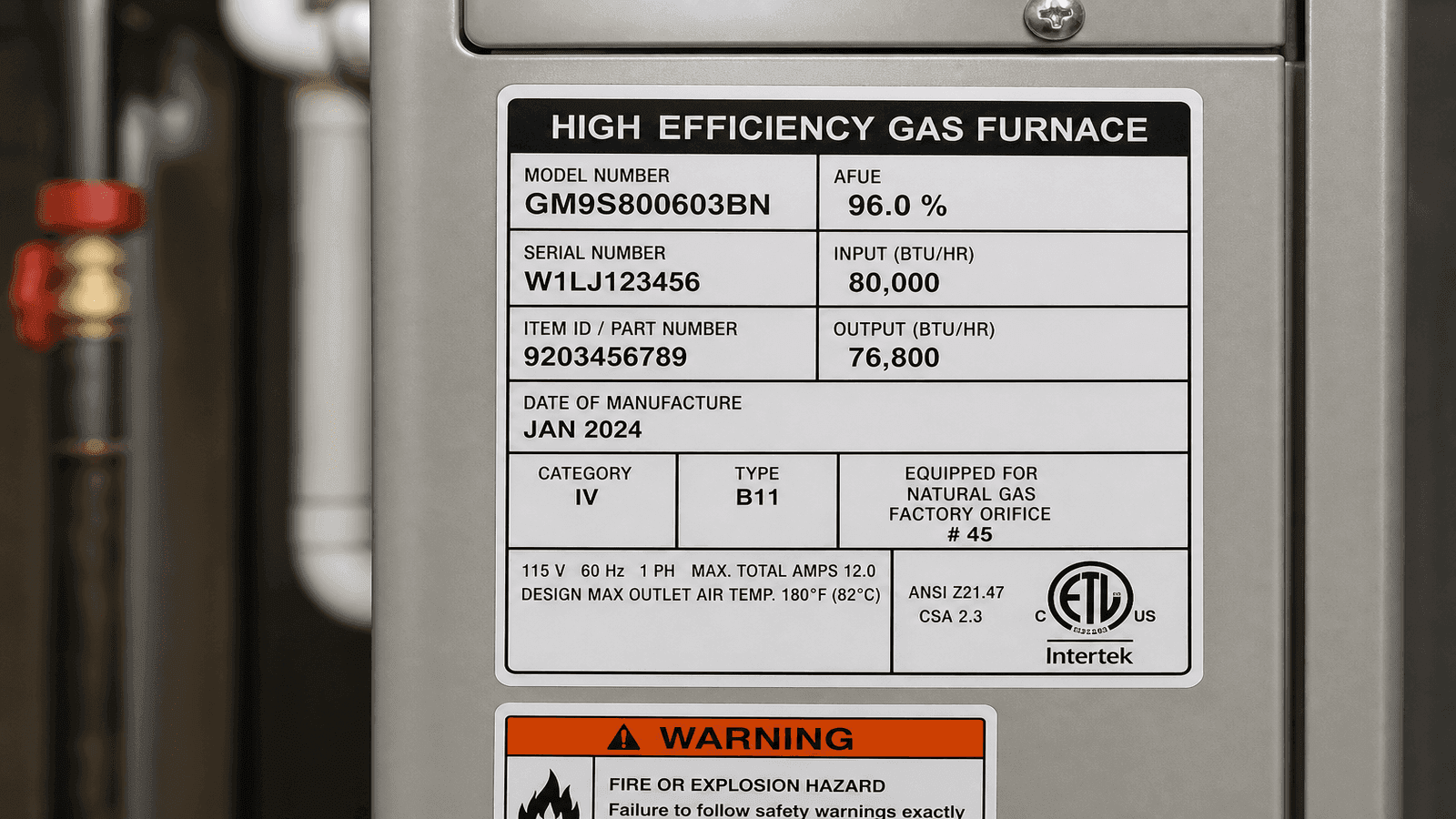
Photo: Close-up of a high-efficiency gas furnace nameplate showing AFUE rating, BTU input and output, and model specifications
Carrier furnaces cost $2,400-$8,000 installed. The Infinity 98 (59MN7) achieves 98.5% AFUE with a modulating gas valve and variable-speed blower. Carrier's 10-year parts warranty is standard with product registration. Carrier and its sister brand Bryant are manufactured by the same parent company (Carrier Global) and share identical core components [7].
Trane furnaces cost $3,000-$9,000 installed. The S9X2 model delivers 96% AFUE with a two-stage burner. Trane markets durability, using thicker gauge steel cabinets and heat exchangers that contribute to an expected 20-25 year lifespan when maintained. The registered warranty covers 10 years on parts [7].
Lennox furnaces cost $3,000-$9,500 installed. Lennox holds the efficiency crown with the SL297NV at 98.7% AFUE, the highest-rated gas furnace available. Lennox also manufactures the Merit and Elite series at lower price points. The 10-year registered parts warranty plus 20-year heat exchanger warranty is competitive [7].
Goodman furnaces cost $2,100-$6,300 installed and are the value leader. The GMVM97 delivers 97% AFUE at a price point $1,500-$3,000 below equivalent Carrier or Trane models. Goodman includes a Lifetime heat exchanger warranty when registered. Goodman is owned by Daikin, the world's largest HVAC manufacturer, giving it supply chain and engineering resources that match the premium brands [7].
| Brand | Installed Cost Range | Top Model AFUE | Parts Warranty | Heat Exchanger Warranty |
| Carrier | $2,400-$8,000 | 98.5% | 10-year | 20-year |
| Trane | $3,000-$9,000 | 96% | 10-year | Limited Lifetime |
| Lennox | $3,000-$9,500 | 98.7% | 10-year | 20-year |
| Goodman | $2,100-$6,300 | 97% | 10-year | Lifetime |
I install all four of these brands regularly. At the same AFUE and feature level, Goodman and Carrier are priced within $800-$1,200 of each other, and all four will last 20 years with annual maintenance. Where the money really goes is the installation. A $6,000 furnace installed by a crew that cuts corners on ductwork transitions and airflow testing will underperform a $4,000 furnace installed correctly. Spend your budget on the contractor, not the brand name.
Installation Labor Costs
Labor represents 35-50% of total furnace replacement cost. A straightforward swap of a gas furnace with matching efficiency takes a two-person crew 6-10 hours. Complex installations involving fuel-type conversion, ductwork modification, or electrical upgrades can run 12-18 hours [8].
Standard labor rates for licensed HVAC technicians range from $75-$150 per hour depending on region. Total labor on a typical gas furnace replacement runs $1,500-$3,500. The Northeast and West Coast sit at the high end, while the Southeast and Midwest are lower [8].
What labor includes: removal and disposal of the old furnace ($150-$400), setting and connecting the new unit, gas line and electrical connections, thermostat wiring, ductwork transitions at the plenum, combustion testing, airflow verification, and system startup.
Common labor add-ons: fuel-type conversion ($1,500-$4,500), ductwork modification ($500-$2,500), electrical panel upgrade for electric furnaces ($1,200-$2,500), PVC venting for high-efficiency ($850-$1,850), permits and inspection ($50-$300), and condensate drain lines ($200-$400).
NearbyHunt network insight: HVAC contractors across our network report that permit requirements vary widely by city. Some municipalities require a mechanical permit and two inspections for any furnace replacement; others require permits only when changing fuel type. Ask your contractor whether permits are included before signing.
Case Study: The Hendersons' Oil-to-Gas Conversion
Mark and Lisa Henderson own a 2,200 square foot colonial in Andover, Massachusetts, built in 1987. Their 24-year-old oil furnace (Beckett model, 84% AFUE) failed in January 2026 during a cold snap. The repair estimate was $2,800 for a cracked heat exchanger, which Daniel Torres advised against given the unit's age and declining efficiency.
The decision: Convert from oil to natural gas. A gas main ran along their street, and the local utility (National Grid) offered a $1,500 connection incentive for new gas customers.
Project breakdown:
Project breakdown
| Item | Cost |
| Carrier 59MN7 (98.5% AFUE, 80,000 BTU) | $3,400 |
| Installation labor (12 hours, 2-person crew) | $2,800 |
| Gas line from meter to furnace (35 ft) | $1,200 |
| PVC venting installation | $950 |
| Old oil furnace removal and disposal | $350 |
| Oil tank decommissioning and removal | $1,400 |
| Permits and inspection (2 inspections) | $275 |
| New programmable thermostat | $180 |
| Total project cost | $10,555 |
| National Grid gas connection incentive | -$1,500 |
| Massachusetts Mass Save rebate | -$1,250 |
| Net cost after incentives | $7,805 |
Result after one heating season: The Hendersons' annual heating cost dropped from $3,100 (oil at $3.80/gallon) to $1,150 (natural gas). The $1,950 annual savings puts their net payback at 4 years. The furnace's sealed combustion also eliminated the oil smell that had been a persistent complaint from the family.
Get quotes from top-rated pros.
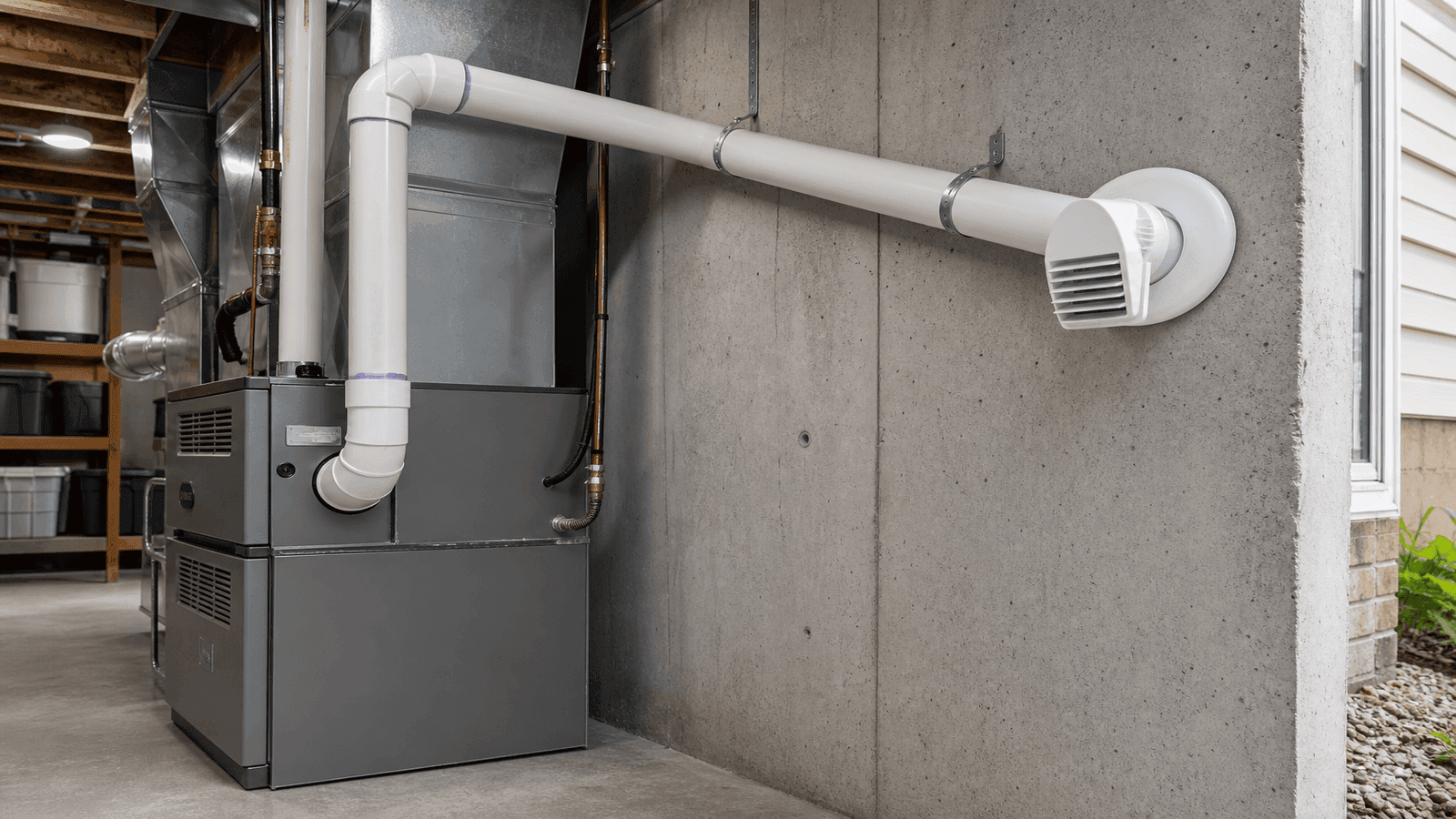
Photo: Residential furnace installation showing new PVC exhaust venting through a basement sidewall with proper slope and termination
Tax Credits and Rebates in 2026
The federal tax credit situation for furnace replacements shifted significantly at the start of 2026. Understanding what is and is not available prevents budgeting based on outdated information.
Federal Section 25C tax credit: expired. The Energy Efficient Home Improvement Credit, which provided 30% of equipment and installation costs up to $600 for qualifying gas, propane, or oil furnaces (ENERGY STAR certified, 97%+ AFUE), expired on December 31, 2025. Furnace installations completed in 2026 are not eligible for this credit. If you installed a qualifying furnace in 2025, you can still claim the credit on your 2025 tax return filed in 2026 [4].
HEEHRA rebates: active in participating states. The High-Efficiency Electric Home Rebate Act, funded through the Inflation Reduction Act, provides point-of-sale rebates for electrification projects including electric furnaces and heat pumps. Rebate amounts depend on household income: low-income households (below 80% AMI) receive up to 100% of costs, moderate-income households (80-150% AMI) receive up to 50%. As of May 2026, over 30 states have launched HEEHRA programs, though Texas, Florida, and several others have not [4][9].
State and utility rebates: the primary incentive path. These programs vary widely but remain the most accessible savings for 2026 furnace replacements:
- Massachusetts: Mass Save offers $1,000-$1,250 rebates for high-efficiency gas furnaces and up to $8,500 for heat pump systems
- Minnesota: Xcel Energy and CenterPoint Energy offer $200-$500 rebates for 95%+ AFUE gas furnaces
- New York: NYSERDA EmPower+ program provides income-qualified rebates up to $8,000 for electrification projects
- Colorado: Xcel Energy offers $300-$400 for qualifying high-efficiency gas furnaces
To find rebates available in your area, visit the DSIRE database at dsireusa.org, maintained by North Carolina State University and funded by the U.S. Department of Energy [9].
The expiration of the federal credit caught a lot of homeowners off guard. I had three customers in March 2026 who thought they were getting $600 back and were surprised when I told them the program ended. The good news is state and utility rebates still knock $200-$1,500 off the project in most markets. Always check before you sign a contract.
Signs Your Furnace Needs Replacement
Not every furnace problem requires a full replacement. But certain conditions make repair uneconomical or unsafe. Here is the framework Daniel Torres uses with his customers:
Replace when:
- The heat exchanger is cracked (repair cost often exceeds $2,000, and a cracked exchanger poses carbon monoxide risk)
- The unit is 15+ years old AND repair cost exceeds 50% of replacement cost
- Annual heating bills have increased 25%+ over the past 3 years with no rate change
- The furnace requires a second major repair within 24 months
- You are converting fuel types for long-term savings
- The system cannot maintain even temperatures across rooms despite duct balancing
Repair when:
- The issue is a draft inducer motor, igniter, or flame sensor (common parts, $150-$600 each)
- The furnace is under 12 years old with no prior major repairs
- A single component failure on an otherwise well-maintained system
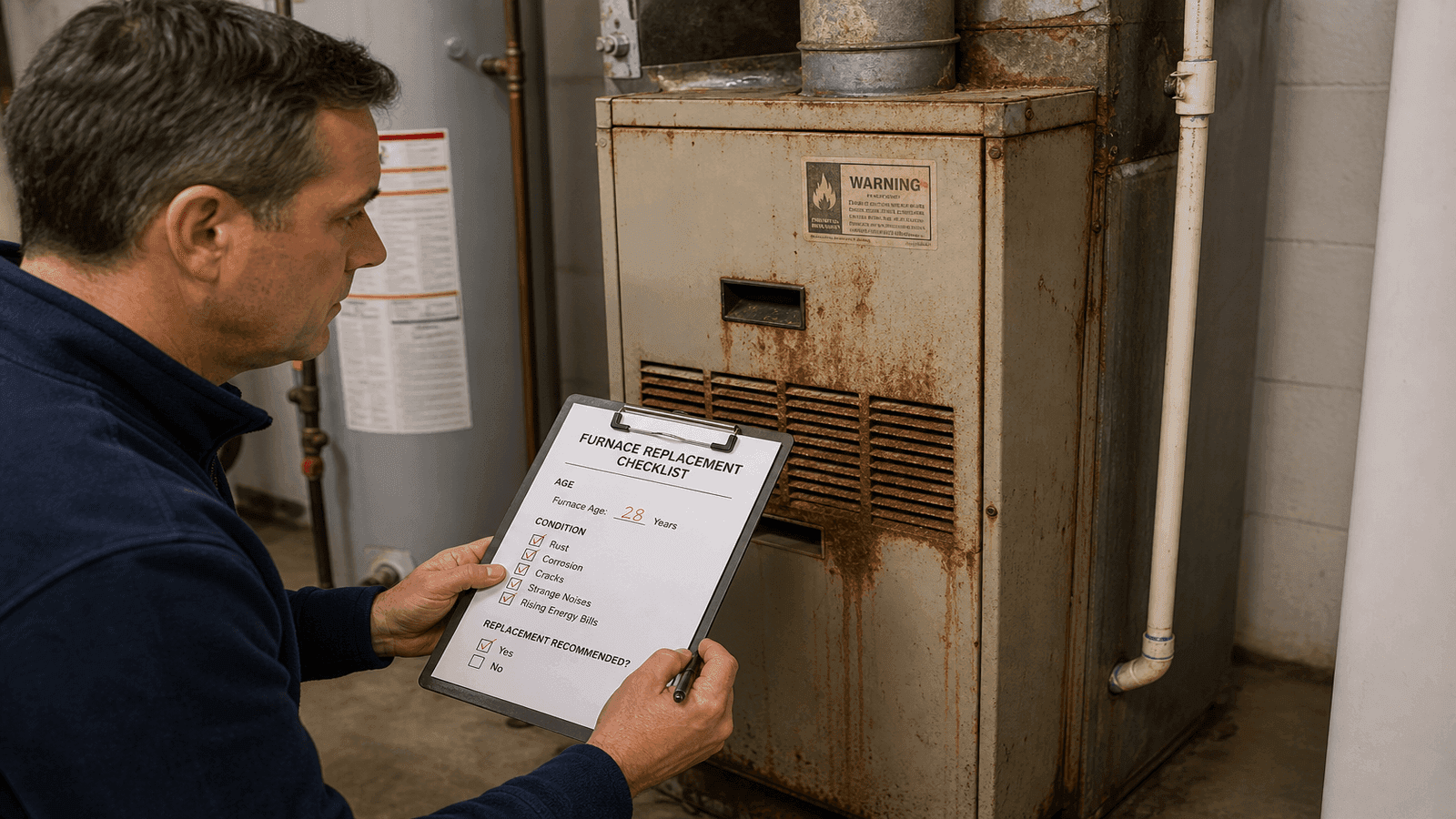
Photo: Homeowner examining an old residential furnace with visible rust and wear, comparing age and condition indicators for replacement decision
How to Get Accurate Bids
Getting comparable bids requires asking the right questions before contractors visit your home. Furnace bids that appear $2,000 apart may actually be quoting different equipment, different efficiency levels, or excluding key line items.
Get at least three written bids. Each bid should specify the furnace brand, model number, AFUE rating, BTU capacity, and whether the price includes old furnace removal, permits, thermostat, ductwork modifications, PVC venting (for high-efficiency), condensate drain, and post-installation combustion testing with manufacturer warranty registration.
Verify contractor credentials. A qualified HVAC contractor should hold a state or local mechanical contractor license, carry general liability and workers' compensation insurance, and have technicians with EPA 608 certification. NATE certification is an additional indicator of competency.
Ask about Manual J sizing. Any contractor who proposes matching the old unit's BTU rating without running a load calculation is guessing. A Manual J takes 30-60 minutes, accounts for your home's characteristics, and ensures proper sizing.
Request a post-installation test. A complete installation includes combustion analysis (measuring flue gas temperature, CO levels, oxygen percentage), static pressure measurement, and temperature rise verification.
Disclaimer: Furnace replacement costs vary significantly by region, fuel type, home size, and contractor. The prices in this article are national averages based on 2026 data and may not reflect costs in your specific area. Always get written estimates from multiple licensed contractors. The federal 25C tax credit expired December 31, 2025. State and utility rebates vary by location. This article is for informational purposes only.
Sources
- Forbes Home. "How Much Does a New Furnace Cost?" 2026.
- Bob Vila. "How Much Does a High-Efficiency Furnace Cost?" 2026.
- This Old House. "How Much Does an Electric Furnace Cost?" 2026.
- ENERGY STAR. "Federal Tax Credits for Energy Efficiency." 2026.
- Bob Vila. "How Much Does an Oil Furnace Cost?" 2026.
- FurnaceSizeCalculator.com. "Furnace Size Calculator: Manual J BTU & Heat Loss Tool." 2026.
- Consumer Reports. "Best Furnace Brands" 2026.
- This Old House. "How Much Does a New Furnace Cost?" 2026.
- AC Direct. "State-by-State HVAC Rebates in 2026." 2026.
- U.S. Department of Energy. "Energy Efficient Home Improvement Credit." IRS, 2026.
Need furnace replacement quotes from licensed HVAC contractors near you? Find trusted HVAC pros on NearbyHunt and compare bids at no cost.

Daniel is an EPA-certified HVAC technician & Energy Efficiency Consultant with over 14 years of experience in maintaining and installing heating and cooling systems throughout the Midwest. Passionate about sustainability, Dan specialises in energy-efficient retrofits and intelligent climate control systems. He writes for NearbyHunt to help homeowners extend the lifespan of their HVAC units while lowering utility bills.

Christine is an EPA-certified HVAC professional with 17 years of experience in heating, cooling, and indoor air quality systems. She has managed large-scale residential installations and worked as a technical trainer for new HVAC apprentices. Chris’s reviews focus on accuracy, safety, and performance standards in modern HVAC practices.