- A single-zone ductless mini split costs $2,000 to $6,000 installed in 2026, with the national average landing around $3,500 for a 12,000 BTU wall-mounted unit in a standard installation [1].
- Multi-zone systems (2 to 5 zones) cost $5,000 to $14,500 installed, with each additional indoor head adding $1,500 to $3,500 depending on brand, BTU capacity, and line set routing [2].
- Mitsubishi and Daikin command the highest prices at $1,200 to $7,800+ per zone installed, while DIY-friendly brands like MrCool start at $700 to $3,000 per zone with significant labor savings [3].
- The federal 25C tax credit expired December 31, 2025. ENERGY STAR-certified mini split heat pumps may qualify for up to $2,000 under the IRA Section 25D credit, and state HOMES/HEAR rebates of $2,000 to $8,000 remain active in participating states [4].
- Mini splits save 20-30% on energy costs compared to central forced-air systems due to zero duct losses, making them especially cost-effective for additions, converted garages, and older homes without existing ductwork [5].

Get quotes from top-rated pros.
A ductless mini split is one of the most flexible and energy-efficient ways to heat and cool a home, but the pricing can be confusing. Costs vary dramatically based on whether you need one zone or five, whether you pick a premium Japanese brand or a budget-friendly DIY unit, and how complex the installation turns out to be.
Daniel Torres, a Certified HVAC Technician and Energy Efficiency Consultant with EPA 608 Universal, NATE, and HVAC Excellence certifications, has installed hundreds of ductless systems across the Minneapolis metro over 14 years. His pricing data and installation insights are woven throughout this guide. "Mini splits are the fastest-growing segment of my business," Torres says. "But I spend more time educating homeowners on what drives the price than on any other system type. The range between a basic single-zone cooling unit and a five-zone cold-climate heat pump is massive, and the cheapest option is rarely the right one."
For a broader look at all HVAC system types and their costs, see our complete HVAC costs guide.
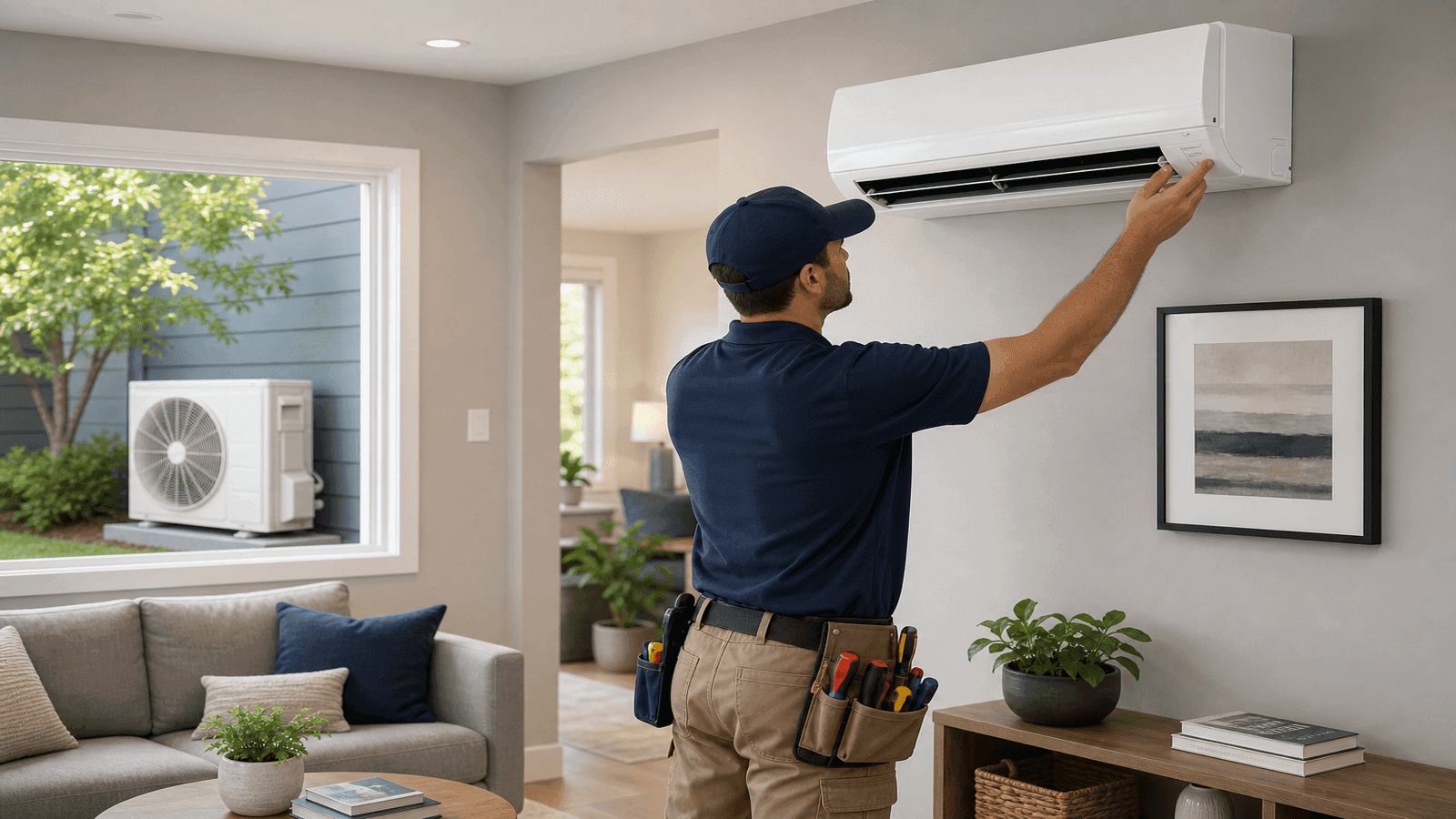
Photo: Wide shot of a ductless mini split indoor wall unit mounted in a modern living room with a technician adjusting the unit, outdoor condenser visible through a window in the background
Single-Zone Mini Split Cost
A single-zone ductless mini split pairs one outdoor condenser with one indoor air handler. This is the most common and affordable configuration, ideal for cooling or heating a single room, addition, garage conversion, or attic space.
Cost by BTU Capacity
| BTU Capacity | Room Size | Equipment Cost | Installed Cost |
| 9,000 BTU | 250-400 sq ft | $800-$1,800 | $2,000-$3,500 |
| 12,000 BTU (1 ton) | 400-600 sq ft | $1,000-$2,400 | $2,500-$4,500 |
| 18,000 BTU (1.5 ton) | 600-900 sq ft | $1,400-$3,000 | $3,000-$5,500 |
| 24,000 BTU (2 ton) | 900-1,200 sq ft | $1,800-$3,800 | $3,500-$6,500 |
| 36,000 BTU (3 ton) | 1,200-1,500 sq ft | $2,500-$4,500 | $4,500-$7,500 |
The most popular single-zone size is 12,000 BTU, which handles a standard bedroom, home office, or sunroom. At the national average of $3,500 installed, it represents the entry point for most homeowners considering ductless [1].
I size every mini split using Manual J, not rule-of-thumb BTU calculators. Last fall I quoted a 500 sq ft sunroom addition in Maple Grove, MN that the homeowner assumed needed 12,000 BTU. The Manual J showed 18,000 BTU because of the floor-to-ceiling glass on three walls and minimal insulation in the knee walls. An undersized unit would have run nonstop and frozen up in winter. The $800 upgrade to an 18,000 BTU unit saved the homeowner from a failed system within the first heating season.
What Affects Single-Zone Price
- SEER2 rating: Base models at 15-17 SEER2 are cheapest. Upgrading to 20+ SEER2 adds $500-$1,500 to equipment cost but qualifies for more rebates and saves $100-$250 annually on electricity [5].
- Heat pump vs. cooling only: Most mini splits sold in 2026 include heat pump functionality at minimal added cost ($200-$400), making cooling-only models increasingly rare.
- Line set length: Standard installations include 15-25 feet of copper refrigerant line. Every additional 10 feet adds $50-$150 in materials [2].
- Electrical requirements: A dedicated 20-amp or 30-amp circuit is required. If your panel has capacity, expect $200-$500 for the electrical work. A panel upgrade adds $1,500-$3,000.
Multi-Zone Mini Split Cost
Multi-zone systems connect two to five indoor heads to a single outdoor condenser. They allow independent temperature control in each room, which is the primary advantage over central systems with a single thermostat. However, the cost per zone drops as you add zones because you share one outdoor unit.
Cost by Number of Zones
| Configuration | Equipment Cost | Labor Cost | Total Installed |
| 2-Zone | $2,500-$5,000 | $1,500-$3,000 | $5,000-$8,000 |
| 3-Zone | $3,500-$6,500 | $2,000-$3,500 | $6,500-$10,000 |
| 4-Zone | $4,500-$8,000 | $2,500-$4,000 | $8,000-$12,000 |
| 5-Zone | $5,500-$10,000 | $3,000-$4,500 | $9,500-$14,500 |
Each additional indoor head adds roughly $1,500 to $3,500 to the total project cost, including the unit itself, line set, wiring, condensate drain, and labor to mount and connect it [2].
Get quotes from top-rated pros.
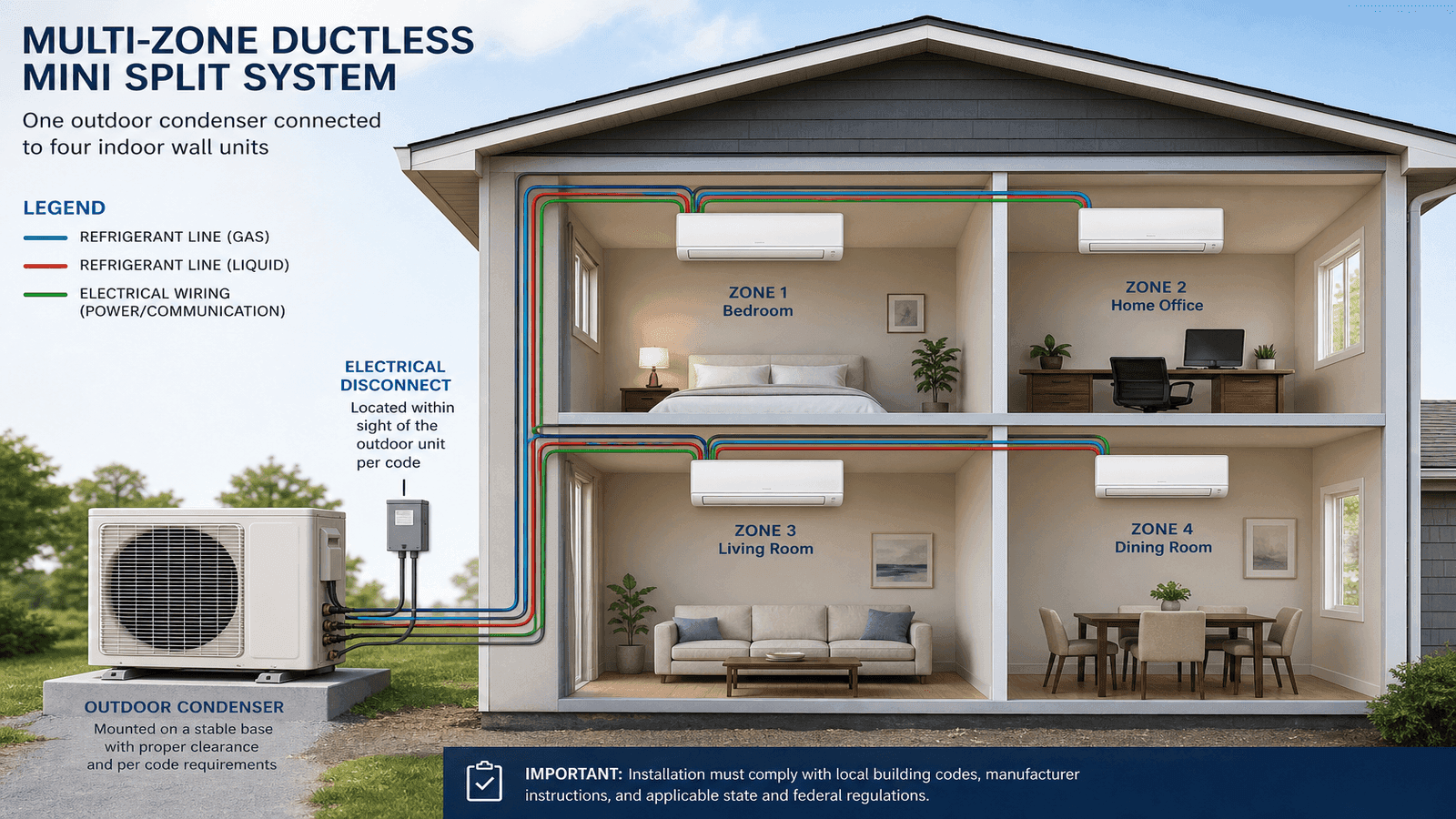
Photo: Diagram showing a multi-zone ductless mini split system with one outdoor condenser connected to four indoor wall units in different rooms of a house, line sets and electrical connections labeled
Multi-Zone Sizing Rules
The outdoor condenser must have enough capacity to serve all indoor heads simultaneously. A common mistake is pairing a 36,000 BTU outdoor unit with four or five 12,000 BTU heads. While Mitsubishi allows up to 130% indoor-to-outdoor capacity ratio in some configurations, exceeding the outdoor unit's rated capacity causes efficiency losses and compressor strain.
I see this mistake constantly on DIY forums. Someone buys a 3-ton outdoor unit and connects five heads expecting 60,000 BTU. The system cannot deliver that. I always size the outdoor unit to handle at least 90% of total connected indoor capacity under peak conditions, factoring in the diversity ratio.
When Multi-Zone Makes Sense
Multi-zone ductless is most cost-effective in these scenarios:
- Homes without existing ductwork: Installing new ductwork costs $3,000-$7,000. A 3-zone mini split at $7,500-$10,000 provides zoned comfort without tearing open walls and ceilings.
- Additions and renovations: Extending existing ductwork to a new addition is often impractical. A single-zone mini split solves the problem for $2,500-$5,000.
- Older homes with radiator heat: Mini splits add cooling capability without the cost and disruption of a full central air installation.
- Energy efficiency upgrades: Zoned heating and cooling eliminates the waste of conditioning empty rooms, cutting energy use 20-30% compared to a single-zone central system [5].
Brand Comparison and Pricing
Not all mini split brands are equal. The market splits into three tiers: premium Japanese manufacturers with the longest track records, mid-tier brands offering strong value, and budget/DIY brands that trade professional installation for lower upfront cost.
Brand Pricing Comparison (Single-Zone, 12,000 BTU, Installed)
| Brand | Tier | Equipment Cost | Installed Cost | Warranty | Key Strength |
| Mitsubishi | Premium | $1,800-$3,200 | $3,500-$5,500 | 12-year compressor/parts | Best cold-climate performance (H2i) |
| Daikin | Premium | $1,500-$2,800 | $3,000-$5,000 | 12-year compressor/parts | Best value among top-tier brands |
| Fujitsu | Mid-Premium | $1,400-$2,600 | $2,800-$4,800 | 10-year compressor/parts | Quietest operation (XLTH+) |
| LG | Mid-Tier | $1,200-$2,200 | $2,500-$4,200 | 10-year compressor, 5-year parts | Strong smart home integration |
| MrCool | Budget/DIY | $700-$1,800 | $700-$3,000 | 7-year compressor/parts | Pre-charged line sets, DIY install |
| Senville | Budget | $600-$1,500 | $1,800-$3,500 | 5-year compressor/parts | Lowest upfront cost |
Premium Brands: Mitsubishi and Daikin
Mitsubishi pioneered ductless technology in North America and remains the contractor-preferred brand. Their Hyper-Heating (H2i) technology maintains rated heating output down to -13F, making Mitsubishi the standard in cold-climate markets like Minneapolis, Chicago, and the Northeast [3]. Daikin, the world's largest HVAC manufacturer, offers comparable quality and efficiency at 10-15% lower pricing. Both brands offer 12-year warranty coverage when installed by a certified contractor.
NearbyHunt Network Insight: Across the NearbyHunt contractor network, Mitsubishi and Daikin account for approximately 65% of all ductless installations quoted in 2025-2026. Contractors consistently report that these brands have the lowest callback rate and the easiest warranty claim process, which factors into their strong recommendation despite higher upfront cost.
Mid-Tier: Fujitsu and LG
Fujitsu's XLTH+ line competes directly with Mitsubishi's H2i on cold-climate performance while running quieter (as low as 19 dB indoor). LG's Art Cool and Multi V S lines integrate with LG ThinQ smart home systems and offer competitive pricing for homeowners prioritizing app-based control and aesthetics.
Budget and DIY: MrCool and Senville
MrCool's Quick Connect line sets come pre-charged with R-410A refrigerant, allowing handy homeowners to install a single-zone system without an HVAC license or vacuum pump. This eliminates $1,000-$2,000 in labor costs. However, DIY installation voids the warranty with some brands and may not meet local code requirements for permit and inspection.
I have mixed feelings about DIY mini splits. For a tech-savvy homeowner installing a single-zone cooling unit in a garage workshop, MrCool is a legitimate option that saves real money. But for a primary living space heat pump that needs to perform at -10F, I strongly recommend professional installation with a Manual J load calculation, proper evacuation of the line set, and a permit. The $1,500 you save on labor can cost $5,000 in compressor replacement if moisture gets into the refrigerant lines.
Installation Cost Factors
The equipment price is only part of the story. Installation labor, electrical work, and site-specific conditions can add 30-50% to the base equipment cost. Understanding what drives installation pricing helps you evaluate quotes and avoid surprises.
Get quotes from top-rated pros.
Labor Rates
| Cost Factor | Price Range | Notes |
| Standard single-zone labor | $500-$2,000 | Includes wall-mount, line set, electrical |
| Multi-zone labor (per additional head) | $800-$1,500 | Mounting, line set routing, condensate |
| Electrical circuit (new dedicated) | $200-$500 | 20-amp or 30-amp, breaker to unit |
| Electrical panel upgrade | $1,500-$3,000 | Only if panel is full or undersized |
| Concrete pad for outdoor unit | $100-$300 | Pre-cast pad or wall bracket |
| Line set cover (exterior) | $150-$400 | Paintable plastic channel, aesthetic |
| Permit and inspection | $100-$500 | Required in most jurisdictions |
| Ceiling cassette installation | $500-$1,000 extra | Requires ceiling space and drain routing |
| Concealed duct unit | $800-$1,500 extra | Mounted in ceiling/closet, short duct runs |
What Drives Installation Price Up
Line set length. Runs exceeding 25 feet add $50-$150 per additional 10 feet in copper tubing and refrigerant [2]. Building construction. Masonry penetrations (concrete block, brick) add $200-$500 versus standard wood-frame walls. Ceiling cassettes or concealed duct units add $500-$1,500 per head for ceiling work, drain routing, and clearance requirements [2]. Regional variation. Labor in New York City, San Francisco, and Boston runs 25-40% above national average. NearbyHunt network data shows the lowest installation costs in Texas, Georgia, and the Carolinas.
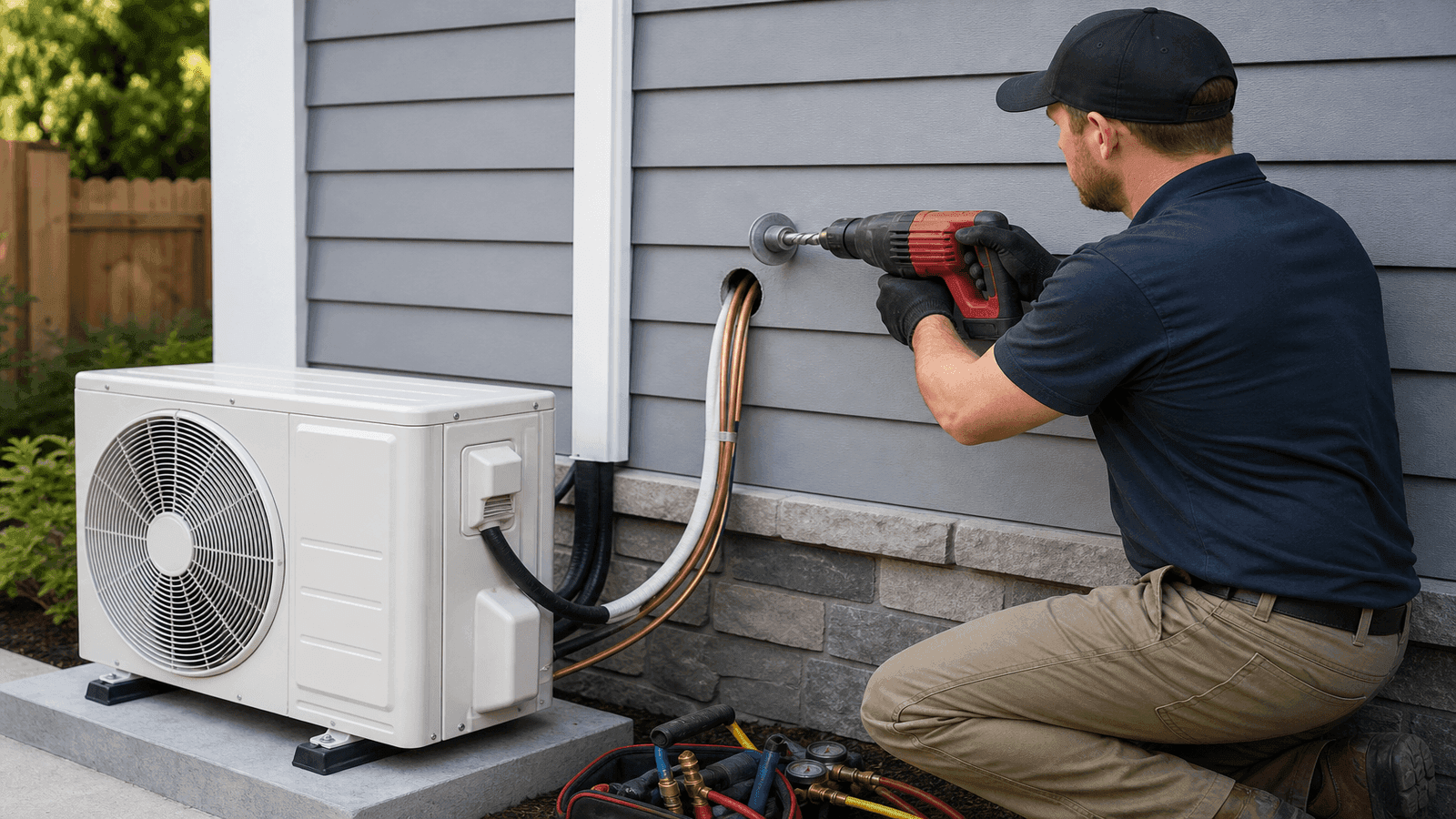
Photo: HVAC technician drilling a hole through an exterior wall to route copper line sets for a ductless mini split installation, with outdoor condenser unit staged on a concrete pad below
Real-World Case Study: The Kowalski Family, Duluth, MN
The Kowalski family owns a 1,600 sq ft split-level home built in 1978 with forced-air gas heat and no central air conditioning. After two summers of relying on window units, they contacted Daniel Torres for a ductless mini split quote in September 2025.
The situation: Three bedrooms upstairs had no cooling. The basement family room stayed cold in winter because the gas furnace could not overcome the heat loss through the below-grade walls. Window units cost roughly $180/month in electricity during July and August.
The solution: Torres recommended a Mitsubishi 4-zone hyper-heating system:
- One 36,000 BTU outdoor condenser (MXZ-4C36NAHZ2)
- Three 9,000 BTU wall units in the upstairs bedrooms
- One 12,000 BTU wall unit in the basement family room
The cost breakdown
| Item | Cost |
| Mitsubishi outdoor condenser | $3,800 |
| Four indoor heads (3x 9K + 1x 12K) | $3,600 |
| Copper line sets (four runs, 15-30 ft each) | $1,200 |
| Electrical (two new 20-amp circuits) | $650 |
| Labor (three-day installation, two technicians) | $3,200 |
| Permit and inspection | $175 |
| Line set covers (exterior) | $350 |
| Total | $12,975 |
The savings: The Kowalskis applied for Minnesota's HOMES rebate (pending launch in 2026) and will receive an estimated $4,000-$6,000 back once the program opens, which would bring their net cost to $6,975-$8,975. They eliminated $180/month in summer window-unit electricity and reduced winter gas bills by roughly $85/month because the heat pump handles the basement heating load more efficiently than the gas furnace. First-year projected savings: $1,200-$1,500 in energy costs.
The Kowalski project is a textbook case for ductless. The alternative was $8,000-$10,000 for new ductwork plus $7,000-$9,000 for a central heat pump. The mini split saved them $2,000-$6,000 versus a ducted solution and delivers better zone control.
Operating Costs and Energy Savings
Mini splits eliminate duct losses that waste 25-30% of energy in typical forced-air systems, making them among the most efficient HVAC options available [5].
Annual Operating Cost by Climate
| Climate Zone | Annual Cooling | Annual Heating | Total Annual |
| Hot/Humid (Miami, Houston) | $400-$700 | $100-$200 | $500-$900 |
| Mixed (Nashville, Charlotte) | $250-$450 | $300-$500 | $550-$950 |
| Cold (Minneapolis, Chicago) | $150-$300 | $500-$900 | $650-$1,200 |
| Very Cold (Duluth, Fargo) | $100-$250 | $700-$1,200 | $800-$1,450 |
Estimates assume a 12,000 BTU unit at 20 SEER2 / 10 HSPF2, with electricity at $0.12-$0.18 per kWh [5].
Over 10 years, a single-zone mini split at $3,500 upfront costs roughly $12,500 total (including energy and maintenance), compared to $15,300 for window units plus space heaters and $20,000 for baseboard electric heat. For spaces without existing ductwork, a mini split pays for itself within 3-5 years compared to portable heating and cooling alternatives [5].
Rebates and Tax Credits in 2026
The federal 25C tax credit expired on December 31, 2025, but several state and federal programs still help offset ductless mini split costs in 2026.
Get quotes from top-rated pros.
Federal Incentives
25C Energy Efficient Home Improvement Credit: EXPIRED. This credit, which offered 30% of equipment cost up to $2,000 for qualifying heat pumps, is no longer available for systems installed after December 31, 2025 [4].
25D Residential Clean Energy Credit (through 2032). Geothermal heat pumps still qualify for the 30% credit with no cap. Standard air-source mini splits do not qualify under 25D.
| Income Level | HEAR Rebate Amount | Eligibility |
| Low income (under 80% AMI) | Up to $8,000 | Full rebate, covers up to 100% of cost |
| Moderate income (80-150% AMI) | Up to $4,000 | Covers up to 50% of cost |
| Above 150% AMI | Not eligible | No HEAR rebate available |
State Rebate Status (May 2026)
| State | HOMES/HEAR Status | Mini Split Rebate | Notes |
| California | Launched (HEAR fully reserved) | $2,000-$8,000 | Single-family waitlisted |
| New York | Launched | $2,000-$8,000 | Active through NYSERDA |
| Colorado | Launched | $2,000-$8,000 | Active through CEO |
| Maine | Launched | $2,000-$8,000 | Active through Efficiency Maine |
| Massachusetts | Launched | $2,000-$8,000 | Active through Mass Save |
| Minnesota | Pending (expected 2026) | $2,000-$8,000 | Not yet accepting applications |
| Texas | Not launched | Utility rebates only | Check local utility programs |
I tell every client to check their state's HEAR program status before signing a contract. A moderate-income household in New York can get $4,000 back on a $10,000 multi-zone installation. That turns a 7-year payback into a 4-year payback. But these funds are first-come, first-served. California's program was fully reserved within months of launch.
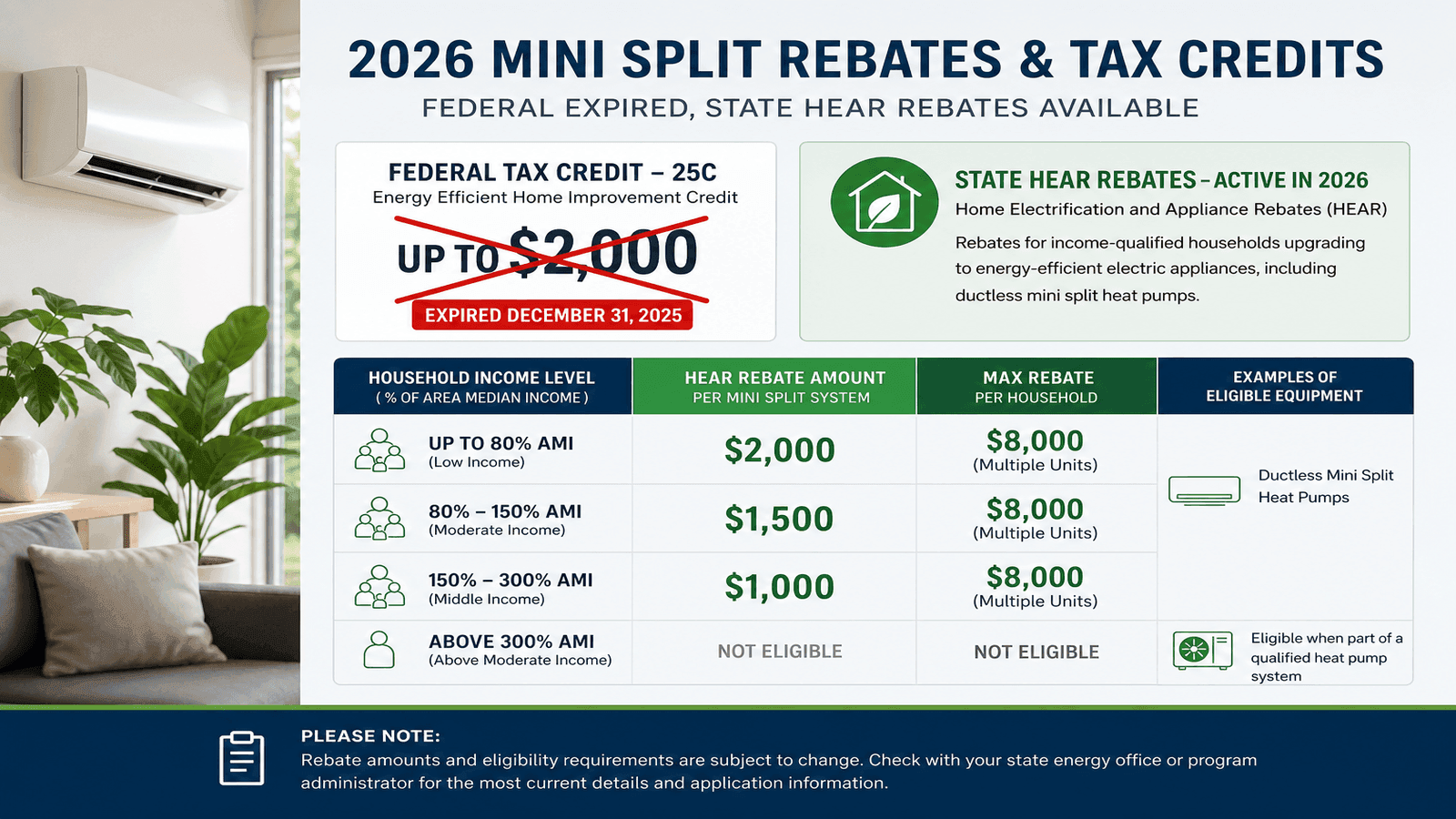
Photo: Infographic showing 2026 mini split rebates and tax credits comparison chart with federal expired 25C crossed out and active state HEAR rebate amounts by income level
Sizing and DIY vs. Professional Install
Proper sizing is the single most important factor in mini split performance. An oversized unit short-cycles, wastes energy, and fails to dehumidify. An undersized unit runs continuously without reaching setpoint. The baseline rule is 20-25 BTU per square foot for cooling in well-insulated spaces, 25-30 BTU for average insulation, and 30-40 BTU per square foot for primary heating in cold climates. Always use the heating load (not cooling load) to size systems in cold-climate applications.
The most expensive mistake I fix is improperly sized equipment. A Manual J calculation costs $150-$300 and takes about two hours. Compare that to the $3,000-$5,000 cost of replacing an undersized system. Every reputable HVAC contractor includes Manual J in their quote. If a contractor quotes based solely on square footage, get a second opinion.
DIY vs. Professional Cost
| Installation Type | Equipment | Labor | Total |
| Professional (single zone) | $1,000-$2,400 | $1,000-$2,000 | $2,000-$4,400 |
| DIY with pre-charged kit | $700-$1,800 | $0 (your time) | $700-$1,800 |
| DIY + electrician for circuit | $700-$1,800 | $200-$500 | $900-$2,300 |
DIY kits from MrCool and Senville save $1,000-$2,600 in labor and work well for cooling-only applications in garages, workshops, or bonus rooms. For multi-zone systems, cold-climate heat pumps, or primary living spaces where warranty coverage matters, professional installation is worth the added cost. Improper evacuation of refrigerant lines introduces moisture that can destroy a compressor within two years.
Disclaimer: Ductless mini split costs vary by region, brand, installer, and home-specific conditions. The prices in this guide represent national averages compiled from manufacturer pricing, NearbyHunt network contractor data, and published industry sources as of May 2026. Always obtain multiple written quotes from licensed HVAC contractors for your specific project. NearbyHunt does not perform installations and is not responsible for contractor pricing or workmanship.
Sources
- Forbes Home. "How Much Does a Mini Split Cost? (2026)." https://www.forbes.com/home-improvement/hvac/mini-split-cost/
- Carrier. "Ductless Mini Split Installation Costs in 2026." https://www.carrier.com/residential/en/us/products/ductless-mini-splits/ductless-mini-split-installation-cost/
- Mini-Splits By Joseph. "Daikin vs. Fujitsu vs. Mitsubishi: 2026 Buyer's Guide." https://minisplitsbyjoseph.com/daikin-vs-fujitsu-vs-mitsubishi-2026-buyers-guide/
- AC Direct. "Federal Tax Credits for HVAC in 2026: What's Still Available After the IRA Changes." https://www.acdirect.com/blog/federal-hvac-tax-credits-2026/
- FilterBuy. "How Much Does a Mini Split Cost in 2026? Full Price Breakdown." https://filterbuy.com/heating-cooling/mini-splits/cost/mini-split-cost/
- Bryant. "Ductless Mini Split Cost Guide 2026." https://www.bryant.com/en/us/products/ductless-systems/mini-split-cost/
- NuWatt Energy. "Mini-Split Cost 2026: $3,500-$14,000 by Zone Count." https://nuwattenergy.com/en/heat-pump-guide/mini-split-cost-guide-2026


Daniel is an EPA-certified HVAC technician & Energy Efficiency Consultant with over 14 years of experience in maintaining and installing heating and cooling systems throughout the Midwest. Passionate about sustainability, Dan specialises in energy-efficient retrofits and intelligent climate control systems. He writes for NearbyHunt to help homeowners extend the lifespan of their HVAC units while lowering utility bills.

Christine is an EPA-certified HVAC professional with 17 years of experience in heating, cooling, and indoor air quality systems. She has managed large-scale residential installations and worked as a technical trainer for new HVAC apprentices. Chris’s reviews focus on accuracy, safety, and performance standards in modern HVAC practices.